



Abstract
Background
Accurate citations are vital for academic integrity and evidence-based nursing scholarship. However, citation errors and low confidence in using reference management software are common among nursing students.
Aim
To evaluate the effect of a video-based educational intervention on nursing students’ practical skills and self-confidence in citation writing using EndNote.
Methods
A one-group pretest–posttest research design was conducted among 250 nursing students in the West Bank, Palestine. Participants completed a structured EndNote practical skills checklist and a visual analog scale assessing confidence before and after viewing a 25-minute instructional video. Data were analyzed using the paired t-tests, independent t-tests, and one-way analysis of variance.
Results
Practical skills scores improved significantly from 2.1 ± 1.8 to 8.3 ± 2.1 (p < .001, Cohen’s dz = 4.27), and self-confidence increased from 1.6 ± 2.9 to 9.1 ± 2.3 (p < .001, Cohen’s dz = 2.68). Students with higher cumulative academic averages, greater computer literacy, and stronger research interest achieved significantly higher posttest scores (p < .001), indicating that academic performance and digital competence influenced the extent of improvement.
Conclusion
Video-based education produced large and meaningful gains in both citation proficiency and self-confidence, thereby confirming its pedagogical value in nursing education. Integrating structured multimedia training into curricula can enhance future nurses’ research competence, digital fluency, and equitable learning outcomes.
Keywords
Introduction
Accurate citations and referencing are fundamental to scholarly integrity and evidence-based nursing education. However, reference inaccuracies remain widespread across health and nursing literature, with studies reporting citation error rates ranging from 3% to over 20%.1–4 These errors undermine academic credibility, hinder information retrieval, and reflect insufficient training in reference-management practices.
In nursing education, variability in information literacy and referencing competence persists, particularly among students enrolled in research-intensive courses. Although tools such as EndNote facilitate reference management, many students lack confidence and practical experience in using these systems effectively.5–7 Prior studies emphasize the need for structured, technology-supported interventions to strengthen citation skills and confidence.
Evidence from education science suggests that focused, short-form digital instruction (e.g., microlearning video modules) and structured workshops can produce measurable gains in procedural skills and applied performance among health profession learners—an approach well-suited to teaching citation workflows in EndNote. 8
Despite the availability of various reference management systems (RMS) and institutional referencing guidelines, many nursing students and healthcare professionals continue to struggle to produce accurate, style-compliant reference lists and in-text citations. Studies have demonstrated that referencing errors are widespread across higher education and healthcare disciplines, with nearly half of the participants reporting poor referencing performance due to challenges in citing online sources, managing multiple references, and maintaining consistency. 6 Such findings indicate that incorrect referencing is seldom intentional but primarily stems from deficits in technical skills, limited familiarity with referencing tools, and inadequate training support. These challenges have been reported across low-, middle-, and high-income educational settings, indicating that deficiencies in citation skills and reference management are a global concern rather than a context-specific issue.
Persistent citation errors and formatting inconsistencies remain evident in nursing and biomedical publications, suggesting that foundational referencing competencies are insufficiently developed in professional education. Information literacy (IL) studies among nursing cohorts have consistently identified gaps in students’ applied citation skills and confidence when using RMS tools. 7 These deficiencies not only risk the propagation of misinformation but also hinder evidence retrieval, scholarly communication, and the credibility of academic and clinical outputs.
Given the increasing integration of digital technologies in education, video-based microlearning interventions represent a practical, scalable, and cost-effective strategy for enhancing referencing proficiency. Implementing an instructional EndNote training video could address these skill deficits by providing structured, visual, and accessible learning for large cohorts of students and staff, particularly in institutions with limited face-to-face training resources. However, empirical evidence evaluating the effectiveness of media-based RMS training in nursing education remains scarce.
Aim of the study
To evaluate the effect of a video-based educational intervention on nursing students’ practical citation writing skills and self-confidence in using EndNote.
Study hypotheses
H1: Nursing students’ practical citation writing skills will significantly improve after participation in the video-based educational intervention compared with pre-intervention scores. H2: Nursing students’ self-confidence in using EndNote for citation writing will significantly improve after participation in the video-based educational intervention compared with pre-intervention scores.
Methods
Study design
This study employed a single-arm quasi-experimental pretest–posttest design to evaluate the effect of a standardized video-based educational intervention on nursing students’ practical citation-writing skills and self-confidence in using EndNote. The study adhered to the CONSORT 2025 guidelines for educational interventions. 9
Setting and participants
The study was conducted in the computer laboratories of Modern University College (MUC), which located in West Bank, Palestine from Jan 2024 to the end of May. 2025. The participants were nursing students enrolled in the scientific research course at MUC, including both regular and upgrading/bridging students in their third or fourth year. Eligible students had no prior formal training in reference management systems (RMS), had access to a computer with EndNote installed, and provided informed consent. The exclusion criteria included prior EndNote coursework and training, professional RMS certification, or documented advanced RMS training. Recruitment was conducted through course notifications using a simple random sampling approach and participation was voluntary.
Sampling methods and sample size
A convenience sampling approach was employed. All nursing students enrolled in the scientific research course at MUC during the study period (n = 280) were invited to participate. Recruitment was conducted through formal course announcements and written invitations distributed during scheduled class sessions. Participation was entirely voluntary and independent of academic grading.
17 students declined participation due to personal scheduling conflicts or lack of interest and were excluded prior to allocation. No students were excluded based on eligibility criteria. Consequently, 263 students were allocated to the intervention and completed the baseline (pretest) assessment. Thirteen participants withdrew before completing the posttest assessment. Therefore, 250 students completed both pretest and posttest assessments and were included in the final analysis.
The assignment process was non-randomized and followed a single-arm interventional design in which all consenting participants received the same standardized video-based educational intervention. No comparison group was used. To minimize potential selection bias, all eligible students within the accessible population were invited rather than selecting a subset. The recruitment process was transparent, and no incentives or academic penalties were associated with participation or withdrawal. However, because participation was voluntary, self-selection bias cannot be entirely excluded, as students with higher academic motivation may have been more likely to participate.
Information bias was minimized through standardized data collection procedures. Pretest and posttest assessments were conducted under supervised laboratory conditions using parallel tasks of equivalent complexity. Structured scoring criteria and inter-rater reliability procedures were implemented to reduce observer bias and measurement error. Additionally, participants were not permitted access to external resources during assessments to ensure consistency.
The required sample size was calculated using G*Power version 3.1.9 for a paired-samples t-test. 10 Assuming a medium effect size based on Tawalbeh, 11 α = 0.05 (two-tailed), and 90% power, the minimum required sample was 44 students. The final analyzed sample of 250 participants exceeded this requirement, indicating adequate statistical power. 13 participants withdrew prior to completing the posttest assessment.
Participant flow
A total of 280 students were assessed for eligibility. Of these, 17 declined to participate and were excluded. Consequently, 263 students were allocated to the video-based educational intervention and completed the pretest assessment. During the intervention phase, 13 students withdrew before completing the posttest. Therefore, 250 participants completed both the pretest and posttest assessments and were included in the final analysis. As seen in Figure 1. Flowchart of the single-arm CONSORT guideline 2025.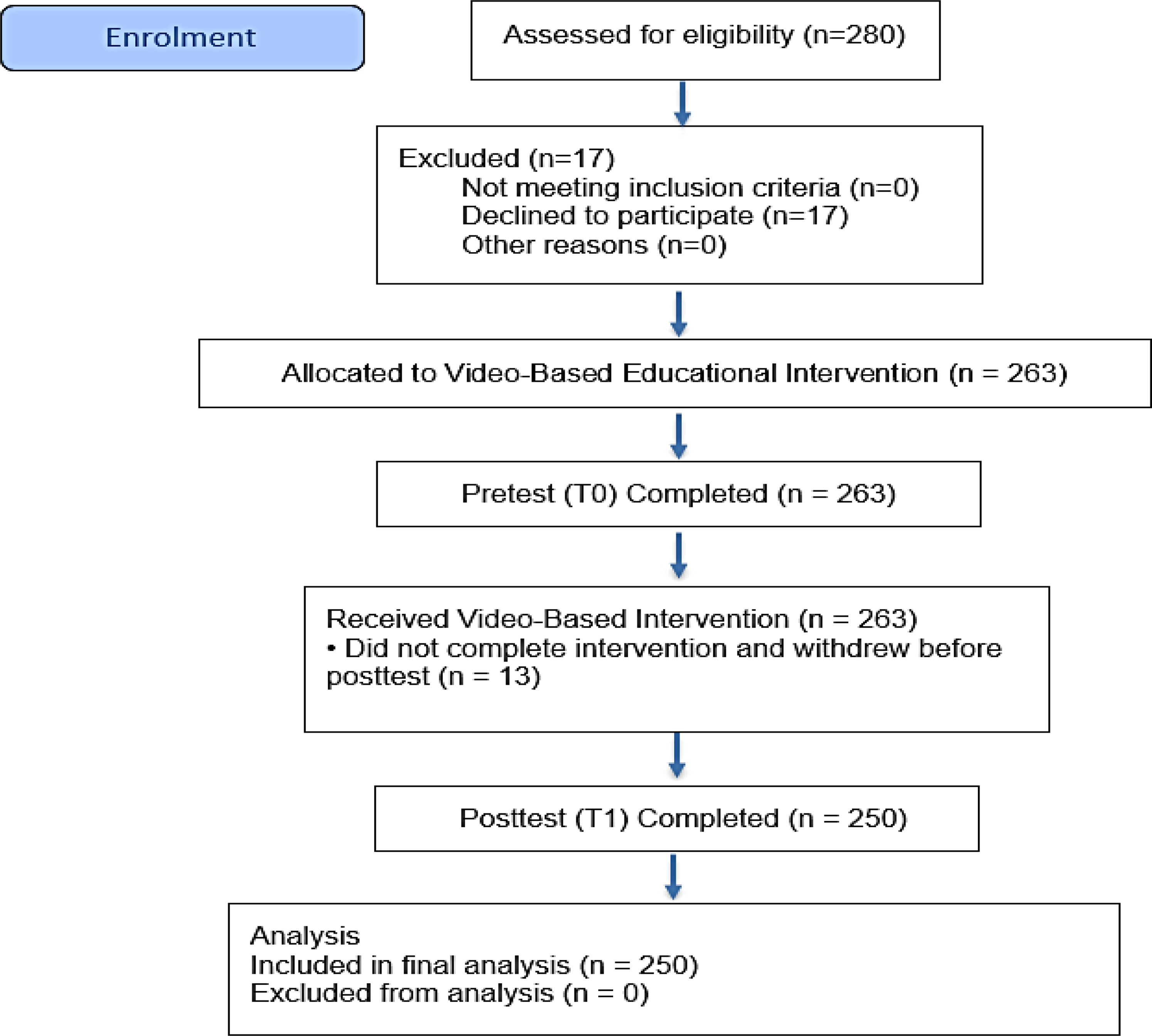
Data collection instruments
The practical skills of the participants in using the EndNote reference management system and producing accurate, style-compliant references were assessed using a structured, performance-based instrument developed specifically for this study. The EndNote Practical Skills Checklist (EPSC) tool was designed to measure participants’ procedural, not conceptual, knowledge of performing essential EndNote functions and applying correct referencing procedures before and after the video-based educational intervention.
EPSC is an objective, task-oriented checklist that evaluates participants’ ability to execute key operations within the EndNote environment. The instrument was developed by the researcher, and its content validity was reviewed by two nursing educators and one academic librarian to ensure its accuracy and relevance to nursing education contexts.
The checklist consists of ten core skill items reflecting essential stages of reference management using EndNote: (1) creating a new EndNote library, (2) importing references manually, (3) importing references from an online database (e.g., PubMed, CINAHL), (4) editing and updating reference details, (5) organizing references into groups or folders, (6) attaching and annotating PDF files, (7) removing duplicate references, (8) using the “Cite While You Write” feature in Microsoft Word, (9) changing citation output styles (APA 7th or Vancouver), and (10) generating and formatting a complete reference list.
Each task was rated on a binary scale: 0 = not applied and 1 = correctly applied. The total score ranges from 0 to 10, with higher scores indicating greater proficiency in practical EndNote usage. The median score was considered for interpretation as follows: low skills (<50% of total score, 0–5points), moderate and high skills (50–100%).
Additionally, a visual analog scale (VAS) was included to assess participants’ confidence in referencing using EndNote, scored from 0 (no confidence) to 10 (very confident). 12
Instrument reliability and validity
Rigorous procedures were implemented to establish the reliability and validity of the EPSC and ensure the accuracy and consistency of the practical skills assessment. Reliability was examined through inter-rater reliability and internal consistency, whereas validity was assessed via expert content evaluation. Instrument development followed a structured multi-step process: (1) item generation based on EndNote functional domains and academic referencing competencies; (2) expert review for content relevance and clarity; (3) pilot testing to evaluate feasibility and comprehension; and (4) statistical testing of reliability indices.
For inter-rater reliability, two independent evaluators—experienced in academic writing and EndNote use—observed and rated 20% of participants’ performances during the pilot phase. Raters were trained using standardized scoring guidelines and a calibration session was conducted prior to data collection to ensure consistent interpretation of checklist criteria. The level of agreement between raters was quantified using the Intraclass Correlation Coefficient (ICC), which yielded a value of 0.87 (95% CI [0.79–0.93]), indicating excellent reliability and demonstrating a high degree of consistency among evaluators. The internal consistency reliability, computed using the Kuder–Richardson 20 (KR-20) formula due to the dichotomous scoring of checklist items, was 0.84, reflecting satisfactory internal reliability.
Before the main data collection, the pilot sample size (n = 10) was determined based on feasibility considerations and the limited number of students available outside the main study cohort during the academic term. Given that the instrument was being evaluated for clarity, feasibility, and procedural functionality rather than for hypothesis testing, a small pilot group was considered methodologically appropriate. Previous methodological guidance indicates that pilot samples of approximately 10-12 participants are adequate to detect ambiguities in instructions, logistical challenges, and inconsistencies in scoring prior to full-scale implementation. 13 Feedback from this phase informed refinements in item wording, scoring criteria, and observation procedures, thereby minimizing subjective bias.
Content validity was evaluated using the Content Validity Index (CVI). A panel of ten experts—eight nursing educators and two health sciences librarians—rated each item for relevance, clarity, and representativeness on a four-point Likert scale (1 = not relevant, 2 = somewhat relevant, 3 = quite relevant, 4 = highly relevant). The item-level CVI (I-CVI) values ranged from 0.83 to 1.00, whereas the scale-level CVI (S-CVI/Ave) was 0.93, exceeding the minimum acceptable threshold of 0.80. However, further evaluation of construct- and criterion-related validity is recommended to strengthen the tool’s psychometric properties.
Test–retest reliability was not evaluated because the EPSC and VAS were administered within an interventional pretest–posttest design, in which changes in scores were anticipated following the educational intervention. Under such conditions, temporal stability would reflect intervention-related change rather than measurement consistency. Accordingly, reliability assessment focused on inter-rater agreement and internal consistency for the EPSC. The VAS, as a single-item measure of perceived confidence, has demonstrated acceptable reliability and responsiveness in educational and clinical research contexts. 14 Together, these statistical findings confirm that the EPSC is a valid, reliable, and psychometrically sound instrument for assessing the practical competencies of nursing students and staff using EndNote for academic referencing.
Intervention
The intervention, titled “How to Use EndNote for Accurate Referencing and Citation,” was designed to strengthen nursing students’ practical referencing skills and self-confidence. Its primary objective was to enhance participants’ competence in managing EndNote libraries, importing and organizing references, applying citation styles, such as APA 7th and Vancouver, and generating accurate, style-compliant reference lists.
Data collection procedure
Data collection was conducted in three sequential phases: pretest (T0), intervention, and immediate posttest (T1), during a single 60-minute session involving groups of 20 students each without retest follow up.
At T0 (pretest), the participants completed a structured reference-formatting task to establish their baseline competency using EndNote. They were provided with a standardized set of five source materials (journal articles, book chapters, and web-based resources with DOIs and attached PDFs) and instructed to create a formatted reference list following either the APA 7th or Vancouver citation style according to institutional preference. This task was completed individually under direct supervision in a controlled computer laboratory equipped with computers preinstalled with EndNote software. To maintain standardization and prevent bias, participants were not permitted access to online tutorials, reference guides, or peer assistance during the task. Observers monitored compliance and provided technical support only in the event of a software malfunction. In addition, participants rated their perceived confidence in using EndNote using a visual analog scale (VAS) ranging from 0 (no confidence) to 10 (very high confidence).
Detailed structure and delivery characteristics of the video-based educational intervention.

At T1 (posttest), immediately after the intervention, the participants performed a parallel version of the reference-formatting task using a new but equivalent set of five sources matched in complexity and content type. They applied the learned EndNote procedures to import, organize, cite, and format references within Microsoft Word using the “Cite-While-You-Write” feature. Task completion time was automatically recorded through the EndNote activity log and verified using system timestamps to ensure an objective measurement of efficiency. The observers again ensured that the participants worked independently and without access to external aids. Finally, the participants completed the VAS again to assess changes in self-perceived confidence following the training. All data from the practical tasks, including performance scores, time records, and VAS ratings, were anonymized and coded immediately after collection to ensure confidentiality and data integrity. No follow-up assessment was conducted, as the study aimed to evaluate immediate changes in practical skills and self-confidence following the intervention.
Statistical analysis
Statistical Package for the Social Sciences (SPSS) version 27 was used for data analysis. Descriptive statistics were computed, including frequency distributions and percentages for categorical variables and means with standard deviations for continuous variables. Normality of the data was assessed using the Kolmogorov–Smirnov test, which indicated that the data were normally distributed. Parametric inferential tests were conducted accordingly. The paired t-test was used to compare pretest and posttest mean scores within the same group, while the independent t-test and one-way ANOVA were employed to examine differences in outcome variables across participants’ demographic characteristics. Effect sizes were calculated using Cohen’s d to quantify the magnitude of pretest–posttest differences. Statistical significance was set at P < 0.05.
Ethical consideration
Ethical principles were strictly followed to protect participants’ rights and ensure the integrity of the study. Ethical approval was obtained from the Research Ethics Committee of MUC (approval no. muc006/2024). Informed consent was obtained from all participating students after a clear explanation of the study’s purpose, procedures, and potential benefits was provided. Participation was voluntary, and the students were informed of their right to withdraw at any time without any academic or personal consequences. Confidentiality and privacy were maintained by anonymizing all data and securely storing them to prevent unauthorized access. This study was conducted in accordance with the ethical principles outlined in the Declaration of Helsinki.
Results
The association of video-based education with practical skills and self-confidence in citation writing among nursing students
The association of video-based education toward practical skills and self-confidence in writing citation among nursing students (n=250).
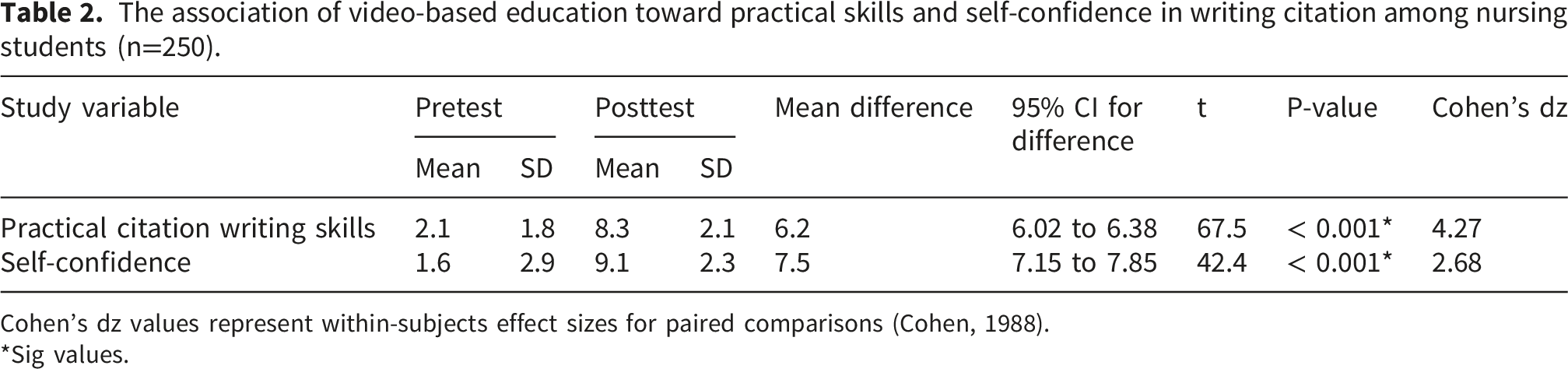
Cohen’s dz values represent within-subjects effect sizes for paired comparisons (Cohen, 1988).
*Sig values.
The association of video-based education toward practical skills domains in writing citation among nursing students (n=250).

Note. Cohen’s dz values represent within-subjects effect sizes for paired comparisons (Cohen, 1988).
*P < 0.05.
The difference between demographic variables of nursing students in terms of both practical skills and self-confidence posttest sum score (n=250).

Independent t test and One Way ANOVA.
*P < 0.05.
Analysis of covariance (ANCOVA) for both posttest practical skills and self-confidence controlling for pretest scores
After adjusting for baseline pretest scores using ANCOVA, the pretest score was a significant covariate for both practical skills and self-confidence (p < 0.001), indicating that initial performance levels were associated with post-intervention outcomes. Academic average, computer skills, and interest in scientific research remained significant predictors of posttest practical skills and self-confidence after controlling for baseline differences (p < 0.05). In contrast, sex and year of study were not significantly associated with post-intervention outcomes. These findings suggest that academic performance, digital literacy, and research engagement may influence the magnitude of benefit derived from video-based educational interventions, even after accounting for baseline competency.
Discussion
The association of video-based education on practical skills and self-confidence in writing citations
The findings of the present study demonstrate that the video-based educational intervention significantly enhanced both practical citation skills and self-confidence among nursing students. The magnitude of improvement was substantial, indicating that structured video-based instruction is an effective strategy for strengthening competence and confidence in citation management tasks.
The large magnitude of improvement suggests that the intervention was not simply marginally beneficial, but had a pronounced educational impact. This aligns with the growing evidence that multimedia and video-based pedagogies can lead to meaningful gains in both performance and self-confidence in healthcare education. A systematic review and meta-analysis found that video-based learning (VBL) yielded a moderate effect size for skills development among nursing learners, with consistent results across studies. 15 Similarly, Natarajan, Joseph 16 demonstrated that interactive educational videos enhance self--confidence and motivation among nursing students. Thus, the current study’s results fit comfortably within the positive trend of video-based interventions that benefit nursing education.
From a theoretical perspective, these improvements can be understood through experiential and multimedia learning theories. Video-based instruction provides a dual-channel presentation of content (visual and auditory), which may facilitate deeper cognitive processing and mastery of complex procedural tasks (e.g., using citation software) by allowing learners to observe, reflect, and practice. According to Mayer 17 multimedia learning theory, which combines visual and auditory inputs, facilitates dual-channel processing, reduces cognitive load, and improves knowledge retention. Moreover, the substantial increase in self-confidence may reflect both mastery experience (having successfully performed the tasks) and vicarious experience (observing demonstrations in the video), both of which are known to foster self-confidence. 18
Furthermore, the dramatic shift of means from very low baseline levels (practical skills around 2.1, self-confidence around 1.6) to high post-intervention levels (8+ on both measures) indicates that the intervention filled a major gap in students’ prior preparation. This suggests that prior to the intervention, many students may have lacked exposure or structured training in citation management tools and associated confidence. Therefore, the present findings point to the critical role of structured video-based modules as part of nursing education curricula, especially for tasks that may be perceived as ancillary (such as reference management) but are integral to scholarly competence.
The very large effect sizes observed in this study should be interpreted with caution. In single-group pretest–posttest designs, effect sizes may appear inflated due to low baseline performance (floor effect), immediate post-intervention assessment, and the absence of a control group. Importantly, the intervention targeted procedural EndNote skills that were largely novel to the participants and not routinely practiced within their curriculum. As such, the substantial magnitude of change likely reflects the acquisition of newly introduced technical competencies rather than incremental improvement of previously mastered skills. Additionally, the close alignment between the instructional content and assessment tasks may have contributed to the observed magnitude of effect. Because outcomes were measured immediately after training, the findings primarily represent short-term learning gains, and future controlled and longitudinal research is needed to examine retention and broader applicability.
Differences between demographic variables
Analysis of demographic differences revealed that sex and year of study did not significantly influence either practical skills or self-confidence scores following the video-based intervention (p > 0.05). This indicates that the educational program was equally effective across male and female students and between third- and fourth-year nursing cohorts. These findings suggest that VBL may promote equitable engagement and knowledge acquisition, regardless of gender or academic level, consistent with previous research showing that multimedia learning methods can minimize demographic disparities in student outcomes.15,19
Conversely, significant differences were found in the cumulative average, computer skills, and research interest. Students with higher cumulative averages demonstrated superior posttest performance in both practical skills (p = .006) and self-confidence (p = 0.004). This suggests that academic achievement may enhance students’ ability to integrate and apply newly learned materials. Similar trends were observed by Alrashidi, Pasay an, 20 who reported that academically high-performing nursing students showed greater adaptability to digital- and simulation-based training. This finding supports the quantitative results presented in Table 4, where the cumulative average showed a significant effect on both practical skills (F = 4.27, p = 0.006) and self-confidence (F = 4.61, p = 0.004).
Students who possessed prior computer skills achieved notably higher scores on both domains (p < .001). This finding highlights the mediating role of digital literacy in maximizing the effectiveness of technology-assisted instruction. As digital competence facilitates the smoother navigation of software-based tasks and decreases cognitive load, it may allow learners to focus more effectively on conceptual understanding. 16 In line with Mayer 17 multimedia learning theory, familiarity with digital interfaces can enhance dual-channel information processing and increase learning efficiency.
Likewise, students who reported an interest in scientific research outperformed those who did not (p < .001). This aligns with a study demonstrating that research-oriented nursing students tend to exhibit higher intrinsic motivation, self-regulated learning behaviors, and engagement with digital educational resources. 21 Interest in research likely strengthened both cognitive engagement and confidence in applying EndNote functions, reflecting the assertion of self-determination theory that intrinsic motivation fosters deeper learning and satisfaction. 22
Overall, these results underscore that, while the video-based intervention effectively improved all students’ skills and confidence, its benefits were greatest among those with stronger academic performance, better computer literacy, and higher research motivation. Therefore, nurse educators should assess students’ baseline digital competence and tailor support accordingly, offering preliminary training sessions for less digitally experienced learners, and fostering research curiosity to sustain engagement. By integrating video-based education with mentoring and guided practice, nursing programs can promote both equitable learning outcomes and sustained digital fluency, which are essential for modern evidence-based practice.
In summary, this study provides strong evidence that video-based education can yield large and meaningful improvements in both practical skill acquisition and self-confidence among nursing students. Future investigations should replicate these results across diverse cohorts, evaluate long-term retention, and explore moderating factors, such as prior digital literacy, learning style, and cognitive engagement.
Strengths of the study
This study has several notable strengths. First, it employed an objective, performance-based assessment tool (EPSC) to evaluate practical citation-writing skills, reducing reliance on self-reported measures and enhancing measurement validity. Second, the intervention was standardized, structured, and reproducible, allowing consistent delivery across participants and improving internal consistency. Third, the study incorporated rigorous psychometric evaluation of the primary instrument, including inter-rater reliability, internal consistency, and content validity assessment. Fourth, the relatively large sample size provided adequate statistical power to detect meaningful changes. Finally, the study addressed a novel and underexplored area in nursing education by evaluating video-based training for reference management, contributing empirical evidence to an emerging field of digital instructional strategies.
Limitations
This study has several limitations. The one-group pretest–posttest design lacked a control group, which limits causal inference regarding the effectiveness of the intervention. Outcomes were measured immediately after the intervention; therefore, the persistence and long-term retention of the observed improvements remain unknown and require future longitudinal evaluation. The single-site design may restrict the generalizability of the findings to other institutions or student populations. Furthermore, the study did not explicitly employ a formal training evaluation framework such as the Kirkpatrick model to structure outcome assessment, future studies may adopt such frameworks to provide a more comprehensive evaluation of educational association across multiple levels. Additionally, although very large effect sizes were observed (Cohen’s dz > 4), such magnitudes are uncommon in behavioral education research and may be influenced by the short interval between assessments and the structured nature of the assessment tool.
Suggestions for future research
Future studies should incorporate comprehensive training evaluation frameworks, such as the Kirkpatrick Model, to assess higher-level outcomes beyond immediate learning gains. Specifically, future research may examine behavioral transfer (Level 3) and organizational impact (Level 4) to determine whether improved citation skills translate into sustained academic practice and broader institutional outcomes.
Conclusion
This study demonstrates that video-based education is a highly effective strategy for enhancing nursing students’ practical skills and self-confidence in citation management using EndNote. Significant improvements, with large effect sizes, were observed across all skill domains, confirming the strong pedagogical value of multimedia learning. The findings highlight that student with higher academic performance, stronger computer literacy, and greater research interest gained the most benefits, underscoring the importance of tailoring instruction to learners’ digital readiness and motivation. Overall, integrating video-based learning into nursing education can promote active engagement, equitable learning outcomes, and development of essential competencies for evidence-based academic and professional practice. However, these gains should be interpreted cautiously because the one-group pretest–posttest design cannot rule out possible confounders, such as practice effects.
Implications
• Integrating video-based learning into nursing curricula can effectively enhance the practical skills and self-confidence of students. • Assessing and strengthening students’ digital literacy is essential to ensure the equitable benefits of technology-based instruction. • Encouraging research interest can foster motivation, confidence, and sustained engagement in evidence-based nursing practices. • This study did not include multivariable regression analysis to identify independent predictors of post-intervention outcomes, as the primary aim was to evaluate intervention association. Future research may incorporate regression modeling to further explore associated factors.
Footnotes
Acknowledgements
The authors sincerely thank all enrolled students in this study. Despite heavy academic workloads and challenging conditions due to ongoing conflict, their dedication made this research possible.

Funding
The authors received no financial support for the research, authorship, and/or publication of this article.
Declaration of conflicting interests
The authors declared no potential conflicts of interest with respect to the research, authorship, and/or publication of this article.