




Abstract
Background
No studies have evaluated Crohn's disease-related video quality on short video platforms. This study assesses the quality, reliability, and audience engagement of such videos on Douyin and Xiaohongshu to guide patients and healthcare professionals.
Methods
The top 100 videos from each platform were retrieved using “Crohn's disease” as the keyword. Quality was evaluated using modified DISCERN, JAMA, and PEMAT tools. Comment themes were extracted to identify audience concerns.
Results
Of 200 videos analyzed, overall JAMA and mDISCERN scores ranged from 2–3. Douyin videos showed higher quality and engagement: higher DISCERN scores (IQR 2.00–2.00 vs 1.00–2.00, p < 0.001), better PEMAT operability (IQR 0.50–0.75 vs 0.25–0.50, p = 0.002), longer duration (100 s vs 67.5 s, p < 0.001), and more interactions. Douyin was dominated by gastroenterologists (71%), while Xiaohongshu had more individual users (50%). Douyin emphasized prognosis and diagnosis; Xiaohongshu focused on treatment and care. Nursing-related videos scored lowest in quality, while follow-up content had the highest operability and engagement.
Conclusion
Douyin provides higher-quality Crohn's disease content than Xiaohongshu. Key issues include low dissemination of professional content and poor-quality nursing information. Recommendations are threefold: for content creators to improve video quality; for platforms to institute medical review mechanisms for care content; and for patients and the public to practice critical thinking. These measures can support a precise, effective, and scientifically-grounded digital health knowledge ecosystem.
Introduction
Crohn's disease (CD) is a chronic transmural inflammatory bowel disease (IBD) that can affect any segment of the digestive tract from the mouth to the anus, with the terminal ileum and colon being the most commonly involved.1,2 The main symptoms of the disease include chyle diarrhea accompanied by severe abdominal pain, 3 characterized by recurrent mucosal damage and prolonged inflammation, presenting a progressive course with alternating periods of remission and relapse. 4 The etiology is not yet fully understood, but the mainstream view suggests that genetic susceptibility (such as NOD2 gene mutations), dysbiosis, and environmental triggers (such as dietary changes) contribute to immune dysregulation, which collectively determines the progression of CD.5–8 Long-term active inflammation can significantly increase the risk of colorectal cancer 9 and may also induce psychological issues such as anxiety and depression, which greatly affect patients’ quality of life.10,11 With the evolution of industrialization and globalization, the incidence in East Asia has been continuously rising and the incidence of CD in East Asia has increased nearly 40-fold over the past 30 years, 12 although the incidence of CD is much lower compared to diseases such as cardiovascular diseases.13–15 Biological agents, such as anti-tumor necrosis factor (TNF) antibodies, can significantly improve clinical outcomes for CD patients, 16 but the medical knowledge involved and long-term disease management are highly complex, making self-health management for patients particularly challenging. 17 Therefore, enhancing disease awareness and obtaining reliable medical information have become key aspects in improving the prognosis of CD.18–20
In recent years, the rise of short video platforms has reshaped the way medical and health-related information is disseminated. 21 Douyin (the mainland Chinese version of the short-video platform) pushes over 48 million pieces of medical-related content daily through algorithm-driven information customization services. 22 Its content characteristics are manifested in the high-density output of practical information such as symptom recognition and medication guidance through 15–60 s visual narratives. 22 Xiaohongshu focuses on “real experience sharing,” forming a chronic disease management community ecosystem. 23 A considerable proportion of research focuses on tumors (such as lung cancer, breast cancer, etc.)24,25 and cardiovascular diseases (such as coronary heart disease, hypertension, etc.),26,27 demonstrating the unique advantages of self-media in medical popularization. However, existing studies have revealed shortcomings of short videos in medical popularization. For example, regarding esophageal cancer-related videos on the Douyin platform, although the quality of professional content from gastroenterologists is significantly better than that of non-professional creators, the public is more inclined to pay attention to popular science content produced by non-professionals, resulting in a significantly lower audience coverage for professional medical accounts. 28 To date, only one such study has been published, which exclusively examined short videos providing dietary guidance for IBD. 29 That research also highlighted a limited availability of relevant videos on digital platforms and reported that their quality was generally “unsatisfactory and varied widely depending on the source”. These findings suggest that the quality issues of medical short videos may be universal. However, for CD, which has a heavy clinical burden and is highly concerned by the public, there is still a lack of cross-platform, multidimensional systematic analysis.
The modified DISCERN tool is widely used to assess the quality of health information and the reliability of videos, particularly whether patients can obtain reasonable guidance when seeking medical advice. 30 The JAMA standards focus on evaluating the accuracy and completeness of video information, aiming to help assess the scientific and practical nature of the content. 31 The PEMAT tool focuses on evaluating the understandability and operability of health information, ensuring that video content is easy for patients to absorb and understand. 32 Our study conducts a multidimensional quality assessment of CD-related videos on Douyin and Xiaohongshu platforms, including content reliability, understandability, operability, and user comment preferences and concerns, aiming to quantify the reliability of medical information regarding CD across different short video platforms; guiding relevant personnel to identify misleading content. The research results will provide indicate directions for health communication optimization for healthcare workers, and provide empirical evidence for regulatory authorities to establish standards for health information in short videos.
Methods
Search strategy and data collection
To minimize the influence of personalized recommendation algorithms, data were collected using newly registered accounts with no browsing history on Douyin (v25.8) and Xiaohongshu (v8.18) to perform video searches. The keywords for this study were “克罗恩病(Crohn's Disease)”, and video searches were conducted on both platforms on July 14, 2025. The collection and downloading of all videos were completed by an independent researcher using a newly registered account (with no prior usage history or personalized settings) to ensure data consistency and reliability. The videos were collected based on the platform's default and were screened and rated according to the following criteria: (1) the video language is Chinese; (2) the video content is related to CD; (3) exclude videos of an advertising nature, duplicate content, videos unrelated to CD, and non-original videos such as reprints and plagiarism. Among all videos that met the inclusion criteria, the following characteristics were recorded and analyzed: video duration(Time), number of likes, number of comments, number of saves, number of shares, upload date(Days), uploader type, video presentation format and video content.
Video classification
To facilitate in-depth analysis of video quality, we categorized the uploader types based on video sources into three categories: gastroenterologists, non-gastroenterology doctors, and personal. Gastroenterologist: This category includes certified specialists in gastroenterology or accounts explicitly representing such professionals. Non-gastroenterology Doctor: This category includes certified medical doctors whose specialty is not gastroenterology. Personal: This category includes non-professional accounts, such as those of patients with Crohn's disease, their family members, or general health enthusiasts. The video content was classified according to themes, including epidemiology, diagnosis, etiology, symptoms, treatment, prevention, prognosis, nursing, and follow-up. In addition, the presentation formats of the videos were divided into various types, including monologue, Q&A format, medical scene, and others.
Video quality and reliability assessment
This study utilized the Patient Education Materials Assessment Tool for Audio-Visual Content (PEMAT-A/V),33,34 the modified DISCERN (mDISCERN)35–37 and JAMA benchmarks36,38 to evaluate the video quality and reliability of short videos,and the detailed scoring rubrics for each assessment tool are provided in Supplementary 1. The core domain measured by each tool that mDISCERN assesses “information reliability”; JAMA assess “completeness of quality reporting”; PEMAT-A/V assesses “understandability” and “actionability”. Before formal scoring, the researchers responsible for the assessment collectively studied the scoring criteria of the above scoring tools to reduce cognitive bias and achieve independent scoring. If uncertainty or disputes arose during the scoring process, a third researcher would discuss and reach a consensus.
Data analysis
This study employed descriptive statistics and non-parametric tests to analyze video characteristics and quality indicators. Since this study did not meet the normal distribution assumption, the median and interquartile range (IQR) were used to describe the central tendency and dispersion of continuous variables. The Mann–Whitney U test and Kruskal–Wallis test were applied to compare video quality and reliability scores across categories. To compare the distribution of categorical variables (e.g., platform, JAMA/mDISCERN component compliance), we performed Chi-square tests when all expected cell counts were greater than 5, and Fisher's exact tests (Monte Carlo simulation with 10,000 replicates) when any expected cell count was 5 or less. Dunn's test, adjusted using the Original FDR method of Benjamini–Hochberg (false discovery rate < 0.05), was applied for all subgroup and correlation analyses. Meanwhile, Spearman correlation analysis was used to evaluate the correlation between video characteristics (such as likes, comments, shares, video duration, etc.) and video quality and reliability scores. On video quality scores. All statistical analyses were two-sided tests, with a P-value less than 0.05 considered statistically significant. All data analyses were processed using R software (version 4.3.0), and data analysis and visualization were completed using R packages such as tidyverse, ggplot2, and rstatix.
Ethical statement
All data were sourced from publicly available videos, contain no identifiable personal information, and that the study complied with the platforms’ Terms of Service and relevant ethical guidelines for social media research. Since this study did not directly involve human participants and only used publicly available information, ethical approval for this study was not required.
Results
The basic characteristics and quality of CD videos on short video platforms.
This study conducted a systematic analysis of 200 CD-related videos on both Douyin and Xiaohongshu platforms (Fig. 1). As shown in Table 1, the most prominent difference between the two platforms is the video duration; Douyin videos average 100 s, which is 32.5% longer than Xiaohongshu's 67.50 s (p < 0.001). Additionally, Douyin significantly outperforms Xiaohongshu in user interaction: the number of likes, comments, shares, and saves are 41.9 times, 25.3 times, 51.0 times, and 37.0 times that of Xiaohongshu, respectively (p < 0.001). In terms of content quality assessment, the JAMA score did not show differences between platforms, while the DISCERN score had the same median of 2.00 points, but the distribution difference was significant (Douyin IQR 2.00-2.00 vs. Xiaohongshu 1.00–2.00; p < 0.001). The PEMAT-operability score for Douyin was higher (0.50 [0.50–0.75] vs. 0.50 [0.25–0.50]; p = 0.002), but there was no significant difference in Intelligibility.

Flowchart of short videos selection.
Overall characteristics and quality scores of short videos on CD.

Statistical comparisons were performed using Mann–Whitney U test
Comparison results of video uploader types, presentation forms, and content characteristics related to CD
Overall, the number of treatment-related content is the highest (97, 25.39%), followed by symptoms (80, 20.94%) and diagnosis (79, 20.68%), while prevention-related content is the least (6, 1.57%), (Table 2).
Types of CD uploader type, presentation forms, and content characteristics.

Statistical comparisons were performed using Chi-square tests when all expected cell counts were >5; otherwise, Fisher's exact tests with Monte Carlo simulation (10,000 replicates) were employed.
From the comparison between platforms, Douyin and Xiaohongshu show significant differences in content distribution (Table 2). Douyin has a significantly higher proportion of professional medical content in diagnosis (21.74%), prognosis (15.42%), and follow-up (5.14%) compared to Xiaohongshu (diagnosis 18.6%, prognosis 6.2%, follow-up 0%). Notably, follow-up content accounts for 5.14% on Douyin, while it is completely absent on Xiaohongshu. In contrast, Xiaohongshu focuses more on treatment (31.78%) and nursing (11.63%) content, with its nursing content significantly higher than Douyin (0.79%).
Symptom and etiology content are relatively evenly distributed across both platforms (Table 2), maintaining ranges of 20.93%–20.95% and 6.20%–6.72%, respectively, indicating a universal demand for this basic disease awareness information across platforms. Epidemiology content has a low proportion on both platforms (Douyin 5.14%, Xiaohongshu 3.88%), reflecting that the disease's epidemiological characteristics are not a focus for short video creators. Notably, prevention content has the lowest proportion on both major platforms (Douyin 1.98%, Xiaohongshu 0.78%), suggesting a significant lack of knowledge regarding primary prevention and health promotion for CD in the current short video ecosystem, which may limit the platforms’ potential value in disease prevention.
The impact of video uploader, different presentation formats and the thematic content on video popularity
Research has found that user interaction behaviors vary among different uploaders, with significant differences in sharing behavior (p = 0.002) (Table 3). Non-gastroenterology doctors had the highest median video shares (167.00 times), which is 2.5 times that of gastroenterologists (67.00 times) and 41.8 times that of individual creators (4.00 times). Additionally, there were differences in saving behavior (p = 0.022), with gastroenterologists having a significantly higher median video saves (72.00 times) compared to individual creators (9.00 times), while non-gastroenterologists were in between (40.00 times). Other interactions such as likes, comments, and video duration did not show statistical differences among the three types of uploaders.
Types of video uploaders, different presentation forms, and content's impact on video popularity.

Statistical comparisons were performed using Chi-square tests when all expected cell counts were >5; otherwise, Fisher's exact tests with Monte Carlo simulation (10,000 replicates) were employed.
In terms of video presentation formats, although the inter-group differences did not reach statistical significance, Q&A format and medical scene videos performed better than monologue videos on most interaction metrics. Notably, videos in the “other” format (N = 4) performed exceptionally well in likes (1123.5 times), saves (436 times), and shares (441.5 times).
The most significant differences were observed in the video contents, where user interaction behaviors showed a high dependence on the video content: follow-up content (N = 13) significantly outperformed other content, achieving a median of 974 likes, 173 comments, 275 saves, and 212 shares, all significantly higher than other contents (all p < 0.05). In contrast, nursing videos exhibited the poorest interaction performance. Although treatment videos (Treatment) had the highest quantity (N = 97), their median interactions were significantly lower than follow-up videos (likes 285.00 vs. 974.00 times). The median comment count for etiology (Etiology) basic popular science content (N = 25) was only 10.00, less than 6% of follow-up content. Aside from follow-up content, diagnosis (Diagnosis) and prognosis (Symptoms) videos performed well in terms of comments, receiving 54 and 62 comments respectively.
Quality analysis of different video uploaders, presentation formats, and thematic content
Through evaluations using the JAMA, mDISCERN, and PEMAT scales, it was found that the type of uploader has a systematic impact on the quality of CD videos (Figure 2). The content from gastroenterologists and non-gastroenterology doctors was significantly superior to that of individual creators in terms of information reliability (JAMA score) and evidence quality (mDISCERN score), but there was no statistical difference between the two types of doctors. In the dimension of understandability (PEMAT-Intelligibility), both gastroenterologists and non-gastroenterology doctors significantly surpassed individual creators, with scores being equal between the two types of medical professionals. Notably, the operability (PEMAT-operability) dimension showed a divergence: gastroenterologists scored significantly higher than individual creators, but non-gastroenterology doctors only showed a slight advantage over individual creators (not statistically significant), and there was no statistical significance between gastroenterologists and non-gastroenterologists.

Video quality evaluation of different uploader types. Statistical comparisons were performed Kruskal–Wallis rank sum test, Dunn's test, adjusted using the Benjamini–Hochberg (false discovery rate < 0.05).

Evaluation of video quality in different presentation forms. Statistical comparisons were performed Kruskal–Wallis rank sum test, Dunn's test, adjusted using the Benjamini–Hochberg (false discovery rate < 0.05).
The quality analysis of videos on different contents about CD found that content type significantly affects information reliability, evidence quality (Figure 4). Nursing videos scored the lowest for JAMA scorevand mDISCERN score. The JAMA scores for etiology were significantly higher than for treatment content. The mDISCERN scores for nursing content were significantly lower than those for follow-up, prognosis, diagnosis, symptoms, etiology, and epidemiology, while the scores for prognosis, etiology and epidemiology were all higher than for treatment content. In terms of user understanding, the PEMAT-Intelligibility score for treatment content was the worst. Additionally, follow-up content performed outstandingly in terms of PEMAT-Operability, with scores significantly higher than nursing and treatment.

Evaluation of video quality of content with different themes. Statistical comparisons were performed Kruskal–Wallis rank sum test, Dunn's test, adjusted using the Benjamini–Hochberg (false discovery rate < 0.05).
Analysis findings of user interaction and video element correlation
The correlation analysis reveals the relationship patterns between different elements of CD video content (Figure 5). User interactions are highly consistent, with a strong positive correlation between likes, saves, and shares (r = 0.92–0.95), particularly the correlation between saves and shares reaching 0.94. Regarding quality ratings, there are significant positive correlations among the three dimensions of intelligibility, mDISCERN, and operability, with the highest correlation between intelligibility and mDISCERN (r = 0.73), followed by intelligibility and operability (r = 0.65).
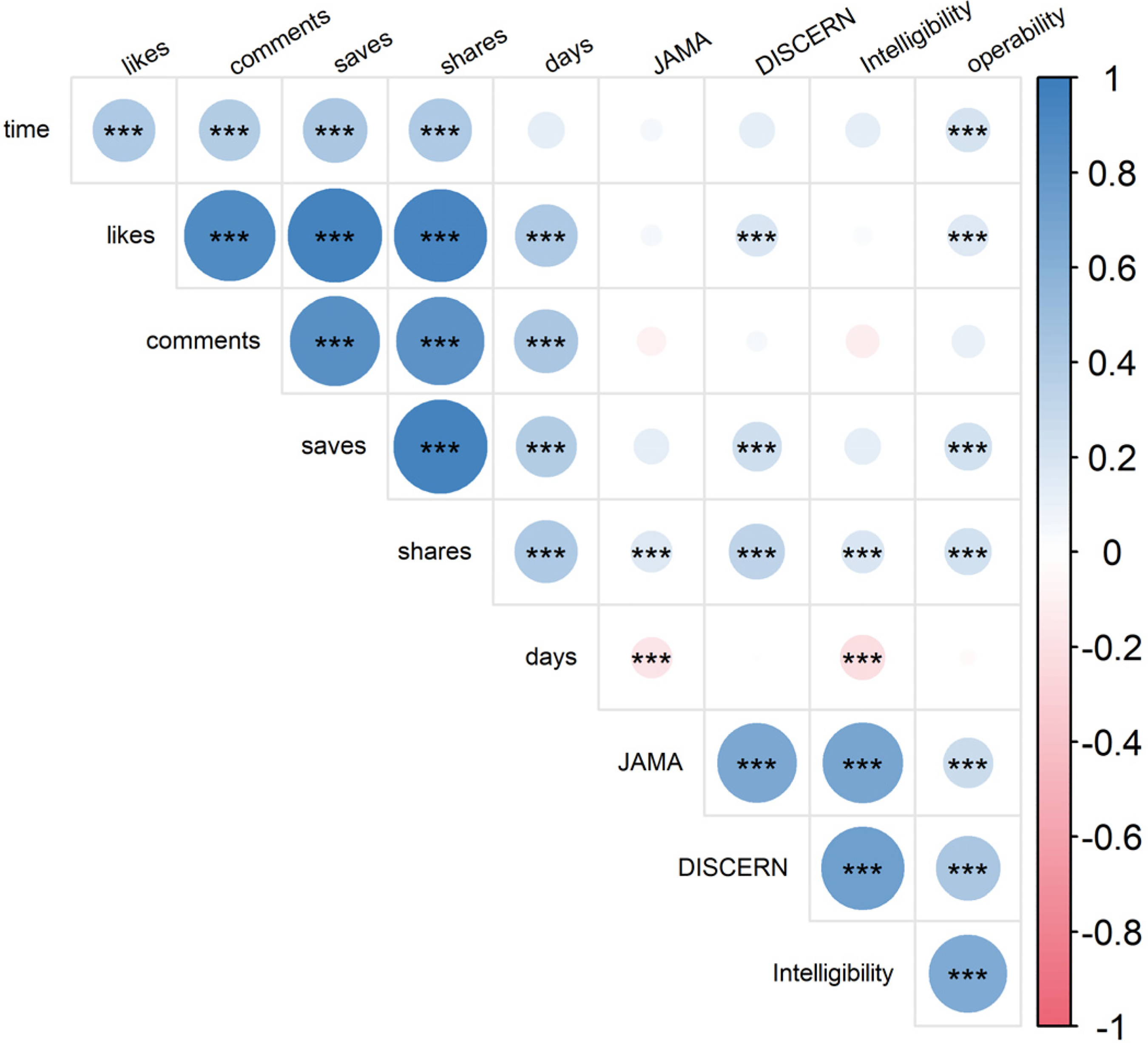
Correlations among video elements. Spearman correlation analysis was used to evaluate the correlation between video characteristics.
Statistical significance of correlations among video elements
The analysis results show a highly consistent significant association within user interaction behaviors (Figure 5), with a very strong positive correlation between likes, comments, saves, and shares (p < 0.0001). Video duration also shows a very significant positive correlation with all user interaction metrics (p < 0.0001). Regarding quality assessment metrics, there are significant correlations among intelligibility, mDISCERN, and operability (p < 0.0001). The intelligibility score generally lacks statistical significance in relation to user interactions, with only a weak but significant correlation with sharing behavior (p = 0.0068). In contrast, the mDISCERN score shows a more significant correlation with user interaction, particularly with saves (p = 0.0003) and shares (p < 0.0001). Operability also shows significant positive correlations with save behavior (p = 0.0009) and share behavior (p = 0.0011). What's more, we conducted a correlation analysis between the average online duration and the engagement metrics (shares, likes, comments) (Figure 5). On Douyin, a clear and significant correlation was observed between the time a video has been online and its engagement metrics and this correlation was notably weaker On Xiaohongshu (Supplementary Figure 1).
Discussion
Summary and analysis of main findings
Firstly, the overall quality of CD videos on both platforms is not very good. The mDISCERN reliability of Douyin is slightly higher than that of Xiaohongshu (p < 0.001). Additionally, Douyin videos are longer than those on Xiaohongshu, and user engagement is significantly higher on Douyin (p < 0.001), including the number of likes, comments, saves, and shares. Professional gastroenterologists (58%) and personal media creators (37.5%) are the main uploaders of CD videos. The video scenes mainly consist of monologue (70%) and medical scene (25%). Among all video content, follow-up content videos are the most welcomed, while nursing video content is the least popular and of the lowest quality. These results suggest that although short video platforms have become important channels for health communication regarding CD, this study reveals that the overall content quality is poor, and there are significant differences between platforms. The uploaders, presentation formats, content popularity, and quality of different videos vary greatly, indicating an urgent need to establish cross-platform quality standards and explore the impact of various factors on video quality and popularity.
Impact of different factors on video quality
Similar to previously published studies on IBD, lymphatic edema, esophageal cancer, and pancreatic cancer videos,28,29,39,40 the overall quality of CD-related videos is poor. However, the quality on Douyin is slightly better than on Xiaohongshu, which may be related to the fact that professional gastroenterologists are the main contributors on Douyin, while personal uploaders dominate Xiaohongshu. This aligns with findings from studies on pediatric pneumonia and other short videos, as videos created by medical professionals typically exhibit more comprehensive knowledge coverage, more accurate information presentation, and higher evidence reliability, thus possessing more significant guiding value.40,41 In terms of video presentation format, medical scenes receive higher JAMA scores (Figure 3). Furthermore, video content also affects video quality. CD videos related to nursing generally receive lower scores across various assessment tools, which may be closely related to the uploaders of nursing videos: 88% of nursing content on the platform is produced by individual users, while professional medical personnel contribute only 12% of nursing videos.
Impact of different factors on video popularity
Viewer interactions such as likes, comments, saves, and shares can serve as indicators of video popularity, audience engagement, and acceptance of the video's core message. 35 Research on audience engagement reveals that videos by professional gastroenterologists generate more saves (reflecting patients’ need to retain authoritative content), but their share count (67.00 times) is significantly lower than that of non-gastroenterology doctors (167.00 times). This contradiction suggests that specialized content from gastroenterologists may be viewed by patients as “personal health management materials” (high save count), but due to dense terminology and lack of emotional warmth, it suppresses the willingness to share socially; non-gastroenterology doctors, through interdisciplinary perspectives or relatable narratives, are more likely to trigger audience sharing desires. In terms of video content, although similar to videos related to pediatric dental caries and esophageal cancer, CD videos primarily focus on symptoms and treatment,28,42 the follow-up related videos on CD receive the highest attention (including likes, comments, saves, and shares), reflecting the urgent need for long-term disease management information among CD patients. Compared to basic disease knowledge such as etiology, patients are more concerned about practical guidance that directly affects their quality of life.43,44 Despite daily nursing being a core aspect of CD management, its interaction rate is low, which is also related to the previously mentioned low quality of nursing videos. On Douyin, a clear and significant correlation was observed between the time a video has been online and its engagement metrics. On Xiaohongshu, this correlation was notably weaker. We interpret this divergence as likely stemming from fundamental platform-specific characteristics: Douyin typically has a larger, more active user base and is designed for more immediate content consumption, which may amplify the effect of time online on cumulative engagement. In contrast, the content ecosystem and user engagement patterns on Xiaohongshu may attenuate this relationship.45,46
Patient cognitive bias and health inequality
Our study reveals the real dilemmas faced by CD patients. In reviewing comments, we found that patients repeatedly raised questions such as “Is there a mature clinical consensus on the use of biologic agents?” and “Can dietary restrictions be fully lifted during remission?” These discussions often sparked heated debates due to individual differences, such as differing perceptions of controversial foods like chili powder or eggs. This interactive relationship between video content and comment demands reflects how fragmented information dissemination exacerbates the misinterpretation of medical knowledge. Notably, numerous comments seeking “cures” appeared under videos claiming to be “curative,” reflecting patients’ anxiety about their disease understanding and irrational expectations for “cure,” which can easily be exploited by unregulated therapies (such as so-called “self-immune healing programs”), further undermining adherence to scientific treatments.
Moreover, we also found significant gaps in video content. Many parents in the comments inquired about “treatment and care methods for children with CD,” but there is relatively little content related to pediatric CD on both platforms, despite children accounting for over 20% of overall CD patients, with incidence rates rising annually.47,48 Therefore, pediatric CD deserves further attention. It is also noteworthy that user comments reveal the impact of economic pressure on treatment, particularly concentrated in the area of biologic agents, with frequent expressions of inability to afford treatments such as “I can't afford the monthly payment of 3000 for ustekinumab,” which not only challenges the universality of treatment but also forces some patients to turn to unregulated therapies with unknown risks.
Practical recommendations
For content creators like clinicians and healthcare institutions: they could use the assessment dimensions from our study (PEMAT, mDISCERN, JAMA benchmarks) as a framework to actively guide patients on how to critically evaluate online videos during consultations.
For patients and the public: Patients and the public are advised to practice critical thinking, facing educational messaging, emphasizing the need for “active skepticism” when viewing health-related short videos (e.g., checking uploader credentials, seeking cross-verification from multiple sources, being wary of absolute cure promises).
For social media platforms and policymakers: We call for public health agencies to collaborate with platforms to develop and promote standard creation guidelines for short-form health content.
Limitations
This study has several limitations. Firstly, the sample only covers two platforms, Douyin and Xiaohongshu, and does not include knowledge-based communities like Bilibili, which may limit the representativeness and generalizability of the results. Secondly, a key methodological limitation arises from our data collection strategy. The sample of videos was obtained using the platforms’ default search and ranking algorithms. Consequently, our sample may be systematically biased toward videos that are more popular, provocative, or aligned with broad user interests, as determined by the platform's logic. Finally, this study has several statistical limitations. The subgroup analyses, particularly those involving videos created by non-gastroenterologist physicians and those focusing on follow-up-related content, were affected by substantial imbalances in sample size. The very small numbers in these subgroups limit the statistical power and robustness of the comparisons, and the results should be interpreted with caution. Therefore, future studies with larger, prospectively collected, and balanced samples are needed to validate these preliminary observations and draw more definitive conclusions.
Conclusion
This study utilized multiple scoring software to evaluate CD videos on Douyin and Xiaohongshu platforms, finding that the overall quality of these videos is poor, with Douyin’s related videos slightly better than those on Xiaohongshu. In terms of content, although professional gastroenterologists dominate the publication of specialized content, their share count is lower than that of non-gastroenterology doctors. It is recommended that, given that follow-up content demonstrated higher information quality and user need (reflected in engagement) in our study, content creators might consider prioritizing the production and visibility of such high-quality, high-utility content like follow-up-related content. This provides empirical evidence for constructing a digital health knowledge ecosystem of “precise supply-effective dissemination-scientific cognition.”
Supplemental Material
sj-jpg-1-dhj-10.1177_20552076261433840 - Supplemental material for Evaluation of the quality, reliability of Crohn's disease-related content on Douyin and Xiaohongshu with insights from user comments: A cross-sectional study
Supplemental material, sj-jpg-1-dhj-10.1177_20552076261433840 for Evaluation of the quality, reliability of Crohn's disease-related content on Douyin and Xiaohongshu with insights from user comments: A cross-sectional study by Jing Cai, Yuan Huang, Min Xu, Qingqing Li, Jianhong Wu, Lihua Liu, Fei Wang and Peipei Luo in DIGITAL HEALTH
Supplemental Material
sj-xlsx-2-dhj-10.1177_20552076261433840 - Supplemental material for Evaluation of the quality, reliability of Crohn's disease-related content on Douyin and Xiaohongshu with insights from user comments: A cross-sectional study
Supplemental material, sj-xlsx-2-dhj-10.1177_20552076261433840 for Evaluation of the quality, reliability of Crohn's disease-related content on Douyin and Xiaohongshu with insights from user comments: A cross-sectional study by Jing Cai, Yuan Huang, Min Xu, Qingqing Li, Jianhong Wu, Lihua Liu, Fei Wang and Peipei Luo in DIGITAL HEALTH
Footnotes
Acknowledgements
We gratefully acknowledge all individuals who participated in this study.

Ethical approval
This study analyzed publicly available videos and related user comments about CD on Douyin and Xiaohongshu. All data were sourced from publicly available videos, contain no identifiable personal information, and that the study complied with the platforms’ Terms of Service and relevant ethical guidelines for social media research. Since this study did not directly involve human participants and only used publicly available information, ethical review was not required.
Author Contributions
JC, YH contribute to conceptualization, writing—original draft,formal analysis. MX,QFY, JHW,QQL, LHL contribute to methodology, investigation and data curation. FW, PPL contribute to writing and editing, supervision, and funding acquisition and project administration.
Funding
The authors disclosed receipt of the following financial support for the research, authorship, and/or publication of this article: This work was supported by the Jiangsu Provincial Health Commission Guidance Project, Wuxi Science and Technology Bureau, Jiangsu Key Laboratory of Medical Science and Laboratory Medicine Open Project, Changzhou Municipal Health Commission - Menghe Medical School Heritage and Innovation Development Project, Youth Fund of the National Natural Science Foundation of China, (grant number Z2021076, K20231047, JSKLM-Y-2025-02, MH202509, 82302543).
Declaration of conflicting interests
The authors declared no potential conflicts of interest with respect to the research, authorship, and/or publication of this article.
Supplemental material
Supplemental material for this article is available online.
References
Supplementary Material
Please find the following supplemental material available below.
For Open Access articles published under a Creative Commons License, all supplemental material carries the same license as the article it is associated with.
For non-Open Access articles published, all supplemental material carries a non-exclusive license, and permission requests for re-use of supplemental material or any part of supplemental material shall be sent directly to the copyright owner as specified in the copyright notice associated with the article.

