




Abstract
Background
The US organ transplantation system is pursuing modernization of the allocation process through the integration of new technologies such as artificial intelligence (AI). However, the legal and ethical issues within the transplantation industry are still of concern.
Objective
We explore the opportunities and challenges for Organ Procurement Organizations (OPOs) to adopt AI. The US organ transplant system is a highly regulated industry yet open to innovation.
Methods
Ten structured interviews were conducted with OPO representatives using the Extended Technology, Organization, Environment (TOE) framework.
Results
Overall, we identified five core tensions in AI adoption: (1) misconceptions, (2) approach to training, (3) need for AI expertise, (4) impact of organization size, and (5) top-down versus bottom-up adoption viewpoints. First, some of the positive perceptions of AI, such as bias elimination, are related to misconceptions about what is technically possible. Second, some OPOs believed that using AI systems requires basic knowledge about the AI system, while others stated that AI should be intuitive and require no training. Third, they disagreed on whether it is necessary to add AI-experienced staff as part of an AI adoption strategy. Fourth, smaller OPOs may struggle to develop, maintain, and implement AI systems due to their limited resources, yet they are more nimble and able to pivot due to less bureaucracy. Fifth, there are competing visions for how AI should be adopted across OPOs nationwide, either top-down driven by regulatory requirements or bottom-up driven by performance expectations.
Conclusions
Ongoing work is needed to determine best practices for integrating AI in OPOs to support optimal organ use and expand transplant access for patients. The TOE framework highlights organization-level tensions that need to be addressed by the transplant sector for successful AI adoption and integration.
Keywords
Introduction
The US organ transplantation system is undergoing a modernization effort, which is likely to also increase the use of artificial intelligence (AI) tools.1,2 However, transplantation is a highly regulated field, with actively debated legal and ethical issues that are still of concern in the organ allocation process (e.g. rules for allocation out of sequence, when to determine donor death).3,4 In 2024, while over 91,000 patients were on the waiting list for kidney transplantation, only 28,000 kidney transplants were performed.5,6 This inability to meet the high demand for transplantation has created space for innovation, which may involve increased AI adoption. There are numerous risks, benefits, and challenges in medical AI adoption. 7 AI here is defined as “the computational capacity to perform tasks such as learning, reasoning, problem-solving, perception, and decision-making in a manner that is indicative of human intelligence.” 8 This includes specific techniques, such as machine learning, which can execute tasks without direct instruction. 9 Broadly, challenges in AI adoption include concerns for transparency, technological reliability, awareness, professional liability, as well as ethical and privacy issues in medical settings. 10 Implementing AI is not limited to technology but also involves the workforce, organizational culture, and process changes.11,12 The positive relationship between technological and organizational innovation reinforces this perspective. 13 Therefore, successful implementation of AI necessitates research going beyond the technological aspects of AI adoption. 14
Furthermore, bibliometric evidence indicates the exponential growth in AI-related research and applications in treatment optimization, medical decision support, and diagnostics.15,16 Nevertheless, the acceleration of technological innovation has not been accompanied by the same level of attention to the organizational processes that are necessary to integrate AI into the daily operations of healthcare. Therefore, in this study we apply the extended technology–organization–environment (TOE) framework to discover key factors and areas of tension influencing AI adoption by organizations involved in the organ allocation process, namely Organ Procurement Organizations (OPOs).
In this article, we provide a literature review on the extended TOE framework, followed by background on the transplantation system and the operation of OPOs. Next, details are provided about our interview methods with OPO staff. Finally, we present analysis and summaries of our findings on AI adoption in organ placement.
The extended TOE framework
While many technology adoption theories (e.g. theory of planned behavior, technology acceptance model, etc.) primarily focus on individual factors, the TOE framework explains the adoption process from an organizational perspective. 17 The extended TOE framework reflects the challenges organizations face when adopting AI systems. 18
Technological factors
Under the technological context, the extended TOE framework proposes that relative advantages and compatibility with the business case and business process can increase technology adoption. 18 The adoption process of a new technology is enhanced when the benefit of the new technology is more compelling than that of the existing one.18,19 For example, if the new technology reduces operational costs while improving efficiency, organizations are more likely to adopt it. 19 However, conflict arises between those who prefer to use AI purely for efficiency and cost-saving purposes versus those who prefer to use AI to improve decision-making, which takes time, human oversight, and resources.20,21 The more compatible the new technology is with existing technical infrastructures, work procedures, culture, philosophies, norms, and values, the faster the adoption process.19,22 In addition, the simpler a technology is to use and learn, the faster the adoption process.19,22
Not all organizations approach AI adoption in the same way. One study showed that across eight public organizations with different AI maturity levels, the AI adoption process varied across two different approaches: top-down driven by strategic initiatives and bottom-up through technological considerations. Some organizations were actively engaged in AI-driven solutions by hiring specialists, suggesting a top-down adoption process. However, most organizations did not have the initial intention to use AI. They integrated AI in their business process when they could no longer solve their problem with conventional technologies, suggesting more of a bottom-up approach. 23
Applying the TOE framework in medical settings also introduces new technological factors that may impede adoption: lack of transparency and adaptability of machine learning (ML) tools. 22 The complex nature of ML systems in high-stakes decisions was the major obstacle to adoption. In contrast, another study found no relationship between big data complexity and its adoption in healthcare. 24 Providing an explainable result may promote the adoption process.25,26
Organizational factors
Under the organizational context, the extended TOE framework reflects the effect of culture, resource availability, organization size, and organization structure.18,19,22,23,27,28 Organizational culture includes top manager support, change management strategy, and innovative culture, all of which enhance the adoption process. 18 Allocation of financial resources, data availability, and the presence of employees who have knowledge about AI systems support AI adoption. 18 The effect of organization size is mixed and creates conflicting implications.18,19,22,23 On the one hand, large organizations have access to more financial resources and larger volumes of customer data, which supports adoption. On the other hand, larger organizations can have slower bureaucratic structures, which may impede new changes.
The decision to adopt AI must be made while considering ethical requirements and potential risks. The use of AI can raise privacy concerns if models are adapted to tasks other than their original purpose. 29 Also, while allocating financial resources encourages AI adoption, a better foundation for organizations to adopt AI is provided when there is no return-on-investment expectation. The gains from AI are unpredictable and influenced by data accessibility. 18
Within healthcare, financing structures and the availability of employees who have knowledge in both medicine and data science could create a challenge for AI adoption. 22 Budgetary constraints requiring clinics to allocate their financial resources to mandatory costs, such as purchasing medical equipment, may prevent enough funding for AI systems. While having medical knowledge can help in selecting appropriate training data and evaluating the conditions proposed by an ML system, technical expertise is essential for building and training these systems. Currently, there are very few ready-made ML solutions available for medical use, meaning that healthcare institutions often need to develop their own ML systems. Therefore, providing continuous training programs about AI systems to medical professionals may encourage AI adoption. 22
Environmental factors
Under the environmental context, the extended TOE framework includes competitive pressure, industry requirements, government regulations, and customer readiness.18,23 Organizations that experience competition end up engaging in AI adoption to obtain competitive advantages. 18 Depending on the nature of the organization, industry requirements can either enhance or hinder the adoption process. These requirements include organization-environment connections, external circumstances that affect the company, and specific laws related to a particular industry. 18 For example, organizations may be less likely to adopt AI if they have a rigid financial allocation process or struggle to recruit expertise due to a reputation for not being innovative. 23 Some studies found that customers and regulatory requirements encourage technology adoption in service companies. 19
The adoption of AI systems is shaped by both regulatory uncertainty and the readiness of customers to embrace emerging technologies. Uncertainty regarding the application of regulations and general federal laws creates an open space for interpretation, concerns about AI compliance, and may delay AI projects. 23 Organizations that have customers willing to purchase innovative products are more likely to adopt AI systems. 18
Within healthcare, government support and regulatory frameworks play a critical role in medical AI adoption. 30 ML systems that are approved by authorities are more likely to be adopted. 22 In addition, there is likely to be new and evolving legislation related to data protection and accountability for AI recommendations in medical settings.22,27 For example, the use of potentially biased historical data raises concern for medical ethics that could be addressed by clear regulations.22,27
Organ allocation for transplantation
OPOs identify prospective deceased donors, communicate with transplant centers and donor families, and perform organ recovery and organ placement. Of all the organs, the kidneys are transplanted at the highest rate. In 2024, almost 28,000 kidneys were transplanted, compared to 12,000 for livers, 5000 for hearts, and 3000 for lungs. 5 As a result, there is more data available for kidney transplants, which can support AI applications.
OPO services begin when a potential donor is identified in the hospital. To find a potential transplant candidate for an available organ, a match run is performed, which provides a list of compatible candidates in rank order. Based on this ranked list, OPO staff electronically offer organs to the transplant centers for the top candidates. If the kidney is accepted, OPOs transport the kidney to the transplant center. However, the kidney may be declined due to poor kidney function, damage or anatomical concerns, risk factors for shortened long-term graft survival, or a mismatch between the donor and patient for other factors such as size. If many transplant centers successively decline the offer, the OPO may use a process called out-of-sequence allocation. In this instance, OPOs contact transplant centers with a history of accepting hard-to-place kidneys. A kidney may be considered hard-to-place because of donor age, comorbidities, and infections. AI systems can help OPOs identify hard-to-place kidneys earlier, reducing the non-utilization rate for kidneys.
The implementation of distance-based allocation policy legislated in March 2021 and the regulatory pressures on OPOs to maximize kidney transplant and organ utilization has led to a surge in the rate of out-of-sequence allocation, from 2% in 2019 to 20% in 2023. 31 However, OPOs significantly vary in out-of-sequence practices ranging from 0% to 43%, where many of these incidents happened between high-volume OPOs and transplant centers. 32 These patterns point to system stress, where reforms seeking a particular change (e.g. reducing geographic disparity in transplant access) may have yielded unintended inefficiencies or disparities. 33 In addition to these challenges in the allocation process, overall, 28% of kidneys from deceased donors are not utilized for transplantation, with higher rates for kidney donor profile index of 85% or higher (73%), donors from aged 65 years or older (72%), and biopsied kidneys (41%). 34 While some non-utilization is medically justifiable, some represent missed opportunities. To deal with these challenges, many have proposed using AI systems to assist the allocation process.2,35 However, AI systems have not yet been systematically adopted.
Method
Executive directors and chief operating officers from 10 OPOs across the US participated in semi-structured interviews based on the technological, organizational, and environmental aspects of AI adoption. The extended TOE framework was employed to construct the interview questions.
Participants
To gain an in-depth understanding of AI adoption in OPOs, we employed a purposive sampling strategy to identify knowledgeable participants with direct decision-making authority or strategic involvement in technology adoption at OPOs. Inclusion criteria include (1) holding an executive or senior management position and (2) possessing knowledge of or responsibility for innovation, technology integration, or organizational processes.
We directly emailed the executive directors and chief operating officers of all 56 OPOs to request and set up interviews (see Supplemental Appendix B). Informed consent documents were shared in advance, and verbal consent was obtained at the start of the interview. This procedure was approved by the University of Missouri IRB (#2099248). This resulted in 10 interviews from 10 different OPOs representing 18% (10/56) of the total OPOs in the US. In three interviews, participants also invited other members of their leadership team who participated in that OPO's interview (see Supplemental Appendix A). While we aimed for 12 interviews as recommended to achieve data saturation, 36 in this close-knit industry, with a fixed number of OPOs, most participants shared similar insights by interview 5 and no new codes emerged by interview 8.
These 10 OPOs varied in terms of size, population served, and performance as summarized in Supplemental Appendix A. Their sizes are representative of OPOs in general, which range from ∼200 to 400 + employees. Likewise, their population served ranges from seventh to 54th in population size among the 56 US OPOs, indicating representative coverage. 37 Finally, performance of OPOs is measured with a CMS (Centers for Medicare & Medicaid Services) score, which classifies all OPOs in quartiles based on being in the top two quartiles or the bottom half. Our interviews showed adequate representation with 40% in the top quartile, 30% in the second quartile, and 30% in the bottom half.
Interview
Two authors (a graduate and undergraduate psychology students) were trained and conducted interviews from January to August 2024 over Zoom, lasting 20 to 53 minutes. The semi-structured interview consisted of an inductive and deductive section (see Supplemental Appendix C for all questions). The first section of seven questions aimed to elicit participants’ general understanding of AI and their attitude toward AI adoption without priming participants. This supports inductive reasoning, in which a general conclusion is driven by raw data that allow patterns, themes, and theories to emerge naturally. 37 The second section of 21 questions focused on factors that influence AI adoption in organizations based on the extended TOE framework to support deductive reasoning. If the participant did not mention specific factors from the theory, follow-up questions were asked regarding that factor. The purpose of combining inductive and deductive methods was to discover any other influencing factors that might be specific to OPOs while making decisions for AI adoption.
Data coding and analytical method
The data coding was conducted using MaxQDA qualitative analysis software. Deductive codes were derived from the extended TOE framework, while inductive codes emerged from participants’ narratives to capture new or context-specific themes (see Supplemental Appendix D). Two authors separately coded the raw data in each interview. For inconsistent coding, four authors discussed the code definitions and boundaries to reach consensus. 38 Thematic saturation was reached when no new codes or themes emerged in interviews 8 to 10. In total, we identified 27 codes and 383 applications of those codes. Fifteen of the codes were from the extended TOE framework; however, 12 of the codes were new and classified as subcodes within the extended TOE framework (see bulleted codes in Figure 1). Figure 1 highlights the factors that can be generalized, so it does not include three additional codes identified under compatibility with the business case (see Supplemental Appendix E).

Generalizable themes from the Organ Procurement Organization (OPO) context. Numbers in parentheses are code counts, and bulleted codes are subcodes of main schemes.
Results
Overall, the interviews demonstrate the complex nature of AI adoption and emphasize careful consideration of AI integration in the OPO context. Although many OPOs see potential advantages to AI as a technological improvement, that is not always sufficient to drive adoption. Instead, organizational context—especially culture and resources—were more heavily discussed as the primary factors driving, or impeding, adoption. In contrast, the environment may limit and complicate the AI adoption process. The primary themes are summarized in Figure 1, and the codes are summarized in Supplemental Appendix E.
Technological factors
Relative advantages
The primary relative advantages OPOs expect to receive from AI systems are (1) usability and (2) bias elimination. OPOs expect to benefit from AI systems that are easy to use, simple, and accessible for users without a strong technical background: If it is the right AI system, it should be pretty easy, Chat GPT is easy. There's other things that are pretty easy. The build out is complex and hard, but the user interface shouldn't be, and I think they [OPOs with limited technical expertise] would adapt to that pretty quickly. (ID 10)
While usability reduces the learning curve and encourages AI adoption, concerns about bias in the allocation process may prevent AI adoption. As mentioned here, there are misconceptions that AI may resolve bias issues: [The transplant system is] loaded with bias. As soon as you start talking about age or the type of donor like a DCD donor [when circulatory and respiratory function are irreversibly ceased] versus a brain-dead donor [organs meeting neurological criteria for death], immediately the bells start going off and you have surgeons who remember the one bad case. [….]. So, my hope is in AI and it's so true for anything. Ideally, the algorithms will not be loaded up with so much of that bias. (ID 6)
While AI and algorithms in general may be able to help with decision-making heuristics like availability bias, 39 they are not able to fully remove bias. Bias is often embedded in algorithms due to its presence in training data and assumptions made during data cleaning. Unfortunately, the optimism that AI systems can mitigate bias in general is at odds with the existing technological capabilities, the regulatory issues, and practical limitations of bias mitigation strategies to fully eliminate bias from the allocation process.40,41
Compatibility with the business case
OPOs mentioned three key use cases of AI systems that are expected to increase the likelihood of AI adoption: (1) improving organizational outcomes, (2) managing out-of-sequence allocation, and (3) identifying behavioral patterns of surgeons.
Improved organizational outcomes
OPOs are interested in improving organizational outcomes such as (1) their donation and transplant rates, (2) process efficiency, and (3) match quality. CMS aims to incentivize OPO performance using a performance-based tier (quartile) system.42,43 Based on the donation and transplant rates, OPOs are sorted into three tiers: top quartile, second quartile, and bottom half. OPOs in the second quartile or bottom half are at risk of losing their territory to OPOs in the top quartile. Thus, the urgency to improve relative performance may encourage the use of AI: They [CMS] are going to put us in tiers [quartiles]—tier one [top quartile], tier two [second quartile], and tier three [bottom half], based on organizational performance under those two metrics [donation rate and transplant rate]. If you [OPO] are in tier two [second quartile] or tier three [bottom half], you're up for decertification. Tier one [top quartile] keeps your territory by other territories. […]. Now, it's like we adopt AI, and it is going get us to allocate organs faster and get them where they need to go. Then, it's going to increase our transplant rate. (ID 3)
If some OPOs adopt AI, this will create pressure for all OPOs to adopt AI to succeed in the performance metrics.
Second, AI adoption may result in process efficiency. Once out-of-sequence allocation initiates, the OPO coordinators must contact multiple transplant centers in a labor-intensive process: It [AI] will make it go better. Ideally, it would reduce the actual number of steps. […]. Basically, because our software systems or our IT infrastructure is not nationally as sophisticated as it needs to be yet, it dumps right back down into human-to-human calling and stuff like that which we'll never get rid of, but it would ideally reduce that amount of time. (ID 6)
OPOs are interested in automating processes to reduce employee workload. However, they still believe that the allocation process cannot be fully automated, and some level of human interaction will remain necessary. Even partial automation could provide benefits.
Third, there is interest in improving quality outcomes, such as a better donor-patient match. Sometimes, several transplant centers consecutively decline an offer due to a poor donor-patient match. AI could help minimize these types of issues: We could identify really the best recipient for the right kidney. There's no reason to offer a 65-year-old kidney to an 18-year-old patient. Most transplant centers aren’t going to consider that. (ID 4)
This would also reduce workload and support process efficiency because unnecessary offers create noise and burden in the system. Screening out these offers could help prioritize attention on valid offers.
Out-of-sequence allocation support
Improving the placement of hard-to-place kidneys can improve an OPO's transplant rate. OPOs mentioned their preference for an AI system to recognize a transplant center's historical practices and provide a dynamic list based on those previous practices. For example: I think what it would do is it would give us the ability to have a more dynamic allocation process, a more dynamic list that changes and evolves over time as opposed to being this is our set list, and you gotta go through 1, 2, 3, 4, because at certain points we know, based on geography or what's happening, weather, flight availability, and like certain things, are going to fall off. Certain transplant programs are no longer going to be suitable. But we still have to click through stuff unnecessarily, as opposed to just going to the center that the data says. But we'll take the most likely to take it and the patient that's gonna do the best. So kind of let the organ choose the patient. (ID 3)
As indicated in the previous quote, the current system provides OPOs with a ranked patient list that OPOs follow regardless of whether the transplant center could accept or decline the offer. It can be difficult to predict transplant center behaviors, since the only available filters are yes/no answers: Because of the way the OPTN system is set up, it's not multivariant, they can say yes or no to DCD [Donation after Circulatory Death], they can have a maximum and a minimum age. But practically those 2 things play with each other and AI would help to identify what the center's practices are, for lack of a better term, in a multidimensional way as opposed to just a bunch of yes/no answers. Yes, they'll take DCD; yes, they'll take donors up to 75, but they're not gonna take a 75 year old DCD and their historical practice is known that they've turned down X number of offers over the course of the last 20 years or whatever. AI would help to identify that and move them to the bottom of the list so that they're not in the process. (ID 5)
These quotes imply that the rigid, static nature of the ranked patient list and the limited filtering options for transplant centers result in inefficiencies and unnecessary steps in the allocation process. By enabling AI to recognize historical practices and adjust the waiting list accordingly, OPOs can optimize organ placements, reduce wasted time and effort, and improve overall allocation efficiency.
Surgeon-level prediction
Decisions about whether to accept or decline an offer are typically made by specific transplant surgeons. Even within a single transplant center, surgeons vary in terms of their risk posture, medical training, and experience.
44
This can create conflict when OPOs are trying to allocate hard-to-place kidneys, which they are incentivized to place, but transplant surgeons are not incentivized to accept. Two OPOs suggested that AI systems can recognize these factors and make the allocation process faster: If the system could learn the behavior based on what surgeon is on call, time of day, all the other kind of stuff, it could filter those people out. Then the transplant center is like, we're not getting these organ offers. It's because of your behavior, change your behavior. The system will prioritize you differently. (ID 3)
The quote speaks to the challenges in using AI as a panacea for all of the challenges in the transplant system. From a technical perspective, there are challenges in implementing a system like this because the data are stored at the transplant center, rather than the surgeon level. From an organizational perspective, it is unclear whether this would be an effective incentive scheme because limiting organ offer characteristics will make it difficult for surgeons to change their behavior, even if they wanted to. Optimism about the capabilities of AI may contribute to misconceptions of what is possible.
Compatibility with business process
AI adoption is likely to be limited by the need for human involvement, but may be encouraged by the observation of an AI system's outcomes in a test environment. A few OPOs were reluctant to completely rely on AI systems and remove human involvement in the process: AI can add a lot of value in making sure that we remove human error. But, I don't think that AI should be used to remove human instinct. I think that's one of the most important things we want to try to maintain the human touch, the human understanding, the human compassion of the gift. (ID 9)
An AI system that is designed to function as a collaborative tool rather than a replacement is more likely to be adopted.
The novelty of AI systems makes OPOs hesitant to incorporate these systems in their business process without clear evidence of their effectiveness. Running AI systems in a test environment allows OPOs to observe the effects of AI systems on their business process and outcomes: What would entice me to do it [adopt AI] is if we could have a simultaneously running test environment. We tend to adopt things and run it in real life and then see if it works. It would be really great if you have the live system in the test system and it runs both; and it can tell you, hey if AI was live, this is what would happen versus seeing the results of your current practice. (ID 8)
This suggests that OPOs expect tangible evidence of AI efficacy before fully integrating it into their existing process. Therefore, it is valuable to run the AI system in a test environment and adopt phased implementation strategies that allow stakeholders to observe the benefits of AI while the integrity of existing transplant operations is not compromised.
Organizational factors
Culture
Based on the TOE framework, culture includes (1) top manager support, (2) change management strategy, and (3) innovative culture, all of which increase the possibility of AI adoption. There was strong agreement that top management support and innovative culture are critical to motivate AI adoption and appropriately allocate resources: I think the biggest push would be coming from senior leadership, and I think they would help support it in every way possible. (ID 10)
While most OPOs emphasized the use of a change management strategy during AI adoption decisions, there was disagreement regarding how to approach AI training. First, there is an awareness problem both at the staff-level and for the public more broadly. This creates external pressures associated with AI adoption: I think you know not everybody is aware of what AI actually is. […] we have to be conscious of how we communicate about what we're doing, so that people have a comfort level that we're using it appropriately. (ID 5)
Unclear understanding of how AI works, its benefits, and its risks require transparency and effective communications. There are a wide range of stakeholders, ranging from patients to government regulators to transplant surgeons to OPO staff, who need to be comfortable with the adoption of AI.
Second, OPOs disagreed about how much training should be required for staff to interact with AI systems. Some OPOs argued they only want an AI system that is easy and intuitive to use without training (see Table 1). This approach prioritizes ease of use for employees to effectively utilize AI systems. This suggests simplifying technology could reduce the barriers to adoption and foster immediate integration into workflows. However, there is a risk that easy-to-use AI systems may be perceived as better or be more convincing even if there is no evidence.45 Others believed that training about accuracy, fairness, and reliability was critical to support decision-making with an AI assistant. This training could range from an onboarding program to a public campaign to the inclusion of explainable AI interfaces. The quotes in Table 1 highlight the range of perceptions.
Example quotes for artificial intelligence (AI) training tension.

For innovative culture, three OPOs mentioned that possessing a higher risk tolerance is a vital driver for AI adoption. However, financial allocation was a concern for all interviewed OPOs due to different underlying reasons. Some mentioned AI adoption as an intelligent risk: I think you [OPO] have to have an organization that's willing to take intelligent risk and you have to have an organization that has the financial wherewithal to take that intelligent risk which is going to cost some amount of money. So, you've got to have the financial resources and the business acumen to take some risk because we don't know going in what we're going to get out of AI. But we can make some assumptions. (ID 1)
This shows a calculated approach where organizations should consider uncertainties before committing to AI investments, which have the potential to be high risk, high reward.
Organizational resources, size, and structure
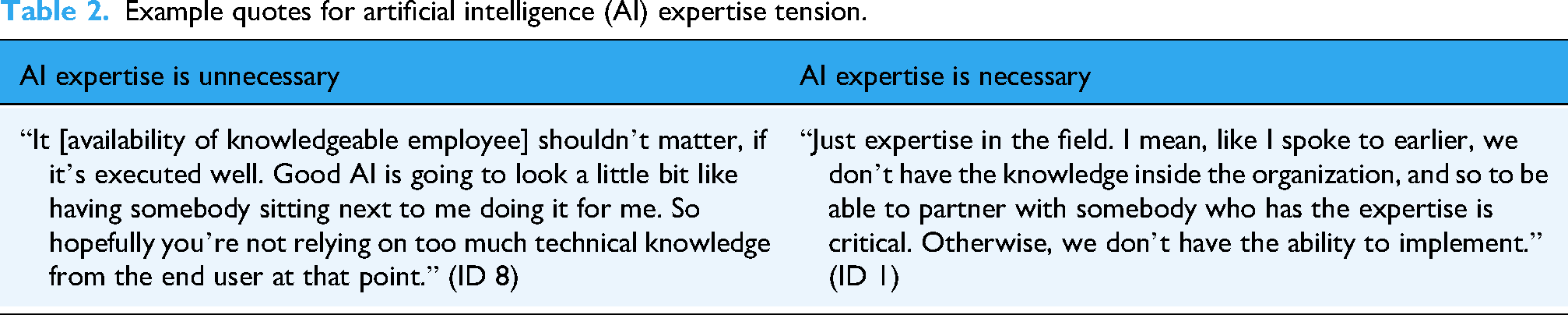
Resource availability (e.g. budget, employees, and data) and organizational structure are influenced by organizational size. To explain the overlapping effect of organizational resources, size, and structure, all of these factors are discussed together in this section. For employees, there was disagreement about the need for AI expertise. This is summarized in Table 2.
Example quotes for artificial intelligence (AI) expertise tension.
Smaller OPOs had both benefits and drawbacks compared to larger OPOs. Smaller OPOs tended to have fewer resources (e.g. budget and employees). However, even medium and large OPOs have budget constraints. OPOs are non-profit organizations that generate revenue based on gifts (i.e. donated organs): Any money we make, any revenue we make, is from the gifts of others. So, we want to be careful that we practice good financial stewardship of that gift. (ID 9)
Therefore, there is an emphasis on good financial stewardship and may be an aversion to taking financial risks. For organizational structure, smaller OPOs tend to have reduced bureaucracy compared to larger OPOs: I think in many ways it [being a small organization] is a blessing, because we don't have as many people to involve as if you were like in a big university hospital that has 7000 employees and layers of management. (ID 5)
For the tension around the need for AI expertise, OPOs disagreed about the importance of staffing AI experts (see Table 2). Some emphasized the importance of having AI-knowledgeable employees or a health informatics team to provide a foundation to adopt AI: So within the organ procurement organizations having a health informatics infrastructure to know how to do this, whether it's 1 person or 2. Most OPO's don't have any. They'll have kind of like an IT person that is playing with the boxes and the wires and things, but then also have a responsibility to do the math, and that's not very effective. (ID 6)
However, the cost for these employees may be prohibitive in small organizations: If it [an AI system] was a labor-intensive thing as well, that'd be something we'd have to consider if it took 5 or 6 or 7 people to run it. We'd have to adjust our staffing costs internally, this would be a pretty big adjustment. (ID 2)
Small OPOs are particularly concerned with staffing costs. Two OPOs felt that there was no need for these professionals. This raises concerns about the implementation of AI in smaller OPOs with fewer employee resources. As AI products develop, more high-quality off-the-shelf products will be available. But investments may be required during the transition period.
In addition to the availability of budget and the opposing visions for AI expertise, concerns regarding data sharing and inconsistency in terminology in the available data were raised. The following statement shows that all OPOs and transplant centers are required to use electronic medical records (EMRs) for consistency, but this requirement is not sufficient for data availability since donor hospitals avoid sharing and transferring this information: There's no requirement that are really currently placed on donor hospitals to upload or share data electronically. We're required to have an EMR. They're required to have an EMR. But there's nothing that says that they transfer data to us electronically. (ID 5)
In addition to data sharing avoidance, there is an inconsistency in technical terminology in the transplant system: I think one of the real problems on a national level is inconsistency in terminology and definitions. So different organizations, both in the OPO world and in the transplant world and in the government world, define a donor differently. (ID 5)
Environmental factors
Competitive pressure
OPO performance is evaluated by CMS metrics to maintain a high donation and transplant rate. This creates competition amongst OPOs because the metrics are used to sort them into tiers (quartiles). OPOs in the top quartile can take over the territory of lower performing OPOs: With the way the new CMS metrics have come out with donation rate and transplant rate and their tier [quartile] system, for that question [asking for naming competitors or benchmarks], the answer is always yes, there are competitors. Because if an OPO is in a tier two [second quartile] or tier three [bottom half] other OPOs or outside entities could apply for their territory. That being said, I think it's important for each individual OPO to drive excellence. (ID 4)
This competitive pressure and relative ranking system may drive AI adoption as each OPO has a desire to out-perform others. AI adoption is more likely when it offers a strategic advantage. This incentive scheme can drive innovation, but there are also concerns about equity implications if some OPOs lack resources for AI adoption.
Government regulations
Government regulations are likely to prevent OPOs from adopting AI systems. All OPOs mentioned that they are required to maintain compliance with regulations such as the Health Insurance Portability & Accountability Act (HIPAA), which includes data privacy, security, and confidentiality: A second influencer from the environment is the medical legal aspects of Protected Health Information, […]. It's tightly regulated, and any kind of effort to hand to utilize that data certainly has to be evaluated against what the limitations and the allowances are for using it by HIPAA. The penalties for HIPAA violations are financially catastrophic in some cases for healthcare organizations. (ID 5)
Even if an AI system offers operational or clinical benefits, the legal and financial vulnerabilities and reputational risks create a barrier for AI adoption. Clear and consistent regulatory guidelines regarding AI use in healthcare need to balance promoting innovation with safeguarding patient confidentiality.
Industry requirements
The conflict between competitive and regulatory forces drives two opposing visions for AI adoption: (1) top-down adoption, where a regulatory agency facilitates all OPOs adopting AI at the same time, and (2) bottom-up adoption, where individual OPOs decide to adopt AI. While five OPOs preferred a top-down approach and three preferred a bottom-up approach, two OPOs identified value in both strategies.
The OPOs that favor a top-down approach expect to face strict regulatory boundaries that prevent the use of AI. This is partly related to concern about violating regulations and potential consequences. However, the need for consistency, unity, and fairness across OPOs is also a driving factor in preferring top-down adoption (see Table 3 for quotes). There is a sense that it is inappropriate to deviate from the traditional process without pre-authorization and without all OPOs implementing a new process at the same time.
Example quotes for the top-down versus bottom-up tension.

However, this approach to technology adoption is at odds with the competitive pressure that is also present. As described in the example quote in Table 3, there is also an expectation for OPOs to pursue innovative strategies to increase their donation and transplant rates. A bottom-up approach where individual OPOs are first adopters is consistent with the five stages of the diffusion of innovation theory46: It is the same thing with everything else. There's going to be the diffusion of innovation curve. My organization would be on the front side of it. There are other organizations that would be on the last part of it, and then most of them will be in the middle. (ID 6)
Collectively, these opposing visions, top-down and bottom-up adoption, demonstrate the tension between regulatory constraints and competitive pressure. While the top-down approach is driven by concerns about equity implications, the bottom-up approach emphasizes innovation to maximize performance.
Customer readiness
Donor families, transplant candidates, and transplant centers are customers for OPOs. Donor families and transplant candidates suffer from the time-consuming allocation process: Sometimes families walk away because they know it's going to take a while. So, if we could improve and speed up the process, I'd be curious to see if that would be impacted as well. (ID 10) The number one customer really is the candidate, the transplant candidate who's waiting. They don't care. They just want to get the organ offer faster. (ID 6)
Improving and speeding up the allocation process can have significant benefits for both donor families and transplant candidates.
However, transplant centers are managing a high volume of work and need AI systems to facilitate processing. Transplant centers do not want AI to be an additional burden: In organ allocation our customers are the transplant centers and their readiness. They are highly over capacity […]. Putting some integrated steps that would benefit them, I'm sure they would appreciate that. But the idea of new implementation into their workflow would be highly stressful. (ID 10)
AI should reduce unnecessary offers and speed up interpreting the valid offers. AI interventions offering a quicker and more effective allocation process are more likely to be adopted.
Discussion
Organ donation and transplantation is a high-stakes industry where missed opportunities contribute to deaths on the waiting list. Consequently, as the transplant industry moves forward with modernization, there is increased interest in AI solutions. We found that OPOs expect AI to improve performance metrics, accelerate the allocation process, and increase match quality in the organ allocation process. There are clear use cases in both the general allocation process as well as less frequent scenarios, such as out-of-sequence allocation.
Overall, we identified five core tensions in AI adoption for organ allocation at OPOs: (1) misconceptions, (2) approach to training, (3) need for AI expertise, (4) impact of small versus large organizations, and (5) top-down versus bottom-up adoption viewpoints. The extended TOE framework is a valuable tool for systematically identifying and surfacing those tensions.
Within the technological context, some of the positive perceptions are driven by misconceptions about what problems AI can and cannot solve. For example, there is interest in surgeon-level predictions, which are technically challenging to achieve,47–48 This existing bias may also result in concerns for medical ethics principles such as fair and equal treatment of patients.22,27
Within organizational factors, the tensions centered around disparities in available resources, especially budget and employee resources, which vary widely based on organizational size. Two of the tensions, approach to training and need for AI expertise, focused on employee resources.23,49 Some OPOs believed that using AI systems requires basic knowledge about AI systems, consistent with prior studies on the need for continuous training.18,22,49 However, others stated that AI should be intuitive and require no training. Ultimately, both perspectives will need to be addressed to streamline the implementation of a change management strategy for introducing AI systems within business operations. For example, while intuitive systems reduce the learning curve, AI literacy training could address concerns about transparency and accountability.22,28,29
This tension is also consistent with concerns about resource allocation and how much needs to be invested in hiring new employees as well as educating existing ones as part of an AI adoption strategy. Smaller OPOs may struggle to develop, maintain, and implement AI systems because they have a smaller budget, fewer employees, and less expertise.50,51 The unclear return on investment for AI systems makes this a high-risk, high-reward decision. While many OPOs take a cautious, conservative approach, a few OPOs showed openness to taking calculated risks when it comes to AI adoption. OPOs with less resources and less appetite for risk may need support from outside organizations to support AI adoption through the development of training materials, maintenance services, and bias auditing.
Within environmental factors, there are competing visions for how AI should be adopted across OPOs nationwide. While some argued that a top-down adoption process ensures compliance with regulatory requirements, others specified that a bottom-up adoption process better addresses the competitive pressure for higher performance levels in each OPO.23 OPOs follow strict rules and regulations to ensure unity, consistency, and fairness in the allocation process. A national level AI adoption strategy supports consistency and aims to eliminate any potential risks that would compromise the allocation systems’ fairness. On the other hand, a bottom-up adoption approach is driven by competitive pressure to achieve high transplant and donation rate metrics. To stay competitive and avoid decertification, OPOs look for strategies to meet or exceed their performance benchmarks. This approach follows the diffusion of innovation curve,52 in which some adopt AI early (early adopters), aiming to improve their performance, and others wait to determine the AI advantages (late adopters). Observing the benefits of AI used by one organization increases the likelihood of adoption. However, market competition typically does not optimize for fairness and equity, which is why there is a role for regulation. Regulators need to design market mechanisms (e.g. the tier-based performance evaluations) to achieve high performance without sacrificing fairness.
Theoretical expansion through emergent codes
While the TOE framework emphasizes contextual enablers of technology adoption, the emergence of AI, particularly in complex and high-stakes domains, necessitates the integration of additional dimensions, including risk perception, governance, and fairness. The underlying mechanism for the observed tensions in the OPO context is existing bias in the historical data, the size of the organization, and regulatory requirements. Misconceptions, uncertainty, and equity concerns are cross-cutting factors that shape organizational decisions yet remain underrepresented in the TOE framework.
Misconceptions present a theoretical challenge within the TOE framework for explaining AI adoption that is driven by both true and false perceived benefits. In the OPO context, some of the negative implications of misconceptions may be alleviated by the strong emphasis on the need for human collaboration, the need for ethical considerations such as transparency, and the need for testing AI systems to discover its effect on the allocation process before full-scale adoption. In addition, this use of a phased implementation with gradual integration and testing may also help mitigate resistance to change and reduce risks.
Concerns about risk and uncertainty were a cross-cutting theme across all three contexts in the TOE framework. Within technological factors, there is uncertainty about the achievable benefits of AI. Within organizational factors, there is variation in risk tolerance across organizations. Within environmental factors, there is high regulatory uncertainty regarding how to treat AI as a tool within the organ allocation system. This heavily influences adoption decisions but is not highlighted as a core part of TOE.
Lastly, concerns about equity and fairness are particularly critical for technology adoption in the healthcare industry. This is more than simply an industry requirement and leads to a core conflict between competitive pressure and government regulations. This is an especially critical factor for AI adoption, which has historically contributed to inequity. 53
Generalizability limitations
While many of these findings likely extend beyond the OPO context, there are four primary limitations. First, the relatively low response rate and the potential lack of representativeness may not reflect other stakeholders’ perspectives in this context. Second, the structured part of the interview may have inadvertently influenced participants’ responses and shaped the direction and the content of their responses. Third, some participants were familiar with the work of our team to develop an AI in the transplant space.1,2 This may have introduced bias and limited generalizability to a broader population that are unfamiliar with these technologies. Lastly, the unique organizational and environmental requirements in the OPO context may limit generalizability to other organizations, even within healthcare.
Policy and practical implications
This study underscores the need for a multi-stakeholder view when implementing AI in a healthcare domain. From a policy perspective, regulations governing AI use may need to extend beyond generic healthcare frameworks to address the unique contextual and operational realities of each clinical domain. Consequently, policymakers could formulate adaptive regulations that incorporate ethical, technical, and operational considerations.
In the OPO context, it would be valuable to have industry standards for addressing algorithmic bias, such as a minimum data volume for model training and validation to ensure reliable and generalizable predictions across a diverse patient population. There is also a need for data governance standards. Establishing a uniform data format, consistent reporting fields, and interoperable data systems makes model development easier and reduces the risk of biased or unreliable predictions.
From an executive and clinical perspective, it is valuable to use a comprehensive framework that integrates technological capabilities with organizational readiness, human expertise, and change-management strategies. Using the TOE framework summarized in Figure 1, OPO leaders can move beyond the technical advantages AI might bring to determine how to effectively develop, implement, and use AI that improves services, customer satisfaction, and quality of life. 54
Conclusion
Using the extended TOE framework, this study highlights five core tensions for AI technology adoption in OPOs: (1) misconceptions, (2) approach to training, (3) need for AI expertise, (4) impact of organization size, and (5) top-down versus bottom-up adoption viewpoints. Collectively, these factors and sources of tension have key implications for investment decisions at the OPO-level as well as rulemaking by regulators. They present both practical and theoretical challenges that need to be addressed to support AI adoption that balances both performance and equity.
This research is also useful for hypothesis generation for future research. Based on the tensions related to training and expertise, there is a need for studies that identify the required level of AI explainability and training for different types of users in different contexts. This can help ensure that training and explainable AI products are not over- or under-built. It would also be valuable to integrate various stakeholders’ perspectives, such as surgeons, patients, and donor families, in this process. This may raise other organizational considerations that should be taken into account in adopting AI.
Supplemental Material
sj-docx-1-dhj-10.1177_20552076261425344 - Supplemental material for Five tensions of artificial intelligence adoption for organ allocation: Applying the technology–organization–environment framework
Supplemental material, sj-docx-1-dhj-10.1177_20552076261425344 for Five tensions of artificial intelligence adoption for organ allocation: Applying the technology–organization–environment framework by Amaneh Babaee, Daniel B Shank, Casey Canfield, Joely Grace Hall, Krista L Lentine, Henry Randall and Mark Schnitzler in DIGITAL HEALTH
Supplemental Material
sj-docx-2-dhj-10.1177_20552076261425344 - Supplemental material for Five tensions of artificial intelligence adoption for organ allocation: Applying the technology–organization–environment framework
Supplemental material, sj-docx-2-dhj-10.1177_20552076261425344 for Five tensions of artificial intelligence adoption for organ allocation: Applying the technology–organization–environment framework by Amaneh Babaee, Daniel B Shank, Casey Canfield, Joely Grace Hall, Krista L Lentine, Henry Randall and Mark Schnitzler in DIGITAL HEALTH
Footnotes
Acknowledgements
The authors gratefully acknowledge all the respondents who participated in this study. We extend our sincere thanks to the support of our larger research team, especially Cihan Dagli, Sid Nadendla, and Brendon Cummiskey. We also appreciate valuable guidance, feedback, and support from the advisory board committee, namely, Kevin Fowler, Gary Marklin, Rawashdeh Badi, Thomas Beje, Harry Wilkins, and David Axelrod, and other transplant and OPO professionals. This work was supported by the National Science Foundation (NSF) under grant numbers 2222801 and 2026324. An earlier version of this manuscript (before peer review) is available in the Missouri University of Science and Technology institutional repository (Scholars’ Mine) as part of a graduate student oral presentation archive.
ORCID iDs
Ethical consideration
The eCompliance Ethics Review Committee at Missouri University of Science and Technology University approved our interviews (approval: 2099248) on November 2023.
Consent to participate
Informed consent was obtained verbally before the start of the interviews.
Author contributions
Amaneh Babaee: conceptualization, methodology, validation, formal analysis, investigation, writing–original draft, and visualization. Daniel B Shank: conceptualization, methodology, writing–review and editing, supervision, and funding acquisition. Casey Canfield: conceptualization, methodology, writing–review and editing, supervision, project administration, and funding acquisition. Joely Grace Hall: validation, formal analysis, investigation, and writing–review and editing. Krista Lentine: writing–review and editing, funding acquisition. Henry Randall: writing–review and editing, and funding acquisition. Mark Schnitzler: writing–review and editing, and funding acquisition.
Funding
The authors disclose receipt of the following financial support for the research, authorship, and/or publication of this article: This work was supported by the National Science Foundation [grant numbers 2222801 and 2026324].
Declaration of conflicting interest
The authors declare the following financial interests/personal relationships which may be considered as potential competing interests: Dr Krista L Lentine is a senior scientist of the Scientific Registry of Transplant Recipients (SRTR), scientific director of the SRTR Living Donor Collective, past chair of the American Society of Transplant (AST) Living Donor Community of Practice (COP), co-chair of the NLDAC Advisory Group, member of the American Society of Nephrology Transplant Committee, and member of the National Kidney Foundation Transplant Advisory Committee. Dr Krista L. Lentine also declares relationships with CareDx Inc., Calliditas Therapeutics US Inc., and Maze Therapeutics Inc. that include consulting or advisory roles, and with Sanofi that includes speaking and lecture fees. Dr Henry Randall reports relationships with Mid-America Transplant and the American Society of Transplant Surgeons that include board membership, and with The Randall Group that includes employment. Dr Mark Schnitzler reports a relationship with CareDx Inc that includes consulting or advisory.
Data availability statement
The data of this study cannot be shared due to confidentiality issues.
Guarantor
CC.
Supplemental material
Supplemental material for this article is available online.
References
Supplementary Material
Please find the following supplemental material available below.
For Open Access articles published under a Creative Commons License, all supplemental material carries the same license as the article it is associated with.
For non-Open Access articles published, all supplemental material carries a non-exclusive license, and permission requests for re-use of supplemental material or any part of supplemental material shall be sent directly to the copyright owner as specified in the copyright notice associated with the article.
