




Abstract
Objectives
Skin cancer represents a significant public health concern, and consistent sunscreen use reduces risk. With social media emerging as a dominant source of health information, unconventional video formats have gained increased prominence. Despite these shifts in health promotion practice, limited research has examined how digital message formats influence health-related beliefs. The objective of this study is to examine how different social media-based message formats (amateur video, professional video, written text, and control) and participant characteristics affect perceptions of skin cancer risk, sunscreen efficacy, and intentions to wear sunscreen to prevent skin cancer.
Methods
A national sample of white US adults (N = 538) were assigned to one of four digital message conditions in an online randomized controlled experiment. Participants completed a fully automated Qualtrics-based survey grounded in the Extended Parallel Process Model (EPPM). EPPM variables, audience perceptions of the message, confidence in identifying signs of skin cancer, and behavioral intentions to wear sunscreen were evaluated through a series of one-way analyses of variance (ANOVAs). Standard multiple regression analysis was used to assess associations between message assignment, demographic characteristics, and EPPM variables.
Results
Both amateur and professionally produced video formats significantly increased participants’ beliefs in sunscreen's effectiveness compared to the control condition. The only significant audience perception differences were higher engagement and lower boredom ratings in the professional video condition compared to the amateur video and text-only conditions. Demographic variables including sex, generation, skin sensitivity, and education were significantly associated with differences in perceived threat and efficacy.
Conclusion
Findings indicate that both amateur and professional video-based social media messages can effectively promote sun safety. Public health campaigns aiming to reduce skin cancer risk may be strengthened by incorporating varied digital message formats and tailoring content to key demographic characteristics of the target audience.
Keywords
Introduction
Skin cancer in the USA
Skin cancer remains one of the most prevalent malignancies in the USA. Non-melanoma skin cancers (NMSCs) and melanoma represent a major public health concern for millions of Americans. The USA has among the highest global incidence rates of NMSC, 1 with treatment costs estimated at $650 million annually. 2 NMSCs are the most frequently diagnosed malignancies among white populations.3,4 Although less common, melanoma accounts for most skin cancer deaths in the USA, with over 100,600 new melanoma cases estimated in 2024. 5 White individuals experience disproportionately higher melanoma mortality rates compared to all other racial or ethnic groups. 6
Given this substantial disease burden, it is critical to develop and disseminate effective risk-reduction messages. Since the clinical presentation and outcomes of skin cancer vary across racial and ethnic groups, 7 prevention and detection messaging must be culturally and demographically tailored. This study examines the effects of skin cancer prevention messaging tailored to white US audiences, who represent the demographic most susceptible to skin cancer.
Audience perceptions and message effectiveness
The increasing popularity of social media platforms allows anyone to post and share health-related information, raising concerns about the accuracy and quality of such content. 8 The effectiveness of online health information depends on several factors. Audience perceptions of message believability (credibility, trustworthiness, reliability, and accuracy) shape how audiences judge, accept, share, or act on the information provided.9,10,11 Long-term effectiveness is also shaped by how personally relevant and engaging the message feels to the audience. 12 Messages that are perceived as boring tend to reduce attention while engaging and relatable messages may increase attention. 13
These perceptions are influenced by additional variables such as differing effective communication styles across various social media platforms, message framing (e.g., gain versus loss), perceived expertise of the messenger or legitimacy of the content source, social endorsement cues (e.g., comments or “likes”), appeal type (e.g., ethos, logos, or pathos), and the presence or absence of corrective or corroborating information.14,15,16,17,18 However, limited research has examined how the presentation format of the message itself influences credibility, personal relevancy, and engagement, independent of message content.
Shifting health promotion practices
Traditional health communication channels, such as print media, radio, and television, are increasingly being supplanted by digital and online media. The widespread availability of internet access, proliferation of mobile devices, and rise of social media platforms has transformed public health professionals’ opportunities to disseminate health messages to audiences. Moreover, most users keep their mobile device within arm's reach, enabling continuous access to health messaging. 19
However, this evolving landscape also presents challenges, including the spread of health misinformation and difficulty of engaging all demographic groups.20,21 Social media platforms differ widely in user demographics, message formats, and reliability of health-related content. 22 A systematic review indicates persistent gaps in audience segmentation strategies in addition to evaluating social media's impact in health promotion and behavior change. 23
The diffusion of mobile devices has also shifted health media production norms. Amateur “selfie-style” videos, which were once deemed unprofessional, are now commonplace in digital health promotion. This vertical video format was historically considered aesthetically displeasing due to black sidebars and deviation from the way humans naturally view the world in a horizontal panorama. 24 These evolving standards are relevant for public health communication, as audiences may evaluate message credibility and engagement differently depending on production quality and style.
A recent systematic review of digital interventions for sun safety over a 20-year period found that most digital approaches were at least as effective as traditional, non-digital strategies. 25 However, only seven of the studies utilized video-based messages, and none directly compared the effects of user-generated amateur videos with professionally produced videos.
Study aims
The first aim of this study is to explore how message format (professionally produced video, user-generated mobile video, and written message) affects perceptions of skin cancer risk, sunscreen efficacy, and intentions to use sunscreen to prevent skin cancer. Sunscreen use was selected as the behavioral intention variable of interest, as it is a sun protection behavior that is sensitive to sun protection messaging. 26 Professional videos are defined as those created using high-resolution cameras in horizontal orientation, and produced using professional lighting, editing software, and visual design techniques. These videos incorporate elements of signaling, content segmentation, narrative framing, and audiovisual design such as camera placement and angle principles, narrator positioning, music, graphics, and transitions. 27 The amateur video is defined as filmed by a user with only a mobile device, in vertical orientation, with minimal or no post-production editing. It is hypothesized that exposure to the professional video will lead to higher perceived efficacy of sunscreen in preventing skin cancer compared with the amateur video and text-only conditions.
The second aim is to compare audience perceptions of credibility, personal relevancy, and engagement across message formats. It is hypothesized that the professional video will be rated higher on attributes of credibility and engagement, whereas amateur videos will be perceived as more personally relevant. Both video conditions are expected to outperform the text-only condition.
Recognizing that message tactics often interact with personal factors to determine behavioral intentions, 28 the third aim is to explore how demographic characteristics, in conjunction with message condition, influence perceptions of skin cancer risk, sunscreen efficacy, and behavioral intentions to apply sunscreen. It is hypothesized that males, individuals with lower education levels, and individuals who rarely burn will have lower perceptions of skin cancer risk. Females, those with higher educational attainment, and those viewing the professional message are expected to report higher perceptions of sunscreen efficacy.
Materials and methods
Video creation and pilot survey
A standardized health message on identifying and preventing skin cancer was adapted from materials published by the Centers for Disease Control and Prevention.29,30 The identical script was used across all three experimental message conditions (amateur video, professional video, and text-only) to ensure message consistency across formats (Supplementary Material 1, videos available upon request). In the video conditions, the same actor delivered the script in both professional and amateur production formats, while in the text-only condition, the message was presented as written paragraphs. A fourth group received no message, serving as a control condition.
The professional video was produced in collaboration with a commercial film company and featured high-definition visuals captured using professional-grade equipment and studio lighting. The composition followed conventional framing techniques, and the audio quality was optimized using professional microphones to minimize unwanted background noise. The final video included post-production enhancements such as a video title, graphics, on-screen text, transitions, and background music. The amateur video was filmed on a smartphone in a vertical orientation. It featured only the narrator's face and did not incorporate professional elements.
Both videos were pilot tested on a convenience sample recruited via social media platforms (N = 97). Pilot survey participants were aged between 18–35 (38.7%), 36–50 (30.1%), 51–65 (19.4%), and 66 or older (11.8%). 94.6% identified as white/Caucasian. All participants viewed both the professional and amateur videos and were subsequently asked to rate elements of the perceived production quality of each (e.g., video clarity, sound clarity, music, and text). All individuals who completed the survey (N = 93) either agreed or strongly agreed the professional video contained all the characteristics of a professionally produced message.
Survey development
An online randomized controlled experiment with four parallel arms (amateur video, professional video, text, and control) was delivered online via the Qualtrics platform. Study procedures and reporting followed recommendations from the CONSORT-EHEALTH guidelines. 31 The survey included demographic items, randomization into one of the four message conditions, and follow-up questions related to skin cancer threat, sunscreen efficacy, audience perceptions of the message, confidence in identifying signs of skin cancer, and behavioral intentions to wear sunscreen (Supplementary Material 1). Demographic items were adapted from previous sun safety research and included sex, ethnicity, household income, education level, generational cohort, recent sunscreen history, and skin sensitivity.32,33,34
Perceptions of threat and efficacy were assessed using constructs from the Extended Parallel Process Model (EPPM). 35 In alignment with the model, threat of skin cancer was operationalized through two components: perceived severity (beliefs about the seriousness of skin cancer) and perceived susceptibility (beliefs about the likelihood of developing skin cancer). Efficacy was similarly assessed through two components: perceived self-efficacy (confidence in one's ability to engage in sunscreen use) and perceived response efficacy (beliefs about the effectiveness of sunscreen application in reducing skin cancer risk).
Following random assignment to one of the four experimental conditions, participants were asked to score a series of EPPM statements. Each item was measured on a 5-point Likert scale ranging from 1 (strongly disagree) to 5 (strongly agree). Theory items were adapted from the Risk Behavior Diagnostic (RBD) Scale, which has demonstrated good reliability and validity and is regularly used in online surveys. 36 Items included “I am at risk for skin cancer” (susceptibility), “Skin cancer is serious” (severity), “Using sunscreen consistently will reduce my risk of getting skin cancer” (response efficacy), “I am able to use sunscreen consistently” (self-efficacy), and “Next time I am out in the sun, I plan to wear sunscreen” (behavioral intentions). According to the EPPM, individuals who do not perceive a significant threat are unlikely to engage in protective behaviors, regardless of efficacy beliefs. If the threat perception is high but efficacy is low, individuals may engage in a fear control response such as denial or defensive avoidance. High levels of both perceived threat and perceived efficacy promote danger control responses, leading to behavior change. 37 This theoretical framework guided survey design and interpretation of participant's risk and efficacy beliefs.
Participants then completed a series of questions assessing audience message perception variables. These items consisted of statements evaluating participants’ beliefs about the message to which they were assigned. Respondents indicated their level of agreement with each statement on a Likert scale ranging from 1 (strongly disagree) to 5 (strongly agree). Statements related to message credibility were based on an online messaging credibility framework.38,39 Items included: “I believe the information was credible,” “I believe the information was reliable,” “I believe the person or source providing the information was trustworthy,” and “I believe the information was accurate.” An item related to personal relevance included, “The information given was personally relevant to me.” Statements related to message engagement included: “The delivery of the information was engaging,” and “The message was boring.” An item assessing changes in confidence was also included, “I feel more confident that I can identify the signs of skin cancer.”
Survey administration and analysis
This study was approved by the Institutional Review Board (IRB) at a university in the Mountain West region of the USA. Both the pilot and online surveys included a written informed consent statement with an option to participate or decline. Only participants who provided consent proceeded to eligibility screening questions, demographic items, random assignment to one of four message conditions, and subsequent follow-up questions related to the EPPM, perceptions of the message, confidence in identifying signs of skin cancer, and intentions to wear sunscreen. To achieve a balanced distribution across conditions, sex and generation (Baby Boomer: born 1946–1964, Gen X: born 1965–1980, Millennial: born 1981–1996, and Gen Z: born 1997–2012) were nested in quotas. The survey was optimized within the Qualtrics platform using ExpertReview. All recommendations of the digital review were resolved until the survey received a score of 100% for both personal computer and mobile viewing. The survey was fully automated.
Following completion of screening and demographic items, randomization into one of the four message conditions was implemented using the Qualtrics randomizer function. The Qualtrics system assigned all conditions; the reasearchers did not manually assign any participants. Participants were blinded to the message conditions in the study and were not aware of the format of their assigned condition until message viewing. Each of the messages was embedded within the Qualtrics survey which served as a hosting platform for the video and text conditions. Messages included: professional video (run time 1:14), amateur video (run time 1:08), text-only (written video script), or a control condition that contained no message. Duration filters ensured ≥1 min exposure to the experimental condition. Participants who did not meet the minimum viewing or reading time requirements were excluded from the final analysis. After viewing or reading the assigned message, participants advanced to survey follow-up questions. Three attention-check questions were embedded throughout the survey, and participants who incorrectly answered any of the three questions were excluded from the final analysis.
A national sample was recruited by a third-party data collection company (Qualtrics Online Sample, Provo, UT, USA) via email in May 2024. The company targeted respondents who reported being at least 18 years old, white, and residing in the USA. Eligibility also included having internet access and basic computer literacy. Of the 2328 individuals who accessed the survey link, 1691 provided informed consent and began the survey. Participants who were under the age of 18 (N = 139), resided outside the USA (N = 6), or self-identified with a race other than white (N = 273) did not meet study inclusion criteria. A data filter was implemented to include only participants who passed all quality control measures (duration filters, attention questions, and completion of all survey items). The final analytic sample consisted of 538 participants, surpassing minimum sample size requirements for a four-armed trail at 95% confidence as calculated in G*Power 3.1. Figure 1 shows the total number of participants during enrollment, randomization, analysis, and exclusion stages. Participants received nominal compensation (<4 USD) for completing the survey. No adverse events or technical issues were reported, and no modifications were made to videos or survey content during data collection.

CONSORT flow diagram.
All statistical analyses were conducted using SPSS Statistics. Frequencies and percentages were calculated for demographic variables across each message condition using cross-tabulation. Pearson's chi-square was performed to assess sampling distribution across conditions. To address the first and second aims, a series of one-way analyses of variance (ANOVAs) were conducted to examine differences in message conditions as the independent variable, and EPPM-related perceptions and audience perceptions of the assigned message as outcome variables, retained as a 1–5 Likert scale, with Tukey's post hoc test used to probe significant effects.
The third study aim was assessed using a series of standard multiple linear regressions, with message conditions and demographic characteristics (sex, generation, skin sensitivity, sunburn history, and education level) serving as independent variables. Employment status, income, and ethnicity were excluded due to multicollinearity or insufficient sample size. Non-significant predictors were dropped from the multivariate models. Outcome variables included perceived susceptibility, severity, self-efficacy, response efficacy, and behavioral intentions retained as a 1–5 Likert scale.
Results
Participant characteristics and sampling distribution
Pearson's chi-square indicated no significant differences in sampling distribution for any demographic variable across the four message conditions (Table 1). Fitzpatrick skin type was consolidated into three categories to ensure adequate sample size: usually or always burns (types 1–2), sometimes burns and sometimes tans (type 3), and rarely or never burns (types 4–6). 43.3% of participants reported experiencing at least one sunburn within the past three months. 35.1% of participants classified themselves as being skin type 1 or 2. 34.2% reported being type 3. 30.7% reported being type 4, 5, or 6.
Participant demographics and chi-square.

ANOVA results
The first study aim examined whether message condition influenced participants responses to EPPM items. Table 2 presents the means and standard deviations for all EPPM variables and audience message perception variables across message conditions. Statistically significant differences were found across message conditions for most EPPM variables, but not for behavioral intentions.
Means, standard deviations, and ANOVA results.
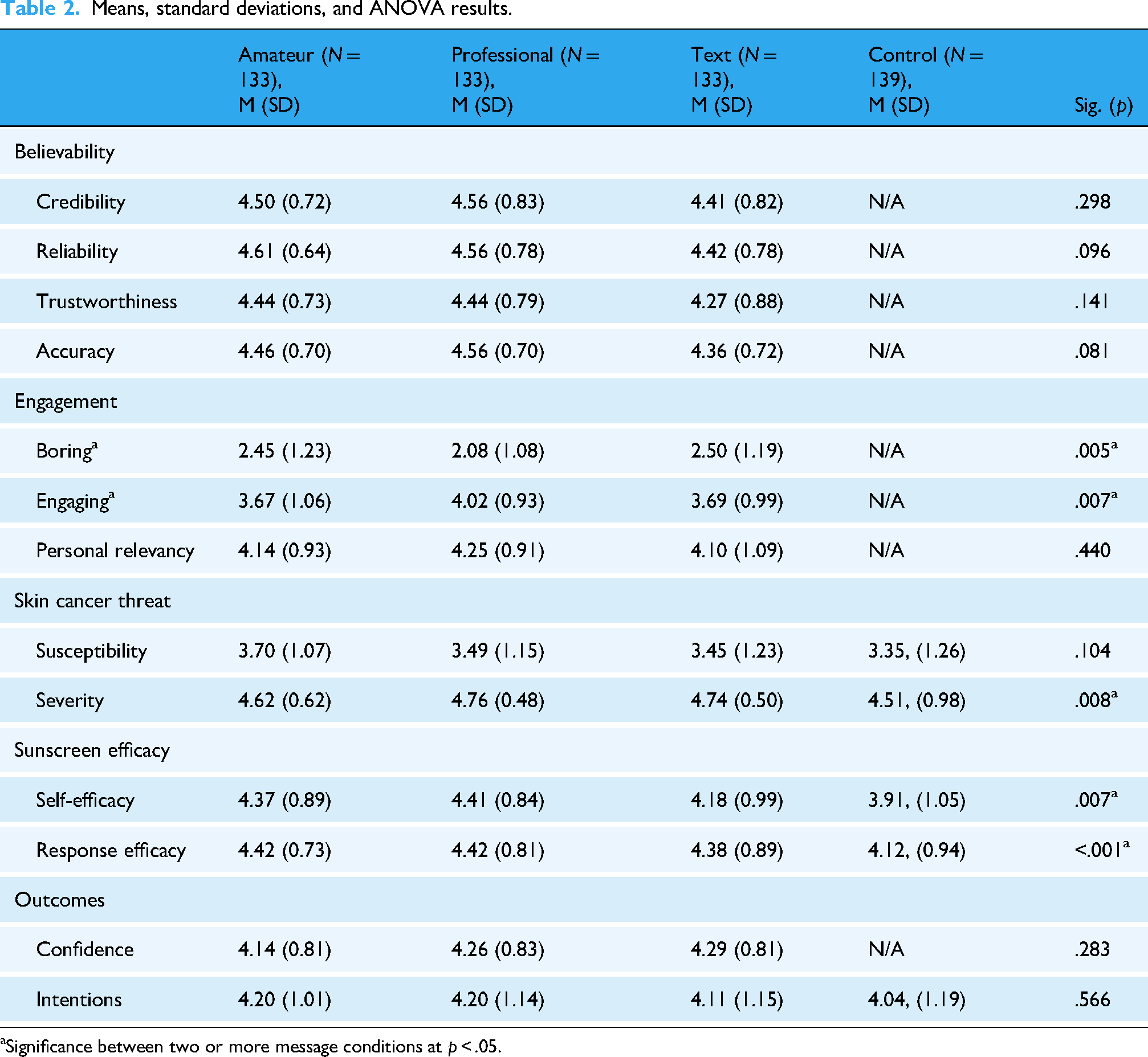
Significance between two or more message conditions at p < .05.
One-way ANOVA results revealed significant differences in perceived severity, F(3, 534) = 3.97, p = .008. Tukey's post-hoc multiple comparisons indicated that participants in the professional video condition, p = .014, 95% CI = [0.04, 0.46] and written text condition, p = .025, 95% CI = [0.02, 0.45] reported significantly higher severity perceptions than those in the control group. No significant differences were found for perceived susceptibility to skin cancer, F(3, 534) = 2.07, p = .104, although the amateur and control conditions approached significance, p = .074, 95% CI = [−0.02, 0.72].
Response efficacy varied significantly by condition, F(3, 534) = 7.95, p < .001. Participants in the amateur video condition, p < .001, 95% CI = [0.17, 0.76] and professional video condition, p < .001, 95% CI = [0.20, 0.80] reported higher perceptions of sunscreen's effectiveness than those in the control condition. The difference between the written message and control condition approached significance, p = .068, 95% CI = [−0.01, 0.58].
Significant differences were found for self-efficacy, F(3, 534) = 4.12, p = .007. Participants in both the amateur video and professional video conditions reported significantly higher self-efficacy compared to the control, p = .016 for both, 95% CI = [0.04, 0.57]. The difference in self-efficacy between the written text and control group approached significance, p = .056, 95% CI = [0.00, 0.53]. No significant differences were observed between message groups for behavioral intentions to wear sunscreen, F(3, 534) = .678, p = .566.
The second aim explored whether audience perception variables differed across the three experimental message formats. There were no significant differences at p < .05 between any of the message conditions for perceptions of messenger credibility (F(2, 396) = [1.22], p = .298), reliability (F(2, 396) = [2.36], p = .096), personal relevancy (F(2, 396 = [0.82], p = .440), trustworthiness (F(2, 396) = [1.97], p = .141), accuracy (F(2, 396) = [2.54], p = .081), or confidence in identifying signs of skin cancer (F(2, 396) = [1.13], p = .283).
Results from one-way ANOVA showed that perceptions of the message being boring (F(2, 396) = [5.33], p = .005) and engaging (F(2, 396) = [5.01] p = .007) varied significantly across message conditions. Tukey's post-hoc multiple comparisons showed that those in the professional video condition found the video to be significantly less boring than those in the amateur video condition (p = .024, 95% CI = [0.04, 0.71]) and those in the text only condition (p = .008, 95% CI = [0.09, 0.77]). There were no significant differences in perceptions of the message being boring between the amateur video and text only conditions (p = .928, 95% CI = [−0.39, 0.28]). Similarly, Tukey's post hoc test found the professional video to be significantly more engaging than both the amateur video (p = .14, 95% CI = [0.06, 0.63]) and the text only conditions (p = .023, 95% CI = [0.04, 0.61]). There were no significant differences in engagement between the amateur video and text conditions (p = .981, 95% CI = [−0.27, 0.31]).
Regression results
The third aim examined how participant characteristics, in tandem with message assignment, influenced EPPM variables and intentions to wear sunscreen. Table 3 provides results of multiple regression analyses. Five predictors contributed significantly to the perceived susceptibility model, including sex, amateur video format, generation, skin sensitivity, and education. The overall model was statistically significant, R2adj = .141, F(5, 530) = 18.49, p < .01, with generation and skin sensitivity being the strongest predictors. Participants who were female, older generational cohorts, viewed the amateur video, and reported higher skin sensitivity and education levels were more likely to perceive themselves at risk for skin cancer. Generation and skin sensitivity were significant predictors of perceived severity, R2adj = .025, F(2, 535) = 7.69 p < .01. Being in an older generational cohort was the stronger predictor. Older participants and those with greater skin sensitivity were more likely to perceive skin cancer as a serious health threat.
Multiple regression results.
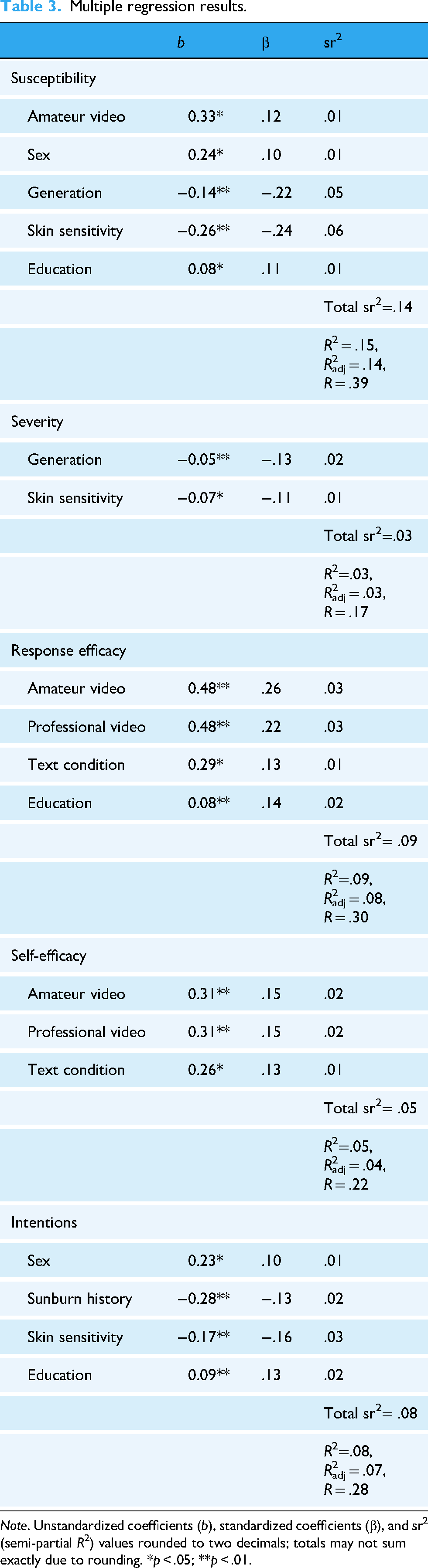
Note. Unstandardized coefficients (b), standardized coefficients (β), and sr2 (semi-partial R2) values rounded to two decimals; totals may not sum exactly due to rounding. *p < .05; **p < .01.
Message conditions and education level contributed significantly to perceived response efficacy, R2adj = .054, F(4, 531) = 8.7, p < .01. All message conditions contributed to the model, with participants in any of the experimental message conditions reporting higher response efficacy compared to those in the control group. Additionally, participants with higher education demonstrated greater beliefs of the effectiveness of sunscreen as a preventive measure. For perceived self-efficacy, all message conditions significantly contributed to the model, R2adj = .017, F(3, 534) = 4.13, p < .01. Participants exposed to any of the experimental messages reported higher confidence in consistently using sunscreen compared to the control group.
Sex, sunburn history, skin sensitivity, and education were significant predictors of behavioral intentions to wear sunscreen, R2adj = .067, F(4, 531) = 10.65, p < .01. Skin sensitivity was the strongest predictor. Higher behavioral intentions were associated with being female, a recent history of sunburn, greater skin sensitivity, and higher educational attainment.
Discussion
Message format
Findings from this study suggest that professional video content may be more effective than amateur videos in increasing perceived severity of skin cancer, agreeing with previous assumptions that higher production quality enhances message effectiveness. 40 However, those in the amateur video condition had higher perceptions of skin cancer susceptibility. A possible explanation is that the amateur video, despite its lower production quality, may have appeared more relatable and authentic with skin cancer risk messaging appearing to come from an everyday person. However, severity and susceptibility perceptions were not statistically significant between the two video messages in the ANOVA analysis, and mixed results require further research to determine the effect of video production quality in relation to the rise of public distrust of information that appears to come from professional sources such as public health experts, physicians, and scientists. 41 Health promotion practitioners could consider leveraging a combination of low-cost, user-generated-style videos along with professional videos to target audiences, potentially reducing skepticism associated with polished, promotional content.
All message formats (amateur video, professional video, and written text) significantly improved perceptions of sunscreen efficacy compared to the control group. This suggests that even brief, single-exposure messages can positively influence beliefs about sunscreen's protective benefits, regardless of the format. Video-based messages were more effective than written content, reinforcing prior evidence supporting video as a preferred medium for conveying sun safety information,33,42 although it contrasts with other prior research. 43
Despite positive shifts in efficacy beliefs, no significant differences in sunscreen use intentions were observed across message formats, suggesting that improved efficacy alone is insufficient to drive behavior change. Practitioners should consider incorporating strategies that more effectively increase perceived risk and address behavioral barriers (e.g., forgetfulness, cost, and social norms) to strengthen the impact of messaging.
Contrary to expectations, few differences emerged in audience perception variables across the three experimental message conditions. The only statistically significant differences were observed for engagement and boredom. The professional video, characterized by its use of music, on-screen text, visuals, and transitions, likely enhanced engagement by capturing and sustaining participants’ attention more effectively than the other formats. However, this increased engagement did not consistently lead to higher threat or efficacy perceptions, nor increase confidence in identifying signs of skin cancer or intentions to wear sunscreen, among viewers of the professional video.
It is notable that mean ratings of credibility, reliability, accuracy, trustworthiness, personal relevancy, and intentions to wear sunscreen were higher for both video conditions compared to the text-only condition, with one exception of mean engagement ratings being negligibly higher for the text-only condition compared to the amateur video condition. Although the differences were not statistically significant, higher mean ratings suggest that both video formats may be perceived as superior compared to the text-only format regarding message credibility, personal relevance, and engagement.
Message format and demographic characteristics
Message format is only one important determinant of effective health communication. Study results showed differences in intentions to use sunscreen to prevent skin cancer among various demographic subgroups. These findings point to the need to examine barriers and enablers to skin cancer risk perceptions and sunscreen use among white subpopulations in the USA, including groups with lower perceived skin cancer susceptibility perceptions and reduced intentions to use sunscreen, such as younger generations, men, those with lower education levels, and individuals who rarely burn.
Study results found that participants in older generations reported higher perceived skin cancer risk. These results are supported by a study that found awareness of skin cancer, prevention strategies, and consistent sunscreen use increased with age, peaking in the 40–59 age group. 44 Prior studies found that specific message framing may resonate more strongly with certain ages; for instance, appearance-based messaging has shown greater impact among adolescents compared to health-based messages. 45 Message framing strategies to promote sunscreen use for generational subgroups is an area for further research.
Women were more likely to perceive higher skin cancer risk in this study, which is consistent with prior literature on gender differences in preventive health behavior, 46 although some studies note that for certain health issues, women may underestimate their vulnerability. 47 Prior studies also suggest women are more likely to engage in tanning behavior. 48 Since skin cancer prevention behaviors may coexist with riskier behaviors, further research is needed to determine effective messaging strategies to increase sunscreen use while simultaneously reducing tanning behavior among white women. Furthermore, prior studies suggest masculine social norms that are barriers to sunscreen use may need to be addressed to increase sunscreen use among males. 49
Individuals with higher education levels tended to have higher perceived skin cancer susceptibility, greater confidence in sunscreen's effectiveness in preventing skin cancer, and increased intentions to wear sunscreen. This is supported by prior studies that found individuals with higher education levels tend to have greater awareness and knowledge of skin cancer risks.44,50 Individuals with sun-sensitive skin were more likely to perceive skin cancer as serious and likely to personally occur, aligning with evidence that certain skin types are at elevated risk of developing skin cancer.51,52 This suggests a need for additional research to determine effective ways to increase perceived severity and susceptibility perceptions for individuals who do not burn easily and may underestimate their risk to motivate preventive action.
Exposure to any of the three message formats, especially video formats, enhanced participants confidence in their ability to consistently use sunscreen and beliefs about sunscreen's effectiveness in preventing skin cancer. This suggests that short-form video messages can build efficacy for sunscreen use to prevent skin cancer. However, message condition did not significantly impact behavioral intentions in a single view. Prior studies suggest internet-based behavior change interventions have a small but significant impact on health behavior, 53 and that repeated exposure to health promotion messages can enhance behavioral intentions over time. 54 Practitioners should design campaigns around repeated exposures.
Stronger behavioral intentions were associated with being female, higher education levels, history of recent sunburn, and sensitive skin. These findings are consistent with prior studies indicating women are more likely to engage in preventive sunscreen use, 55 and that a higher percentage of women use sunscreen regularly. 56 Regardless, both sexes demonstrate relatively low rates of consistent sunscreen use. 57 Results also align with studies suggesting education is linked to more consistent preventive behaviors,48,50 reinforcing the importance of skin cancer prevention campaigns among those with lower education levels. Since individuals with sun-sensitive skin tend to use sunscreen more regularly,48,57 those who rarely burn may benefit from messaging to increase perceptions of skin cancer risks.
Limitations and future research
The study's online experimental design allowed for controlled comparisons of message formats but also introduced several limitations. First, participants’ intentions were measured in a hypothetical context rather than actual decision-making situations. Future studies could incorporate behavioral measures or field-based interventions to better assess real-world effects. Second, the effectiveness of health communication is shaped by numerous contextual and psychological factors. Future research should examine additional audience perception constructs particularly relevant to amateur videos, such as perceived authenticity, potential susceptibility to misinformation, and whether audiences view such videos as evidence based.
Third, the sample was restricted to white participants because the messages reflected typical skin cancer presentation among this demographic, limiting generalizability to more racially diverse populations. Although skin cancer is more prevalent among white individuals, prior research indicates that it can present differently and is often diagnosed at later stages and carries a worse prognosis among individuals with darker skin tones.58,59 These disparities may stem at least partially from lower perceptions of skin cancer susceptibility among individuals with darker skin. 50 Furthermore, research suggests that race influences perceived credibility in health-related messaging 60 and that racially targeted messages can enhance perceived personal relevance. 61 Future research should therefore explore how message format and tailoring strategies function across racial and ethnic groups, and how sunscreen messaging can be optimized for diverse populations with varying perceptions of skin cancer risk and presentation.
Future studies should examine if there are possible differences in takeaway messages or platform effects for amateur and professional videos (e.g., YouTube, Facebook, Instagram, and TikTok). Another limitation is that the present study primarily emphasized efficacy of sunscreen use, with less focus on skin cancer threat. Incorporating higher-threat or fear-based messages may more effectively motivate behavioral change, particularly when coupled with efficacy information. Replicating the experiment across other preventive health contexts or in real-world decision-making could help clarify the broader impact of digital message formats on both risk perceptions and preventive behaviors. Finally, although this study focused on using sunscreen to prevent skin cancer, future research should investigate practical barriers to sunscreen use to inform targeted, evidence-based communication strategies that reduce audience-perceived obstacles and enhance consistent protective behavior.
Conclusion
Results of the study suggest that short, single-view videos may effectively increase audience efficacy perceptions regarding sunscreen use to prevent skin cancer. While the intervention did not increase behavioral intentions, repeated exposure to health promotion messages can enhance behavioral intentions over time. Practitioners may consider developing low-cost user-generated videos in their campaigns, while being mindful of maintaining audience engagement. Disparities in skin cancer risk perceptions, sunscreen efficacy perceptions, or intentions to wear sunscreen were found for young people, males, those with low education levels, and those who tan easily. Future research should investigate practical barriers to sunscreen use to inform targeted, evidence-based communication strategies that reduce audience-perceived obstacles and enhance consistent protective behavior.
Supplemental Material
sj-docx-1-dhj-10.1177_20552076261415919 - Supplemental material for The role of social media message design and audience demographics in promoting sunscreen use to prevent skin cancer: An online randomized controlled experiment
Supplemental material, sj-docx-1-dhj-10.1177_20552076261415919 for The role of social media message design and audience demographics in promoting sunscreen use to prevent skin cancer: An online randomized controlled experiment by Sarah M. Hall, David Morin, Joshua B. Hall and Alisha H. Redelfs in DIGITAL HEALTH
Supplemental Material
sj-docx-2-dhj-10.1177_20552076261415919 - Supplemental material for The role of social media message design and audience demographics in promoting sunscreen use to prevent skin cancer: An online randomized controlled experiment
Supplemental material, sj-docx-2-dhj-10.1177_20552076261415919 for The role of social media message design and audience demographics in promoting sunscreen use to prevent skin cancer: An online randomized controlled experiment by Sarah M. Hall, David Morin, Joshua B. Hall and Alisha H. Redelfs in DIGITAL HEALTH
Footnotes
Acknowledgements
We would like to acknowledge Brigham Young University and Utah Valley University for funding this project.

Ethical approval
IRB approval was obtained for this study through Utah Valley University.
Author contributions
Sarah M. Hall contributed to conceptualization, methodology, investigation, data curation, formal analysis, visualization, writing–original draft, writing–review and editing, software, supervision, project administration, and funding acquisition; David Morin contributed to data curation, formal analysis, and writing–review and editing; Joshua B. Hall contributed to conceptualization, methodology, investigation, and writing–review and editing; Alisha H. Redelfs contributed to visualization, validation, and writing–review and editing.
Funding
The authors disclosed receipt of the following financial support for the research, authorship, and/or publication of this article: this study was funded by Brigham Young University and Utah Valley University.
Declaration of Conflicting Interests
The authors declared no potential conflicts of interest with respect to the research, authorship, and/or publication of this article.
Supplemental material
Supplemental material for this article is available online.
References
Supplementary Material
Please find the following supplemental material available below.
For Open Access articles published under a Creative Commons License, all supplemental material carries the same license as the article it is associated with.
For non-Open Access articles published, all supplemental material carries a non-exclusive license, and permission requests for re-use of supplemental material or any part of supplemental material shall be sent directly to the copyright owner as specified in the copyright notice associated with the article.
