




Abstract
Introduction
Sexual and reproductive health (SRH) services remain inaccessible for many young adults in low-resource settings. Mobile health (mHealth) technologies present an innovative solution, yet adoption rates among university students in sub-Saharan Africa are poorly characterized. This study investigated the knowledge, utilization patterns, and key determinants of mHealth adoption for SRH services among Ghanaian university students using established behavioral frameworks.
Methods
We conducted a cross-sectional study of 390 undergraduates at Kwame Nkrumah University of Science and Technology, selected through multistage sampling across six residence halls. A validated questionnaire, incorporating constructs from the Unified Theory of Acceptance and Use of Technology and Health Belief Model, assessed: (1) mHealth knowledge, (2) SRH service utilization, and (3) psychosocial determinants of adoption. Confirmatory factor analysis validated measurement scales, while hierarchical regression analyzed predictors across three models (demographic, behavioral, and interaction terms).
Results
The study revealed three key findings: First, while 73.8% of respondents demonstrated mHealth awareness, actual usage for SRH remained low (mean = 3.40/7, SD = 1.83). Second, performance expectancy (β = 0.345, p < 0.001) and life quality improvements (β = 0.197, p < 0.05) significantly predicted adoption. Third, substantial barriers included social stigma (β = −0.210, p = 0.016), resistance to technology adoption (β = −0.221, p = 0.001), and privacy concerns (β = −0.208, p = 0.004). Notably, perceived health threats did not moderate the relationship between performance expectations and usage (p = 0.488).
Conclusions
This study highlights a critical gap between awareness and actual use of mHealth for SRH among Ghanaian university students. It identifies key barriers—such as perceived usefulness, privacy concerns, and behavioral resistance—and reveals how sociocultural norms influence youth engagement with digital health tools. The findings underscore the need for culturally sensitive, trust-based mHealth initiatives that strengthen digital literacy and promote behavioral change. Such approaches could enhance youth-focused mHealth strategies in Ghana and offer valuable lessons for similar contexts across sub-Saharan Africa.
Keywords
Introduction
Sexual and reproductive health (SRH) remains a critical public health challenge for young adults globally, particularly in low- and middle-income countries (LMICs) where access to quality healthcare services is often limited.1,2 Adolescents and young adults aged 15–24 account for nearly half of all new sexually transmitted infections (STIs) worldwide, and unintended pregnancy rates in this demographic remain alarmingly high, contributing to maternal morbidity and unsafe abortions. 3 In sub-Saharan Africa, where cultural and structural barriers further restrict SRH education and services, young people face disproportionate risks, including Human Immune Virus (HIV) acquisition, early pregnancies, and gender-based violence. 4 Despite these challenges, traditional healthcare systems often fail to meet the SRH needs of young adults due to stigma, cost, and lack of youth-friendly services. 5
Sexual and reproductive health challenges remain a significant public health concern among young people in Ghana, characterized by high rates of adolescent pregnancies, STIs, and low contraceptive use.6,7 According to the 2022 Ghana Demographic and Health Survey, about 14% of adolescent girls aged 15–19 have begun childbearing, with a greater prevalence in rural than urban areas. 8 Youth aged 15–24 years make up about one-third of new HIV cases in the country, highlighting ongoing gaps in sexual health education and prevention services. Additionally, the use of modern contraceptives among sexually active unmarried women aged 15–24 remains low, around 43%, 9 due to barriers such as stigma, limited access to youth-friendly SRH services, and misconceptions about contraceptive side effects. 7 These statistics highlight the continued burden of SRH challenges among Ghanaian youth and emphasize the need for targeted, youth-centered interventions to improve access to comprehensive SRH information and services.
Mobile health (mHealth) technologies have emerged as a promising solution to bridge these gaps by providing discreet, accessible, and cost-effective SRH information and services.10,11 Defined as the use of mobile devices—such as smartphones, tablets, and SMS platforms—to support healthcare delivery, mHealth has gained traction in LMICs due to widespread mobile phone penetration. 12 In Ghana, where mobile subscription rates exceed 80%, mHealth initiatives like the Mobile Midwife program have demonstrated success in improving maternal health outcomes.13,14 However, most existing interventions target older populations, leaving young adults—particularly university students—underserved despite their high mobile usage and SRH risks. 11
University students represent a unique at-risk group due to their transitional independence, increased sexual activity, and exposure to peer influences. 15 Studies in Ghana reveal that though university students are sexually active, contraceptive use remains low.16,17 While students are often assumed to be digitally literate and thus ideal candidates for mHealth adoption, evidence suggests that awareness does not always translate into usage.18,19 Barriers such as privacy concerns, lack of trust in digital platforms, and perceived irrelevance of SRH apps hinder engagement. 20 Additionally, sociocultural norms that discourage open SRH discussions further limit the uptake of mHealth services, even when available. 10
Theoretical frameworks such as the Unified Theory of Acceptance and Use of Technology (UTAUT) and the Health Belief Model (HBM) provide complementary lenses for understanding mHealth adoption among young people. The UTAUT model posits that technology use is driven by performance expectancy (perceived benefits), effort expectancy (ease of use), social influence, and facilitating conditions. 21 This framework is particularly relevant for examining youth engagement with mHealth platforms, as perceptions of usefulness, peer influence, and accessibility often determine technology uptake. Conversely, the HBM emphasizes that health behaviors are influenced by perceived susceptibility to health threats, perceived severity of consequences, perceived benefits of action, and cues to action. 22 These constructs are essential for understanding SRH behaviors, where beliefs about vulnerability to unintended pregnancies or STIs strongly shape health-seeking behaviors. Integrating UTAUT and HBM, therefore, offers a more holistic understanding of mHealth adoption, capturing both technological acceptance factors and health behavior motivations that drive youth engagement. Prior research in LMICs has applied these models to mHealth with varying results. For instance, while performance expectancy strongly predicts adoption in Bangladesh, 23 social influence has shown mixed effects, sometimes discouraging use due to stigma. 24 Given the interplay between digital access, sociocultural norms, and personal health beliefs in Ghana, combining UTAUT and HBM provides a robust framework for exploring not only whether youth adopt mHealth tools, but also why and under what contextual and behavioral conditions they do so.
In Ghana, no study has comprehensively examined these factors among university students, despite their high exposure to SRH risks and mobile technology. This study addresses this gap by investigating the knowledge, usage patterns, and determinants of mHealth adoption for SRH services among undergraduates at KNUST. Specifically, the study aimed to: (1) evaluate students’ knowledge of mHealth; (2) assess their usage of mHealth for SRH services; and (3) identify the factors influencing mHealth adoption for SRH in this population.
Methods
Study design
This study employed a cross-sectional quantitative design to assess knowledge, usage, and determinants of mHealth adoption for SRH services among undergraduate students at KNUST in Kumasi, Ghana. The study addressed three main objectives: (1) to assess students’ knowledge of mHealth, (2) to determine the extent of mHealth usage for SRH services, and (3) to identify the behavioral and contextual factors influencing mHealth adoption in this population.
Setting
The study was conducted at KNUST, a large public university located in Kumasi, the capital of Ghana's Ashanti Region. At the time of the study, the university had an estimated undergraduate student population of approximately 50,000. KNUST comprises several academic colleges and residential halls, which serve as both accommodation and social hubs for students. Data were collected across six major halls of residence: Unity Hall, University Hall, Independence Hall, Queens Hall, Republic Hall, and Africa Hall. These halls were selected to ensure broad representation across academic disciplines, genders, and year groups.
Participants
The target population consisted of full-time undergraduate students residing in the selected halls. Eligibility criteria included being enrolled in any undergraduate program. A minimum sample size of 394 was calculated using the De Vaus formula based on a 95% confidence level and a 5% margin of error. The Krejcie and Morgan formula was subsequently applied to proportionally allocate the sample across the six residential halls, ensuring representativeness. In total, 390 valid responses were obtained and included in the final analysis.
Sampling procedure
A multistage sampling approach was employed to select study participants. In the first stage, the six main halls of residence were identified as the primary sampling clusters. In the second stage, proportional allocation was used to determine the number of participants to be drawn from each hall, based on the relative student population size. Although academic colleges were unevenly represented, this reflected the natural distribution of enrollment across the halls. In the third stage, systematic random sampling was conducted within each hall. Official student lists obtained from the hall administrations served as the sampling frame. A random starting point was determined by selecting a random number between 1 and k, and then selecting every kth student on the list until the desired sample size for that hall was reached. While this approach enhanced representativeness across halls, it is acknowledged that the process depended on the completeness and accuracy of the available student lists and that access limitations in some halls may have introduced minor selection bias, limiting the ability to ensure true randomness.
Variables and measurement
The outcome variable was mHealth usage for SRH services, measured using multiple Likert-scale items. Independent variables included constructs from the UTAUT, such as performance expectancy, effort expectancy, social influence, and facilitating conditions, and from HBM, including perceived health threat and life quality expectancy. Additional constructs included resistance to change, cost concerns, and privacy and security risk.
Data collection instruments and procedures
Data were collected using a structured, self-administered questionnaire developed for the study and grounded in the UTAUT and HBM frameworks. The instrument comprised four sections: (1) sociodemographic information, (2) knowledge of mHealth, (3) use of mHealth for SRH services, and (4) perceptions and factors influencing mHealth adoption. Items assessing perceptions were rated on a 7-point Likert scale (1 = Strongly Disagree to 7 = Strongly Agree). Respondents provided written consent before participating in the study.
The questionnaire was reviewed by three subject-matter experts in public and digital health for face and content validity. A pilot test involving 30 students (excluded from the final sample) was conducted to assess clarity and reliability. Based on feedback, minor revisions were made to wording and formatting. Internal consistency for all primary constructs was confirmed using Cronbach's alpha, with all values exceeding 0.70.
Statistical analysis
Data were entered in Microsoft Excel and analyzed using SPSS Version 20 (for descriptive statistics), STATA Version 14 (to cross-check regression results and generate diagnostic statistics), and LISREL Version 8.50 (to conduct confirmatory factor analysis [CFA]). Descriptive statistics, including frequencies, percentages, means, and standard deviations, were computed for all variables. Confirmatory factor analysis was used to validate measurement constructs and assess convergent and discriminant validity through factor loadings, composite reliability, and average variance extracted.
To identify factors associated with mHealth usage, a hierarchical ordinary least squares (OLS) regression was conducted in three models. Model 1 included sociodemographic control variables (gender, age, hall of residence, and college of study). Model 2 added key predictors from UTAUT and HBM constructs (e.g., performance expectancy, resistance to change, privacy concerns). Model 3 tested the interaction between performance expectancy and perceived health threat to explore possible moderation effects.
Model fit was evaluated using R2, adjusted R2 values, and Durbin–Watson statistic, while multicollinearity was assessed using Variance Inflation Factors. To evaluate whether each model significantly improved explanatory power, analysis of variance was performed at each step. A significant F-test indicated that the added variables made a meaningful contribution to predicting mHealth usage.
Ethical considerations
Ethical approval for this study was granted by the Committee for Human Research, Publication, and Ethics (CHRPE) at Kwame Nkrumah University of Science and Technology, with reference no. CHRPE/AP/162/21. The study was conducted in full compliance with the ethical principles outlined in the Declaration of Helsinki. Informed consent was obtained from all participants before data collection. Confidentiality was ensured by using anonymized data.
Results
Sociodemographic characteristics of respondents
A total of 390 undergraduate students from six main halls of residence at KNUST participated in the study. The majority of respondents were female (56.2%), and over half (55.8%) were aged 17–20 years. Participants were drawn from all six academic colleges, with the highest representation from the College of Humanities and Social Sciences (26.8%) (see Table 1).
Sociodemographic characteristics of the respondents.

Knowledge of mHealth among students
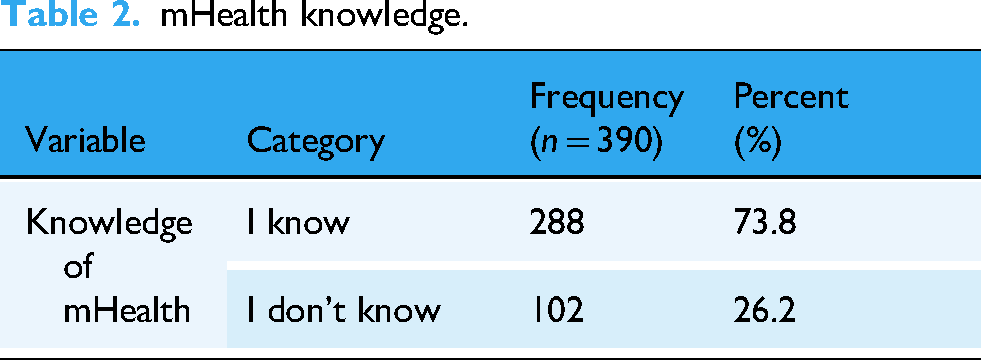
The study found that 73.8% of respondents reported knowing mHealth. Students demonstrated a good understanding of the concept, agreeing that mHealth involves mobile phone-based technologies that provide access to health information and services (see Table 2).
mHealth knowledge.
Level of students’ mHealth knowledge
Of the total sample (n = 390), only participants who reported prior knowledge of mHealth services (n = 288) were included in the analyses presented in Tables 3–8. This subset was selected because analyses predicting mHealth usage required participants to have baseline awareness of mHealth.
Level of students’ mHealth knowledge (n = 288).

Scale: [1 – Strongly Disagree, 2 – Disagree, 3 – Somewhat Disagree, 4 – Neither Agree nor Disagree, 5 – Somewhat Agree, 6 – Agree, 7 – Strongly Agree].
Descriptive statistics of the variables (n = 288).

Scale: [1 – Strongly Disagree, 2 – Disagree, 3 – Somewhat Disagree, 4 – Neither Agree nor Disagree, 5 – Somewhat Agree, 6 – Agree, 7 – Strongly Agree].
mHealth usage for sexual and reproductive health purposes (n = 288).

Scale: [1 – Strongly Disagree, 2 – Disagree, 3 – Somewhat Disagree, 4 – Neither Agree nor Disagree, 5 – Somewhat Agree, 6 – Agree, 7 – Strongly Agree].
Model summary/diagnostic test results.

Note: Durbin–Watson (D-W).
Analysis of variance (ANOVA) results of the hierarchical regression models.

Hierarchical multivariate OLS regression.

Note: PE: performance expectancy; PHT: perceived health threat; VIF: Variance Inflation Factor.
The respondents generally agreed that mHealth is mobile phone technology that provides health information through software applications (μ = 5.39, σ = 1.52), indicating a basic understanding of its role in health communication. They also agreed that mHealth typically includes applications in both public health and clinical medicine (μ = 5.36, σ = 1.39), suggesting awareness of its broad utility. Respondents recognized that mHealth applications can aid in monitoring personal health indicators such as weight (BMI and caloric intake) (μ = 5.42, σ = 1.35) and vital signs such as blood pressure and heart rate (μ = 5.37, σ = 1.29), reflecting appreciation of its practical health-monitoring functions. There was moderate agreement that mHealth can support planning and monitoring of targets in sports or exercise (μ = 5.48, σ = 1.32), as well as facilitate communication with other users (μ = 5.25, σ = 1.42) and comparisons of results in areas such as sports and nutrition (μ = 5.38, σ = 1.14) (see Table 3).
Descriptive statistics of the study constructs
The study assessed key psychosocial and behavioral constructs using a structured questionnaire based on the UTAUT and HBM frameworks, with items measured on a 7-point Likert scale and validated through CFA. As shown in Table 4, students generally agreed that mHealth improves access to SRH services (Performance Expectancy, M = 5.05, SD = 1.36) and found it easy to use (Effort Expectancy, M = 5.09, SD = 1.31), suggesting favorable perceptions of its utility and ease of use. Moderate scores for social influence (M = 4.52, SD = 1.64) and resistance to change (M = 4.54, SD = 1.59) indicate potential barriers to adoption related to peer or societal pressures and reluctance to adopt new technologies. Students also reported moderate perceptions of facilitating conditions (M = 4.80), privacy and security concerns (M = 5.00), and perceived health threats (M = 5.23), highlighting the influence of structural and personal factors on engagement. Expectations regarding life quality improvements (Life Quality Expectancy, M = 4.69) and app quality (M = 5.22) were moderately positive, while cost concerns were slightly lower (M = 4.64), suggesting some apprehension about affordability. Despite these generally favorable perceptions, actual mHealth usage remained relatively low (M = 3.40, SD = 1.83), emphasizing a gap between positive attitudes and actual engagement with mHealth services (see Table 4).
Usage of mHealth for SRH services
Despite high awareness, actual mHealth use for SRH purposes was low. Mean usage scores for activities such as accessing information on contraceptives, STIs, pregnancy prevention, and postabortion care ranged from 3.3 to 3.6 on a 7-point Likert scale (see Table 5).
Factors associated with mHealth usage for SRH
The factors influencing tertiary students’ usage of mHealth technologies for SRH services were examined using hierarchical multiple regression analysis. Model 1 included only control variables (gender, age, hall of residence, and college of study), providing a baseline assessment of demographic influences. Model 2 added key explanatory variables, including performance expectancy, effort expectancy, social impact, facilitating conditions, resistance to change, perceived health threat, mHealth app quality, cost concerns, life quality expectancy, and privacy and security risk, allowing an evaluation of how psychosocial and behavioral factors contribute to usage. Model 3 introduced an interaction term between performance expectancy and perceived health threat to explore a potential moderating effect, indicating whether the impact of perceived usefulness on mHealth engagement differs across students’ perceptions of health risk (see Table 6).
In Model 1, the control variables explained only 2.4% of the variance in mHealth usage (R2 = .024), and the model was not statistically significant (F = 1.776, p = 0.134), indicating that demographic factors alone were insufficient to account for students’ mHealth use for SRH purposes. Model 2, which included both control and explanatory variables, showed a significant improvement (R2 = .206, F = 5.268, p < 0.001), with the added variables explaining an additional 18.2% of the variance (ΔR2 = .182). This finding suggests that performance-related beliefs, attitudes, and contextual barriers are key determinants of mHealth usage among students. The Durbin–Watson statistic for both models was close to 2.0, indicating no autocorrelation in the residuals. Model 3 tested whether perceived health threat moderated the relationship between performance expectancy and mHealth usage. The interaction term contributed minimal additional explanatory power (ΔR2 = .001) and was not statistically significant (F = 0.482, p = 0.488), suggesting that the influence of performance expectancy on mHealth engagement is consistent regardless of students’ perceived health threat (see Table 7).
Table 8 presents the results of hierarchical OLS regression models assessing factors influencing students’ use of mHealth for SRH services. In Model 1, none of the control variables—gender, age, hall of residence, and college—significantly predicted mHealth usage (all p > 0.05). In Model 2, five explanatory variables showed statistically significant associations with mHealth usage. Performance expectancy (β = 0.345, p < 0.001) and life quality expectancy (β = 0.197, p < 0.05) were positively associated with mHealth use, suggesting that students who believed mHealth would improve health outcomes or quality of life were more likely to use it. In contrast, social influence (β = −0.210, p = 0.016), resistance to change (β = −0.221, p = 0.001), and privacy and security risk (β = −0.208, p = 0.004) were negatively associated, indicating that peer pressure, technological reluctance, and data privacy concerns discouraged usage. Other variables such as effort expectancy, facilitating conditions, perceived health threat, mHealth app quality, and cost concern were not significant predictors (p > 0.05). In Model 3, the interaction between performance expectancy and perceived health threat was not significant (β = 0.041, p = 0.488), indicating no moderation effect.
Discussion
This study explored the knowledge, usage, and determinants of mHealth adoption for SRH services among tertiary students at a major Ghanaian university. The findings of this study highlight a critical paradox in the adoption of mHealth technologies for SRH among university students in Ghana. While a significant majority (73.8%) of respondents demonstrated awareness of mHealth, actual utilization for SRH services remained strikingly low. This gap between knowledge and practice aligns with broader trends observed in LMICs, where mHealth interventions often struggle to translate awareness into sustained use.10,25
Despite high awareness of mHealth among students, actual engagement with these tools for SRH purposes remained low, highlighting a notable paradox. This gap suggests that awareness alone is insufficient to drive adoption. Beyond the barriers identified in this study—such as resistance to change, privacy concerns, and limited facilitating conditions—other factors may play a role, including the perceived relevance of available services, lack of youth-oriented content, cultural norms discouraging open discussion of SRH, and limited trust in digital health information. Behavioral factors, such as low self-efficacy or competing priorities, may also reduce active usage. These findings underscore that promoting mHealth uptake requires interventions addressing not only awareness but also cultural, structural, and behavioral determinants of engagement.
One of the most significant barriers identified in this study was privacy and security concerns, which negatively influenced mHealth usage. This finding resonates with global research indicating that data security concerns are a significant deterrent to digital health adoption, particularly for sensitive topics such as SRH.26,27 In Ghana, where cultural and religious norms often stigmatize open discussions around contraception, STIs, and abortion, concerns about confidentiality in digital platforms may be especially pronounced. If users fear that their SRH-related queries or activities could be exposed, they are likely to avoid mHealth services altogether. This underscores the urgent need for developers and policymakers to implement robust data protection measures, such as end-to-end encryption and anonymized user profiles, to build trust and encourage uptake.
Another key barrier was resistance to change, reflecting a broader reluctance to adopt new technologies for health management. This aligns with prior studies on technology adoption in healthcare, which show that habitual behaviors and skepticism toward digital solutions hinder uptake.28,29 In the context of SRH, where traditional norms and face-to-face consultations have long been the primary means of seeking care, students may perceive mHealth as an unfamiliar or unreliable alternative. Addressing this resistance requires targeted educational campaigns that demonstrate the tangible benefits of mHealth, such as convenience, accessibility, and anonymity, while also addressing misconceptions about its effectiveness.
Contrary to expectations, social influence was negatively associated with mHealth use, suggesting that peer opinions may discourage rather than encourage adoption. This contrasts with findings from other LMICs, where social networks often facilitate technology adoption.24,30 The adverse effect observed in this study may be attributed to the stigmatization of SRH topics in Ghanaian society. If discussing reproductive health is considered taboo, students may fear judgment from peers for using mHealth apps related to contraception or STIs. This highlights the need for interventions that not only promote mHealth but also work to destigmatize SRH conversations at a societal level.
On the other hand, performance expectancy, the belief that mHealth will improve health outcomes, emerged as the strongest predictor of usage. This aligns with the UTAUT, which posits that perceived utility is a key driver of technology adoption. 21 Students who viewed mHealth as a practical tool for accessing reliable SRH information were more likely to engage with it, suggesting that emphasizing real-world benefits (e.g., instant access to medical advice, discreet STI screening) could enhance adoption rates. Additionally, life expectancy and the belief that mHealth would improve overall well-being positively influenced usage, reinforcing the idea that framing mHealth as a holistic wellness tool rather than just a medical resource may broaden its appeal. 31
Interestingly, perceived health threats did not moderate the relationship between performance expectancy and mHealth usage, contrary to predictions based on the HBM. 22 This suggests that even students who recognized their vulnerability to SRH risks did not necessarily turn to mHealth as a solution unless they also perceived the technology as applicable. This finding implies that fear-based messaging (e.g., “STIs are dangerous, so use this app”) may be less effective than campaigns that highlight the practical advantages of mHealth (e.g., “Get fast, private answers to your SRH questions”). 32
The study also revealed that facilitating conditions, such as access to smartphones and internet connectivity, did not significantly predict mHealth usage. This contrasts with research in other settings where infrastructure limitations were significant barriers.33,34 The nonsignificance of this factor in our study suggests that, while technological access is a prerequisite, it alone does not guarantee engagement. Instead, usability, relevance, and cultural acceptability appear to be more critical determinants of adoption as reported in previous studies.35,36
To increase mHealth use for SRH services, interventions should target the factors that influence student engagement. Since performance expectancy was a strong predictor, educational campaigns, and peer-led workshops should demonstrate the practical benefits of mHealth. Effort expectancy highlights the need for user-friendly, multilingual apps with offline functionality. Moderate social influence and resistance to change suggest that stigma-reduction strategies and peer endorsements on social media can encourage adoption. Privacy and security concerns also significantly impacted usage, emphasizing the importance of robust data protection measures and clear communication about safeguards. Tailoring interventions to these key determinants can enhance trust, usability, and sustained engagement with mHealth services among tertiary students.
Study limitation
This study has some limitations. First, the use of self-reported data on sensitive SRH topics may have introduced social desirability bias, potentially leading participants to overstate positive behaviors or attitudes. Second, the findings are based on a single, relatively prestigious university in Ghana, which may limit generalizability to other tertiary institutions or youth populations with different demographic and socioeconomic characteristics. Third, the regression analyses were conducted only on participants who reported prior mHealth knowledge (n = 288), introducing potential selection bias and limiting the applicability of these results to students already familiar with mHealth services.
This study also explored the general adoption and use of mHealth tools among young people, but did not distinguish between specific types of mHealth technologies. In particular, more interactive and youth-focused platforms, such as conversational health technologies (e.g., chatbots and virtual health agents), were not separately examined, even though evidence suggests that such tools may be especially appealing to young people because of their anonymity, responsiveness, and sense of interpersonal engagement. Additionally, while the study recognized the influence of cultural factors on SRH behaviors and attitudes, it did not evaluate the cultural appropriateness or fit of the mHealth tools within the study setting. Cultural beliefs, language, and social norms may affect how youth perceive and interact with these technologies, especially in sensitive areas such as SRH. These gaps limit the understanding of how different mHealth approaches and cultural factors influence youth engagement, and future research should investigate these areas to improve the relevance, acceptance, and effectiveness of mHealth interventions in similar contexts. Future research should address these issues to strengthen the evidence base.
Conclusion
This study highlights a significant gap between awareness and actual use of mHealth technologies for SRH among university students in Ghana. While students demonstrated high levels of digital literacy and perceived mHealth as applicable, usage remained low due to concerns about privacy, resistance to change, and stigma associated with SRH. Key enablers of adoption included performance expectancy and perceived improvements in life quality, while social influence and perceived health threats were either negative or nonsignificant predictors. These findings suggest that improving mHealth uptake will require addressing behavioral and cultural barriers, enhancing data security, and emphasizing the practical benefits of mHealth tools in youth-focused health interventions.
Supplemental Material
sj-docx-1-dhj-10.1177_20552076251412705 - Supplemental material for Determinants of mHealth adoption for sexual and reproductive health services among university students in Ghana: A UTAUT and health belief model analysis
Supplemental material, sj-docx-1-dhj-10.1177_20552076251412705 for Determinants of mHealth adoption for sexual and reproductive health services among university students in Ghana: A UTAUT and health belief model analysis by Abigail Gyebi Nimo, Richard Abeiku Bonney and Labaran Musah in DIGITAL HEALTH
Footnotes
Acknowledgments
The authors acknowledge and are grateful to the management of the various halls of residence at KNUST and all students who participated in the study.

Consent for publication
All the authors approved the final manuscript and the submission to this journal.
Contributorship
Conceptualization: AGN and RAB; methodology: AGN, RAB, and LM; data curation: AGN and LM; formal analysis: LM and AGN; writing initial draft: RAB; reviewing and editing: RAB, AGN, and LM; project administration: RAB and AGN; supervision: RAB. All the authors have read and approved the final manuscript.
Funding
The authors received no financial support for the research, authorship, and/or publication of this article.
Declaration of conflicting interests
The authors declared no potential conflicts of interest with respect to the research, authorship, and/or publication of this article.
Data availability statement
The data provided in this study are available upon request from the corresponding author.
Supplemental material
Supplemental material for this article is available online.
References
Supplementary Material
Please find the following supplemental material available below.
For Open Access articles published under a Creative Commons License, all supplemental material carries the same license as the article it is associated with.
For non-Open Access articles published, all supplemental material carries a non-exclusive license, and permission requests for re-use of supplemental material or any part of supplemental material shall be sent directly to the copyright owner as specified in the copyright notice associated with the article.
