




Abstract
Objective
Herpes zoster (HZ) is a common viral skin disease. As short video platforms have become an important source of health information, evaluating the quality of HZ-related content is increasingly important.
Methods
This cross-sectional study analyzed 186 HZ-related videos collected from the Chinese short video platforms TikTok (n = 96) and Bilibili (n = 90) from 12 to 16 July 2025. Video characteristics (duration, likes, shares, comments, and collections), content domains (etiology, clinical manifestations, diagnosis, treatment, and prognosis), and uploader identity were recorded. Quality was evaluated using the Global Quality Score (GQS) and modified DISCERN (mDISCERN).
Results
TikTok videos had shorter durations (47.5 vs.196.0 seconds) but significantly higher engagement metrics, including likes (481.5 vs. 29.5), comments (20.5 vs. 3.5), and shares (152.5 vs. 19.0). Most videos were uploaded by pain medicine specialists (31.72%), followed by traditional Chinese medicine physicians (27.96%) and dermatologists (19.35%). Treatment was the most frequently addressed topic (67.74%), whereas prognosis was least discussed (18.28%). The median GQS was 2.00 (interquartile range (IQR): 1.00–3.00) and the mDISCERN score was 3.00 (IQR 1.00–3.00). Dermatologists achieved higher GQS and mDISCERN scores than patients and traditional Chinese medicine physicians (p < 0.05). No significant correlations were observed between engagement metrics and GQS scores (p > 0.05).
Conclusions
HZ-related videos on short video platforms are of moderate quality and skewed toward treatment. Dermatologists involvement and better content regulation are needed. More emphasis should be placed on prognosis education to enhance public understanding.
Introduction
Herpes zoster (HZ) is caused by reactivation of latent varicella-zoster virus in sensory ganglia.1,2 It primarily affects older adults and immunocompromised individuals, with typical manifestations including unilateral vesicular rash, dermatomal distribution, and neuropathic pain.3,4 Despite the availability of effective antiviral therapy and vaccines, the disease remains a significant public health concern, particularly due to complications such as postherpetic neuralgia (PHN), which severely impacts quality of life. 5
In recent years, short video platforms such as TikTok and Bilibili have become important sources of health information for the public, not only in China but also globally. Since its launch in September 2016, TikTok has rapidly become one of the fastest-growing social media platforms worldwide. 6 The platform allows users to create short videos that combine music, text, and effects, quickly becoming the most downloaded app globally in 2020, with a total of 850 million downloads. 7 As of January 2024, TikTok has surpassed 1.62 billion users, with daily active users (DAU) exceeding 600 million. 8 While TikTok mainly focuses on entertainment, its use in education and health is also increasing. 9 The platform has a broad user base across all age groups, with content covering various topics such as health, nutrition, and beauty.10,11 Bilibili, initially focused on anime and gaming videos, has expanded to include professional long-form videos and educational content.12,13 As of the third quarter of 2024, Bilibili had 107 million DAU and 348 million monthly active users. 14 Bilibili emphasizes content depth and professionalism, making it an ideal platform for users seeking more comprehensive and specialized information.15,16 In recent years, Bilibili has seen an increasing use of health-related videos, providing rich medical knowledge.17,18 Both platforms offer significant advantages, such as easy access, strong visual appeal, and rapid information dissemination, making them important tools for public health education. However, the openness of short video platforms and algorithm-driven content distribution have also raised concerns about the accuracy and reliability of medical information. Previous studies have found significant differences in the quality of videos related to diseases such as esophageal cancer, 19 pancreatitis, 20 dry eye syndrome, 21 thyroid eye disease, 22 and hypertension, 23 with many lacking scientific evidence, proper citations, or detailed explanations of treatment options. Despite the growing influence of these platforms in disseminating health-related content, there has been no systematic study evaluating the content and quality of HZ-related videos on short video platforms.
This study aims to systematically evaluate the general characteristics, content coverage, and quality of HZ-related videos on TikTok and Bilibili, using validated tools such as the Global Quality Score (GQS) and the modified DISCERN (mDISCERN). We further compare differences across platforms and uploader types, and explore associations between video quality and user engagement. The results are expected to guide future efforts to enhance the quality of health information distributed via short video platforms.
Methods
Study design, data sources, and search strategy
We conducted a cross-sectional content analysis from 12 to 16 July 2025, focusing on HZ-related videos on the Chinese short video platforms TikTok and Bilibili. The keyword “带状疱疹” (HZ) was used to retrieve videos on both platforms. To minimize potential bias from search history or personalized algorithms, all searches were performed using a logged-out browser environment. On each platform, the top 100 videos ranked by default algorithms were screened.
Inclusion and exclusion criteria
Inclusion criteria were (1) related to HZ and (2) Chinese-language videos, while exclusion criteria were (1) videos unrelated to HZ, (2) duplicate videos, and (3) explicit commercial advertising videos. All videos that met the inclusion criteria and did not meet any exclusion criteria were included in the final analysis. The study flow diagram is shown in Figure 1.

Flowchart of video selection and inclusion process.
Data collection and processing
For each video, we extracted duration, numbers of likes, favorites (collections), comments, and shares, the uploader identity, and the video content. Uploaders were further categorized into seven groups: dermatologists, pain medicine specialists, traditional Chinese medicine physicians, science communicators, patients, neurologists, and orthopedic surgeons. Given that neurologists and orthopedic surgeons contributed only three videos each, which was insufficient for subsequent subgroup analyses, we restricted the analyses to five groups: dermatologists, pain medicine specialists, traditional Chinese medicine physicians, science communicators, and patients. In addition, video content was coded using a nonexclusive multilabel approach across five aspects: etiology, clinical manifestations, diagnosis, treatment, and prognosis. A single video could be assigned to multiple aspects. Results were summarized as the number of videos addressing each aspect. Therefore, the sum across aspects may exceed the total number of included videos.
Video quality
Video quality was independently assessed using two validated instruments: the GQS 24 and the mDISCERN tool. 25 The GQS is a five-point scale designed to evaluate the overall educational quality of health-related videos, where a score of 1 indicates poor quality with limited usefulness, and a score of 5 represents excellent quality that is clear, comprehensive, and highly informative. The mDISCERN tool, adapted from the original DISCERN questionnaire, assesses the reliability of video content across five key domains: (1) clarity, conciseness, and understandability; (2) citation of valid information sources; (3) balanced and unbiased presentation; (4) listing of additional sources for patient reference; and (5) mention of areas of uncertainty. Each video was independently rated by two trained reviewers. Discrepancies in scoring were resolved through discussion or consultation with a third reviewer to ensure consistency and minimize subjective bias. Detailed scoring criteria for GQS and mDISCERN are provided in Supplemental Tables 1 and 2.
General information, quality, and reliability scores of HZ videos on TikTok and Bilibili.

GQS: Global Quality Score; HZ: herpes zoster.
Characteristics, quality, and reliability of HZ videos by different uploaders on TikTok and Bilibili.

DER, dermatologists; PAT, patients; PMS, pain medicine specialists; SC, science communicators; TCM, traditional Chinese Medicine Physicians.
Statistical analysis
Descriptive statistics were used to summarize continuous variables, which were expressed as mean ± standard deviation (SD) for normally distributed data, or as median and IQR for non-normally distributed data. Categorical variables were reported as frequencies and percentages. The Shapiro–Wilk test was employed to assess the normality of continuous variables. Between-group comparisons were performed using the independent samples t-test for normally distributed variables and the Mann–Whitney U test for non-normally distributed variables. For comparisons among three or more groups, the Kruskal–Wallis H test was applied. Spearman's rank correlation coefficient was used to evaluate associations between video quality scores (GQS and mDISCERN) and engagement metrics (likes, comments, shares, and collections). A two-tailed p-value <0.05 was considered statistically significant. Statistical analyses were conducted using R software version 4.3.2.
Results
Video characteristics
A total of 186 HZ-related videos were included in this study, comprising 96 from TikTok and 90 from Bilibili. Video characteristics were analyzed based on duration, number of likes, collections (favorites), comments, and shares. Compared to Bilibili, TikTok videos were shorter in length (median: 52.50 seconds, IQR: 37.75–75.75) but demonstrated superior performance in user engagement metrics, including likes (median: 481.50, IQR: 204.25–1121.25), collections (median: 397.50, IQR: 79.00–1483.25), comments (median: 20.50, IQR: 10.00–71.00), and shares (median: 152.50, IQR: 49.75–403.25), as shown in Table 1. In terms of uploader identity, videos uploaded by patients had the longest durations, whereas those uploaded by dermatologists were the shortest. Videos uploaded by patients had the highest numbers of likes, comments, and shares. Detailed statistics are presented in Table 2.
Uploader characteristics and video content
In terms of uploader classification, the majority of videos were uploaded by pain medicine specialists (31.72%), followed by traditional Chinese medicine physicians (27.96%), dermatologists (19.35%), science communicators (12.37%), and patients (5.38%; Figure 2(a)). On the TikTok platform, pain medicine specialists contributed 52% of the videos, with patients accounting for only 4%. On the Bilibili platform, traditional Chinese medicine physicians represented 32%, while dermatologists contributed 23% (Figure 2(b)). Among all 186 videos, the most frequently covered topic was treatment (67.74%), followed by clinical manifestations (52.15%), with prognosis being the least discussed (18.28%). Treatment-related content was the most prevalent on both platforms, while prognosis was the least addressed, as shown in Figure 3.

Distribution of uploader identity among included videos. (a) Overall proportion of uploader types. (b) Comparison of uploader distribution across TikTok and Bilibili. DER, dermatologists; NEU, neurologists; ORT, orthopedic surgeons; PAT, patients; PMS, pain medicine specialists; SC, science communicators; TCM, traditional Chinese Medicine Physicians.

Distribution of video content themes across TikTok and Bilibili.
Video quality
The overall quality of the HZ-related videos was moderate, with a median GQS score of 2.00 (IQR: 2.00–3.00) and a median mDISCERN score of 3.00 (IQR: 1.00–3.00). Videos on Bilibili had significantly higher mDISCERN scores than those on TikTok (p < 0.05). Although Bilibili also had higher GQS scores, the difference was not statistically significant (Table 1). Figure 4(a) shows the distribution of GQS scores across different uploader types, while Figure 4(b) shows the distribution of mDISCERN scores. Compared to traditional Chinese medicine physicians and patients, dermatologists, science communicators, and pain medicine specialists had higher GQS (p < 0.05, Figure 5(a)) and mDISCERN scores (p < 0.05, Figure 5(b)). Dermatologists scored higher than pain medicine specialists on GQS (p < 0.05, Figure 5(a)), while no significant difference in GQS scores was found between science communicators and pain medicine specialists (p > 0.05, Figure 5(a)). No significant differences were found in mDISCERN scores between dermatologists, pain medicine specialists, and science communicators (p > 0.05, Figure 5(b)). The GQS and mDISCERN scores for different video uploaders are presented in Table 2.
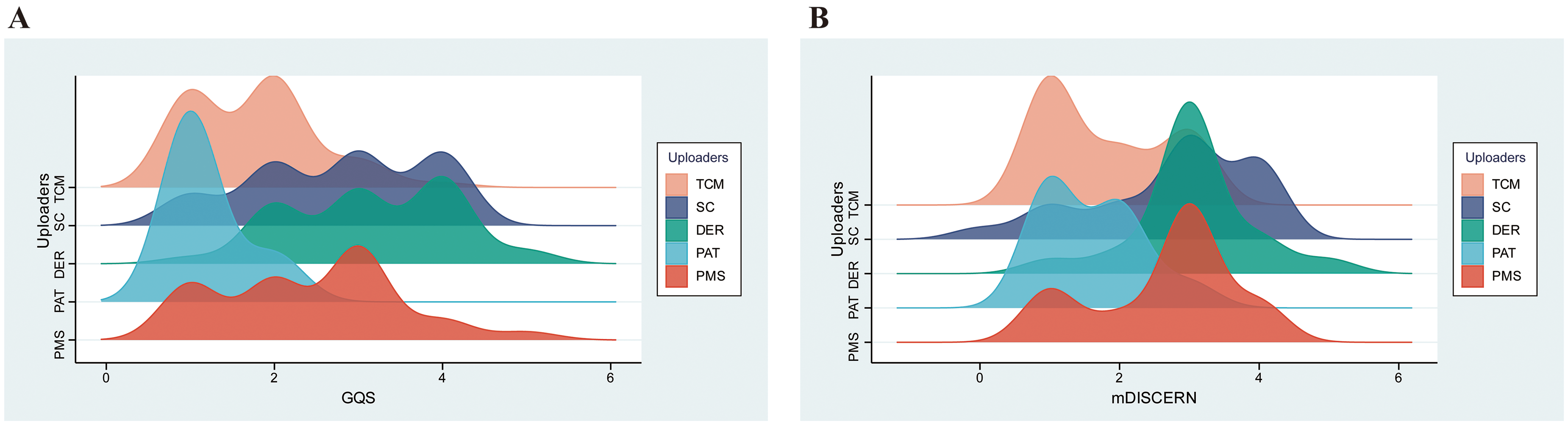
Distribution of quality scores across uploader types. (a) Distribution of GQS scores by uploader type. (b) Distribution of mDISCERN scores by uploader type. DER, dermatologists; GQS: Global Quality Score; PAT, patients; PMS, pain medicine specialists; SC, science communicators; TCM, traditional Chinese Medicine Physicians.

Comparison of video quality scores among different uploader types. (a) GQS; (b) modified DISCERN (mDISCERN). Significance levels: ns, p > 0.05; * p ≤ 0.05; ** p ≤ 0.01; *** p ≤ 0.001; **** p ≤ 0.0001. DER, dermatologists; GQS: Global Quality Score; PAT, patients; PMS, pain medicine specialists; SC, science communicators; TCM, traditional Chinese Medicine Physicians.
Correlation analysis
Spearman correlation analysis revealed strong positive correlations among video engagement metrics (p < 0.05). Additionally, a significant positive correlation was observed between GQS and mDISCERN scores (p < 0.05). No correlation was found between video engagement metrics and GQS scores (p > 0.05) (Figure 6).

Correlation matrix between video characteristics and quality metrics.
Discussion
This cross-sectional study systematically evaluated the content quality of 186 HZ related videos from two major short video platforms, TikTok (n = 96) and Bilibili (n = 90). Using validated tools including the GQS and the mDISCERN, along with analyses of uploader identity, content themes, and user engagement metrics, this study provides a detailed overview of how HZ information is communicated on social media. The results showed that content related to HZ primarily focused on treatment, with prognosis addressed less frequently. TikTok videos were shorter in duration but demonstrated significantly higher engagement metrics compared to Bilibili. Overall, the quality and reliability of the videos were moderate. Videos uploaded by dermatologists had higher quality and reliability than those uploaded by patients and traditional Chinese medicine physicians. Video engagement metrics were not correlated with video quality. These findings provide valuable insights for optimizing health communication strategies and guiding platform-level improvements in short video-based public education on HZ.
Engagement disparities between TikTok and Bilibili
We observed significant differences in user engagement between platforms. Although videos on TikTok were shorter in duration, they demonstrated higher levels of interaction in terms of likes, shares, comments, and favorites. This reflects the characteristics of the TikTok platform, where short-form video formats and algorithm-driven exposure mechanisms may facilitate rapid information dissemination and user engagement. In contrast, videos on Bilibili tended to be longer but showed lower engagement metrics. This pattern is consistent with previous studies on TikTok and Bilibili content related to other medical conditions such as thyroid eye disease, 22 esophageal cancer, 19 and ankle sprain, 26 suggesting that video length and platform-specific algorithms jointly influence audience reach and participation. The use of social media, especially short video platforms like TikTok, has changed people's attention span. Compared to traditional long videos or text formats, short videos can convey key information in a shorter time, a condensed content format that better aligns with modern audience reading habits. Particularly in health education, short videos can quickly capture viewers’ attention and encourage interaction. 27 TikTok's algorithm-driven exposure mechanism facilitates the rapid dissemination of health information and audience engagement. The interactivity and rapid dissemination characteristics of short video platforms make them effective tools for patient education. 28 For patients who need to quickly understand disease, treatment options, and impacts, short videos can convey key information concisely and encourage viewers to obtain knowledge within limited time. Additionally, the interactive mechanisms of social media platforms offer patients opportunities to ask questions and engage, further enhancing the learning experience. 29 However, short videos may also risk oversimplifying information, so future health communication strategies need to balance simplicity with depth, ensuring that they attract viewers while also providing comprehensive and accurate health knowledge.
Differences in video quality between TikTok and Bilibili
This study also found that the overall video quality was at a moderate level, with a median GQS score of 2.00 and a median mDISCERN score of 3.00. Videos on the Bilibili platform scored higher on both measures, with the difference in mDISCERN being statistically significant. This result may be attributed to the longer video format on Bilibili, which allows for more detailed explanations, as well as to the fact that mDISCERN more objectively reflects the reliability of videos across multiple dimensions. Nevertheless, the scoring outcomes still reveal widespread deficiencies in source citation, content comprehensiveness, and informational reliability.19,30 To address these deficiencies, future health education content should place greater emphasis on the reliability of information sources, explicit citation of clinical guidelines, and comprehensive explanations of treatment options and disease prognosis. It is also important to provide health communication training for medical professionals, particularly those involved in content creation, to enhance their ability to deliver accurate health information on digital platforms. Furthermore, platform-level measures such as the implementation of content review mechanisms or medical information labeling systems may improve the visibility and credibility of high-quality health information and better support informed decision making among the public.
Video content
From a content perspective, treatment is the most frequently discussed topic, while prognosis is the least addressed. This imbalance in information coverage may limit the audience's understanding of comprehensive disease management, especially in the case of herpes zoster, where prognosis plays a critical role due to the potential development of long-term complications, such as PHN. 31 Additionally, there is an incomplete representation of clinical manifestations. Besides the typical skin lesions, herpes zoster can also present as “zoster sine herpete,” a variant that may be more painful and distressing. 32 It is concerning that videos, especially those uploaded by nondermatology healthcare professionals, provide limited discussion on this atypical manifestation, leading to a lack of comprehensive understanding of HZ. Because this variant may lack visible skin lesions, patients may ignore or misdiagnose it, leading to delayed treatment. Therefore, future video content should strive for greater balance by incorporating comprehensive clinical manifestations and prognosis information, while also increasing awareness of atypical manifestations such as zoster sine herpete. This will ensure a more comprehensive understanding of the different clinical presentations of HZ, thus enhancing the overall quality and completeness of health communication.
Differences in video quality among uploader
Regarding uploader identity, most videos were uploaded by pain medicine specialists, followed by traditional Chinese medicine physicians, dermatologists, science communicators, and patients. Significant differences in video quality were observed across uploader groups. Compared with patients and traditional Chinese medicine physicians, videos uploaded by dermatologists demonstrated higher quality and reliability. This finding underscores the critical role of professional expertise in ensuring the reliability of health information. The results are consistent with prior studies on coronary heart disease, 33 gastroesophageal reflux disease, 34 and gonorrhea, 27 which likewise indicate that videos created by medical professionals tend to be more accurate and authoritative. In addition, we found that videos uploaded by pain medicine specialists and science communicators were of higher quality and reliability than those uploaded by patients and traditional Chinese medicine physicians. Videos uploaded by dermatologists outperformed those from pain medicine specialists and science communicators in quality and reliability, although the differences were not statistically significant. Nevertheless, dermatologists accounted for a relatively small proportion of all uploaders. To bridge this gap, platforms should actively encourage greater participation of dermatologists in public education on HZ. Viewers are also advised to prioritize dermatologist-created videos when seeking health information in order to enhance the accuracy and utility of the content they consume.
Association between video quality and user engagement
Notably, our correlation analysis revealed no significant relationship between video quality scores and user engagement metrics, suggesting that popularity is not necessarily determined by content quality.35,36 However, strong positive correlations were observed among likes, comments, shares, and collections, consistent with the findings of Wang et al. 22 This indicates the presence of synergistic effects within engagement metrics, where highly interactive videos tend to perform well across multiple dimensions. 37 We also found that videos uploaded by patients exhibited high levels of user engagement. This “popularity paradox,” in which highly engaged videos often originate from less authoritative sources, aligns with previous research. 22 While personal experiences may strongly resonate with viewers, they often lack the scientific rigor required for reliable health communication. This raises concerns that low-quality or potentially misleading videos may still gain widespread attention, highlighting the importance of algorithmic support for evidence-based health content. Therefore, implementing robust content review mechanisms and optimizing recommendation algorithms may help enhance the dissemination efficiency of high-quality educational material and contribute to a more trustworthy digital health information ecosystem on short video platforms.
Overall, social media platforms such as TikTok and Bilibili have increasingly become important channels for health information dissemination, offering the public convenient access to medical knowledge and social support.38–41 Their rapid information diffusion, visual content formats, and algorithm-driven recommendation systems contribute to their growing influence in public health education. However, this study found that HZ-related videos on these platforms exhibit notable deficiencies in content quality and thematic coverage. Most videos lacked systematic information on disease prognosis, and no significant association was observed between user engagement and content quality. Although videos uploaded by dermatologist demonstrated the highest quality scores, their overall representation remained low, indicating limited involvement of professional resources. To improve the scientific rigor and utility of health communication on these platforms, we recommend the implementation of medical content labeling systems and the prioritization of verified high-quality videos in recommendation algorithms, thereby shifting content distribution away from a purely engagement-driven model. In addition, dermatologists should be actively encouraged to participate in content creation through verified contributor programs, traffic support, or incentive mechanisms, in order to increase the availability and visibility of authoritative content. Video content should also be structured more comprehensively, with greater emphasis on prognosis, complications, and long-term disease management, to facilitate more effective and trustworthy health education.
This study has several limitations that should be noted. First, it analyzed content only from two major short video platforms in China (TikTok and Bilibili), which may limit the generalizability of the findings to other platforms. Second, the study focused exclusively on Chinese-language video content, so the results may not reflect the characteristics of health communication in other linguistic or cultural contexts. Lastly, although validated assessment tools such as the GQS and mDISCERN were used, the evaluation of video quality inevitably involved some subjectivity, and the clinical backgrounds and interpretive biases of the evaluators may have influenced the scoring results.
Conclusion
This study highlights both the opportunities and challenges of using short video platforms such as TikTok and Bilibili for HZ-related health communication. While these platforms enable wide dissemination, video content often lacks depth and accuracy, and user engagement does not reflect information quality. Videos uploaded by dermatologists had higher quality and reliability, but their representation among uploaders remained low. To improve health communication quality, we recommend increasing contributions from dermatologists, enhancing the algorithmic visibility of high-quality content, and encouraging the inclusion of essential topics such as prognosis. These efforts may strengthen the credibility and effectiveness of health education on digital platforms.
Supplemental Material
sj-docx-1-dhj-10.1177_20552076251412693 - Supplemental material for The quality and reliability of herpes zoster information on TikTok and Bilibili: A cross-sectional study
Supplemental material, sj-docx-1-dhj-10.1177_20552076251412693 for The quality and reliability of herpes zoster information on TikTok and Bilibili: A cross-sectional study by Kaidi Zhao and Jiashu Liu in DIGITAL HEALTH
Footnotes
Acknowledgements
The authors express their gratitude to the Dermatology Department of the Second Affiliated Hospital of Xi'an Jiaotong University and its leadership for their support.

Ethics approval
This study did not involve human participants, clinical data, laboratory animals, or histological procedures. All data were obtained from publicly accessible TikTok and Bilibili videos, and collection complied with both platforms’ Terms of Service. No private or personally identifiable information was collected or processed, and no user interaction occurred, and individual consent was not required. Therefore, the study qualifies for an ethics exemption and does not require ethics approval.
Informed consent
Not applicable.
Patient and public involvement
Patients and/or the public were not involved in the design, or conduct, or reporting, or dissemination plans of this research.
Contributorship
KZ developed the study idea and concept, analyzed the data, and drafted the article. KZ and JL collected the data. All authors interpreted the results, critically revised the manuscript, and approved the final version.
Funding
The authors received no financial support for the research, authorship, and/or publication of this article.
Declaration of conflicting interests
The authors declared no potential conflicts of interest with respect to the research, authorship, and/or publication of this article.
Data availability statement
The data supporting the findings of this study are available from the corresponding author upon reasonable request.
Guarantor
Jiashu Liu is the guarantor of this article. She takes full responsibility for the integrity of the research and data, has full access to all data, and had the final decision-making authority regarding publication.
Statement
No AI tools were used in the conception or writing of this manuscript.
Supplemental material
Supplemental material for this article is available online.
References
Supplementary Material
Please find the following supplemental material available below.
For Open Access articles published under a Creative Commons License, all supplemental material carries the same license as the article it is associated with.
For non-Open Access articles published, all supplemental material carries a non-exclusive license, and permission requests for re-use of supplemental material or any part of supplemental material shall be sent directly to the copyright owner as specified in the copyright notice associated with the article.
