



Abstract
Keywords
Introduction
Across global higher education systems, anxiety has shifted from an episodic concern to a sustained, population-level priority and is increasingly recognized as compromising students’ academic progress and everyday functioning. A systematic review and meta-analysis of school-based depression and anxiety prevention programs indicates that school-based psychological prevention programs produce statistically significant reductions in symptoms and identifies educational settings as key platforms for scalable mental health support. 1 Using four years of data on first-year university students, subgroup analyses show marked differences in depression, anxiety, and stress, indicating that mental health problems are not evenly distributed across subgroups and that age, gender, study load, and academic performance are associated with distinct mental health profiles. 2 A large meta-analytic synthesis of 89 studies including more than 1.4 million higher-education students estimated pooled prevalences of 34% for depressive symptoms, 32% for anxiety symptoms, and 33% for sleep disturbances, highlighting a substantial mental health burden in this population. 3 Beyond student samples, causal evidence syntheses by Ridley and colleagues demonstrate bidirectional causal links between poverty and common mental disorders such as depression and anxiety and show that anti-poverty interventions can improve psychological well-being; 4 these mechanisms are also relevant for students facing financial strain and socioeconomic disadvantage. In a large US national survey including students from multiple universities, anxiety symptoms were strongly associated with suicidal ideation and suicide attempts above and beyond depression, and modeling suggested that screening only for depression would identify about 23% of students with suicidal ideation, compared with about 35% when anxiety was also assessed. 5 Developmentally, data from the US National Comorbidity Survey Replication (NCS-R) show that roughly three-quarters of lifetime Diagnostic and Statistical Manual of Mental Disorders IV (DSM-IV) mental disorders have onset before age 24, 6 and epidemiological follow-up studies indicate that adolescent anxiety and depressive disorders confer an approximately two- to three-fold increased risk of anxiety and depressive disorders in early adulthood. 7 Taken together, these findings indicate that multi-domain stressors—including heavy workloads and competitive academic climates, financial strain, social readjustment, and disrupted sleep—intersect with socioeconomic disadvantage and age-related transitions to sustain elevated levels of anxiety and related symptoms among university students worldwide.
Therapeutic landscape (TL) theory, proposed by Gesler, posits that natural environments can substantially enhance psychological recovery and physical health. 8 It explains the healing effects of landscapes as arising from interactions among the physical, social, and symbolic components of the environment, which work together to reduce psychological stress and enhance emotional well-being. 9 Ulrich's stress reduction theory (SRT) and Kaplan and Kaplan's attention restoration theory (ART) further provide convergent evidence by showing that exposure to natural settings lowers physiological arousal, diminishes negative affect, and restores depleted attention, thereby facilitating stress recovery.10,11 Building on this foundation, previous literature has observed that applying TL concepts to university student populations can help mitigate stress, anxiety, and emotional exhaustion in higher-education settings. Studies of compact and high-density campuses indicate that embedding nature-rich spaces and healing gardens within teaching and residential areas can alleviate study-related pressure and support health-promoting campus structures. 12 Evaluations of campus green spaces and small courtyards using perceived restorativeness and related indicators show that the restorative potential of these environments depends not only on the presence of vegetation but also on how spatial configurations and views of nature support psychological recovery in daily study routines.13,14 Other research highlights cultural and psychological mechanisms, indicating that students’ responses to campus landscapes are shaped by cultural background, prototype landscape consciousness derived from earlier life environments, and the development of place attachment and positive emotions in everyday campus life.15,16 Work on horticultural therapy programs for college students further demonstrates that, when TL principles are operationalized through structured activity plans, supportive natural settings, professional facilitation, and sustained maintenance, campus environments can function as organized resources for anxiety reduction and emotion regulation. 17 Yet many urban campuses face material and spatial constraints that limit sustained access to high-quality TL settings. Consequently, when direct contact with physical landscapes is restricted, there is a growing need for complementary modalities to deliver TL experiences, among which immersive virtual reality (VR) is particularly promising.
VR enables the simulation of natural environments and provides immersive, multisensory experiences that can alleviate anxiety and promote psychological recovery. 18 Research has shown that exposure to virtual nature, via visual and auditory stimuli, can significantly reduce anxiety and enhance emotional well-being.19,20 When TL theory is systematically embedded in VR design, it gives rise to the notion of virtual therapeutic landscapes (VTLs), which offer an innovative modality for mental health interventions targeting university students, particularly in high-density urban areas where access to restorative physical settings is limited. Evidence from TL-informed VR applications indicates that immersive, multisensory virtual environments can alleviate anxiety symptoms. 21 Evidence from virtual forest and other nature-based VR scenarios indicates that TL-informed VR environments can improve emotional state and perceived recovery, with therapeutic effects that approach those observed in in situ natural settings. 22 Beyond reproducing natural scenes, VR also affords precise parameter control and repeatability, enabling systematic personalization as a moderating layer and supporting cost-aware deployment in institutional contexts such as universities. 23
However, despite these encouraging findings, systematic work at the interface between TL theory and immersive VR remains limited. Existing studies seldom formalize TL-informed immersive VR as a theoretically grounded conceptual framework that specifies experiential domains and subfactors and justifies their relative weights on theoretical and empirical grounds; instead, evaluation practices often privilege technical realism or ad hoc content over validated factor structures. Moreover, integrating open-ended user evidence with pre–post psychometric change to iteratively calibrate and refine the VTL conceptual framework remains insufficiently represented in the extant literature. Subgroup heterogeneity documented in university cohorts is rarely incorporated into moderation-aware design and evaluation reasoning. Against this backdrop, the present study addresses the following research questions.
How can TL theory be formalized into a VTL framework that specifies core experiential domains and their relative importance? Does brief exposure to VTL environments among university students improve psychological state? Which VTL experiential domains, and which interdomain couplings, exert the strongest influence on psychological change?
Methods and materials
Figure 1 summarizes the design framework, and the research is organized into three main phases. The first phase, model construction, involved literature analysis, semi-structured interviews, and the development of a VTL conceptual framework to extract core design elements, thereby establishing the methodological basis for subsequent VTL design and evaluation. The second phase, design practice, used the analytic hierarchy process (AHP) to construct an evaluation system for VTL design elements, and the VTL experience was designed and implemented as a standardized 5-min exposure using a Pico 4 Pro head-mounted VR display and a real-time pipeline in Unreal Engine 5. The final phase, empirical research, evaluated the effectiveness of VTL exposure in alleviating anxiety, enhancing vitality, and regulating emotions through a standardized pre–post VR intervention. Data were analyzed using paired-samples t-tests and Cohen's d effect sizes to assess within-subject change, and features extracted from open-ended questionnaire responses were text-mined to refine the expert-weighted VTL model and adjust domain emphases.
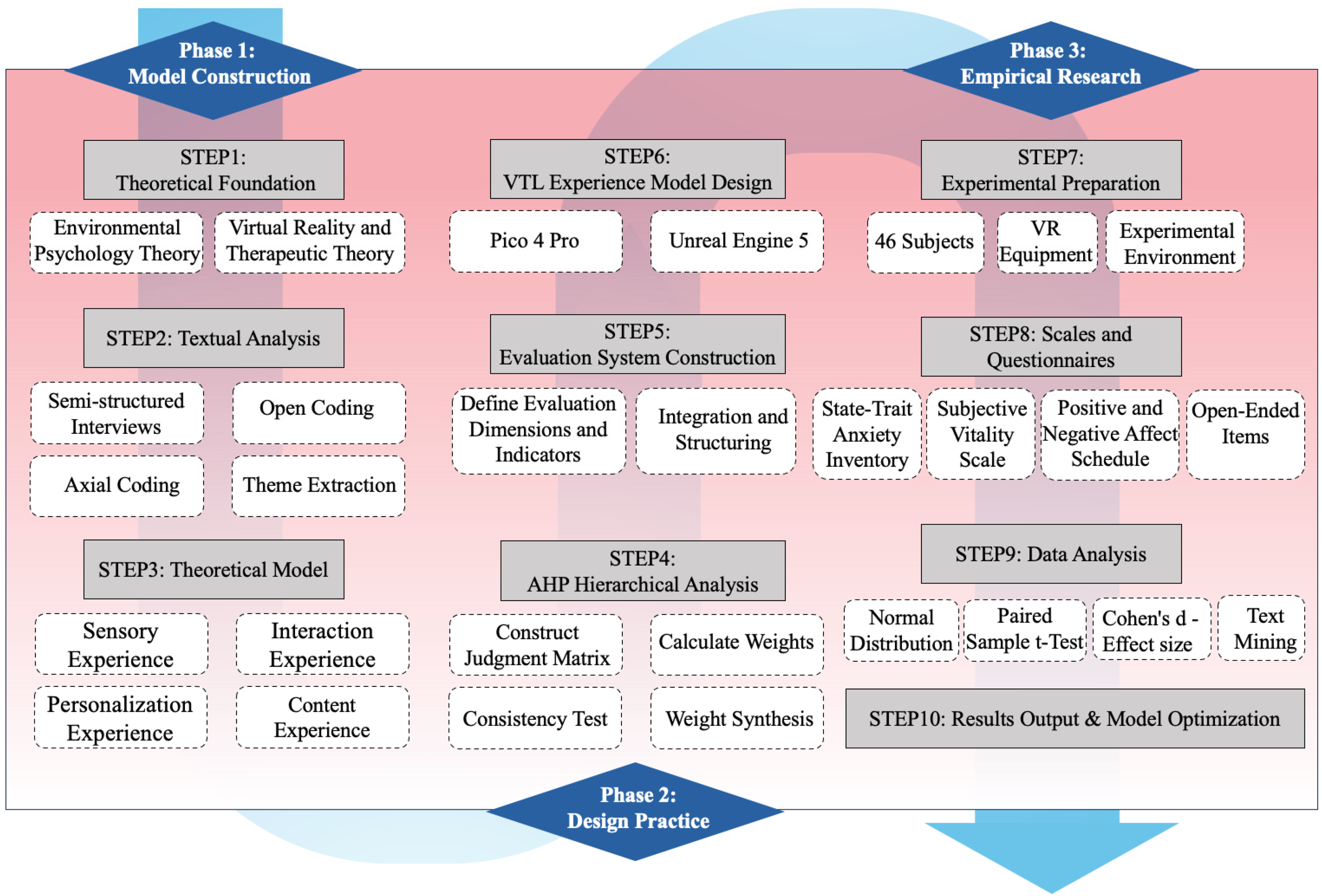
Research framework for VTL design and evaluation. VTL: virtual therapeutic landscape.
Construction method of the VTL design strategy theoretical model
This study examined university students’ needs and preferences for VTL using a semi-structured interview method. 24 Interviews were conducted on campus in Zhejiang Province during summer 2024. The interview framework was grounded in environmental psychology accounts of restoration, incorporating the arousal theory of emotion, ART, and SRT, and was initially specified through an extensive literature review. 25 Based on the theoretical framework, the interview content was refined with feedback from experts in environmental psychology and VR technology. Additionally, a small-scale pilot was conducted to test the interview questions, and adjustments were made based on the feedback. The interview process was conducted in a quiet and comfortable environment, with each interview lasting 40 to 55 min. The interviews used open-ended questions designed to deeply explore participants’ intuitive impressions, emotional responses, and overall evaluations of VTL.
Textual analysis was conducted using thematic analysis, which involved open coding, axial coding, and theme extraction of the interview content. NVivo software was employed to facilitate this analysis. 26 Ultimately, the core elements of the VTL design were identified, providing the basis for the development of the theoretical model for VTL design strategies.
Participants were recruited at a comprehensive university in Zhejiang Province through university-affiliated online communication groups and official digital channels. Recruitment notices directed eligible students to an electronic sign-up form, and enrollments were scheduled in order of response until the target sample size was reached. Eighteen students participated in total. Nine were male, and nine were female. Eight were aged 18–20 years, accounting for 44.4% of the sample, and 10 were aged 21–24 years, accounting for 55.6%. Academic backgrounds were diverse: six students were from science and technology disciplines, eight from art and design, and four from the humanities and social sciences. The study received ethics approval from the authors’ institutional committee, and all participants provided written informed consent prior to participation.
Construction method of the VTL evaluation factor system
Building on the interview findings, VTL design elements were organized into a hierarchical structure comprising a goal level, a criterion level, and a sub-criterion level, and their relative importance was quantified using the AHP.27 Eligibility required at least seven years of post-degree practice in a relevant field, verifiable domain outputs, and a current academic or industry appointment aligned with that expertise. Experts were identified via nominations from departmental chairs and professional associations, and each nominee was vetted against these criteria. A panel of 12 specialists was constituted across four disciplinary clusters—psychological sciences, design and pedagogy, spatial environment, and computing and information engineering—providing balanced coverage across theory, design, and technology and mitigating single-discipline bias. Table 1 summarizes expert backgrounds.
Expert backgrounds for the VTL evaluation factor system.

Note: VTL: virtual therapeutic landscape; VR: virtual reality; UX: user experience; ICT: information and communication technology.
Pairwise comparisons were elicited on the standard 1–9 scale at each level of the hierarchy. Individual judgments were aggregated using the geometric mean and analyzed in IBM SPSS Statistics. Priorities were estimated with the eigenvector method to obtain normalized weights that permit quantitative comparison across levels while preserving theoretical interpretability.
Judgment quality was evaluated with the AHP consistency ratio (CR), and only matrices with a CR below 0.10 were retained. The resulting weights were synthesized across levels to produce a multi-level, weighted factor system for evaluating the VTL design. To meet standards of methodological transparency and reproducibility, the full procedure and technical details—including matrix specification, weight computation, and consistency diagnostics—are provided in Appendix A.
Empirical research method on the effectiveness of VTL experience in alleviating university students’ anxiety
Experimental subjects and research preparation
This single-group, within-subject pre–post experimental study was conducted on campus in Zhejiang Province during autumn 2024. Inclusion criteria were full-time enrollment at the host university, age 18–24 years, normal or corrected vision and hearing, and capacity to provide informed consent; exclusion criteria comprised self-reported conditions incompatible with safe VR use, including vestibular or balance disorders, recurrent migraine, a history of severe motion sickness or vertigo, epilepsy or photosensitive susceptibility, uncorrected visual impairment preventing comfortable headset wear, or prior adverse reactions to immersive VR.
Participants were recruited via online voluntary sign-up. An a priori power analysis (G*Power; paired-samples t-test; assumed medium effect size d = 0.50; two-tailed α = 0.05; desired power 1 − β = 0.80) indicated a minimum of 34 participants. In total, 65 students registered; three were screened out due to VR-related safety considerations; one elected to discontinue during acclimation because of symptoms consistent with cybersickness; and one could not tolerate the headset due to high-myopia-related discomfort, yielding a final analytic sample of 60. The age distribution was balanced (18–20 years: 30, 50.0%; 21–24 years: 30, 50.0%); gender was near balanced (28 male, 32 female). With respect to prior VR exposure, 11 participants (18.3%) reported experience, and 49 (81.7%) reported none. To minimize any influence of familiarity with VR, all participants received standardized instructions and completed a brief acclimation session immediately before the intervention. Participants were informed that they could stop at any time if discomfort occurred. Before data collection, all students were briefed on study aims and procedures and provided written informed consent; the protocol was approved by the authors’ institutional ethics committee.
VTL scenario and equipment
To verify the effectiveness of VTL in alleviating anxiety, enhancing vitality, and regulating emotions, this study developed a targeted VTL experience model based on the VTL evaluation factor system. The model accurately simulated natural landscapes, including forests, green spaces, and lakes, to provide participants with an immersive virtual environment. All participants experienced the same standardized VTL scenario during the intervention. The VR environment consisted of a high-fidelity virtual landscape that combined forest paths, a lakeside setting, and ambient natural sounds. This design ensured consistent sensory exposure across all participants. An illustration of the VTL scenario is presented in Figure 2. The scene was presented in a fixed sequence without randomization to maintain stimulus uniformity for experimental control.

Real-life photo from VTL experience and 360° scene presentation in the headset device. VTL: virtual therapeutic landscape. The real-life photo was taken by the authors; the 360° virtual scene was developed in Unreal Engine 5 using the third-party environment asset “Nordic Conifer Biome” (Pixelgoat Store, Epic Games Fab/Unreal Engine Marketplace) under the Standard License.
The auditory component included natural sounds such as birdsong, flowing water, and wind through leaves, which were synchronized with the visual scenes. Stereo spatialization was applied to enhance immersion, and sound levels were standardized to ensure consistency across participants. The experiment utilized the Pico 4 Pro headset, equipped with dual 2.5K resolution displays and a 90-Hz refresh rate. The model featured high-resolution 3D rendering, and the simplified interface enabled participants to complete the restorative experience smoothly and without distraction.
Experimental design and psychological measurement
This study adopted a two-stage psychological measurement framework, with measurements taken before and after the intervention experience. By comparing the data from these two stages, this study aimed to verify the potential effectiveness of the VTL experience in alleviating anxiety, enhancing vitality, and regulating emotions among university students. Before the experiment began, all participants first completed baseline measurements by recording their initial psychological state. The psychological measurement tools covered three main dimensions: anxiety levels, psychological vitality, and emotional states, capturing participants’ psychological changes from multiple perspectives.
The assessment of anxiety levels was conducted using the State–Trait Anxiety Inventory (STAI), which distinguishes between state anxiety (brief) and trait anxiety (long-term) and is widely used in psychological research. 27 Psychological vitality was assessed using the Subjective Vitality Scale (SVS), which is a highly sensitive tool that effectively reflects the positive impact of short-term interventions on an individual's vitality. 26 Emotional state was assessed using the Positive and Negative Affect Schedule (PANAS), which independently evaluates positive and negative emotions, revealing the bidirectional regulation of emotions by the intervention, specifically including the enhancement of positive emotions and the alleviation of negative emotions. 28
Internal consistency was estimated for each scale and subscale at pre- and post-exposure using Cronbach's α. Reverse-scored items were handled per the instrument manuals. Following common conventions, α ≥ .70 was considered acceptable.
Before the intervention, participants completed the above scales to record their psychological baseline data. Subsequently, the intervention phase began, where participants wore standardized VR devices to engage in the VTL experience, with the experience duration set to 5 min. This duration was based on best practices from previous studies to ensure participants received adequate immersion while avoiding cognitive load or fatigue effects caused by excessively long experience times. 29 After the intervention, participants immediately completed all psychological scales again. By comparing the data before and after, this study analyzed the differences in the effects of the VTL experience on anxiety relief, vitality enhancement, and emotion regulation.
Data processing and statistical analysis
Before statistical analysis, this study performed the Jarque–Bera normality test on all psychological scale data, assessing skewness and kurtosis to determine if the data followed a normal distribution. Parametric methods were used for normally distributed data, while nonparametric methods were applied otherwise. To assess the impact of the VTL experience on participants’ psychological state, the study primarily used the paired-samples t-test. By comparing changes in psychological scale scores before and after the intervention, the study analyzed the specific effects of VTL in alleviating state anxiety, enhancing subjective vitality, and regulating emotions. Additionally, Cohen's d effect size was calculated to quantify the intervention's magnitude.
Open-ended response text mining
After the post-exposure session, participants answered two open-ended items that captured peak moments and design feedback. Responses were analyzed in KH Coder 3.0.0.0 through tokenization and cleaning, frequency analysis, construction of co-occurrence networks, and clustering with correspondence analysis. Q1 and Q2 were analyzed separately; nodes represented unigrams and salient bigrams, and edges represented sentence-level co-occurrence. Low-frequency terms were removed and near-synonyms were merged to improve interpretability. Two researchers independently named the clusters and then reached consensus.
Results
Model for constructing a system of evaluation and factors in VTL
As shown in Figure 3, the analysis moves from initial code to topic and then to dimension. Topics correspond to the 12 sub-criteria C1–C12—visual quality (C1), auditory quality (C2), tactile quality (C3), system stability (C4), usability (C5), richness of interaction (C6), immersion (C7), device compatibility (C8), personalized service quality (C9), narrative quality (C10), cultural educational value (C11), and aesthetic value (C12)—which aggregate into four dimensions B1–B4: sensory experience (B1), interaction experience (B2), personalization experience (B3), and content experience (B4).

Model for constructing a system of evaluation and factors in VTL. VTL: virtual therapeutic landscape.
Weight results of the VTL evaluation factor system
This study adopted a three-level hierarchy comprising goal level (A) defined as “providing the most effective VTL experience”; criterion level (B) comprising sensory experience (B1), interaction experience (B2), personalization experience (B3), and content experience (B4); and sub-criterion level (C) consisting of C1–C12, as shown in Figure 3. Twelve experts conducted pairwise comparisons at the criterion and sub-criterion levels to construct judgment matrices, all of which met the AHP consistency requirement (CR < 0.10). IBM SPSS Statistics was used to compute the maximum eigenvalue (λ_max), the consistency index (CI), the CR, and the normalized principal eigenvector as the weight vector. Individual judgments were aggregated using the geometric mean to yield criterion-level weights, sub-criterion local weights, and sub-criterion global weights.
Figure 4 synthesizes the hierarchical weighting results, comprising criterion-level weights, sub-criterion local weights, and sub-criterion global weights. At the criterion level, sensory experience has the highest priority (37.52%), followed by interaction experience (26.11%), content experience (21.38%), and personalization experience (14.99%). This ordering indicates that judgments are anchored first in immediate perceptual cues and then in interaction, with content and personalization contributing at comparable but smaller magnitudes.

Criterion-level, local, and global weights in the VTL evaluation factor system. VTL: virtual therapeutic landscape.
Within each criterion, the local weights indicate clear leading factors, though dominance is not uniform across domains. In sensory experience, visual quality (67.57%) exceeds auditory quality (22.68%) and tactile quality (9.75%). In interaction experience, usability (39.43%) and system stability (39.37%) are near parity, with richness of interaction (21.20%) providing a secondary contribution. In personalization experience, device compatibility (45.41%) leads, followed by immersion (33.33%) and personalized service quality (21.26%). In content experience, narrative quality (44.51%) exceeds aesthetic value (40.13%) and cultural educational value (15.35%). This pattern indicates a primary lever in sensory experience (visual quality), a balanced structure in interaction, and a narrative-led emphasis within content.
The global distribution reflects this structure. Visual quality contributes about 25.35% of total global weight, followed by usability (10.30%), system stability (10.28%), narrative quality (9.52%), aesthetic value (8.58%), and auditory quality (8.51%). Device compatibility (6.81%), richness of interaction (5.54%), and immersion (5.00%) follow, with tactile quality (3.66%), cultural educational value (3.28%), and personalized service quality (3.19%) accounting for smaller shares. Taken together, these leading contributors explain most of the overall importance. Interpreted as a prioritization schema, the weights support a three-stage design logic: (1) foundational safeguards—secure visual fidelity with low-friction usability and robust system stability, complemented by device compatibility; (2) content orchestration—emphasizing narrative quality with aesthetic coherence and calibrated auditory cues to sustain attentional settling; (3) progressive enhancement—phase in lower-weight elements as optional or adaptive layers only when pre-specified tests show benefit without added burden.
Weight analysis of the VTL evaluation factor system
Scale reliability
Before pre–post effects were tested, internal consistency was evaluated at baseline and post-exposure for each instrument. All analyses were based on N = 60. Cronbach's α (pre/post) were as follows: STAI-State, 0.749/0.746; STAI-Trait, 0.741/0.744; SVS, 0.788/0.784; PANAS-Positive, 0.777/0.770; and PANAS-Negative, 0.780/0.785. These coefficients indicate good internal consistency across measures, meeting conventional benchmarks (α ≥ .70) and supporting their use in subsequent analyses.
State–trait anxiety relief effect
The STAI consists of two parts: state anxiety and trait anxiety. The State Anxiety Inventory consists of 20 items, measuring an individual's immediate emotional state in the current situation, with a score range of 1 to 4, indicating the degree from “almost not true” to “completely true.” Among them, Q1, Q2, Q5, Q8, Q10, Q11, Q15, Q16, Q19, and Q20 are reverse-scored items. The Trait Anxiety Inventory contains 20 items, typically reflecting an individual's long-term emotional state, with the same scoring range. Reverse-scored items include Q26, Q27, Q30, Q33, Q34, Q36, and Q39. The higher the score, the more significant the level of anxiety.
As shown in Table 2 and Figure 5, the VTL experience significantly alleviates participants’ state anxiety. Specifically, the average score for state anxiety before the experience (BEF) is 43.83, which drops to 37.38 after the experience (AFT), with a mean difference of 6.45. The paired t-test result is t = 8.053, p < 0.001, and Cohen's d = 1.040, indicating that the VTL experience has a significant intervention effect in the short term.
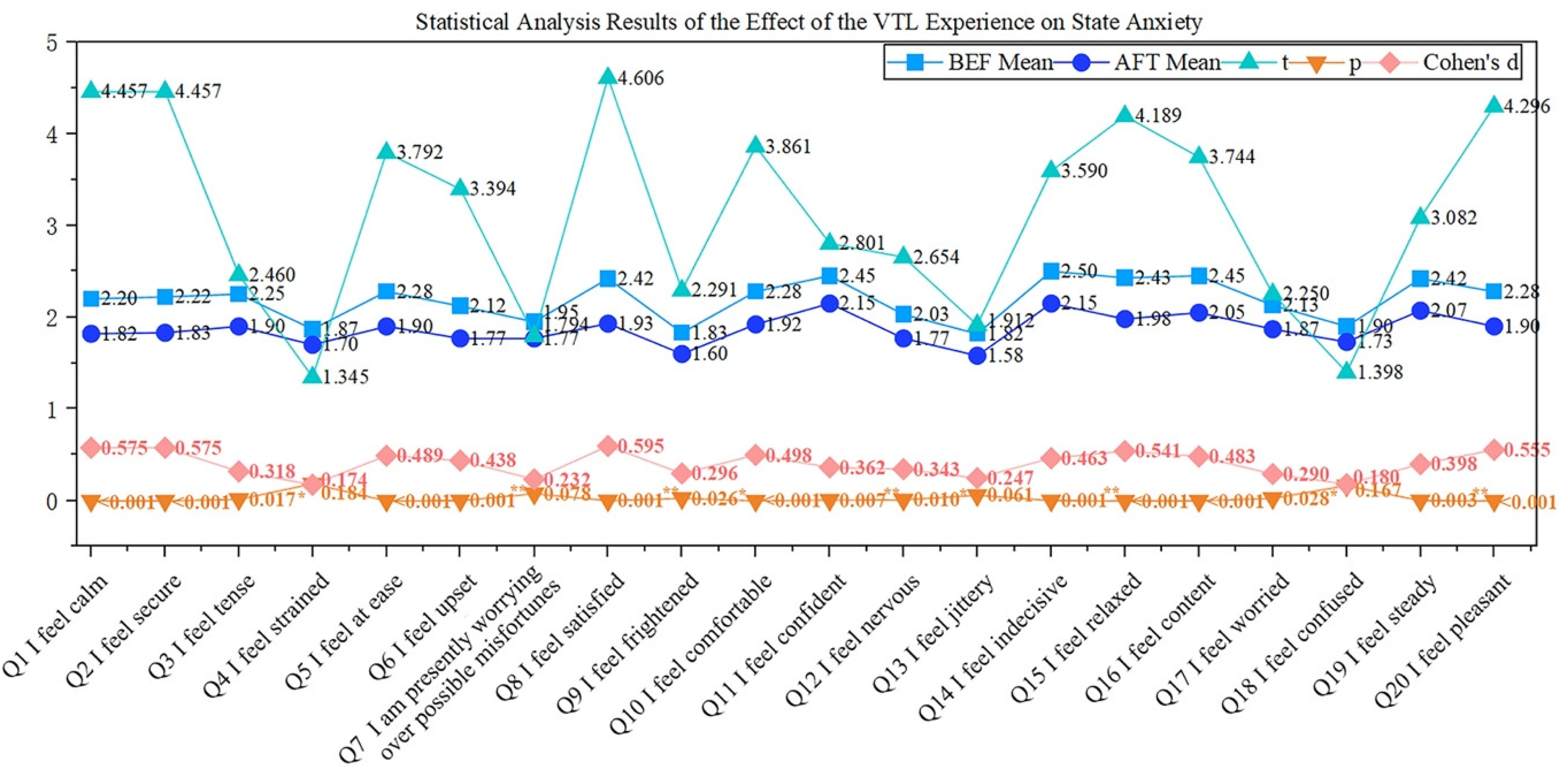
Statistical analysis of VTL experience on state anxiety relief. AFT: after the experience; BEF: after the experience; VTL: virtual therapeutic landscape.
Statistical analysis results of the VTL experience on state anxiety relief.

Note: *p < 0.05, **p < 0.01; very small p-values reported as p < 0.001. “Difference” = BEF − AFT. Cohen's d: small 0.2 ≤ d < 0.5, medium 0.5 ≤ d < 0.8, large d ≥ 0.8. AFT: after the experience; BEF: after the experience; VTL: virtual therapeutic landscape.
In the specific analysis of the emotional dimension, participants showed score shifts on reverse-scored calmness items consistent with anxiety reduction, including “I feel calm” (t = 4.457, p < 0.001, d = 0.575), “I feel secure” (t = 4.457, p < 0.001, d = 0.575), “I feel at ease” (t = 3.792, p < 0.001, d = 0.489), and “I feel relaxed” (t = 4.189, p < 0.001, d = 0.541). These results further confirm the effectiveness of the VTL experience in alleviating participants’ state anxiety and enhancing their emotional state.
As shown in Table 3 and Figure 6, although trait anxiety typically reflects an individual's long-term emotional state and changes more slowly, the study results still indicate that the VTL experience has a relief effect on trait anxiety. The average trait anxiety score of participants decreases from 45.78 before the experience to 42.17 after, with a mean difference of 3.62, t = 6.000, p < 0.001, and Cohen's d = 0.775, showing a medium-strength intervention effect at the total-score level.
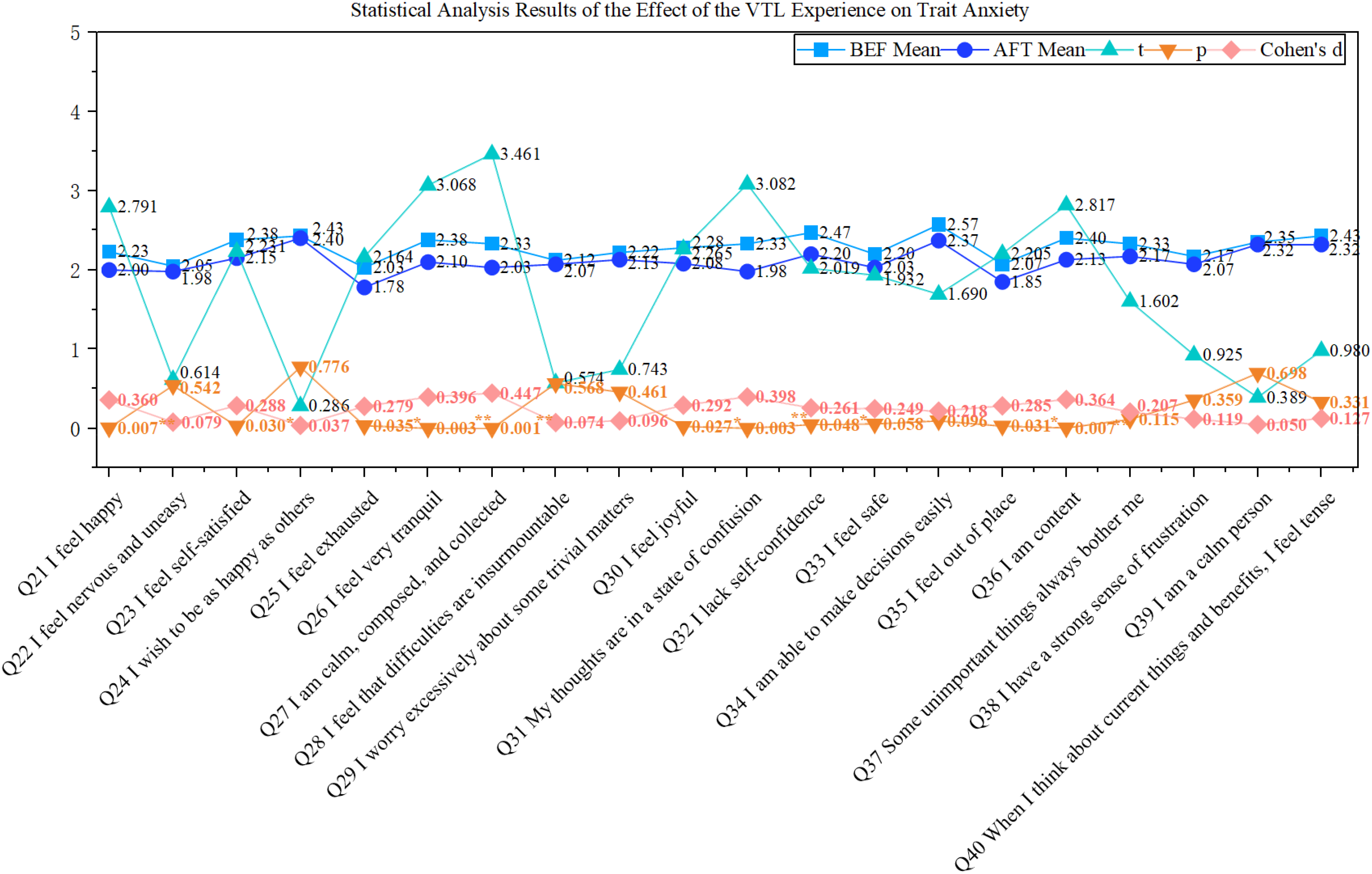
Statistical analysis of VTL experience on trait anxiety relief. AFT: after the experience; BEF: after the experience; VTL: virtual therapeutic landscape.
Statistical analysis results of the VTL experience on trait anxiety relief.

Note: *p < 0.05, **p < 0.01; very small p-values reported as p < 0.001. “Difference” = BEF − AFT. Cohen's d: small 0.2 ≤ d < 0.5, medium 0.5 ≤ d < 0.8, large d ≥ 0.8. AFT: after the experience; BEF: after the experience; VTL: virtual therapeutic landscape.
In the analysis of the emotional dimension, significant improvements were observed for “I feel self-satisfied” (t = 2.231, p = 0.030, d = 0.288) and “I feel very tranquil” (t = 3.068, p = 0.003, d = 0.396). Reductions were also evident for “I feel exhausted” (t = 2.164, p = 0.035, d = 0.279) and “My thoughts are in a state of confusion” (t = 3.082, p = 0.003, d = 0.398), indicating decreases in fatigue and cognitive disorganization. Although the trait anxiety total score showed a medium within-subject change (mean difference = 3.62; t = 6.000, p < 0.001; d = 0.775), item-level effects were predominantly small (d ≈ 0.28–0.40), consistent with the relative stability of trait anxiety under brief exposure.
Subjective vitality enhancement effect
As shown in Table 4 and Figure 7, this study evaluated the effect of the VTL experience on enhancing subjective vitality. The evaluation of subjective vitality is conducted using the SVS, which includes six items to measure an individual's sense of vitality and physiological energy. The scoring range for each item is from 1 to 7, where “1” means “almost not true” and “7” means “completely true.” Higher scores indicate a greater sense of vitality and physiological energy, while lower scores reflect a lower sense of vitality and energy.

Statistical analysis of VTL experience on subjective vitality enhancement effect. AFT: after the experience; BEF: after the experience; VTL: virtual therapeutic landscape.
Statistical analysis results of the VTL experience on subjective vitality enhancement effect.

Note: *p < 0.05, **p < 0.01; very small p-values reported as p < 0.001. “Difference” = BEF − AFT. Cohen's d: small 0.2 ≤ d < 0.5, medium 0.5 ≤ d < 0.8, large d ≥ 0.8. AFT: after the experience; BEF: after the experience; VTL: virtual therapeutic landscape.
According to the SVS results, the overall score increases from 23.33 before the experience to 26.27 after (mean difference = −2.93; t = −6.148, p < 0.001; Cohen's d = 0.794), indicating a medium to large within-subject effect. At the item level, “I feel focused and alert” and “I can forget everyday worries” improve significantly (t = −5.144 and −3.879, both p < 0.001; d = 0.664 and 0.501), and “I have enthusiasm and energy for my everyday routines” also shows a significant increase (t = −4.127, p < 0.001; d = 0.533). Other indicators show small but significant gains in restorative relaxation and cognitive clarity, whereas calm does not reach statistical significance. Overall, brief VTL exposure primarily strengthens activation-related components of subjective vitality, with secondary improvements in restorative relaxation and cognitive clarity.
Positive–negative emotion regulation effect
As shown in Table 5 and Figure 8, this study assesses the effect of the VTL experience on the regulation of positive and negative emotions. The PANAS scale consists of 20 items, with 10 used to assess positive emotions and the other 10 to assess negative emotions. The scoring range for each item is from 1 to 7, where “1” means “almost not true” and “7” means “completely true.” Higher scores indicate stronger emotional responses, with higher positive emotion scores indicating stronger positive emotions and higher negative emotion scores indicating stronger negative emotions.

Statistical analysis of VTL experience on positive and negative emotion regulation effects. AFT: after the experience; BEF: after the experience; VTL: virtual therapeutic landscape.
Statistical analysis results of the VTL experience on positive and negative emotion improvement.

Note: *p < 0.05, **p < 0.01; very small p-values reported as p < 0.001. “Difference” = BEF − AFT. Cohen's d: small 0.2 ≤ d < 0.5, medium 0.5 ≤ d < 0.8, large d ≥ 0.8. AFT: after the experience; BEF: after the experience; VTL: virtual therapeutic landscape.
In terms of positive emotions, the VTL experience shows a small enhancement at the total-score level. The overall score increased from 38.85 before the experience to 41.13 after (mean difference = −2.28; t = −2.956, p = 0.004; Cohen's d = 0.382). Item-level gains were observed for “I feel inspired” (t = −2.892, p = 0.005, d = 0.373) and “I feel active” (t = −2.045, p = 0.045, d = 0.264), whereas “I feel alert” remained nonsignificant (p = 0.925).
In terms of negative emotions, reductions were more pronounced. Participants’ negative emotion scores decreased from 31.13 to 26.35 (mean difference = 4.78; t = 4.415, p < 0.001; Cohen's d = 0.570), indicating a medium effect in reducing negative affect. At the item level, distress (t = 3.543, p = 0.001, d = 0.457), irritability (t = 4.182, p < 0.001, d = 0.540), and nervousness (t = 3.393, p = 0.001, d = 0.438) showed clear decreases; upset, guilt, jitteriness, and fear also declined significantly with small magnitudes. Overall, VTL produced a small improvement in positive affect concentrated on activation-related facets and a medium reduction in negative affect.
Based on the integrated analyses, the VTL experience yields robust short-term reductions in state anxiety, moderate decreases in trait anxiety at the total-score level with predominantly small item-level shifts, and pronounced gains in subjective vitality. Emotion regulation shows a differential pattern in which positive affect increases modestly and chiefly in activation-oriented facets, whereas negative affect declines to a medium extent, primarily via reductions in distress, irritability, and nervousness, with additional modest decreases in upset, guilt, jitteriness, and fear. Taken together, these results indicate that, under brief exposure, VTL preferentially amplifies energetic engagement and downregulates high-arousal negative states, while shifts in low-arousal calmness and in stable trait dispositions are comparatively limited.
Text mining co-occurrence analysis of open-ended responses
Text mining of open-ended responses yielded two co-occurrence networks (Figure 9). For Q1 (peak relaxation or absorption), five clusters were identified: immersion and calm, environmental comfort and low-effort entry, sound and rhythmic calming, scene and narrative, and visual and composition. Cross-cluster links from ambient sound and water sound to atmosphere and transition are consistent with the interpretation that auditory cues support attentional settling as scenes evolve. Additional bridges from viewpoint and framing toward attention suggest that compositional choices help channel where attention rests. For Q2 (design features and desired optimizations), five compact clusters were observed: narrative timing and attention guidance, scene and sensory alignment, motion pacing and risk control, personalization with effective defaults, and on-screen guidance and readable options. Links from volume and fine-tuning to soundscape, detail, and eye focus indicate that light-touch personalization improves comfort without adding interaction cost. The grouping of pacing, speed, and angle with camera and time implies that risk control is delivered primarily through system-level pacing rather than frequent user actions.

Co-occurrence network maps from open-ended responses. Left: Q1. Right: Q2. Node size indicates term frequency; edge width reflects co-occurrence strength; colors denote clusters identified by modularity-based community detection.
Taken together, the co-occurrence patterns align with a model in which coupling between sensory experience and narrative quality, supported by low-friction guidance, provides the primary design lever, while personalization moderates user comfort and fit.
Discussion
This study uses university students as the study sample, explores the potential of VTL as a psychological intervention in this population, and delineates a four-domain experiential structure—sensory experience, interaction experience, personalization experience, and content experience—supported by an expert-weighted evaluation system, with sensory experience prioritized in line with the weighting results. Together, this structure provides the theoretical basis that links design choices to measurable outcomes. The findings of this study emphasize that multisensory immersion plays a key role in alleviating anxiety and regulating emotions, with particularly significant effects observed in the immediate reduction of state anxiety. VTL, through high-fidelity sensory stimulation, enhances presence and thereby significantly reduces participants’ immediate anxiety levels. This finding aligns with the core principles of ART and the biophilia hypothesis, which suggest that natural environments, through “soft fascination,” reduce cognitive load and facilitate emotion regulation and psychological recovery.30,31 In this account, multisensory stimulation alleviates cognitive fatigue and accelerates emotional recovery, engaging involuntary attention and further supporting the positive impact of natural environments on psychological regulation. 32 Consistent with evidence from relaxation-based VR interventions and VR exposure therapy, the VTL paradigm is designed around presence as a proximal mechanism for affective improvement and uses standardized short-duration exposures with low-friction interaction experience to reduce cognitive and vestibular burden, thereby improving tolerability33–35; this approach accords with reviews and empirical studies on presence mechanisms, the effectiveness of VR for anxiety, and strategies to mitigate cybersickness.36, 37 Building on this architecture and the co-occurrence structure of open-ended responses, three levers are specified as central to presence and attentional settling: coupling between sensory experience and narrative quality, low-friction guidance that sustains attention without interaction overhead, and scene–sensory alignment achieved through luminance comfort, glare control, and coherent viewpoints. An integrated depiction of this optimized architecture is provided in Figure 10.

Integrative model for VTL design and evaluation calibrated by AHP weights and text mining. AHP, analytic hierarchy process; VTL: virtual therapeutic landscape.
In the optimized model, sensory experience and content experience constitute the design layer, whereas interaction experience and personalization experience constitute the implementation layer. This separation clarifies how high-level experience goals are translated into delivery mechanisms. Sensory experience provides the foundation and carrier for presence, while content experience prioritizes and sequences narrative elements so that visual composition and auditory rhythm converge on attentional settling. Interaction experience streamlines and consolidates user flow through on-screen guidance, readable options, motion pacing, and risk control, thereby sustaining presence without increasing interaction cost. Personalization experience provides light-touch feedback and adaptive adjustment via effective defaults and small retained adjustments. This division of labor mirrors the hierarchical weighting where sensory experience showed the highest priority and where narrative quality and low-friction interaction experience emerged as primary levers, with personalization experience acting as a moderator.
Furthermore, VTL's integration of visual, auditory, and tactile multisensory experiences may amplify the therapeutic effects. High-fidelity dynamic visual landscapes, environmental soundscapes, and light tactile simulations such as airflow and subtle temperature changes collectively create an immersive sensory experience. This multidimensional sensory integration is associated with enhanced restorative effects, consistent with existing research. 38 However, the study also found that VTL's effect on trait anxiety is relatively limited. Trait anxiety, as a more stable, trait-like disposition, is typically less responsive to brief exposures and is influenced by life experiences and personality traits. 39 Consistent with the results, STAI-State total scores improved markedly, while STAI-Trait showed small or nonsignificant item-level changes, indicating selective short-term benefits concentrated on stateful symptoms. At the item level, several STAI indicators did not reach statistical significance, suggesting that the anxiolytic effects observed at the total-score level are not uniformly distributed across all dimensions of state and trait anxiety. By contrast with clinical VR protocols designed for diagnosable conditions and often delivered under therapist supervision, the present VTL is positioned as a nonclinical, campus-compatible, low-burden option for broadly anxious student populations, emphasizing accessibility, standardization, and ease of deployment within academic routines. Within the optimized model, these integrations are operationalized as subfactors mapped to concrete design choices: visual fidelity paired with luminance comfort and glare control; soundscape quality with rhythmic contours that support breathing and timing; and narrative timing with coherent transitions and viewpoint framing that stage the locus of attention. Interaction is reweighted toward low-effort entry, readable prompts with controlled density and placement, and risk-aware pacing for motion and cuts, in order to maintain presence while minimizing vestibular load.
This study further underscores the pivotal role of VTL in emotion regulation and the enhancement of subjective vitality, with personalization acting as a moderator rather than a primary driver, which amplifies the intervention's effectiveness. Experimental results demonstrate that VTL significantly alleviates negative emotions and effectively enhances subjective vitality. By contrast, increases in positive affect were small to moderate, consistent with evidence on brief VR exposures and indicating statistically reliable but modest gains. The study also finds that VTL's effect on alleviating negative emotions is notably stronger than its effect on enhancing positive emotions. These findings align with the SRT, which posits that restorative environments address individual psychological needs, resulting in notable emotional improvements. 10 VTL's personalization experience exhibits strong adaptability, effectively catering to diverse user requirements for restorative environments. Specifically, the virtual scenes in this study, with carefully planned visual elements and environmental atmosphere, offer participants a standardized yet widely applicable therapeutic experience. Consistent with the moderating role suggested by the text-mining evidence, personalization in the optimized model emphasizes effective defaults and lightweight remembered adjustments including volume, brightness, color temperature, subtitle size, and sensitivity modes for motion and luminance, thereby supporting attentional settling without increasing interaction cost.
Lastly, narrative and cultural depth represent significant extensions within the VTL design, playing an indispensable role in enhancing emotion regulation and psychological intervention efficacy. 40 This study finds that the seamless integration of aesthetic value and contextual narrative endows the VTL content experience with deeper emotional significance and cultural resonance, successfully triggering participants’ emotional engagement and cognitive reflection. 41 This result aligns with the environmental preference model's account of complexity and mystery, highlighting the unique value of narrative and artistic elements in emotion regulation. 11 The dynamic natural changes and landscape designs with cultural educational value in the VTL experience not only strengthen immersion but also foster deeper emotional connections and reflective processing. This finding is consistent with previous studies that emphasize the facilitative role of culture and art in psychological interventions. 42 Furthermore, cultural variability in the reception of narrative and artistic elements suggests scope for improving cross-cultural applicability. Future work should evaluate adaptive narrative templates and culturally diverse cues in multisite trials to strengthen generalizability and situational fit.
Conclusion
This study systematically explores the potential of VTL as an innovative intervention for alleviating anxiety and promoting psychological well-being among university students. The findings suggest that VTL may help reduce state anxiety, enhance subjective vitality, and improve emotional regulation, highlighting its potential as a useful tool for mental health interventions in high-stress environments. On a theoretical level, this study formalizes TL theory by integrating it with VR technology, offering new insights into how multisensory experiences, low-friction interaction experience, and narrative elements work synergistically to foster psychological restoration. The development of a four-domain, expert-weighted design framework, which incorporates sensory experience, interaction experience, personalization experience, and content experience, provides a fresh perspective on the design of immersive therapeutic environments. Across psychometric endpoints (STAI, SVS, PANAS), convergent short-term improvements indicate a coherent restorative signal under standardized 5-min exposure in a single-group pre–post design (n = 60), while text-mined user evidence clarifies the experiential pathways through which these changes likely arise and supports the optimized model in which sensory and content experiences form the design layer, interaction and personalization experiences form the implementation layer, and three levers—coupling of sensory experience with narrative quality, low-friction guidance, and scene–sensory alignment—operate with personalization as a moderator.
However, the study has certain limitations. First, the evidence pertains to short-term, preliminary effectiveness only. Second, the sample was drawn from a single comprehensive university in Zhejiang Province, which reduces generalizability. Multi-site studies with more diverse student populations are therefore needed. Additionally, while the design emphasizes high-fidelity visual and auditory experiences, other sensory channels, including olfaction and enriched tactile cues, remain underexplored, which may constrain immersion and therapeutic impact. Furthermore, while VTL effectively alleviates negative emotions, improvements in positive emotions, though statistically reliable, were small to moderate in magnitude, whereas reductions in negative affect were stronger. This suggests that future research could focus on optimizing narrative content and emotional resonance within the VTL environment to better stimulate positive emotional responses. Additionally, incorporating real-time adaptive feedback based on individual psychological data could further personalize the intervention, leading to more effective and targeted mental health outcomes. Future work should therefore prioritize randomized or otherwise controlled, multi-site trials with extended follow-up to assess durability, improve generalizability, and evaluate implementation across varied campus contexts.
In conclusion, VTL presents a promising and innovative tool for mental health interventions, particularly in alleviating anxiety and regulating emotions. By overcoming the current limitations and continuously refining the multisensory and personalized aspects of the experience, VTL has the potential to meaningfully augment mental health management, offering a scalable and flexible solution for mental health challenges in a variety of settings. It should be regarded as a complementary, low-burden option that can be integrated with existing campus services, with scalability and repeatability as its principal advantages.
Footnotes
Acknowledgments
The authors would like to extend their sincere gratitude to all participating students for their cooperation and dedication during the study. Special thanks are due to Associate Professor Guangzhu Zhang, Associate Professor Kai Yu, Dr Shuping Yang, and Dr Liang Du for their professional support and invaluable contributions to this research. The VTL scenario was developed in Unreal Engine 5 using the “Nordic Conifer Biome” environment asset (Pixelgoat Store, Epic Games Fab/Unreal Engine Marketplace, Standard License) as the primary natural forest base. Their expertise and these high-quality assets were instrumental in shaping the outcomes of this work.

Ethical approval
This study has been ethically approved by the Ethics Committee of the Department of Science and Technology Management at Zhejiang University of Finance and Economics Dongfang College (No. DFL20231215003), and informed consent was obtained from all participants.
Contributorship
Yi-Tong Cui was primarily responsible for the conceptualization of the study, experimental design, and the drafting of the manuscript. Wenwen Shi played a key role in creating illustrations, revising the manuscript, and providing guidance during the experimental process. Weicong Li contributed significantly to the conceptualization of the study and provided insights on structuring the article. Boshen Hu and Yihong Liu assisted with the execution of experiments and contributed to data collection. Yun Qian supported the study by helping with experimental logistics and providing feedback on the results. Haidong Xi was responsible for data processing and analysis, ensuring the accuracy and consistency of the findings presented in this study.
Funding
The authors disclosed receipt of the following financial support for the research, authorship, and/or publication of this article: This work was supported by the Zhejiang Provincial Philosophy and Social Sciences Planning Project (No. 26NDJC062YBM), the Scientific Research Fund of Zhejiang Provincial Education Department (No. Y202455732), and the Zhejiang Province Higher Education Undergraduate Teaching Reform Project during the 14th Five-Year Plan period (No. JGBA2024792).
Declaration of conflicting interests
The authors declared no potential conflicts of interest with respect to the research, authorship, and/or publication of this article.
Data availability statement
Data will be made available upon reasonable request.