




Abstract
The five senses are gateways to our wellbeing and their decline is considered a significant public health challenge, which is linked to multiple conditions that contribute significantly to morbidity and mortality. Modern technology, with its ubiquitous nature and fast data processing, has the ability to leverage the power of the senses to transform our approach to day-to-day healthcare, with positive effects on our quality of life. Here, we introduce the idea of ‘sensory-driven micro-interventions’ for preventive, personalised healthcare. Micro-interventions are targeted, timely, minimally invasive strategies that seamlessly integrate into our daily lives. This idea harnesses humans’ sensory capabilities, leverages technological advances in sensory stimulation, and real-time processing ability for “sensing the senses.” The collection of sensory data from our continuous interaction with technology (e.g. tone of voice, gait movement, and smart home behaviour) opens up a shift towards personalised technology-enabled, sensory-focused healthcare interventions, coupled with the potential of early detection and timely treatment of sensory deficits that can signal critical health insights, especially for neurodegenerative diseases such as Parkinson's disease.
Keywords
Introduction
In our daily lives, we continuously process sensory information. Our main senses, smell, sight, hearing, touch, and taste, are essential for daily functioning and health maintenance. They constantly gather cues and send them to the brain, where they are processed, enabling us to perceive and interact with our surroundings. 1 These senses do not operate in isolation, instead, they blend together to provide a richer representation of the world we live in. 2 As such, sensory experiences profoundly influence our behaviour, decisions, and emotions, 3 and shape our memories. Imagine how different your memories would be, if you experience the world without seeing? Reduced or no vision and hearing impairments can significantly diminish everyday experiences, social interactions and overall quality of life. 4 Perhaps less apparent are the effects of dysfunctions on our sense of smell, taste and touch. What would eating be like if you couldn't smell the flavours or savour the seasoning? Beyond impact on day-to-day interactions, disorders and the degradation of these senses also possess significant health and wellbeing challenges to those affected. 5 Interventions such as olfactory training have proven positive effects on olfactory functions, 6 smell rehabilitation and promise additional benefits to counteract the natural decline of the sense of smell in older age. 7
Sensory-impaired populations are more prevalent than one might think. For example, 5% of people are thought to have anosmia, the inability to smell, with around 20% facing some form of smell disorder. 8 This number rises to 75% for people aged between 70 and 80 years.8,9 With the increasingly ageing world population, the number of people affected by sensory deficits continues to increase. Taste, smell and tactile sensitivity, 10 proprioception, 11 vision 12 and hearing 13 all deteriorate with age. Most importantly, these sensory deficits contribute to morbidity, disability and mortality. 14 Given their profound impact on health and wellbeing, the timely identification of any deterioration in sensory perception and intervening, where possible, to slow the decline can have a profound impact on people's lives.
The early diagnosis of sensory decline can also support practitioners in the prompt identification of and intervention for several conditions that manifest as a decrease in sensory-perceptual abilities. For example, transient ischaemic attacks (TIA) 15 brain tumours, 16 multiple sclerosis (MS) 17 and diabetes 18 can all manifest in their early stages through a vision deficit. Hearing, taste and smell losses and disturbances can all be predictors of multiple neurological, psychiatric and systemic diseases, such as dementia.19–21
Speculative future scenario (part 1)
There is growing evidence of smell being an early biomarker for neurodegenerative disease development. The most common non-motor symptom in Parkinson's disease patients is smell (olfactory) impairment, occurring at least 4 years prior to motor symptom onset. 22 While we cannot avoid this disease developments, regular sensory assessments can enable early detection and diagnosis. Thus, offering the growing ageing population the opportunity for a longer independent living and timely treatments. This can start with self-care and an increased awareness about the senses in everyday life, such as illustrated in Figure 1.

Speculative scenario (see detailed narrative in the box below) where regular smell training (middle round visual) enabled an early identification of Parkinson's disease. Smell training is only an example of an early sensory stimulation approach that is relevant for the broader sensory-driven micro-intervention approach. Illustration credit: Ana Marques.
In this future scenario the main character Emma was diagnosed with Parkinson's disease early on, enabled by regular self-monitoring of her olfactory functions, and the integration of her olfactory training data with her healthcare records. Despite growing scientific evidence on the importance of sensory data in relation to early diagnosis, detection and treatment of disease development, we still lack clear guidance on how to harness sensory-driven data for efficient health innovation. In this article, we offer a perspective on a future-looking preventive, personalised healthcare approach: sensory-driven micro-interventions. This approach is increasingly made feasible due to technological advancements in digital health innovations, including the emergence of sensory devices and interfaces that go beyond assessments of visual and hearing capabilities, 23 as well as the undeniable potential of artificial intelligence (AI) and connected sensor and Internet of Things (IoT) systems. Those technologies offer real-time data collection and processing infrastructure, personalisation through machine learning algorithm, and a unique ecosystem for embedding sensory-driven micro-interventions.
The importance and effectiveness of micro-interventions
Micro-interventions refer to small, targeted actions or treatments of very short duration, often repeated over time, either with regular cadence or triggered by specific conditions in the patient, aimed at addressing specific health issues, improving patient outcomes, or enhancing the delivery of healthcare and mental health and wellbeing services.24,25 Micro-interventions vary in depth, duration and timing of content delivery. In the form of few, short breathing exercises at strategic moments, they have been shown to help managing stress and increase mindfulness. 26 As video-guided gratitude and mindfulness tasks, micro-interventions have been proven to increase body satisfaction. 27 As memory recall exercises executed before sleep, they have been shown to significantly decrease the occurrence of bad dreams in subjects. 28 People often unconsciously seek micro-interventions in everyday situations, such as playing an uplifting song. It has been shown that music-based micro-interventions can effectively reduce stress, and are associated with decreased physiological arousal, cortisol levels and heart rate. 29 Micro-interventions have shown considerable efficacy in psychology, particularly in enhancing mental health and fostering behavioural change. 30
Unlike broad, systemic interventions or major surgical procedures, micro-interventions are often subtle, focused and less invasive. They can play a significant role in preventative care, early treatment and patient management, especially in chronic diseases or in improving patient experiences within healthcare systems. 31 Specific types of micro-interventions, called ‘Just-in-Time Adaptive Interventions’ involve resources that are quick to consume and are designed to elicit an immediate positive response, aligned with moments of greatest risk. 32 Other types of micro-interventions are less strict when it comes to the timing of the intervention delivery, 27 but still maintain their easy-to-access and quick-to-consume characteristics. Despite this promising work, micro-interventions remain under-researched in healthcare and wellbeing, and do not leverage the potential inherent in sensory interaction and perception.
The potential of ‘sensory-driven’ micro-interventions in digital health
Beyond traditional micro-intervention approaches, we reflect here on the opportunities sensory-driven micro-interventions can offer for improved health and wellbeing outcomes. In clinical practice, many interventions consist of delivering sensory stimulation to patients, divided into three main categories: sensory training, sensory substitution and sensory integration therapy. In sensory training, sensory stimuli can be used to restore perceptual abilities that have been damaged by ageing or underlying diseases. For example, delivering prolonged mechanical noise in neuropathic patients has been shown to improve their ability to perceive tactile stimuli, 33 in turn improving their motor skills 34 and posture. 35 Furthermore, sensory training has been exploited to improve the action-perception loop 36 by providing exercises focused on strengthening proprioception, 37 visual processing 38 and balance. 39 Finally, it is important to highlight that, while the body of work on training chemical senses is somewhat less developed, smell and taste have also been trained with success in healthy adults, improving stimuli discrimination and recognition.7,40 For example, smell training using odours can improve olfactory functioning 6 and digital solutions are developed to enable self-monitoring at home. 7
Next to sensory training, a single sense may not be as effective as providing complementary information through another sensory modality. Hence, the second treatment category refers to sensory substitution that acts by replacing or complementing information typically conveyed by one sensory modality to another, for example based on correspondences between vision through sound. 41 It is widely known that sensory substitution has been used in translating visual stimuli to acoustic and tactile ones, to aid visually impaired subjects in reading tasks. 42 Recently, sensory substitution has become more reliant on technology, with systems detecting and analysing stimuli from one sense and translating them into another. 43 For example, technology-powered sensory substitution systems can now use tactile stimuli to replicate pictures 44 or use spatialised sound to enhance three-dimension (3D) perception. 44 Sensory substitution has also been used to provide compelling musical experiences for individuals with hearing dysfunctions through exploring the use of colours and haptics to ‘translate’ musical experiences 45 while other researchers use vibrations to ‘feel’ musical performances. 46
Finally, sensory stimuli can be delivered as part of a treatment for many developmental, neurological and psychological conditions, in what has been called sensory therapy or sensory integration therapy (SIT). 47 SIT can take various forms, delivering different sensory stimuli across different sensory modalities, often to enhance attention, 48 helping to manage emotional reactions 49 and improve social skills. 50 In fact, sensory therapy strategies fit the short delivery, easy-to-consume paradigm which is the trademark of micro-interventions. Songs, which only last a few minutes, have been used in the past as guise of micro-interventions to manage stress 29 and several studies showed how just a few minutes of tactile stimulation can deliver benefits in managing emotions to patients of different age groups, although the benefits may be reduced compared to prolonged stimulation. 51
As suggested, sensory training, sensory substitution and SIT can all be adapted to a micro-intervention format. Their effectiveness, delivery methods and target populations can vary widely within each category, depending on who designs the specific micro-intervention. However, sensory micro-interventions tend to share common features within their type. Sensory training and sensory substitution are more often initiated in response to identified sensorimotor deficits, whereas SIT is typically linked to psychological interventions. Micro-interventions based on SIT and sensory substitution are usually introduced timely when the deficit is detected, while training-based micro-interventions are repeated adaptively throughout the day to integrate seamlessly into a person's daily routine.
Notably, almost all the micro-interventions delivering sensory stimuli as therapy act towards the psychological wellbeing of the users. In other words, micro-interventions that deliver sensory stimuli to users heavily focus on ‘sensory integration therapy’, with no examples of using micro-interventions for ‘sensory training’ and ‘sensory substitution’.
This article puts an emphasis on those often overlooked and neglected treatment approaches for preventive and personalised healthcare. Technological advancements increasingly allow us to reflect upon and speculate about the future opportunities of detecting patterns that stem from deviations in sensory and perceptual capabilities, as well as for delivering short, timely stimulation to tackle sensory deficits either through training or sensory substitution. These speculations are grounded in the growing ability of ‘sensing the senses’ and ‘intervening for the senses’ through technological advancements enabling digital micro-interventions.52,53
Micro-interventions for sensory training and substitution
Those micro-interventions can deliver personalised sensory stimulation for training and substitution accounting for personal preferences, variation in perceptual thresholds and aligned with daily routines to generate bespoke sensory protocols for each individual and to maximise health and wellbeing outcomes. For example, hearing impairments could be picked up by virtual assistants analysing the voice of the users. 54 Smart home sensors and phone data could then be used to analyse the user's day and design a suitable sensory training regime to slow down hearing loss that fits the user's schedule (e.g. integrated with daily meditation sessions). The system could also alert users when a visit to a healthcare professional if necessary. Additionally, the assigned healthcare professional could be notified to review any anomalies in the data and determine whether an in-person visit or continued remote monitoring with further data collection would be more beneficial. This approach could help reduce the strain on healthcare systems, lower costs, and conserve increasingly stretched resources.
Speculative future scenario (part 2)
If we now think back to the future scenario of Emma (see Figure 1), who was diagnosed with Parkinson's disease early on, how can we imagine her living with Parkinson's considering the benefits of the sensory-driven micro-intervention treatment she was enrolled? Here is what we collaboratively imagined as a desirable future – a day in the life of Emma (see Figure 2).
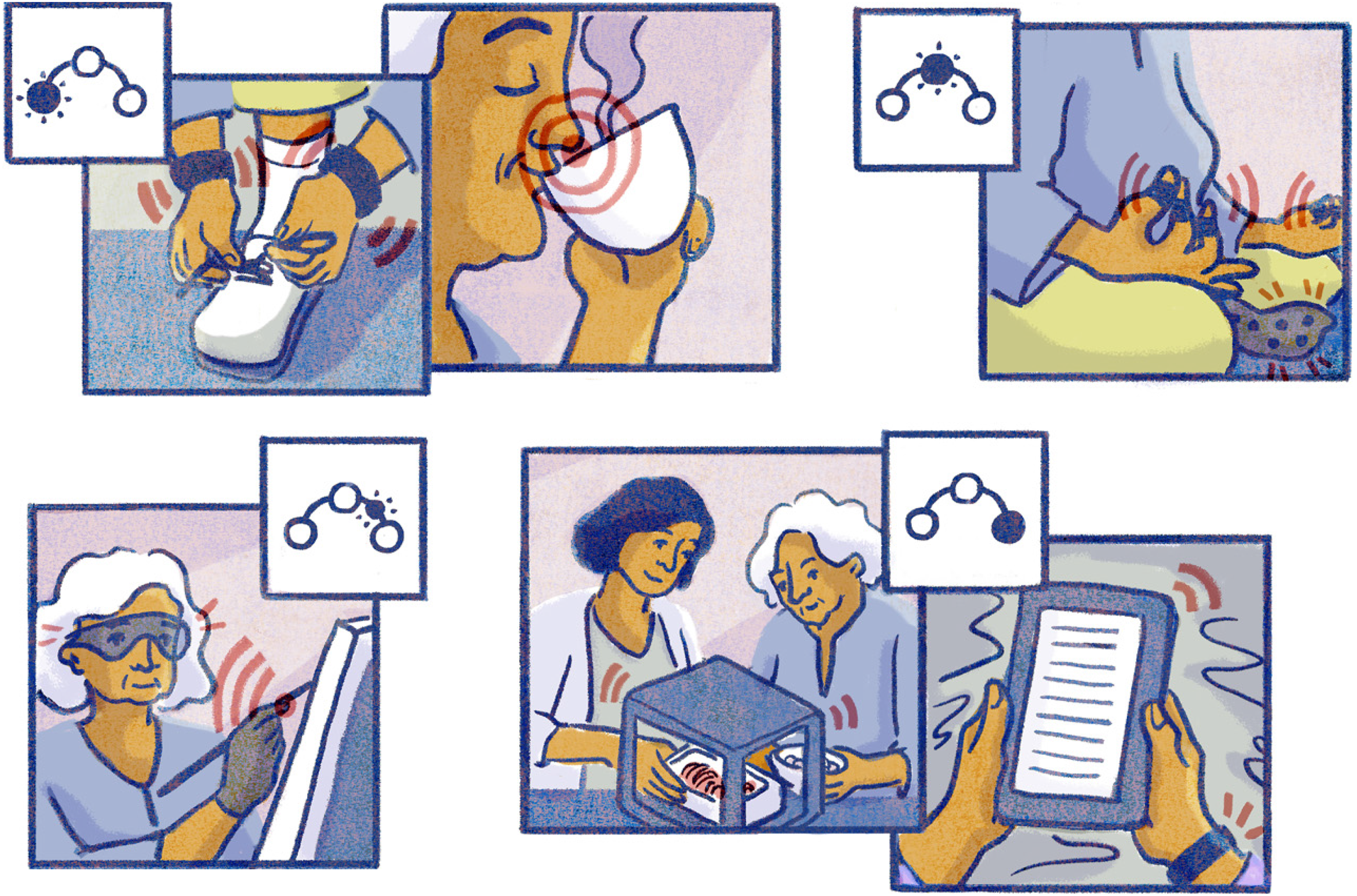
A day in the life of Emma (see detailed narrative in the box below), who is living with Parkinson's and the envisaged benefits of early sensory-driven micro-intervention enabled through technological advancements from wearables, sensory stimulation devices/interfaces, food printing and smart sensing/Internet of Things (IoT) systems. Illustration credit: Ana Marques.
This scenario depicts one day in the life of Emma. It is showing a collaborative speculation of a desirable future when living with Parkinson's disease, enabled through technological advancements and the integration of sensory-driven micro-intervention. The success of sensory-driven micro-intervention, as imagined in this future scenario (Figure 2) relies on technologies in two major ways: First for ‘sensing the senses’, the use embedded sensors and users’ interaction and behavioural data to assess the users’ sensory perceptual capabilities and, when needed, to design a pattern of interventions that integrates seamlessly with the users’ day-to-day activities and known sensory profile (continuously updated through new data points). Second for ‘intervening for the senses’, to deliver the sensory-driven micro-intervention stimulation for timely, personalised sensory training or sensory substitution. This technology could be as widespread as audio devices like headphones or earbuds, vibration patterns in smart devices, but could also be considerably more complex when involving other senses such as smell and taste, where sensory devices and interfaces are only emerging. 55 Those technologies taken together form the foundation for a personalised, continuous monitoring network and ecosystem, updated and adapted to a users’ sensory profile and training and substitution patterns and practices.
Insights from ‘sensing the senses’
Advances in technologies such as wearables, IoT, and AI offer a timely opportunity to create a holistic, sensory-driven approach to personalised and preventive healthcare. However, these technologies currently work in isolation, limiting their potential impact. To efficiently and meaningfully deliver short, targeted and personalised sensory-driven micro-interventions, we need to connect those multiple data sources to create a reliable profile of users’ perceptual and sensory abilities and interpretation of the recorded users’ behaviours and patterns over time.
For example, sensory changes, such as in a person's voice recorded through their interaction with a smart assistant, their phone, or any microphone-equipped device can provide information about their hearing abilities. Subsequently, recognition of the volume at which they speak could indicate a loss of hearing. Similarly, an increase in ambient lighting could be interpreted as a decrease in visual acuity; or a change in the gait recorded from a phone's accelerometer might suggest issues with a person's balance and repeatedly dropping objects might suggest sensorimotor issues of various natures, including tactile, proprioceptive and visual deficits. In a future smart home scenario, recordings of its smoke alarm going off repeatedly might suggest the presence of anosmia (loss of the sense of smell), potentially signalling early neurodegenerative diseases development like Alzheimer's and Parkinson's, more prevalent in older age, but also an early warning sign for other associated health and mental health issues.
These examples are only a snapshot of the data generated today through our constant interaction with technology. It is important to remember that behavioural changes related to the senses and sensory perception can have many causes. One might speak louder because of excitement, rather than because of hearing loss. Brightness could be increased in a room because something got lost and a higher than usual visibility is needed. The collection of sensory-related data therefore cannot be considered in isolation nor for single instances. Such data will need to be integrated with longitudinal data encompassing the ‘sensorial history’ of an individual, their known psychophysical condition, their transient context and their preferences. Moreover, there has to be an option for the integration of users’ subjective assessments and feedback, considering the highly subjective nature of sensory experiences and perceptual variability across and within people over time. 56 Such self-reporting features may need to be kept to a minimum and strategically placed throughout time to reduce the demand for the individual and yet offer both control and agency concerning their own health and wellbeing data.
Ability to ‘intervening for the senses’
Alongside the identification of sensory changes and monitoring those changes over time, sensory-driven micro-interventions depend on future technological innovations in the domain of sensory devices and interfaces to capture the full spectrum of humans’ sensory abilities. Devices for olfactory and gustatory stimulation are emerging 55 and have the ability to deliver sensory stimuli for all the main senses in order to train sensory capabilities and substitute for sensory deficits.
Given the transient and in-the-moment nature of these envisioned sensory-driven micro-interventions, digital solutions designed for sensory stimulation must meet specific conditions: (i) they should be portable, enabling stimulation to be delivered whenever required, often on short notice; (ii) they should be easy to use, as individuals receiving these interventions may have perceptual impairments and are likely to belong to the ageing population; and (iii) they should be adaptable and personalisable, as sensory deficits caused by cognitive impairments which can make it harder for individuals to maintain their devices. These devices should also be capable of detecting even minor deviations from a person's baseline to ensure effective and timely adjustments and actions by healthcare professionals.
Today, most sensory stimulation devices that can deliver substitutions satisfying all these conditions have been built to aid visually impaired people in navigating their environment. The white cane, for example, represents a simple, durable and portable device designed to effectively translate environmental, typically visual, information to haptic stimulation. 57 However, we also see chemosensory interfaces such as a tongue display that satisfies the portability, ease-of-use, and resilience characteristics 58 and uses electrodermal patterns delivered on the tongue to aid users’ navigation.
Traditionally, most devices substituting the sense of sight use vibrotactile feedback to communicate the presence and distance of obstacles during navigation. 59 Sensory substitution devices delivering information supplementing senses other than vision are rarer and often less portable. Virtual reality (VR) headsets can be used to supply additional visual information to support users that are hard of hearing 60 and ad hoc vibrotactile devices have been created to deliver localised information that conveys auditory experiences, 61 provide information about the environment to visually impaired users, 44 and allow for a better signal discrimination in noisy environments for hard of hearing people. 62
On the other hand, sensory training has traditionally not relied on specific devices to deliver sensory stimulation. Instead, interaction paradigms leveraging general-purpose devices, such as computers or smartphones, have been developed over time. For instance, video game-based training has been proposed as a potential method to enhance visual sensitivity and attention in users. 63 Similarly, computer applications have been utilised to improve auditory perception, often focusing on enhancing phoneme perception and discrimination. 64 In contrast, tactile sensory training has typically avoided the use of specific devices, favouring physical props such as real objects or textured surfaces. 65 A notable exception to this trend is smell training, where the controlled delivery of odours required for odour discrimination and detection has been achieved using specialised devices, digitally controlled by an app.
Opportunities and grand challenges
Sensory-driven micro-interventions have the potential to transform healthcare practice and improve the wellbeing of thousands, alleviating pressure on healthcare systems while enhancing the quality of life for a significant portion of the population. This is particularly true as challenges related to their execution are increasingly addressed through advancements in wearable and sensor systems, cloud computing and AI/machine learning algorithms. These technologies, when embedded in real-world environments, effectively navigate their inherent complexities and adapt to dynamic conditions of everyday life.
At the same time, this approach, which leverages the human senses, offers a unique opportunity to advance technology and science, as it is not without its challenges.
Challenge 1 – Sensory profiling: One challenge when deploying sensory-driven micro-interventions is the identification of sensory deficits through pattern recognition and analysis of a user's sensory history – an intriguing problem for machine and deep learning practitioners. This issue aligns with existing research in healthcare technology, where anomaly detection in user behaviour has been a focus for years. Techniques such as long short-term memory neural networks (LSTMs) and autoencoders have been widely explored to identify irregular behaviours. 66 If these methods are adapted to sensory data, which present challenge in acquisition, storage and selection, they could play a critical role in ensuring the accurate and timely delivery of sensory micro-interventions.
Challenge 2 – In-the-moment delivery: Alongside the identification of sensory impairments, a significant challenge lies in developing effective delivery devices for sensory stimulation during micro-interventions. While current technologies, such as mobile phones, are promising mediums for delivering vibrotactile, acoustic and visual stimuli, the creation of bespoke devices tailored to optimise specific sensory training or sensory substitution paradigms involving smell and taste remains in its infancy. The development of feasible, compelling and portable solutions for these chemical senses is still evolving. Notable progress has been made, particularly within the Human-Computer Interaction (HCI) research community, which has shifted from lab-based and clinical equipment towards more portable and adaptive systems, such as those designed for smell 23 and even taste. 67
Challenge 3 – Intervention design: A challenge that is less technology-focused but more healthcare-oriented lies in the development of the micro-interventions themselves. Researchers will need to design effective micro-interventions that maximise the benefits and durability of sensory training and sensory substitution. This task merges technical challenges with the real-world need for meaningful and impactful interventions, requiring a fundamentally user-centric approach to address individual circumstances, needs and preferences. As such, the creation of micro-interventions will represent a cross-disciplinary challenge, demanding collaboration across fields to ensure their success.
Challenge 4 – From innovation to adoption: Beyond technological and scientific challenges, cultural and logistical barriers must also be addressed. The acceptability of micro-interventions both by the wider public and healthcare professionals will likely depend on the perceived security of the monitored data used to identify sensory decline. Adherence to sensory training programmes will hinge on the usability of the devices and the thoughtful design of training protocols. Critical questions about data integrity, control over data flow and access must also be considered when designing the ecosystem for sensory-driven micro-interventions. Beyond simple biomedical models, a broader lifecourse-informed model to healthcare should be considered, fostering the ‘preventive’ approach as we also tried to illustrate in our speculative future scenario (Figures 1 and 2).
Challenge 5 – Privacy, equity and regulatory readiness: A further challenge lies in responsibly managing the continuous ‘sensorial history’ data required for sensory-driven micro-interventions. These longitudinal, highly personal records must comply with General Data Protection Regulation (GDPR) and Health Insurance Portability and Accountability Act (HIPAA), demanding privacy-by-design approaches, clear user consent and options for local or on-device data processing to limit exposure of sensitive health and behavioural signals. At the same time, ensuring equitable access is critical: the advanced multi-sensory technologies imagined in future scenarios may be cost-prohibitive, requiring lower-cost implementations using smartphones, wearables, and simple haptic or olfactory interfaces. Adoption will also depend on regulatory feasibility, while self-care apps may qualify as EU Medical Device Regulation (MDR) Class I or Food and Drug Adminstration (FDA) ‘general wellness’, diagnostic or therapeutic systems providing adaptive stimulation could require higher-risk MDR Class IIb/III or FDA 510(k)/De Novo/Premarket Approval (PMA) pathways. These routes imply more extensive safety evidence, cybersecurity assurances and cost-intensive validation, underscoring the need for early regulatory and reimbursement planning to make large-scale deployment realistic.
Conclusions
In the current era, the widespread availability of digital technologies has significantly simplified the application of digital micro-interventions. For instance, smartphone applications enable the timely delivery of interventions, addressing critical needs at pivotal moments, 52 while web-based platforms have increased treatment accessibility at a lower cost. 53 Furthermore, with the continued advancement of AI, IoT, wearable sensor and sensory systems, and their increasing integration into daily life, sensory-driven micro-interventions can seamlessly become part of everyday routines. This empowers individuals to fully harness their senses to achieve specific health and wellbeing goals and healthcare professionals to keep track of any anomalies early on. While challenges persist, the moment is ripe to tackle them, advancing the design of bespoke devices and intervention to bring sensory micro-interventions to everyone. We envision a future where our senses are sharpened, trained and unlocked to transform health strategies, enhance wellbeing and improve quality of life outcomes as we age.
Footnotes
Acknowledgements
The authors would also like to thank Ana Marques for creating the wonderful illustrations for the manuscript.

Ethical approval
Not applicable.
Contributorship
M.Ob. and M.Or. initially coined the idea of sensory-driven micro-interventions with support by EG but YA become the main lead of the manuscript write up, synthesising the multiple discussions and feedback on the manuscript development, closely supported by EG. All authors contributed to the final manuscript through.
Funding
The authors disclosed receipt of the following financial support for the research, authorship, and/or publication of this article: Funding support from a UCL Research Excellence Scholarship for Y.A. and the British Academy, PPHE25\100379, for M.Ob.
Declaration of conflicting interests
The authors declared the following potential conflicts of interest with respect to the research, authorship, and/or publication of this article: M.Ob. is Chief Scientific Officer (CSO) and co-founder of Hynt Labs Limited, developing digitally controlled multi-channel scent-delivery devices that are validated for smell testing and olfactory training.
Peer review
Dr. Kelsey, Lau-Min, Harvard Medical School reviewed this article.