




Abstract
Objectives
The present study aims to identify the key challenges related to information security and confidentiality in health chatbots, extract relevant solutions, and propose a conceptual model to ensure secure and confidential data management within such systems.
Methods
To achieve the study's objectives, a scoping review was conducted. This phase focused on identifying reported challenges and proposed solutions in prior studies regarding information security and confidentiality in health chatbots. In this context, we selected English-language articles in international journals and conferences related to information security and confidentiality in health chatbots. After that, relevant international frameworks, studies, and guidelines on information security, confidentiality, and privacy were systematically reviewed and analyzed and then, a conceptual model was created which was further developed and refined through validation by a panel of experts.
Results
Out of 1233 articles screened, 16 met the inclusion criteria. Recurring challenges in health chatbots, such as breaches of privacy, no transparency, incomplete consent, technical issues in data handling, lack of legal frameworks, and emerging threats, were identified in the results. The literature suggested measures like encryption, risk management, access control, standardization, and regular evaluations. Based on international frameworks, a comprehensive conceptual model with four key dimensions was developed, integrating software, hardware, and middleware layers to improve data security and confidentiality.
Conclusion
These findings can benefit users, health practitioners, the regulatory authorities, and chatbot developers who want to increase the safety and credibility of health chatbot systems.
Introduction
Recognizing intelligent systems and artificial intelligence (AI) as foundational elements of contemporary services and applications is widely used as a means of supporting individuals in their various activities. 1 An area with immense growth potential is the use of AI technology in chatbot development. A conversational agent, or chatbot, is a program that engages users in conversation by emulating a person's speech through AI technologies like natural language processing and machine learning. All kinds of businesses such as those in e-commerce, healthcare, and finance, as well as education, benefit greatly from the efficiency and ease that these bots provide. 2 Interactions with a human to a chatbot can occur in a voice, text, or a mix of both. The systems try understanding a user's queries and respond in an expected manner. At their core, chatbots are essentially input-output systems programmed to provide output, either text or speech, in a natural and user-friendly manner. Because of this, chatbots are seen by many businesses as effective tools to improve customer service and interrelations. From the perspective of the businesses, the primary benefit of chatbots is cost reduction. As repetitive processes are automated, employees can concentrate on more complicated, value-generating tasks. 3
The use of artificial intelligence (AI) in medicine and healthcare is one of the most active and practical fields. In medicine, the adoption of technologies is expanding AI in medicine. Among these technologies, chatbots (or conversational agents) have been increasing employed to provide supportive healthcare services. 4 There are several health-related areas where the use of chatbots.5,6 Chatbots in healthcare can provide information on symptoms and management, schedule appointments, and provide reminders of medications. Another use involves chatbots in behavior modification for the patients to adopt a healthy lifestyle or chronic condition management. 7 In terms of healthcare, chatbots designed to provide optimal support in appropriate, timely situations and social contexts can help modify behavior, e.g., smoking cessation, chronic condition monitoring, and proactive care assistance5,6 Due to the high price and scarce availability of healthcare services, more and more people seek medical treatment on websites and smartphone applications. AI-powered chatbots are increasingly being adopted on these platforms. Often these chatbots use large language models (LLMs), which are the next generation of internet searches. The availability of these tools has further renewed the interest concerning the employment of AI technology in healthcare. Through the elimination of simple and repetitive works, conversational agents can alleviate physician burnout and enhance efficiency. 8
On the converse, to access the advantages of health chatbots, users need to sign up and give their information, which includes sensitive health information. As a result, the increasing popularity and usage of health chatbot applications has exacerbated their security and privacy concerns. 9 As noted before, every conversational agent is intended to minimize human contact. There is literature describing the use of chatbots during emergencies, such as the COVID-19 mandates and with the provision of ease in human resource allocation and process. Crisis does expose the patients to more personal and fearful information. These inputs can also be used by chatbots to “understand users better,” which poses even greater privacy and security concerns. People do not understand how their sensitive information is acquired through various methods, which include a lack of transparency regarding the processes of collection, storage, utilization, and sharing.3,8,9
Current-day chatbots face other unmatched challenges such as lack of advanced tailoring capabilities, absence or unreliability of real-time monitoring, minimal reporting and customization for physicians, lack of comprehensive integrative mechanisms, restricted inter-system resource sharing, and fragmented knowledge transfer. Most of these problems stem from the rigid frameworks prevalent in most works. In addition, chatbot administration often utilizes a consolidated approach to data organization, making persistent adherence to privacy protocols exceedingly difficult. Data gathered during chatbot interactions is extremely sensitive, therefore necessitating that users regain control over their personal data. This empowers users while ensuring compliance. 1 Privacy in AI systems incorporates ethical and legal frameworks as well as user trust; therefore, it should not be neglected the responsible, ethical, and compliant development and implementation of AI systems, data trust policies support user trust and the overall success, acceptance, and resilience of these technologies. Focusing on the intersections of privacy and data security relating to chatbots, we can identify a few essential issues: ethics, compliance, trust, data quality, and preventing malignancy. 10 Any security-related concern can broadly be categorized into two big buckets: threats and vulnerabilities. A security threat is some foreseeable risk that could impact an entity and its ecosystem. Computer security threats include spoofing, tampering, repudiation, information disclosure, denial of service (DoS), privilege escalation, and many others.3,11
Many people are now paying close attention to information security issues. In relation to chatbots, one of the foremost concerns is securing sensitive user information. As chatbots are implemented in more businesses and use cases, the amount of personal information shared through these systems keeps increasing. Thus, these systems become an even greater target for cybercriminals.
2
The digitalization of healthcare processes has markedly increased the creation and analysis of healthcare data. Therefore, there is more focus on the areas of security and privacy of mobile health (mHealth) applications. Most publicly available mHealth applications, however, do not have adequate security and privacy safeguards during the critical phases of data collection, storage, or processing. For these issues, some recommendations have been formulated for mHealth application developers regarding secure mHealth application development. Additionally, security and privacy testing frameworks have also been introduced.
12
Although security and privacy in mHealth applications have been discussed briefly in various studies,13–15 there remains a noticeable gap in the literature focusing specifically on conversational agents in healthcare. For example, Dastani and Mohseni briefly addressed privacy concerns within the broader scope of ethical challenges, highlighting that ensuring ethical use of AI in medicine -including data privacy, bias, and accountability- poses significant challenges that must be addressed.
14
This study was on the ethical challenges of AI in medicine and examined privacy in general. Instead, health chatbots have specific characteristics (such as direct interaction with the patient, collection of sensitive data in real time, lack of transparency in data storage, and dependence on LLMs). Therefore, the findings of that study are not fully generalizable, and there is a need for a dedicated study on health chatbots. However, to the best of our knowledge, no study has explicitly focused on the security and confidentiality of health-related conversational agents powered by chatbot technologies. While privacy and security models have been developed for various technologies, such models appear to be lacking in the context of health chatbots.16,17 These limitations highlight the need for a dedicated study on security and confidentiality in health chatbots. Although there is a growing number of studies that have focused on data security and privacy in both mHealth applications and general AI systems, very few comprehensive, future-oriented, model-based studies have been carried out with a special focus on privacy and security challenges presented by AI-driven health chatbots. Much of the existing literature merely views these systems as an extension of traditional mHealth platforms, failing to give due consideration to the real-time user interaction, dynamic data flows, and reliance on LLMs. This has very much narrowed the scope for developing systematic frameworks that could guide secure and confidential deployment of such chatbots within a healthcare context. On the other hand, despite studies having reviewed the security, privacy, and confidentiality challenges in health chatbots,18–26 most of them have provided general analysis and have not presented comprehensive conceptual models or integrated frameworks for managing the security, privacy, and confidentiality of sensitive user data. Particularly, no previous study has yet presented a comprehensive conceptual model that can ensure data security and privacy in health chatbots, and the existing solutions often remain fragmented and domain-specific. Therefore, the objective of the present study is to identify the challenges related to information security and confidentiality in health chatbots, extract corresponding solutions, and propose a conceptual model aimed at ensuring secure and confidential information handling in health chatbot systems. To achieve this, the following objectives are addressed:
To identify the security and confidentiality challenges in health chatbots and solutions to overcome them To propose a conceptual model for ensuring information security and confidentiality in health chatbot systems.
Methods
To achieve the objectives of this study, a two-phase approach was undertaken as follows: First, through a scoping review, existing studies on information security and confidentiality in health chatbots were examined to identify relevant challenges and corresponding mitigation strategies. In the second phase, aiming to propose a conceptual model for ensuring information security and confidentiality in health chatbot systems, international regulations, guidelines, and standards from reputable organizations were extracted and analyzed. Based on these findings, a conceptual model was developed by the authors and subsequently validated through an expert panel. Informed consent was obtained from all participants of the expert panel prior to their involvement. The details of each phase are explained in the following sections.
Scoping review of security and confidentiality challenges and mitigation strategies in health chatbots
The first purpose of the study was to identify pertinent literature, and for that, a scoping review was conducted on the databases PubMed, Scopus, IEEE Xplore, and ACM Digital Library without any time constraints. The retrieval process was done using keywords on the concept of security (Information Protection, Data Protection, Data Security, and Cybersecurity); confidentiality (Confidential Information, Privacy, and Confidential Data); the field of healthcare (Health, Medical, and Health); and chatbots (Chatbots, Chat Robots, Conversational AIs, and Virtual Agents). Boolean operators, truncation symbols, phrase searching, and other filters were creatively used to facilitate thorough and exact retrieval of the pertinent articles. Standardized keywords were selected based on Medical Subject Headings (MeSH) and terms used in related studies. In addition to automated electronic searches, backward snowballing was used to identify further relevant studies by reviewing the reference lists of retrieved articles. A sample of the search strategy is provided in Appendix A. This Scoping Review has been registered in the PROSPERO database with registration number CRD420251084354.
Selection process
After retrieving sources based on the search strategy, duplicate studies were first removed. Then, titles, abstracts, and full texts of the articles were independently reviewed by two researchers according to the study's inclusion and exclusion criteria, and irrelevant sources were excluded. In case of disagreement in article selection, a third reviewer was consulted for the final decision. This study included English-language articles published in international journals and conferences focusing on the challenges of information security and confidentiality in health chatbots. Studies were excluded if they met any of the following criteria: (1) observational studies, letters to the editor, short reports, posters, and newspapers; (2) articles without full-text availability; and (3) articles addressing chatbots outside the healthcare domain. Any disagreements that came up during the screening and selection of studies by the two reviewers were solved through discussion and consensus. In cases where consensus could not be reached, a third reviewer was consulted for the final decision.
Data collection, extraction, and synthesis
In this study, a data extraction form was used to collect information from the relevant texts. The form included components such as the author's name, study title, year of publication, country, security challenges, confidentiality challenges, proposed solutions for security, and proposed solutions for confidentiality. The data extraction form was designed using Excel 2016 software. Extracted data from the related articles were analyzed using a meta-synthesis approach and organized and classified into tables and charts. The synthetic report mainly followed the PRISMA Extension for Scoping Reviews (PRISMA-ScR) guidelines. After extracting concepts from selected studies, thematic analysis was conducted for categorization. Thematic synthesis was conducted in three main steps: line-by-line initial coding of the extracted data, organization of codes into descriptive themes, and development of analytical themes that reflected higher-level patterns and associations. All coding and synthesis were done manually and independently verified by two reviewers to ensure consistency and reliability.
Conceptual model for ensuring information security and confidentiality in health chatbots
In order to accomplish the study's second objective, the research team first gathered and classified information pertinent to laws and policies regarding information security and confidentiality. This includes HIPAA regulations, NIST security and privacy controls for information systems and organizations, the GDPR of the European Union, the Center for Internet Security Critical Security Controls for Effective Cyber Defense, and ISO/IEC 27001 standards. Formulated conceptual models were iteratively developed and then refined through an expert panel for evaluation. The expert panel consisted of seven specialists in the fields of digital health, information security, legislation, chatbot development, medical ethics, health information management, and medical informatics. These professionals represented academia, healthcare institutions, and technology companies. Their ages ranged from 32 to 58 years, with a mean of 44.6 years. There were four men and three women among the specialists. All experts had between three and twenty years of professional experience and held positions such as faculty members, cybersecurity officers, senior system designers, and health data governance specialists. This multidisciplinary composition ensured a balance in theoretical, practical, and technical perspectives, thus enhancing the evaluation process. The sampling method was purposive non-random sampling, selecting experts with a minimum of three years of relevant professional experience.
For the evaluation, a questionnaire containing eight closed questions using a Likert scale and one open-ended question for expert feedback was used (Appendix B). Prior to the panel meeting, the questionnaires along with the designed conceptual model were sent to the experts via email. After one week, the panel convened to review, critique, and finalize the model. Qualitative data from open-ended responses and panel discussions were analyzed using a systematic thematic analysis approach. Open coding, to identify recurring concepts within experts’ feedback, was performed independently by two members of the research team. Codes were compared, combined, and organized into broader themes through consensus-based discussions. These directly informed the subsequent refinement and restructuring of the conceptual model. The quantitative data from Likert-scale items were summarized descriptively.
Results
Overview of included studies
After the initial search, 1233 studies were identified from the databases. Following the removal of duplicates, 922 articles were screened based on their titles and abstracts, ultimately resulting in 16 eligible studies selected for inclusion. The study selection process, based on the PRISMA guidelines, is illustrated in Figure 1. In the subsequent sections, after summarizing all articles, the study results are categorized according to the general characteristics of the selected studies, the security and confidentiality challenges identified in these studies, relevant standards and regulations for information security and confidentiality, and the proposed conceptual model for information security and confidentiality in health chatbots.

Prisma flowchart for article selection.
A summary of the general characteristics of the selected studies is shown in Table 1. From the data outlined in the table, it can be noted that the distribution of articles spans from 2017 to 2024, with the peak joint publication period occurring in 2023–2024 (n = 10). Most of the studies, however, were conducted in the United States (n = 4). Among the selected studies, 10 were review articles and six were original research studies. Regarding the application domain of chatbots, the most common use case was in the field of mental health (n = 6).
Matrix of included and characteristics of study (n = 16)

Information security and confidentiality challenges and solutions in health chatbots
In order to evaluate the security and confidentiality of information in health chatbots, the study first examined existing literature to identify reported security and privacy challenges, noting proposed solutions to those challenges (Table 1). Most health chatbots don't have adequate safeguards when it comes to the privacy of users’ information. Medical, psychological, and identifiable personal information are processed and kept on systems. Also, there was a lack of transparency regarding the data collection, storage, and usage practices of the systems, which resulted in users being inadequately informed about the data processing operations. Furthermore, the consent-collection processes, along with the obtaining of consent from users, were incomplete in an informed consent context. Consent forms were generally long and complex, leading users to accept them without full comprehension. Another key issue identified was the presence of technical vulnerabilities in the transmission and storage of data, with some chatbots utilizing unencrypted channels and storing data on insecure servers. The review also revealed that many chatbots have insufficient policies for secure deletion and long-term data management. The absence of unified legal frameworks and international security standards has contributed to inconsistencies and confusion in privacy compliance when using such technologies. As also outlined in Table 1, most studies addressed security and privacy challenges only in a general manner. The identified challenges in the literature can be categorized as follows: disclosure and misuse of users’ personal information, unauthorized third-party access to chatbot data, unauthorized collection and use of user data, lack of proper or informed consent mechanisms, noncompliance with ethical guidelines and standards, security and confidentiality breaches during data transmission, inadequate policymaking for chatbot data security and privacy, lack of regular and systematic monitoring and evaluation, exposure to phishing attacks and malware, noncompliance with regulatory standards, data disclosure by cloud service providers, user and staff errors, collection, processing, and storage of unnecessary data.
On the other hand, the proposed solutions in this area can be grouped as follows: data encryption, compliance with third-party data sharing regulations, deletion of unnecessary or unused data, minimization of data collection and processing, adherence to technical standards and protocols, development of international policies and standardization for health chatbot security and privacy, de-identification or encryption of personally identifiable information during data transmission, risk management, implementation of precise mechanisms for obtaining informed consent, user management, access control, and auditing, periodic evaluation of health chatbots, network protection, secure software development lifecycle (SDLC), secure data storage.
Table 2 provides a thematic overview of the main security and privacy challenges associated with health chatbots extracted from the selected studies. These challenges can be grouped into eight thematic categories, including data privacy, system security, user authentication and access control, compliance and ethics, transparency and user consent, data management and storage, risks associated with AI and LLM models, and behavioral and interaction risks. Also, Table 2 depicts the key issues identified across the literature cited in the different categories, with their relative priority based on frequency and potential impact. Critical study challenges that need immediate attention include, but are not limited to, high-priority challenges like a lack of compliance with data protection laws and unauthorized access to sensitive data. There were also significant and medium-priority challenges, like insecure data storage and weak authentication, that will require streamlined efforts and actions. Lower-priority challenges, such as those associated with voice assistants, are less widely reported but still significant. On the other hand, for each challenge, risk mitigation strategies and solutions are also presented, including technical measures such as encryption and multi-factor authentication, as well as organizational and ethical measures such as informed consent protocols and regulatory compliance.
Thematic overview of security and confidentiality issues in health chatbots reported in selected studies.

Priority: The relative importance of each challenge based on its frequency in studies.
Conceptual model of information security and confidentiality in health chatbots
Following the extraction of data from the included studies, the second task was to search and categorize the information security and privacy laws, regulations, and standards. These included the Health Insurance Portability and Accountability Act (HIPAA), the National Institute of Standards and Technology (NIST) information systems and organization security and privacy controls, the European Union General Data Protection Regulation (GDPR), the Center for Internet Security (CIS) Critical Security Controls, and the ISO/IEC 27001 standards. Table 3 provides a summary of findings of this phase.
Guidelines, principles, and standards of information security and confidentiality.

Information security guidelines and standards, each with its specific focus, provide organizations with guidelines that allow them to protect their information. HIPAA, being health information-specific, addresses technical, physical, and administrative safeguards such as authentication, access control, workstation security, risk analysis, and employee training. The NIST framework, comprising three series (SP 800, SP 500, and SP 1800), is based on five key functions: identify, protect, detect, respond, and recover-providing a full roadmap to information system security. GDPR, based on a user rights paradigm, places highest priority on rights such as the right of access, erasure, rectification, restriction of processing, and transparency, together with legal procedures for processing personal data. CIS Critical Security Controls are a list of prioritized actions such as asset management, network defense, malware defense, data backup, and security awareness training, with a pragmatic approach to preventing cyber-attacks. ISO/IEC 27001, finally, specifies a standard for the implementation of an Information Security Management System (ISMS), with a focus on risk assessment and an integrated set of organizational, human, physical, and technological controls for overall information security. As Table 2 shows, all of these frameworks emphasize access control, risk management, and employee awareness. However, HIPAA deals solely with health information; GDPR deals with the rights of data subjects; NIST and ISO offer general guidelines for all types of organizations; and CIS is operationally and technically oriented.
Then, and following the results of the first and second phases of the study, the research team constructed the conceptual model of health chatbot information security and confidentiality and subsequently presented it to an expert panel to evaluate and improve it. To assess the content validity and structural credibility of the conceptual model, a qualitative evaluation method was employed through an expert panel. In this regard, the initial conceptual model, which had been developed based on the findings from the first and second phases of the study, was documented both visually and descriptively, outlining its key components. The initial version of the model, along with a semi-structured questionnaire, was then distributed to seven subject matter experts. The panel members evaluated the model based on several criteria, including conceptual clarity, logical consistency among components, completeness of the model, consistency with standards, implement ability, and validity and feasibility of the model. Thematic analysis of experts’ qualitative feedback highlighted areas that require modification. The key themes were:
Based on these thematic insights, several revisions were made to the conceptual model. These includined re-defining certain concepts, modifying specific terminologies, merging two overlapping components, and adding a new dimension and several subcomponents according to their operational applicability in the research context. Moreover, it was pointed out that causal links among the model components needed to be more precisely established, which was considered in the final version of the model. There was an absence of disagreement between the experts and that reflected a satisfactory level of validity for the conceptual model from a professional point of view. Overall, the expert panel feedback enhanced the model's structural validity and adherence to both scientific theory and practicality. The qualitative analysis results were summarized using average scores. All aspects of the model received acceptable mean ratings, with the lowest score pertaining to the model's comprehensiveness (mean = 4.25), and the highest score (mean = 4.75) related to its feasibility of implementation and value-added potential. The remaining components of the model also received an average expert rating of 4.5.
The final version of the conceptual model for information security and confidentiality in health chatbots is illustrated in Figure 2. As shown in this figure, the model comprises four main sections: levels of security and confidentiality, health data management, health chatbot design and development management, and individuals-constituting the core of the model. Each section is supported by layers of software, hardware, and middleware, and operates under the overarching domains of policy-making, risk management, and standardization. The dimensions are interconnected and interact in a synergistic manner. Health information management forms the basis of secure data handling, which, in turn, enables the design and development management of chatbots. These processes are further strengthened by mechanisms of information security and confidentiality that ensure compliance and technical protection. The individual dimension acts both as a beneficiary and an active participant, influencing and being influenced by the other dimensions through responsible use, awareness, and feedback. All these dimensions operate within and are led by overarching policies, risk management strategies, and standardization efforts that bring about an integrated, dynamic system for the protection of data security and confidentiality in health chatbots. The subsequent section provides a detailed description of the model's components.
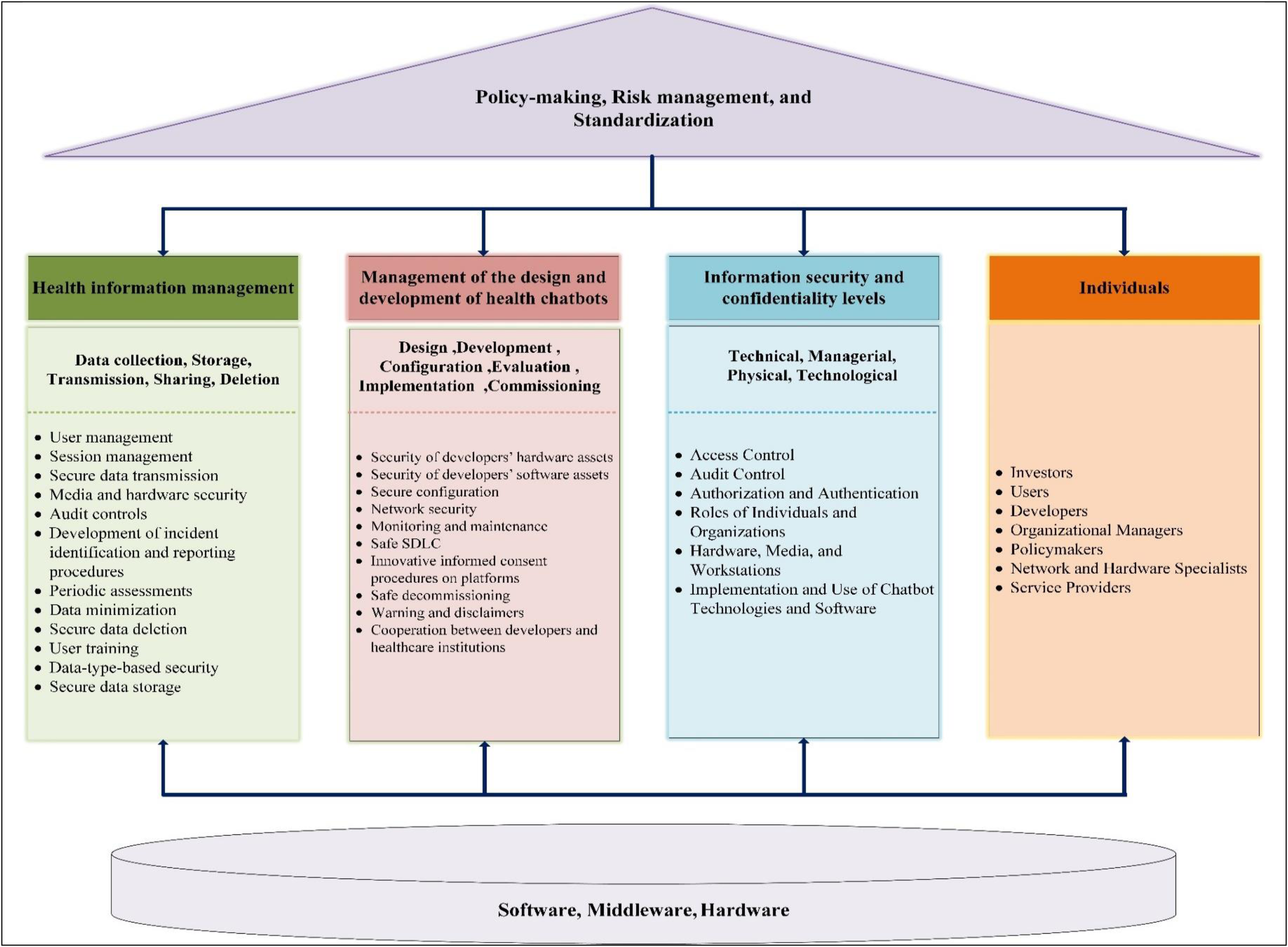
Conceptual model of information security and confidentiality in health chatbots.
Policy-making, risk management, and standardization
In the health chatbot data security and confidentiality theoretical model, the overall structure is provided by policy-making, risk management, and standardization as they influence all activities, tools, and stakeholders involved and therefore position them at the top of the hierarchy. Developing policies involves creating general policies, guidelines, and procedures pertinent to the security and confidentiality of information within chatbots, including awareness and educational campaigns, issuance of development and use permits for health chatbots, development of protocols to avert violations, and specifying penalties and sanctions for non-compliance. The collaborative efforts of legal personnel, policymakers, technologists, and healthcare practitioners are necessary to streamline the creation of effective security and privacy policies concerning health chatbot systems. Risk management involves actions aimed at detecting, controlling, preventing, mitigating, and rectifying threats and vulnerabilities concerning the security and confidentiality of data. Setting the necessary standard involves developing and promulgating specific context-oriented standards that revolve around the security and confidentiality of health chatbot data. These standards must accommodate the necessary global use, yet align with the local and national statutes. The necessary standards must be built around the established global use. Furthermore, they should comprehensively address all dimensions of electronic health data, artificial intelligence, and intelligent agents.
Health information management
Health information management encompasses the entire lifecycle of data, including collection, storage, transfer and sharing, and deletion. In this sector, numerous important measures are being undertaken to uphold the security and secrecy of information:
User management: Username allocation and assignment of unique identifiers for each user; obtaining informed consent (e.g., data use permissions, data transfer and storage permissions, right to require erasure of data, right to be forgotten, right to rectify data, right to object, right to be notified in case of security or privacy breach, and right to revoke consent); authentication, authorization, access control, and guest access control. Session management: Using session security assurance, including automatic logout mechanisms. Secure data transmission: Data encryption, anonymization during transmission, encrypted outputs, data classification and marking, third-party transfer guidelines, data reuse policies, and data transmission protocols. Media and hardware security: Secure data erasure, secure device reuse, data recovery and backup procedures, workstation hardening, and hardware disposal. Audit controls and data integrity: Utilizing audit controls to ensure data consistency, assurance, and anomaly detection. Incident reporting and identification procedures: Implementing procedures for identifying and reporting data security and confidentiality breaches. Periodic evaluations: Regular evaluations conducted by healthcare providers and health chatbot developers to assess security controls and adherence. Data minimization: Reducing data amount at the collection point, storage, and processing, and deleting outdated or valueless data on a regular basis. Secure data deletion: Maintaining strict and irreversible data erasure processes. User training: Educating users about how to protect usernames and passwords, hardware and physical media, and preventing unintentional exposures of data. Data-type-based security: Implementing security depending on data types, for instance, adhering to copyright laws for images or restricting the usage of voice communications. Security in data storage: Encrypted storage of data, decentralized storage through options such as blockchain, external storage devices for storing data, customized storage based on data usage and sensitivity, and judicious use of cache memory.
Management of health chatbot design and development
The management of the design and development of health chatbots encompasses the phases of design, development and configuration, evaluation and implementation, and decommissioning. To ensure the security and confidentiality of data, the following measures are implemented:
Security of developers’ hardware assets: Protecting physical devices used in development processes from unauthorized access or tampering. Security of developers’ software assets: Ensuring the safety of software components and source code through access control, version control, and secure storage practices. Secure configuration: Adhering to security best practices in system configuration in order to reduce vulnerabilities during deployment. Network security: Includes penetration testing, anti-malware protection, secure network infrastructure, network monitoring, hardware and workstation security, secure data transport protocols, and use of VPNs. Monitoring and maintenance: Involve performing periodic reviews of the systems, upgrading technologies, and routinely applying security patches to the software Safe Software Development Life Cycle (SDLC): Involves incorporating safe coding practices, extensive software testing, and end-user education prior to software deployment. Innovative informed consent procedures on platforms: Techniques such as slowing down the consent process with interactive screens, displaying summaries of primary risks or warnings, and the use of audio/video content in presenting risks and benefits. Safe decommissioning: Implementing safe and complete procedures for retiring chatbots to avoid data leakage. Warning and disclaimers: Providing users with disclaimers and notifications about the limits of the skill of the chatbot and the type of information delivered. Cooperation between developers and healthcare institutions: Joint efforts in creating and implementing health chatbots that are compatible with clinical, ethical, and technical guidelines.
Information security and confidentiality levels
In the subsequent section of the conceptual model, the various levels of ensuring information security and confidentiality in health chatbots are presented. These levels include technical, managerial, physical, and technological dimensions. This aspect provides essential guidance for implementing appropriate measures to ensure data security and confidentiality in all activities. Technical aspect consists of technical controls such as access control, audit control, authorization, and authentication controls. Managerial aspect emphasizes the management of people and organizations to be managed and controlled to implement security procedures and policies. The physical dimension pertains to hardware, media, and workstations involved in the storage and processing of health data. The technological dimension refers to the implementation and application of chatbot technologies and related software systems.
Individuals
This component identifies the stakeholders involved in ensuring the security and confidentiality of health chatbot data. Every single individual -from policymakers and investors to chatbot developers and end-users- plays an integral role in this. Every one of their duties depends on the specific role and level of interaction. Ongoing training programs and constant demands to keep data secure and safe are compulsory in order to achieve success towards the master goals of the model.
Software, hardware, and middleware
Finally, the foundational layer of the model comprises software, hardware, and middleware. These core components support all processes, dimensions, and levels of the model, and must be thoroughly considered and integrated into each stage of the health chatbot lifecycle to ensure effective and secure functionality.
Table 4 shows the components of a conceptual model for security and privacy in health chatbots. Unlike general information security models that only address general considerations such as encryption, access control, or risk management, this model is specifically focused on the health domain. For this reason, in addition to complying with well-known standards and frameworks (HIPAA, GDPR, NIST, ISO/IEC 27001), it also considers the unique characteristics of health chatbots, as described in the fourth column of the table. In particular, this section addresses issues that are not addressed or are of lesser importance in other areas of IT, including: clinical risk management and the potential consequences of treatment or diagnostic errors resulting from chatbot recommendations; the need for informed clinical consent tailored to the type of service (such as pharmaceutical, genetic or psychological counseling) that is quite different from general consent processes in other digital services; clinical event reporting that specifically relates to patient health outcomes, alongside traditional security reporting; access controls based on the type of medical data (for example, genetic or psychiatric data require a higher level of protection than general health data); and data-centric policies on the location of processing and storage that respond to the high sensitivity of health data at local, national and international levels. From this perspective, the conceptual model presented is not a generic and iterative version, but a specific model for health chatbots that integrates technical, managerial, legal and clinical dimensions and specifically responds to the risks and needs of this field. This fills a gap in the research literature and provides a clear added value compared to general security models.
Mapping the components of the conceptual model of information security in health chatbots to research findings and existing standards.

Discussion
The current study was conducted with the aim of identifying the challenges and solutions related to information security and confidentiality in health chatbots and designing a conceptual model to manage these challenges. Findings from the scoping review indicated that despite the growing use of health chatbots across various domains—including psychotherapy, chronic care, and educational support—there remains an insufficient and fragmented approach to addressing user data security and privacy in a systematic and comprehensive manner. The findings of the present study are consonant with the results of prior review studies, which have consistently emphasized that unauthorized access, inadequate consent mechanisms, insufficient data encryption, and non-compliance with regulations are significant and persistent security and privacy concerns for health chatbots.18–26 Yet, in comparison with prior reviews, which often focused on listing risks and proposing general solutions, the value added by the current study lies in the advancement of the field through its comprehensive conceptual model, which integrates technical, managerial, human, and legal dimensions. While previous reviews strongly recommended separate mitigation strategies, such as data encryption, secure transmission, or consent protocols, the present model provides a holistic, well-structured framework that covers the entire lifecycle of chatbot data, from collection and storage to deletion, mechanisms for continuous monitoring, policy enforcement, and user training. Moreover, it goes a step further than previous studies by including ethical considerations and specific AI-related risks, particularly for those chatbots based on large language models. It is for this reason that the present study represents one of the few works that, after explicitly mapping solutions with regard to identified challenges and operationalizing them within a validated conceptual model, offer a practical multi-dimensional tool able to guide developers, healthcare organizations, and policy makers in ensuring strong information security with confidentiality in deploying health chatbots. Also, it emphasizes data lifecycle management from collection up to secure deletion and considers concepts such as data minimization, distributed storage, and multi-factor authentication. Such features are particularly important in delicate contexts such as psychotherapy or medical consultations, where very sensitive user data is being dealt with.
The utilitarian uses of the model in this current research are also significant. Chatbot developers can utilize this model for building interactive systems for consent management, secure development lifecycle processes, and encryption of sensitive health information. Healthcare organizations will be able to implement local and global security and privacy policies, monitor user access and activity, and regularly monitor the performance of chatbots. Regulators and policymakers can also set legal procedures and guidelines specific to health and promote stakeholder education to enhance the level of acceptance and compliance with data protection regulations by harmonizing international and domestic standards.
Quite a number of caveats aside, there are still certain limitations that must be pointed out. The language limitation in the scoping review and the limited access to specific databases may have excluded relevant studies published in languages other than English. Attempts were made to have extensive coverage of renowned databases, but the review was restricted to English language studies. There is also a possibility of publication bias in this, like any other scoping review, where the chances of publication and, consequently, inclusion are higher for studies with significant or positive results. Further studies should be conducted covering more varied databases and phasing out the language restrictions in order to make the review broader. Another restriction is the narrow scope of implementing and operating the conceptual model as envisioned. Observe that the realization of the same would necessitate significant cross-sectoral cooperation between technology developers, regulators, healthcare establishments, and end-users. Among the top challenges in this regard is the lack of local legal tools in the majority of countries to implement health chatbots, and the inconsistency of international legislations, thus hampering the utilization of uniform national standards. Secondly, even though the proposed model has been tested via expert panels, practical experience-based empirical measurement is yet to be addressed. Future studies could involve field trials and longitudinal evaluations to determine the effectiveness of the model to reduce security incidents and user trust in quantitative terms. Also, another limitation is the panel size and its national limitation, which limits the generalizability of the findings to the international level. It is suggested that future research validate the model with larger, international, and multidisciplinary panels to improve generalizability and increase the external validity of the model. On the other hand, some resources and frameworks may be outdated and may not cover recent changes in laws and technologies, especially health chatbots. Also, most of the existing frameworks and standards are generic and do not cover the specific details of health chatbots, which the present study attempted to fill this gap.
Conclusion
With health chatbot applications growing exponentially, the need to address the security and confidentiality of users’ data has become imperative. The findings of the current study revealed that despite there being research that has recognized security concerns, few of them have been profound and sustained enough to outline technical, legal, and managerial remedies. The present study mapped out the literature gaps and developed a comprehensive conceptual model that addressed systematically all concerns pertaining to security in health chatbots. A primary feature of this model is its integration of technical solutions and human, legal, and strategic elements, possibly fostering increased user confidence and making it possible to use this technology in more widespread applications within healthcare systems. Nonetheless, in order to assess the actual usefulness of the model proposed, further field studies under natural conditions are necessary. Subsequent research is also invited to transcend language limitations and utilize more heterogeneous databases to extend and strengthen this framework.
Supplemental Material
sj-docx-1-dhj-10.1177_20552076251406637 - Supplemental material for Information security and confidentiality in health chatbots: A scoping review and development of a conceptual model
Supplemental material, sj-docx-1-dhj-10.1177_20552076251406637 for Information security and confidentiality in health chatbots: A scoping review and development of a conceptual model by Tahere Talebi Azadboni, Fahimeh Solat, Hanieh Hematti and Meysam Rahmani in DIGITAL HEALTH
Footnotes
Acknowledgments
This research received no specific grant from any funding agency in the public, commercial, or not-for-profit sectors.

Competing interests
The authors declare that there are no conflicts of interest.
Authors’ contributions
Conceptualization: T.T., M.R., F.S., and H.H.; methodology: T.T., F.S., and H.H.; formal analysis: T.T., F.S., and H.H.; investigation: T.T., F.M, and H.H; writing—original draft: T.T. and F.S.; writing—review and editing: T.T. and M.R.; supervision: T.T. All authors have read and agreed to publish the manuscript.
Consent for publication
We confirm that the manuscript has been read and approved by all named authors and that no other persons have satisfied the criteria for authorship but are not listed. We further confirm that all have approved the order of authors listed in the manuscript.
Ethical considerations
This study was performed in line with the principles of the Declaration of Helsinki. Approval was granted by the Ethics Committee of Saveh University of Medical Sciences (IR.SAVEHUMS.REC.1403.063).
Funding
The authors received no financial support for the research, authorship, and/or publication of this article.
Declaration of Conflicting Interests
The authors declared no potential conflicts of interest with respect to the research, authorship, and/or publication of this article.
Data availability
The data that support the findings of this study are available from the corresponding author [F.S, M.R], upon reasonable request.
Supplemental material
Supplemental material for this article is available online.
Appendices
References
Supplementary Material
Please find the following supplemental material available below.
For Open Access articles published under a Creative Commons License, all supplemental material carries the same license as the article it is associated with.
For non-Open Access articles published, all supplemental material carries a non-exclusive license, and permission requests for re-use of supplemental material or any part of supplemental material shall be sent directly to the copyright owner as specified in the copyright notice associated with the article.
