




Abstract
Objective
With the increasing affordability of virtual reality (VR) technology, VR exergames are emerging as promising tools for promoting physical activity and engagement among older adults. However, little is known about how VR-generated game metrics and user experience data evolve over time and influence long-term adherence. This study examined the feasibility of a custom VR exergame-Seas the Day-for at-home use during the COVID-19 lockdown.
Methods
Thirteen community-dwelling older adults completed 18 seated VR sessions over 6 weeks (3×/week), integrating Tai Chi, rowing, and fishing activities. Automatically recorded in-game metrics included rowing repetitions, Tai Chi completion time, fishing response times, distance traveled, and in-game errors. A difficulty-adjusted performance index (DAPI) was computed using session one as baseline to track progress over time. Participants also completed a Game User Experience Scale at weeks 3 and 6.
Results
Most participants showed improving or stable performance across sessions, with a smaller subset declining, highlighting individual differences. Significant gains were observed in Tai Chi completion time, rowing efficiency, and fishing response times. DAPI results confirmed overall upward performance trends despite repeated exposure. Game User Experience ratings remained high, particularly for enjoyment and ease of use, indicating sustained engagement and adherence.
Conclusion
Custom VR exergames can support physical activity and engagement among older adults in home settings, even during periods of social restriction. Game metrics and self-reported experience offer complementary insights into feasibility, adaptability, and individualized progress, underscoring VR exergaming's potential to promote well-being while emphasizing the need for personalized engagement strategies.
Keywords
Introduction
The number of older adults (60+ years) is rapidly increasing and is estimated to reach 2.1 billion by 2050 due to an increase in global life expectancy, longevity (https://www.who.int/news-room/fact-sheets/detail/ageing-and-health), and baby boomers reaching 65 years of age in 2031 (https://www.canada.ca/content/dam/phac-aspc/migration/phac-aspc/publicat/hpcdp-pspmc/36-10/assets/pdf/ar04-eng.pdf). With the population aging, the prevalence of age-associated chronic conditions and functional, cognitive, and perceptual challenges are also expected to increase rapidly. 1 While cognition has an important role in older adults’ functional ability and independence, 2 many cognitive domains, including executive function (e.g. working memory, selective attention, inhibition, and cognitive flexibility) decline with aging.3,4
Cognitive impairment can compromise independence and create social challenges for older adults. Early detection of cognitive impairment is important5,6 as this allows for diagnosis and advanced care-planning and can result in improved prognosis and reduced morbidity.7–9 However, undetected cognitive impairments are common with 50–90% of older adults with dementia not being diagnosed until later stages of the condition.10,11 Early diagnosis of cognitive impairments is often hindered by limited physician screening,12,13 stigma, and older adults or caregivers’ apprehension toward cognitive testing and disclosure.14,15
Virtual reality (VR) has been positioned as a promising approach that can provide mental and physical activity, 16 while allowing for more continuous tracking of performance parameters. VR has been increasingly considered a complementary tool to aid neuropsychological assessment. 17 For instance, the feasibility of using VR as a cognitive screening tool has been explored in samples of older adults with cognitive impairment, 18 Alzheimer's disease, 19 and multiple sclerosis. 20 The acquisition of high-resolution data over time could also facilitate the detection of subtle changes in cognition and perception, which may be helpful in the diagnosis of cognitive impairment in older adults.21–23
The COVID-19 pandemic and associated lockdown measures significantly disrupted traditional healthcare and social support services for older adults, creating an urgent need for innovative remote interventions. VR emerged as a promising technology to address the various needs of older adults confined to their homes during this unprecedented period. Recent meta-analyses have examined immersive VR interventions across multiple domains, demonstrating applications for neuropsychological support, health and mental health improvement, and enhancement of functional abilities. 24 Fully immersive VR has been applied in reminiscence interventions, effectively evoking memories and improving psychological well-being in older adults through realistic virtual environments connected to significant past experiences. Other applications include VR-based physical activities such as Tai Chi programs specifically designed to support mental health during the pandemic 25 and remote group-mediated physical activity interventions that compare VR to videoconference platforms for exercise delivery. 26 The scientific literature reveals promising outcomes for VR interventions among older adults during home confinement. Meta-analytic evidence indicates small but significant positive effects on measures of global cognition, attention, executive functioning, anxiety reduction, and pain management. 27 In addition, virtual social environments enable older adults to maintain social engagement despite distancing measures: using VR to connect with family or peers in shared simulations has been shown to reduce loneliness and improve well-being. 26 However, implementing VR for seniors at home also presents usability and adoption challenges that must be addressed for long-term success. On the one hand, studies have found that—despite minor interface issues—older adults generally rate VR applications as usable and feasible. 28 When appropriately tailored and introduced, VR systems tend to be well-received by seniors, with some trials even reporting high adherence and sustained engagement over time. 29 Ensuring ongoing participation beyond the initial novelty remains challenging; further research is needed to evaluate the long-term feasibility of home-based VR programs and to develop strategies that support sustained adherence in this population. 30
Custom-made VR games, including exercise games (e.g. exergames), can provide rich and informative feedback about exercise engagement and progress, as well as physical and cognitive performance. 31 Given that VR systems can capture data from various sources such as movement and in-game behavior, using digitally captured data is proposed as a potential way to complement the conventional methods for user performance and progress tracking.32,33 This new approach is widely known in digital health as digital biomarkers, which are user-generated physiological and behavioral measures collected through connected digital tools that can be used to explain, influence, and/or predict health-related outcomes. 34 Digital biomarkers collected remotely during the interaction with digital systems may offer therapeutic value in traditional elder-care systems as advanced monitoring tools and provide reliable disease-related information. 35 Using digital sources such as games and interactive applications has been proposed as an innovative, unobtrusive, and engaging method to assess and model physical and mental health outcomes. 36 For instance, data from commercially available games was investigated by Mandryk and colleagues,36 and five categories of game-based data were proposed (behavior, cognitive performance, motor performance, social behavior, and affect) with the potential of being used as digital biomarkers to predict health outcomes.
The use of custom-made videogames beyond VR simulations has also been investigated as a method of predicting mental health outcomes.37,38 Dechant and colleagues proposed methods to use in-game data to assess aspects of mental health associated with social anxiety and found that real-life behaviors reflecting social anxiety also appeared during gameplay. Embedded biomarkers in this study also showed strong potential for the prediction of social anxiety. 37 Custom-made non-immersive exergames has also been investigated as a health predictor and a medium to collect important data in order to assess cognition in older adults with and without cognitive impairments. Konstantinidis and colleagues, for example, collected data from 116 older adults interacting with custom-made exergames to explore the correlations between game metrics and cognitive tests carried out during the intervention. Results showed that in-game data was capable of distinguishing between healthy older adults and those living with cognitive impairments. 38 Exergames provide the opportunity of unobtrusive and continuous data collection, which allows participants to complete cognitive and perceptual assessments from the comfort of their own homes. Additionally, data collected over multiple sessions allows for granular monitoring of trends in the cognitive and perceptual capabilities of the user, something that is commonly omitted (or not possible) during isolated exercise sessions using traditional methods. A challenge of collecting large amounts of data however is to appropriately analyze it, which requires the use of advanced computational methods to extract therapeutically valuable insights. 39
With the growth of VR content creation and the increasing affordability of VR hardware, the global adoption of augmented and VR applications is projected to reach 216 million users by 2025. This expansion will generate large-scale VR-generated data, which could offer valuable insights into older adults’ well-being and engagement, particularly for those with cognitive impairments. However, research exploring how VR exergame data could be leveraged to assess older adults’ performance, user experience, and long-term adoption remains scarce. 24
After co-designing a tailor VR exergame focused on promoting physical activity among people living with dementia and community-dwelling older adults called “Seas the Day,” 40 we conducted a study involving community-dwelling older adults in Canada to explore the use of this game for at-home exercise. This study uses secondary data analysis focusing on game and performance metrics automatically collected by a VR system and game user experience questionnaires to investigate the remote uptake of VR technology.
The focus of this paper is to:
Analyze the performance of older adults over time, based on VR-generated game metrics automatically tracked and collected across multiple sessions. Identify trends in individual performance trajectories by using adjusted game performance metrics to quantify progress, adaptation to difficulty, and engagement retention over time. Evaluate changes in user experience and engagement, using a custom-built questionnaire that assesses usability, enjoyment, and future intent to use at various points.
Methods
We conducted a 6-week pilot study between March and May 2021 with community-dwelling older adults in Ontario, Canada, to evaluate the feasibility of a remotely administered VR exergame intervention. The study was carried out entirely remotely due to COVID-19 restrictions, with all equipment (VR headsets and instructions) sanitized and shipped to participants’ homes. The intervention involved participants engaging with Seas the Day, a custom-designed VR exergame incorporating Tai Chi, rowing, and fishing activities. Participants’ performance data—including game scores, in-game errors, and task-specific response times—were automatically recorded. In parallel, perceived user experience was measured using a custom-built questionnaire administered at weeks 3 and 6 through secure digital forms. This remote methodology ensured safe data collection and engagement while complying with public health guidelines in place during the pandemic.
Study design
Participants completed 18 20-min VR exergame sessions over 6 weeks (three sessions per week). Game metrics were automatically collected in each session and locally stored in the VR headset memory. A detailed description of the study design 41 and the design process of the VR exergame 40 have been previously published.
Participants
To be eligible for the study, participants had to: (i) over 60 years of age, (ii) live in a community setting in Canada, (iii) be able to communicate in English, (iv) be able to provide informed consent to participate, have access to a computing device (computer or tablet), and (v) have access to a reliable internet connection at their place of residence. Exclusion criteria included: (i) self-reported severe motion sickness or commonly experienced motion sickness or nausea (e.g. when driving or sitting in a car, train, or bus), (ii) self-reported hearing impairment that may interfere with the participant's ability to hear and understand the auditory cues in the cognitive and perceptual tasks, (iii) uncorrected visual impairment (e.g. cataracts, glaucoma, macular degeneration, etc.) that may interfere with the participant's ability to see and interact with the VR exergame and perform the cognitive and perceptual tasks, (iv) ear infection in the past 12 months or a diagnosis of a disease of the middle ear such as Meniere's disease, and (v) any pre-existing conditions that would prevent them from engaging in exercise, including having a cardiac pacemaker.
Study procedures
After confirming eligibility, a VR headset and a study manual were shipped to each participant's place of residence. The study manual included detailed written and visual content (e.g. images) on how to set up and use the VR system as well as troubleshooting tips. An introductory remote one-on-one session was carried out over Zoom for each participant where the study research assistant helped participants to get familiar with the VR technology and study protocol. Participants were asked to play the exergame at pre-scheduled times and not to share the headset with others if they were not part of the study to ensure researchers could identify sessions in the data log system. The VR system automatically created a unique data log file of around 15 MB per session, which was locally stored in the headset memory. At the end of the study participants sent the VR headset and a logbook back to the researchers through pre-addressed courier box. Upon receiving the headset, all the session files were jointly extracted and used to create a database of the participants for further analysis. Each participant was asked to complete a total of 18 sessions with three sessions per week (no more than one session per day) over a 6-week period. Before starting the training protocol, participants were instructed in how to use the VR system at-home and they had the opportunity to play and use the VR system at least once before starting the study. This study, titled “VR-At-Home: Feasibility of using virtual reality (VR) exergames to promote physical and mental well-being in community-dwelling older adults (contactless remote testing),” was reviewed and approved by the Research Ethics Board at the University of Waterloo, Canada (Protocol No. 42908). All participants provided written informed consent prior to participation, and the study adhered to the ethical standards set by the institution and the Declaration of Helsinki. Due to COVID-19 restrictions, all study activities—including onboarding, training, and data collection—were conducted remotely. VR headsets were sanitized, individually packaged, and delivered directly to participants’ homes. Support was provided virtually via video calls, ensuring no in-person contact while maintaining participant autonomy, confidentiality, and the right to withdraw at any time without penalty.
Intervention: Seas the Day: a custom-built VR exergame for older adults
Game and gameplay
Seas the Day is an immersive interactive experience that transports players to a remote tropical island to explore different environments and carry out activities aiming to encourage upper body exercise using VR. The game was designed through a collaborative user-centered design process that involved a group of older adults with and without cognitive impairments, exercise professionals, and a company specialized in VR content working with researchers with backgrounds in game user research, human factors, and kinesiology (see Muñoz et al. 40 for a more detailed description of the game development process). The VR exergame “Seas the Day” was custom-designed and developed by our research group, specifically tailored to promote physical and cognitive engagement among older adults. It is not a commercial product, though the game was developed using Unity and open-source development tools with potential for future community-based deployment. Seas the Day was designed for seated gameplay to minimize risk and accommodate varying levels of mobility. The activities—Tai Chi, rowing, and fishing—are performed using upper-body gestures, incorporating arm movements and core engagement. Each session lasts approximately 20 min, and participants completed 18 sessions over 6 weeks. This targeted design approach ensured compatibility with older adults’ needs, both in terms of physical safety and cognitive accessibility, while leveraging the strengths of the VR hardware (Figure 1).

Participants playing Seas the Day at home. Permission to use participant's pictures was obtained in the inform consent letter.
The Seas the Day exergame includes three stages with different expected exercise intensity levels (see Figure 2), aiming to follow the recommendations for exercise training of the American College of Sports and Medicine 42 .
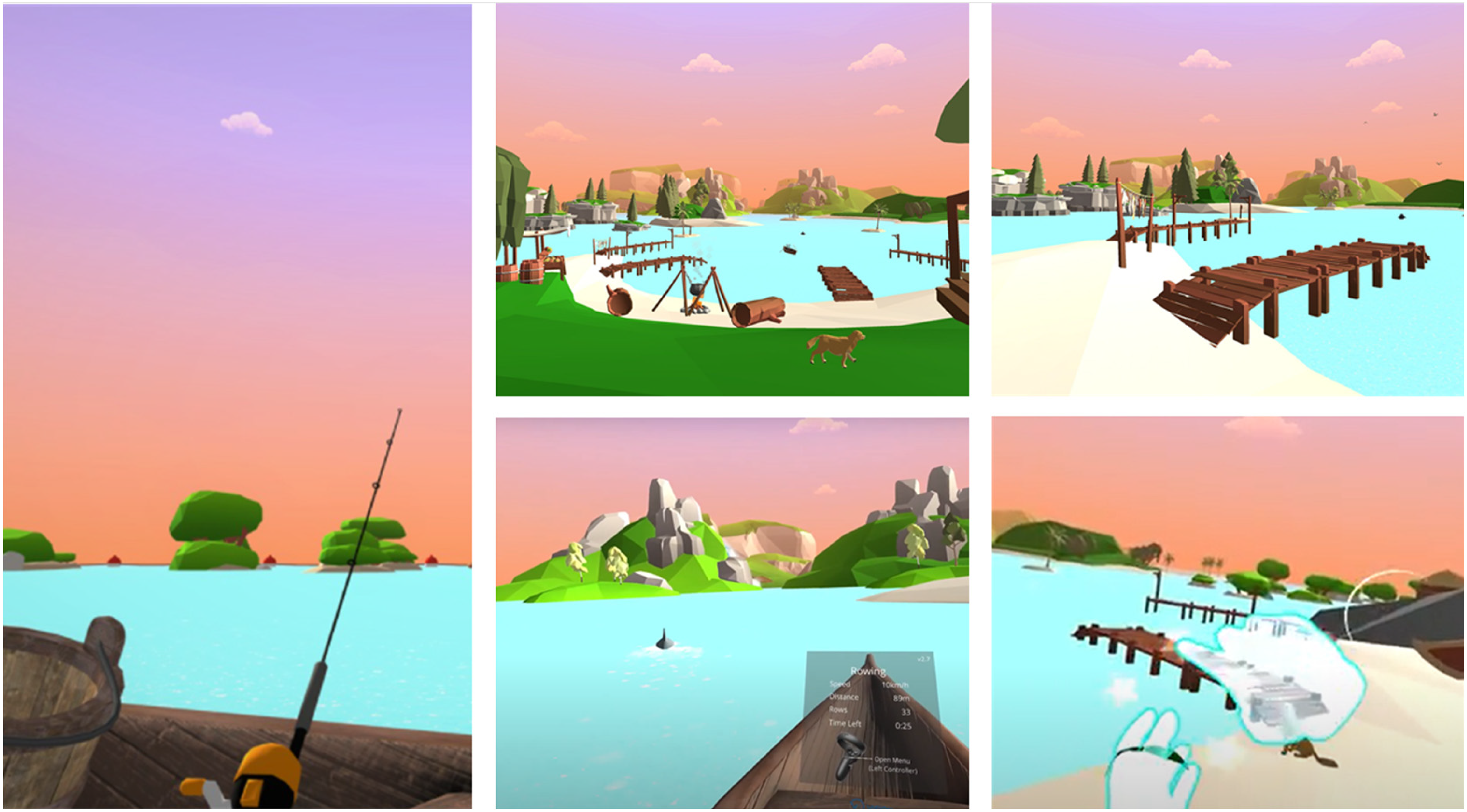
Screenshots of Seas the Day experience.
Stage 1—Warm Up (Tai Chi): Stage 1 stimulates movements similar to Tai Chi to facilitate stretching and warming up upper limb joints including shoulder, elbow, and wrist. After completing this stage (approximately 3 min), players are congratulated and welcomed to Stage 2 with an animation of a virtual dolphin jumping in front of them.
Stage 2—Conditioning (rowing a boat): Players are placed on a simulated boat with oars in the middle of the lake and are asked to row following a dolphin. During gameplay, players are encouraged to keep a good rowing pace and explore the virtual world. Audio instructions provide advice on boat speed and places to explore. Upon the completion of the conditioning stage (approximately 10 min), players are transported to a place in the lake with the boat stationary where fishing (Stage 3) will take place.
Stage 3—Cool-down (fishing): During Stage 3 players are challenged to capture fish by jumping in spots located 180 degrees around the boat. Players are asked to do an up and down motion (flexion/extension of the arms) to cast the line where the fish are jumping. Once cast, players will wait for a vibration, which indicates the fish is hooked and they should start to reel the fishing rod by making repetitive flexion/extension movements of their arms. After completing Stage 3 to cool-down (approximately 3 min), players are prompted to exit the game and remove the headset.
Permission to use the software for research purposes was obtained from the copyright holder (VR Vision) (https://vrvisiongroup.com/), and the game was deployed under a non-commercial research license.
Participants
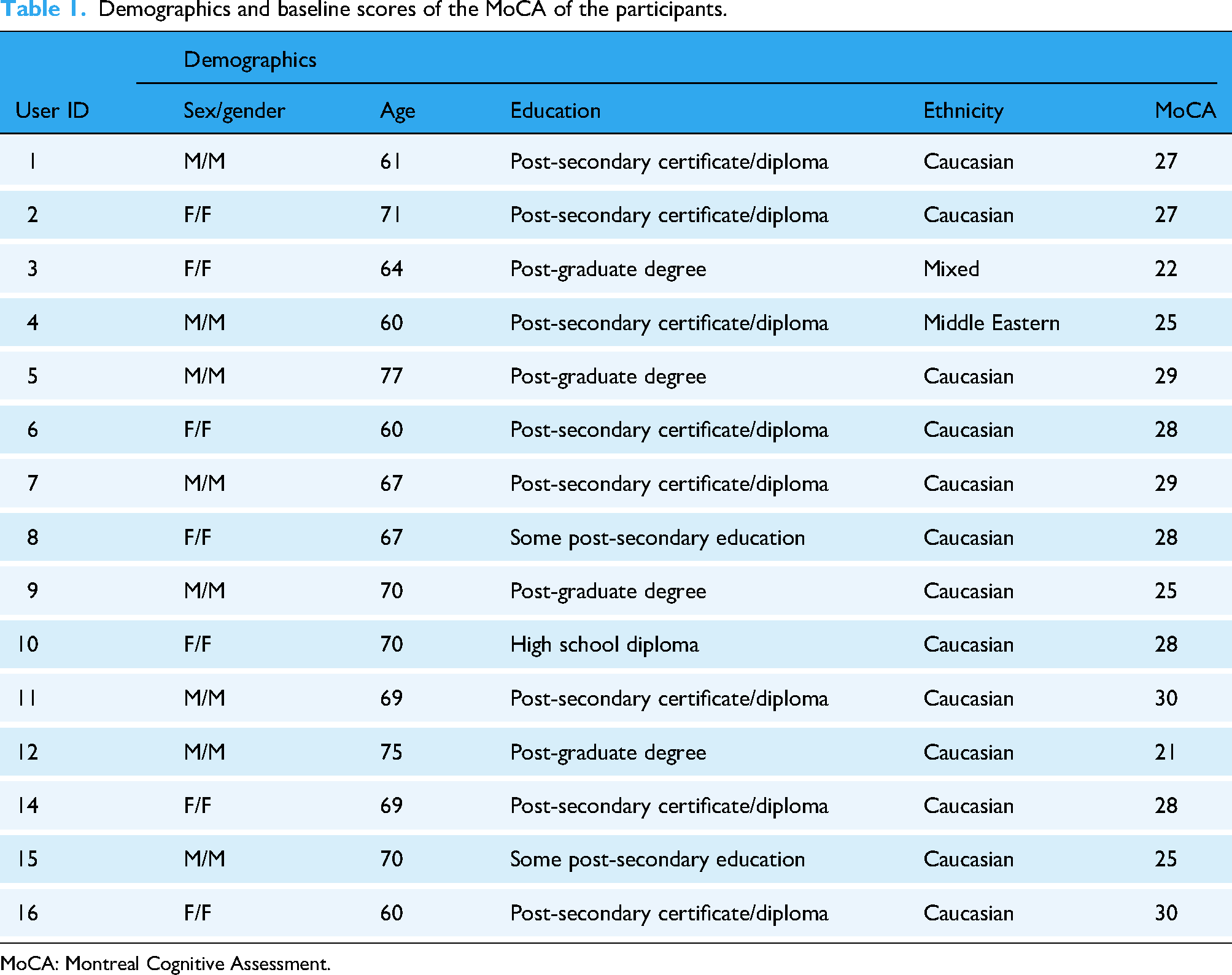
A total of 15 community-dwelling older adults were recruited for the study. Thirteen participants (six female, mean age of 68.46 ± 4.84 years) completed (100% completion rate) the study protocol consisting of 18 sessions of self-administered gameplay at home using Seas the Day. Two participants withdrew due to discomfort caused by cybersickness symptoms. Demographics and screening cognitive assessment information of the participants are presented in Table 1.
Demographics and baseline scores of the MoCA of the participants.
MoCA: Montreal Cognitive Assessment.
Hardware
Seas the Day was designed to be played using standalone VR headsets with relatively simple game interactions (e.g. no interaction with multiple objects at the same time) and the type of visual graphics chosen (e.g. low-poly rendering). The VR headset used in this study was the Meta Quest 2, due to its availability in the market, and reduced weight (compared to the previous version of the same headset), as well as its performance when running the designed game. Two main hardware modifications were made to the headset: (i) the conventional foam cover was replaced with a silicon cover to facilitate cleaning and sanitization of the headset, and (ii) the conventional strap was replaced by an Elite Strap to be more comfortable and to easier to adjust the headset. Seas the Day was then ported to the headset and sent to participants along with controllers, charger, and a pair of batteries. These features made it suitable for home-based use during the COVID-19 lockdown, where ease of setup and sanitation were essential.
Data collection
Game metrics
Game events were automatically recorded while playing Seas the Day and stored locally in the headset's internal memory throughout the study. This information was collected as a time series using a sampling frequency of 60 Hz, wherein every event was captured using a timestamp in one common-separated-values (CSV) file per session for a size of about 15 MB per session. The data recording process was optimized to ensure that the game performance was not affected. Multiple game events were recorded for each stage (e.g. Tai chi, rowing, fishing) so that their potential to describe specific elements of the player's performance and micro-behaviors could be explored (e.g. distances, interactions within the virtual environment, compliance with the expected commands). Among several variables describing players’ behaviors inside the virtual environment, we decided to focus our analysis on variables that described best the player's performance, including errors, achievements, and response times (see Table 2). Furthermore, we also explored variables capable of describing response times since it is one of the variables that has been found to be positively affected by VR training in older adults. 43 The metrics were selected to capture elements related to cognitive, perceptual and physical performance, proposing exploratory metrics such as the response time (during fishing) and the errors, measured through the boat collision during the rowing activity. Similar research has shown how specific behaviors within virtual environments are correlated with important rehabilitation outcomes in stroke rehabilitation applications. 44 An familiarization session was conducted before starting the study to allow participants to be acquainted with the game and minimize potential bias due to novelty effect (week 0).
Game metrics and related outcome measures.

Difficulty-adjusted performance assessment
Difficulty-adjusted performance metrics emerged from game design and human–computer interaction fields as sophisticated tools that balance challenge with player skill. These metrics quantify user performance while accounting for task complexity, creating more personalized and engaging experiences by providing a reliable real-time adaptation mechanism for dynamic difficulty adaptation. 45 We used a similar concept and created a difficulty-adjusted performance index (DAPI) for Seas the Day to evaluate participants’ performance trends across multiple VR-based game sessions while accounting for task difficulty and individual baseline performance. This metric integrates the various game-based performance measures, normalizing them to a comparable scale while considering whether higher or lower values indicate better performance. Specifically, distance travel, number of rowing repetitions, and fish caught were treated as direct performance indicators, where higher values corresponded to improved outcomes. Conversely, Tai Chi time, number of collisions, and reaction time were treated as error-based metrics, where lower values indicated better performance. To ensure comparability across participants, each metric was normalized using Session 1 as a calibration baseline, allowing performance in subsequent sessions to be evaluated relative to initial abilities. This normalization approach ensured that improvements or declines in performance were not biased by individual starting skill levels.
A DAPI was computed by aggregating weighted normalized scores across all relevant metrics for each session, with later sessions receiving progressively higher weights to reflect increasing task complexity. The final formula accounted for both performance gains and error reduction, ensuring that participants who improved over time and performed well under more challenging conditions received higher scores. Additionally, DAPI trends were analyzed across all participants, identifying individuals with significant performance declines. A regression-based trend analysis was conducted to classify users with decreasing DAPI scores, distinguishing them from those demonstrating consistent or improving performance. This method allowed for a more nuanced evaluation of user engagement and skill adaptation over time, providing insights into long-term retention and the feasibility of VR exergames as at-home interventions for older adults.
Game user experience
A custom-built questionnaire was developed to evaluate participants’ perceived game experience and engagement with the VR exergame. This questionnaire incorporated 27 items across six key constructs: Usefulness, Ease of Use, Enjoyment, User Experience, Social Norms, and Intention to Use. The design was informed by established usability and acceptance models, including the System Usability Scale
46
for usability assessment, the technology acceptance model
47
for perceived usefulness, perceived ease of use, and intention to use, and additional dimensions from User Experience, Social Norms, and Perceived Enjoyment frameworks. Each item was rated on a 5-point Likert scale, ranging from strongly disagree (1) to strongly agree (5), capturing participants’ subjective perceptions of their interaction with the VR exergame. This approach ensured a comprehensive evaluation of both technical usability and broader adoption factors relevant to at-home VR interventions. Categories were included considering:
The Usefulness dimension assessed whether participants found the VR exergame entertaining, engaging, and beneficial for their daily activities and physical exercise levels. Ease of Use items measured clarity of instructions, complexity, and the need for technical support, allowing us to identify potential usability barriers. Enjoyment was evaluated by asking participants about their level of engagement and enjoyment while playing. The User Experience construct included aspects related to interface consistency, dizziness, confidence, and satisfaction with performance. Norms measured the influence of social circles (e.g. family and friends) on the intention to use VR exergames. Intention to Use captured participants’ willingness to continue using VR exergames in the future for exercise and mental engagement.
The custom-built questionnaire was administered in paper within the study manual at weeks 3 and 6 to assess changes in user perception over time. Responses were compared to evaluate shifts in usability, enjoyment, engagement, and adoption intent. Figure 3 shows a flow diagram of the weeks and the data collected.

Intervention timeline diagram of the VR program. VR: virtual reality.
Analysis
Given the exploratory nature of our objectives, no a-priori hypotheses or assumptions were set. The first objective was to describe game metrics and player's performance. Players’ game performance over time was inspected for those who finished the 18 sessions and presented using line plots, with a line representing the average performance across sessions for each participant as well as an average line across participants. The mean and standard deviation for each metric across sessions for each participant were determined. A Wilcoxon signed-rank test was used to explore differences in performance between the first (#1) and the last (#18) session of interaction with Seas the Day.
Results
Game performance, errors, and response time
On average players completed the Tai Chi routine in less than 210 s (min = 180 s, max = 404 s) after the first two sessions (Figure 4). The time to complete Tai Chi significantly decreased in the last session (Mdn = 197.6) as compared to the first session (Mdn = 210.3), z = −2.63, p < 0.05, r = −0.5.
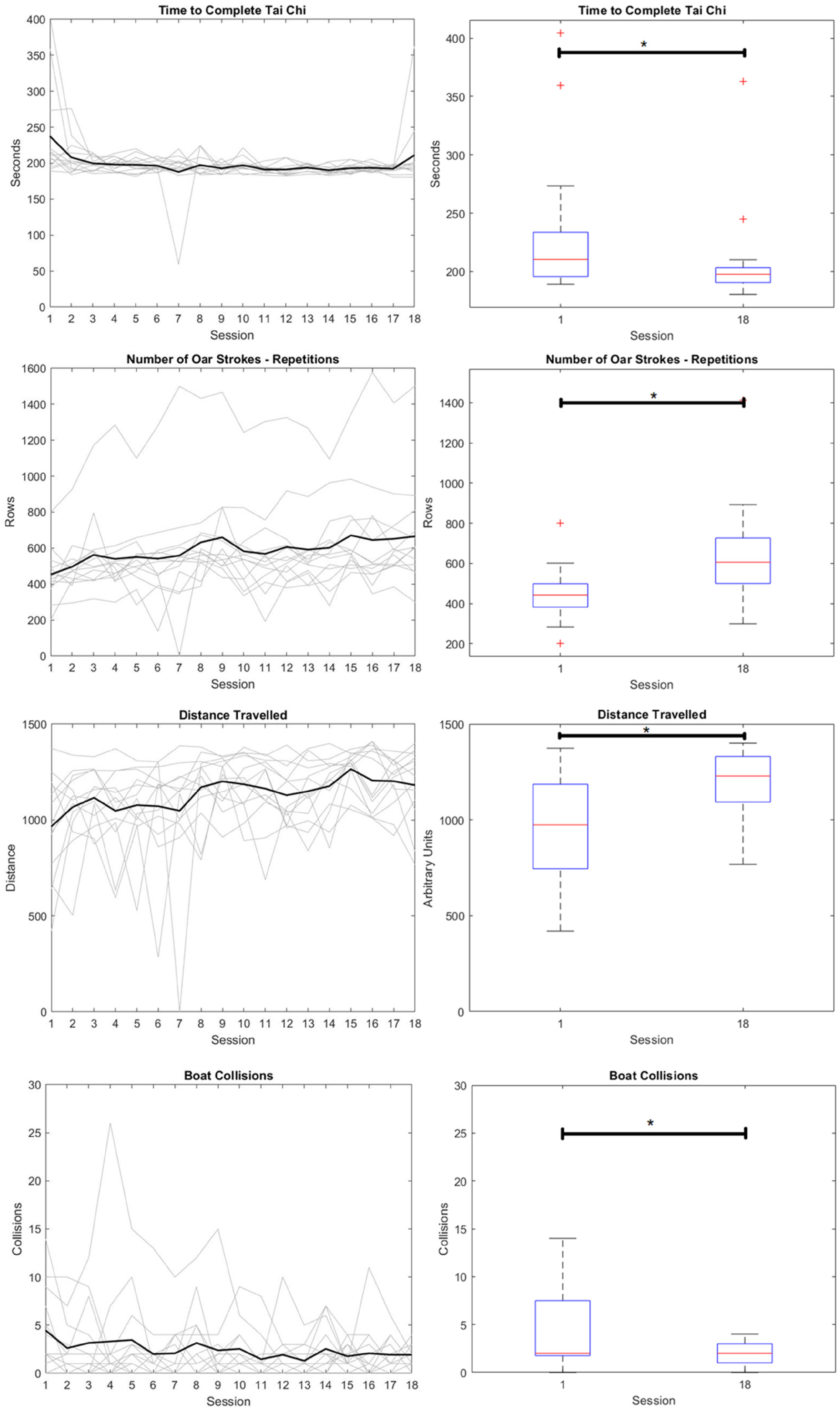
Left: (bold) averaged line of (i) time to complete Tai Chi, (ii) number of oar strokes, and (iii) distance traveled, and (iv) number of boat collisions game metrics per participant for each of the 18 sessions (n = 13). Right: differences of same game metrics between the first and the last sessions. Asterisk (*) denotes statistical significance at p < 0.05.
Rowing was the stage where the players spent more time (∼10 min). Two variables were selected to report the player's performance during rowing as well as a third variable to reflect errors. First, the repetitions or oar strokes performed by players during the rowing task were tracked during the gameplay. This variable quantifies the repetitions of movement for both left and right shoulder/arm during the rowing stage. Results showed a consistent increase in the number of repetitions performed by participants across the 18 sessions of playing Seas the Day. On average, compared to the first session (M = 453), players consistently increased the number of repetitions (min = 137, max = 1577) by more than 40% in the last session (M = 665). A significantly greater difference was found between the number of oar strokes in the last session (Mdn = 605) as compared to the first session (Mdn = 442, z = −2.97, p < 0.05, r = −0.58). Second, the distance traveled, defined by the design team as a “level of accomplishment,” was carefully tracked for each participant as it was designed as a strategy to keep participants motivated during gameplay. Results revealed an increasing trend in the distance traveled, reaching more than 1000 (virtual) meters per session (min = 284, max = 1410) after the second session (Figure 3). Distance traveled consistently increased after each session for the majority of the participants, illustrating a sense of “mastering” the virtual rowing task. Statistical analysis revealed significantly higher levels of distance traveled in the last session (Mdn = 1229) as compared to the first session (Mdn = 974), z = −2.06, p < 0.05, r = −0.40. Finally, the boat collisions were selected to demonstrate errors during the rowing task. Some players did not experience any collisions during some sessions and the trending line shows an overall decrease in the average number of collision-type errors. While mastering the rowing task was reported to be challenging for some participants, players were able to maintain a low number of collisions per session (less than 5, min = 0, max = 26) reaching an average of two collisions during the last session. The statistical analysis showed a significantly lower number of errors measured by the boat collisions during the last session (Mdn = 2) as compared to the first one (Mdn = 2), z = −2.09, p < 0.05, r = −0.41.
The fishing task was created as a cool-down activity to wrap up the exercise routine. As a performance metric, the number of fish caught during the session was computed for each participant. This metric reflects how well players understood and performed the game mechanic created to promote flexion and extension movement of the shoulder/elbow, after feeling the vibration of the controllers as a result of a fish biting the bait. Results show that on average, players caught more fish throughout the sessions (min = 0, max = 14). Moreover, the statistical analysis shows a significant increase in the number of fish caught in the last session (Mdn = 10) as compared to the first one (Mdn = 7), z = −2.63, p < 0.05, r = −0.51 (Figure 5). Finally, our experimental metric designed to capture changes in the response time of players is presented. This was measured as the time to pull out the virtual rod after feeling the vibration indicating the fish was hooked, which was computed in milliseconds. Results reveal a decrease in the response time captured during the interaction in the fishing stage (min = 110, max = 970) (see Figure 5). The statistical analysis shows significantly faster response time during the last session (Mdn = 536) as compared to the first session (Mdn = 770), z = −2.10, p < 0.05, r = −0.41.

Left: (bold) averaged line of (i) boat collisions and (ii) fish caught per session game metrics per participant for each of the 18 sessions (n = 13). Right: differences of same game metrics between the first and the last sessions. Asterisk (*) denotes statistical significance at p < 0.05.
DAPI analysis: how was the overall game performance?
The analysis of DAPI trends across sessions revealed that most participants demonstrated consistent or improving performance, while a subset exhibited declining scores over time. The final trend visualization highlights these differences, with participants experiencing performance deterioration marked in red, contrasting against the overall group trend (see Figure 6). The bold blue line, representing the average DAPI trajectory, indicates a gradual upward trend, suggesting that the majority of participants adapted to the increasing challenge and improved their in-game performance. However, the presence of declining users underscores individual variability in engagement and skill acquisition, emphasizing the need for further investigation into factors influencing long-term adherence and performance sustainability in VR exergames.

DAPI scores of all participants across sessions represented by the gray lines. The average line is represented by the bold-blue line while participants marked in red are the ones that experienced performance deterioration. DAPI: difficulty-adjusted performance index.
Game user experience
The results from the Game User Experience questionnaire indicate that participants generally found the VR exergame useful, easy to use, and enjoyable, with positive user experience ratings maintained across the 6-week period. However, a gradual decline was observed in perceived enjoyment, overall user experience, and intention to use by week 6, suggesting potential engagement fatigue or novelty effects wearing off. Notably, subjective norms, which reflect social influences on continued use, received the lowest scores and slightly decreased over time, indicating that participants may have lacked external encouragement to sustain engagement. While usability concerns were minimal, these findings highlight the need for long-term engagement strategies, such as adaptive game challenges, social features, or gamification elements, to enhance motivation and sustain usage beyond the initial novelty period. These insights emphasize the importance of user-centered design in refining VR exergames for long-term at-home use among older adults. Results are presented in Figure 7.

Game User Experience questionnaire applied during the weeks 3 (mid) and 6 (last) composed by six categories: perceived usefulness, perceived ease of use, perceived enjoyment, user experience, subjective norms and intentions to use. Bars reflect standard deviations.
Discussion
Custom-build VR exergaming demonstrated potential for enabling continuous support for remote physical activity in older adults, providing valuable insights for at-home monitoring by integrating automatic data collection of game metrics and player's performance. Our protocol for data collection included multiple elements for capturing perceived user experience and behavioral data from the in-game metrics, demonstrating the ability to conduct fully remote VR research with older adults. In this study, older adults demonstrated clear performance improvements in the VR exergame over time, while their user experience evolved with initial novelty giving way to slightly reduced enthusiasm by the final weeks. This trend echoes prior findings that older adults can attain sustained physical and cognitive benefits through long-term exergaming, remaining motivated over extended training periods. 24 Importantly, our results reinforce the viability of VR exergames as home-based interventions for older adults, with the potential to deliver exercise and entertainment at home.
We found performance-related game metrics improved over a 6-week period suggesting that participants were able to learn and improve their game performance without day-to-day training or support. Previous research has shown how game performance does not always improve with the time and repetitions among older adults using exergames, and sometimes the gains only occur during early training periods. 48 Tailoring exergaming mechanics to certain populations and creating contextually-informed activities (e.g. rowing, fishing) and the limitations posed by the COVID-19 lock down may explain why participants in our study had high levels of game performance across the 6-week period. Similar research in user-centered exergame design involving older adults has demonstrated how activities that are familiar for certain cultures tend to be more accepted and enjoyed than fictional or unrelated ones. 49
Despite overall improvement, there was substantial intra-individual variability in game metrics day to day (Figures 4 and 5). While it is possible that the variation represents purely intra-individual variability, it seems more likely that differences in attention, purpose, and effort underlie the variation possibly caused by important differences in age, education level, and cognitive scores. This suggests a need to develop game scenarios that are likely to elicit selective attention and consistent goal-orientation so that game performance is reflective of true ability. The continuous stream of gameplay data offers a means for unobtrusive monitoring of participants’ cognitive-motor status in daily life, aligning with emerging digital biomarker approaches and potentially enabling more frequent, granular, and enjoyable assessments outside clinical settings. 36
Statistically significant differences between the first and last sessions were found for all the six game variables explored (e.g. time to complete Tai Chi, distance traveled, number of boat collisions, oar strokes, fish caught, and response time) suggesting that participants’ game performance progressively enhanced over time. Most of the studies in exergaming involving older adults have been conducted using commercially available exergames (e.g. Wii, Kinect), which do not allow an automatic tracking of game variables, 50 thus our results cannot be easily compared. Nevertheless, our intervention using Seas the Day showed how participants’ average game performance consistently improved across the 18 sessions; our comparisons of the first and last sessions reinforce this increase. This is particularly important as we minimized the novelty effect (first vs last session) by allowing participants to play the exergame before starting the training program and data collection to familiarize themselves with the game. Given the participants’ completion rate of 100% and only two participants withdrew from the study after the first session (due to cybersickness), we surmise that our intervention was positively received by the group of older adults and improvements in the game performance played an important role to keep participants motivated throughout the study.
One of the key innovations in this study was the experimental metric developed to measure response time during the fishing activity, integrating haptic feedback with upper-limb movements to provide a more precise and ecologically valid assessment of reaction speed in a VR exergame. Unlike traditional response time metrics, which often rely on button presses or visual cues alone, 51 our approach captured motor responses triggered by vibrotactile stimuli, simulating real-world reaction demands. This method aligns with recent advances in digital health research, where multi-modal sensor integration enhances the accuracy of motor and cognitive assessments in VR environments. 20 Our findings indicate that participants’ response times significantly improved across multiple sessions, demonstrating learning effects and improved motor efficiency over time (see Figure 5). These reductions suggest that repeated interaction with the VR exergame led to faster sensorimotor integration, a critical factor in both cognitive-motor training and rehabilitation contexts. 52 From a broader perspective, improving response time through VR exergames has direct implications for daily functional performance in older adults, particularly in fall prevention, reaction speed in unexpected situations, and overall motor coordination.
The findings of using the difficulty-adjusted metric (called DAPI) revealed that while most participants maintained or improved their game performance and scores across sessions, a subset exhibited declining trends, emphasizing the individual variability in adaptation to VR-based exercise. These results highlight the importance of personalized game progression, where difficulty levels are dynamically adjusted based on real-time user performance to prevent frustration or disengagement. 53 The creation of game performance metrics capable of capturing multiple elements of the player's abilities to respond to the virtual challenges is an innovative approach that could provide valuable insights in relation to the physical and cognitive abilities of older players. 54 Similar metrics have been previously used in dynamic difficulty adaptation in exergaming research focusing on performance assessment using VR, employing metrics such as speed of the virtual objects and response times. 55 Future research should refine the weighting of different game metrics within difficulty-adjusted metrics to optimize its predictive value and explore how it correlates with real-world mobility and cognitive function. These types of research would explore the use of DAPI as an assessment tool for long-term monitoring of older adults engaging with VR at home.
Future work should explore the role of novel artificial intelligent models and techniques (e.g. generative artificial intelligence (AI)) to inform the creation of novel game metrics that could explain complex cognitive variables. Combining VR and AI to develop and optimize positive health outcomes has been previously explored. 39 When using VR applications, participants are highly immersed and involved in the activities they are performing. 56 Literature on establishing direct links between the participant's responses to virtually recreated environments and brain function has positioned VR as a promising technology to collect digital biomarkers that are directly connected to mental states and functions. 57 Previous researchers working with such complex data have proposed leveraging machine learning to fill in the gaps of using VR as a digital therapeutic tool, by enabling tailored treatments using digital biomarkers. 57 Machine learning can be applied to process complex and large amounts of data, extract relevant information and personalize treatment, thus, utilization of VR and machine learning in conjunction can create a strong therapeutic tool for a variety of conditions including cognitive impairments. 39 In a previous investigation, kinematic data collected using Seas the Day was used to predict user experience, cybersickness, and cognitive parameters using machine learning classifiers, demonstrating again the potential of the data generated in VR to predict relevant aspects of aging in older adults. 58
The evolution of the game user experience in Seas the Day followed a relatively steady behavior across the two measured points in the intervention, influenced by usefulness, ease of use, enjoyment, user confidence, social norms, and intention to use. Initially, participants viewed the exergame as highly useful, particularly for physical activity and well-being, a perception that remained strong across sessions, aligning with prior studies emphasizing that older adults prioritize the functional benefits of VR exergames over novelty. 16 The relationship between game performance metrics, DAPI findings, and game user experience highlights how skill progression, engagement, and usability evolved over time in Seas the Day. The DAPI analysis revealed that most participants improved their performance across sessions, with reductions in Tai Chi completion time, rowing efficiency gains, and faster reaction times in the fishing task. These objective performance improvements align with participants’ subjective user experience, as many reported growing confidence and ease of use as sessions progressed (see Figure 7). However, the DAPI analysis also identified a subset of participants with declining trends, suggesting that not all users adapt equally to increasing task difficulty, which can impact engagement. This is further reflected in almost all the categories of the game user experience, where for instance, perceived ease of use improved, but enjoyment slightly declined over time. This suggests that while some participants became more proficient and comfortable with gameplay, others may have experienced fatigue or disengagement, particularly if they struggled with progression. These findings reinforce the importance of adaptive difficulty scaling in VR to accommodate different learning rates and physical capabilities, ensuring that the experience remains both engaging and challenging without becoming frustrating. 59 Furthermore, social norms and external encouragement were key moderators; participants who played with family involvement (e.g. spouse) or peer encouragement often showed higher adherence and motivation, reinforcing prior findings that social interaction enhances long-term exergame engagement. Taken together, these findings suggest that VR exergames must integrate adaptive difficulty, personalized feedback, and social elements to sustain long-term participation and maximize both cognitive-motor benefits and user experience.
Furthermore, a growing body of evidence indicates that VR-based exergames can provide effective cognitive stimulation and even improve functional abilities in older adults with cognitive decline, with measurable gains observed in both cognitive performance and physical functions (e.g. balance and mobility). 60 Importantly, these interventions are generally feasible and engaging for this population: studies report that participants with mild cognitive impairment or dementia find VR exercise sessions safe, enjoyable, and less anxiety-provoking than traditional activities. 61 Furthermore, other studies involving non-immersive exergaming also included automatically capture detailed performance metrics similar to the ones used in the current study and found that the in-game data can serve as objective indicators of cognitive-motor function; for example, specific game performance measures have been shown to correlate with standard cognitive tests to complement the detection mild cognitive impairment. 38
It is important to note that the study was completed remotely, and participants had a strong commitment to complete the 18 sessions proposed in the training program. 41 However, we encountered many challenges when recruiting community-dwelling older adults during lockdown conditions due to COVID-19 pandemic (notice they also apply irrespectively of COVID-19), namely: (i) technology apprehension and low VR technology literacy, (ii) availability, and (iii) time commitment (8 weeks total, with multiple tests and online meetings). We minimized the impact of these challenges by carrying out introductory sessions to facilitate the usability of the technology at the beginning of the trial, using portable standalone VR systems that can be used without internet connection, and building rapport with all participants to encourage participation, encourage freely sharing information, and reduce the burden of participating in this research remotely.
Limitations and future work
Although the study results are promising, there are limitations. Our data collection and analysis processes have different limitations associated with (i) sample size and heterogeneity of participants, and (ii) remote data collection of cognitive and perceptual assessment. First, our participants were heterogeneous considering their level of education, ethnicity, and cognitive ability as per their initial screening scores. This created strong and noticeable differences in the game performance (e.g. light gray lines in Figures 4 and 5) as measured by the six selected variables. Specifically, the dispersion of the reported values during the first session may be due to inexperience with the game, and more importantly with the VR technology itself. Moreover, considering our repeated measures design, we were limited in hardware and human resources to collect data from a greater sample size. A two-tailed a-priori power analysis was conducted to determine the number of participants that would be required to obtain a medium (0.3) and a large (0.5) effect size with an alpha of 0.05 and a power set to 0.8. Our analysis revealed that 84 participants would be required for a medium effect size while 29 participants would be required for large effect size. Unfortunately, due to the pandemic and resources limitations, we could not test the number of participants suggested by the analysis.
Conclusion
This study demonstrates the feasibility and value of using VR exergames as at-home interventions for older adults, particularly during periods of limited social interaction such as the COVID-19 pandemic. Through the integration of automatically collected game performance metrics and the creation of novel game-driven metrics for behavioral tracking, we were able to objectively track participants’ skill progression, learning patterns, and engagement over time. Most participants showed improved performance across sessions, especially in tasks involving motor coordination and response time, while the DAPI metric provided a useful framework for assessing adaptation to increasing difficulty. In parallel, analysis of game user experience revealed evolving perceptions over time. While initial sessions were marked by high levels of enjoyment and novelty, later sessions saw increased ease of use and confidence, albeit with a slight decline in perceived enjoyment—suggesting the importance of content variation and adaptive design to sustain long-term engagement. Together, these insights highlight the potential for VR exergames to support healthy aging, while also providing a foundation for developing potential digital biomarkers that reflect real-world functional status by using game-driven metrics. Future work should continue refining performance metrics like DAPI, improving standardization across platforms, and exploring long-term impacts on physical, cognitive, and emotional well-being.
Footnotes
Acknowledgments
The authors would like to thank Jasmin Jolene Tsui and Sarah Mazan for their assistance with the study recruitment and data collection. Also, the authors would like to deeply thank all participants for their collaboration in this study.

Author contributions
JEM and EAB led the secondary data analysis and paper writing process. All authors contributed to the results interpretation, manuscript revision, read, and approved the submitted version. No AI generative tools were used in the writing or analysis of the manuscript.
Funding
The authors disclosed receipt of the following financial support for the research, authorship, and/or publication of this article: This study is supported by a Natural Sciences and Engineering Research Council of Canada (NSERC) Engage Grant (to SC), University of Waterloo Trailblazer Grant (to MB-C and SC), Ontario Early Researcher Award (to MB-C and LM), and a University of Waterloo Network for Aging Research (NAR) Catalyst Grant (to JB and LM).
Declaration of conflicting interests
The authors declared no potential conflicts of interest with respect to the research, authorship, and/or publication of this article.