



Abstract
Background
Instagram is a key source of health information, particularly for promoting clear aligners therapy but raising concerns about misinformation. Despite over 400 million Arabic speakers across 22 countries, their representation in health information quality research is limited. Thus, this prospective cross-sectional study aimed to qualitatively and quantitatively analyses Arabic Instagram posts about clear aligner therapy.
Methods
On 21 April 2025, Arabic posts were collected using 14 popular hashtags following a stratified random sampling approach, with the top 20 posts per hashtag included. Posts were classified by format, poster role, content type, thematic focus and type. Claim accuracy was assessed using established misinformation frameworks and orthodontic guidelines. Inter-rater reliability was ensured with a multi-coder protocol. Statistical analyses included Mann–Whitney U, Chi-square and Kruskal–Wallis tests with Bonferroni corrections (α = 0.05).
Results
Of 1,058,700 initial posts, 264 were included. Most were promotional (63%), photo-based (75%) and originated from Saudi Arabia (56%). Video and sharing experience posts had higher likes and engagement than photo and marketing posts (p < 0.05). Clinical and educational posts contained more balanced facts (p < 0.001), while 36% of claims were non-factual, particularly in promotional, marketing and practice advertisement posts (p < 0.001, p < 0.05 and p = 0.011, respectively).
Conclusion
Arabic Instagram content on clear aligners is mainly promotional with substantial misinformation. Educational posts, though more accurate, are less common. Given Instagram's impact on treatment decisions, improving the quality of Arabic orthodontic content is crucial for informed consent and public awareness.
Introduction
The digital revolution has significantly altered how patients access and consume healthcare information, with social media platforms becoming primary sources of medical knowledge for millions worldwide. 1 Instagram, with over two billion monthly active users, has a significant impact on patient perceptions and treatment choices, particularly in orthodontics, where its visual format aligns with the aesthetic appeal of orthodontic treatment outcomes.2,3
Clear aligner therapy has experienced significant growth in recent years, primarily driven by social media marketing and patient demand for discreet orthodontic treatment options.4–6 However, this surge in popularity has coincided with concerns about the quality and accuracy of information disseminated through social media channels, revealing a high rate of misinformation, with commercial interests often overshadowing evidence-based clinical guidelines.7–13 The proliferation of direct-to-consumer aligner companies and their aggressive social media marketing strategies has further complicated the information landscape, creating potential risks for uninformed patient decision-making.11,13,14
The Arabic-speaking population, comprising over 400 million individuals across 22 countries, remains significantly underrepresented in health information quality research and faces unique challenges in accessing reliable healthcare information.15–17 Furthermore, the increasing adoption of social media platforms in the Middle East and North Africa region has outpaced the development of appropriate content regulation and professional oversight mechanisms. 18
Despite the growing concern about health misinformation on social media, 19 no comprehensive analysis has specifically examined the quality and accuracy of clear aligner information in Arabic on Instagram. This represents a critical gap in our understanding of how Arabic-speaking patients encounter and potentially act upon orthodontic information in the digital space. Given the permanent nature of orthodontic treatment decisions and the potential for irreversible consequences from inadequate or misleading information, investigating this research gap is crucial for ensuring patient safety and public health. Therefore, this study aims to qualitatively and quantitatively analyse Arabic Instagram posts related to clear aligner therapy.
Methods
This prospective cross-sectional study utilised data from Instagram posts containing clear aligner information in Arabic. While the study analysed publicly available content, we adhered to ethical principles for social media research as outlined by the Association of Internet Researchers (2019). The study protocol was designed to minimise potential harm from republishing health misinformation by focusing on aggregate patterns rather than individual posts. No personal identifying information was collected, and all data extraction respected Instagram's terms of service. Given the observational nature of the study using public data without direct participant contact, formal ethical approval was not required; however, the research team followed established guidelines for responsible social media health research. 20
Sample size justification
A power analysis was conducted using G*Power software (version 3.1.9.6; Heinrich Heine University Düsseldorf, Düsseldorf, Germany). Based on previous studies examining orthodontic information on social media,21–24 we estimated a medium effect size (Cohen's d = 0.3). With α = 0.05 and 1–β = 95%, a sample of 220 posts was needed to detect a 95% confidence level.
Systematic hashtag identification and sampling strategy
A systematic three-phase approach was employed for hashtag identification and post selection. Two authors (KA and SA) conducted preliminary searches using seed terms related to clear aligners in Arabic, consulting with an Arabic-speaking orthodontist (NA) to identify commonly used terminologies. Initial hashtag candidates were identified through: (a) manual exploration of clear aligner-related Instagram accounts, (b) examination of hashtags used in recent orthodontic posts and (c) translation of popular English clear aligner hashtags into Arabic variants. This process yielded 28 potential hashtags.
Using a dedicated Instagram research account with no prior search history, we systematically assessed the frequency and relevance of each candidate hashtag over a one-week period (April 14–20, 2025). Hashtags were ranked by: (a) total post volume, (b) proportion of clear aligner-relevant content and (c) geographic diversity of posts. The top 14 hashtags were selected (Supplemental file 1). On 21 April 2025, posts were collected using a stratified random sampling approach to minimise selection bias and ensure representation across engagement levels. For each hashtag, posts were initially sorted chronologically (most recent 500 posts) to avoid Instagram's engagement-based algorithm bias. Posts were then stratified into three engagement tertiles based on preliminary engagement rate calculations: low (bottom 33%), moderate (middle 34%) and high engagement (top 33%). Using computer-generated random numbers, seven posts were randomly selected from the low engagement stratum, seven from moderate engagement and six from high engagement strata, yielding 20 posts per hashtag for a total target sample of 280 posts.
All selected posts underwent systematic screening for inclusion criteria. Duplicate posts across hashtags and posts not meeting inclusion criteria were excluded following predetermined criteria: (a) content unrelated to clear aligners (e.g., fixed orthodontoc or functional appliances), (b) personal posts without clear aligner information and (c) posts in languages other than Arabic. Inter-rater agreement for inclusion decisions was assessed using Cohen's kappa (κ = 0.85, indicating good agreement). Disagreements were resolved through discussion and consultation with the third author (NA). All post data were systematically extracted to a pre-designed Excel template, including post metadata, engagement metrics, content characteristics and accuracy assessments. A detailed flow chart is presented in Figure 1.

Flow chart of the post selection and analysis process.
Data collection framework
For each included post, the following information was systematically extracted: hashtag source, post caption content, direct post link, engagement metrics (likes and comments) and poster characteristics (role, country and follower count). Posts were classified across multiple dimensions: Format: Photo versus video content. Poster role: Orthodontist, general dentist or dental interest group (clinics/organisations). Content type: Educational or promotional. Thematic focus: Information-giving, marketing or experience-sharing. Post type: Clinical case presentation, practice advertisement or product advertisement. Engagement rate was calculated using the standardised formula: (number of likes + number of comments) ÷ number of followers × 100.
Standardised claim accuracy assessment
Claim accuracy assessment was based on established health misinformation evaluation frameworks
25
and evidence-based orthodontic treatment guidelines.
26
Our classification system adapted and refined categories from previous orthodontic misinformation research.8,23 The used claim accuracy categories were as follows:
Balanced facts: Posts that accurately present clear aligner benefits while acknowledging established limitations, contraindications or potential complications based on peer-reviewed orthodontic literature.26–29 Criteria: Must include at least one evidence-based limitation alongside benefits. Examples: ‘Clear aligners offer aesthetic advantages but require strict patient compliance’, ‘Invisible aligners work well for mild to moderate cases, but complex movements may need traditional braces’, ‘Treatment duration varies from 12 to 24 months depending on case complexity’. Selected facts: Posts presenting only positive aspects of clear aligner therapy while omitting well-established limitations or risks documented in clinical research. Criteria: Contains accurate information but systematically excludes known negative aspects. Examples: ‘Clear aligners are comfortable and removable’ (omitting compliance requirements), ‘Achieve perfect smile with invisible treatment’ (omitting duration/complexity limitations) and ‘Eat whatever you want during treatment’ (omitting wear-time requirements). Non-facts: Posts making claims that contradict established evidence, exaggerate benefits or make unsupported promises inconsistent with systematic reviews and clinical guidelines. Criteria: Contains statements inconsistent with peer-reviewed orthodontic literature. Examples: ‘Fastest orthodontic treatment available’ (contradicts evidence on treatment duration), ‘100% painless treatment with guaranteed results’ (contradicts clinical reality) and ‘Suitable for all orthodontic problems’ (contradicts established indications/contraindications). No claim: Posts that do not make explicit claims about clear aligner therapy effectiveness, characteristics or outcomes. Examples: Before/after photos without descriptive text.
Multi-coder assessment protocol
To minimise subjective bias, a three-coder system was implemented: Primary coders: Two research assistants (KA and SA) with orthodontic backgrounds and Arabic fluency; senior arbitrator: Orthodontic specialist (NA) for resolving disagreements. Prior to data collection, all coders underwent standardised training using 30 pilot posts not included in the final sample. Training included review of operational definitions and examples, practice coding with immediate feedback and discussion of challenging cases and boundary conditions. All the posts were independently coded by both primary coders using a standardised Excel form. Coders were blinded to each other's assessments and post-engagement metrics during initial coding. Posts with complete agreement between primary coders were retained as coded. While posts with any disagreement (n = 47, 17.8%) underwent consensus review with the senior arbitrator. All final classifications required a majority agreement (2 of 3 coders).
Inter-examiner reliability assessment
A stratified random sample of 50 posts was selected for formal reliability assessment, ensuring representation across all accuracy categories and post characteristics. Inter-rater reliability was assessed using Cohen's Kappa for categorical variables (poster role, content type, accuracy categories) and Intraclass Correlation Coefficient (ICC) for continuous variables (engagement metrics). The reliability results were as follows: Claim accuracy categories: κ = 0.87 (excellent agreement), content categorisation: κ = 0.79–0.84 (good to excellent agreement), poster role identification: κ = 0.91 (excellent agreement) and engagement metrics: ICC = 0.98 (excellent agreement).
Statistical analysis
Statistical analysis was conducted using SPSS software (version 28; SPSS Inc., Chicago, IL). Non-parametric tests were selected due to the non-normal distribution of engagement metrics (confirmed by Shapiro–Wilk tests, p < 0.001) and the ordinal nature of some variables. Descriptive statistics included frequencies, percentages, medians and interquartile ranges. The Mann–Whitney U test was used to investigate the differences in engagement rate and number of likes and comments in relation to post format and post content. While the differences in engagement rate and number of likes and comments in relation to poster role, post theme and post type were investigated with the Kruskal–Wallis H test with pairwise post hoc comparison and Dunn–Bonferroni correction. Further, the Chi-square test was used to investigate the relationship between post-claim accuracy and poster role, post format, post content, post theme and post type. Furthermore, for significant Chi-square results, we conducted post-hoc pairwise comparisons using adjusted standardised residuals (z-scores) with the Bonferroni correction. P-value threshold for significance was set to less than 0.05.
Results
Sample characteristics
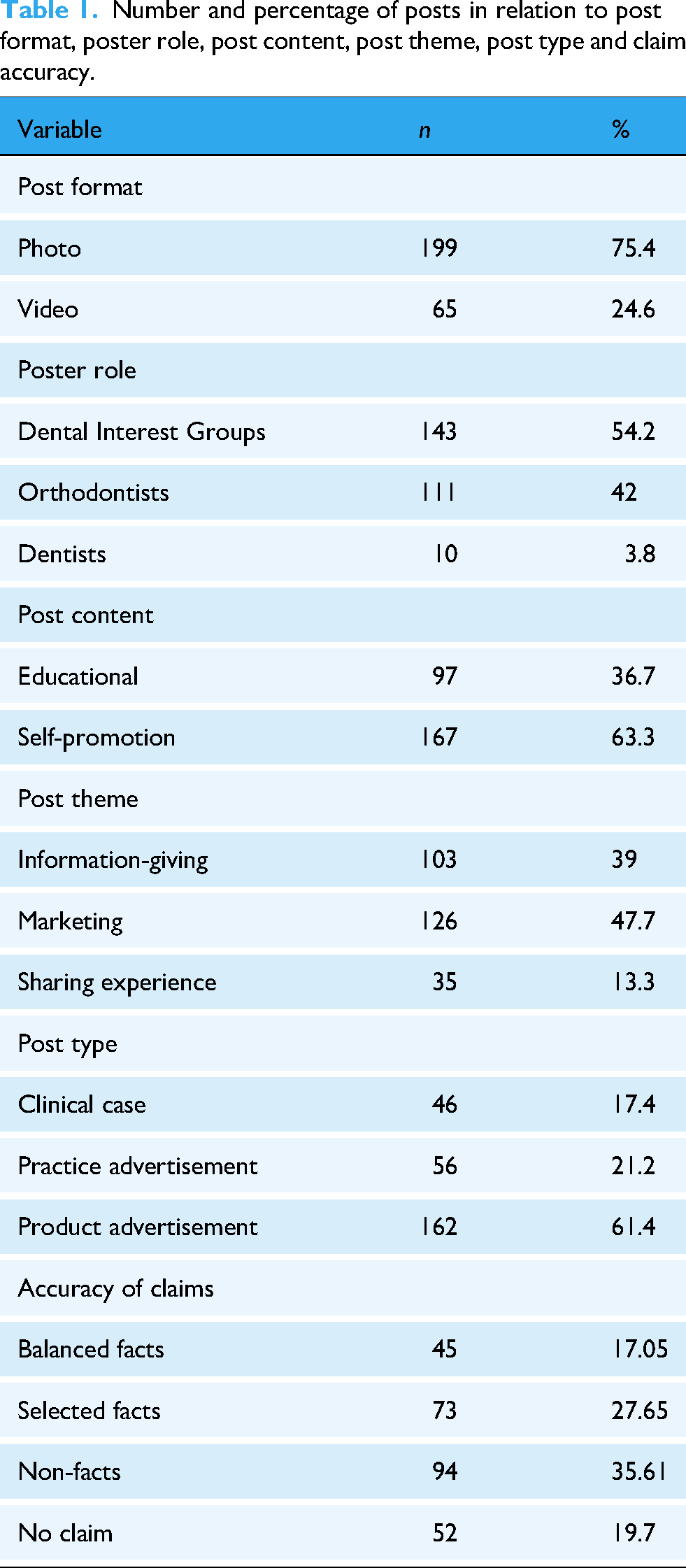
An approximate pool of 1,058,700 posts was identified from the selected hashtags. The highest three hashtags in terms of post number were all related to general orthodontics that contain relevant clear aligner content (Supplemental file 1). A total of 280 posts were retrieved from the selected hashtags, with 16 excluded duplicate posts. The remaining 264 posts were from 13 countries, with 56% originating from Saudi Arabia (Figure 2), while the geographical location was unclear for two posts. Most posts were in photo format (75%), posted by dental interest groups (58%), and were promotional (63%), with a marketing theme (48%), primarily for clear aligner product advertisements (61%) and mainly were non-factual (36%; Table 1).

The total number of posts per country.
Number and percentage of posts in relation to post format, poster role, post content, post theme, post type and claim accuracy.
Likes, comments and engagement rate
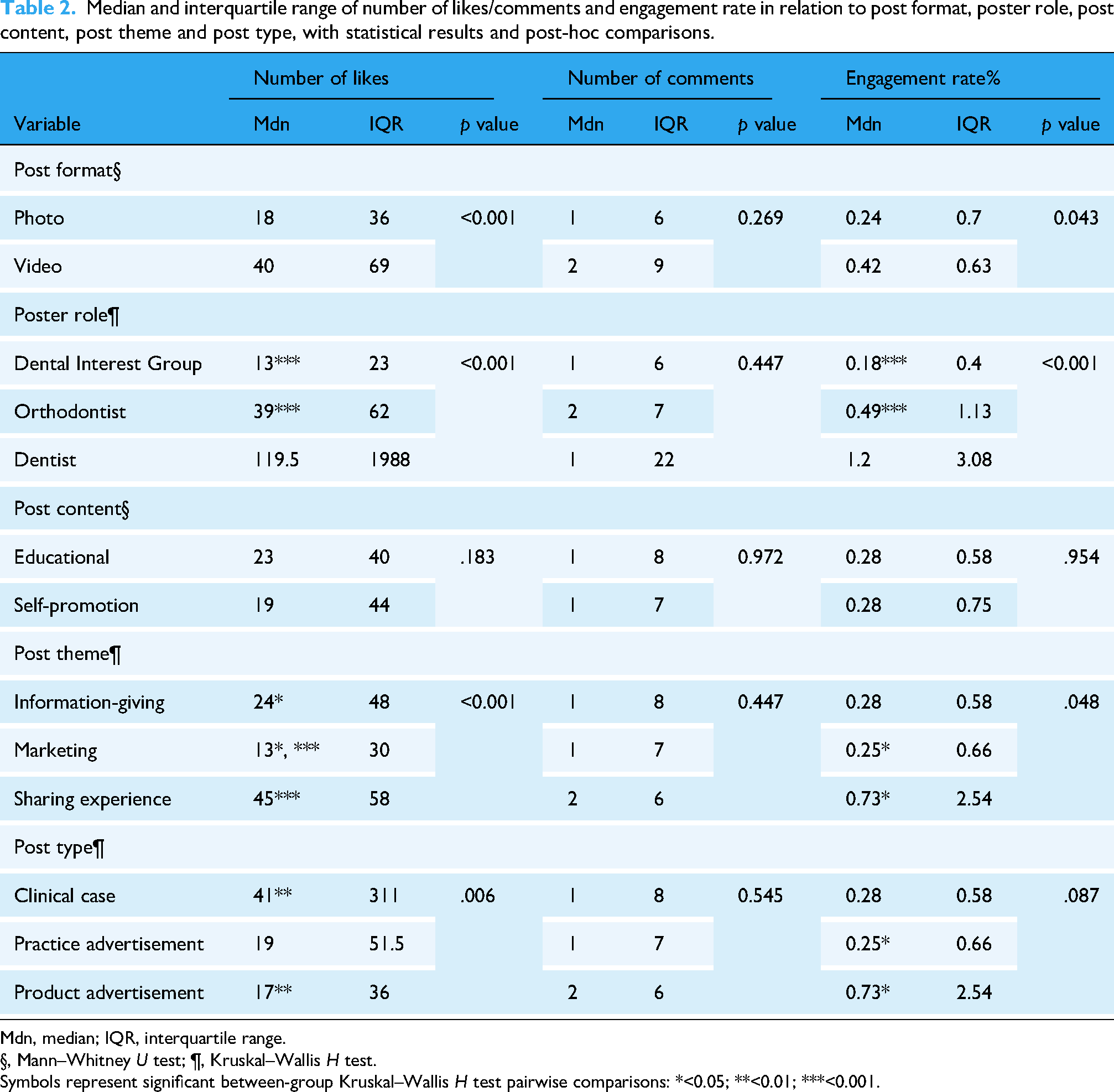
Table 2 presents the number of likes, the number of comments and the engagement rate in relation to the variables of interest. The total number of likes and comments was 33,057 (Mdn = 24, IQR = 53.5) with an overall engagement rate of 0.49% (Mdn = 0.28%, IQR = 0.69). The number of comments was not significant in any variable. However, the number of likes and engagement rate were significantly higher in video posts compared to photo posts (p < 0.05). Regarding poster role, orthodontists showed statistically significant differences in number of likes and engagement rate compared to posts by dental interest groups (p < 0.001). While dentists being the highest in number of likes and engagement rate showed no statistical differences, mainly due to their small sample size (n = 10) and large variability. No differences in the number of likes and engagement rate in relation to post content. However, for post theme, marketing posts received the lowest number of likes than information-giving or sharing experience posts (p ≤ .05 and p ≤ .001), while receiving lower engagement rate than sharing experience posts only (p < 0.05). For post type, clear aligner clinical case posts received the highest number of likes than post with product or practice advertisements (p = 0.005), while no differences in engagement rate.
Median and interquartile range of number of likes/comments and engagement rate in relation to post format, poster role, post content, post theme and post type, with statistical results and post-hoc comparisons.
Mdn, median; IQR, interquartile range.
§, Mann–Whitney U test; ¶, Kruskal–Wallis H test.
Symbols represent significant between-group Kruskal–Wallis H test pairwise comparisons: *<0.05; **<0.01; ***<0.001.
Accuracy of claims
There was a significant relationship between claim accuracy and post format (χ² [3, N = 264] = 8.31, p = 0.04), where claims in photo posts were more likely to have balanced facts compared to video posts (p = 0.008; Table 3). No significant relationship was found between claim accuracy and poster role (χ² [6, N = 264] = 6.34, p = 0.386). However, a significant relationship was found between claim accuracy and post content (χ² [3, N = 264] = 141.75, p < 0.001), where educational posts were more likely to have balanced or selected facts (p < 0.001), while promotional posts were more likely to have no claims or non-facts (p < 0.001). A significant relationship was also found between claim accuracy and post theme (χ² [6, N = 264] = 158.95, p < 0.001), where information-giving posts were more likely to have balanced or selected facts (p < 0.001), while marketing posts to be with non-facts (p < 0.001) and sharing experience posts to have no claims (p < 0.001). Post type also showed a significant relationship with claim accuracy (χ² [6, N = 264] = 80.72, p < 0.001), where clinical case posts were more likely to have no claims (p < 0.001), while practice advertisements to be with non-facts (p = 0.011), and product advertisements to have balanced or selected facts (p < 0.001).
The relationship between post claim accuracy and post format, poster role, post content, post theme and post type, investigated with a Chi-square test.
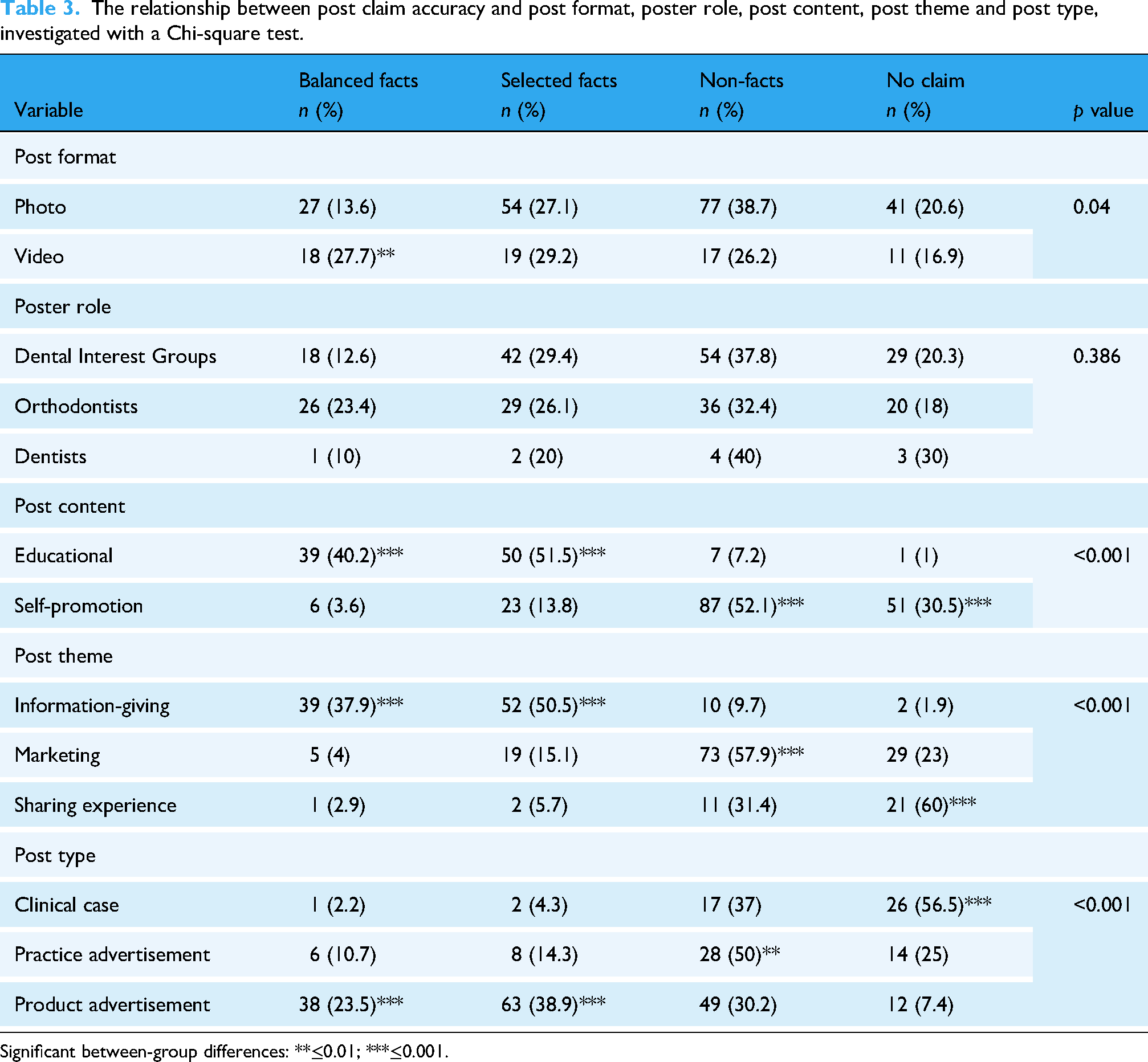
Significant between-group differences: **≤0.01; ***≤0.001.
Discussion
Social media is a common hub for advertisements of orthodontic services and products.4,5,30,31 Moreover, previous studies have found that 99% of orthodontic patients use social media applications, with Instagram being the most popular. 32 This prospective cross-sectional study analysed the quality and accuracy of Arabic clear aligner information on Instagram, analysing 264 posts retrieved from 14 popular hashtags. To our knowledge, this represents the first systematic assessment of Arabic clear aligner-related content on Instagram.
Our findings demonstrated both similarities and distinctive patterns when compared to orthodontic social media research in other linguistic contexts. The predominance of photo-based posts (75%) aligns with studies of English-language clear aligner content on Instagram,8,21,23,33,34 suggesting universal visual appeal in orthodontic marketing across cultures. However, the higher engagement rates for video posts in our Arabic sample contradict findings by Abdelemam et al. 23 who found no differences in engagement rates related to post type in clear aligner English content. This might reflect cultural preferences for dynamic content consumption in Arabic-speaking populations.
Non-factual claims presented in the current study include promises of faster treatment, minimal pain and a more enjoyable experience than traditional braces. In comparison, posts with selected facts emphasised benefits such as improved aesthetics, more patient control and the ability to preview simulated treatment outcomes. However, other key facts about clear aligners – namely, their higher cost and greater reliance on patient compliance compared to fixed appliances – are often omitted. 35 Although, there is no single universal guideline for publishing clear aligner treatment cost on social media, dental professionals must be truthful, transparent, evidence-based and compliant with local regulations. The prevalence of non-factual claims in this study, particularly in promotional-themed posts, raises concerns about the spread of misinformation. Previous studies reported similar trends in orthodontic social media, where promotional content often exaggerates treatment benefits or omits risks, potentially misleading patients.7,8,23,2436–40 Non-factual claims were also shown to be widespread across platforms and regions, including Europe and Brazil, with no evidence that European content is consistently more factual than elsewhere.36,38,41,42
The observed patterns of misinformation in our study align with established theoretical frameworks for understanding health misinformation propagation. The medico-scientific conspiracy theory suggests that societal prejudices and biases contribute to infodemic conditions, fostering distrust in medical science and increasing susceptibility to misleading claims. 19 Our findings of 36% non-factual claims, particularly in promotional content, may reflect confirmation bias, where individuals seek information that confirms pre-existing beliefs about ‘faster’ or ‘painless’ orthodontic treatment options. Additionally, the theory of illusory truth indicates that repeated exposure to misinformation increases its perceived truthfulness, 43 which may explain the persistence of exaggerated claims across multiple posts in our sample. The fuzzy-trace theory provides additional context for interpreting these findings, as when misinformation offers more appealing interpretations than evidence-based information (such as promises of minimal pain vs. realistic treatment expectations), it becomes more persuasive regardless of factual accuracy. 44
Traditional cross-sectional social media research faces inherent limitations in causal identification. 45 Our study identified correlations between post characteristics and misinformation prevalence; however, these findings should not be interpreted as demonstrating causal relationships. The relationships we observed between poster characteristics and content accuracy could be explained by multiple mechanisms: shared exposure to commercial incentives across similar practice types, geographic constraints influencing regional marketing practices, homophily whereby practitioners with similar commercial orientations cluster in social networks or direct influence of marketing strategies on content accuracy. 45 Future research should employ methodological approaches that can better discriminate between these mechanisms, including longitudinal designs with precise measurement of temporal sequences and structural control of social network features.
Regulatory approaches and international context
The regulatory landscape for health information on social media varies significantly across countries, providing context for potential interventions in Arabic-speaking regions. The United States Food and Drug Administration has issued some social media guidance for healthcare communications. However, it mainly covers how pharmaceutical companies should handle unsolicited online requests about off-label drug information. 46 The European Medicines Agency has developed frameworks for real-world evidence integration and digital health app regulation, offering more comprehensive oversight than many other jurisdictions. 47 In contrast, countries like Australia have implemented platform-specific regulations addressing social media content moderation, 48 while Canada has focused on privacy and data protection frameworks that indirectly influence health information sharing. 49 The United Kingdom has emphasised professional accountability for healthcare practitioners’ social media use, requiring adherence to clinical guidelines in online communications. 50 Therefore, the recommended regulatory interventions for Arabic social media content include: (1) clear practitioner guidelines for evidence-based claims in social media posts, (2) implement fact-checking mechanisms specifically for health-related content in Arabic, (3) standardised labelling of promotional versus educational posts and (4) develop coordinated regional regulation across Arabic-speaking countries to manage cross-border content.
Healthcare provider recommendations
Based on established best practices for tackling health misinformation, 51 healthcare providers should implement specific strategies: (1) Professional development – training in social media literacy, misinformation detection and evidence-based orthodontic knowledge; (2) Active engagement – building a credible presence on relevant platforms, consistently sharing accurate content and maintaining professional conduct; and (3) Content strategy – offering balanced, evidence-based information with disclaimers, using accurate visuals and promptly addressing misinformation.
Study limitations and future directions
This study has several limitations that warrant consideration. First, the analysis was restricted to Instagram, excluding other platforms such as Twitter or TikTok, which may host a unique user base and a distinct style of clear aligner content. However, Instagram was selected in the current study since it is a popular source for patients to search health information.42,52 Nevertheless, future research should aim for a cross-platform analysis to develop a more holistic understanding of the Arabic clear aligner information ecosystem. Second, the reliance on a pre-defined set of 14 hashtags may have resulted in a non-exhaustive sample of relevant posts. While the selected hashtags were popular, users may employ a wider and more varied vocabulary, and some relevant content may have been missed. Third, the study's focus on Arabic content from a limited number of countries, with a majority from Saudi Arabia. While this provides important regional insights, the findings may not be representative of the entire Arabic-speaking world. Broader, multi-regional studies are needed to account for cultural and regulatory differences.
Additionally, the method of classifying claims as ‘non-factual’ could also be expanded in future work to differentiate between misinformation (unintentionally false) and disinformation (intentionally misleading), which would offer deeper insights into the motivations of content creators. Finally, this study analysed content but not its impact on patient decision-making. Future research should employ qualitative methods, such as interviews or surveys with patients, to explore how exposure to this type of content influences their perceptions, expectations and treatment choices. Such studies could provide the evidence needed to develop effective patient education initiatives and media literacy campaigns.
Conclusions
This study reveals that Arabic clear aligner information on Instagram is predominantly promotional, with a significant proportion of non-factual claims, particularly in promotional and marketing-themed posts. While educational content is more accurate, its lower prevalence underscores the need for improved dissemination of reliable information. Video and sharing experience posts achieved higher engagement, suggesting potential avenues for delivering credible content. Given Instagram's impact on treatment decisions, improving the quality of Arabic orthodontic content is crucial for informed consent and public oral health awareness.
Supplemental Material
sj-docx-1-dhj-10.1177_20552076251393362 - Supplemental material for Quality and accuracy of clear aligner Arabic information on Instagram: A content-based analysis
Supplemental material, sj-docx-1-dhj-10.1177_20552076251393362 for Quality and accuracy of clear aligner Arabic information on Instagram: A content-based analysis by Kadi AlSuhabani, Shumukh Alothaim and Nabeel Almotairy in DIGITAL HEALTH
Footnotes

Acknowledgements
The Researchers would like to thank the Deanship of Graduate Studies and Scientific Research at Qassim University for financial support (QU-APC-2025).
Contributorship
KA, SA and NA: Investigation. KA, SA and NA: Data acquisition. NA: Conceptualisation, methodology, validation, resources, writing – original draft, visualisation and project administration. KA, SA and NA: Writing – review & editing. All authors approved the final copy of the manuscript.
Funding
The authors received no financial support for the research, authorship and/or publication of this article.
Declaration of conflicting interests
The authors declared no potential conflicts of interest with respect to the research, authorship and/or publication of this article.
Data availability statement
The datasets used and/or analysed during the current study are available from the corresponding author on reasonable request.
Supplemental material
Supplemental material for this article is available online.
References
Supplementary Material
Please find the following supplemental material available below.
For Open Access articles published under a Creative Commons License, all supplemental material carries the same license as the article it is associated with.
For non-Open Access articles published, all supplemental material carries a non-exclusive license, and permission requests for re-use of supplemental material or any part of supplemental material shall be sent directly to the copyright owner as specified in the copyright notice associated with the article.
