



Abstract
Background
Lumbar disc herniation is a common chronic condition among working people. In China, the number of popular scientific videos on health and disease knowledge is increasing on short video platforms, but there is still a lack of sufficient research to evaluate the quality of these short videos. The main objective of this study was to evaluate the quality, reliability, and content completeness of lumbar disc herniation related videos posted on four major short video platforms in China.
Methods
The keyword “lumbar disc herniation” was entered into four major Chinese short video platforms; videos were sorted by the number of likes, and the top 100 were collected. After sifting through the collected videos, their quality was assessed using the Global Quality Score (GQS), DISCERN tool, and content completeness score.
Results
A total of 400 videos were collected from four short video platforms, Douyin, Bilibili, Kuaishou, and Xiaohongshu, leaving 384 videos after screening. The largest group of uploaders was orthopedic surgeons (24.2%), while the smallest was organizations (2.6%). For short video content, the most frequently mentioned content was treatment (83.9%), followed by diagnosis (14.8%). The average number of likes for each video was 25,998. The mean GQS score, DISCERN score and content completeness score of these videos were 2 ± 0.85, 1.71 ± 0.76, and 1.38 ± 0.76. There was little difference in content completeness among the platforms, but Douyin had higher video quality scores.
Conclusions
In summary, the overall quality scores of lumbar disc herniation-related short videos were not high. Short video quality on Douyin was higher than that of other platforms. The quality of videos posted by orthopedic surgeons was better than that posted by other groups. Short videos with a high number of likes tend to have higher GQS and DISCERN scores.
Background
The incidence of lumbar disc herniation is particularly high in the world, especially in the working population, which seriously affects the quality of life of patients.1,2 Currently, lumbar disc herniation is treated with both conservative and surgical treatments. Among them, conservative treatments include drug therapy, exercise therapy, traction therapy, spinal manipulation therapy, etc.3,4 Surgical treatment can also be performed via multiple approaches: traditional surgery (laminectomy and nucleus pulposus decompression), percutaneous puncture minimally invasive surgery (nucleolysis, excision, and photostimulation), and endoscopic minimally invasive surgery. 5 While treatment of the disease is important, it is equally important to understand its etiology and risk factors to prevent the disease from occurring. For example, obesity, occupational factors, and improper exercise are risk factors for the disease, but many people are unaware of this fact.6–8 Lack of knowledge about lumbar disc herniation may delay diagnosis and treatment, thereby affecting patient recovery.
Social media can be used for a variety of health purposes. Studies have shown that up to 80% of Internet users seek health information online. 9 Several new uses have emerged since 2013, including advancing health research and practice, social mobilization, and facilitating offline health-related services and events. 10 Social media has been widely used by various users in health contexts. Different groups of people obtain the knowledge they need through different social media platforms. For example, social media-based activities have been effective in enhancing the knowledge, attitudes, and self-care activities of diabetics, especially during the COVID-19 pandemic. 11 More than 80% of Australian young adults visit social media platforms at least once per day, particularly during key times of the day associated with food choices, such as first thing in the morning and at lunch. 12 A study evaluated the information about lumbar disc herniation on YouTube and found that the overall quality of YouTube videos related to lumbar disc herniation was relatively low. 13 However, the information quality of videos related to lumbar disc herniation on Chinese short-video platforms has not yet been evaluated. In China, Douyin, Kuaishou, Xiaohongshu, and Bilibili are the four most popular platforms. However, with the popularity of short videos, the quantity and quality of health science popularization videos for diseases cannot be assessed, resulting in people not knowing whether to believe these science popularization videos. Therefore, we designed this study to evaluate the quality, reliability, and content completeness of lumbar disc herniation related videos on four major short video platforms in China.
Materials and methods
Data collection
All videos were collected from Douyin (https://www.douyin.com/), Kuaishou (https://www.kuaishou.com/), Xiaohongshu (https://www.xiaohongshu.com/), and Bilibili (https://www.bilibili.com/), four of China's most popular short video platforms. 14 The keyword “lumbar disc herniation” was used to search the four platforms, and videos were ranked by the number of likes. The top 100 most popular videos were aggregated; some were excluded for being duplicates or irrelevant to the research topic. The contents of the data collection include the name and identity of the uploader, time of posting, video contents, duration, number of likes, comments, favorites and shares. Video sources were categorized as orthopedists, non-orthopedists, individual users, organizations, and patients. Duration refers to the length of each video, which was directly recorded in Excel during video review. Non-orthopedists are doctors in other departments such as traditional Chinese medicine, physician internists, and others. The videos were examined by two separate investigators. We calculated the Cohen's κ coefficient to determine the inter-rater reliability. The inter-rater reliability of each evaluation item was greater than 0.8, indicating good inter-rater reliability. For those scores on which agreement could not be reached, the final decision was made by a senior author. All the selected data is recorded in Excel. The Medical Ethics Committee of Shangrao People's Hospital approved this research (Medical Ethics Review No. 695 of 2025).
Evaluation methodologies
We consider the completeness score, GQS and DISCERN scores as instruments for assessing the content completeness, reliability and quality of information in each collected video. Before searching for the videos, the two researchers reviewed the relevant clinical guidelines for lumbar disc herniation. Researchers first record the basic information of the video, such as the identity of the uploader and time of posting. Subsequently, the two researchers separately scored the completeness, reliability and quality of the video. For inconsistent scores, the final decision will be made by a senior author. In order to give a comprehensive assessment of lumbar disc herniation, we categorize the following: The content score is defined as a comprehensive introduction to each of the above aspects, with a completeness score ranging from 0 to 8. For example, a short video gets 1 point if it mentions one of these contents, and no point if it does not. The DISCERN tool is a reliable and valid instrument for assessing the quality of health information. 15 The DISCERN content score (Table S1) includes five aspects: clarity, relevance, tractability, robustness, and fairness, with the highest possible score being 5. The GQS (Table S2) has been used in some published literature.16,17 Normally, the criterion ranking from 1(poor) to 5(excellent) was applied to assess the quality of the short videos in this paper.
Statistical analysis
GraphPad Prism 9.3 and R statistical software 4.1.3 were used for statistical analysis and plotting. For continuous variables, such as the number of likes and comments, normality tests were first conducted. For variables that follow a normal distribution, the mean ± standard deviation (SD) is used for expression. For variables that do not follow a normal distribution, the median (interquartile range, IQR) is used for representation. Two-group comparisons were analyzed using t-tests or Mann–Whitney U tests. One-way ANOVA (and Mann–Whitney U test or mixed) was employed to compare multiple groups. Differences with a p-value <0.05 were considered statistically significant.
Results
Video selection process
In this study, a total of 400 videos were collected from Douyin, Xiaohongshu, Kuaishou, and Bilibili using Chinese keywords in the results. However, 384 videos were included after applying the exclusion criteria. Of the 384 videos, 100 are in Douyin, 99 in Xiaohongshu, 87 in Kuaishou, and 98 in Bilibili. The video analysis process is shown in Figure 1.

Flowchart of the study.
Video characteristics
As shown in Figure 2(A), orthopedists released the most videos (43.2%), followed by non-orthopedists (24.2%), individual users (21.6%), patients (21.6%) and organizations (2.6%). The contents for the videos are treatment (83.9%), diagnosis (14.8%), case (12.5%), pathology (9.1%), anatomy (5.2%), prevention (4.1%), etiology (3.9%) and antidiastole (2.6%) (Figure 2(B)). The average number of likes, comments, and favorites, and average duration (seconds) were 25,998, 1197.3, 13,426, and 147.3, respectively (Figure 2(C)).The mean content completeness score of the included videos was 1.38 ± 0.76,the mean GQS score was 2.43 ± 0.85, and the mean DISCERN score was 1.71 ± 0.76 (Table 1).

Video characteristics. (A) The 3D pie chart shows the proportion of different people uploading videos. (B) The lollipop chart shows the content composition and proportion of the short video. (C) The bubble chart shows the number of likes, favorites, comments, and length of the video.
Video characteristic.

Comparison of different short-video platforms
As illustrated in Figure 3(A), different short-video platforms (Douyin, Kuaishou, Bilibili, Xiaohongshu) have different uploaders. In the platform of Douyin, orthopedists (n = 71) shared the most number short videos, followed by non-orthopedists (n = 20), individual users (n = 5), organization (n = 3) and patients (n = 1). More than one half of videos uploaded by orthopedists (n = 55) in Kuaishou platform, non-orthopedists (n = 31) and individual users (n = 1) followed, but organizations (n = 0) and patients (n = 0) did not shared in these videos. As we can see, in the platform of Xiaohongshu, individual users (n = 46) ranked the number one who uploaded their short videos, followed by orthopedists (n = 23), non-orthopedists (n = 19), patients (n = 9), and organizations (n = 2). In another popular platform, Bilibili, individual users (n = 31) are the major group, then the non-orthopedists (n = 23), patients (n = 22), and orthopedists (n = 17), finally organizations (n = 5).

Comparison of different short-video platforms. (A) The rose charts show the number of different types of uploaders on different platforms.(B–D) Violin plots showing the content completeness scores, GQS and DISCERN scores from different short-video platforms. ns: nonsignificant; *p < 0.05; **p < 0.01; ***p < 0.001; ****p < 0.0001.
We evaluated the information completeness and found there were no statistical significance among the platforms (Figure 3(B)). In contrast, the GQS and DISCERN fractions have different results (Figure 3(C) and (D)).The videos published by Douyin (GQS = 2.89 ± 0.86, DISCERN =2.10 ± 0.73) had the highest mean GQS and DISCERN scores, followed by Kuaishou (GQS = 2.53 ± 0.87, DISCERN = 1.95 ± 0.50), Bilibili (GQS = 2.11 ± 0.72, DISCERN =1.26 ± 0.74), and Xiaohongshu (GQS = 2.20 ± 0.73, DISCERN = 1.56 ± 0.70) (Table 2).
Comparison of different short-video platforms.

Comparison of different uploaders
As shown in Figure 4(A), the video contents, which include etiology, pathology, diagnosis, treatment, case, antidiastole, prevention and anatomy, were shared by different uploaders (orthopedists, non-orthopedists, individual user, organization and patient). However, no organizations and no patients have released short videos involving anatomy and antidiastol. In the picture of Figure 4(B)–(D), we analyzed the content completeness, quality, and reliability of the short videos shared by different vloggers. There is no significant difference in information completeness. However, the GQS and DISCERN scores show statistical significance. Orthopedists obtained highest mean scores (GQS = 2.89 ± 0.85, DISCERN = 2.11 ± 0.64), then organization (GQS = 2.4 ± 0.52, DISCERN = 1.7 ± 0.48), next non-orthopedists (GQS = 2.28 ± 0.71, DISCERN = 1.75 ± 0.62) and individual users (GQS = 1.93 ± 0.56, DISCERN = 1.41 ± 0.95), finally patients (GQS = 1.81 ± 0.64, DISCERN = 0.91 ± 0.73) (Table 3).

Comparison of different uploader.(A) The histogram shows the content composition of short videos by different uploaders. (B-D) Violin plots showing the content completeness scores, GQS and DISCERN scores from different uploaders. ns: nonsignificant; *p < 0.05; **p < 0.01; ***p < 0.001; ****p < 0.0001.
Comparison of different uploaders.

Comparison of high and low likes
To see what kind of videos people prefer, we selected the top 100 and bottom 100 videos ranked by likes and divided these short videos into two groups. As shown in Figure 5(A), there does not seem to be significant difference in the contents, including anatomy (high = 5,low = 6), antidiastole (high = 4, low = 3), case (high = 17, low = 12), diagnosis (high = 16, low = 15), etiology (high = 0, low = 6), pathology (high = 5, low = 10), prevention (high = 0, low = 1), and treatment (high = 90, low = 77). The completeness between high and low group had no significant difference (Figure 5(B)). However, the GQS and DISCERN scores between the two groups of these videos were of statistical significance (Figure 5(C) and (D)). Obviously, high-likes group (GQS = 2.65 ± 0.87, DISCERN = 1.88 ± 0.78) have higher mean scores than low likes group (GQS = 2.1 ± 0.73, DISCERN = 1.34 ± 0.68) (Table 4).
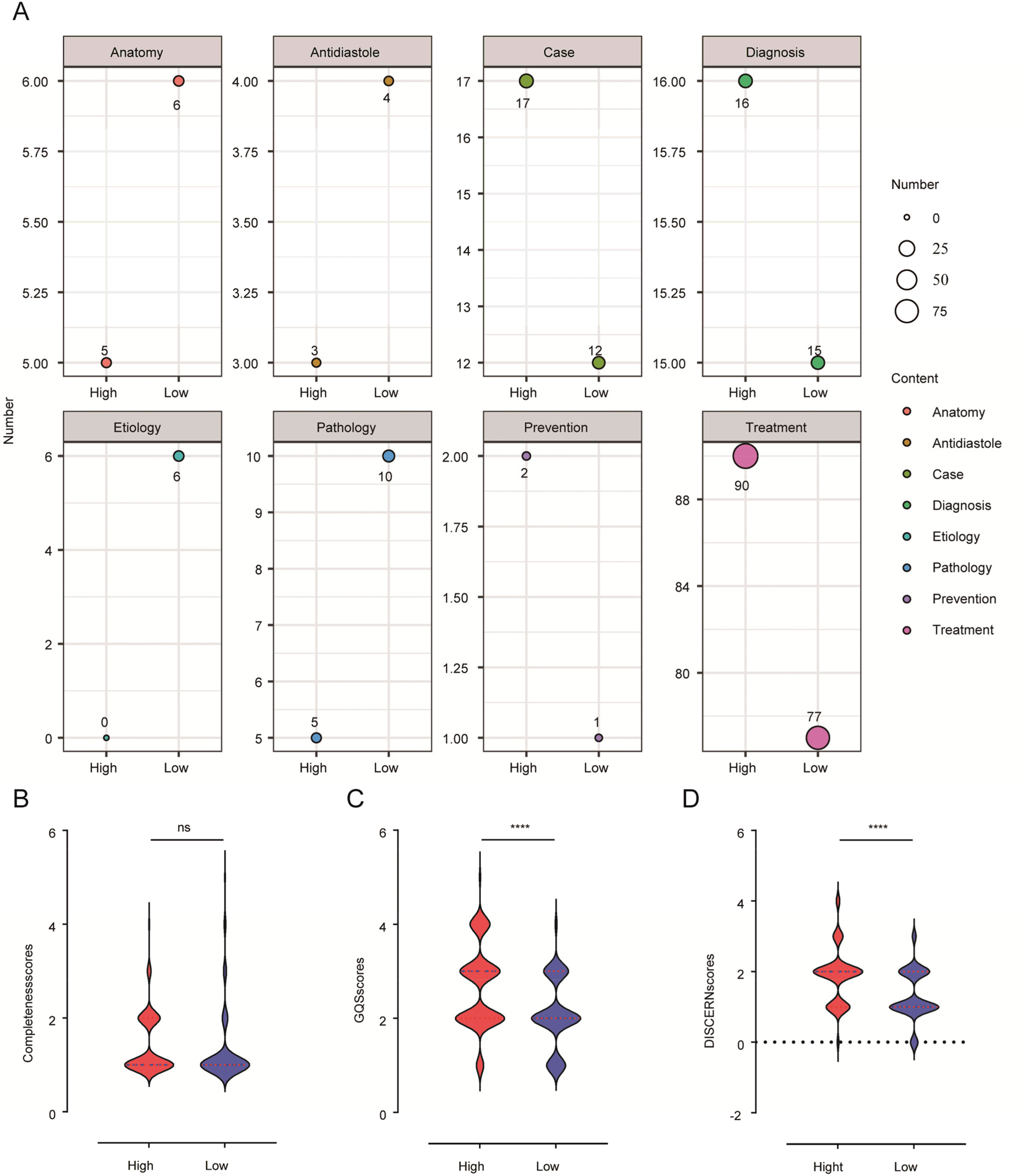
Comparison of different high and low likes. (A) The bubble charts show the content composition of short videos between high and low likes. (B–D) Violin plots showing the content completeness scores, GQS and DISCERN scores between high and low likes. ns: nonsignificant; *p < 0.05; **p < 0.01; ***p < 0.001; ****p < 0.0001.
Comparison of high and low likes.

Discussion
Nowadays, with the popularity of short video, many video platforms are popularizing knowledge related to some diseases, such as malignant tumor.16,17 Especially, during the COVID-19 pandemic, the Internet has become an important way for people to prevent, treat, and care for diseases.18,19 Lumbar disc prolapse, protrusion, and extrusion are the most common causes of nerve root pain and surgical interventions. 20 Surgery is not the only treatment for the disease, and the effectiveness and methods of treating the disease vary in the early and late stages of the disease.21,22 Some proper functional exercises are also effective in relieving symptoms and improving the condition.23,24 Individuals with lumbar disc herniation often lack adequate disease-related information, leading to prolonged severe pain. 25 Currently, in the context of patient education for low back pain, AI-based tools and short videos have become important channels for people to access information related to low back pain. For instance, some studies have compared the roles of ChatGPT 3.5 and ChatGPT 4.0 in the education of patients with low back pain. 26 With the rapid development of the Internet, short videos have become an important source for people to obtain information about diseases. In China, there are a lot of short videos about lumbar disc herniation and platforms for releasing short videos, and there are certainly a lot of differences between different video platforms and videos.
In this study, we collected short videos related to lumbar disc herniation from four most popular Chinese sharing platforms: Douyin, Bilibili, Kuaishou, and Xiaohongshu. The content, quality, and reliability of all data were analyzed on the topic of disease. Overall, all videos scored low on completeness and not high on quality and reliability, possibly because they were short in length and provided only a relatively detailed explanation of one aspect of the disease. This result is consistent with a previous study evaluating the health related to lumbar disc herniation on YouTube. 13 This indicates that how to disseminate high-quality health information through social media platforms may be a global issue, unaffected by specific platforms or regions. Previous studies have shown that the quality of health education videos is related to who uploads them.27,28 Among the videos we collected, our results show that the largest number of people posting videos are orthopedic surgeons, with a smaller percentage of other groups or institutions. The reason for this phenomenon may be that orthopedists have a more comprehensive understanding of the disease, and in this information age, doctors can not only popularize the knowledge of the disease and raise people's awareness of the disease through short video platforms, but also improve the visibility of themselves and the hospital. Health promotion of short videos related to physiotherapy exercises for lumbar disc herniation has also been studied. 29 Furthermore, we also found that the videos released by orthopedic doctors were significantly more reliable and of higher quality, which further indicates that health information released by professional medical staff has a higher level of credibility. The videos posted by patients often tend to share their personal treatment experiences. However, due to the lack of sufficient medical background knowledge, some of the content they post may mislead other video viewers. A study evaluating short videos as a source of health information for pre-colonoscopy intestinal preparation found that videos posted by gastroenterologists had higher quality and credibility than those posted by patients. 30
Short videos about the disease have a large number of likes and favorites, which shows that people are very concerned about the disease. There are significant differences across platforms in the quality and reliability of these videos. Douyin had the highest rating and Bilibili the lowest. The reason for the difference may be that the video publishers of the two are different. On Douyin, orthopedic surgeons are the main demographic for video posting, while on Bilibili, individual users make up the majority. Another possible reason is that from the excluded videos, it can be seen that there are fewer ads or videos unrelated to the topic on Douyin than on Bilibili. A previous study evaluating the video quality related to Chronic Obstructive Pulmonary Disease on TikTok also found that the overall information quality of the videos on TikTok was satisfactory, which might be because the video publishers on this platform were mainly related to medical professionals. 27 These results indicate that although the rise of short-video platforms has brought us many conveniences, the health information on these platforms remains uneven. The public should prioritize obtaining health information from professional healthcare workers. At the same time, more professional health workers should be encouraged to post high-quality videos on short-video platforms to promote the public's understanding of relevant health knowledge. The platform should also strengthen the supervision of health-related videos to prevent the rapid spread of misinformation as much as possible.
There are limitations to our study. First, we only evaluated four short video platforms in China, and there are many other platforms we did not evaluate, such as watermelon video. Second, only two scoring tools, the GQS and DISCERN scores, are used. In addition, when using keywords, only the topic of “Lumbar Disc Herniation” was used, and the related words such as “Lumbar Disc Bulging” and “Lumbar Disc Prolapse / Extrusion” were not searched. Thirdly, the lack of effect size and confidence intervals weakens the interpretability of the results of this study. Finally, this data is also collected over a period of time and can be affected by factors such as new video uploads or changes in platform management.
Conclusions
This study evaluated the quality of 384 lumbar disc herniation-related videos from four short video platforms in China. The results show that among all videos: (1) the short video quality of Douyin platform is higher than that of other platforms. (2) The quality of videos posted by orthopedic surgeons was better than that posted by other groups. (3) Short videos with a high number of likes tend to have higher GQS and DISCERN scores. This suggests that the public should be cautious and selective when viewing such short videos, and prioritize those uploaded by professional doctors. In this era of popular video sharing, there is a great need to improve the quality of posted short videos, and the quality of evaluating these short videos should not be left behind.
Supplemental Material
sj-docx-1-dhj-10.1177_20552076251393278 - Supplemental material for Assessment of information quality and reliability of short videos related to lumbar disc herniation on selected video platforms
Supplemental material, sj-docx-1-dhj-10.1177_20552076251393278 for Assessment of information quality and reliability of short videos related to lumbar disc herniation on selected video platforms by Yuehua Wang, Sheng Lian, Longteng Liao and Wenyu Wang in DIGITAL HEALTH
Supplemental Material
sj-docx-2-dhj-10.1177_20552076251393278 - Supplemental material for Assessment of information quality and reliability of short videos related to lumbar disc herniation on selected video platforms
Supplemental material, sj-docx-2-dhj-10.1177_20552076251393278 for Assessment of information quality and reliability of short videos related to lumbar disc herniation on selected video platforms by Yuehua Wang, Sheng Lian, Longteng Liao and Wenyu Wang in DIGITAL HEALTH
Supplemental Material
sj-docx-3-dhj-10.1177_20552076251393278 - Supplemental material for Assessment of information quality and reliability of short videos related to lumbar disc herniation on selected video platforms
Supplemental material, sj-docx-3-dhj-10.1177_20552076251393278 for Assessment of information quality and reliability of short videos related to lumbar disc herniation on selected video platforms by Yuehua Wang, Sheng Lian, Longteng Liao and Wenyu Wang in DIGITAL HEALTH
Footnotes
Acknowledgements
The authors would like to express their gratitude to the participants who participated in the study.

Ethical approval
The Medical Ethics Committee of Shangrao People's Hospital approved this research (Medical Ethics Review No. 695 of 2025).
Informed consent
No clinical data, human specimens, or laboratory animals were used in this study. All information was obtained from publicly released short videos, and none of the data involved personal privacy concerns. In addition, this study did not involve any interaction with users.
Author contributions
YHW collected data, analyzed relevant information, and drafted the manuscript; SL collected data and drafted the manuscript; LLL revised the manuscript; WYW designed the article, and edited the manuscript. All authors read and approved the final manuscript.
Funding
The authors received no financial support for the research, authorship, and/or publication of this article.
Declaration of conflicting interests
The authors declared no potential conflicts of interest with respect to the research, authorship, and/or publication of this article.
Data availability
The data that endorse the results of this research are available upon reasonable request from the corresponding authors.
Statement
The video content used in the study from Douyin, Bilibili, Kuaishou, and Xiaohongshu was all public at the time of data collection and did not require individual consent for use.
Supplemental material
Supplemental material for this article is available online.
References
Supplementary Material
Please find the following supplemental material available below.
For Open Access articles published under a Creative Commons License, all supplemental material carries the same license as the article it is associated with.
For non-Open Access articles published, all supplemental material carries a non-exclusive license, and permission requests for re-use of supplemental material or any part of supplemental material shall be sent directly to the copyright owner as specified in the copyright notice associated with the article.
