




Abstract
Purpose
Our study comprehensively assesses how Canada and Organisation for Economic Co-operation and Development (OECD) countries have supported researchers, research institutes and their scientific productivity in primary health care (PHC), one of the areas most affected by COVID-19.
Method
We analyzed research contributions among OECD countries and assessed their scientific productivity during COVID-19 using bibliometric methods and machine learning techniques. Our analysis includes co-authorship networks, funding patterns, co-citation analysis, thematic mapping, factor analysis, and topic modeling through latent Dirichlet allocation.
Results
This study analyzes 1061 articles and review papers involving 5765 researchers from OECD countries. PHC systems played a crucial role in the global response to SARS-CoV2 but faced significant challenges. Canada ranks third in PHC research output and forth in COVID-19 research among OECD nations. The findings reveal Canada's strong collaborative ties with countries such as the USA, UK, and Australia. However, disparities in PHC scientific productivity across OECD countries remain, with some nations showing minimal progress.
Conclusions
Our study highlights the importance of academic collaboration in addressing pandemic-related crises. The study recommends enhancing international collaboration, led by countries such as Canada, the USA, and the UK, to strengthen PHC systems during global health crises. It is deemed necessary to include experts and academics from the field of PHC in such structures. It also emphasizes the need for academic journals to improve transparency in funding sources through automated extraction of bibliometric data from platforms such as Web of Science and Scopus, which is crucial for shaping future health and education policies.
Keywords
Introduction
The Black Death, the Plague, 1 then the Spanish Flu,2,3 and now the spread of the new coronavirus disease (COVID-19) remind us again of how epidemics affect the social order. Since the World Health Organization (WHO) declared the disease a pandemic, countries around the world have adopted measures at various levels to limit the spread of the virus. 4 The COVID-19 pandemic has had a tremendous impact on health systems in all countries. The rapid progression of the disease has posed a real challenge for the whole world, and health workers and governments have had a significant fight against the pandemic, as the capacity of the health service provided to citizens has been exceeded.5–7
The global crisis marked by the deepest public health emergency of the century and the most significant economic downturn since World War II has significantly impeded progress towards achieving the Sustainable Development Goals (SDGs), especially Good Health and Wellbeing (SDG 3) and Reducing Inequality within and Among Countries (SDG 10). 8 Particularly, governments worldwide, especially in Organisation for Economic Co-operation and Development (OECD) countries, have been compelled to exert comprehensive efforts to restore economic stability and sustain daily life through stimulus packages. 9 The pandemic has led to a sharp tightening of global financial conditions during the acute phase of the crisis and has resulted in significant economic losses worldwide, potentially with lasting effects.6,7 Throughout the COVID-19 pandemic, policymakers aim to increase consumption and investment by providing stimulus packages. These stimulus packages encompass various fiscal support measures with different public financial implications during the COVID-19 pandemic. 10 Similarly, as an OECD country, the Canadian government has implemented similar economic and fiscal measures. Our study comprehensively assesses how Canada and OECD countries have supported researchers, research institutes and their scientific productivity in primary health care (PHC), the field most affected by COVID-19. For this purpose, bibliometric methods and machine learning techniques are utilized.
Background
There are numerous studies in the literature that focus on the problems experienced by OECD countries during the COVID-19 pandemic. Rathnayaka et al. 9 examined the determinants of financial support during the COVID-19 pandemic in 34 leading OECD countries representing the OECD. They focused on whether the decisions were in line with SDG 3 and SDG 10. 9 Wildman 11 conducted research to determine the relationship between income inequality and COVID-19 cases and deaths in OECD countries. Palmer and Smal 12 conducted a review of government policies in four OECD countries and how they would impact young people and young adults in these countries. Additionally, in the COVID-19 and OECD countries search conducted based on article titles on the Web of Science (WoS), publications were found on various topics such as the state of domestic tourism post-COVID-19, 13 the dimensions of the COVID-19 pandemic for OECD countries, 14 income inequality and COVID-19 mortality rates for OECD countries, 15 the effects of the COVID-19 outbreak on the energy and economic sectors, 16 assessment of adherence to the Mediterranean diet and COVID-19 cases for 24 OECD countries, 17 evaluation of government “blame” and “credit” communication activities through tweets for four OECD countries, 18 the impact of COVID-19 on economic growth, 19 progress in the green finance sector with a focus on OECD countries, 20 and the relationship between organ donation rates and COVID-19 vaccination status. 21 However, no publication questioning the funding status of articles related to the COVID-19 topic produced by OECD countries during the COVID-19 process has been accessed in the literature. As known, support for scientific research during such crises is of critical importance.
Bibliometrics is a fundamental tool for monitoring scientific productivity and progress in a given field, and in health, bibliometrics is often used to measure the impact of research articles. 22 When the literature was examined, studies examining the effect of COVID-19 to many different fields were found. A search with words related to COVID-19 through research titles showed that 574 bibliometric studies were conducted in 77 different research fields. Bibliometric studies have been found in many different research areas such as business and economics, 23 bioinformatics, 24 immunology, 25 nursing, 26 health care sciences services, 27 urology, 28 cardiac cardiovascular systems, 29 endocrinology metabolism. 30 Also, bibliometric studies and latent Dirichlet allocation (LDA) analyses have been realized in different periods in the field of PHC and to analyze different aspects of COVID-19 research. In the related field, global scientific research on sars-cov-2 vaccines, 31 physical activity and COVID-19, 32 nanotechnology and COVID-19, 33 analyses of PHC journals, 34 LDA topic modeling for nursing research, 35 topic modeling-based analysis of diabetes, 36 rheumatology and COVID-19 researches, 37 telemedicine in COVID-19, 38 COVID-19 and urology 28 have been studied. In addition, many studies have focused on the development of PHC general literature in different countries such as Africa, 39 Latin America, 40 and India. 41
When bibliometric studies related to COVID-19 and the field of PHC were evaluated, two studies were found in the literature.34,41 The first study is a local investigation examining the trend of COVID-19 publications in India specifically in the PHC literature, 41 while the second study is a bibliometric analysis of publications in the Journal of Family Medicine and PHC over a five-year period. 34 No research was found in the literature that specifically examines COVID-19 research in the field of PHC. Additionally, no study was found in the literature that analyzes the funding status of COVID-19 research produced in Canada or OECD countries using bibliometric methods and LDA topic analysis machine learning methods. This study provides important reference information for the PHC literature focusing on OECD countries and Canada by comprehensively evaluating high-quality articles in the field, aiming to offer insights for potential future pandemic scenarios.
Materials and methods
Objectives of the study and research questions
As is well known, bibliometric studies enable us to analyze the scientific productivity of countries or institutions on a specific topic or field through bibliometric datasets. Scientific productivity refers to the concept of scientific output and denotes the scientific contributions produced by researchers within a specific timeframe. These outputs may include articles, books, conference presentations, patents, or other scientific works. In our study, scientific productivity specifically refers to the scientific output of researchers from OECD countries, as measured through research and review articles published in prominent journals indexed by WoS in the field of PHC research. Additionally, using the most popular topic modeling tool, LDA analysis, we can discover latent themes within a collection of documents, classify the general contents of documents, and determine the topics to which a document belongs based on the words within it.42,43 Our research aims to address the following questions based on the article data obtained for Canada and OECD countries:
Key contributions to COVID-19 research by Canadian and OECD Countries’ researchers? Key contributions to COVID-19 research by Canadian and OECD Countries’ researchers to the PHC research area? What impact has it had on primary health care in Canadian and OECD countries’ researchers? What do bibliometric studies tell us and what examples are there of coronavirus for Canada and OECD countries? How did Canada's and OECD countries’ research output compare to the investments made? What differences exist in the support provided by OECD countries and Canada in PHC research on COVID-19? How have researchers, affiliations, and country collaborations been realized during the COVID-19 time? What are the journals in which the research is published, the distribution of references they use and their citation status? What are the most intensely related topics and special topics covered in the studies? What is the LDA analysis result for Canadian and OECD Countries’ research's?
OECD countries
The OECD, established in 1961 based on the Paris Convention signed on 14 December 1960, comprises industrialized and developing countries. It consists of 38 member countries spread across the globe from North and South America to Europe and the Asia-Pacific region (List: Australia, Austria, Belgium, Canada, Chile, Colombia, Costa Rica, The Czech Republic, Denmark, Estonia, Finland, France, Germany, Greece, Hungary, Iceland, Ireland, Israel, Italy, Japan, Korea, Latvia, Lithuania, Luxembourg, Mexico, The Netherlands, New Zealand, Norway, Poland, Portugal, The Slovak Republic, Slovenia, Spain, Sweden, Switzerland, Turkey, The United Kingdom (England, Scotland, Wales, Northern Ireland), The United States of America). 44 In our study, particular attention was paid to the unique situation of the United Kingdom and Turkey in the WoS list, and our analyses were conducted accordingly.
Research strings and study design
We retrieved data from the WoS Core Collection on 10 June 2025. The main reason for choosing WoS Core Collection instead of Scopus bibliometric data source is that our research focuses on PHC. PHC is not categorized on Scopus. However, the relevant category is available on WoS. 45 For data analysis, we used the R Bibliometrix library for Biblioshiny program, and VoSViewer program, and Python programming language with Scikit-Learn, 46 NLTK, 47 Gensim, 48 Matplotlib, 49 and Wordcloud 50 libraries. Additionally, Microsoft Excel and Structured Query Language (SQL) were employed for data preprocessing and cleaning. The study design and all techniques used are outlined in Figure 1. The dataset comprises research and review articles, filtered to include only those published between 2020 and 2025. The analysis was conducted on data extracted from the WoS bibliometric database, provided in Plain Text and Excel formats. In addition to the selected tools and techniques employed, the following figure illustrates the search terms utilized to retrieve the relevant dataset from the WoS database. This study provides a detailed comparison of the funding status, research productivity of researchers, institutions, and countries, the most cited works, citation trends, publication journals, and the indexing status of these journals in Canada—an OECD member country—with those of all other OECD nations.

Research methodology and study descriptions.
Why topics analyses, why latent Dirichlet allocation (LDA) and LDA implementation
Topic modeling is an essential technique in text mining and natural language processing that represents words, documents, and corpora as mixture of topics, where a topic is defined as a distribution of words. In this approach, each document contains its own proportion of topics based on the words it contains.42,51 Topic modeling is a machine learning method used to automatically identify hidden structures in large amounts of text data, that is, the underlying themes or topics that texts contain. This technique enables better classification, analysis and understanding of texts. There are various topic modeling methods 52 such as Latent Semantic Indexing (LSI), 53 Probabilistic Latent Semantic Analysis (PLSA), 54 LDA, 42 Correlation Explanation (CorEx), 55 Hierarchical Dirichlet Process (HDP), 56 Dynamic Topic Modeling (DTM), 57 BERTopic, 58 Probabilistic Latent Semantic Analysis (PLSA), 54 and Neural Topic Models (NTM). 59 Each method has advantages and disadvantages, and the appropriate method varies depending on the goals of the project, the size of the data set, and the type of content. For instance, LSA offers simplicity and computational efficiency, particularly when applied to smaller datasets. 53 HDP is a derivative of LDA, but does not need a predetermined number of topics. 56 BERTopic identifies topics using transformer-based deep learning models. 58 For our paper, LDA was the appropriate method.
LDA Topic Modeling is an unsupervised learning method because it does not require labeled data to discover hidden structures (topics) in the data. This model attempts to understand the topics between documents by representing each document and word with their probabilities of belonging to specific topics, thereby learning the hidden structures in the data. This process is classified as a machine learning technique because the learning algorithm is based on finding patterns. Li and Lei 43 examined topic modeling paper between 2000 and 2017. As a result of this analysis, it was determined that LDA is the most popular algorithm in social networks and text analysis topic modeling. Using LDA, the topics in documents can be determined, providing a clear representation of their content. 42 LDA aims to identify topics that align with the content of each document by modeling both the topic distributions of documents and the word distributions of each topic. This approach helps us to more accurately understand the similarities and differences between documents. LDA is a probabilistic model, meaning it expresses the origin of each word in a document as a probability. This feature enhances the model's flexibility and allows it to better learn the relationships between words within a document. Based on the co-occurrence probabilities of words in documents, LDA assigns each document to multiple topics, acknowledging that a document may not belong to a single topic but instead encompass multiple themes. This approach enables a deeper understanding of the nuances between topics.42,43,45,51,60 For instance, consider the topic of “fishing,” which includes words such as “bass,” “anchovy,” “fisherman,” and “fishing boat,” thereby generating meaningful themes. Such themes provide users with more insightful and useful content recommendations or analyses. Additionally, LDA performs efficiently on large datasets, making it a suitable choice for analyzing extensive collections of documents. In our research, analyses are conducted based on various metrics, such as the abstracts, keywords, and titles of numerous articles. In conclusion, LDA is a robust tool for discovering and analyzing latent structures within documents. It is therefore considered a valuable method for topic modeling. For these reasons, LDA has been selected for our research.
In our study, we applied LDA to perform topic modeling on abstracts and titles of research articles related to Canada and other OECD countries. This analysis was carried out using Python with Scikit-learn, NLTK, Gensim, Matplotlib, and Wordcloud libraries. We preprocessed the dataset to prepare it for topic modeling using LDA. The preprocessing steps, performed with Python, included converting text to lowercase, removing punctuation marks and numbers, and eliminating irrelevant words. The text was tokenized using the NLTK library, and lemmatization was performed to merge words with similar meanings. Additionally, stop words were removed.
After preprocessing, we split the dataset into training and validation subsets using the Scikit-learn library. There are two primary hyperparameters α and β that are widely used with the LDA algorithm. α is a hyperparameter that controls the frequency of a document-specific topic in the document. A higher alpha value increases the likelihood that more topics will be found in a document. Conversely, a lower alpha value increases the likelihood that fewer topics will be found in the document. β is a hyperparameter that controls the frequency of the word in a topic. A higher beta value increases the likelihood of more words occurring within a topic. Conversely, a lower beta value increases the likelihood that fewer words will occur within a topic. 61 At this stage, the text data that went through the pre-processing phase was first trained using machine learning with Python language. Afterwards, the LDA algorithm was applied to the validation data. α and β values were tested with various values, symmetrically and asymmetrically, to determine at which values the model gave successful results. When selecting topics for the LDA analysis, the most suitable word patterns were found to be derived from the six-fold dataset. The perplexity metric value and coherence score have been key metrics in this process. Additionally, it was assessed whether the identified word patterns formed meaningful structures from the perspective of researchers. For this purpose, an evaluation was conducted based on the general titles and abstracts of the articles. Finally, we applied the LDA model to conduct the topic modeling, with visualizations generated using Matplotlib and Wordcloud libraries.
Results
General results
A search using the designated keywords related to the coronavirus revealed that a total of 633,271 documents were produced globally. Of these, 29,296 documents were attributed to researchers affiliated with Canada. In the field of PHC research, a total of 110,369 documents were produced, with 3334 documents specifically addressing the relevant topic. Among these, 1428 (including 1061 research articles and review articles) were produced by OECD countries. Canada's contribution within the OECD accounted for 156 documents, including 119 articles (106 research articles and 13 review articles). The annual productivity of these articles was as follows: 2025 (10 articles, 8.40%), 2024 (23 articles, 19.32%), 2023 (22 articles, 18.48%), 2022 (31 articles, 26.05%), 2021 (26 articles, 21.84%), and 2020 (7 articles, 5.88%). Among the 1061 articles produced by OECD-affiliated researchers, 673 (63.43%) were published in journals indexed in the Science Citation Index Expanded (SCI-Expanded). In comparison, 94 articles (78.99%) from Canadian researchers were published in SCI-Expanded journals. Additionally, 388 OECD-affiliated articles (36.56%) appeared in journals indexed in the Emerging Sources Citation Index (ESCI), while 25 Canadian articles (21.00%) were published in ESCI-indexed journals. Similarly, 83 OECD articles (7.82%) were published in the Social Sciences Citation Index (SSCI), with 7 Canadian articles (5.88%) appearing in SSCI-indexed journals.
Authors, affiliations, and countries analyses
The focused research topics by OECD countries, institutions, and researchers are presented in Figure 2(a), while Figure 2(b) shows the research topics addressed by Canadian institutions and researchers.

Three-field plot analyses with author country, affiliations, and keywords (a) OECD countries, and (b) Canada.
The articles related to the coronavirus in PHC research from OECD countries involved 2345 different institutions and 5765 researchers from 96 countries. Whereas, the 119 articles produced by Canada involved 286 different institutions and 692 researchers from 33 countries. Publication statistics for OECD countries are provided in Table 1, publication statistics for OECD countries in Table 2, and the list of researchers in OECD countries in Appendix 1. Additionally, publication statistics for Canadian institutions are presented in Table 3, and the list of Canadian researchers is provided in Appendix 2. Moreover, the list of collaborating countries and the collaboration network for OECD countries are detailed in Appendix 3, while Appendix 4 contains the corresponding information for Canada. In addition to these analyses, co-authorship network analyses for OECD countries have been analyzed by country, institution, and researcher and shared on Figure 3.

Co-authorship network analyses for OECD countries (a) countries, (b) Institutions, (c) authors.
Scientific productivity of OECD countries on COVID-19 in primary health care research area.
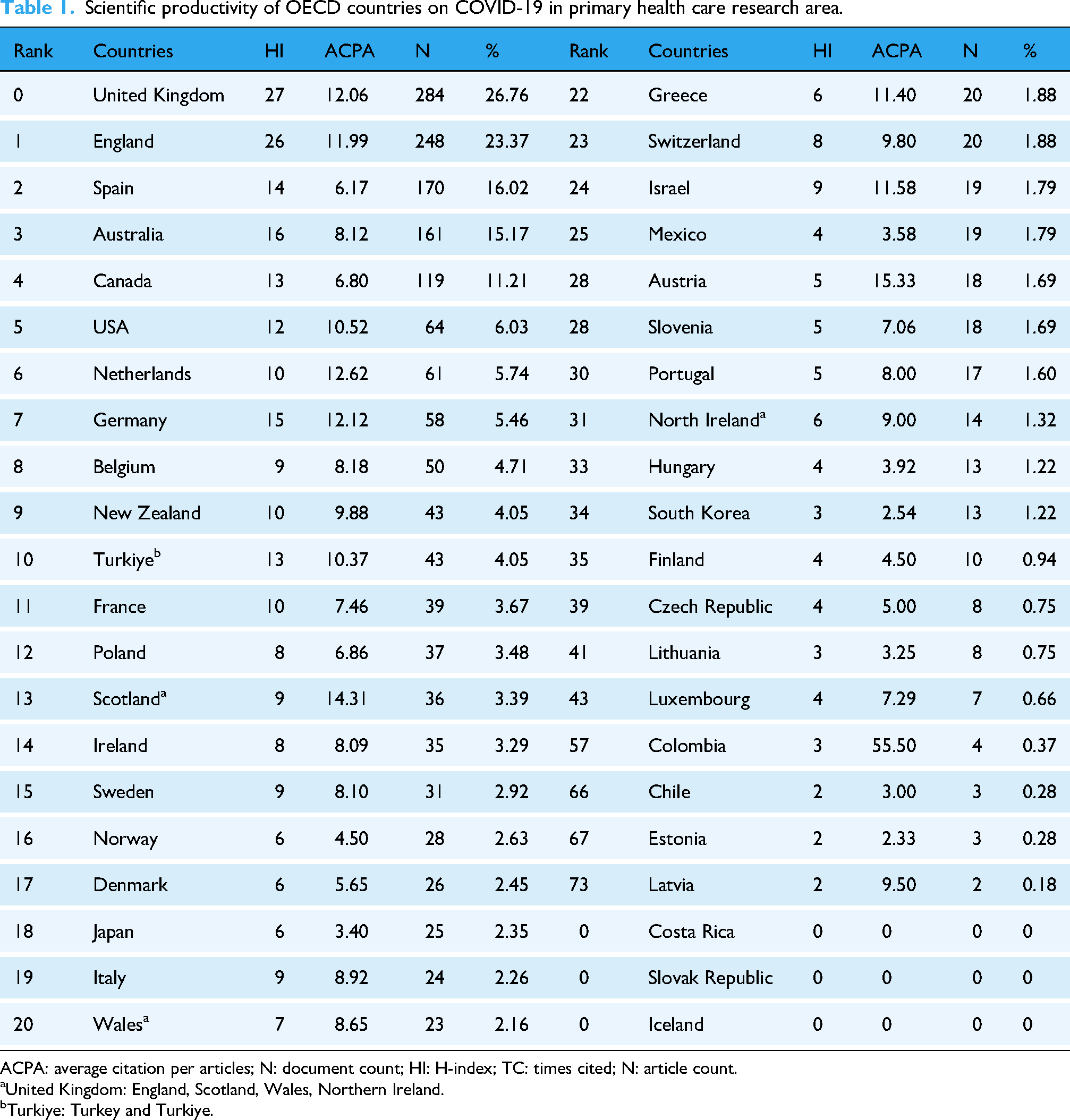
ACPA: average citation per articles; N: document count; HI: H-index; TC: times cited; N: article count.
United Kingdom: England, Scotland, Wales, Northern Ireland.
Turkiye: Turkey and Turkiye.
Scientific productivity of OECD countries’ institutions on COVID-19 in primary health care research area.

ACPA: average citation per articles; N: document count; HI: H-index; TC: times cited; N: article count.
Canadian researchers’ institutional scientific productivity on COVID-19 in primary health care research field.

ACPA: average citation per articles; N: document count; HI: H-index; TC: times cited; N: article count.
Document, citation, and references analyses
Publications from OECD countries addressing COVID-19 appeared in 29 different journals, with a total of 10,179 unique sources and 27,450 references. The Canadian 119 articles were published in 19 different journals, using 1964 unique sources and 3852 references. The journals with the highest number of publications on COVID-19 from OECD countries are provided in Table 4, while the most cited publications from OECD countries are listed in Table 5. Similarly, the journals with the highest number of publications on COVID-19 from Canada are presented in Table 6, and the most cited publications from Canada are listed in Table 7. In addition to these analyses, the co-citation network and density analysis for OECD countries is given in Figure 4.

OECD countries’ co-citation network (a) and density (b) analyses for sources.
Journals with the most intensive publications on COVID-19 in OECD countries in primary health care research area.

N: document count; JIF: journal impact factor for 2023 years; HI: H-index; ACPA: average citation per articles; N: article count.
OECD countries’ most cited publications on COVID-19 in primary health care research area.

JIF: journal impact factor for 2023 years; C: citation.
Journals in primary health care research area where Canadian researchers publish most intensively on COVID-19.

N: document count; JIF: journal impact factor for 2023 years; HI: H-index; ACPA: average citation per articles; N: article count.
Most cited publications on COVID-19 by Canadian researchers in primary health care research area.

JIF: journal impact factor for 2023 years; C: citation.
Based on Bradford's Law,62,63 the primary zone journals for OECD researchers were BMC Primary Care, BJGP Open, British Journal of General Practice, and Medicina De Familia-Semergen. Similarly, for analyses of research from Canada, the two prominent primary zone journals are BMC Primary Care and Canadian Family Physician.
Content analyses and latent Dirichlet allocation
Prominent research topics in OECD countries included telemedicine, telehealth, remote consultation, teleconsultation, virtual care, delivery of health care, access to care, health policy, health promotion, health services accessibility, healthcare workers, mental health, depression, stress, anxiety, burnout, workload, workforce, medical education, diabetes, vaccination, chronic disease, multimorbidity, obesity, physical activity, pregnancy, geriatrics, health system, and hospitalization (Figure 5(a)). A similar trend was observed in Canadian research (Figure 5(b)). Keywords such as pandemic, COVID-19, general practice, family medicine, community health, general practitioners, public health, and PHC were most frequently used in research from both Canada and other OECD countries (Figure 5).

Co-occurrence network analyses keywords (a) OECD countries, and (b) Canada.
Factor analysis is a technique that reduces large datasets into clusters of independent variables. Using the keywords from OECD (Figure 6(a)) and Canadian (Figure 6(b)) research, we generated topic dendrograms through factor analysis. The prominent research topics in the titles and abstracts of OECD and Canadian publications identified through LDA analyses topic modeling, as presented in Table 8. The analysis was based on article keywords, keywords plus, titles, and abstracts and most appropriate six topics for OECD countries and Canada are represented in Table 8. For OECD countries, the perplexity metric value is 2752.627, while the coherence score is 0.866. For Canada, the perplexity metric value is 3077.655, whereas the coherence score is 0.456.

Factorial analysis as a topic dendrograms for article keywords (a) OECD countries, and (b) Canada.
Cluster title and description with LDA analyses for article title and abstract.

Open access to publications and funding sources
Among the relevant articles, 88.40% (938 articles) were published as open access. The average number of citations of articles with open access is 9.14 and the h-index value is 41. In the articles without open access, the average number of citations per article is 4.25 and the h-index value is 11. In OECD countries, 547 articles (51.55%) lacked funding information, while this figure was 60 articles (50.42%) for Canadian research. Some articles were supported by more than one funding agency. Funding information, publication status, and economic data related to COVID-19 research in PHC services from OECD countries are presented in Table 9. Appendix 5 lists the institutions most actively supporting OECD researchers, while Appendix 6 details institutions supporting Canadian publications. Appendix 7 contains economic data specific to Canada. Funded articles for OECD countries were also analyzed by country, institution, and keywords, and the findings are presented in Figure 7.

Co-Authorship country (a), co-authorship institutions (b), and author keywords trend topic (c) analyses for funded OECD countries’ documents.
OECD countries foundation, publication, and some demographic and economics metrics (year: 2024).

F1: article/review article count; F2: unfunded article/review article count; F3: PHC article/review article count; F4: unfunded PHC article/review article count; F5: COVID-19 article/review article count; F6: unfunded COVID-19 article/review article count; F7: COVID-19 article/review article count in PHC; F8: unfunded COVID-19 article/review article count in PHC; R1: population (2024) (millions); R2: employment (millions); R3: unemployment rate (percent of total labor force); R4: gross domestic product, current prices (billions) (purchasing power parity; international dollars); R5: gross domestic product per capita, current prices (purchasing power parity; international dollars); R6: general government revenue (billions); R7: general government total expenditure (billions).
It was observed that non-funded articles had an average citation rate of 8.16 and an h-index of 28. Funded articles were also found to benefit from a more extensive citation network. When country-specific research funds are evaluated, it is seen that English-speaking countries such as the UK, Australia, Canada, and the USA benefit more from such funds. As a result of the content analysis we conducted in our study, it was seen that there was no significant difference in subject matter between funded and non-funded research. However, it was observed that the articles that received funding had a higher citation average.
Discussion
Canada ranks third in article productivity within PHC research among OECD countries, following the USA and the United Kingdom. In the combined domain of COVID-19 and PHC research, Canada also ranks forth, following the United Kingdom, Spain, and Australia. During the COVID-19 pandemic, Canada significantly increased its aid budgets, with donor governments emphasizing the need to distribute vaccines to developing countries, support hospital services, and provide assistance to the most vulnerable individuals in terms of income and livelihoods. 64
As shown in Table 9 and Appendix 7, Canada maintains a robust economic structure and leads in PHC research. One of the key objectives of OECD is to assist governments in achieving prosperity through international cooperation and addressing poverty. The OECD also advises on how to understand emerging global developments and issues while providing actionable solutions. 65 Analysis of co-authorship patterns reveals strong collaboration between New Zealand, USA, Australia, and the United Kingdom during the COVID-19 pandemic. This collaboration is promising for OECD countries, suggesting that these countries could lead international cooperation in future pandemics, enabling more effective international collaboration, with PHC services and higher education institutions playing a more significant role. Additionally, there is no existing literature examining the publication support and funding status of higher education institutions in the context of COVID-19 to this extent and detail.
Palmer and Small 12 advocate for governments to invest in social safety net programs that target the most at-risk populations. Investments in job creation, education and training, paid work experience, early childhood care and education, housing, health, and mental health services are seen as vital for mitigating the pandemic's impacts. The OECD addresses both local and global policy issues, evaluating themes such as trade, social welfare, governance, development, taxation, transportation, science, technology, and innovation. OECD members spent around $12 billion on COVID-19-related activities, with initial efforts focused on health systems, humanitarian aid, and food security. The organization also supported strategies to address the economic and social repercussions of the pandemic. 64 However, coordination among countries has been lacking and poor coordination undermined efforts to control the pandemic, as highlighted in previous research. 66 PHC has been identified as a critical component in combating the virus.
According to data from The Global Health Security Tracking Site reports, nearly 80,000 projects were funded between 2014 and 2020 to support global health security efforts. However, a lack of funding for preparedness systems during the COVID-19 pandemic remains concerning. 67 The likelihood of encountering future pandemics is high, 68 making it essential for OECD countries to issue periodic project calls that promote international cooperation, particularly in areas like pandemics and climate crises. This proactive approach would better prepare the global community for future pandemics.
For OECD countries, a distributed information system integrating data from various platforms—such as a system capable of diagnosing COVID-19 from lung tomography images used during the pandemic—could play a significant role in reducing inequalities among the different healthcare systems of these nations. 69 Deep learning, in particular, has shown extensive applicability in the healthcare sector. 70 While machine learning enables computers to analyze comprehensive datasets, deep learning—a specific methodology within machine learning—excels in extracting meaningful patterns from such data. 69 It is especially relevant for image processing, where lung tomography images were widely used for diagnosis during the COVID-19 pandemic. 71
Deep learning systems demonstrated exceptional potential in providing solutions during the pandemic. 72 However, the implementation and maintenance of such distributed systems inherently come with numerous infrastructural challenges.73–75 Nevertheless, it is crucial to recognize that the literature offers numerous studies addressing these challenges.69,74,76 Through the coordination of OECD countries, the development of AI-based conversational systems, such as ChatGPT, in anticipation of pandemics similar to COVID-19 could significantly simplify daily tasks for OECD citizens. 77 Preparing such systems in advance and making them globally accessible would be of immense value. Such services will also contribute to a more equitable distribution of global health services. Specifically, these services could be assessed by experts in the field of PHC research and further refined to enhance preparedness for future pandemics. Among OECD countries, researchers from institutions such as the University of London, University of Oxford, University of Toronto, University of Melbourne, and Institut Català de la Salut, representing countries including the United Kingdom, Spain, Australia, Canada, Germany, and the United States, have been actively engaged in this area. Leveraging the expertise and knowledge of these researchers more effectively could further strengthen efforts in developing such systems.
Despite demonstrating significant productivity in PHC research during the COVID-19 period, Spain and Turkey could not find enough funding for their studies. In contrast, researchers from the United Kingdom, Australia, Canada, and Germany received substantial financial support during the same period. Notably, the United States, despite being one of the most prominent OECD countries, demonstrated relatively low productivity in PHC research, ranking below nations such as the United Kingdom, Spain, Australia, and Canada. Another interesting fact is that the UK and Canada are the two most important and productive countries in the field of PHC research on WoS in general. In addition, the University of Toronto and the University of London are the two major universities in the field that are prominent in the general PHC literature.
General practitioners play a vital role in the COVID-19 response, but many-faced significant challenges. For example, in Europe, the operations of general practitioners’ clinics were often uncertain, and reliable data were lacking. 78 OECD countries could benefit from implementing comprehensive operational plans that coordinate efforts from primary care to other levels of healthcare during future pandemics. Additionally, many countries supported institutions with tax reductions, direct aid, credit guarantees, and other forms of financial assistance during the COVID-19 crisis. 10 Research centers and higher education institutions also played a crucial role in combating the pandemic, as noted in several studies.79–82 However, our findings indicate a lack of sufficient support for open-access publications, particularly in the economic field, which hindered swift information dissemination. This trend was observed in many OECD countries, including Canada, which underscores the need for more robust support for open access to scientific data circulation during future crises.
Various topics such as burnout,83,84 workload, 83 stress and anxiety, 85 and health promotion86,87 have been extensively explored among healthcare professionals in OECD countries and in Canada. The OECD should continue supporting international collaboration to address healthcare system challenges during crises, provide funding for scientific activities, and sponsor regular health conferences in the field. Publishing periodic reports that evaluate the preparedness of all 38 OECD countries for challenges such as pandemics and climate change would also be highly beneficial.
Patients with chronic diseases such as cancer,88–90 diabetes,91,92 renal failure, 93 and hypertension94,95 have emerged as significant topics within OECD countries. Special attention is also required for pregnant women and the elderly, given the prevalence of age-related diseases in these populations. 96 Future pandemic preparedness in OECD countries must include measures that specifically address the needs of vulnerable groups. Furthermore, Tekerek et al. 97 highlighted that OECD countries should adopt strategies suited to their available resources and chronic disease burdens.
During the COVID-19 pandemic, primary care experienced significant transformations. 98 Research has highlighted important issues such as the roles of primary care providers, 99 primary care clinics, 100 telemedicine,5,101 and remote consultations.100,102 The relationship between patients and doctors changed significantly, with telehealth services playing a crucial role. Canada quickly adapted to the use of telemedicine during the pandemic. 103 Duckett 104 particularly noted that how the shift to telehealth transformed primary care. However, Diamond et al. 105 pointed out some disadvantages, such as the lack of physical examinations and the challenges in maintaining patient–doctor rapport. Evaluating these services through scenario-based research could better prepare us for future pandemics. Another major challenge during the pandemic was the shortage of personal protective equipment.106,107 The OECD could benefit from proactive cooperation to manage the supply chain of critical items during future emergencies. Lavoie 108 highlighted Canada's insufficient investment in basic sciences and the disconnect between laboratory research and the country's ability to produce vaccines and antiviral drugs. Similar issues are likely present in other OECD countries. Establishing supply chain management plans for health equipment across OECD countries, prioritizing internal production, and securing distribution channels during crises are critical areas that warrant research and planning.
Funding for COVID-19 research in PHC in Canada primarily came from national sources. However, Canada has significant institutions and researchers in PHC (see Table 2, Table 3, Appendix 1, Appendix 2), which could potentially make it a leader in PHC research within the OECD. Leveraging Canada's research infrastructure to secure international funding could further enhance its contributions. Instituting internal training programs within Canadian research institutions to better access international funds would be a strategic step forward. The limited output of some OECD countries in PHC research is concerning, given the critical role PHC services play in improving public health during pandemics. The OECD could encourage policies that promote greater scientific productivity in PHC research. Establishing a commission focused on PHC research would strengthen scientific collaboration among OECD countries and improve public health outcomes during future crises. For example, the tremendous transformation and importance of information technologies in our era, combined with the growing impact of artificial intelligence technologies in the healthcare sector, can lead to significant developments in primary healthcare services.109,110 Effective AI-supported information systems established within OECD countries can be designed to be highly beneficial not only for COVID-19 but also for global threats such as cancer.111–114
While Canada's productivity in COVID-19 research is strong compared to many OECD countries, its position in PHC research could be further enhanced. There are also issues with institutional affiliation inconsistencies in Canadian studies (see Table 3). For instance, researchers from the University of Toronto have listed affiliations such as Saint Michael's Hospital or Li Ka Shing Knowledge Institute, creating potential attribution problems. Canadian universities could benefit from implementing clearer corporate policies to standardize naming conventions and ensure consistent representation in global academic rankings. This is because research conducted by a researcher affiliated with the University of Toronto could be attributed to a different institution, potentially disadvantaging Canadian universities that consistently rank high in Times Higher Education and Academic Ranking of World Universities.
Strengths and limitations
The primary reason for selecting the WoS bibliometric data source over Scopus is the inclusion of a specific category for the PHC research area within WoS. This highlights a significant limitation of the Scopus database, as it lacks a dedicated category for a research area as critical to public health as PHC. It is recommended that Scopus address this gap by incorporating PHC into its categories. Furthermore, funding information utilized in this study was derived from bibliometric data available in WoS. However, as demonstrated in Appendices 5 and 6, there are notable limitations in the quality of funding-related data, which may affect the robustness of the analyses. To enhance future funding studies, it would be beneficial to establish guidelines encouraging the detailed and accurate entry of funding data into journal systems indexed by WoS. By categorizing more detailed funding information (such as the funding country, institution, and amount) obtained from researchers using data sources such as WoS and Scopus, and by linking this funding information to institutions and countries, researchers will be able to conduct more detailed research in the future on scientific productivity and the funding institutions and countries. Another limitation of our study is the fact that the number of articles produced in the relevant field can be normalized according to the population or number of researchers in each country. As it is difficult to obtain this type of data, this process could not be carried out.
Conclusions
In our study, COVID-19 research conducted by OECD countries and specifically Canada was analyzed in detail using bibliometric methods, including collaboration patterns, funding statuses, co-authorship, co-citation, thematic mapping, factorial analysis, topic dendrogram, and LDA machine learning technique. As known, the OECD is an organization established through the collaboration of 38 countries, including Canada. PHC is a research area that has actively and prominently engaged in combating COVID-19. Initially, experts in this research field faced numerous challenges. Therefore, within the OECD organization, this study represents the most comprehensive examination of how academia, particularly in the PHC research field, has responded and addressed various issues during such pandemics, and the extent to which publications in the WoS have received funding support.
Literature review reveals that this study represents one of the most comprehensive examinations of funding in the healthcare field. However, institutions such as Clarivate, Scopus, or PubMed could implement a more systematic approach to recording the funding agencies when scanning journals. At this point, obtaining information such as the country of the funding agency, the amount of funding, whether it is supported by multiple institutions, etc., from journal editors or actors involved in the publication process, would be highly valuable for evaluating funding information in research and analyzing scientific productivity to track financial resources.
In addressing infectious diseases, stronger collaboration and coordination mechanisms must be established. In this regard, among OECD countries, Canada stands in a leading position due to its economic strength and reputable educational institutions worldwide. Therefore, Canada can take the lead in assuming responsibility for establishing commissions and structures within OECD countries to be better prepared for future pandemics. Through such structures, guiding actions and policies can be implemented to strengthen the multilateral system for addressing global emergencies and ensuring sustainable development within OECD countries. This initiative could lead to better preparedness for future health crises. It has been observed that the inclusion of PHC experts in such commissions is crucial.
Supplemental Material
sj-docx-1-dhj-10.1177_20552076251389341 - Supplemental material for Science mapping of COVID-19 contributions in primary health care by OECD countries: A machine learning approach
Supplemental material, sj-docx-1-dhj-10.1177_20552076251389341 for Science mapping of COVID-19 contributions in primary health care by OECD countries: A machine learning approach by Muhammet Damar, Benita Hosseini, Andrew David Pinto, Omer Aydin and Umit Cali in DIGITAL HEALTH
Footnotes
Acknowledgements
M.D. and Ö.A was supported by the Scientific and Technological Research Council of Türkiye (TUBITAK) under the TUBITAK 2219 International Postdoctoral Research Fellowship program. M.D. would like to thank the Upstream Lab, MAP, Li Ka Shing Knowledge Institute at the University of Toronto for its excellent hospitality.

Author contributions
Research idea: Muhammet Damar, Andrew David Pinto. Design of the study: Muhammet Damar, Andrew David Pinto. Acquisition of data for the study: Muhammet Damar, Ömer Aydın, Ümit Çalı. Analysis of data for the study: Muhammet Damar, Andrew David Pinto, Ömer Aydın. Interpretation of data for the study: Muhammet Damar, Andrew David Pinto, Ömer Aydın. Drafting the manuscript: Muhammet Damar, Andrew David Pinto, Ümit Çalı. Revising it critically for important intellectual content: Muhammet Damar, Andrew David Pinto, Benita Hosseini. Final approval of the version to be published: Muhammet Damar, Andrew David Pinto, Benita Hosseini.
Funding
The authors disclosed receipt of the following financial support for the research, authorship, and/or publication of this article: M.D and Ö.A was supported by the Scientific and Technological Research Council of Türkiye (TUBITAK) under the TUBITAK 2219 International Postdoctoral Research Fellowship program.
Declaration of conflicting interests
The authors declared no potential conflicts of interest with respect to the research, authorship, and/or publication of this article.
Data availability
The data that support the findings of this study are available from the corresponding author upon reasonable request.
Supplemental material
Supplemental material for this article is available online.
References
Supplementary Material
Please find the following supplemental material available below.
For Open Access articles published under a Creative Commons License, all supplemental material carries the same license as the article it is associated with.
For non-Open Access articles published, all supplemental material carries a non-exclusive license, and permission requests for re-use of supplemental material or any part of supplemental material shall be sent directly to the copyright owner as specified in the copyright notice associated with the article.
