



Abstract
Objective
Social media influencers—individuals with substantial, loyal followings—are influential in shaping public discourse, particularly among youth, on topics like health and well-being. However, their role in facilitating mental health discussions online remains underexplored. This study examines the perspectives of New Zealand (NZ) based influencers as part of a broader investigation into their engagement with mental health content.
Methods
This exploratory study employed remote, semi-structured interviews and reflexive thematic analysis. NZ-based influencers aged 16 and older, with over 10,000 followers and active on Instagram, TikTok, or YouTube, were recruited. Eight influencers (five females, three males, aged 26–45 years) participated, with a mean follower count of 53,000, predominantly on Instagram.
Results
Three key themes emerged, highlighting tensions within influencers’ roles. The first theme, “Defining Influence: Regular Person or Role Model,” explored their perspectives on their general power and identity as influencers. The second, “Discussing Mental Health: Amateur or Expert,” examined their self-perceived qualifications and challenges in creating public mental health content. The third, “Providing Crisis Support: Helpless Bystander or Well-Intentioned Samaritan,” detailed their approaches to responding to followers’ private mental health disclosures.
Conclusions
This study underscores the complex roles influencers play in youth mental health conversations, emphasizing their potential for positive impact alongside ethical and practical challenges. Clearer guidelines, targeted training, and resources are essential to equip influencers to engage safely, ethically, and effectively in these discussions. Influencers and mental health professionals could collaborate by establishing referral pathways and codeveloping psychoeducational or promotional content, while researchers, platforms, and policymakers may contribute by creating guidelines for responsible content distribution.
Introduction
Social media has become a dominant force in the lives of young people, with 96% of those aged 13 to 18 using platforms such as Instagram, TikTok, and YouTube. 1 Nearly half of teenagers endorse being online “almost constantly.” 2 (p.1)and international studies by the World Health Organization suggest problematic social media use is increasing among youth. 3 A third of New Zealand children under 14 have at least one social media account, 4 with increasing concerns regarding the impacts on their wellbeing culminating in a proposed bill to ban social media for under 16s. 5
Digital platforms offer unparalleled opportunities for connection, entertainment, and information sharing. However, the influence of social media on young people is shaped by the content they engage with and the individuals they follow. Among these, social media influencers—individuals with substantial online followings—play a critical role in shaping audience knowledge, beliefs and even behaviors.6,7
Influencers are distinct from traditional celebrities in their immediacy, relatability, and perceived authenticity.8,9 They engage directly with followers through frequent, unmediated communication, offering strategic glimpses into their personal lives and fostering a sense of intimacy. 10 This connection is particularly compelling for “chronically online” young audiences, 11 (p7) who often view influencers as relatable role models or virtual friends.12,13 Authenticity and intimacy therefore serve as forms of social capital, which influencers strategically leverage to maintain their appeal and influence. 14
Given the significant reach and perceived trustworthiness of influencers, audiences are increasingly turning to them for information about a range of health topics, including mental health.15,16 Influencers may create mental health content to share personal experiences, raise awareness, combat stigma,14,17 or even promote professional help-seeking or advertise specific services.18,19 While there is a growing number of mental health advocates and professionals operating as influencers, much of this content is produced by individuals without professional experience. 20 Despite their potential to positively impact mental health awareness and literacy and promote coping strategies,21–23 concerns have been raised about the accuracy of information shared by nonprofessionals and the influence of commercial interests in sponsored mental health content.24,25 Emerging evidence also suggests that influencers may inadvertently glamorize mental health disorders, contributing to increases in inaccurate self-diagnosis, the overidentification of illness identities, and even functional presentations of psychiatric conditions such as Tic disorder and dissociative identity disorder. 26 There are also significant concerns regarding potential contagion effects, particularly for suicide. 27 These complexities highlight the dual role influencers play as both allies and potential risks in mental health promotion.
Research on influencers’ perspectives on creating mental health content remains limited, despite their growing presence in this space. Existing studies suggest influencers share many of the motivations of other social media users, such as combating stigma, fostering connection, and self-expression.14,17,28 However, as public figures, influencers face unique pressures, including audience expectations, online “hate,” platform algorithms, and commercial sponsorships. 29 These dynamics often lead to a phenomenon known as “audience capture,” 30 where influencers feel constrained to produce specific types of content to maintain their popularity, sometimes at the expense of their own well-being. 31
To date, only a handful of studies have examined influencers’ experiences with mental health content, and none from a psychological perspective. Eu 31 for instance, highlighted the deliberate strategies influencers employ to cultivate authenticity, such as sharing personal struggles. While these disclosures are often framed as efforts to destigmatize mental health challenges, they also enhance commercial relatability and engagement. This blurring of authenticity and strategy raises questions about the genuineness of such content, and its impact on both influencers and their audiences.
We undertook a two, concurrent studies designed to examine both sides of the influencer-follower dynamic. The first study documented youth perspectives, providing insights into how young audiences engage with and are influenced by mental health content shared by influencers. 32 The second study, presented in this article, focuses on the creators, examining influencers’ roles, challenges, and motivations in producing mental health content.
The primary research question for this study is: How do influencers perceive their role in creating mental health content, and what challenges and motivations shape their approach? By giving voice to influencers, this study provides a nuanced understanding of their experiences and adds an important dimension to the broader exploration of mental health communication on social media.
Methodology
Study design
This qualitative, exploratory study employed in-depth, remote interviews to examine how social media influencers perceive their roles in engaging youth about mental health. 33 Grounded in a social constructionist framework, the study acknowledges that the researcher's perspectives—shaped by their roles as a psychologists, social media users, and researchers (which were described to the participants)—may differ from those of the participants, influencing the interpretation of findings. 34
Participants
Recruitment targeted New Zealand-based social media influencers using purposive sampling. Participants were identified through a concurrent study and online directories, then contacted via their social media or websites. For the purposes of this study, we defined influencers as individuals (not corporations/brands/groups) with over 10,000 followers, who are active on social media (e.g. post at least once fortnight) and had posted sponsored (paid) content in the past six months. Additional inclusion criteria involved being over 16-years-old and self-identifying as having an interest in mental health or well-being. Interested individuals received study information, had the opportunity to ask questions, and provided informed consent verbally or in writing. Participants received a NZ $50 voucher or charity donation as a thank-you. Ethical approval was granted by the Auckland Health Research Ethics Committee (Ref: AH22629).
We aimed to recruit 5–10 participants, with data saturation reached at eight. This sample size aligns with prior studies on influencer interviews and is considered reasonable given the challenges of recruiting celebrity figures.35,36 Participants were all based in New Zealand, with one temporarily working overseas. While participants used various social media platforms, Instagram was consistently their primary platform with the highest follower count. Full sample characteristics are summarized in Table 1. No participants dropped out. As exploratory research and due to the already small sample population of influencers, recruitment was open to all influencers interested in mental health, regardless of their personal or professional backgrounds. Lived experience of psychological difficulties was neither required nor a basis for exclusion for this study. None of the participants were healthcare professionals or focused exclusively on mental health content, but rather general influencers who discussed mental health on occasion. One participant was a public speaker who frequently addressed mental health alongside other topics.
Participant demographics.

Cultural protocols
To honor Te Tiriti o Waitangi (the Treaty of Waitangi, a foundational agreement between Māori, the Indigenous people of Aotearoa New Zealand, and the British Crown that ensures partnership, protection, and participation of Māori in decision-making), this study incorporated culturally responsive Māori practices commonly used in research. 37 This included offering to open and close interviews with karakia (prayer) and waiata (song, via audiovisual link), and using pepeha (formulaic introductions) and whakawhanaungatanga (relationship-building) to foster connections between the interviewer and participants. 38 Demographic details were collected during these exchanges, while follower counts of participants online accounts were obtained from their public profiles at the time of interview.
Data collection
One-time interviews were conducted by EA between May 2022 and January 2023 using a dedicated research phone, participants were encouraged to participate from a private space though were allowed a support person if desired. Participants selected their preferred format: audio call (n = 2), online messenger (n = 3, including text and voice memos), or videoconference (n = 3, via Zoom). The study was introduced as being part of EA's doctoral research and clinical psychologist training. A semistructured interview guide was employed to explore participants’ perspectives (see Table 2 for sample questions). Interviews ranged from 62 to 95 min, with one lasting 120 min due to delays in participant responses. Following the interviews, participants were offered the opportunity to receive study updates and complete optional member-checking processes, including reviewing their own transcripts and interview summaries. 33
Sample interview questions.

Data analysis
Where necessary, interviews were transcribed by a researcher (EA) or an independent transcriber under confidentiality agreements. All transcripts were anonymized and stored securely. Deductive thematic analysis, 33 supported by NVivo software (version 1.7.1), identified data patterns through iterative steps, including re-reading, coding (by EA), and refining themes. Participants were assigned pseudonyms to maintain the authenticity of quotes while protecting participants’ identities. Quotes are presented verbatim with minor readability edits, and swear words are partially obscured to preserve intensity while ensuring appropriateness for the audience. To ensure rigor, an analytical log was maintained, and decisions were made through consensus. The study adhered to the COREQ checklist. 39 To support data sovereignty and ensure accurate representation of participants’ views, they were given 14 days to review and amend transcripts, along with a brief interview summary as optional member-checking processes. 33
Findings
Thematic analysis produced three key themes in how influencers perceive their roles when engaging with youth about mental health. Each theme relates to a certain topic or aspect of influencers engagement with youth, for example, their approach to discussing mental health publicly. Each theme also highlights a tension between two contrasting roles influencers may adopt, for example, “regular person” versus “role model.” These roles are not necessarily direct labels used by participants and are not fixed or mutually exclusive. While some participants aligned with one role, others shifted or identified with aspects of both. The three themes and their corresponding roles are illustrated in Figure 1 and include: (1) defining influence: regular person or role model; (2) discussing mental health: amateur or expert; and (3) providing crisis support: helpless bystander or well-intentioned Samaritan.
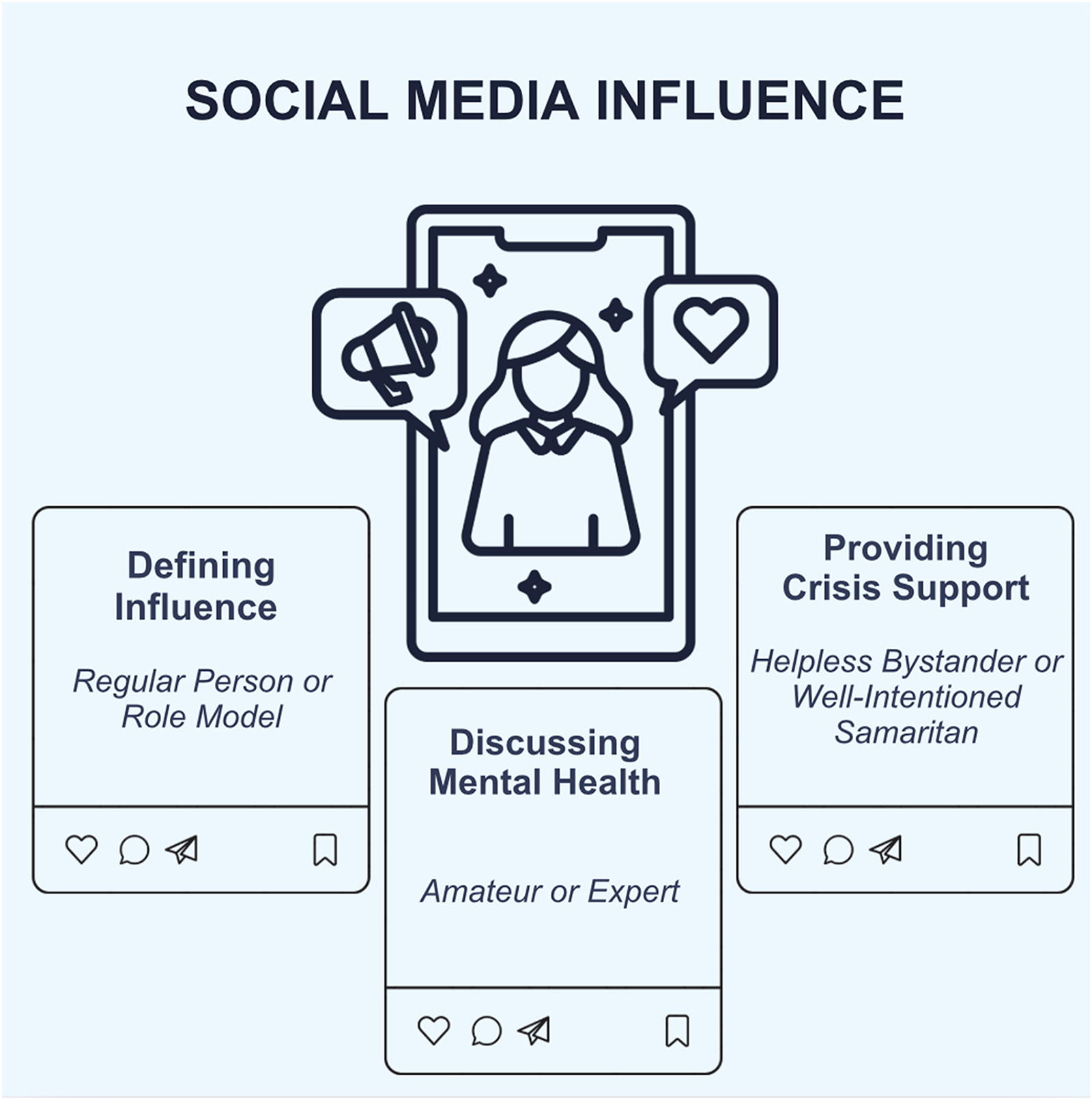
Theme map.
Theme 1: Defining influence: Regular person or role model
This theme captures a tension between influencers seeing themselves as “regular people” versus “role models.” Some participants denied having the intent or power to exert significant influence, particularly given the relative power of audiences and social media platforms. Others acknowledged their position as role models and accompanying responsibilities, particularly toward youth.
Regular person
Participants commonly characterized themselves as just a “regular person.” Seven of the eight participants said they did not identify with the influencer label. Some of these participants denied holding any power, with Orrin saying, “I’m literally just being myself (…) I am not trying to influence anyone” or minimized the significance of their following as “just a number” (Zara). Three influencers highlighted their relative lack of power compared to social media platforms and associated algorithms, which dictate content visibility and often limit the reach of their posts. As Zara explained, “because of Instagram's algorithm always changing as well, sometimes your post doesn’t make it to their feed,” a challenge particularly pronounced for serious topics like mental health: It's almost easier to find the ‘fillerific’ stuff because of the way that the algorithms are set. You’re much more likely to stay watching somebody get hit by a car 50 different ways than you are finding somebody talk about how you can calm your parasympathetic nervous system. (Ross)
Three participants also discussed how influencers’ power also depends on how audiences engage with their content. For instance, their posts are unlikely to make an impact if, as Zara observed, young people “don’t even read the captions.” Audiences also dictate which influencers gain prominence and even what content they produce, as influencers often respond to metrics. Ian remarked, “This got way more views, I’m going to do more of that, right? It's financially rewarding if not, like, spiritually rewarding.” However, this reliance on audience preferences can also leave influencers like Ian feeling “captured by my audience,” and compelled to post specific types of content to retain followers. Audiences not only bestow power to influencers, but can also swiftly take it away, often through “cancel culture.” Influencers noted how audience backlash, often triggered by perceived missteps, can lead to irredeemable public vilification, unfollows, and “hate.” Zara warned, “if you’re cancelled, that's it,” while Ian highlighted the severe consequences of such events, stating, “people commit suicide from cancel culture.”
Role model
However, at other times, almost all participants (seven) were able to acknowledge ways that they had influenced their audiences. Two participants specifically used the label “role models” (Ross), noting the increased attention and power they hold. Several others highlighted how audiences look up to them, particularly to young people who, according to Ines, “put us up on such a high pedestal.” Contrary to her earlier statements, Zara acknowledged her influence saying: “I feel like when you’ve got X amount of followers, you’ve got yourself a little cult that follows you. Whatever you say, they kind of idolize you, and they look up to what you say.” Malcolm agreed, noting, “because if they’re being seen as an influencer, then your opinion on something is valued.”
However, the scope of their influence is not always apparent to influencers themselves, with about half of the participants making comments about difficulties in identifying their impact. Orrin reflected, “it's easy to forget about the number of people following and watching when it's all online.” Zara emphasized the need for influencers to be mindful of their responsibilities, stating, “you have gotta really realize the power that you do have.” Participating in the study appeared to prompt these realizations for some. Orrin noted, “it reminded me that my actions on social media have an impact.” Similarly, Ines overcame her initial feelings of self-doubt upon being recruited, explaining, “Impostor syndrome, tall poppy syndrome, hit me in the face (…) but having (X) people care about what I post and what I say online is actually quite radical.” Some even reconsidered the influencer label after discussing it. Malcolm remarked, “I wouldn’t think of myself as an influencer, but I s’pose on social media I probably have say more attention on my content than the average user. (…) I guess influencer kind of is the best term.”
Theme 2: Discussing mental health: Amateur or expert
While most participants eventually acknowledged their power among youth, they were uncertain about leveraging this for mental health. Some characterized influencers as “amateurs,” lacking the requisite authority, while others highlighted their role as “experts” in lived experience or health promotion.
Amateur
About half of the participants viewed themselves as “amateurs,” without the necessary expertise to discuss mental health. They hesitated even when sharing preexisting psychoeducational material, concerned that it could be perceived as pretentious: I guess the only concern I have with [mental health content], is just not being preachy about it. Or coming across like I’m actually some kind of authority (…) Like, I’m not a doctor. I’m not ‘qualified anything’ (…) here I am now telling people what they should be doing for their mental health, you know? (Malcolm) (If) that specific person starts medicating or taking things as per what an influencer said (…) It would be better for them to go and get professional help (…) Before just taking the word of just a random girl or guy off social media. (Orrin)
In addition to a lack of formal expertise, one influencer, Ian suggested that in the current climate of heightened awareness regarding identity politics, some audiences may question another kind of authority to discuss mental health saying “of course someone who looks like me (…) is going to be critiqued. Just on the account that I’m white, in my 40 s (…) and male.” He explained how audience backlash had left him reluctant to engage in mental health debates, explaining “there is research that says obesity is also bad for your mental well-being. And if you jump on and say, ‘Yo, what's up, let's lose some weight for our mental well-being,’ we got told to stop body shaming.” However, he warned criticism was unavoidable and influencers should therefore focus on authenticity: You’re not going to please everyone and nor should you try to. If I was to give anyone advice who wanted to be a mental health influencer, is that it's actually impossible and you shouldn’t try. You should just be you.
Finally, five participants questioned influencers’ ability to appropriately discuss personal mental health challenges. Two felt guilty discussing their problems given their relative privilege, saying “What the f*** do I have to complain about?” (Ines). Influencers also hesitated to discuss treatment, concerned less resourced youth might think “Oh, this girl's sharing mental health [resources] because she has access to it” (Evie). However, the primary concern among several participants was that sharing personal mental health challenges may glamorize them or increase followers’ self-diagnostic tendencies. Even disclosing a diagnosis could have unintended consequences, as Malcolm warned, if “someone hugely influential on social media, one of those Kardashians was diagnosed (…) there’d probably be millions and millions of young women in America who’d go, ‘Oh, that's me, I’ve got that too, that explains everything.’” Ian argued that influencers who “put their diagnosis in their bio” promote illness identities and hinder recovery as “when we deeply embed our mental illness into our sense of who we are, how are we ever going to get better?.” He warned that influencers may also glorify psychological distress and self-harm, particularly if it is seen to boost engagement: How did [prominent NZ mental health influencer] get famous? [She] took pills six times and talked about it, right? And so, a young person who doesn’t have, like, the broader contextual understanding of what that does, maybe they feel like their mental illness suffering is a pathway to, like, popularity and fame, right? (Ian)
Expert
While lacking formal mental health training, all participants argued that influencers offer valid expertise through lived experience, including providing hope and empathy in ways professionals cannot: I can say, “Look, I’m not a psychologist” (…) But what I can say is, like, “Hey man, I’m really sorry that you’re feeling this way. I know what that feels like too. I want you to know that it gets better” (Ian) Where I talk about my anxiety or my mental health, my panic attacks, people have reached out and gone, “Thank you so much for talking about this (…) it's really nice to hear someone talking about what I’m struggling with as well.” (Ines)
In addition to lived experience, a couple participants also emphasized how influencers are also experts in persuasion, making them ideal vehicles for mental health promotion. Influencers, by definition, affect audiences’ attitudes and behaviors, as Orrin explained, “whenever I think of [an] influencer, I think about someone trying to persuade someone to live/act a certain way.” Several participants shared successes in influencing health topics, even controversial ones, as Vicki explained: “I have been really active since the (COVID-19) pandemic started in trying to educate my followers about vaccines, etc. (…) every mind I helped to change felt like a great win.”
Influencers may also effectively contribute to mental health campaigns, with Zara noting, “that stuff always gets good engagement.” Youth may be particularly receptive, as they often contact influencers to “get some tips and advice” (Ines). Therefore, even influencers without in-depth knowledge can persuasively model behavior, as Ian argued: If you had more, like, people who had a cursory understanding in mental health, jumping online like, “Yo, every day I wake up and I don’t pick up my phone. I wake up, I meditate, do my breath work” (…) that would go a long way. [Helpful content] is available for you, but it's a sort of needle in a haystack stuff, which is why we're trying to do this stuff with [organization] where we have a whole bunch of us to go “Hey, this is what I do.” Every month that pops up (…) by using influencers and those big accounts to push these things, it can go a long way and change a lot of lives. (Ross)
Theme 3: Providing crisis support: Helpless bystander or well-meaning Samaritan
The final theme explored influencers’ roles in responding to private messages from distressed individuals. While almost all participants had received such messages, their responses varied greatly. Some felt like “helpless bystanders,” unwilling or unable to assist, while others acted as “well-intentioned Samaritans,” trying their best to help but unsure of their effectiveness.
Helpless bystander
Several participants were reluctant to respond to distressed individuals, not least “because sometimes their messages just, they never stop” (Malcolm). Others like Ian highlighted safety concerns, including privacy and legal implications: The other day, a guy emailed me, “Hey man, could you give me a call”? And I’m like, nope, I cannot give you a call because I don’t want you to have my phone number. I’m not a psychologist. What if you kill yourself and then go, “Ian, you said this to me, and it didn’t work?” Like, f*** no.
Instead, participants utilized various strategies, including limiting public mental health discussions to discourage private messages: That's as far as my page goes with like the discussion of mental health. I haven’t really like dug deep and brought it up as a topic in my stories. I just feel like ‘cause I need the capacity to be able to reply to someone if they message me. (Zara) There was a girl I follow, and she one time put on her story saying, “Hey guys, I’m going through a lot. If you’re going through something, please do not message me because I don’t have the space or the energy for it right now” (…) I’ve never done that. I feel like even if I don’t have the capacity (…) I wanna be able to help where I can. (Zara)
However, the primary concern for half of the participants was their lack of expertise to effectively support distressed individuals. As Ross stated, “if my kids were getting mental health advice off someone like myself, I’d be concerned. Really concerned.” Consequently, some, like Vicki, avoided such conversations, acknowledging, “I’m definitely not equipped to deal with issues.” These participants noted that crisis intervention was far beyond their usual responsibilities, with high stakes generating considerable anxiety and self-doubt: It's a toughie because you never want to be in a position where you lead somebody astray. Like there's a massive difference between encouraging somebody to buy a pack of f***ing Tim Tams [biscuits] and then telling them what to do with their mental health. (Ross)
This puts influencers in a difficult position, with pressure to respond “correctly” or risk exacerbating the situation: I actually have to just like take a moment to just think about what I reply. Because if I’m going to influence them, I need to know that I’m saying something that's going to be bringing them up and not down. (Zara) I've even been in situations where I've offered all of these solutions and people just come back to me and “I've done it all. I'm still shit. Now what?” and I’m like “Well, I’m not a f***ing psychologist, I’m not a psychiatrist (…) There is not much that I can do to help you here.” (Ross)
Well-intentioned Samaritan
While some influencers felt reluctant or unable to help, others acted as “Well-intentioned Samaritans,” with at least five participants emphasizing the importance of trying anyway. They argued that distressed individuals do not expect professional help but “just a listening ear” (Zara), and that a lack of training does not absolve influencers of responsibility. As Zara explained: “I do feel [under-skilled] like that sometimes (…), but then I think if my little sister came up to me and said I’m feeling suicidal, am I just gonna say ‘Sorry, I’m under-skilled, I can’t help you?.’” Others contended that influencers might even be ideal support sources, being perceived as more approachable and knowledgeable than traditional services: The reason people message influencers (…) is because we’re alive and active, right? Whereas a lot of those services are static, and people don’t see them, they’re not visible. So when someone messages me, it's because I’m intermittently going, “Yo, what's up? Make sure you eat your greens and go for a run. It's good for your brain” (…) And they go, “Oh, this guy knows [his stuff].” (Ian)
Most of these participants, however, remained realistic about the challenges of supporting distressed youth, and agreed it should be optional, as it “comes down to that person and if they want to help” (Zara). Ross encouraged fellow influencers to set boundaries and “be honest and just say ‘This is not a space that I can operate in, nor I can offer you any advice in.’” Ian suggested that influencers proactively share helpful resources, which they can later direct youth to, noting, “I’ve written a couple of blogs.”
Others agreed that being able “move those people on” (Ross) to professional support was one of the key roles of an influencer. Even small touches can make a difference as Ian recounted: “I had [helpline service] make a personalized link for me, and a bunch of other people (…) that stuff makes people feel valued, you know?.” Zara argued that influencers can connect youth with formal support “and at the same time, still be there for them as an outlet,” but others emphasized the importance of knowing when to step back: Sometimes being able to say “Here's, here's a number to call” (…) that's almost where you need to leave it. Like it's not necessarily our job (…) to solve that problem; it's the stopgap measure in which we can provide as probably about the limit in which we're qualified to do it. (Ross)
Discussion
This exploratory, qualitative study appears to be the first to explore how social media influencers feel about their roles when engaging with young people online about mental health. In summary, the findings reveal that influencers have varying perspectives on their duties and capabilities related to various tasks, including (1) defining influence, (2) creating public mental health content, and (3) providing crisis support. Regarding power and identity, participants viewed themselves as “regular people” or “role models.” While some outright rejected the influencer label, others eventually embraced it, recognizing their sway among youth while still acknowledging the power of platforms and audiences. However, participants debated whether to leverage this authority for mental health. Some characterized influencers as amateurs, questioning their ability to share psychoeducation, product reviews or personal experiences safely. Others contended that influencers were experts in other ways—adept at managing their own well-being and in persuading audiences. Engaging in private discussions about mental health, often with distressed individuals, was recognized as a significant challenge for many of the participants. Some felt themselves to be helpless bystanders, reluctant or incapable of assisting, while others assumed the role of well-intentioned Samaritans, attempting their best to help while accepting their limits.
Comparisons to other research
Social media influencers are often perceived as powerful opinion leaders, particularly among young audiences, shaping knowledge, attitudes, and behaviors across various domains, including health.16,40 Participants in this study acknowledged their status as role models but challenged the notion of unilateral influence, emphasizing the role of audiences and platforms in shaping their reach and content. While followers do look up to influencers, 12 recent scholarship has highlighted the ways audiences impact influencers, suggesting that power dynamics between influencers, followers, and platforms are not unidirectional but fluid and reciprocal. 41 New concepts like “audience capture” have also emerged to describe how influencers may feel constrained to create specific content due to follower expectations and algorithmic pressures. 30 However, there remains a dearth of research exploring how influencers perceive and manage their power, particularly concerning mental health content.
Participants expressed enthusiasm for discussing mental health online but were concerned about their ability to do so accurately and safely, fearing that they may inadvertently share unreliable or unhelpful information or advice. The popularity of influencer mental health content on social media continues to rise, 15 with evidence suggesting that such content can improve mental health literacy, increase awareness of symptoms and treatments, and promote coping strategies.20,22,23 However, concerns about misinformation persist. Studies have shown that mental health content produced by influencers can lack accuracy and evidence-based guidance, prompting organizations and researchers to develop educational interventions to support influencers.24,42 For instance, psychoeducational workshops for influencers have been shown to improve both the quality and quantity of mental health-related content. 24
The commercialization of mental health content further complicates the role of influencers. Although the participants in this study had not yet engaged in sponsored mental health promotions, research suggests that this practice is becoming more prevalent. 43 Sponsored content can attract higher engagement but concerns about authenticity and the credibility of advertised services persist.44,45 Navigating these dynamics poses unique challenges for influencers, particularly in small markets like New Zealand, where opportunities for sponsorship may be limited, but concerns about maintaining authenticity remain central to their brand identity.
The role of lived experience emerged as a pivotal theme in this study, with influencers often sharing personal mental health challenges to foster connection and normalize struggles. This aligns with previous research indicating that lived experience can be a powerful tool for reducing stigma and encouraging help-seeking. 46 Youth frequently identify influencers as relatable figures who can effectively promote positive mental health messages.21,47 However, participants were also cautious about the potential risks of glamorizing mental health struggles. Studies have documented unintended consequences of such content among audiences, including increases in inaccurate self-diagnosis and the mimicking of symptoms.15,27 For instance, influencers have been implicated in the recent surge of functional tic and dissociative identity disorder presentations among youth.48,49
The challenge of providing private crisis support further underscores the complexity of influencers’ roles. Although health promotion agencies have acknowledged that influencers often receive messages from distressed individuals, 50 this remains a relatively undocumented phenomenon, with little published about the nature of these messages or their impact on influencers. Reports from participants suggest that while influencers can sometimes offer meaningful support, they often feel unqualified and anxious about exacerbating crises. This concern is echoed by organizations such as Australia's Orygen, which has developed guidelines for influencers on suicide communication but offers limited guidance on safeguarding their own well-being. 50 While there is growing recognition of influencer burnout and industry efforts to mitigate it, the specific challenge of managing crisis messages remains largely unaddressed, highlighting a significant gap.29,51
Strengths and limitations
While influencer mental health content has received increasing attention recently,23,52 few studies have examined creators’ perspectives. Prior interview studies have primarily taken a sociological approach, examining how influencers conceptualize mental health content within their professional roles.31,35 To the best of the authors’ knowledge, no studies have specifically explored influencers’ perspectives about their role in shaping youth mental health and their interactions with young audiences. This study, therefore, provides a unique psychological insight, uncovering influencers’ views on how they shape young people's mental health knowledge, beliefs, and behaviors. The study also employed a flexible methodology to prioritize participant comfort and rights, offering multiple communication and reimbursement choices and processes to maintain data sovereignty and fidelity.
As is typical of studies involving the recruitment of celebrities and influencers,31,35,36 this study had a smaller sample size, resulting in limitations regarding participant size, platform representation, and cultural diversity. Larger-scale quantitative research could provide a more comprehensive and robust picture of the current landscape.
Most participants were micro-influencers primarily active on Facebook and Instagram. 53 Future research should examine macro-influencers, given their broader reach and celebrity status, as well as influencers on YouTube and X (formerly Twitter), platforms particularly popular among males. 54 Although all participants had an interest in mental health, it was not their primary content focus, distinguishing them from dedicated mental health advocates or professionals who may face distinct challenges. 19 Enhanced recruitment strategies, such as insider research 31 or alternative celebrity recruitment approaches, 36 could improve sample diversity and address potential sampling issues such as self-selection bias. The study also lacked adequate Māori representation, reflecting broader industry diversity issues, particularly in the wellness sector.55,56 Oversampling nonwhite influencers may be necessary to amplify underrepresented perspectives. 56 Finally, this study primarily examined adult influencers, treating influencers and young audiences as distinct groups. However, the rise of child, teen, and young adult influencers suggests the need for further research into the complexities of occupying both roles. 57
Conclusions
Overall, influencers appear to hold diverse and, at times, contradictory views on their roles in shaping youth mental health conversations, including nuanced perspectives on their identity, power, abilities, and responsibilities. Despite lacking formal expertise, they enthusiastically contribute to online mental health discourse, offering personal insights and relatable advice. Influencers leverage their role model status to encourage positive behaviors like help-seeking and self-care and openly discuss their own experiences in efforts to normalize mental health struggles and treatment. They also provide support and guidance to followers in distress while facing considerable risks to their own mental health. Influencers engaging in mental health discourse also face being criticized or the threat of being “canceled,” while the potential for misinterpretation, misinformation and glorification poses risks to creators and audiences alike.
This study, therefore, underscores the complexities inherent in creating influencer mental health content. It sheds valuable light on the diverse roles, motivations, barriers, benefits, and hazards involved. By understanding these dynamics, stakeholders—including influencers, mental health professionals and social media platforms—can work together to promote safer and more effective mental health content. Influencers and healthcare providers may consider establishing referral pathways, increasing support and education for influencers, or collaborating on psychoeducational content. While industry-led efforts to address misinformation and harmful content should continue, policymakers may need to intervene if such efforts fall short. Practical supports, such as brief intervention training, may help influencers navigate the complexities and risks of engaging with youth on mental health topics, particularly in crisis situations. By recognizing both the opportunities and challenges faced by influencers, we can better understand and harness their influence to shape the field of youth mental health.
Footnotes
Acknowledgments
The authors extend their gratitude to the participants for their valuable contributions.

Ethical considerations
Ethical approval was secured from the Auckland Health Research Ethics Committee on 02/09/2021 (Ref No. AH22629).
Consent to participate
Prior to the interview, participants were asked if they had read and understood the participant information and consent forms, had no further questions and agreed to participate. Participants affirmative responses (e.g. “yes I consent”) were then documented in the interview transcripts as evidence of their informed consent.
Consent for publication
Participants provided informed consent for their data (verbatim quotes) to be used, including in any research outputs. This submission does not include identifying details or other personal data relating to an individual person.
Author contributions
EA researched literature and conceived the study. KS was involved in protocol development, gaining ethical approval and data analysis. Both authors wrote the first draft of the manuscript, and were involved in reviewing, editing, and approving the final version of the manuscript.
Funding
The authors received no financial support for the research, authorship, and/or publication of this article.
Declaration of conflicting interests
The authors declared no potential conflicts of interest with respect to the research, authorship, and/or publication of this article.
Data availability
The ethical approval obtained for this study does not provide for the sharing of raw data. Interested researchers may contact authors for raw data relating to tables and charts, however qualitative data cannot be shared without compromising participant confidentiality.