




Abstract
The intersection of digital health technologies (DHT) and real-world evidence (RWE) is redefining the landscape of clinical research and regulatory science, offering unique opportunities to improve drug development, patient monitoring, and evidence-based decision-making. The extensive use of digital technologies has facilitated continuous, real-time health data collection, while RWE helps bridge the gap between controlled clinical trials and real-world patient experiences. As healthcare systems progressively integrate these various data sources, they are reshaping regulatory approval processes and enhancing post-market surveillance of therapies. Furthermore, advancements in the integration of artificial intelligence and the application of pharmacogenomics results in more effective, efficient, and personalized healthcare delivery. Nonetheless, these developments are met with critical challenges, and the lack of standardized global regulatory frameworks creates disparities in how this data is utilized across jurisdictions. Addressing these limitations through robust validation frameworks, harmonized regulatory policies, and interdisciplinary collaboration is essential to realizing the complete potential of DHT and RWE in precision medicine applications. This review examines the opportunities, challenges, and future directions of merging DHT and RWE to enhance precision medicine, emphasizing the importance of collaboration among researchers, regulators, and healthcare providers.
Introduction
On average, it takes about 12–15 years for a new therapeutic product such as a drug or biologic to progress from development to commercialization. 1 This lifecycle usually involves identification of a therapeutic target, followed by preclinical studies, and then progresses through clinical phases of testing aimed at evaluating safety, efficacy, toxicity, and dosage of the potential drug in human participants. 2 The data from preclinical and clinical studies are then submitted to regulatory agencies for review and marketing approval. Clinical trial operations are strictly governed by legal and regulatory requirements, based on Good Clinical Practices 3 and require close interdisciplinary collaboration to ensure the treatments remain safe and effective even after market approval. 4
The healthcare industry has embraced economic globalization as a core aspect of its business model, particularly in clinical research where global clinical trials have become the norm. As of April 2025, ClinicalTrials.gov lists 29% registered studies with locations in the USA and 56% of study locations outside of the USA. 5 indicating a more favorable landscape for multinational trial sites. While conducting trials internationally offers significant advantages, it also presents challenges related to diverse regulatory frameworks, cultural and ethical differences among participant populations, and varying healthcare systems. 6 For regulatory affairs professionals and pharmaceutical companies, engaging with regulatory authorities worldwide means navigating distinct requirements from each region. This calls for a deep understanding of international regulations along with the ability to harmonize those requirements without compromising local compliance. At the same time, technological advancements add another layer of complexity, as the pharmaceutical industry increasingly integrates cutting-edge technologies into drug development. 7 In today's rapidly changing world, traditional problem-solving methods often struggle to address the complex challenges brought on by technological advances, global market changes, and evolving regulatory demands. This has created an urgent need for innovative, data-driven tools to manage the growing complexity of global clinical trials and to support timely and compliant drug development and approval. 8
To meet these challenges, organizations are turning to advanced tools, stronger data capabilities, and better platform integration. These efforts aim to give regulatory teams the insights they need to stay compliant and competitive. From leveraging Digital Health Technologies (DHT) for data collection, 9 employing artificial intelligence (AI) and machine learning (ML) to integrate and analyze datasets, 10 to utilizing real-world evidence (RWE) to inform everyday patient treatment decisions, 11 these emerging trends are reshaping clinical trial design and drug development worldwide. Moreover, evolving patient needs, advances in data analytics and sequencing technologies, alongside robust research funding and large-scale genomic initiatives, have elevated the prominence of precision medicine in recent years. 12 Among these technological innovations, DHT and RWE have emerged as particularly transformative forces in addressing the challenges of globalized clinical research while advancing personalized medicine.
In this article, we will focus our discussion on DHT and RWE as essential tools for achieving Precision Medicine, examining how these technologies are being integrated to drive therapeutic innovations.
Digital health technology
Digital Health Technology is defined as the use of wearable devices, mobile applications, and/or software by patients to monitor their health in real time. These tools can also be used by the physicians to monitor patient's health and make targeted decisions regarding diagnosis, treatment, or prevention of diseases outside of conventional clinic settings. 13
DHT has significantly enhanced clinical trials by facilitating the collection of real-world data (RWD) beyond the conventional clinical setting and adopting more patient-centered methods. Utilizing DHTs to collect data from trial participants remotely might enable more regular or even ongoing data gathering compared to scheduled trial visits that necessitate participants traveling to a facility.9,14 DHT could also offer chances to gather data from individuals engaging in daily activities (e.g., walking, sleeping, routine tasks) regardless of their location (e.g., home, school, workplace, outdoors). Additionally, they might aid in gathering information from participants who cannot communicate their experiences (e.g., infants, individuals with cognitive impairments). All of these contribute to easing the strain on patients, thus enhancing patient recruitment and retention rates.
The following are some examples of DHT tools used to capture patient data:
Wearable devices: Wearable devices like smart watches and fitness trackers are the most widely used digital health technology. Smart watches act as an extension of the smartphone providing basic health measurements such as step count, calories burn count, heart rate, and pulse rate. Fitness trackers are a more sophisticated version of wearable devices that measure and collect data about an individual's movements and physical responses such as blood pressure measurement, blood oxygen, electrocardiogram (ECG) and sleep monitor. However, both wearable devices are prone to inaccuracies when worn by people with gait irregularities.
15
Mobile applications: The use of mobile applications in healthcare is commonly referred to as mHealth. It involves the use of applications designed for smartphones to provide personalized advice, increase diagnostic accuracy, provide cognitive behavioral therapy (CBT) and patient education.
16
mHealth applications can function in two primary ways: either as platforms that analyze, interpret, and display data collected through wearable devices or as standalone applications that gather and process data input directly by patients. Additionally, some mHealth applications offer patients access to CBT by connecting them with therapists. This approach has gained significant popularity in recent years, with a notable example being the app BetterHelp, an online platform that connects patients with licensed therapists via chat, video, or phone. Electronic medical records (EMRs): An EMR is a digital version of a patient's medical history maintained by a healthcare provider. It includes vital administrative and clinical data, such as demographics, progress reports, problems, medications, vital signs, medical history, immunizations, lab results, and radiology reports. These records can be shared across different health care settings eliminating the need to track down a patient's previous medical history.
17
Telemedicine: Telemedicine is a general term that covers the ways in which patient and healthcare providers use technology to communicate without being in the same room.
18
This can either be phone or video calls, email or other secure system to transfer health information. Telemedicine helped bridge the gap of distance by connecting patients in remote locations with the physicians, which was vital in the time of the COVID-19 pandemic.
19
Real-world evidence
RWE refers to clinical evidence regarding the usage and potential benefits or risks of medical products derived from the analysis of RWD. 11 RWD encompasses various types of data related to patient health status and healthcare delivery, including EMR, claims and billing activities, product and disease registries, patient-generated data from home-use settings and data gathered from mobile devices and social media. 20 Unlike data from randomized controlled trials (RCTs), which are conducted in controlled environments and often involve homogeneous patient populations, RWE reflects the actual use and performance of products in diverse real-world settings. This broader scope provides insights into how treatments work in routine clinical practice, capturing a wider range of patient experiences and outcomes. 11
RWE plays a crucial role in supplementing data obtained from RCTs, offering insights into the long-term effectiveness and safety of treatments, and informing clinical guidelines and policy decisions. 21
A few key examples of RWD sources are as follows:
Claims and billing data: Claims and billing data provide valuable insights into healthcare utilization, costs, and economic outcomes, making them essential for health economics and outcomes research.
22
Insurance claims provide key data for assessing treatment costs, healthcare usage, and effectiveness, facilitating economic analyses of therapies.
23
Patient registries: Patient registries collect data related to specific diseases or conditions, enabling long-term follow-up studies and comparative effectiveness research. These systems monitor long-term outcomes for targeted populations, such as those in disease-specific registries, and provide support for comparative effectiveness research.
24
Pharmacy data: Prescription fulfillment records can help track medication usage, adherence, and patterns of drug utilization.
23
Social media and patient forums: Platforms such as “PatientsLikeMe” and “Inspire” allow individuals to share their experiences with treatments, side effects, and outcomes. These forums foster patient engagement and generate valuable datasets. By analyzing unstructured data from these platforms, researchers can gain real-time insights into patient perspectives on treatment effectiveness and adverse events.
25
Researchers and regulators are using these platforms to analyze RWD. For instance, in a study analyzing vasomotor symptoms in menopause, data from “PatientsLikeMe” contributed to understanding patient management strategies.
26
Additionally, these forums aid in capturing real-world insights that are often missed in clinical trials.
27
This kind of data enriches the evidence base, enabling healthcare providers to consider a broader range of patient experiences when making treatment decisions.
RWD and DHT are reshaping regulatory approval processes by offering insights into treatment efficacy and safety through diverse data sources. Data collected using these tools also enables optimization of healthcare including product value assessment, pricing and reimbursement, and patient access infrastructure. This data is widely used to inform policy changes and health technology assessment (Figure 1). These sources enhance the efficiency of healthcare delivery to make medicine more personalized and precise.

Integration of digital health technologies and real-world data in healthcare optimization data collected using digital health technologies (green circles) and real-world evidence tools (blue circles) help inform regulatory decisions including product value assessment, pricing and reimbursement, and changes to health policies. This data is also used in many aspects of the drug development and regulatory authorization.
From data to decision: how DHT and RWE enable precision medicine
Precision medicine is an advanced approach to healthcare that tailors treatments to individual patients based on their unique genetic, environmental, and lifestyle factors. It aims to identify specific biomarkers and uses them to predict the most effective treatments for particular patient subgroups. 28 Unlike traditional “one-size-fits-all” approach, precision medicine seeks to optimize therapy based on individual differences, resulting in more accurate treatment outcomes. This treatment considers genomics, biomarkers, electronic health records (EHRs), demographics, and patient's medical history and involves the use of new technologies such as AI, ML, Big Data, etc. to identify the precise medicine and exact dose for the patient. 12
DHTs can be used to deliver precision medicine to patients by getting real-time data from devices, self-reporting, or web-based platforms. 14 RWE further supports precision medicine by offering insights from clinical practice and patient-reported data, refining treatment decisions based on diverse populations (Figure 2). 29
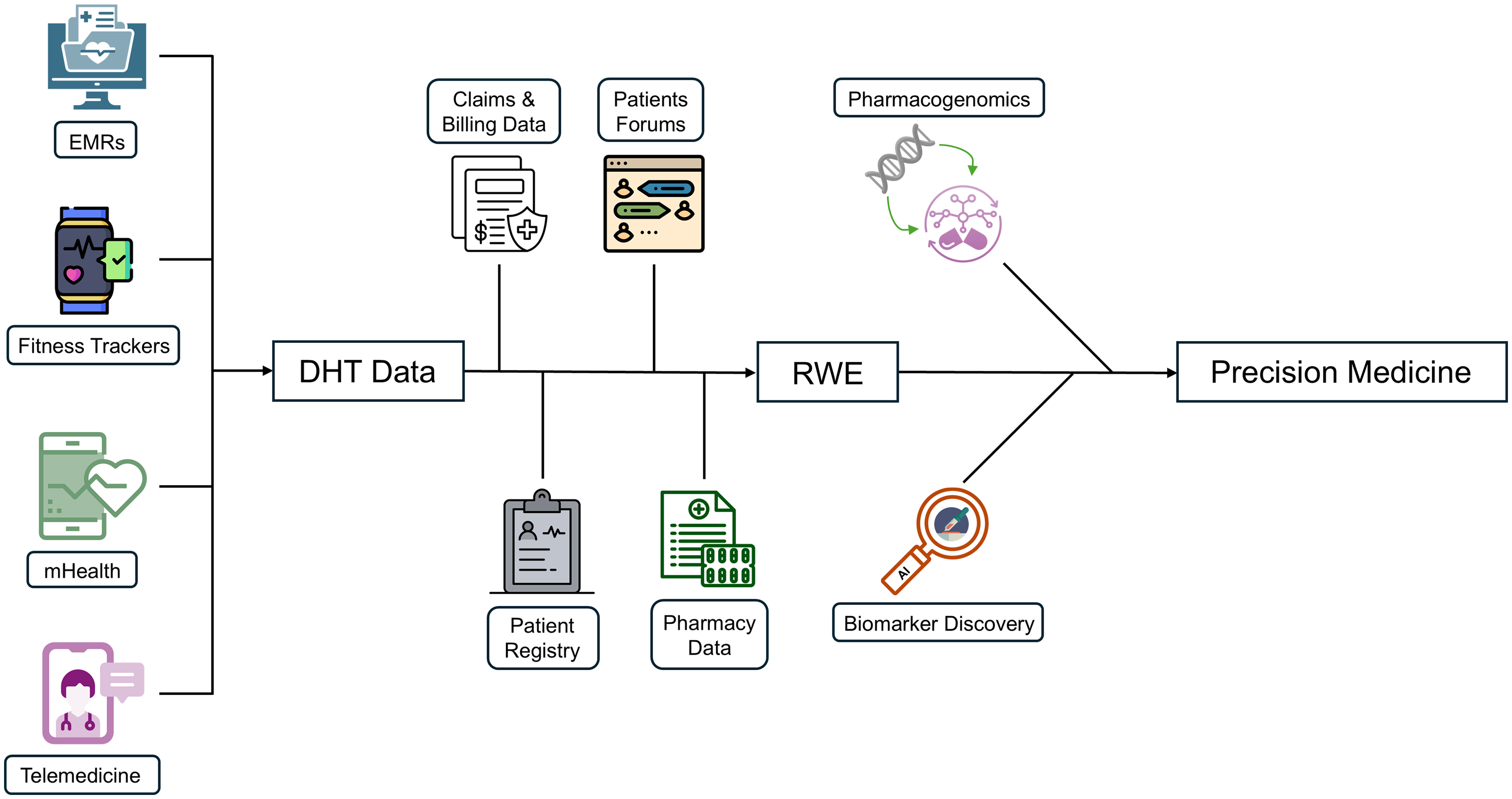
Data pathway toward precision medicine the figure illustrates the progression of data flow from the initial to the final stage. Data collection begins with the acquisition of patient health information from various electronic sources, termed Digital Health Technology data. This is enhanced by Real World Evidence data, including patient forums, insurance claims, patient registries, and pharmacy records. The integration of this dataset with pharmacogenomics, aided by artificial intelligence in biomarker discovery, enables the implementation of Precision Medicine.
As precision medicine continues to evolve, two key trends are playing a pivotal role in advancing its effectiveness: the integration of AI for biomarker discovery and the application of pharmacogenomics to tailor drug therapies.
AI in biomarker discovery: AI algorithms can sift through vast genomic datasets to identify novel biomarkers for various diseases. For example, AI has been used to find specific mutations that predict patient responses to immunotherapies in cancer treatment, enhancing the precision of targeted therapies. These AI-driven insights enable oncologists to select precise therapies, improving the effectiveness of treatments and minimizing unnecessary interventions. Similarly, AI is revolutionizing dental medicine by analyzing salivary biomarkers to detect oral diseases like dental caries and periodontal conditions with high accuracy, showcasing its versatility in biomarker discovery across diverse medical fields.
30
In line with these developments, specialized AI platforms like PandaOmics are pushing the boundaries of biomarker discovery for complex diseases. PandaOmics, a cloud-based AI platform by Insilico Medicine, integrates bioinformatics and multimodal omics data to uncover therapeutic targets and biomarkers for complex diseases such as Alzheimer's, amyotrophic lateral sclerosis, and aging, with validated applications in over 20 studies spanning cancer immunotherapy, fibrosis, and age-related conditions.
31
Pharmacogenomics: Pharmacogenomics explores how an individual's genetic profile influences drug response, significantly improving precision medicine. For example, in psychiatry, it has streamlined the process of prescribing antidepressants by identifying genetic variations in CYP2D6 and CYP2C19 enzymes, which metabolize selective serotonin reuptake inhibitors. This helps guide clinicians in selecting the most suitable medication
32
and minimizes adverse reactions while ensuring safer, personalized psychiatric care.
Leveraging DHT and RWD in clinical trials and regulatory approvals
The increasing use of DHT and RWD has revolutionized clinical research and regulatory processes, with healthcare systems integrating diverse data sources to monitor patient outcomes. RWD identifies patient subgroups that benefit most and aids in trial modifications to reflect real-world settings whereas DHT applications enhance data collection, thus improving trial relevance and outcomes. 33 Furthermore, post-market monitoring of therapies using RWD and DHT ensures their long-term safety and effectiveness, which is critical in regulatory decision-making. 34
There are several instances where use of DHT has been successfully implemented to either detect or diagnose medical conditions. In 2017, the U.S. Food and Drug Administration (FDA) approved the first “digital pill,” called Abilify Mycite. This innovative pill contains a tiny tracking system that helps track adherence to aripiprazole treatment, an atypical antipsychotic commonly prescribed for schizophrenia. 35 The Norwegian ECG247 Smart Heart Sensor, a user-friendly wireless continuous ECG monitoring device that includes a web portal, a smartphone app, a back-end cloud service, a reusable sensor, and an electrode patch is another example of how DHT is used. According to the EU Medical Device Directives (93/42/EEC), the system is certified as a medical diagnostic device and complies with the General Data Protection Regulation's (GDPR) standards. 36 An example of the use of DHT in clinical study is the trial being conducted in the Netherlands. Radboud University Medical Center is conducting a study to create a comprehensive Parkinson's disease dataset using continuous wearable sensor data from 520 patients. In this trial, participants will wear the Verily Study Watch to collect high-resolution movement and other data, which will be correlated with clinical outcomes to assess disease progression and treatment responses. 37
RWD has been successfully applied in regulatory approvals, as seen with Entresto (sacubitril/valsartan). Initially approved by the FDA through RCTs, RWD analysis from EHRs and patient registries demonstrated its effectiveness across broader populations, leading to expanded use. 38 Similarly, Ibrance (palbociclib) was supported by RWD during its approval process by the European Medicines Agency, 22 confirming the drug's efficacy across diverse patient subgroups. 39 In clinical trial design, precision medicine has increasingly relied on RWD to improve trial outcomes. For example, the integration of RWD in oncology trials has allowed more accurate targeting of therapies based on real-world patient data, enhancing trial designs and results. 40
Precision Medicine is also being investigated for its utility and viability in treating specific conditions through clinical trials. One example is the Precision Medicine Study, sponsored by the Icahn School of Medicine at Mount Sinai, which will be a 2-year observational trial assessing cancer sequencing in multiple myeloma patients to improve tumor characterization and identify novel therapeutics. The study will involve advanced genomic analyses, reporting findings to participants and their physicians with a focus on the total number of somatic single-nucleotide variants per patient. 41 Another study, the NSIGHT2 trial, will investigate whether rapid genomic sequencing improves outcomes for critically ill infants by comparing whole-genome sequencing and whole-exome sequencing. This study aims to quantify the diagnostic benefits, clinical efficacy, and cost-effectiveness of these methods in managing acutely ill infants 42 (Table 1).
Shows selected ClinicalTrials.gov studies highlighting the use of digital health technology (DHT) and real-world evidence (RWE) in personalized medicine (PM) approach.

Sample sizes presented as rounded values (nearest 10 or 1000) for clarity.
Regulatory frameworks guiding DHT and RWE
U.S. Food and Drug Administration (FDA): The FDA's RWE Program encourages the use of RWD to supplement clinical trial data, focusing on approvals for drugs and devices. The 21st Century Cures Act (2016) mandates that the FDA integrate RWD to support regulatory decisions, particularly in areas like labeling changes and expanding drug indications. 52 This program is essential for the development of DHT, which benefit from RWD for performance monitoring and validation. To further support this program, the FDA has released several guidance documents in recent years, including Submitting Documents Using Real-World Data and Real-World Evidence to FDA for Drug and Biological Products (September 2022), Considerations for the Use of Real-World Data and Real-World Evidence to Support Regulatory Decision-Making for Drug and Biological Products (August 2023), Data Standards for Drug and Biological Product Submissions Containing Real-World Data (December 2023), and Real-World Data: Assessing Electronic Health Records and Medical Claims Data to Support Regulatory Decision-Making for Drug and Biological Products (July 2024).
The European Medicines Agency (EMA): The EMA emphasizes RWD for post-market safety assessments through its Pharmacovigilance Risk Assessment Committee (PRAC). The EMA's Big Data Steering Group issued guidance in 2021 to leverage RWD for post-authorization safety studies, making RWD pivotal for evaluating DHT efficacy after public use. 52 This enhances real-time monitoring of safety and effectiveness.
Health Canada: Health Canada has adopted RWD cautiously but is exploring its use, especially in post-market surveillance. The Health Canada Notice of Compliance with Conditions (NOC/c) program enables the integration of RWD for monitoring drugs under conditional approval. 53 However, the agency's guidelines are less developed compared to the FDA and EMA, presenting an opportunity for further regulatory innovation in DHT and RWD.
Challenges in regulating these trends
While precision medicine holds enormous promise, regulating its application poses significant challenges due to the complexity of data and treatment personalization.
Data standardization: RWD and ML models often come from disparate sources, including hospitals, research centers, and patient platforms. These sources may use varying data formats and methodologies, making it difficult to standardize and assess data quality.
54
Regulatory agencies like the FDA and EMA face challenges in ensuring that data from these sources is consistent, reliable, and meets regulatory standards. Ethical and privacy concerns: With precision medicine heavily reliant on genomic and patient data, privacy concerns are paramount. The collection, storage, and use of sensitive health data require robust privacy protection laws. However, the regulations governing data protection, such as the GDPR in Europe, may sometimes hinder the cross-border sharing of critical data for research and clinical trials.
24
Ethical and operational concerns are especially pronounced in the validation of digital health tools in real-world environments. Clinical registries often lack structured protocols for assessing the performance of AI-enabled or sensor-based tools across diverse patient populations. This gap affects reliability, safety assessments, and equitable integration into healthcare delivery systems.
55
Reimbursement models: Precision medicine often involves expensive, highly tailored therapies, creating challenges in developing reimbursement models that are fair and sustainable. The current “one-size-fits-all” reimbursement framework is not well-suited for individualized therapies, and there is a growing need for precision reimbursement models that adapt to the specific needs of each treatment.
54
Gaps in data equity and interoperability: A significant challenge in leveraging RWE for precision medicine lies in data interoperability and equitable access to patient-generated data. Precision medicine depends on integrating large-scale genomic, clinical, and RWD to tailor treatments effectively, but the lack of standardized data formats across healthcare systems prevents seamless data sharing and utilization.
61
Fragmented electronic health records (EHRs), inconsistent genomic data reporting, and variability in coding standards (e.g., SNOMED CT vs. ICD-10) hinder the development of robust, real-time clinical decision support tools and limit the regulatory utility of RWE.62,63 While initiatives such as EuCARE have attempted to harmonize data across multiple COVID-19 cohorts, the broader challenge of integrating routine clinical care data persists due to limited semantic interoperability and disparate data-sharing policies .
64
In parallel, patient-collected data and DHTs hold promise for enhancing RWE, but several limitations constrain their utility. Device reliability and data accuracy can vary widely across platforms and user conditions, which may impact the consistency of collected data.
65
Importantly, there are known disparities in access to these technologies, influenced by socioeconomic status, geographic location, and digital literacy.
65
Not all patients have equal access to smartphones, wearables, or home monitoring equipment, which can introduce bias in data representativeness. Similarly, the availability and integration of EHRs vary considerably between institutions—many hospitals and clinics do not use advanced or standardized EHR platforms such as Epic, Oracle Health, or Veradigm—further limiting data completeness and interoperability.66,67 These issues must be addressed through harmonization protocols, standardized coding systems, and investments in health IT infrastructure to support equitable and reliable use of RWE in clinical research and regulatory decision-making. Regulatory uncertainties: Regulatory frameworks were originally designed with traditional drug development in mind and often lack the flexibility to fully incorporate RWD and DHT. Both Europe and the U.S. face regulatory challenges when integrating DHTs and RWE into clinical research, as existing regulations such as the EU's Regulation (EU) 2017/745 (Medical Device Regulation [MDR]) and the U.S. FDA's medical device pathways were not designed to accommodate these emerging technologies. In Europe, the MDR focuses on device certification for CE (Conformité Européenne, or European conformity) marking but provides limited specific guidance on the use of DHTs in clinical drug trials, particularly when such devices lack CE marking.
68
Sponsors face challenges incorporating DHT-derived endpoints into pivotal trials due to the absence of specific regulatory guidance. For example, digital tools like the Floodlight MS app for multiple sclerosis have struggled to validate endpoints under the MDR. These difficulties stem from proprietary software restrictions, limited data accessibility, and the lack of standardized evaluation methods recognized by regulators, highlighting how current frameworks are not well-equipped to accommodate innovative digital tools.
69
By contrast, the U.S. FDA has provided clearer mechanisms to support DHT integration, including the nonsignificant risk (NSR) designation for low-risk devices and a structured framework through its DHT program.
70
While the FDA has also shown some flexibility in accepting RWD, for instance, expanding the indication of Palbociclib to male patients with metastatic breast cancer based on RWD, this openness has not been consistent. Despite its growing role in post-marketing and safety evaluations, RWE's regulatory acceptance for efficacy remains constrained by inconsistent standards.
71
Concerns related to lack of randomization, endpoint alignment, and data quality continue to limit broader acceptance, as traditional evidence hierarchies still prioritize RCTs. A notable example is Nabiximols (Sativex), a treatment for multiple sclerosis spasticity approved in Europe and Canada but not by the FDA. The agency denied approval due to the sponsor's reliance on observational data and registries, rather than robust clinical trial evidence. This case underscores that RWD alone is often insufficient to meet FDA standards for new indications without the support of strong RCT data. These challenges are further compounded by regulatory gaps surrounding AI, including explainability, continuous software updates, and the lack of clear guidelines for validating adaptive algorithms. AI-enabled tools often undergo frequent version changes, yet existing regulations are not equipped to manage iterative learning systems that evolve post-deployment.72,73 Health Technology Assessment (HTA) bodies are also struggling to keep pace with these changes. Many agencies have yet to adopt consistent methodologies to evaluate the clinical and economic value of DHTs and RWD-based interventions. While some European HTA agencies are moving toward structured frameworks to guide digital evidence generation, the absence of harmonized standards continues to delay access and reimbursement for emerging technologies.
74
To improve the applications of precision medicine regulatory agencies are evaluating frameworks for algorithmic transparency, emphasizing the need for explainability in AI-based RWE assessments.
56
The increasing use of AI to analyze RWD introduces concerns about algorithmic bias—systematic errors in AI models resulting from imbalanced or incomplete training data.
57
Bias in AI-driven decision-making can lead to disparities in healthcare outcomes,
58
particularly for underrepresented populations, underscoring the urgent need for transparent algorithm development and equity-focused oversight mechanisms.
59
Ensuring diversity in training datasets and adopting bias-mitigation techniques are critical for the ethical integration of AI in regulatory science.
60
Future Directions: Future efforts should focus on harmonizing data standards and interoperability to enable effective integration of RWD and DHT in regulatory decisions. Initiatives like the FDA's Digital Health Center of Excellence and the EU's DARWIN platform aim to improve frameworks for RWE integration but are still evolving. Developing tailored validation guidelines and encouraging hybrid trial designs such as the MDNA55 glioblastoma phase III study that combined RWE with clinical data, 23 will help address current challenges. The FDA's approval of EndeavorRx, the first prescription video game for pediatric attention deficit hyperactivity disorder , demonstrates regulatory willingness to embrace novel digital therapeutics. Employing AI to enhance data reliability and promoting transparency in algorithm design are also critical for building regulatory trust. Moreover, addressing health equity by expanding access to digital tools for underserved populations is essential. Investing in regulatory education and advancing global harmonization will further enable timely approvals and broader access to precision medicine.
Conclusion
The integration of DHT and RWD into precision medicine is transforming clinical research by providing personalized healthcare solutions. Despite existing challenges, precision medicine continues to evolve, and regulatory bodies are gradually adapting to ensure that these innovations are accessible to patients while maintaining safety and efficacy standards. This will require collaboration among regulators, industry, healthcare providers, and patients to create clear guidelines and sustainable reimbursement models. Additionally, investing in regulatory education and pursuing global harmonization will support timely approvals and wider patient access to precision medicine.
Footnotes
Author contributions
SM and PS conducted investigation and wrote the manuscript. SM and PS are equal contributors. EJS conceptualized the content and edited the manuscript. All authors have read and agreed to the published version of the manuscript.

Funding
The authors received no financial support for the research, authorship, and/or publication of this article.
Declaration of conflict of interest
The authors declared no potential conflicts of interest with respect to the research, authorship, and/or publication of this article.