



Abstract
Background
As digitalization accelerates, digital competency has become crucial for elderly well-being. However, little is known about the psychological mechanisms that link digital skills to life satisfaction. This study investigates whether satisfaction with digital transformation mediates this relationship and whether Digital Devices Self-Efficacy moderates it.
Methods
We analyzed data from 2300 older adults (aged 55+) drawn from South Korea's 2022 Digital Information Gap Survey. Digital competency, satisfaction with digital transformation, digital devices self-efficacy, and life satisfaction were measured using validated scales. PROCESS Macro Model 7 was used to test moderated mediation effects, controlling for age, gender, education, occupation, disability, and living arrangement.
Results
Digital information competency significantly predicted higher life satisfaction, both directly (β = .095, p < .01) and indirectly via satisfaction with digital transformation (β = .055, 95% CI [0.040, 0.070]). Moreover, the strength of the relationship between digital competency and satisfaction with transformation was moderated by digital devices self-efficacy (interaction β = –.108, p < .01). Notably, the positive effect of digital competency was strongest among individuals with lower self-efficacy.
Conclusion
Improving digital skills alone may not suffice to enhance well-being in older adults. Programs should also boost self-efficacy and emphasize personal relevance to increase satisfaction with digital transformation. These findings inform future interventions aimed at reducing digital inequality and supporting more inclusive digital aging policies.
Keywords
Introduction
The global acceleration of digitalization in services is closely linked to both technological advancements and the recent global pandemic.1–3 The COVID-19 pandemic heightened the necessity for remote work, education, and consumption, accelerating digital transformation across various sectors. 1 In this context, the growing digital divide among vulnerable populations, such as the elderly, disabled, low-income households, and rural residents, has become increasingly apparent. 4 The pandemic introduced new challenges in the digital era, one of which is the widening digital divide, stemming from disparities in access to technology and digital information competency. 5
Digital information competency refers to the fundamental skills required to access, evaluate, manage, and communicate information using digital technologies. These include digital literacy, online communication, information evaluation, content creation, and problem-solving, as defined in the DigComp framework (Vuorikari et al., 2016). In this study, these domains were assessed using a validated multi-item scale that captures key aspects of digital competency relevant to older adults, such as online information search, communication via digital platforms, and digital content handling.
Research has consistently shown an inverse relationship between age and digital competency.6–8 For the elderly, barriers to digital competency are often linked to limited exposure to formal education on digital technologies, resulting in challenges in tasks such as online banking, social networking, and e-commerce.9,10
A European study revealed that while 80% of individuals aged 44–54 possess the digital skills necessary for daily life, this figure drops to 44% among those aged 65 and older. 11 In Finland, elderly populations showed low usage rates of digital services, often due to limited awareness of the benefits these services could provide. 12 Similarly, digital service usage among older adults has been associated with lower engagement levels compared to younger groups, highlighting the need for targeted interventions. 13
Digital transformation, as defined by the European Union's 2021 regulation (EU 2021/694), involves leveraging technologies such as the Internet of Things (IoT), cloud computing, and artificial intelligence to transform industries and services. Key sectors impacted by digital transformation include communications, finance, and healthcare. In South Korea, the National Information Society Agency (NIA) emphasized that economic, social, cultural, and lifestyle changes have increasingly centered around digital technologies. The pandemic has further accelerated these changes across fields such as healthcare, education, transportation, and culture. 14
The widespread adoption of remote work and digital tools during COVID-19 compelled individuals to engage with digital devices, whether willingly or reluctantly, to adapt to the new normal. 15 Previous studies have demonstrated that digital device usage positively influences life satisfaction among middle-aged and elderly populations. 16 Enhanced digital information competency has been shown to improve information utilization, efficacy, and overall life satisfaction. 17 Furthermore, the use of digital devices like smartphones fosters social participation and improves life satisfaction for the elderly.
Notably, the relationship between digital competency and satisfaction with daily life in the digital era is likely to be more pronounced among older adults than younger generations.
This tendency can be attributed to the fact that older individuals, who often face greater barriers to digital inclusion, tend to experience substantial improvements in autonomy, relief from social isolation, and enhanced psychological well-being when acquiring digital skills (Pejić Bach et al., 2023; Cho & Cho, 2023). However, data indicate significant challenges: the proportion of adults aged 65 and above who find digital devices difficult to use is 34% in the UK, 29% in the US, and 46.3% in South Korea.18,19
Digital competency encompasses several domains, including information and data literacy, communication and collaboration, media literacy, digital content creation, and problem-solving. 20
These competencies extend beyond technical skills to include knowledge, attitudes, and critical thinking, which collectively foster self-efficacy. Self-efficacy, originally defined by Bandura (1977) as an individual's belief in their capability to perform specific tasks, remains a relevant concept in the digital age, particularly for older adults. As demonstrated in more recent studies, digital self-efficacy plays a critical role in enhancing the elderly's confidence in adopting and effectively using digital devices (Heponiemi et al., 2022; Pejić Bach et al., 2023), thereby facilitating greater adaptation to digital transformation (Galindo-Domínguez & Bezanilla, 2021).
Global efforts have increasingly focused on educating the elderly to improve their digital skills. Studies have shown that targeted programs for older adults enhance their self-efficacy, information accessibility, and overall well-being.21,22 Digital interventions have also been linked to better privacy awareness and reduced financial vulnerability among older adults. 23 For example, elderly individuals who actively use digital devices report higher effectiveness in accessing health and financial information. 24 Despite these advancements, much of the existing research has focused on basic digital access or the use of specific devices like PCs and smartphones. There is a lack of studies examining the broader satisfaction derived from digital services and their impact on life satisfaction among the elderly. Older adults often face cognitive declines and adaptability challenges due to physical aging, which can contribute to lower satisfaction with digital transformation and ultimately affect their overall life satisfaction. 25 This study aims to address this gap by investigating how digital information competency influences life satisfaction among the elderly, with satisfaction with digital transformation as a mediating variable and self-efficacy in digital device usage as a moderating variable. The present study is grounded in the following theoretical frameworks. First, digital information competence was measured using an instrument based on the Digital Competence Framework (DigComp) developed by the European Commission (Vuorikari et al., 2016), as adapted for the Korean elderly population by Hwang et al. (2022). Second, the concept of digital self-efficacy as a moderating variable was theoretically underpinned by Bandura's (1977) self-efficacy theory.
Third, life satisfaction was assessed using the Korean-adapted version of the satisfaction with life scale (SWLS) originally developed by Diener et al. (1985), validated by Cho and Cho (2023). Based on these theoretical foundations, this study employed PROCESS Macro Model 7 (Hayes, 2018) to test a moderated mediation model. By exploring these relationships, the study seeks to provide insights into effective strategies for bridging the digital divide and enhancing the well-being of older populations.
Research model
Digital information competency
Digital competency was first introduced by the European Commission in 2013, rooted in the European Union's 2006 proposal of eight key competences for lifelong learning, one of which was digital competence. 20 Digital competency encompasses terms like digital literacy, e-literacy, and media literacy, emphasizing the importance of managing technology in the digital age. 26 According to the council recommendation on key competences for lifelong learning, digital competence involves the confident, critical, and responsible use of digital technologies in learning, work, and social participation, combining knowledge, skills, and attitudes. 27
The COVID-19 pandemic significantly accelerated the importance of digital competency, as digital engagement became a necessity across various sectors. 28 Simultaneously, digital competency is increasingly seen as a critical factor in addressing digital inequalities. 29 Elderly populations, who often face chronic illnesses, disabilities, and social isolation, exhibit lower digital adoption rates compared to younger cohorts due to limited exposure to formal digital education.12,30,31 This includes challenges in tasks such as online banking, social networking, and e-commerce. 32 Furthermore, specific physical and cognitive limitations, such as impaired vision and memory, have been linked to lower digital competency among the elderly. 33
Digital information competency refers to the ability to effectively use digital tools and technologies to access, evaluate, and create information, often encompassing skills such as digital literacy, problem-solving, and collaboration.
20
Research has highlighted its importance in fostering adaptability and engagement in digitally mediated environments, particularly for older adults who may face barriers in adopting technology.10,31 Studies suggest that higher digital competency among the elderly enhances their ability to navigate digital tools confidently, increasing their satisfaction with the digital transformation that is reshaping various aspects of daily life.6,17 Furthermore, digital competency has been linked to improved access to resources, greater social participation, and higher overall life satisfaction.
34
Based on this, the study proposes the hypothesized relationships between these variables.
Life satisfaction
Life satisfaction among the elderly has been widely studied as an indicator of successful aging, mental health, and adaptation to later life. 35 Increasingly, information and communication technology (ICT) use is being recognized as a determinant of life satisfaction. For example, Yoo and Son 36 argued that enhancing self-esteem through internet media significantly improves the quality of life among the elderly. Similarly, Jeong, Yoon 37 found that higher internet skills lead to greater social participation, which subsequently enhances life satisfaction. These findings suggest the need for changes in digital education to promote broader social engagement among older adults.
Satisfaction with digital transformation
Satisfaction with digital transformation refers to the positive perceptions of changes brought about by advancements in artificial intelligence, data-driven industries, and hyper-connected networks. 37 These changes, accelerated by the COVID-19 pandemic, have impacted various sectors, including healthcare, education, and transportation. 14 Increased use of video conferencing platforms like Zoom and social media platforms such as WhatsApp and YouTube has transformed social interactions and work environments.
In terms of welfare, ICT-based care services have emerged to address care gaps for elderly individuals, particularly those living alone. These services include AI-assisted monitoring, interactive robots, and app-based health and lifestyle management tools. 38 Although limited research exists on the mediating role of digital transformation satisfaction between digital competency and life satisfaction, evidence suggests that it can provide a clearer understanding of this relationship. The integration of digital technologies into everyday life can significantly enhance satisfaction levels among elderly individuals. 39
Satisfaction with digital transformation refers to individuals’ positive perceptions of changes brought about by advancements in digital technologies, such as artificial intelligence and online platforms, that impact their daily lives.
40
Studies have shown that embracing digital transformation enhances individuals’ ability to connect socially, access resources, and engage in meaningful activities, which can positively influence overall life satisfaction.41,42 For elderly populations, digital transformation satisfaction is particularly significant, as it addresses barriers to social isolation and empowers them with tools for improved autonomy.10,17 Additionally, satisfaction with digital transformation serves as a crucial link between digital competency and broader well-being outcomes by fostering confidence and reducing apprehensions about technology use.43–45 Therefore, this study proposes these relationships for further exploration.
Digital devices self-efficacy
Building on previous studies,12,30,31 this study hypothesizes that digital information competency affects life satisfaction via satisfaction with digital transformation and that self-efficacy in using digital devices moderates this relationship. Motivation for digital device usage among the elderly includes enjoyment, autonomy, and improved communication. 46 However, barriers such as complex interfaces and device usability issues often hinder adoption. Despite these challenges, many elderly individuals exhibit a willingness to learn and utilize digital technologies.47–49
Traditionally, discussions around digital adoption were framed by the technology acceptance model, emphasizing users’ subjective perceptions. However, this study posits that digital competency enhances self-efficacy, which in turn fosters life satisfaction. Self-efficacy, defined as the belief in one's ability to successfully execute actions required to achieve specific outcomes, 50 empowers elderly individuals to approach new tasks with confidence, ultimately improving their satisfaction with digital transformation.
This study focuses on the moderated relationship between digital self-efficacy and satisfaction with digital transformation, exploring how digital competency influences life satisfaction through these mechanisms. By understanding these dynamics, the research aims to provide a clearer framework for designing interventions that enhance digital adoption and well-being among elderly populations.
Digital devices self-efficacy refers to an individual's belief in their ability to effectively use digital tools and technologies to accomplish specific tasks.
50
This self-efficacy significantly influences how individuals interact with and perceive the outcomes of using digital technologies, particularly among elderly populations who often face barriers to technology adoption.10,31 Studies suggest that higher digital devices self-efficacy amplifies the benefits of digital competencies, such as confidence and adaptability, enhancing satisfaction with digital transformation.51–53 Conversely, low self-efficacy can hinder the full realization of these competencies, as individuals may struggle to translate their skills into meaningful digital engagement.
34
Thus, the level of efficacy with digital devices is expected to moderate the relationship between digital competency and satisfaction with digital transformation.
Figure 1 illustrates the conceptual research model developed based on prior literature. In addition to this, Figure 2 presents the statistical path model used for empirical analysis, incorporating the hypothesized moderated mediation relationships among the observed variables based on PROCESS Macro Model 7. 54

Research model.

Moderating effects of digital devices self-efficacy.
Research methodology
This study was approved by an institutional review board of a Catholic university. The IRB approval number of the Catholic university is MC22QISI0026.
Study design
This study employed a cross-sectional survey design using secondary data from the Digital Information Gap Survey (2022), an official national dataset managed by the Korean Government to assess disparities in digital access and capability across vulnerable populations. The data is collected annually to guide national policy and assess progress in digital inclusion.
Participants
The original survey targeted 15,000 individuals aged 7 years and older residing in households across South Korea. For the purpose of this study, data from 2300 older adults aged 55 and above were extracted and analyzed. The elderly were chosen due to their significantly lower levels of digital competency, as confirmed by the dataset's national sampling estimates with 95% confidence intervals (see Table 1).
Comprehensive digital informatization level (unit: %)

Source: South Korea 2022 Digital Information Gap Survey (NIA VIII-RSE-C-22046 14 )
Data collection
Data were collected between September and December 2022 using
Questionnaire
A structured, psychometrically validated questionnaire was administered to participants. Key variables and their item counts include:
Digital Information Competency (12 items) Digital Devices Self-Efficacy (4 items) Satisfaction with Digital Transformation (4 items) Life Satisfaction (5 items)
All items were measured on standardized Likert-type scales. The tools were selected based on prior national surveys and policy evaluation frameworks.
Statistical analyses
This study employed a quantitative, regression-based moderated mediation analysis using IBM SPSS Statistics 26.0 and PROCESS Macro Version 4.1 (Model 7), as proposed by Hayes (2018). The reliability of measurement instruments was first assessed using Cronbach's alpha, followed by descriptive statistics and Pearson's correlation analysis to examine the general characteristics of the sample and interrelationships among variables.
Moderated mediation effects were tested through conditional process analysis with 5000 bootstrap resamples at the 95% confidence level. PROCESS Macro was selected over traditional mediation approaches such as Baron and Kenny's (1986) framework, which lacks the capacity to estimate complex indirect paths and does not account for measurement error (Preacher & Hayes, 2008).
Although Structural Equation Modeling (SEM) is considered superior for modeling latent constructs and evaluating model fit, PROCESS Macro was more appropriate for this study, which focused on testing conditional indirect effects among observed variables using composite scores from validated multi-item scales.
To mitigate the known limitations of PROCESS in handling measurement error, this study utilized psychometrically validated instruments with high internal consistency (Cronbach's α > .80). Construct validity was further ensured through descriptive and correlational analyses. This methodological approach enabled statistically robust testing of the hypothesized conditional process model while maintaining parsimony in line with the study's objectives.
Measures and variable structure
All variables in this study were derived from validated self-report questionnaire items and treated as observed variables. While conceptually reflective of latent constructs—such as digital competence or life satisfaction—composite scores were used for analysis, consistent with prior studies.
The key variables in this study were classified as follows:
Observed Variables: Digital information competency, satisfaction with digital transformation, digital devices self-efficacy, and life satisfaction—all measured using multi-item validated scales. Latent Constructs: While each variable reflects an underlying theoretical construct, no confirmatory factor analysis was conducted in this study; thus, all were analyzed as observed variables. Exogenous Variable: Digital information competency was modeled as an independent variable, not influenced by other variables in the framework. Endogenous Variables: Satisfaction with digital transformation (mediator), life satisfaction (dependent variable), and digital devices self-efficacy (moderator) were treated as endogenous variables influenced within the hypothesized framework.
This structure aligns with the moderated mediation model tested via PROCESS Macro Model 7 (Hayes, 2018), which examines how the effect of digital competence on life satisfaction is mediated by satisfaction with digital transformation and moderated by digital devices self-efficacy.
Independent Variable: digital information competency level of elderly individuals
The independent variable in this study is the digital information competency level of elderly individuals. To measure this, a 12-item scale was utilized, and respondents (elderly participants) provided answers on a 5-point Likert scale. The digital information competency level was calculated as the average score of the 12 items (Cronbach's α = .960). The survey question was structured as, “To what extent can you independently perform the following activities using a PC (desktop/laptop) and smart devices (e.g., smartphones, tablets)?” The specific survey items are presented in Table 2.
Measurement for each construct.

Note: Control variables were included in the PROCESS Macro Model 7 analysis to statistically adjust for demographic effects.
The digital information competency scale was used to evaluate the competency levels of elderly individuals, based on a framework adapted to the Korean context by Hwang, Lee. 55 This scale drew upon the Digital Competence Framework for the EU (DigComp), which defines digital competence across five dimensions: Information and Data Literacy, Communication and Collaboration, Digital Content Creation, Safety, and Problem Solving.20,56,57
Dependent variable: life satisfaction
The dependent variable in this study, life satisfaction, was measured using a 5-item scale, with the average score used for analysis (Cronbach's α = .820). This scale is based on the Satisfaction with Life Scale (SWLS) developed by Diener, Emmons, 58 which reflects the overall fulfillment of motivational needs across one's life. The Korean version of the scale, translated and adapted by Cho and Cho, 18 was used. The original 7-point scale was converted to a 4-point Likert scale for data collection in the 2022 Digital Information Gap Survey. 14
Mediator: satisfaction with digital transformation
The mediating variable, satisfaction with digital transformation, was derived from the “2022 Digital Information Gap Report.” This variable represents satisfaction with daily life changes brought about by digital transformation, measured through a 4-item scale. The average score of these items was used for analysis (Cronbach's α = .911). Digital transformation refers to the rapid evolution of technologies such as artificial intelligence, data-driven industries, and hyper-connected networks, leading to significant changes in the economy, social structures, culture, and lifestyles. 14 The COVID-19 pandemic has accelerated digital transformation in various sectors, including healthcare, education, transportation, environment, and culture. Respondents rated their satisfaction with these changes on a 5-point Likert scale, where 1 indicates “Strongly Disagree” and 5 indicates “Strongly Agree.”
Moderator: digital devices self-efficacy
Digital devices self-efficacy usage refers to an individual's confidence in performing various activities such as searching for information, communicating, and making decisions using digital devices. It reflects an individual's digital capabilities and competencies as an information consumer, a critical factor for adaptation and participation in a digital society.
This concept has been defined in various studies. Eastin and LaRose 59 introduced the concept of “Internet Self-Efficacy,” measuring an individual's belief in their ability to use the internet, including areas like internet services, information retrieval, and online communication. Hargittai 60 expanded this to “Digital Literacy,” which encompasses the ability to find, understand, evaluate, and create information in digital environments, including confidence in using digital devices. Deursen and Van Dijk 61 proposed “Digital Skills Literacy,” which includes technical understanding and the ability to use digital devices.
These studies significantly contributed to the development of self-efficacy scales for digital device usage. Drawing on these frameworks, this study used the self-efficacy scale employed in the 2022 Digital Information Gap Survey 14 to analyze this variable.
Results
This section presents the analytical findings in alignment with the methods described earlier. The analyses were conducted in the following sequence: (1) reliability analysis, (2) descriptive statistics, (3) correlation analysis, and (4) moderated mediation analysis using PROCESS Macro Model 7.
Reliability analysis
Cronbach's α coefficients were calculated to assess the internal consistency of the measurement tools. All variables demonstrated acceptable reliability levels: digital information competency (α = 0.91), satisfaction with digital transformation (α = 0.88), digital device self-efficacy (α = 0.86), and life satisfaction (α = 0.87).
Descriptive statistics
The general characteristics of the 2300 elderly participants (aged 55 and older) are summarized. The largest age group was individuals aged 60–69 years, comprising 45.8% (n = 1054) of the sample (Table 3). Female participants constituted 51.4% (n = 1182), indicating a relatively balanced gender distribution. With respect to occupational status, the most common category was “non-traditional and other occupations,” representing 46.2% (n = 1063) of respondents. Regarding educational attainment, the majority of participants had completed high school or had some college-level education, accounting for 51.5% (n = 1185). The vast majority of participants (97.7%, n = 2248) reported no disabilities. In terms of household composition, 86.2% (n = 1983) resided in multi-person households, suggesting that most participants lived with others.
Profile of the respondents (N = 2300).

Note: Control variables were included in the PROCESS Macro Model 7 analysis to statistically adjust for demographic effects.
The demographic characteristics presented in Table 3 were used as control variables in the analysis. By including these variables as covariates, the analysis accounted for their potential confounding effects on the relationships among key psychological constructs, enhancing the robustness and validity of the findings.
To validate the model and assess the normality of variables, descriptive statistical analysis was conducted, and the results are summarized in Table 4. The findings reveal that the participants’ digital information competency level had a mean score of 2.172 (SD = .948), indicating a relatively low level. Life satisfaction and satisfaction with digital transformation scored means of 2.534 (SD = .514) and 2.724 (SD = .884), respectively, suggesting a relatively positive perception of digital transformation among participants. In contrast, Digital devices self-efficacy usage had a mean score of 2.178 (SD = .710), highlighting particularly low confidence in using digital devices among the elderly population. Skewness values exceeding 3 and kurtosis values above 10 indicate severe non-normality. In this study, descriptive statistics including means, standard deviations, and Pearson's correlation coefficients were used to examine the general characteristics and interrelationships among the observed variables. Descriptive statistics including means, standard deviations, and Pearson correlation coefficients were used to assess variable distributions and interrelationships among constructs.
Scale reliabilities.

Correlation analysis
To understand the linear relationships among the independent, dependent, mediating, moderating, and control variables and to determine the degree of influence one variable has on another, Pearson's correlation analysis was conducted. The results are summarized in Table 5.
Correlation of the research variables.

Note: p < .05, ** p < .01
Age was found to be correlated with occupation, education level, living alone, digital information competency level, life satisfaction, satisfaction with digital transformation, and Digital devices self-efficacy usage. Notably, education level showed a strong positive correlation with digital information competency level (r = .592, p < .01). Additionally, digital information competency level exhibited strong positive correlations with life satisfaction, satisfaction with digital transformation, and Digital devices self-efficacy usage.
Results of mediation and moderation effect analysis
(1) Mediating effect analysis results
To verify the mediating effect of satisfaction with digital transformation in the relationship between digital information competency and life satisfaction, the analysis was conducted using SPSS Process Macro (Model 4). Bootstrapping was performed with 5000 resamples, and a 95% confidence interval was applied (Table 6). The significance test results for each pathway showed that digital information competency positively and significantly influenced satisfaction with digital transformation (B = .498, t = 26.641, p < .01) and life satisfaction (B = .095, t = 6.173, p < .01). Furthermore, satisfaction with digital transformation positively and significantly influenced life satisfaction (B = .110, t = 7.776, p < .01). These findings confirm the mediating role of satisfaction with digital transformation in the relationship between digital information competency and life satisfaction.
Simple mediation effect: indirect effect analysis.
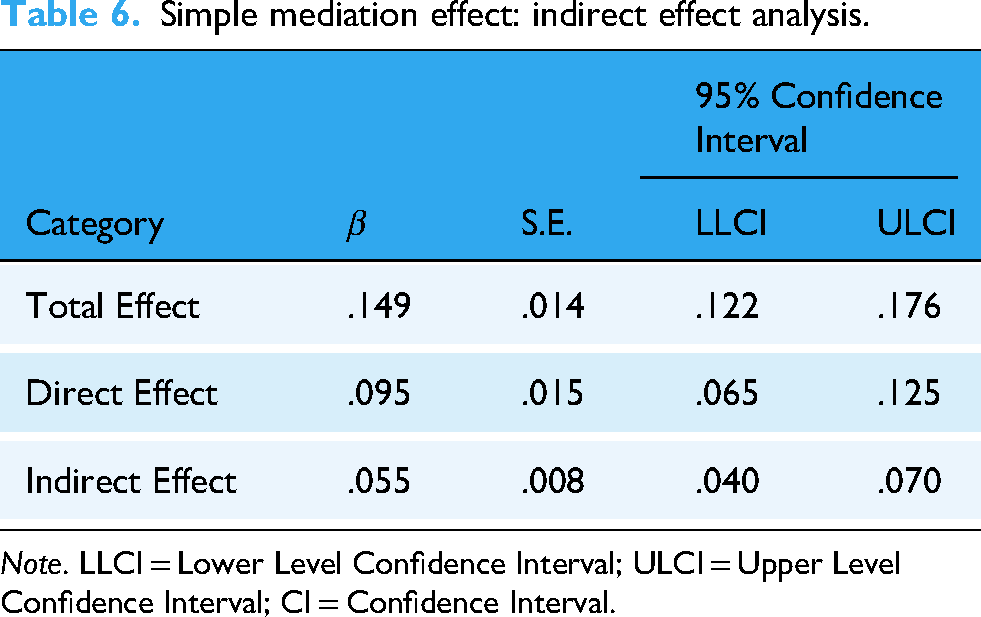
Note. LLCI = Lower Level Confidence Interval; ULCI = Upper Level Confidence Interval; CI = Confidence Interval.
(2) Moderation effect analysis results
This study focused on analyzing the moderating effect of digital devices self-efficacy on the relationship between digital information competency and satisfaction with digital transformation (Table 7). Multivariate regression analysis, moderation effect analysis, and the Johnson-Neyman technique were employed for this purpose. 54
Johnson-Neyman method results (digital information competency level × digital devices self-efficacy)

The interaction effect between digital information competency and digital devices self-efficacy was found to be significant [β = -0.104, p < 0.05; 95% CI (–0.148, −0.068)], indicating that efficacy with digital devices moderates the relationship between digital information competency and satisfaction with digital transformation. Specifically, as digital devices self-efficacy increases, the strength of the relationship between digital information competency and satisfaction with digital transformation progressively decreases (β: 0.485 → 0.377 → 0.269 → 0.160). This result demonstrates that individuals with higher digital devices self-efficacy usage experience a weaker relationship between digital information competency and satisfaction with digital transformation.
The regression equation is expressed as follows:
To further confirm the statistical significance of the moderating effect, the Johnson-Neyman technique was applied. 54 The results revealed significant moderating effects across efficacy values ranging from 1 to 4, highlighting the conditional impact of efficacy on the relationship between digital information competency and satisfaction with digital transformation (Figure 2 and Table 7).
Additionally, multivariate regression analysis was conducted to examine the effects of various demographic variables on satisfaction with digital transformation. Among these variables, gender showed a significant influence (p < 0.05), while age, occupation, education level, disability status, and living arrangement did not exhibit significant effects (Table 8).
Moderation effect of digital devices self-efficacy.

Note: R = 0.683, R² = 0.466, F = 222.060 (p < .001).
Discussion
These findings support previous research showing that digital competence enhances well-being, and extend the literature by empirically validating satisfaction with digital transformation as a key psychological outcome.19,62,63
These findings align with prior research indicating that digital competence enhances psychological well-being and subjective quality of life in aging populations.19,62 The significant mediating role of satisfaction with digital transformation extends previous work, 63 who argued that digital inclusion must be understood not only in terms of access and skills but also in terms of subjective digital experience. This study supports their claim by empirically validating satisfaction with digital transformation as a meaningful psychological outcome of digital competence.
The moderating effect of digital devices self-efficacy further enriches the understanding of how older adults engage with digital technologies. In accordance with Self-Efficacy Theory,46,50 individuals with higher perceived Digital devices self-efficacy were better able to translate their digital competencies into greater life satisfaction. Similar effects have been reported in studies, 64 which emphasize the importance of confidence and perceived competence in technology use among older adults.
These results suggest several practical implications. First, digital literacy programs for older adults should go beyond technical training to incorporate psychological empowerment strategies. For example, creating personal digital content (e.g., YouTube or blogs) not only builds skills but also enhances self-worth and social inclusion. This echoes findings that meaningful engagement, not just access, is key to bridging the digital divide.65,66 Second, targeted interventions should be tailored based on individual self-efficacy levels, as those with lower confidence may benefit from peer support or gradual exposure to technology. Such approaches are supported by intervention studies 67 showing that adaptive learning environments increase sustained engagement among elderly learners. Lastly, gender differences observed in satisfaction with digital transformation warrant further exploration, as they may reflect broader socialization patterns or technology usage motivations. Despite the robustness of the findings, this study has limitations. The cross-sectional nature of the data precludes causal inference. Longitudinal or experimental studies would help confirm the directionality of the observed effects. In addition, while this study proposed a conceptual model, future research should test its generalizability across diverse cultural or socioeconomic elderly groups. Overall, this study contributes to the growing literature on digital aging by integrating psychological constructs such as self-efficacy and satisfaction into models of digital engagement. It offers a nuanced understanding that can inform both theory development and evidence-based digital inclusion policies.
Conclusion
This study demonstrated that digital information competency significantly enhances life satisfaction among older adults, both directly and indirectly through satisfaction with digital transformation. Furthermore, the strength of this mediated relationship varies according to individuals’ levels of digital devices self-efficacy, highlighting the critical role of psychological resources in digital engagement. By integrating both mediation and moderation effects into a single framework, the study provides a comprehensive understanding of how digital skills, confidence, and subjective experiences jointly shape well-being in later adulthood. These findings suggest that digital competence is not merely a technical skillset but a psychologically embedded attribute that influences quality of life through complex social and emotional pathways.
Implications for researchers
This research advances digital aging studies by integrating psychological mechanisms into the framework of digital inclusion. While much of the existing literature has focused on access or skill acquisition, our findings suggest that perceived satisfaction with digital transformation plays a crucial role in determining how digital skills affect life outcomes. This aligns with prior work arguing that subjective experience, not just technical ability, defines meaningful digital participation.
Furthermore, the moderating role of digital devices self-efficacy underscores the need to move beyond linear models of digital engagement. Our findings show that even with similar levels of digital competence, older adults with higher self-efficacy report greater satisfaction and well-being, suggesting that confidence in using technology significantly conditions the benefits derived from it.
By empirically validating both satisfaction and self-efficacy as psychological components of digital engagement, this study extends theoretical frameworks and encourages future research to explore dynamic interactions between skillsets, belief systems, and subjective perceptions among diverse elderly populations.
Managerial implications
From a practical perspective, this study offers important insights for designing effective digital literacy programs and policies for aging populations. First, it is essential to go beyond technical training and incorporate elements that build self-efficacy and enhance perceived relevance. For example, activities such as creating personal digital content (e.g., blogs, YouTube channels) can help older adults experience a sense of achievement, identity reinforcement, and social connectedness.
Second, given the significant role of self-efficacy, digital education should be differentiated based on individual confidence levels. Those with low digital self-efficacy may benefit more from peer mentoring, scaffolded instruction, or community-based learning, all of which can create a safe and relatable learning environment. Previous intervention studies also support the use of adaptive learning environments for promoting sustained engagement and reducing digital fatigue among older learners.
Third, the observed gender differences in satisfaction with digital transformation suggest that digital inclusion strategies should consider socialization patterns and motivational differences. Tailoring programs to address these gender-based needs can improve their effectiveness.
Lastly, continuous and long-term learning opportunities are essential to prevent disengagement and promote sustainable digital participation. Short-term or one-time interventions are unlikely to be sufficient. It is critical for policymakers and service providers to build ongoing support systems, follow-up programs, and technical help channels that encourage continuous learning and adaptation to evolving digital environments.
These implications collectively suggest that effective digital inclusion requires a holistic approach—one that addresses not only access and skills, but also confidence, satisfaction, and long-term engagement. Empowering older adults in this way can enhance their well-being and foster more equitable participation in a digital society.
Limitation and further research directions
While this study provided an in-depth exploration of the relationship between digital information competency levels and life satisfaction among the elderly, it has several limitations that highlight opportunities for further research. This study relied on secondary data, which restricted the inclusion of diverse predictive variables. Future studies should aim to collect and analyze data that explore a broader range of factors influencing the relationship between digital information competency and life satisfaction. Additionally, data collection should consider variables that can inform the development of policies to enhance satisfaction with digital technology usage and services among different demographic groups. The study was limited to the elderly population in South Korea, which raises questions about the generalizability of the findings to other cultural and geographic contexts. Future research should expand to include elderly populations from diverse countries and cultural backgrounds to examine whether similar results are observed globally. To better explain the relationship between digital information competency and life satisfaction, future studies could incorporate a wider range of mediating and moderating variables. For example, the role of social support, psychological factors, or other contextual influences could be explored. Investigating these factors may provide a more comprehensive understanding of how digital transformation impacts elderly populations. Future studies should consider the socioeconomic, educational, and occupational backgrounds of the elderly, as these factors may influence digital information competency and satisfaction with digital transformation. Additionally, analyzing how these variables interact with digital competency across various life domains can offer deeper insights into targeted interventions. By addressing these directions, future research can deepen the understanding of how digital information competency impacts life satisfaction and contribute to the design of inclusive policies and practices that empower elderly individuals in an increasingly digital society.
Footnotes
Acknowledgements
E.M.B. contributed to the original draft writing, table development, supervision, and review & editing. B.H.C. contributed to review & editing. S.H.K. contributed to the original draft writing, supervision, multiple rounds of editing, figure development assistance, and final review & editing.

Funding
This research received no specific grant from any funding agency in the public, commercial, or not-for-profit sectors.
Declaration of conflicting interests
The authors declared no potential conflicts of interest with respect to the research, authorship, and/or publication of this article.