



Abstract
Objective
Traumatic dental injuries (TDIs) require immediate emergency care. Nondental healthcare professionals frequently encounter these cases, yet studies indicate their knowledge of emergency management is often insufficient. The ToothSOS mobile application, launched by the International Association of Dental Traumatology, provides first-aid guidance on dental trauma. This is the first study in Saudi Arabia to assess medical, nursing, and pharmacy students’ knowledge of TDIs and awareness of the ToothSOS app, identifying key gaps and opportunities for integration into curricula.
Methods
A cross-sectional study was conducted among 361 medical, nursing, and pharmacy students at King Abdulaziz University (KAU) using a validated electronic questionnaire. The survey collected demographic data, assessed knowledge of TDIs, and evaluated awareness of the ToothSOS app. Sufficient knowledge was defined as correctly answering at least five of eight knowledge-based questions. Descriptive statistics, chi-square tests, and logistic regression were used for analysis.
Results
Only 26% of participants demonstrated sufficient knowledge. Nursing students scored significantly higher than medical and pharmacy students (p < .05). Female students were three times more likely to have adequate knowledge (p < .001). Awareness of the ToothSOS app was low (21.1%), but 78.4% of unaware participants expressed willingness to use it.
Conclusion
Healthcare students at KAU showed inadequate knowledge of TDIs and limited awareness of the ToothSOS app. Integration of TDI management training into healthcare curricula is recommended. Promoting the ToothSOS app as an accessible resource can enhance the emergency management of TDIs.
Keywords
Introduction
Traumatic dental injuries (TDIs) account for 5% of all reported injuries. 1 The most serious type of TDI is avulsion, where the tooth is completely displaced from its socket, and this injury accounts for approximately 0.5–16% of all TDIs in permanent teeth.2,3 Early intervention and appropriate emergency treatment are critical to ensure a favorable outcome for a traumatized tooth. 4 Sometimes, TDIs occur alongside other bodily injuries, and patients are usually directed to an emergency care center, where they are initially seen by a nondental healthcare professional. 5 Previous studies that evaluated nondentists’ knowledge of emergency management for avulsed teeth demonstrated a lack of sufficient knowledge.6–9 Basic emergency interventions can improve patient outcomes and help minimize complications.2,10,11 In 2018, the International Dental Traumatology Association (IADT) launched the ToothSOS mobile app to provide accessible first-aid information for TDIs. This free app aims to educate both the public and dental professionals on managing TDIs. 12
In Saudi Arabia, awareness of TDIs has been evaluated among teachers,13–18 dentists and dental students,19–23 and, in one study, among mothers. 24 Additionally, one study assessed knowledge among medical students. 25 However, there is a lack of research assessing knowledge of TDIs and awareness of the ToothSOS mobile application specifically among medical, nursing, and pharmacy students. Given their role in emergency care, these students often encounter emergency cases where they may be the first to assess and manage dental trauma before referral to a dentist. Therefore, equipping them with essential knowledge and skills in basic emergency interventions is crucial for ensuring appropriate immediate management and improving patient outcomes in emergency settings. Despite its potential benefits, the ToothSOS app remains underutilized in healthcare education. One possible reason for this is the lack of targeted promotion. Thus, by assessing awareness levels and willingness to use the app, this study aims to highlight the need for integrating digital resources into healthcare training. To bridge this gap, this study evaluates knowledge of dental trauma and awareness of the ToothSOS app among these healthcare students at King Abdulaziz University (KAU), Jeddah, Saudi Arabia.
Materials and methods
This cross-sectional survey-based study was conducted following approval from the Ethical Research Committee of the Faculty of Dentistry at King Abdulaziz University, Jeddah, Saudi Arabia (Protocol Code: 121-10-24). This study follows the Strengthening the Reporting of Observational Studies in Epidemiology (STROBE) guidelines for reporting cross-sectional studies. 26 A copy of the STROBE checklist is provided in Appendix B for reference.
Participants were recruited from medical, nursing, and pharmacy programs at KAU. Data collection was conducted over one month, from November to December 2024, using a convenience sampling approach. An electronic questionnaire, created using Microsoft Forms (Microsoft Corporation, Redmond, WA, USA), was shared on social media platforms, including Telegram and WhatsApp, to recruit participants.
Inclusion criteria included medical, nursing, and pharmacy students at KAU who consented to participate in the study. Exclusion criteria included first-year students to avoid including participants with minimal exposure to the healthcare curriculum.
To minimize selection bias, participation in this study was voluntary, and recruitment was conducted across multiple student groups within each discipline to ensure diverse representation.
A validated questionnaire, adapted from a previous study 27 was used with minor modifications, including the addition of the option “I don’t know” to selected questions to improve response accuracy. All questions were closed-ended. The questionnaire consisted of three main sections. The first section included a consent form explaining the study's objectives. Electronic informed consent was obtained from all participants prior to study initiation. Before proceeding with the survey, participants were required to confirm their consent by selecting one of two options: “Yes,” which allowed them to continue with the questionnaire, or “No,” which automatically terminated the survey, ensuring that no data was recorded from nonconsenting individuals. The second section collected demographic data, such as gender, specialty, and academic year. The third section evaluated knowledge of TDIs and awareness of the ToothSOS mobile application using multiple-choice questions. A copy of the questionnaire is provided in Appendix A for reference.
The sample size was determined using the Qualtrics Sample Size Calculator (Qualtrics, Provo, UT, USA). 28 Based on a population of 4243 medical, nursing, and pharmacy students enrolled in KAU during the 2024–2025 academic year, using a 95% confidence level and a 5% margin of error, the required sample size was calculated to be 353 participants.
Data analysis was done using Statistical Package for the Social Sciences software, version 24.0 for Windows. Descriptive statistics summarized the demographic characteristics of the participants, with results presented as frequency (n) and percentage (%). The relationships between categorical variables were evaluated using the Pearson chi-square test. Logistic regression analysis was conducted to determine the predictors of knowledge and awareness. A p-value <.05 was considered statistically significant.
Results
A total of 361 students agreed to participate in this study, with their demographic characteristics summarized in Table 1. The gender distribution was nearly balanced, with 51.5% female and 48.5% male participants. In terms of specialty, most participants were enrolled in medicine (45.2%, n = 163), followed by pharmacy (29.4%, n = 106) and nursing (25.5%, n = 92). Among the different academic years, second-year students had the highest participation rate (33.8%, n = 122), while sixth-year students constituted only 10.2% (n = 37).
Demographic characteristics of the participants in the study (n = 361).

Knowledge was assessed based on participants’ ability to answer at least five out of eight questions correctly. Table 2 shows the distribution of participants’ knowledge of TDIs. The majority of participants (74.0%, n = 267) showed inadequate knowledge, while only 26.0% (n = 94) demonstrated sufficient knowledge.
Knowledge of traumatic dental injuries among medical, nursing, pharmacy students at KAU (n = 361).

Note: KAU: King Abdulaziz University.
Sufficient knowledge was defined as correctly answering at least five out of eight questions.
Table 3 presents the responses of participants to a series of knowledge-based questions related to TDIs, along with the results of chi-square tests for group differences. Significant differences were observed for two questions. First, when asked whether antiseptic rinsing solutions should be suggested for patients with TDIs, nursing students demonstrated the highest proportion of correct responses (65.2%), followed by medicine (62.0%) and pharmacy (48.1%) (p = .027). Similarly, for the question identifying the most commonly traumatized tooth, nursing students again had the highest proportion of correct responses (53.3%), compared to medicine (37.4%) and pharmacy (34.9%) (p = .016). No statistically significant differences between the groups were found for the other questions (p > .05).
Frequency and percentage of correct responses for knowledge items among medical, nursing, pharmacy students at KAU (n = 361).
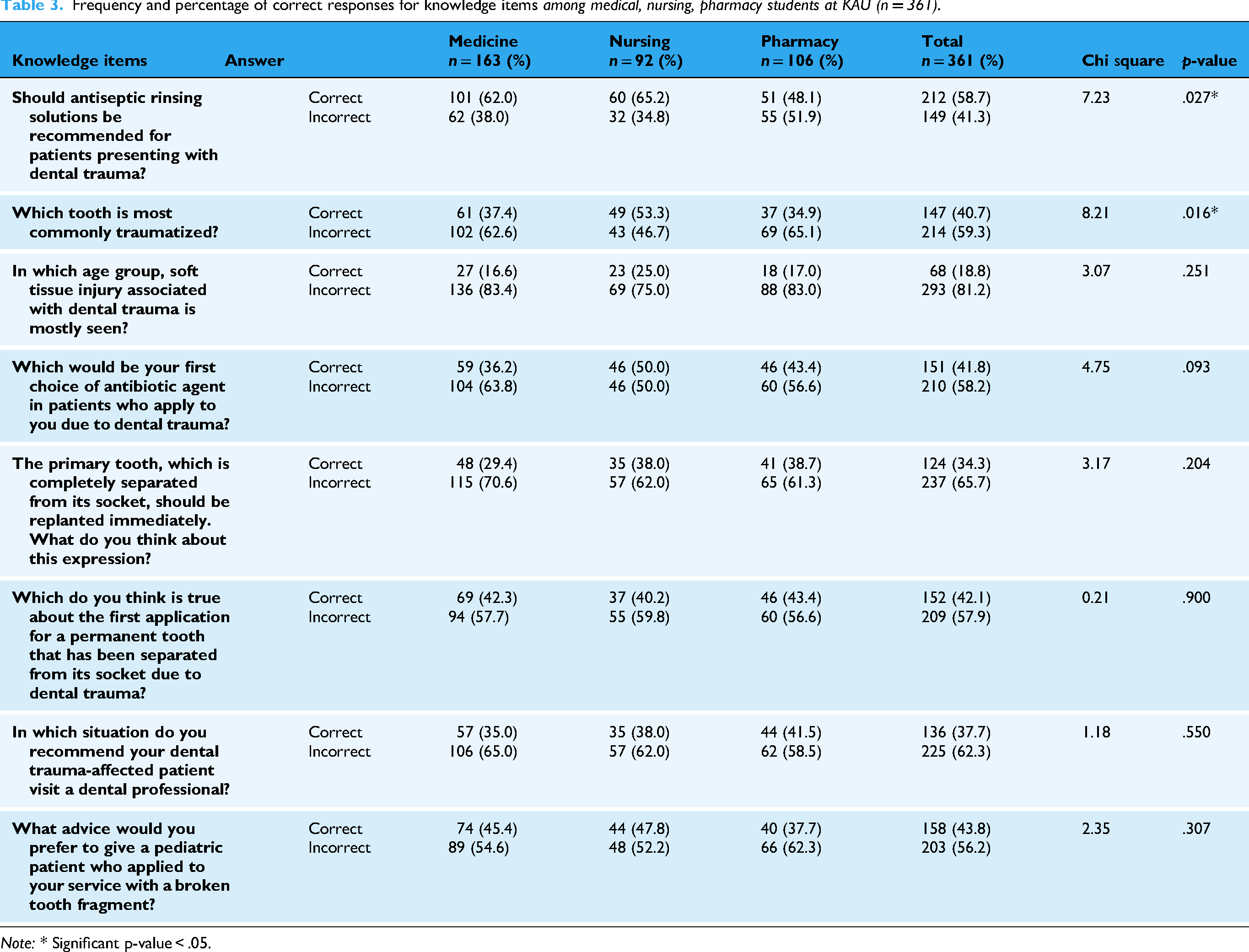
Note: * Significant p-value < .05.
The analysis highlighted significant disparities in the knowledge of TDIs across various sociodemographic and specialty groups. A binary logistic regression analysis was done to assess the influence of sociodemographic factors (gender, specialty, and academic year) on knowledge levels, as illustrated in Table 4. Among the variables analyzed, gender emerged as a significant predictor (B = 1.102, Wald = 18.563, p < .001), with females being three times more likely to have adequate knowledge compared to males (Exp(B) = 3.011). However, specialty (p = .129) and academic year (p = .296) were not statistically significant predictors of knowledge.
Logistic regression analysis for predicting knowledge of dental trauma.

Note: B: regression coefficient; S.E.: standard error; Wald: Wald statistic; df: degrees of freedom; Exp(B): odds ratio.
* Significant p-value < .05.
Table 5 highlights the awareness of the ToothSOS application among medical, nursing, and pharmacy students and their willingness to use it in the future. Among the 361 participants, 78.9% were unfamiliar with the app, though 78.8% of those unaware expressed a willingness to use it in the future. Awareness levels were consistent across specialties, with 23.9% of nursing students, 20.2% of medical students, and 19.8% of pharmacy students reporting familiarity with the app. Similarly, when asked about their likelihood of using the app in the future, 80.4% of medical students, 81.5% of nursing students, and 72.6% of pharmacy students expressed interest. Chi-square tests revealed no statistically significant differences in either awareness or the willingness to use the app in the future among the groups.
Awareness and willingness to use the ToothSOS app by specialty.

Note: NA: not applicable.
Discussion
Emergency assessment and intervention skills are critical components of healthcare students’ education. Preparing them with the knowledge and skills to manage TDIs in emergency situations might enhance their ability to provide effective emergency care, ultimately improving patient outcomes. Our aim was to evaluate the knowledge of dental trauma and awareness of the ToothSOS mobile application among medical, nursing, and pharmacy students at KAU in Jeddah, Saudi Arabia.
Knowledge of TDIs was assessed based on participants’ ability to correctly answer at least five out of eight multiple-choice questions. To improve response accuracy and reduce response bias, an “I don’t know” response option was included. This approach ensured that participants answered only the questions they were confident about, allowing responses to more accurately reflect actual knowledge rather than being influenced by forced choices. While this modification introduces a slight adjustment to the original validated instrument, the core content and structure of the questions remained unchanged.
This study revealed that medical, nursing, and pharmacy students at KAU demonstrated insufficient knowledge regarding TDIs. The findings of this study align with previous research25,29–32 indicating that nondental healthcare students still lack the knowledge of TDIs. A literature review assessing medical doctors’ knowledge of dental trauma management revealed that many doctors struggle with both the knowledge and confidence needed to handle these injuries effectively. Across the studies, a consistent gap emerged in their ability to assess and manage dental trauma. These results highlight the importance of targeted education and training to strengthen this gap. 33 Similar deficiencies were observed among Saudi medical students. A study found that only 5.8% had received formal training on TDIs, and many graduating students lacked confidence in diagnosing or managing TDIs. 25 Similarly, a survey of 365 paramedical students (nursing, pharmacy, and physiotherapy) revealed that while the majority understood the concept of avulsion and recognized the possibility of tooth reimplantation, many lacked knowledge of proper emergency management. 30
The findings of the current study reveal notable lack in the knowledge of TDIs among healthcare students, with gender emerging as a significant predictor. The logistic regression revealed that female students were three times more likely to possess adequate knowledge compared to their male counterparts. Although some previous studies showed no gender differences or male outperforming female students, 34 our findings are consistent with previous studies showing stronger academic performance among female students in healthcare education. 35 This observed gender difference can be attributed to many factors; probably due to differences in learning approaches, interest levels, and motivations. 36 Significant differences in learning preferences between genders have been previously reported, with males favoring a unimodal learning style and females favoring a multimodal learning style. 37 The current results underscore the need for targeted educational interventions that cater to both genders and to enhance learning effectiveness, discussions particularly among male students in managing TDIs effectively. Future research should explore in detail the possible underlying factors contributing to this disparity and assess the impact of structured educational programs on knowledge enhancement across different demographic groups.
Despite nursing students’ exposure to emergency situations as part of their curriculum, and the ongoing development of emergency training within their education,38–40 their performance in our questionnaire on dental emergency management did not surpass that of students from other disciplines. Except for two questions asking about identifying the most commonly traumatized tooth, and the use of antiseptic rinsing solutions suggested for patients with TDIs. This finding aligns with prior studies that highlight gaps in nursing students’ knowledge of dental emergencies. A study conducted on nurse students showed that students’ knowledge and awareness of avulsion as well as the diagnosis and management of dentofacial traumatic injuries were found to be inadequate, regardless of their year of study. 41 These findings suggest that despite positive training experiences, gaps remain between nursing interns’ preparation and real-world clinical demands. 42 This misalignment may partially explain our findings, suggesting that their exposure to dental emergency cases remains insufficient. Enhancing nursing education by incorporating structured training on dental emergency management could bridge this gap either through formal training or as part of continuing education programs.
Proper management of avulsed teeth depends on identifying whether the tooth is primary or permanent.2,11 Only one-third of our participants correctly identified that replantation of a primary tooth is not an appropriate management approach. Similarly, 45.9% of pediatricians in a previous investigation were aware that primary teeth should not be replanted. 27 Research on Saudi medical students also revealed that many graduating students struggled to differentiate between primary and permanent tooth fractures. 25 This highlights the importance of integrating basic dental anatomy, particularly the structure of primary and permanent teeth, into medical and paramedical curricula.
In the present study, 42% of healthcare students correctly identified the appropriate management of avulsed permanent teeth, which includes cleaning and replanting the tooth, followed by referring the patient to a dental professional. This result is consistent with findings from previous study, where many physicians lack the necessary knowledge to handle avulsion cases. 43 However, our results are notably higher than those reported in a study where only 6.4% of medical students correctly managed a scenario involving a conscious 12-year-old with an avulsed tooth and slight bleeding, where the appropriate response was to replant the tooth. 25 The difference in findings may be attributed to the fact that real-life scenarios, which require a deeper understanding and broader knowledge base, demand a higher level of competence compared to straightforward questions used in the present study.
After immediate emergency intervention at the site of the accident, patients should always be seen by a dentist for complete clinical and radiographic examination. 2 In our research only 38% of participants indicated that after conducting a detailed examination, they would refer all patients with orofacial trauma to a dental professional. However, a higher percentage was reported in a study conducted in the United Arab Emirates among school nurses and physical education teachers, 57.3% stated they would inform the parents about a broken or chipped tooth and advise them to contact a dentist. 32 The difference in findings may be attributed to variations in the participants’ professional roles, training, and levels of exposure to dental trauma cases. For example, school nurses and physical education teachers may be more likely to recommend seeking dental care because of their direct responsibility for student well-being and injury management in a school setting. In contrast, the healthcare students in our study may have had less training or awareness regarding the importance of immediate dental referral following orofacial trauma.
The ToothSOS mobile app, developed by the IADT is a free resource that provides guidance on managing emergency dental trauma. 12 Previous research has shown that the ToothSOS app effectively increases knowledge of TDIs among both healthcare workers and nonhealthcare workers. 44 A previous study conducted in Turkey found that none of the 229 pediatricians surveyed were aware of the ToothSOS application, although 91.7% indicated a preference for using this tool in their future practice. 27 This finding aligns with the present study, where 78.9% of our participants were unaware of the ToothSOS app but expressed a willingness to integrate it into their future clinical practice. This gap in awareness among future healthcare providers underscores the need for targeted efforts to promote the ToothSOS app and integrate it into educational curricula. This could be achieved through interactive training sessions, simulation-based learning, and digital modules embedded within emergency medicine, pediatrics, and primary care courses. 45 However, potential barriers to implementation must be considered, including limited time within already dense curricula, lack of awareness among educators, and potential resistance to adopting new digital tools. To address these challenges, a structured implementation strategy through collaboration between dental associations, medical education institutions, and healthcare organizations is essential. 46 Moreover, to encourage adoption in clinical practice, incorporating the app into continuing professional development programs and certification courses for medical and nursing professionals can reinforce its relevance. 47 Establishing it as a standardized resource within emergency dental trauma guidelines and promoting its use through accreditation bodies and professional organizations can further support widespread implementation. 46 Despite its evidence-based foundation, the app's effectiveness depends on strategic adoption and overcoming potential barriers. 48 Future research should explore targeted strategies to address these challenges, ensuring that the ToothSOS app becomes a widely accepted and sustainable tool for improving TDIs management.
The use of mobile apps in healthcare and in dentistry is rapidly advancing,47,49–52 particularly in promoting oral health and behavior management.51,53 However, enhancing the visibility and integration of the ToothSOS app within healthcare settings is essential for maximizing its impact on TDIs management. Since the patient version of the app is compact, healthcare facilities can display high-quality printable posters in waiting areas or offer a sustainable alternative through QR codes for easy digital access.
A key strength of this study is that it is the first to assess knowledge of TDIs and awareness of the ToothSOS app among medical, nursing, and pharmacy students in Saudi Arabia. This study sheds light on the preparedness of future healthcare professionals to manage dental emergencies, highlighting gaps that need to be addressed in their education. Furthermore, it assesses awareness of the ToothSOS app, a global tool for providing reliable information for dental injury management, emphasizing its potential to enhance emergency care practices.
The limitations of this study include the recruitment of participants from a single institution, which limits the generalizability of the findings to other academic or geographic settings. Additionally, employing a convenience sampling method may introduce selection bias. Future research could address these limitations by adopting random sampling techniques and recruiting participants from multiple institutions to enhance the representativeness and generalizability of the results. Furthermore, this study relied on self-reported knowledge and perceptions similar to previous studies,22,25,27,29–31 which may be subject to response bias. Future studies should incorporate practical case-based assessments or objective evaluations to more accurately measure participants’ competence in managing TDIs. Utilizing standardized patient scenarios, simulation-based assessments could provide deeper insights into the effectiveness of interventions, such as the use of the ToothSOS app, in improving clinical decision-making.
Conclusion
Based on this study's findings, medical, nursing, and pharmacy students at KAU in Jeddah, Saudi Arabia have inadequate knowledge of TDIs and are unaware of the ToothSOS app. Therefore, additional education and training on the assessment and management of TDIs are needed. This can be addressed by integrating a well-structured curriculum into university programs, with the ToothSOS app serving as an excellent supplementary resource to enhance the proper management of TDIs.
Footnotes
ORCID iDs

Ethical considerations
Ethical approval was obtained from the Ethical Research Committee of the Faculty of Dentistry at King Abdulaziz University, Jeddah, Saudi Arabia (Protocol Code: 121-10-24) before starting the study.
Author contributions
Conceptualization and design: Ayman M. Abulhamael and Nujud O. Saber; data collection: Nujud O. Saber, Manar A. Alzaidi, Maram A. Alkenani, and Raghad M. Alotaibi; analysis and interpretation of data: Ayman M. Abulhamael, Nujud O. Saber, and Obadah Austah; drafting of manuscript: Ayman M. Abulhamael, Nujud O. Saber, and Shatha S Zahran; and critical revision of manuscript: Ayman M. Abulhamael, Nujud O. Saber, Omar R. Alkhattab, Shatha S Zahran, and Obadah Austah; approval of final manuscript: Ayman M. Abulhamael, Nujud O. Saber, Manar A. Alzaidi, Maram A. Alkenani, Raghad M. Alotaibi, Omar R. Alkhattab, Shatha S Zahran, and Obadah Austahl
Funding
The authors received no financial support for the research, authorship, and/or publication of this article.
Declaration of conflicting interests
The authors declared no potential conflicts of interest with respect to the research, authorship, and/or publication of this article.
Data availability statement
The data supporting the findings of this study are available from the corresponding author upon reasonable request.
Informed consent
Participation in this study was voluntary. Electronic informed consent was obtained from all participants prior to participation.
Appendix A: Survey questions
Section 1: Informed consent
This study aims to evaluate the knowledge of dental trauma and awareness of the ToothSOS mobile application among medical, nursing, and pharmacy students in Saudi Arabia. This is a short questionnaire. By completing the survey, you are providing your informed consent to participate in the study.
Do you consent to participate in this study?
Yes No
Section 2: Demographic data
2. Gender
Male Female 3. Specialty
Medicine Nursing Pharmacy 4. Academic year
2nd year 3rd year 4th year 5th year 6th year
Section 3: Assessment of the knowledge of dental trauma
5. Should antiseptic rinsing solutions be recommended for patients presenting with dental trauma?
Yes No I don't know 6. Which tooth is most commonly traumatized?
Upper incisor teeth Canine teeth Molar teeth I don't know 7. In which age group, soft tissue injury associated with dental trauma is mostly seen?
Age 2–6 years Age 7–11 years Age 12 years and above I don't know 8. Which would be your first choice of antibiotic agent in patients who apply to you due to dental trauma?
Penicillin Cephalosporin Lincosamide Macrolides I don't know 9. The primary tooth, which is completely separated from its socket, should be replanted immediately. What do you think about this expression?
True False I don't know 10. Which do you think is true about the first application for a permanent tooth that has been separated from its socket due to dental trauma?
If the tooth separated from its socket can be found in the surrounding area, the patient should be directed to the dental professional immediately after it is cleaned and replanted If the tooth separated from its socket can be found in the surrounding area, the patient should be direct at to the dental professional directly without doing anything I don't know 11. In which situation do you recommend your dental trauma-affected patient visit a dental professional?
I refer all patients with orofacial traumas to a dental professional after a clear examination I will examine it. If a broken tooth or soft tissue damage is observed, I will refer the patient to a dental professional I don't know 12. What advice would you prefer to give a pediatric patient who applied to your service with a broken tooth fragment?
I would recommend keeping the broken tooth fragment in milk until the patient goes to the dental professional I would recommend storing the broken tooth fragment dry until the patient goes to the dental professional I don't know
Section 4: Awareness of the ToothSOS mobile application
13. Do you know about the ToothSOS App, a free mobile application software of the International Society of Dental Traumatology that provides instructions on what to do in an emergency after dental injuries?
Yes No 14. If your answer to the above question is No, would you consider using the ToothSOS App?
Yes No