




Abstract
Objective
The COVID-19 pandemic has deeply impacted mental health, especially among young people, driven by extended social isolation, routine disruptions, and uncertainties about health and the future. While rising levels of anxiety and depression in this group are well-documented, little is known about their online information-seeking patterns during this prolonged crisis. Exploring these patterns is vital for understanding how individuals navigate mental health challenges and seek support in times of uncertainty.
Method
This cross-sectional study investigates the online mental health information-seeking behaviors of young people in China during the COVID-19 pandemic. Using content analysis, we examined 1211 questions and 2303 responses from a popular Chinese social Q&A platform, Zhihu. Among these, 691 questions were identified as originating from young people, with the remainder attributed to adults. The analysis focused on the types of information sought, the effectiveness of responses, and the responsibility frameworks conveyed. By comparing the information-seeking behaviors of young people to those of adults, the study aims to uncover the unique needs of younger individuals.
Findings
First, young people primarily sought information about social adaptation, whereas adults demonstrated greater interest in diagnosis-related queries. Second, while young people's questions received more responses on average, nearly half remained unanswered for over four weeks, reflecting a lack of timely support. Finally, the qualitative nature of responses presented limitations, particularly for youth: they received more responses emphasizing individual responsibility and fewer recovery stories compared to adults, limiting exposure to systemic perspectives and hope-inspiring recovery pathways.
Conclusions
This study highlights the unique mental health information-seeking behaviors of young people in China and the potential of social Q&A platforms, offering valuable insights to help health professionals and policymakers allocate resources effectively and design targeted interventions to support this demographic during the pandemic.
Keywords
Introduction
The emergence of global health crises, particularly the COVID-19 pandemic, has precipitated unprecedented challenges to both physical and mental well-being worldwide. Of particular concern is the pandemic's profound impact on mental health outcomes, manifesting in elevated rates of anxiety, depression, and social isolation. Recent meta-analytic evidence demonstrates a striking sevenfold increase in global depression prevalence compared to pre-pandemic levels in 2017, underscoring the magnitude of this public health challenge. This deterioration in mental health is further evidenced by the significant surge in suicide-related content and expressions of loneliness across social media platforms.1,2
Adolescence and young adulthood (spanning ages 12 to early 20s), collectively referred to as “young people” in this investigation, represent a pivotal developmental transition from childhood to stable adulthood. 3 Although adolescence and young adulthood involve distinct developmental milestones, several factors support examining these stages together, with many studies referring to this demographic as Adolescents and Young Adults (AYA). Specifically, both periods share critical developmental tasks such as identity formation and heightened sensitivity to peer relationships, 4 demonstrate similarly elevated vulnerabilities to the onset of mental health disorders,5,6 and exhibit broadly comparable patterns of online health information behaviors. 7 Additionally, contemporary societal trends, including delayed transitions into traditional adult roles, have prompted scholars to argue for an expanded conceptualization of adolescence up to age 24, recognizing this extended period of “semidependency.” 8 Therefore, while acknowledging internal developmental variability, this study analyzes AYA collectively in comparison to older adult populations.
During the COVID-19 pandemic, young people faced multiple concurrent stressors as schools and universities simultaneously transitioned abruptly to remote learning. Both AYA encountered substantial challenges, including difficulties adapting to online educational environments, academic uncertainty, enforced social isolation, and notably reduced physical activity. Collectively, these factors contributed to a marked deterioration in mental health among youth, as evidenced by an increase in suicide-related emergency visits among AYA, 9 and notably high rates of depression and anxiety reported in Chinese adolescents 10 and university students. 11 Consequently, a surge in proactive mental health information-seeking behavior was observed, with more than 70% of Chinese university students actively pursuing resources to alleviate the psychological impact of the pandemic. 12 Moreover, the pandemic's impact was especially pronounced for youth with preexisting conditions, who experienced particularly severe symptom exacerbations. 13 As digital natives in a highly digitized society, examining these youth groups’ online experiences during the crisis provides crucial insights.
Among online platforms, social Q&A platforms, in particular, have emerged as a preferred information source among young people, representing a significant channel for health information exchange. 14 Unlike general social networks or online health communities, these platforms distinctively empower users to obtain personalized information through direct question-posing, thereby facilitating the acquisition of tailored advice that addresses individual circumstances and needs. 15 Moreover, questions posted on these platforms more accurately reflect users’ authentic information needs to be driven by recognized knowledge gaps. 16 In addition, the anonymous nature and peer-based structure of social Q&A platforms create a particularly conducive environment for young people to express mental health concerns and seek support, especially given their heightened vulnerability to stigma-related barriers in traditional help-seeking channels.17,18 Therefore, analyzing depression-related questions and responses on these platforms offers unique insights into both the information needs of young people and the effectiveness of their help-seeking behaviors.
The current study
While extensive research has documented the prevalence of depression and anxiety among young people during the pandemic, a critical knowledge gap persists regarding their specific information needs and levels of satisfaction with available mental health resources. Previous investigations have primarily focused on general social networking sites 2 or dedicated depression communities, 19 limiting our understanding of how young people seek mental health information across diverse digital environments. This study addresses these limitations by analyzing user-generated content on social Q&A platforms, enabling the identification of risk and protective factors, guiding evidence-based resource allocation for health practitioners, and informing the development of targeted interventions for this vulnerable population.
Therefore, the aim of the current study is to investigate the depression-related information-seeking behaviors and the nature of received support among young people on a major Chinese social Q&A platform (Zhihu) during a critical period of the COVID-19 pandemic, explicitly comparing their experiences with those of adults. To achieve this, a content analysis of 1211 depression-related questions (691 originating from youth and 520 from adults) and 2303 corresponding answers was conducted, specifically focusing on: (i) characterizing and comparing the distinctive depression-related information needs of youth versus adults; (ii) evaluating the effectiveness of this social Q&A platform in meeting these information needs; and (iii) examining and comparing the nature of the responses received by each group, focusing on the responsibility frames employed and the patterns of personal narrative sharing. Together, these analyses seek to illuminate the unique patterns of youth mental health information-seeking online, while also assessing the efficacy and characteristics of social Q&A platforms as a source of peer-supported, experience-based mental health resources during crises.
Literature review
Depression-related information-seeking online
Depression-related information-seeking predominantly occurs through digital platforms; 89% of Internet users and 84% of social media users sought depression-related information following a celebrity's mental health disclosure. 20 This digital information-seeking pattern extends to China, where social media platforms serve as a primary source for both individuals with depression 21 and the general college student population. 22 Understanding the specific nature and evolution of this widespread digital information seeking is therefore crucial.
Prior to 2020, depression-related information needs predominantly centered on symptoms, diagnosis, and coping strategies,19,23,24 with secondary emphasis on relationship management and social activities. 25 The COVID-19 pandemic, however, has dramatically reshaped these digital information-seeking behaviors. 26 Studies during this period demonstrate not only intensified mental health challenges due to remote learning but also increased reliance on online platforms for immediate social support and coping resources. 27
This transformation in information-seeking behaviors has not affected all age groups equally. Existing research has documented significant age-based differences in pandemic-related information behaviors, with Chinese young people aged under 25 showing a strong preference for digital platforms such as Weibo, and knowledge-sharing websites. 28 Among these popular digital environments, social Q&A sites represent a particularly relevant environment to study youth mental health information seeking. Unlike the often broadcast-style communication on general social media, these platforms enable direct question-answering interactions, allowing users to seek specific advice for their unique situations. The anonymous nature of these platforms particularly resonates with young users seeking mental health support, as demonstrated by prior studies. 29 During the pandemic, these platforms have documented substantial increases in depression-related inquiries, particularly among student populations. 22
Given the unique confluence of pandemic-related stressors impacting social and academic life and the developmental sensitivities of youth, understanding the specific types of depression-related information they prioritized on these platforms during this crisis becomes particularly important. However, despite young people's active engagement in depression-related discussions, 22 there remains a critical knowledge gap in understanding how this vulnerable population seeks and interacts with user-generated depression-related content.30,31 While research has extensively documented differences in channel preferences across age groups,32,33 far less attention has been paid to how information needs might vary developmentally.
Beyond what information is sought and how needs vary by age, another critical dimension is understanding who precisely is doing the seeking. Questions related to mental health may be posted not only by patients themselves but also by members of their “social support networks”—such as concerned family, friends, or classmates. These social support networks significantly contribute to the patient's mental health information status; they might seek information to assess potential risks for their loved ones, 20 gather additional resources for those affected, or help filter relevant materials from the overwhelming amount of information available online. 34 Differentiating between these seeker identities becomes particularly critical in the mental health context because stigma associated with mental illness, as well as limitations in an individual's capacity possibly due to their condition, can act as significant barriers preventing patients from seeking information directly themselves. 35 This pattern may be especially pronounced among youth, who may face additional barriers related to limited autonomy, dependence on adults, and heightened sensitivity to peer judgment. Therefore, understanding who primarily seeks depression-related information—patients themselves or their support networks—provides crucial insights into help-seeking patterns among youth.
To address this gap and examine young people's depression-related information seeking during the COVID-19 pandemic, we propose the following research questions:
RQ1: How do young people seek depression-related information on social Q&A sites during the COVID-19 pandemic?
– RQ1a: What types of depression-related information do they seek? – RQ1b: Who are the primary information seekers (patients vs. support networks)? – RQ1c: How do these information-seeking patterns differ from those of adults?
Efficacy of information-seeking online
Beyond understanding what information young people seek, it is equally important to examine how effectively these needs are met on social Q&A platforms. While social Q&A platforms facilitate personalized advice and patient expertise sharing,15,16 the mere possibility of interaction does not guarantee satisfactory responses. Response efficacy is crucial as it significantly influences users’ channel selection in health information seeking.36,37 Notably, unanswered or inadequate responses can leave users feeling unsupported in their daily illness management, 38 potentially reducing platform credibility and deterring future use. 14
Understanding response patterns on social Q&A platforms involves examining both quantitative and qualitative dimensions.
Focusing first on the quantitative aspects, research has identified various factors affecting response rates, including questioner attributes (follower count, posting frequency), question characteristics (length, hashtags, emoticons), and contextual factors (topic, timing).39,40 However, these findings primarily derive from general contexts and may operate differently in depression-related discussions, where content sensitivity and user vulnerability play crucial roles. 41
Given that young people are navigating critical developmental tasks and face unique barriers—such as susceptibility to potentially negative online encounters or information29,42 and a tendency toward subtle, indirect expressions of distress 43 —their resulting vulnerability in these online mental health discussions likely shapes interaction patterns differently compared to adults, potentially creating age-specific response patterns that remain largely unexplored in current literature.
Therefore, it is crucial to examine response rates in user-generated content within this specific context, particularly how these vary across different user demographics and topics. To address these gaps, we would like to examine:
RQ2: How effective is this social Q&A platform in addressing the depression-related information needs?
– RQ2a: How do question characteristics (e.g. topic, severity) influence response rates? – RQ2b: How do questioner demographics (i.e. youth vs. adult) influence response rates?
Framing and narrative patterns
Regarding the qualitative dimensions of response patterns, prior research on mental health information quality has primarily examined professional content from search engines and crowdsourcing sites.44,45 However, social Q&A platforms increasingly feature patient-generated content, which, despite its growing significance in health communication, 16 may lack professional validation and potentially contain misleading information. 46 This tension between experiential knowledge and information accuracy necessitates an examination of how depression-related information is framed and shared on these platforms.
The framing of depression-related information significantly influences how responsibility and solutions are perceived. Responsibility frames, which attribute issues to different actors or institutions, 47 can be classified into four distinct types in health contexts 48 : (i) individual responsibility frames: focus on personal actions (e.g. lifestyle changes, help-seeking behaviors), potentially reinforcing self-attribution and self-blame; (ii) social network frames: emphasize interpersonal support and micro-level social structures; (iii) societal frames: address broader systemic factors through public policies and healthcare resources; and (iv) combination frames: integrate multiple levels of responsibility. While individual frames may intensify self-blame, social network, and societal frames can promote broader understanding and acceptance of depression by highlighting external factors and support systems. 49
Research suggests that the way depression-related responsibility is framed can vary depending on the platform structure. One-to-many communication systems like traditional news media typically emphasize Individual Responsibility over societal factors. 48 In contrast, platforms featuring more dialogic or participatory communication structures, which allow for personal narratives and audience interaction, often frame depression more through environmental factors. 50 Social Q&A platforms represent a particularly valuable context for examining responsibility framing because their communication structure centers on collaborative knowledge construction through question-answer exchanges. This dialogic structure potentially produces unique responsibility framing patterns that remain largely unexplored.
Moreover, studies of health issues have revealed distinct age-based patterns in how responsibility is framed. For example, in obesity-related coverage, media tends to attribute adult cases to individual behaviors and lifestyle choices, while framing children's cases through systemic causes such as food environments and social policies.
51
This difference in framing may indicate that age influences how media assigns responsibility for health outcomes, highlighting a potential area for future research to explore more deeply. These differential framing patterns can significantly influence public perception and support for interventions.
48
However, within depression-specific discussions on Q&A platforms, where young users are particularly active in seeking mental health information,
22
how responsibility is framed differently for young people versus adults remains unexplored. This gap is particularly significant given that framing can shape both help-seeking behaviors
52
and social support provision,53,54 potentially affecting young people's mental health outcomes differently from adults, which leads to our next research question:
RQ3: How do responsibility frames manifest in depression-related responses on social Q&A platforms?
– RQ3a: What responsibility frames (individual, social network, societal, or combination) predominate in responses to young people's depression-related questions? – RQ3b: How do these framing patterns differ between responses to young people and adults?
While responsibility frames reveal how depression-related advice is structured and attributed, the way this information is conveyed through personal narratives adds another crucial dimension to understanding response effectiveness. These narratives, particularly those sharing lived experiences, serve multiple functions in online mental health communication.
55
Young people specifically demonstrate a strong preference for experiential knowledge over general health information,56,57 suggesting that personal stories might resonate more with this population. Notably, exposure social support to similar experiences can facilitate positive mental health outcomes,
58
while recovery narratives play a unique role in destigmatization and treatment motivation.59,60 The interaction between personal narratives and age-specific needs is particularly intriguing.
61
While younger individuals may seek role models and peer validation through these stories,
56
adults might value different aspects of personal narratives.
62
However, the representation and reception of these narratives, especially recovery stories, remain unexplored in the Chinese social media context. Therefore, we would like to examine:
RQ4: How do personal narratives function in depression-related responses?
– RQ4a: What types of personal narratives (e.g. lived experiences, recovery stories) appear in responses? – RQ4b: How do these narrative patterns differ between responses to young people and adults?
The conceptual framework of this study, depicted in Figure 1, demonstrates the research objectives, questions, and their theoretical relationships.

Research framework.
Methods
Data
This study analyzes data from Zhihu, a prominent Chinese social Q&A platform with over 400 million registered users as of March 2024. Similar to Quora, Zhihu features a question-answer format where users can pose questions, provide responses, and engage in threaded discussions. The platform primarily facilitates peer-to-peer knowledge exchange and mutual support, where community endorsement is reflected through the voting system. Although predominantly peer-driven, Zhihu also features user verification, allowing identification of accredited users who may share professional knowledge. 23 The platform's “depression” (“Yiyuzheng” in Chinese, specifically referring to the Zhihu topic on the clinical disorder of depression) topic, which has attracted 4 billion views and generated more than 4.5 million questions and responses, represents a significant repository of mental health discussions, particularly during the COVID-19 pandemic. Notably, at the time of data collection for this study, Zhihu offered a semianonymous environment. 63 Users could choose to reveal their professional credentials while maintaining personal privacy, making this platform particularly suitable for sensitive mental health discussions.
Using a custom-built Python web crawler, we collected depression-related content from Zhihu during a critical phase of the pandemic (May 23 to June 19, 2020). To capture the complete interaction dynamics, we extended the data collection window for each question by four weeks beyond its posting date (e.g. responses to questions posted on May 25th were monitored until June 22nd). This approach yielded a comprehensive dataset of 1881 questions and 3194 corresponding answers. Note that, each question on Zhihu consists of two components: a concise, character-limited question and an optional detailed description where users can provide contextual information. We collected both components to ensure a comprehensive understanding of the information seekers’ situations and needs. Figure 2 presents an example of questions and corresponding responses.

Screenshots of question and question description on Zhihu.
To classify users by age group (“Youth” vs. “Adult”), we employed a content-based verification process, as Zhihu's user profile system lacks a dedicated field for age specification. This process utilized both the content of the target question and the user's entire available question and answer history on Zhihu (excluding anonymous posts).
Researchers manually examined available data for each user—including the target question, question description, and posting history—and subsequently classified each user into one of two primary age groups:
Youth: This category included users showing evidence of being in the younger age range (approximately 12–24 years). Indicators included: explicit mentions of age within this range; references to educational contexts such as middle school, high school, or college/university; descriptions of student life and academic challenges (e.g. exams, coursework).
Adult: This category included users demonstrating evidence of being in an older age range (approximately 25 years or older). Indicators included: explicit mentions of age in this range; indirect age references (e.g. “diagnosed with depression 10 years ago at age 21”); references to established career positions or professional life; or discussions involving marital relationships or parenting.
This systematic classification process identified 691 questions (36.42% of the initial sample) as originating from “youth” users, and 520 questions (27.65%) from “Adult” users. A total of 670 questions where the user's age group could not be reliably determined with sufficient confidence were excluded. A flow diagram illustrating the selection of questions for analysis is provided in Figure 3.
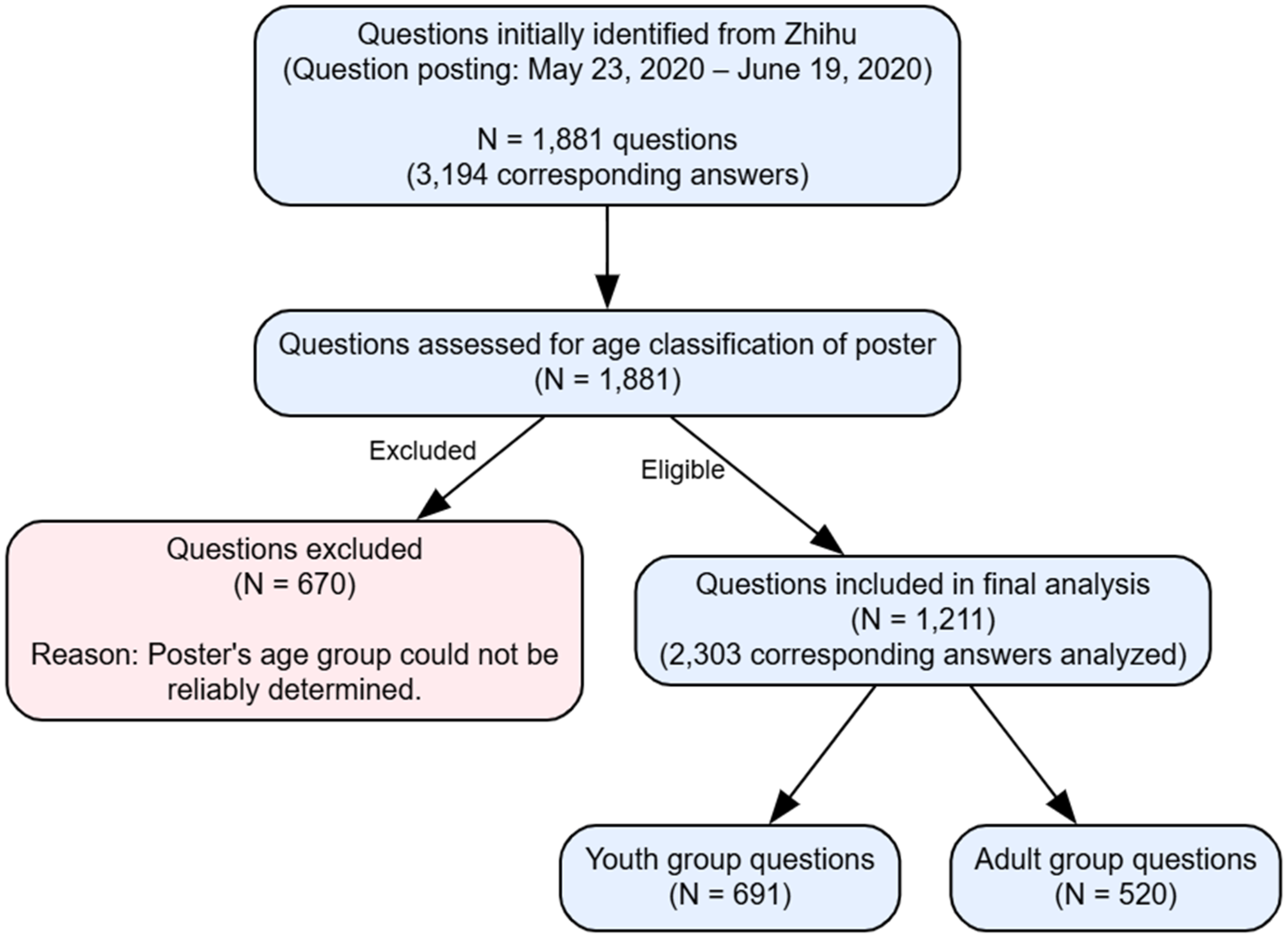
Flow diagram of the question selection process.
Coding procedure and reliability
Building on prior research (shown in Table 1), we developed a comprehensive coding scheme encompassing multiple dimensions: information-seeking topics, seeker identity, responsibility frames, and narrative patterns. To ensure coding reliability and validity, we implemented a three-phase coding process:
Coding scheme for depression-related questions and answers.

First, to refine the initial coding scheme, two experienced coders independently analyzed a pilot sample (approximately 5% of the dataset) to identify potential ambiguities or inconsistencies in code application. Any coding discrepancies were thoroughly discussed and resolved through consensus, leading to refinements in coding criteria and the establishment of detailed coding guidelines.
Second, we conducted a formal reliability test where five trained coders jointly coded 10% of the sample. Intercoder reliability was assessed by Krippendorff's alpha, a robust measure that accounts for chance agreement and is suitable for multiple coders. 65 The alpha values obtained for all categories ranged from 0.76 to 0.93. While some categories fell slightly below the 0.80 threshold conventionally considered to indicate acceptable reliability, all exceeded the 0.667 threshold deemed acceptable for making tentative conclusions.65,66 This suggests that the coding scheme used in this study demonstrates good reliability overall.
Finally, after establishing satisfactory reliability, the remaining dataset was systematically coded by the trained coders working independently, with regular checks and discussions to maintain coding consistency throughout the process.
Statistical analysis
All statistical analyses were performed using IBM SPSS Statistics version 26. Chi-square tests were conducted to compare the youth and adult user groups on several categorical outcomes: the distribution of information topics sought, the presence of suicidal and self-harm ideation, the likelihood of receiving at least one response, the distribution of responsibility frames in responses, the overall presence of personal narratives in responses, and the distribution of narrative types (current experience vs. recovery).
Furthermore, to compare the mean number of responses received across different conditions, one-way analysis of variance (ANOVA) tests were employed. These ANOVA tests assessed potential differences in the number of responses based on (1) the user group (youth vs. adult), (2) the type of question asked, and (3) the perceived severity of the issue presented in the question. A significance level of p < 0.05 was used for all inferential statistical tests.
Results
Information-seeking behavior
To address RQ1 regarding how young people seek depression-related information, the topics of the questions and seeker's identities were analyzed. As shown in Table 2, analysis of the 691 questions posted by young people revealed distinct patterns in both topical distribution and query purpose. Content analysis showed that the topic category “Social Issues” was the most frequent type of information sought by youth (52.97%), substantially outweighing interests in “Diagnostic Concerns” (23.88%) and “Coping Strategies” (15.77%). Regarding the purpose of information seeking, the majority of questions (69.61%) were from users experiencing depression, while 19.25% were support-oriented queries from their social network (families, friends, and classmates), with the remaining 11.14% being general inquiries. The occurrence of suicidal and self-harm ideation in questions from young people (30.00%) did not differ significantly from that from adults (25.38%) (χ2(1,N = 1211) = 3.08, p = 0.08).
Topic and purpose of information seeking in depression-related questions.

Content analysis revealed a clear hierarchy of information needs among young people's depression-related queries. Within the dominant “Social Issues” category (52.97%), four distinct areas of concern emerged. Interpersonal relations constituted the largest segment (27.06%), followed by academic/career impact (15.48%). Students were particularly concerned about social adaptation and future prospects, as evidenced by frequent references to “classmates,” “leave of absence,” and disclosure concerns in academic settings. Public perceptions (6.51%) and institutional support (3.91%) represented smaller concerns. Diagnostic concerns accounted for 23.88% of queries, focusing primarily on professional assessment and access to care. The relatively lower proportion of coping strategies inquiries (15.77%) may indicate that young people prioritize understanding the social implications of depression and navigating their social environments, rather than seeking immediate solutions or self-management techniques.
Statistical analysis revealed significant age-based differences in depression-related information needs (χ2(3,N = 1211) = 11.48, p = 0.01). In particular, youth demonstrated a markedly different information-seeking pattern in Table 3. While Social Issues was the most frequent topic for both groups, adults focused less on this category compared to youth, with a substantially lower interest in academic or career impact (3.85% compared to 15.48% among young users). Conversely, adults showed a notably higher focus on Diagnostic Concerns (30.96%) compared to youth (23.88%) (χ2(1,N = 1211) = 7.567, p < .01).
Information needs by age group.
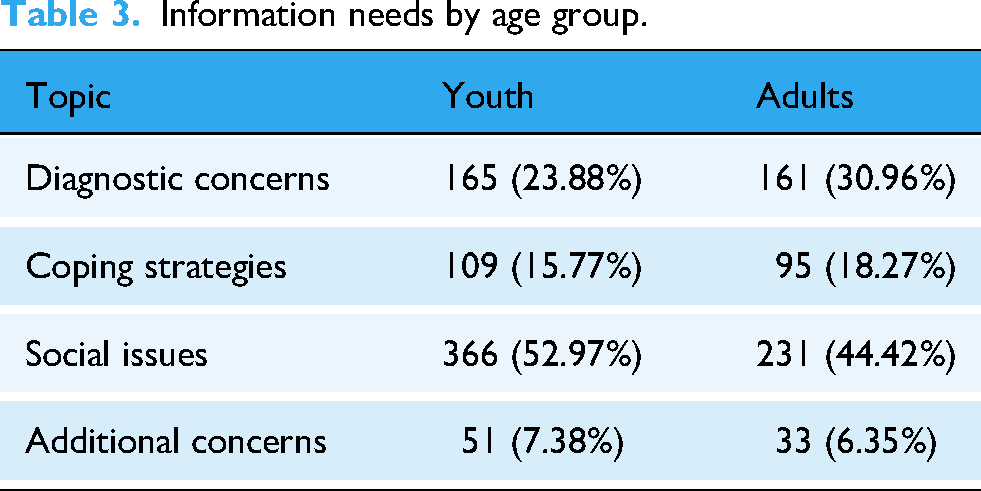
Such a contrasting pattern suggests that young people uniquely utilize Zhihu as a platform for navigating the interpersonal and academic/career challenges associated with depression, potentially filling a gap in traditional support channels. These age-specific variations in information priorities underscore the importance of developing targeted resources that address the distinct needs of different age groups.
Efficacy of information seeking
RQ2 is concerned with the effectiveness of social Q&A platforms in meeting youth's information needs. Analysis of response patterns revealed significant demographic and content-based variations. Regarding demographics, young people's questions received significantly more responses (M = 2.52, SD = 8.46) than adults’ (M = 1.24, SD = 2.60), F(1,1209) = 11.204, p < 0.01. For content characteristics, Coping Strategies questions received marginally more responses (M = 3.92) compared to Social Issues (M = 2.40) and Diagnostic Concerns (M = 2.19), though these differences were not statistically significant (F(3687) = 1.36, p = 0.25).
However, the platform showed limited effectiveness in providing timely and comprehensive responses. Although questions posed by youth were significantly more likely than questions from adults to receive at least one response (53.84% vs. 42.50%; χ2(1,N = 1211) = 15.26, p < 0.001), this meant a substantial proportion (46.16%) of youth inquiries still remained unanswered after four weeks. Furthermore, among the youth questions that did receive responses, 39.78% garnered only a single answer, highlighting challenges in achieving comprehensive engagement.
The average number of responses for questions including suicidal and self-harm ideation (M = 2.83) did not significantly differ from those for questions without such ideation (M = 2.39; F(1689) = 0.40, p = 0.53). A concerningly high proportion (44.93%) of questions explicitly mentioning suicidal or self-harm ideation still received no responses. This highlights a critical gap in meeting the needs of young people seeking urgent support and guidance on the platform.
Responsibility frames in responses
Analysis of response content revealed distinct patterns in responsibility attribution. Of all responses, 44.16% (737) did not contain explicit responsibility frames, instead focusing on sharing personal experiences, offering encouragement, or seeking clarification from questioners.
With respect to RQ3, age-based analysis (shown in Table 4) revealed a statistically significant difference in frame distribution (χ2(3,N = 1325) = 9.54, p = 0.02). Youth's responses emphasized Individual Responsibility more heavily (66.85% vs. 59.80% for adults), while adults received more response in Combination Frames (26.46% vs. 20.06% for youth).
Distribution of responsibility frames by age group.

Individual Responsibility frames, predominant across both age groups, emphasized personal agency through specific recommendations including lifestyle modifications (exercise, meditation, dietary changes), recreational activities (pet keeping, gaming), and academic adjustments (temporary leave from school). A notable subset of Individual Responsibility frames (5.94%) focused on religious or spiritual solutions, with users frequently sharing links to personal blogs with religious content. Such a pattern was primarily driven by a small group of active users within this subset–5 users contributed 28 of the 37 spirituality-focused responses, suggesting the presence of a cluster of users promoting religious or spiritual solutions. Of particular interest, when expanding the scope to all users, 4 of the 14 most active respondents consistently promoted religious approaches, with the most frequent contributor (10 responses) belonging to this group.
Social Network frames, slightly less prevalent in youth responses, demonstrated a dual focus on support resources and boundary setting. For youth, responses emphasized emotional connection over logical intervention (e.g. “prioritize companionship over reasoning”), while simultaneously advocating for balanced caregiving practices (e.g. “Prevent yourself from falling into depression as well”). Such a balanced approach acknowledged both the importance of peer support and its potential risks.
Combination Frames were also less common in responses to young people. These responses integrated multiple levels of responsibility, acknowledging the complex interplay of individual, social, and societal factors in depression. This nuanced approach may be particularly valuable for young people as they navigate the multifaceted challenges associated with mental health. It encourages a holistic understanding of depression and highlights the importance of addressing the issue from multiple perspectives.
Societal Frames were less frequent overall, appearing in only 0.97% of responses to young people and 0.25% of responses to adults. This suggests that both age groups received limited emphasis on systemic factors and potential policy solutions in addressing depression, highlighting a potential area for improvement in online mental health discourse, where a greater focus on societal factors and potential policy interventions could contribute to a more comprehensive understanding of depression and its solutions.
Personal narratives in responses
Concerning RQ4, personal narratives appeared in a similar proportion of responses directed towards youth (20.85%) and adults (20.35%), without statistically significant difference (χ2(1,N = 2303) = 0.07, p = 0.82).
Within the subset of responses that contained personal narratives (N = 477), current patient experiences were prominent for both age groups, especially for youth users (83.05% vs. 74.42% for adults) with significant distributional difference (χ2(1,N = 477) = 4.50, p = 0.04). This narrative focusing on three main aspects: (i) emotional resonance, (ii) practical guidance, and (iii) shared challenges.
Emotional support was commonly expressed through solidarity statements (e.g. “I am also facing similar difficulties. Let us work together”), while practical guidance often addressed specific concerns such as medication costs and healthcare navigation. Narratives also frequently acknowledged ongoing challenges, including academic disruptions, treatment costs, and pandemic-related anxieties, fostering community through shared experiences.
Recovery narratives, though less prevalent, served distinct functions. These stories emphasized hope and empowerment through successful recovery journeys (e.g. “I could do this, so can you”), often coupled with offers of ongoing support (e.g. “If you need someone to talk to, I am here for you”). However, their relative scarcity, particularly in responses to young users (16.95% vs. 25.58% for adults), suggests a potential gap in providing aspirational peer support.
Discussion
This study illuminates the unique patterns of depression-related information exchange among young people on Zhihu, a prominent Chinese social Q&A platform, during the COVID-19 pandemic. Specifically, this study addresses three key research questions: (1) the specific types of depression-related information sought by young people during the pandemic; (2) the effectiveness of platform provided support in meeting these informational needs; and (3) the characteristics of the information provided. Our findings yield two primary insights. First, young users distinctly emphasize information related to social adaptation concerns. Second, significant limitations exist in the support offered by the platform, including both quantitative gaps and qualitative deficiencies within the response content.
The predominance of social adaptation concerns
In response to RQ1 regarding information types sought by youth, our analysis reveals a fundamental transformation in how young people sought mental health information during the COVID-19 pandemic. Most notably, 52.97% of youth-generated queries focused on social adaptation concerns, marking a significant departure from traditional information-seeking patterns. While previous studies consistently showed that symptom identification, diagnosis, and treatment information dominated depression-related queries, 23 , 25 our findings demonstrate a clear shift toward social concerns, with young people predominantly seeking guidance on managing social relationships, navigating academic challenges, and supporting peers with depression.
This notable divergence from both historical patterns and concurrent adult information-seeking behaviors stems from three interconnected challenges unique to young people's pandemic experiences. First, and most significantly, the complex transition between online and in-person education created unprecedented adaptation demands. Our analysis of personal narratives on Zhihu revealed that this educational disruption manifested in three critical ways: declining academic performance, persistent difficulty maintaining concentration, and heightened uncertainty about future prospects. The frequency of “leave of absence” discussions further underscores this challenge, highlighting widespread concerns about academic reintegration following mental health–related breaks.
Second, the implementation of social distancing measures created a paradoxical situation that particularly affected young people's mental well-being. At precisely the time when peer support became most crucial for maintaining mental health,67,68 young people faced severe disruptions to their social networks. This severe disruption likely amplified the hedonic utility associated with seeking peer connection and validation online, 69 driving young people to prioritize social adaptation topics on social Q&A platforms. While finding practical solutions was undoubtedly important, the ability to connect with others facing similar social adaptation struggles, share experiences, and mitigate feelings of isolation likely provided a powerful emotional driver. This amplified need for online peer validation and connection during the pandemic may be particularly acute for young people in China. While peer relationships, particularly friendships which evolve to provide crucial intimacy and support, undergo significant changes between adolescence and young adulthood, 70 in China, the establishment of stable peer networks during this period presents distinctive patterns. Even university students—typically developing mature social connections—struggle to form stable networks due to structural pressures (academic competition, focus on social mobility) and cultural shifts toward individualism. 71
Third, these challenges were exacerbated by inadequate institutional responses within educational settings. The limited provision of mental health resources and support services left young people without sufficient professional guidance during this critical transition period. This institutional gap interacted with the previous two challenges, creating a compound effect that likely drove young people to seek alternative sources of support.
In response to these interconnected challenges, young people strategically leveraged social Q&A platforms like Zhihu for guidance and connection. The platform proved an especially suitable alternative for addressing complex social adaptation challenges 72 due to a combination of its distinctive features: its anonymity, access to diverse experiential knowledge, and crucially, its function as a peer-led environment. This environment enables personalized, experience-based exchanges where young people can find mutual understanding and connection around shared difficulties, something distinct from traditional, impersonal channels such as search engines. 73 The strategic utilization of these platforms’ features suggests both the resilience of young people in finding alternative support channels and the crucial role digital platforms can play in crisis periods. Nevertheless, this reliance on peer platforms also highlights a critical need for more robust institutional support systems that can better address the unique social and academic challenges young people face during widespread disruptions.
Gaps in social Q&A platform support
Turning to RQ2 about the effectiveness of support provided on Zhihu, our findings indicate significant gaps in response coverage of this social Q&A platform. Approximately half of the youth-generated questions remained unanswered during the four-week observation period, with about 20% receiving only a single response. Particularly worrying is the lack of timely responses to crisis-related content, including questions about self-harm or suicidal thoughts. While young users’ questions generally attracted more responses than those from adults, these response rates remain inadequate for individuals seeking urgent mental health support.
Furthermore, comparing our finding (M = 2.52 responses per youth question during Spring 2020) against prior research on Zhihu reveals a potentially concerning trend, 22 examining depression topics over a broader 2019–2020 timeframe, reported a substantially higher average of 7.64 responses per question. This stark difference suggests that the acute crisis conditions during the early phase of the pandemic studied here may have significantly suppressed typical user engagement and response provision on the platform, severely limiting its effectiveness in meeting youth needs during that critical period.
RQ3 explored how responsibility frames manifest in responses. The predominant emphasis on individual responsibility in responses presents a significant limitation in platform support, especially for young users who encounter this framing more often than adults. While personal agency is important, this narrow framing inadequately addresses the broader social and structural factors influencing depression. Our analysis of user narratives frequently revealed economic barriers and social isolation as critical external factors, yet these systemic issues were rarely addressed in responses.
Although previous research suggests that peer communicators might be more inclined than traditional one-to-many communication to recognize contextual influences,50,74 our findings reveal that within this peer-dominated Q&A environment, advice still predominantly emphasized individual actions. This tendency to provide individually focused solutions, particularly to young people navigating critical developmental tasks related to identity formation and social integration,3,4 may inadvertently intensify feelings of self-blame or personal inadequacy.
Such an emphasis on personal agency, while sometimes empowering, can be problematic if it overshadows systemic factors or the lived realities of navigating mental health challenges, especially for vulnerable populations. Ultimately, the disproportionate focus on individual responsibility in responses to young users risks stigmatizing depression sufferers and potentially discouraging them from seeking help. 35
RQ4 investigated how personal narratives function in depression-related responses. The pattern of narrative sharing further compounds these limitations. Personal narratives appeared in approximately one-fifth of responses, primarily sharing current patient experiences. This restricted prevalence constrains opportunities for young users to benefit from others’ experiences and coping strategies. Moreover, in place of experiential knowledge, young users often received generalized, potentially misleading advice. For instance, blanket statements about institutional responses to mental health disclosures oversimplified the varying approaches of different schools and organizations. This finding is particularly noteworthy given that young people demonstrate a strong preference for experiential knowledge over general health information. 56 Moreover, recovery stories were significantly scarcer in responses directed at youth compared with adults. These recovery narratives are uniquely valuable as they can foster hope, reduce stigma by showcasing positive outcomes, and motivate engagement with treatment or coping strategies.59,64 Therefore, the scarcity of these specific narratives directed at young users on this platform limits their exposure to crucial hope-inspiring peer examples and tangible pathways toward well-being. This limitation potentially diminishes the overall supportive efficacy of the narrative content they receive.
An unexpected finding was the concentrated promotion of religious practices (e.g. Taoism, Buddhism) by a small group of highly active users. This pattern raises concerns in light of previous research 72 documenting how supernatural attributions of depression can potentially harm patients’ mental health and sense of security. Given traditional Chinese cultural contexts and varying levels of mental health literacy, such religious promotion could disproportionately influence vulnerable users seeking support.
Limitations
Our study comes with limitations. First, identifying the target age group involved inferring age from online content, a process acknowledged to have inherent limitations regarding accuracy. Our approach relied on information users chose to self-disclose in their public posting histories, meaning the verification process was constrained by user disclosure choices. Consequently, our analysis potentially excluded youth content without explicit demographic markers, and the final sample may disproportionately represent users who were relatively more forthcoming with age-related information in their online participation. Second, while our study focused on “young people,” this category encompasses a range of developmental stages from adolescence to young adulthood. More nuanced age-related variations in emotional expression, language style, or the differential impact of platform engagement. Future research should investigate these potential developmental distinctions in unmeasured domains, and caution should be exercised when generalizing findings across the entire youth spectrum without considering these developmental nuances. Third, while we identified various online coping strategies, we could not assess their practical impact on mental health outcomes. Future research should examine how online information-seeking influences help-seeking behaviors, evaluate the effectiveness of different digital support platforms, and explore methods for optimizing professional engagement in online mental health discussions.
Implications
Our findings point to an urgent need for more comprehensive support strategies. First, educational institutions must develop more robust support mechanisms for students returning to school, whether after pandemic-related online learning or mental health-related leaves of absence. While research has established the crucial role of school and family involvement in successful reentry, 75 there remains a significant gap in evidence-based practices for supporting students following mental health–related absences. 76 Such a gap is particularly pronounced in China's education system, where school reentry represents a critical weakness in adolescent mental health practice. 77 Educational institutions should develop standardized yet flexible reentry protocols, including clear communication of available support policies, accommodation options, and transition strategies. This proactive approach would help reduce students’ reliance on potentially misleading social media advice and provide more reliable guidance for navigating reentry challenges.
Second, our analysis indicates a pressing need to expand mental health education beyond traditional clinical focuses. Current educational programs typically emphasize symptoms, diagnosis, and treatment, but our findings suggest the need for additional content addressing social interaction skills and peer support strategies. Educational institutions should develop comprehensive resources—including lectures, workshops, and guidance materials—that help students, teachers, and parents better understand how to interact with and support individuals experiencing mental health challenges.
Third, while social Q&A platforms like Zhihu have emerged as vital resources during the pandemic, our findings highlight the need for significant platform enhancements. To address the high proportion of unanswered questions and concerns about response quality, platforms should consider implementing structured response systems that incorporate professional expertise and trained peer support. The notable scarcity of recovery narratives, particularly in responses to young users, suggests the value of actively promoting diverse narrative sharing, especially stories that demonstrate successful navigation of mental health challenges.
Conclusion
Our analysis of depression-related discussions on Zhihu reveals both opportunities and challenges in using social Q&A platforms for youth mental health support during crisis periods. Key findings highlight three distinctive characteristics. First, young users exhibited a distinctive emphasis on seeking depression-related information tied primarily to social dimensions, such as interpersonal relationships and academic pressures, rather than diagnostic or clinical details. Second, although the platform demonstrated potential for meaningful peer engagement, significant gaps in the provision of support were evident, as many questions received limited or no responses. Third, the responses provided tended to emphasize individual responsibility for managing depression, notably lacking narratives that focus on recovery or broader contextual factors. The findings highlight young people's distinct focus on social adaptation concerns, while also exposing critical platform limitations, including low response rates, overemphasis on individual responsibility, and insufficient professional engagement. Our findings contribute valuable insights for developing more effective, age-appropriate mental health support systems.
Footnotes
Acknowledgements
The authors are grateful to Danna Bawuerjiang from Xinjiang University of Finance & Economics, Libin Wang from Central University of Finance and Economics, and Zixuan Li from Nankai University for their help with the coding of the data.

Author contributions
Pan, Hu, and Wang contributed to the conception and design of the study. Pan and Hu collected, analyzed, and interpreted the data. Pan wrote the first draft of the manuscript. Hu and Wang revised the manuscript critically. All authors contributed to manuscript revision, read, and approved the submitted version.
Funding
The authors disclosed receipt of the following financial support for the research, authorship, and/or publication of this article: This work was supported by the National Natural Science Foundation of China under Grant 72104261 and the Central University of Finance and Economics under the Program for Innovation Research.
Declaration of conflicting interests
The authors declared no potential conflicts of interest with respect to the research, authorship, and/or publication of this article.