




Abstract
Objective
The dissemination of health information plays a crucial role in health promotion. With the evolution of the Internet, short videos have become a significant medium for health information dissemination. This study aims to examine how short video features influence users’ intentions for health information and provide actionable recommendations for improving health communication strategies.
Methods
By integrating trust and perceived interactivity into the technology acceptance model, this study introduces a modified acceptance model for short videos. The model was evaluated through a survey conducted among 435 Chinese adults aged 18 and above, who had prior experience with short videos. The analysis was carried out using the partial least squares structural equation modeling technique for parameter estimation and model validation.
Results
The analysis revealed that the model accounts for 18.3% of the variance in perceived usefulness, 34.9% in attitudes towards the videos, and 26.4% in the intention to use them. Significant positive associations on usage intention were observed from trust (β = 0.184, P < 0.001), perceived interactivity (β = 0.247, P < 0.001), and attitude (β = 0.210, P < 0.001). Perceived usefulness (β = 0.240, P < 0.001), perceived ease of use (β = 0.213, P < 0.001), trust (β = 0.173, P < 0.001), and perceived interactivity (β = 0.152, P = 0.001) were found to have significant positive associations with attitude.
Conclusions
Perceived usefulness, ease of use, trust, and perceived interactivity emerged as strong predictors of usage intention, with attitude serving as a mediating factor in the relationship between trust, perceived interactivity, and usage intention. These findings highlight the importance of creating authoritative, user-friendly, and engaging content of short videos to enhance health information dissemination effectiveness and credibility.
Keywords
Introduction
Short videos refer to online videos ranging from a few seconds to a few minutes in duration, distributed and shared through social media platforms, video-sharing websites, and mobile applications. 1 As an innovative social media format, short videos offer a more effective means of user engagement than traditional communication methods, using vivid and illustrative visuals to convey information.2,3 The uniqueness of short videos lies not only in their duration but also in their algorithm-driven dissemination efficiency, entertainment-oriented content, and highly interactive user engagement. 4 The motivations for using short videos are multifaceted, encompassing habitual behaviors and specific psychological needs, including seeking novelty, habit formation, relationship maintenance, stress relief, time-killing, and escapism. 5 Studies indicate that from cognitive and motivational perspectives, the design features of short videos (e.g., infinite scrolling and personalized content algorithms) can easily lead to habitual and compulsive usage patterns. 6 This behavior is often driven by the brain's reward system, with the unpredictability of content acting as a powerful reinforcing factor. 1 Moreover, from an emotional perspective, short videos offer users a temporary escape from the demands of work or study, providing pleasure and satisfying psychological needs, 7 while also creating opportunities for social interaction. 8 Therefore, the rise of short videos has garnered substantial user interest, markedly influencing daily life. Recent data indicates that, in the third quarter of 2023, TikTok, the leading short video platform, recorded 272.7 million global downloads and surpassed 1 billion monthly active users. 9 YouTube Shorts boasts 50 billion daily views globally and over 1.5 billion monthly active users, demonstrating an impressive annual growth rate of 135%.10,11
In the healthcare domain, short videos have shown significant potential for the dissemination of health information. While educational content exists in short videos, their brevity often limits depth, making them more suitable for introductory information rather than comprehensive education. However, recent studies suggest that short videos for health information are more favored by audiences for viewing, sharing, and liking compared to longer videos, particularly in popularization and extension.12,13 Amid the COVID-19 pandemic, short videos related to COVID-19 on TikTok were widely circulated, with approximately 93.1 billion views. 14 Short videos tagged with “medical” and “doctor” attracted 1.4 billion and 6.7 billion views, respectively. 15 Healthcare researchers are increasingly inclined to use short video applications to communicate health information to the public.16,17 Numerous healthcare professionals advocate for the inclusion of short video platforms in health communication strategies. 18 Existing research primarily focuses on quantitative metrics of engagement, such as views, likes, and shares, without adequately exploring the underlying mechanisms that drive user intention. Research on how short videos influence users’ health information-seeking intention or behaviors remains limited.
Although using social media for healthcare is not a new concept, the rapid rise of short videos has introduced some relatively new issues, particularly regarding user health information behavior when engaging with short videos. Prior to the advent of these applications, health information behavior was extensively studied on traditional social networking sites. For example, Facebook and Instagram have become significant platforms for commercial entities and health promotion organizations to conduct health activities. 19 Goodyear et al. reported that social media is an important channel for accessing health information, and social media users can obtain information related to exercise and dietary quality, thereby facilitating self-management of behaviors associated with physical activity, diet, and overall quality of life. 20 Li et al. highlighted the important role of social media in promoting vaccine information and the potential of social media to engage teenagers and promote interventions aimed at increasing the uptake of the Human Papillomavirus Vaccine. 21 However, the role of short videos, as an emerging form of social media in providing health information, has not been thoroughly examined. 16 The unique features of short videos, such as algorithm-driven content delivery, high interactivity, and immersive viewing experience, distinguish them from traditional social media platforms and play a significant role in the dissemination of health information.
In China, the “China Internet Development Statistics Report” highlights that, as of 2023, short video users have reached 1.026 billion, representing 95.2% of the nation's total internet users. 22 To date, there has been limited research exploring the factors influencing users’ intention to use short videos as a source of health information. Notably, Song et al. investigated the impact of social presence and immersion on the sustained use intention of TikTok for obtaining health information. 16 Their study demonstrated that social presence and immersion can significantly affect users’ sustained use intention of TikTok for health information. A qualitative study has explored the potential benefits of Chinese ageing women watching health short videos to receive health information, with results indicating that health short videos on social media platforms can enhance health awareness among them. 23 However, research that validates the intention to use short videos based on a theoretical framework, such as the Technology Acceptance Model (TAM), remains unexplored.
Despite the increasing use of short videos in health information dissemination, some studies have primarily focused on traditional social media platforms. Some studies have applied the TAM to the field of information dissemination through short videos, but these are mainly focused on education, 24 advertise, 25 or travel intentions, 26 with less application in the intentions for health information regardless of content form. As an emerging and unique form of social media, the role of short videos in shaping user behavior and health information engagement remains underexplored. Additionally, while previous studies have examined the effects of social presence, immersion, and health awareness in the context of short videos, they lack a clear theoretical framework. Therefore, the aims of this study are: (1) to investigate how the distinctive features of short videos including perceived usefulness, trust, and interactivity influence users’ intentions to access health information using the TAM as a theoretical framework; and (2) to provide actionable recommendations for healthcare professionals and policymakers to design more effective health communication strategies tailored to the short video format. Furthermore, regarding the target population, current research has rarely concentrated on the primary audience of short videos—young and middle-aged adults in China. Although this demographic holds a significant presence on short video platforms, their behavioral characteristics and usage patterns have not been thoroughly examined. By focusing on this population, this study provides region-specific insights into the use of short videos within China's unique cultural and digital context.
Literature review and proposed model
Technology acceptance model
This study's framework is based on the TAM, introduced by Davis in 1989 to explain the acceptance and use of new technologies. 27 TAM suggests that external factors influence perceived usefulness (how helpful a technology is) and perceived ease of use (how effortless it is to use), which shape users’ attitudes and intentions to adopt the technology. 27 In the health sector, TAM has been widely used to study consumer acceptance of information technologies, such as social media for health information.28–31
Initially designed to improve efficiency in organizational contexts,32,33 the traditional TAM primarily emphasizes perceived usefulness and ease of use, often overlooking other key factors influencing technology acceptance in healthcare. 34 While most studies focus on antecedents of behavioral intention, there is a growing need to explore mediating factors that enhance the model's explanatory power. 35 To address this gap, this study extends the TAM by incorporating trust and perceived interactivity as additional constructs, aiming to better understand users’ intentions to obtain health information through short videos. Trust is particularly crucial in the context of health information, as users are more likely to engage with sources they perceive as credible and reliable. 36 Given the prevalence of misinformation on social media platforms, trust becomes a key factor in determining users’ acceptance of health-related content. Similarly, interactivity—enabled by features such as likes, comments, and shares—plays a significant role in enhancing user engagement. This high level of interactivity not only fosters a sense of connection and social presence but also significantly influences users’ attitudes and intentions.
While some studies have expanded TAM by incorporating variables such as trust or interactivity, these efforts have primarily focused on contexts like education, travel, or e-commerce.24–26 For example, Wang et al. found that trust significantly influences the use of short videos for travel information, 37 while Li demonstrated that perceived interactivity impacts the adoption of mobile healthcare services. 38 However, current research rarely applies the extended TAM with trust and interactivity in the field of health information dissemination through short videos. For example, Zhao et al. extended the TAM to include social interactivity, intrusiveness, informativeness, and relevance, validating the impact of health advertisements on short videos on user attitudes, 25 but did not consider the effects of trust. Therefore, to investigate the factors influencing the user intention and augment the model's explanatory capabilities, we have extended the dimensions of trust and perceived interactivity within the framework of the original TAM in this study.
Theoretical framework
Perceived usefulness
Perceived usefulness refers to the extent to which individuals believe a system is beneficial,
27
such as enhancing work performance or, in this context, supporting health behaviors through health information.
27
In our study, it represents users’ subjective assessment of the value of short videos in guiding their health actions. Research shows that perceived usefulness is a key factor influencing the intention to use technology.
27
Kim et al. found it significantly affects attitudes toward adopting health information technology,
28
and useful technologies also boost user satisfaction.
39
Pavlou confirmed a positive link between perceived usefulness and attitudes toward using information systems.
40
Based on this and TAM, we hypothesize:
H1: Perceived usefulness has a positive impact on users’ attitudes towards utilizing short videos for health information.
Perceived ease of use
Perceived ease of use, defined as how effortlessly a user can operate an electronic system, is a key factor influencing the intention to use such systems.
27
Studies show that health consumers prefer user-friendly social media platforms for accessing or sharing health information
41
and that perceived ease of use impacts attitudes directly and indirectly by influencing perceived usefulness.42,43 Based on this and TAM, we hypothesize:
H2: Perceived ease of use has a positive impact on users’ attitudes towards utilizing short videos for health information. H7: Perceived ease of use positively influences perceived usefulness.
Trust
Giffin defined trust as the confidence in achieving uncertain outcomes by relying on objects, events, or individuals in risky situations. 44 Trust is crucial when sourcing and consuming health information, 45 as mobile networks and devices often involve uncertainties and risks. 46 Reliable information is essential for informed health decisions, while misleading information can cause harm. Wu et al. found that trust significantly boosts users’ willingness to engage with social media for health information. 47
Users are more likely to accept and adopt information from sources they deem trustworthy. Individuals may highly trust medical advice from healthcare institutions because these entities are considered professional and authoritative. User trust in influencers may depend on their authenticity and how well their values align with those of the users.
48
Some users may be distrustful about motives or qualifications of influencers. Ideally, users should maintain a high level of trust in high-quality media and decrease their trust in low-quality media.
49
This variability in trust shows the importance of incorporating trust into the TAM, as it could influence users’ intention to accept or reject health information based on short videos, and provide insights for short video providers on enhancing user trust. Based on this and TAM, we hypothesize:
H3: Trust positively influences users’ attitude toward using short videos to acquire health information. H4: Trust positively influences users’ intention to use short videos to acquire health information.
Perceived interactivity
Perceived interactivity refers to the extent users feel their experience resembles interpersonal interactions and provides a sense of social connection.
50
Cyr et al. found that perceived interactivity significantly enhances e-loyalty.
51
Social media users prefer interacting with healthcare professionals or individuals for health discussions, gaining expertise and advice to improve health management.52,53 Lin and Chang showed that perceived interactivity boosts health management, social relationships, and information exchange on social media.
54
Based on this and TAM, we hypothesize:
H5: Perceived interactivity has a positive impact on users’ attitudes towards using short videos for health information. H6: Perceived interactivity positively influences users’ intentions to utilize short videos for health information.
Attitude
Ajzen defined attitude as an individual's positive or negative response to objects, people, institutions, or events.
55
In TAM, Davis described “attitude toward use” as the evaluation of a system's impact in a workplace.
56
Behavior is influenced by motivation, which is directly shaped by attitude.57,58 Research consistently shows a positive link between attitude and usage intention.59–61 Thus, we define attitude as an individual's positive or negative feeling toward using short videos for health information and propose:
H8: Attitude positively influences users’ intention to use short videos to acquire health information.
Based on the eight hypotheses outlined above, we developed a theoretical model, as shown in Figure 1.
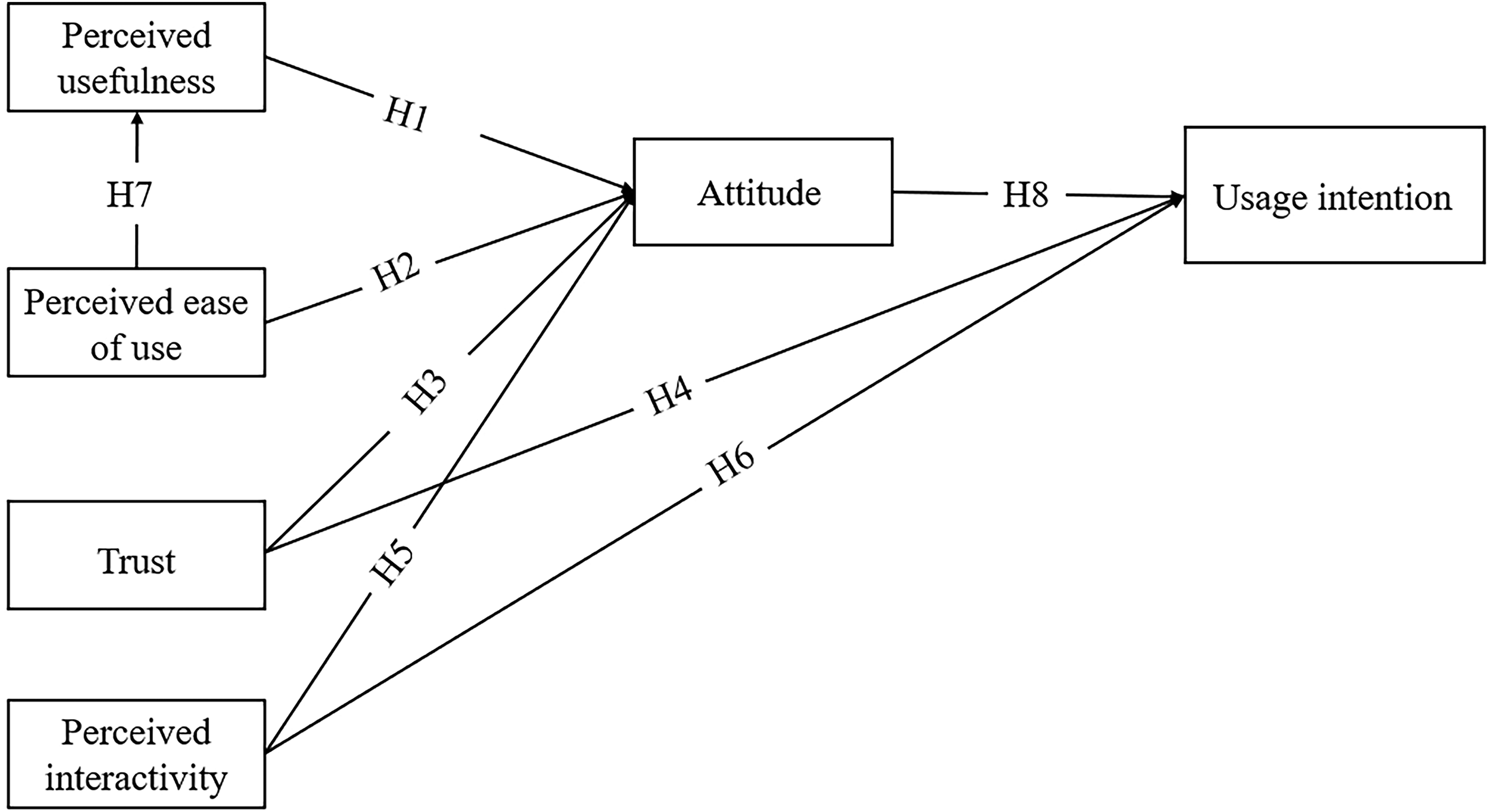
The research model.
Methods
Sample and data collection
In this study, participants were recruited through Wenjuanxing (http://www.wjx.cn), one of China's leading survey platforms, 62 where the questionnaires were distributed in August 2023. We used the commercial sampling services provided by Wenjuanxing to access our target respondents. With the aid of this service, the survey was randomly distributed to end-users, resulting in 435 valid responses. Valid response should meet the following criteria: (1) The participant must complete all sections of the questionnaire, (2) the responses contain no significant contradictions or logical errors, such as inconsistent answers to related questions, and (3) to ensure the integrity of the questionnaire responses, quality control questions were integrated into the survey. For example, participants were instructed to select ‘Agree’ for certain items as a measure to gauge their attention. Individuals who met the inclusion criteria and voluntarily agreed to participate were invited to complete the survey. The inclusion criteria are that participants must (1) be aged 18 and above, (2) capable of understanding and consenting to participate in the survey, and (3) have experience watching short videos for health information in the past six months.
The determination of sample size is subject to two requirements: (1) The ratio of sample size to the number of parameters should be greater than 5:1 63 ; (2) The sample size should be more than ten times the maximum number of formative items used for measuring a single construct, or ten times the maximum number of paths associated with a latent variable in the model.64,65 In this study, the number of paths for the latent variables is eight, the number of parameters is six, and the number of formative items is three. Therefore, we have a sample size of 435, which meets the threshold requirements.
Data analysis
Measures
The survey was structured into three segments, with the initial section aimed at identifying the appropriate demographic. The inclusion criteria specified adults with experience viewing short videos who are aged 18 and above. The target group is screened by asking the questions: ‘Have you had the experience of watching short videos?’ and ‘Are you over 18 years old (including 18)?’. The second section of the questionnaire gathered demographic data from the participants, including gender, age, educational background, occupation, income, and residential area.
Before conducting the survey on user intention, the content and examples of health information were first introduced. The health information includes a wide range of content types, including preventive health information (e.g., COVID-19 prevention tips, vaccination awareness), treatment-related guidance (e.g., managing chronic diseases, post-surgery care), and health promotion campaigns (e.g., mental health awareness, physical activity encouragement). The information is delivered by various entities, such as health institutions, government agencies, and influencers. The third part of the questionnaire focused on key constructs based on the health information of short videos: perceived usefulness, perceived ease of use, trust, perceived interactivity, attitudes, and usage intention. Each construct was assessed using a 7-point Likert scale, ranging from 1 (totally disagree) to 7 (totally agree). All the structural measurements used in this study are listed in Supplementary Material. The perceived usefulness of short videos is composed of four items from the Davis, which is widely used in research across different fields and has demonstrated good reliability and validity.66–68 In our survey sample, the scale exhibited good internal consistency reliability, with a Cronbach's alpha of 0.885. For perceived ease of use, the scale is derived from the research of Yang and Davis, comprising four items.27,69 The results showed good internal consistency reliability, with a Cronbach's alpha of 0.885. Trust includes a total of eight items, encompassing two dimensions: trust in the content of short videos (four items) and trust in the providers of short videos (four items). 70 Trust in the content is based on four items from Narangajavana's research, showing good reliability and validity. For trust in short video providers, we used four items from the research of Narangajavana and Wang. 71 The scale exhibited good internal consistency reliability, with a Cronbach's alpha of 0.933. Trust in providers refers to users’ perception of the credibility, reliability, and professionalism of the sources disseminating health information through short videos. For perceived interactivity, we used four items from Cyr's scale, showing good internal consistency reliability, with a Cronbach's alpha of 0.890. 51 We measured attitudes towards using short videos with a four-item questionnaire based on Bashir and Madhavaiah's previous research, 72 demonstrating good internal consistency reliability, with a Cronbach's alpha of 0.888. The scale for intention to use short videos contains six items, drawn from the studies of Kim and Ahmed, resulting in good internal consistency reliability, with a Cronbach's alpha of 0.913.61,73
Statistical analysis
In this research, data analysis was conducted using SmartPLS 4.0, with categorical variables presented as numbers and frequencies. The analysis process was divided into two phases. The initial phase involved assessing the reliability and validity of the scales through SmartPLS 4.0, adhering to the criteria set forth by Henseler and Fornell.74,75 This assessment covered various metrics including Cronbach's alpha, composite reliability, average variance extracted (AVE), discriminant validity, and the heterotrait-monotrait ratio (HTMT). 76 The established thresholds are as follows: Cronbach's alpha and composite reliability should exceed 0.7 for each construct; AVE must be greater than 0.5; the AVE of each construct should surpass its squared correlation with any other construct; 75 and the HTMT ratio should not exceed 0.85. 77 Moreover, the model was evaluated for multicollinearity issues by calculating the variance inflation factor (VIF). According to the guideline by Hair, a VIF value within the range of 0.2 to 5.0 indicates an absence of multicollinearity concerns in the model. 77
The second phase involved evaluating the structural model. Initially, the normed fit index and the standardized root mean square residual were employed as metrics of model fit. Acceptable thresholds were established with the standardized root mean square residual values below 0.08 and the normed fit index values ranging from 0 to 1, where values closer to 1 are indicative of a superior model fit.77–79 Subsequently, hypothesis testing was conducted utilizing the partial least squares structural equation modeling (PLS-SEM) technique. PLS-SEM maintains a significant statistical power even with relatively small sample sizes. 80 The partial least squares (PLS) method is preferred over covariance-based approaches due to its robustness against deviations from multivariate normality 81 and its suitability for theory testing in preliminary stages of research. 82 Given that the investigation into users’ intentions to use short videos for health information is nascent and the model builds upon the TAM framework, the application of the PLS method was deemed highly suitable for facilitating the validation and exploratory objectives of this study.
Results
Demographic profile of participants
Table 1 presents the demographic characteristics of the participants. Following data collection, rigorous data cleaning procedures were undertaken to exclude outliers and responses of low quality. 83 This process yielded 435 valid questionnaires for analysis. The gender distribution among participants was predominantly female, accounting for 54.48%. Age-wise, 29.66% of participants were aged 18–29 years, 42.07% fell within the 30–53 years bracket, and 4.82% were older than 54 years.
Demographic profiles of participants (n = 435).

Regarding educational levels, a significant majority, 81.38%, had pursued higher education. Among these, 39.54% had obtained bachelor's degrees, and 5.29% had achieved master's degrees. The middle-income range (70,000 to 160,000 yuan) was the most common among respondents, representing 59.31% of the total, indicating that over half of the survey participants fell into this income bracket. Participants were geographically diverse, with 20.00% residing in Eastern China, 17.01% in Central China, and 18.85% in Northern China. The proportion of medical workers within the respondent pool was relatively low, comprising only 4.60% of the total sample.
Validation of scales
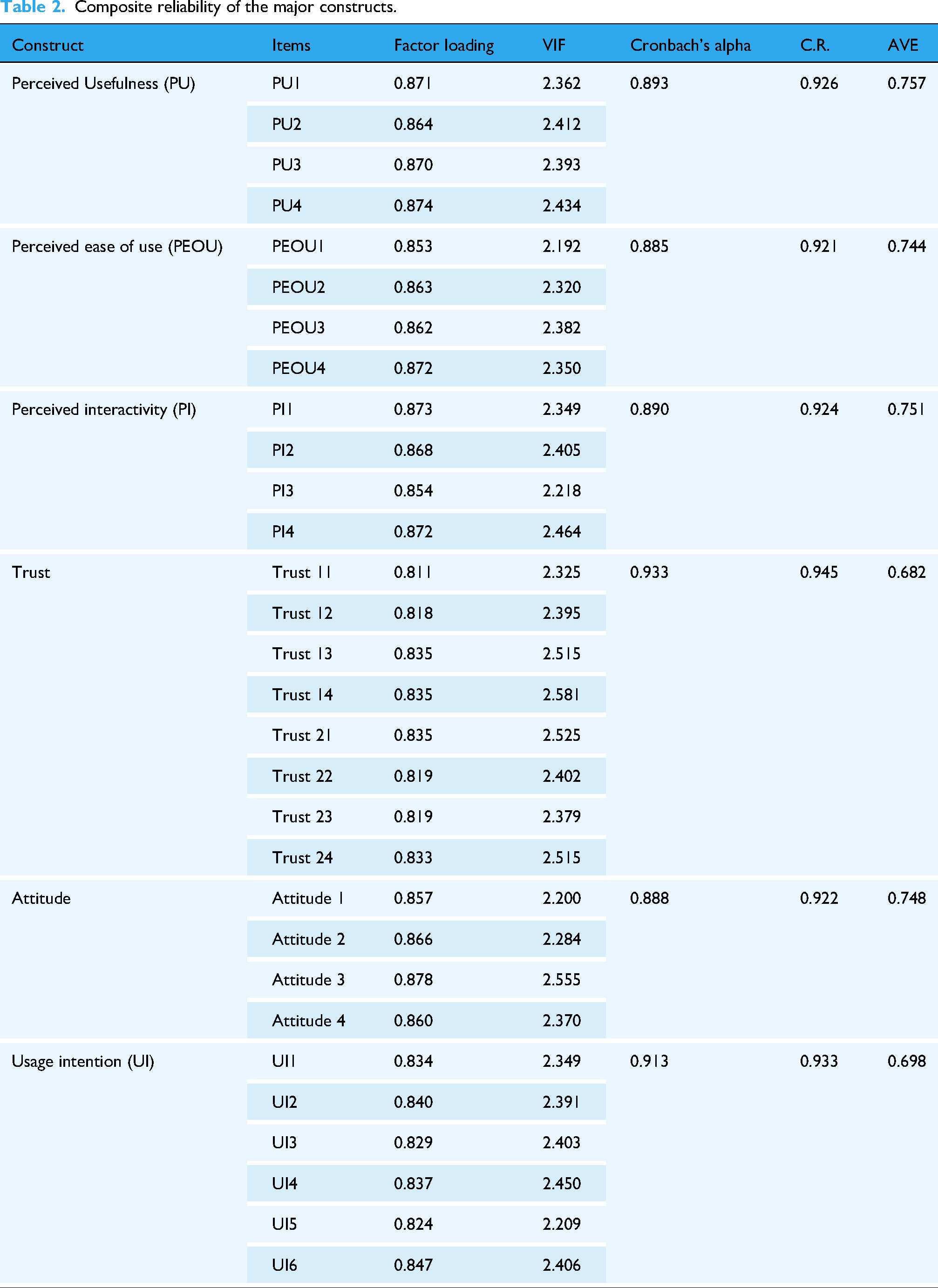
As presented in Table 2, the Cronbach's alpha values for all constructs ranged from 0.885 to 0.933, all surpassing the 0.8 threshold, and the composite reliabilities all exceeded 0.9. This demonstrates the study's high internal consistency and robust reliability. Furthermore, the AVE for each construct exceeded 0.6, surpassing the benchmark of 0.5, thus confirming adequate convergent validity. Additionally, as shown in Table 3, the AVE of each construct was higher than its squared correlation with any other construct, meeting the Fornell-Larcker criterion. Regarding the HTMT ratio, as shown in Table 4, all HTMT values were below 0.85, adhering to the Henseler criterion and affirming sufficient discriminant validity. Consequently, the measurement model's overall reliability and validity are deemed sufficient for evaluation.
Composite reliability of the major constructs.
Discriminant validity and descriptive statistics by Fornell and Larcker criterion. a

UI: usage intention, PEOU: perceived ease of use, PI: perceived interactivity, PU: perceived usefulness.
HTMT ratio. a

HTMT: heterotrait – monotrait, UI: usage intention, PEOU: perceived ease of use, PI: perceived interactivity, PU: perceived usefulness.
Concerning the multicollinearity assessment, as shown in Table 2, the VIF values ranged from 2.192 to 2.581, fulfilling Hair's criterion. This indicates the absence of multicollinearity issues within the model.
The structural model
SmartPLS 4.0 was utilized to assess the model's efficacy. The standardized root mean square residual values and the normed fit index values indicators stood at 0.057 and 0.810, respectively, demonstrating a satisfactory model fit. Following Hair's methodology, 5000 bootstrap subsamples were randomly selected to compute the t-statistics, thereby ascertaining the significance of the findings. 77 Table 5 details the path coefficients (β) and their significance (P), substantiating the positivity of all eight hypotheses.
Path coefficients and test results. a

UI: usage intention, PEOU: perceived ease of use, PI: perceived interactivity, PU: perceived usefulness
H1 posited that the perceived usefulness of short videos positively impacts users’ attitudes towards their utilization for health information. As shown in Table 5, SmartPLS 4.0 output indicated a significant relationship between perceived usefulness and attitude (β = 0.240, P < 0.001), indicating that perceived usefulness positively affects users’ attitudes towards using short videos as a source of health information to guide health behaviors, thereby confirming H1.
H2 proposed that the perceived ease of use of short videos positively affects users’ attitudes towards their application in acquire health information. The analysis confirmed a significant association between perceived ease of use and attitude (β = 0.213, P < 0.001), verifying H2 by illustrating the positive impact of ease of use users’ attitudes towards using short videos for acquire health information.
H3 examined the influence of trust on users’ attitudes towards using short videos for health information. The findings revealed a significant correlation between trust and attitude (β = 0.173, P < 0.001), indicating that trust positively modifies users’ attitudes towards utilizing short videos, thus supporting H3.
H4 explored the effect of trust on users’ usage intention. The analysis showed a significant relationship between trust and usage intention. (β = 0.184, P < 0.001), affirming H4.
H5 investigated the impact of perceived interactivity on users’ attitudes towards using short videos for health information. The results highlighted a significant relationship between perceived interactivity and attitude (β = 0.152, P = 0.001), validating H5.
H6 focused on the connection between perceived interactivity and users’ usage intention. The findings indicated a significant relationship (β = 0.247, P < 0.001), corroborating H6.
H7 addressed the relationship between perceived ease of use and perceived usefulness. The results demonstrated a significant relationship (β = 0.428, P < 0.001), affirming H7.
H8 assessed the influence of attitude on users’ usage intention to use short videos for health information. The significant correlation (β = 0.210, P < 0.001) confirmed that attitude positively impacts users’ intention, validating H8.
Finally, after incorporating control variables, the model was subjected to further examination. The test results, as presented in Appendix 2, indicate that gender, age, education, income, residence, and occupation did not have a significant impact on the intention to use short videos.
Mediation effect
This study's model proposes potential mediators within three hypothesized pathways: “perceived ease of use → perceived usefulness → attitude”, “trust → attitude →usage intention”, and “perceived interactivity → attitude → usage intention “. The bootstrap method was selected to assess the statistical significance of indirect effects, providing a more accurate control of the error rate compared to the Sobel test.84,85 Wang et al. delineated three categories of mediation and two forms of non-mediation, 86 where the mediation effects are classified as follows: (1) Complementary Partial Mediation, where both direct and indirect effects are present and aligned in direction; (2) Competitive Partial Mediation, where both direct and indirect effects exist concurrently, but in opposite directions; and (3) Indirect-only Mediation, where an indirect effect is observed without a corresponding direct effect.
Table 6 reveals that the indirect effect (β = 0.103, t-value = 4.627) of perceived ease of use on attitude towards short videos is significant, as is the direct effect (β = 0.213, t-value = 4.828). This suggests Complementary Partial Mediation by perceived usefulness between perceived ease of use and attitude towards short videos. Likewise, attitude serves as a Complementary Partial Mediator between both trust and perceived interactivity on usage intention.
Multiple mediation analysis. a

UI: usage intention, PEOU: perceived ease of use, PI: perceived interactivity, PU: perceived usefulness
***P < 0.001, **P < 0.01, *P < 0.05.
Formative construct trust interpretation
We used PLS-SEM to further examine the effects of users’ trust in the content of short videos and trust in the short video provider. Trust 1 denotes users’ confidence in the content of short videos, whereas Trust 2 signifies users’ faith in the providers of short videos. As depicted in Table 7, both Trust 1 and Trust 2 exhibited an identical path coefficient of 0.517, which indicates that the content and providers of short videos contribute similarly in the process of gaining users’ trust in short videos.
Path coefficients of trust.

Discussion
This research augmented the TAM by integrating new variables to formulate a short videos TAM. This model elucidates the manner in which short videos foster users’ intentions among Chinese adults to utilize short videos for acquire health information for guiding health behaviors. The analytical model encompassed six constructs and assessed eight hypotheses to investigate the interplay among these constructs. The findings affirmed all eight hypotheses, establishing significant correlations between the constructs. In social science or behavioral science research, a low R² of at least 0.1 (or 10%) is considered acceptable when some or most of the predictors or explanatory variables show statistical significance. 87 In our model, based on the TAM, we examined the factors influencing the intention behavior to use short videos for health information. The variance explained for perceived usefulness at 18.3%, attitudes at 34.9%, and intention at 26.4% are deemed acceptable.
This research indicates that perceived usefulness and perceived ease of use have significant impacts on users’ intentions to use short videos for obtaining health information, which aligns with the classic TAM model proposed by Venkatesh et al. This influence has been validated multiple times in health information contexts.31,88,89 In addition, this study incorporates the characteristics of short videos by introducing trust and perceived interactivity as new variables, thereby extending the application of the traditional TAM model. Furthermore, this research analyzes user trust from two perspectives—video content and providers—and the results demonstrate that both aspects have a similar impact on user trust. This dual-perspective analysis is a novel contribution to TAM research in the health information domain.
Furthermore, it was discovered that perceived usefulness and perceived ease of use are significantly associated with on users’ attitudes towards short videos, confirming the importance of perceived usefulness and perceived ease of use in influencing users’ attitudes towards using short videos. This is a novel finding. This may be a manifestation of users using short videos as a source of health information. Users prefer to obtain valuable information and employ easy-to-follow methods when seeking health information. This observation is similar to the findings of Ahadzadeh et al., who highlighted the critical importance of perceived usefulness and perceived ease of use in molding attitudes towards utilizing the internet as a health information resource. 90 Moreover, the research indicates that the relationship between perceived ease of use and users’ attitudes towards short videos is partially mediated by perceived usefulness, a result that aligns with other studies. For example, a study by Kim et al. 28 on South Korean internet users using the TAM demonstrated that perceived usefulness and perceived ease of use significantly affect the attitudes and behavioral intentions of health consumers. Moreover, perceived usefulness acts as a significant mediator between perceived ease of use and attitudes or behavioral intentions. Based on this, our research further validated the positive association between attitudes and intentions, positioning attitudes as a pathway that links perceived usefulness and perceived ease of use to intentions. Therefore, for developers or policymakers designing interventions or technologies based on short videos for health information dissemination, enhancing the perceived ease of use and usefulness of these technologies can foster more positive attitudes among users, ultimately leading to higher acceptance and adoption. In addition, most of participants in this study have a higher education background (Junior college and higher). Individuals with higher education typically have better health literacy skills, essential for understanding and applying health information, 91 which might enhance the influence of certain model variables, such as perceived usefulness and perceived ease of use. Therefore, our findings may limit the applicability to populations with lower education background and could be more applicable to populations with higher educational levels.
From the perspective of trust, this research corroborates the significant role of user trust in short videos concerning their propensity to utilize such videos. Trust emerges as a pivotal element in the acceptance of health information, 92 resonating with findings from previous studies. Shin et al. have identified trust as a fundamental determinant in users’ sustained engagement with health-related IT services, 93 whereas Song et al. have pinpointed trust as a crucial factor influencing the adoption of short video applications for health information. 16 Additionally, this study unveils that trust's effect on users’ intention to use short videos is partially mediated through its impact on attitudes. This is a novel finding. Trust in short videos may lead consumers to develop a sense of psychological safety, which makes them feel more at ease when using short videos as a source of health information, thereby encouraging their usage intention. Niu et al. found trust could shape users’ attitudes, thereby affecting their willingness to partake in behavioral health services via social media platforms. 94 Another important finding from this study is the parallelism between the trust derived from short video providers and the content within these videos. This indicates that both the content and the providers of short videos are instrumental in fostering trust among users. Current studies indicate that the perceived expertise of content providers and the quality of the content itself are key factors that users consider when determining the credibility of online information.2,3 Particularly in the context of health information, accurate and reliable information significantly impacts users’ health decisions and behaviors. Therefore, by ensuring high-quality content and establishing trustworthy providers, developers can enhance the effectiveness of short videos as reliable sources of health information. Future health intervention programs can effectively enhance user trust and acceptance of health information by improving the authority (such as introducing expert interpretations or real-life cases) and practicality (such as providing specific health advice) of short video content.
From the perspective of perceived interactivity, this study confirms that there is a significant association between the perceived interactivity and users’ intention to use short videos as a source of health information for guiding health behaviors, partially mediated by their attitudes towards short videos. Interactivity serves as a pivotal factor in shaping users’ engagement intentions with technology.95,96 Song et al. demonstrated that interactivity affects users’ experiences and their willingness to utilize short video applications for health information. 16 A study on attitudes towards short-video health advertisements based on the TAM showed that social interaction had a greater impact on the perceived usefulness and was a key element in enhancing user acceptance. 4 Therefore, users’ perception of interactivity may enhance their sense of engagement and belonging, which can motivate users to more actively use short videos to obtain health information for guiding their health behaviors. Designing interactive function within short videos for health information may play a positive role in enhancing user acceptability.
This study makes several theoretical and practical implications. As for the theoretical implications, firstly, the current body of research on the role of video-based social media as a source of health information is limited. 16 This study focuses on the intention of individuals to use short videos, thus contributing to the literature by further evaluating the feasibility of short videos as a source of health information to guide health behaviors. Secondly, this study enhances the TAM by incorporating variables associated with trust and perceived interactivity, leading to the development of the short video technology acceptance model. This adaptation provides a theoretical basis for examining users’ intentions to utilize short videos. Thirdly, this study shows that there is a positive association between both trust and perceived interactivity and users’ attitudes towards short videos and the mediating role of attitudes, which indicating the potential predictors for usage intention. Fourthly, this study conducts a dual-perspective analysis of user trust, focusing on both short video content and the providers of these videos. It reveals that each aspect similarly influences user trust, thereby expanding the body of research on trust in short video platforms. Furthermore, this study introduces the user perspective on users’ intention to use short videos for accepting health information based on an expended TAM, adding literature on how health information consumers seek relevant information.
This research carries practical implications. First, it was found that there is a significant association between perceived usefulness and users’ intention to use. This indicates the importance of considering user needs. Providing more authoritative and higher-quality health information in short videos, tailored to users’ understanding, thus satisfies their demand for health information. Second, the content of short videos should be presented in an accessible manner, employing straightforward language while steering clear of specialized jargon and complex terminologies. Using clear visuals and charts can help convey health information more intuitively. Furthermore, these videos should be designed with user-friendliness in mind, ensuring that users can easily locate the information they seek. For health video providers, it is beneficial to use narrative-driven content to make health information more relatable and memorable. For example, sharing personal health journeys or patient success stories can resonate with the audience. 97 In fostering a sense of engagement and belonging among users, participation can be encouraged through voting, quizzes, or challenges. Third, trust significantly impacts users’ intentions to engage with content, necessitating platforms to underscore the authority and reliability of the information presented. It is advisable to involve esteemed healthcare professionals or public health authorities and organizations in the content creation process and secure official platform certifications. Providers could highlight the qualifications of the content creators or endorsers to enhance credibility. For instance, provincial health commissions in China have begun leveraging TikTok to connect with the local populace and share health information. 98 Short video platforms should also actively refute incorrect health information to bolster the credibility of the health content they host. Fourth, enhancing user engagement and interactivity should be a focal point for short video platforms. By fostering stronger connections between health information providers, disseminators, and users, platforms can offer more immersive experiences and open up avenues for direct communication. The usage intention also depends on the specific short video platform. For instance, TikTok and Instagram are characterized by high interactivity and strong visual appeal, thus they can attract users through interactive stories and encourage active participation in health-related activities. In TikTok, creative and entertaining content formats, such as dance, mimicry, or challenges, could be used to make health information more appealing to younger audience. In Instagram, high-quality visual content and story features to share visually impactful health transformation stories or quick health tips could be used. YouTube Shorts, on the other hand, boasts strong search engine optimization capabilities, making its videos more easily discoverable through Google and YouTube search functions. Emphasis can be placed on enhancing the feasibility and practicality of health information content in short videos to increase user acceptability when they search. Overall, in terms of content dissemination, platforms can leverage algorithms to push personalized content that matches users’ interests and health needs, and gather user feedback through comments, likes, and shares, and optimize content strategies based on user preferences.
This research conducted an empirical analysis of the factors affecting users’ intentions to adopt health behaviors through short videos. Nevertheless, the study faces certain limitations. First, the utilization of cross-sectional data in this study curtails the establishment of cause-and-effect relationships. Future research endeavors are encouraged to adopt longitudinal methodologies and experimental designs to substantiate the proposed hypotheses further. Second, we used a sampling service via an online questionnaire platform, which might have introduced selection bias, as younger and more educated individuals are more likely to have the opportunity or willingness to complete the survey. Future research could adopt diversified sampling channels, not limited to online platforms, but also including phone surveys and paper questionnaires. Third, given the differences in cultural backgrounds, socio-economic conditions, internet access, and digital literacy, our findings may not be generalizable to countries outside the East Asian region. Additionally, the usage habits of Chinese users regarding short video platforms and their trust in health information may differ from those of users in Western countries. Particularly when compared with other low and middle-income countries, significant differences are not only in culture but also in economic conditions. Different cultural backgrounds might have varying health beliefs and ways of expressing health concerns, all of which could limit the generalizability of our findings. Therefore, future research could further conduct across different cultural contexts through cross-cultural comparisons and international studies. Fourth, due to the different characteristics and interactivity of various short video platforms, self-reported measures of trust and interactivity in short videos without context may have limitations. In future research, it could be beneficial to collect additional data based on actual short videos and consider a wider range of variables in the model, including the characteristics of different platforms, the credibility of sources, the content of the videos, and the prior attitudes and experiences of participants related to specific content.
Conclusion
As the Internet has evolved, short videos have emerged as a significant medium for disseminating health information, playing a crucial role in healthcare. This study revealed that perceived usefulness, perceived ease of use, perceived interactivity, and trust exert have significant association with users’ attitudes and intentions to use these videos. Notably, it was found that attitude serves as a partial mediator in the association between perceived interactivity, trust, and usage intention. This study proposes a model for the dissemination of health information through short videos, extending research related to TAM, which recommends creating authoritative, user-friendly, and engaging content to enhance health information dissemination effectiveness and credibility.
Supplemental Material
sj-docx-1-dhj-10.1177_20552076251335519 - Supplemental material for The intention to use short videos for health information among Chinese adults: Based on the technology acceptance model
Supplemental material, sj-docx-1-dhj-10.1177_20552076251335519 for The intention to use short videos for health information among Chinese adults: Based on the technology acceptance model by Junjiang Liu, Rui Huang, Jinluan Ren, Peifan Li and Pengfei Wang in DIGITAL HEALTH
Footnotes
Abbreviations
Acknowledgements
The authors thank all participants for their responses to the questionnaire. Professor Jinluan Ren and Associate Professor Rui Huang are acknowledged for their guidance. We also thank Dr. Peifan Li for her contribution to polishing the paper.

Ethical considerations
This study was approved by the Human Research Ethics Committee of the Communication University of China, China (Registration number: XSLL20240312-1). To maintain informed consent, we ensure that all participants fully understand the purpose, procedures, potential risks, and benefits of the study, as well as their right to withdraw from the survey at any time, before they participate. We provide a detailed consent form that outlines this information, and participants are required to confirm their understanding and agreement before proceeding with the questionnaire. Informed consent was obtained from all participants through online responses before the start of the survey.
Author contributions CRediT
Junjiang Liu: Writing – original draft, Visualization, Validation, Methodology, Investigation, Formal analysis, Data curation. Rui Huang: Writing – original draft, Supervision, Resources, Methodology, Conceptualization. Jinluan Ren: Resources, Investigation, Funding acquisition, Writing-review &editing. Peifan Li: Formal analysis, Data curation. Pengfei Wang: Methodology, writing-review & editing.
Funding
The author(s) disclosed receipt of the following financial support for the research, authorship, and/or publication of this article: The work is supported by the National Science Foundation of China (grant number 72374184).
Conflicting interests
The authors declared no potential conflicts of interest with respect to the research, authorship, and/or publication of this article.
Data availability
The data used in this research are available upon individual request from the corresponding author.
Supplemental material
Supplemental material for this article is available online.
References
Supplementary Material
Please find the following supplemental material available below.
For Open Access articles published under a Creative Commons License, all supplemental material carries the same license as the article it is associated with.
For non-Open Access articles published, all supplemental material carries a non-exclusive license, and permission requests for re-use of supplemental material or any part of supplemental material shall be sent directly to the copyright owner as specified in the copyright notice associated with the article.
