




Abstract
Background
The prevalence of chronic diseases is rising annually due to the aging of the population, and these illnesses constitute a major cause of mortality. Digital therapeutics (DTx) is a promising solution for the prevention and management of chronic diseases. With the rapid advancement of information technology in recent years, software algorithms or applications based on clinical assessment, evidence, and technology can be used to directly provide digital medical interventions to patients to promote disease management. Digital therapeutics has been applied in the field of various diseases. The most significant application area among them is the management, treatment, and intervention of chronic illnesses.
Objectives
To provide a comprehensive understanding of the benefits and drawbacks of using digital therapeutics for the management of patients with chronic diseases.
Methods
The scoping review framework developed by Arksey and O’Malley was applied to the process. Using the research method of scope review, the network retrieval of pertinent papers was conducted in eight databases, including PubMed, Web of Science, ScienceDirect, and CNKI. The database was retrieved between the date of database creation and September 20, 2023. The “PCC” principle was used to determine the inclusion criterion. Analyze and discuss the mentioned literature. Findings were presented in tabular and descriptive formats.
Results
The scoping review included 25 studies. The intervention carriers of digital therapeutics included health management systems, digital health platforms, learning machine models, and so on. Professional technologists, medical personnel, and others were among the implementation personnel. Disease management strategies included application-based home workout plan intervention, virtual reality digital control mode intervention, and so on. Digital therapeutics helped patients with symptom monitoring, medication management, weight control, mental health, and everyday activities.
Conclusion
Digital therapeutics improves the treatment of chronic disease patients and promotes health recovery. In the future, under the supervision of the treatment team, we should formulate scientific, standardized, and relevant digital therapeutic disease management programs according to the application status of patients with chronic diseases and develop more customized digital therapeutic projects.
What is known?
According to WHO data (e.g., WHO, 2022), nearly 3/4 of the global deaths are related to chronic diseases, and chronic disease-guided deaths are extremely severe. Limited studies are focusing on disease management in patients with chronic diseases. 1
Digital therapeutics has been widely used in the field of chronic disease management in European and American countries, and digital therapeutics has become an effective solution for the prevention and management of chronic diseases with development prospects. 2
What is new?
Chronic disease management can promote the recovery of patients’ health and reduce medical costs. It is safe, feasible, and effective for patients with chronic diseases. 3
Digital therapeutics has created new ideas for chronic disease management, greatly improved the accessibility and effectiveness of medical service resources, and played an important supporting role in patient disease management. 4
Introduction
Chronic disorders like diabetes, obesity, cardiovascular disease, chronic obstructive pulmonary disease, and cancer are becoming more common as the population ages. 5 Nearly three-quarters of all fatalities worldwide are attributed to chronic illnesses, per WHO data (e.g., WHO, 2022). 1 Eighty-six percent of all deaths in China are attributable to chronic illnesses. 6 It is evident that the mortality rate from chronic illnesses is very high and has grown to be a significant public health issue that lowers people's health. The focus of chronic illness prevention and treatment in China will shift from disease treatment to health management, according to the medium- and long-term plan for the prevention and treatment of chronic diseases in China (2017–2025). 7 Chronic disease is a disease with long-term and long-lasting effects that often require long-term management by individuals and their health professionals. Under Australia's National Strategic Framework for Chronic Diseases, education and health literacy are considered important tools for chronic disease management. 8 This involves enabling patients to master their role in disease management through self-management. 9 Effective management of chronic diseases can expedite patients’ recuperation, lower medical expenses, and maximize the use of available resources in the healthcare system. 10
The swift advancement of information technology in recent times has led to the creation of a novel digital medical treatment format. This has not only enhanced the effectiveness and accessibility of medical service resources but also inspired new ideas for managing chronic diseases. Digital therapeutics (DTx) is defined by the Digital Therapeutics Alliance (e.g., Digital Therapeutics Alliance, 2021) as evidence-based, clinically proven software for the treatment, management, and prevention of diseases. 11 The concept of DTx was first introduced by a foreign scholar named Dr. Kvedar in 1995. Patients with early-stage diabetes were able to alter their lifestyles thanks to an application created by Omada Health in 2013. This was the first validation and implementation of DTx. In both European and American nations, the field of managing chronic diseases has made extensive use of DTx. Corresponding clinical trials have been conducted in China in the recent past. 12 However, as a new thing, DTx appears in the field of medical care. 13 Many medical workers lack a clear and comprehensive understanding of it. At present, most of the studies on DTx are randomized controlled trials and based on truth.
DTx represents a promising and effective solution for the prevention and management of chronic diseases. Therefore, this paper aims to review the research scope of disease management of patients with chronic diseases based on DTx at home and abroad, to fully understand the advantages and disadvantages of its management, provide theoretical guidance for the application of DTx intervention programs in the construction of various clinical chronic diseases in the future, and play a reference role in the research of DTx disease management programs in the future.
Method
The scoping review followed the framework of Arksey and O’Malley: identifying research questions, identifying relevant research, selecting research, drawing data charts, and organizing, summarizing, and reporting results. In addition, a series of research methods and steps were carried out under the guidance of the scope review writing guide published by the Joanna Briggs Institute (JBI) in Australia as the methodological framework. 14 The review of existing literature did not require ethical approval.
Identifying the research question
Following a review of the literature and a group discussion, the following were the primary research questions: (1) What is the application status and development trend of DTx in disease management of patients with chronic diseases? (2) What are the specific contents(management equipment, implementers, intervention duration, and outcome indicators) of DTx intervention for patients with chronic diseases? (3) What are the types of research on the application of DTx for patients with chronic diseases in disease management?
Identifying relevant studies
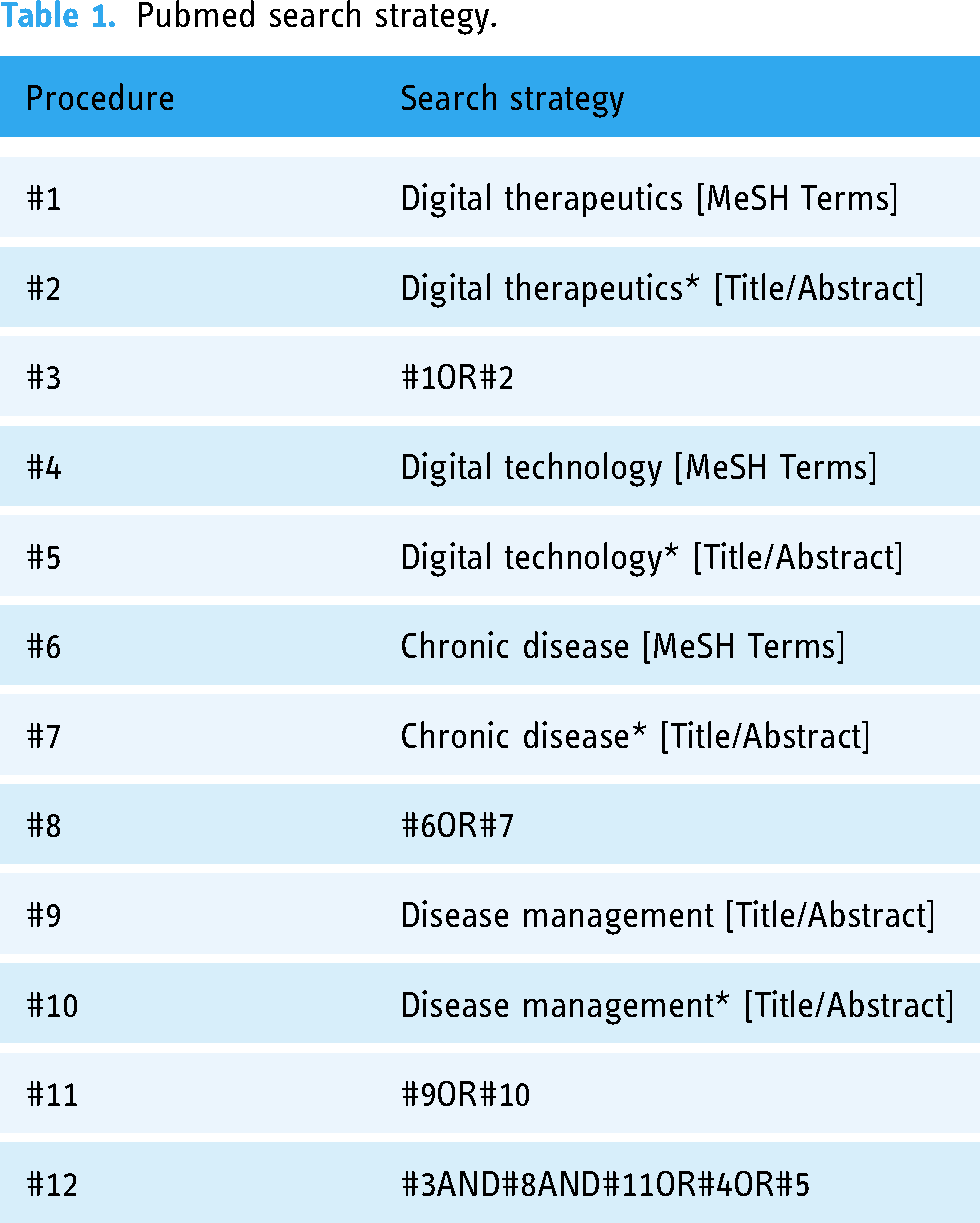
The Chinese biomedical literature database, ScienceDirect, Wanfang, CNKI, PubMed, Web of Science, VIP, and full-text Chinese medical journal databases were all searched by computers. For retrieval, a mix of Boolean logic operator connections, free words, and MeSH topic words was employed. Search terms in English were “digital therapeutics/digital therapeutics ‘*/digital technology/digital technology*,’ ‘chronic disease/chronic disease*,’ and ‘disease management/disease management*.’” Chinese search terms were “digital therapy/digital technology, ‘chronic disease,’ and ‘disease management.’” The database was retrieved between the date of database creation and September 20, 2023. (To retrieve more valuable literature and expand the search time range, the search time was set on the day of the beginning of the search.) Taking PubMed as an example, the specific search strategy is shown in Table 1.
Pubmed search strategy.
Study selection
The inclusion criteria were established according to the “PCC” principle 15 : (1) patients (P): those suffering from long-term illnesses; (2) concept (C): For patients with chronic illnesses—which the World Health Organization describes as noncommunicable diseases with a protracted course and sluggish development—it entails disease care based on DTx. This study focused on chronic conditions such as diabetes, obesity, heart disease, chronic obstructive pulmonary disease, chronic pain, sleeplessness, nervous system disorders, and mental health issues; (3) context (C): Intervention in disease management is required.
The exclusion criteria were as follows: (1) unable to access the complete text; (2) non-Chinese, English; (3) repeatedly published literature; (4) research plan, guidelines, opinions, and policy papers; (5) review literature; (6) paying attention to how DTx is developing.
Charting the data
To get rid of redundant literature, the retrieved materials were imported into NoteExpress 3.5.0.9054. Two expertly trained researchers separately screened the material by reading the title and abstract under the inclusion and exclusion criteria. They then reviewed the entire text for secondary screening and identified the included literature. Valid information such as author, nation, publication time (year), research location, research kind, intervention item, intervention technique, intervention duration, and effect was extracted from the data independently by two researchers. The information was recorded in a Microsoft Excel file. If the two researchers’ viewpoints diverged, they would consult the third researcher.
Collating, summarizing, and reporting the results
To characterize and summarize the results, the data graphs extracted from the included studies were presented in tabular form. We introduced the authors, year, country, study type, sample size, intervention duration, intervention methods, and main findings. We described and analyzed the intervention practice, results, advantages, or challenges of the study in detail to answer our research questions.
Results
A total of 4419 articles were obtained in the initial examination, and 3673 articles were left after removing duplicate articles. After reading the title and abstract, there were 456 articles left, and after reading the full text, there were 21 articles left. The citation tracing method was used to supplement the references of the included literature, and finally, 25 articles16–40 were included. The specific literature screening process is shown in Figure 1.
Description of included studies
A total of 25 articles were finally included, including 2 qualitative studies,16,17 18 randomized controlled trials,18–35 1 before-after controlled study, 36 2 cohort studies,37,38 and 2 single-arm trials.39,40 The 25 articles were from 11 countries, including 2 from the UK, 2 from France, 3 from China, 10 from the US, 2 from Japan, 1 from Germany, 1 from South Korea, 1 from Sweden, 1 from Scotland, 1 from Ireland and 1 from the Czech Republic. The detailed characteristics of the included studies are in Table 2.

Literature screening flow chart- source: authors’ construct.
Included literature characteristics.

Characteristics of included studies
According to 25 studies, there were DTx management systems created especially for patients with chronic illnesses. These systems included virtual learning machine models, home video game systems, and more, and their DTx projects can be tailored to the needs of the patients. Additionally, public DTx platforms and systems are being used more and more in the chronic illness field.
Intervention carrier
The majority of the software algorithms or applications used in the DTx-based chronic illness management intervention were based on technology, clinical judgment, and evidence. Additionally, it served as a link between patients and portable medical services. It served the same or a comparable purpose to traditional medications in terms of illness prevention, management, and treatment, as well as enhancing patient health. Numerous disease management software applications based on customized DTx were emerging as a result of ongoing scientific and technological advancements. Examples included the mobile digital health platform, 17 the digital medical rehabilitation system,18,19 the VR(virtual reality) digital control headset, 20 the clinical triage service, and the technical service desk using response symptom alarm, 16 the learning machine model, 29 and the self-management mobile application installed on tablet PC. 34 The participation was determined by recording the interaction between the patient and the software application during the trial. Based on real-time feedback, patients were provided with a range of disease management programs, including medications, lifestyle intervention programs, follow-up programs, and teaching materials. It should be highlighted, nonetheless, that the study's DTx-based software application differs from everyday health management apps. The former belonged to the category of medical services and was capable of giving patients direct medical attention. The latter was an active behavior in health management that was unregulated by healthcare organizations. It was available for independent users to download and use from the application store.
Intervention content
The three functional project product categories that have made up DTx in recent years are prevention, management, and treatment. 41 DTx used in this study was primarily a project product of the management function and was a type of digital intervention used in the management of chronic illnesses. It was characterized by guiding patients to self-manage the factors affecting the development of the disease after the diagnosis of the disease, to control the disease, reduce complications, or reduce adverse reactions. In most studies, DTx was used alone, and disease management was performed through tools with interactive or real-time feedback functions in an Internet digital virtual environment. For example, to achieve the goal of disease management, the wrist-worn smart bracelet was employed to track the application usage rate every 12 weeks for three months. Within the first three months, feedback was given. 19 For instance, automatically integrated structured data from hospital information systems and provided patient medication, lifestyle intervention programs, follow-up programs, and educational materials based on real-time diagnostic feedback. 25 Some studies used DTx containing game components, 33 such as family video games, to nonspecifically collaborate with multiple specialized cognitive networks involved at a low level in the form of games, which was conducive to cognitive remodeling in patients with chronic diseases. 20 In a small number of studies, DTx was used in conjunction with routine care. For example, DTx was added to the standard lifestyle adjustment plan, which could effectively reduce 24-h outpatient, home, and office blood pressure compared with a separate plan. 28 DTx can be used either on its own or in conjunction with more traditional forms of treatment including medication and medical equipment. These interventions had a positive impact on patients through information factors such as text, pictures, and videos, physical factors such as sound, light, and current, and drug factors.
Implementers
The majority of them were overseen and carried out by the treatment team, which was primarily made up of medical professionals. In certain studies, parents and treatment teams worked together as co-supervisors, with the management intensity being regularly modified based on the children's progress.33,40
Intervention duration
The disease management cycle based on DTx ranged from 20 h to 1 year, the frequency ranged from 3 to 7 days per week, and the intensity ranged from 10 to 90 min per day. Five studies were followed up from 9 weeks to 400 days.36–40
Intervention results
DTx improved patients’ chronic pain (n = 4), cognitive function (n = 1), anxiety and depression (n = 4), promoted patients’ self-management (n = 4), improved patients’ medication compliance (n = 2), and timely monitored disease symptoms (n = 13) in the 25 included studies. The most popular tools for assessing the level of pain in people with chronic pain were the modified Oswestry dysfunction index, the pain digital evaluation scale, and the visual analog scale. Individuals with cognitive impairment were more likely to use instruments like the mental behavior rating scale and cognitive ability screening scale; self-rating depression and anxiety scales were also more frequently used in the assessment of anxiety and depression in patients; some research assessed the changes of chronic diseases like obesity, diabetes, heart disease, and hypertension using various chronic disease criteria.22,25,27,36–37
Discussion
The scoping review included 25 articles, summarized the intervention carriers and management strategies of DTx in patients with chronic diseases, and improved patient symptom monitoring, medication management, weight management, mental health, and daily activities.
Patients with chronic illnesses have had some success with the application of DTx-based disease management interventions. The patient's disease management objectives are met by altering their physiological indicators, psychological state, and behavioral patterns. These include alleviating pain,18,20,23,24 promptly monitoring blood pressure,17,25,28,36,37 controlling weight,27,35 fostering positive psychological and cognitive remodeling,21,26,28–30 enhancing medication compliance,16,32 and enhancing self-management ability.25,31,34
The research on disease management of patients with chronic diseases based on DTx is still in the preliminary stage, and the distribution is not balanced. There is an unequal distribution of research population, time, place, and literature type across the 25 included articles. With 3 articles published in 2020, 7 in 2021, 6 in 2022, 5 in 2023, 1 in 2016, and 3 in 2017, the number has climbed from 2020 to 2023. The United States published the most, with a total of 10 articles, followed by China, with a total of 3. Patients with mental health issues, diabetes, obesity, and cardiovascular disease make up the majority of the study's subjects. Randomized controlled trials, qualitative studies, cohort studies, and single-arm trials are the most common types of research. The literature primarily aims to introduce connected concepts of DTx, the use of technical service desks and digital health platforms, as well as the use of DTx-based management information systems for chronic diseases. Furthermore, the literature assesses the efficacy of DTx-based approaches for managing chronic diseases concerning patient satisfaction and the viability of digital platform systems.
With the “Internet + nursing service” growing at a rapid pace in recent years, DTx has become a popular tool for managing patients with chronic illnesses and preventing sickness. To change negative behavior and encourage health recovery, it is anticipated that in the future, more digital information systems and platforms for the management of patients with chronic diseases will be developed under the collaborative research and mining of academics both domestically and internationally. Additionally, the content and methods of DTx will be updated and optimized regularly.
The intervention carrier of DTx needs to accurately meet the personalized needs of patients with chronic diseases. The foundation of DTx is software, which acts as a conduit to enable information exchange between patients and healthcare providers and greatly expands the accessibility of medical services. In recent years, many disease management software programs for DTx have been developed internationally. However, in some countries, the use of DTx is still not widespread. For example, a study showed that the follow-up management of patients with hypertension through WeChat, due to the small number of participants, the sample size of the study was insufficient. The results showed that the patients had stepped up physical exercise, but there was no significant difference in blood pressure control compared with the control group. 42 Therefore, it is imperative to develop efficient and easy-to-spread DTx management techniques. A small number of patients with chronic diseases have privacy requirements among the 25 studies. 26 To improve patients’ compliance with new and improved DTx management strategies, it is necessary to develop and use one-to-one program devices with privacy, pay attention to protecting patients’ privacy, and use digital platforms to provide multimedia (such as images and videos) materials. Furthermore, the availability of DTx interventions decreases with complexity, and this issue may have a detrimental effect on participants’ motivation to act or participate in the future. 32 Medically vulnerable populations, such as low-income families, still can not afford the cost of digital health technology systems or platforms, and there are challenges in promoting their usage. 35 Consequently, the creation of a customized, user-friendly, and affordable platform or management system is more favorable to the use of digital treatment across a wider range of communities and households. To meet the demands of patients with a range of chronic diseases in terms of disease management, the development team should include a variety of experts, including seasoned specialized nurses, based on the technological support of DTx.
The mechanism of DTx needs to be fully understood to improve the management process of chronic diseases. A problem in the intervention process is that the implementers or supervisors are not clear about the mechanism of the disease management intervention based on DTx, which has a positive effect on symptom monitoring, weight management, cognitive psychology, medication management, and other aspects of most patients with chronic diseases in the 25 studies that are included. Andersson pointed out that, there was a lack of awareness of the possibilities of digital systems since not all patients and experts had followed instructions on how to utilize them. 17 Studies found that, in the process of disease management intervention, parents and clinicians may not be able to observe the impact of DTx on patients ‘ disease management.. 33 As the primary participants in the patient's disease management process, parents and clinicians have a significant impact on the patient's disease management intervention. They ought to be completely aware of how DTx works and contribute to improving the impact of illness management. To obtain the optimal intervention impact, future research must stress a complete understanding of the working mechanism and influence of DTx. Furthermore, a successful intervention will positively impact the behavioral motivation of patients with long-term conditions. According to some research,25,28,40 long-term monitoring is necessary for chronic diseases to assess the clinical outcomes and long-term efficacy of mobile application-based therapies. However, most studies do not follow effects over time, and this needs to be taken seriously in later studies.
Due to the long course of chronic diseases, patients have increased various burdens. The burden of patients with chronic diseases mainly includes physical burden, psychological burden, economic burden, and so on. Chronic diseases are usually characterized by a slow progression of the disease, which in the long run damages the health of the body, and may cause a burden on the patient's psychology during the disease, which may increase the prevalence of mental diseases such as depression and anxiety. In addition, patients with chronic diseases usually need long-term medication or regular visits to hospitals for examination, which may impose a burden on the patient's economic situation. DTx can effectively solve the physical burden, psychological burden, and economic burden of patients with chronic diseases. DTx has a positive effect on improving the physical and mental burden of patients through symptom monitoring, weight management, cognitive psychology, and medication management. DTx is based on smartphones and driven by software programs. It continuously tracks the patient's condition and improves the treatment effect and clinical service level. It has the characteristics of personalization, convenient operation, and low cost, and reduces the economic burden of patients.
Limitations
Prior research has indicated that DTx plays an important role in the management of patients with chronic diseases, but it has also revealed several shortcomings. First, the sample population has an issue with singleness. 23 Studies suggested that, in addition to patients of all ages and patients with various chronic diseases, DTx should be extended to patients who have no prior experience with DTx to expand the population. 32 Second, the majority of the current studies have small sample sizes, and additional samples are required to investigate the impact of disease management interventions based on DTx.23,27,34 Third, the effect of other intervention factors is unclear in some studies, 18 which influences the assessment of the effect of DTx. As per the nursing guidelines, it is imperative to take into account the impact of the control group in addition to the efficacy of DTx. 24 Thus, more pertinent research must be done in the future to create intervention goals and programs that are appropriate, for example, process evaluation can be carried out through mixed research to explain the influence mechanism of intervention factors. Fourth, Selecting a reliable assessment instrument is crucial. A study found that DTx had a positive effect on the mental health of patients with schizophrenia, but there was no significant effect in the scale results. 26 As a result, more suitable evaluation instruments must be created or employed.
Conclusion
Patients with chronic illnesses have been using the DTx-based approach to disease treatment extensively. This study compiles the advantages and disadvantages of DTx for those with chronic conditions. To achieve the best management of disease prevention and control in patients with chronic diseases, more DTx projects appropriate for these patients can be developed in the future based on the research that is currently available. Additionally, personalized management plans can be formulated for different disease management objectives. This scoping review provides theoretical guidance for the design, research, and implementation of future DTx interventions in the management of various clinical chronic diseases.
Supplemental Material
sj-docx-1-dhj-10.1177_20552076241297064 - Supplemental material for Research on disease management of chronic disease patients based on digital therapeutics: A scoping review
Supplemental material, sj-docx-1-dhj-10.1177_20552076241297064 for Research on disease management of chronic disease patients based on digital therapeutics: A scoping review by Zhu Chengyu, Huang Xueyan and Feng Ying in DIGITAL HEALTH
Footnotes
Acknowledgments
None.
Contributorship
Zhu Chengyu: Conception and design, literature research and collation, drawing charts, thesis writing. Huang Xueyan: Conception and design, literature research and collation, thesis revision. Feng Ying: critical revision of important knowledge content, final approval of the version to be submitted.
Declaration of conflicting interests
The authors declared no potential conflicts of interest with respect to the research, authorship, and/or publication of this article.
Consent for publication
All the authors approved the final manuscript and the submission to this journal.
Data availability statement
Data sharing does not apply to this article as no datasets were generated or analyzed during the current study.
Funding
The authors received no financial support for the research, authorship, and/or publication of this article.

Supplemental material
Supplemental material for this article is available online.
References
Supplementary Material
Please find the following supplemental material available below.
For Open Access articles published under a Creative Commons License, all supplemental material carries the same license as the article it is associated with.
For non-Open Access articles published, all supplemental material carries a non-exclusive license, and permission requests for re-use of supplemental material or any part of supplemental material shall be sent directly to the copyright owner as specified in the copyright notice associated with the article.
