




Abstract
Objectives
To analyze the characteristics of hospital injured patients and the factors that affect treatment results.
Methods
We used the data from the Korea National Hospital Discharge In-depth Injury Survey from 2019 to 2021 of the Korea Disease Control and Prevention Agency (KDCA), 18,037 people who experienced hospital injury accidents were analyzed. In a retrospective cross-sectional study, general characteristics and injury-related characteristics of patients with hospital-acquired injuries were collected. The data were analyzed using chi-square test and logistic regression analysis of complex sampling design. The significance of all statistical analyses was verified at the p-value (<0.05) level.
Results
Variables that significantly affected the death of patients with hospital injuries were gender, age, route of admission, type of hospital injury, principal diagnosis, and length of stay (p < 0.05). The risk of death was 3.174 times (95% confidence interval: 2.376–4.238) higher when neoplasm was the principal diagnosis compared to cases with principal diagnosis of other systems.
Conclusions
It is necessary to do patient safety education to help medical personnel be more aware of groups of patients who had a high risk of death from hospital damage, such as male and elderly patients, patients who admitted through the emergency room, and patients whose principal diagnosis was neoplasm, circulatory system, or respiratory system disease.
Introduction
Interest in healthy life and the quality of medical services is increasing due to the development of advanced medical technology and the increase in chronic diseases. 1 The focus on the quality of medical care is leading to interest in patient safety, which guarantees a safe environment and treatment while the patient is admitted to the hospital. 2 Patient safety accidents include drug, blood transfusion, surgical damage, etc. due to accidental damage or medical error in the medical process that occurs in the course of treatment in the hospital.3–5 According to previous studies conducted in the United States and Korea, the incidence of patient safety accidents is generally reported to be approximately 3.2% to 16.8% of all hospitalized patients.6–8 Patient safety incidents account for 9.5% of all deaths in the United States, and are the third leading cause of death after cardiovascular disease and cancer. 9 In the United Kingdom, one patient safety incident is reported every 35 seconds. 10 Of these patient safety incidents, 50% are reported as preventable adverse events. 11
Patient safety is a fundamental right to deal with human life and a matter of dignity. 12 Occurrence of a patient safety accident not only causes physical damage to the patient, but also gives mental stress, and causes a burden of medical expenses due to examination and treatment due to the injury. 13 In addition, due to the treatment of hospital injuries caused by patient safety accidents, the length of stay of hospitalization increases compared to the same disease. 14 An increase in the length of stay due to hospital damage causes inefficient use of medical resources, leading to a decrease in the revenue of medical institutions.15,16
Hospital damage can be caused by various aspects. The causes of such damage are various, such as personal negligence, medical accidents, hospital environment, patient's immune problems, and malnutrition, and the causes may work in combination.17,18 Previous studies have emphasized that the root cause of medical accidents is related to the system, and not due to individual indifference or mistakes. The root cause of medical accidents is reported to be problems with medical personnel and software, and among them, problems related to procedures are the most common.17,19 Due to the rapid development of medical care, the provision of a large amount of services, and the special nature of medical care, such as the complicated process and environment of medical practice, errors inevitably occur in medical care, and it is difficult to exist perfect medical care.17,19 With the rapid development of medicine, the system is improving, but errors still occur due to the increasing demand for medical services and the segmentation and complexity of protocols. In addition, despite the continuous rapid development of medicine, the uncertainty of not only the cause of a disease but also the diagnosis, treatment, and prognosis resulting in various results also affects medical errors. 17 According to previous studies, the diversity and limitations of medical care cause injury accidents as an essential cause of medical care. 17 Therefore, in order to improve patient safety, cooperation and systematic approaches from stakeholders are required involved in the medical provision process, such as the country, medical institutions, medical personnel, and patients. 20
In order to prevent injury accidents in hospitals, first of all, many cases should be reported and analyzed, and based on this, research and policy activities will be active. Therefore, monitoring and research on hospital injury accidents are important. Other countries, including Korea, are also very interested in establishing a hospital damage accident monitoring system to guarantee a patient safety system.7,18,21–23 However, previous studies14,18 have mainly dealt with the relationship between hospital injuries, length of stay, and medical expenses, and studies on factors related to mortality, which is the result of treatment of patients with hospital injuries, are rare.
The purpose of this study is to provide basic data for healthcare policies for patient safety by analyzing the characteristics of hospital injured patients and the factors that affect treatment results by utilizing representative Korea National Hospital discharge in-depth injury survey data.
Method
This study is a cross-sectional study that investigated the types of hospital injuries and explored factors related to treatment outcomes using data collected from medical records of discharged patients from medical institutions at the national level.
Study population
This study used the data from the Korea National Hospital Discharge In-depth Injury Survey from 2019 to 2021 of the Korea Disease Control and Prevention Agency (KDCA). The Korea National Hospital Discharge In-depth Injury Survey (KNHDIS) is a nationwide survey data introduced in Korea in 2005 and conducted annually, and is a nationally approved statistical data (Statistics Korea, approval number 117060). 24 KNHDIS aims to contribute to social safety and damage prevention through monitoring of damage occurrence and time-series characteristics. The population of KNHDIS is for patients discharged from general hospitals with more than 100 beds across the country. Sampling was performed using the stratified two-stage cluster sampling method, and the number of beds was used as a stratification variable.21,25,26 From 2019 to 2021, there were a total of 905,515 in the Korea National Hospital Discharge In-depth Injury Survey data. Referring to previous studies, the exclusion criteria for study subjects included cases where the diagnosis code of the hospitalized patient was not related to a hospital-acquired injury, cases where the injury occurred at a location other than a hospital, and cases where there were missing values in the data.7,27 Among them, 18,037 patients with a diagnosis indicating hospital damage accidents such as adverse events, misadventures, and complications during treatment and patients whose damage occurred at a medical institution were selected as study subjects (Figure 1).

Flow chart of study subject selection.
Variables
The dependent variable in this study was the result of treatment of patients with hospital injuries, and it was divided into whether or not there was death. Independent variables were composed of general characteristics and injury-related characteristics of patients with hospital injuries. The independent variables used in this study were selected with reference to the results of previous studies using data from the KNHDIS.14,25,27 The independent variables for general characteristics were gender, age, hospitalization route, insurance type, and hospital region. Admission routes were classified as outpatient, emergency, and others, and hospital locations were classified into the capital city (Seoul), metropolitan cities, and Gyeonggi-do with a large population, and others. Independent variables related to hospital injury were surgery, hospital injury type, principal diagnosis group, and length of hospital stay.
Hospital injury types were classified into five categories according to the ICD-10 (International classification of diseases 10th revision) classification code in order to identify differences in treatment results and influencing factors for each type of hospital injury. Table 1 presents definitions of categories of hospital injury types. Types of hospital injuries were divided into adverse drug-related injuries (X40-49, Y40-59), treatment-related misadventures (Y60-69), treatment device-related injuries (Y70-Y82), and treatment-related complications (Y83-Y84), and other injuries such as falls and collisions that occurred in other medical institutions.
Categories for hospital injury events.

Statistical analysis
The data were collected from patients hospitalized and discharged from general hospitals with 100 or more beds from 1 January 2019 to 31 December 2021.
The data were analyzed using IBM SPSS version 25.0 (IBM Co., Armonk, NY, USA). The data used in this study were sample survey data according to the complex sample design, and were analyzed by applying integrated weights according to the data utilization guidelines.28,29 The characteristics of patients who experienced hospital injuries were identified using representative data. Frequency analysis and chi-square test were conducted to identify differences in treatment results according to general characteristics and injury-related characteristics of patients with hospital injuries. T-test was conducted to identify the difference in length of hospital stay according to treatment results, and a logistic regression analysis was conducted to identify factors affecting the treatment outcome of hospital injuries. The significance of all statistical analyzes was verified at the p-value (<0.05) level.
Results
General characteristics of study subjects
Table 2 shows the general characteristics of 18,037 patients with hospital injuries as study subjects. There were more males (50.7%) than females, and the 20- to 64-year-old group had the highest share (49.4%) by age group. As for the route of admission, outpatient hospitalization (63.4%) was the most common, and in terms of insurance type, health insurance patients (82.9%) were the most common. According to the region of the hospital, the number of patients with hospital injuries was highest in Seoul (capital), with 31.0%, followed by metropolitan cities with 28.8%. Of the total hospital injury patients, 54.1% did not undergo surgery, and 3.5% died. As for the distribution of patients by type of hospital injury, surgery and treatment-related injuries accounted for the most with 66.0%, and the principal diagnosis group was with injuries and poisoning patients with 56.0%.
General characteristics of study subjects (n = 18,037).

Differences in treatment outcome of hospital injured patients
Table 3 shows the differences in treatment outcome according to the general characteristics of patients with hospital injuries. The treatment outcome of patients with hospital injury were found to have statistically significant differences in gender, age, route of admission, insurance type, and type of hospital injury (p < 0.05). The mortality rate, which is an outcome of the treatment of hospital injured patients, was higher for men (4.1%) than for women (2.8%), and the older the patient, the higher the mortality rate. As for the route of admission, the mortality rate was higher for those who went through the emergency room (6.0%) than for outpatients (2.0%), and the mortality rate by insurance type was higher for health insurance (3.6%) and medicare (3.6%) than for others. The mortality rate according to type of hospital injury was highest in misadventures during treatment (5.0%).
Differences in treatment outcome of hospital injured patients according to general characteristics.

Table 4 shows the difference in mortality rates of patients with hospital injuries according to principal diagnosis. As a result of the chi-square test, there was a statistically significant difference in the mortality rate of patients with hospital injuries according to principal diagnosis (p < 0.05). Hospital injury patients whose principal diagnosis was respiratory disease had the highest mortality rate of 14.5%, followed by neoplasm (11.0%) and circulatory system (10.1%). A T-test was performed to determine the difference in length of stay according to treatment results for hospital-injured patients. The difference in length of stay according to treatment results was statistically significant, and the average length of stay for patients who died was 59.18 days, which was higher than the average length of stay for surviving patients (17.65 days) (Figure 2).

Difference in LOS according to the treatment outcome. T-test, p < 0.001. LOS: length of stay.
Differences in treatment outcome of hospital injured patients according to principal diagnosis group.

Factors affecting of the death hospital injured patients
Table 5 shows the results of a logistic regression analysis to identify factors affecting the death of hospital injured patients. As a result of the analysis, variables that significantly affected the death of patients with hospital injuries were gender, age, route of admission, type of hospital injury, principal diagnosis, and length of stay (p < 0.05). The risk of death in men was 1.346 times (95% confidence incidence (CI): 1.134–1.597) higher than in women, and the risk of death in the group aged 65 or older was 3.052 times (95% CI: 1.843–5.052) times higher than in the group aged under 20. By admission route, the risk of death was found to be 3.311 times (95% CI: 2.687–4.081) higher for patients hospitalized through the emergency room compared to patients hospitalized as outpatients. As a result of analysis by type of hospital injury, compared to other injuries, the risk of death from accidental poisoning injury was 0.418 times (95% CI: 0.195–0.894) lower, and the risk of death from adverse drug effect injury was 0.493 times (95% CI: 0.320–0.761) lower. In terms of principal diagnosis, the risk of death was 3.174 times (95% CI: 2.376–4.238) higher when neoplasm was the principal diagnosis compared to cases with principal diagnosis of other systems. When the principal diagnosis was respiratory disease, the risk of death was 2.904 times (95% CI: 2.032–4.152) higher. According to the results presented in Table 4, the mortality rate was high in the order of respiratory disease and neoplastic disease as the principal diagnosis, but in the logistic regression analysis results of multivariate analysis, the odds ratio of death risk was high in the order of neoplastic disease and respiratory disease. It is analyzed that this result was caused by the characteristics of other variables being considered and having an effect in the multivariate analysis. The goodness of fit of the model was significant at Wald F = 36.157, p < 0.001, and showed an explanatory power of 21.1% (Nagelkerke R square = 0.211).
Factors affecting death of hospital injury patients using weighted logistic regression model.

*p< 0.05.
CI: confidence interval; OR, odds ratio.
Discussion
This study was implemented to be used as basic data for healthcare policies for patient safety by analyzes the factors affecting death and characteristics of hospital injury accidents targeting 18,037 people who experienced hospital injury accidents from 2019 to 2021 using the Korea National Hospital Discharge In-depth Injury Survey data.
Patients with hospital injuries were predominantly male (50.7%) and in the 20 to 64 age group (49.4%), and the frequency of hospital injuries was highest in hospitals in the capital area (31.0%). Among the categories of hospital injuries, injuries related to surgery, and treatment were the most common at 66.0%, which is consistent with the results of previous studies on medical accidents at Harvard and Australia. 8 As a result of analyzing the mortality rate according to the type of injury in patients with hospital injuries, the highest mortality rate was found in the following order: misadventure (5.0%), other injury (4.5%), and surgical events (3.5%). A study by De Vries et al., 30 which conducted a systematic review of adverse events with in-hospitals, also showed that adverse events related to operation were the highest. The results of Halfon et al.'s study related to adverse events related to hospital care also showed that adverse events related to operation had the highest rate, which is consistent with the results of this study.31,32 It is considered that patients undergoing surgery are vulnerable to damage because the procedures are complex and diverse. As a result of analyzing the length of stay according to the presence or absence of death in hospital injured patients, the average length of stay in the case of death was 59.18 days, which was significantly higher than the 17.65 days in the case of survival. In fact, according to the research results of Forster et al., who analyzed the length of stay of patients who experienced a hospital injury accident in the intensive care unit (ICU), the average length of stay increased by 31 days when a hospital injury accident occurred in a seriously ill patient. 33 This is believed to be a result of the higher the severity of the disease, the longer the length of stay and the higher the likelihood of death.
As a result of analyzing the risk factors for death after a hospital injury accident in this study, the risk of death was higher in men than in women, the older the age, the higher the risk of death after an injury accident, and the risk of death after a hospital injury accident in patients hospitalized through the emergency room was higher. These research results are consistent with the results of a previous study by Kim and Lee, which analyzed factors related to death of in-hospital injured patients. 27 In addition, in terms of type of injury, the risk of death was found to be lower for accidental poisoning accidents and adverse drug effects compared to other hospital injuries. The results are inconsistent with the results of previous studies that suggested a high risk of drug-related hospital injury accidents, but it is considered that this is different because previous studies presented risks according to the type of hospital injury or presented the risk of hospital injury for specific groups.33,34 The risk of death was found to be higher for hospital injury accident patients whose principal diagnosis was neoplasm, respiratory system, or circulatory system disease compared to other diseases. Previous studies related to this were mainly research results on whether co-morbidities were related to the risk of hospital injury, and research results on whether the type of principal diagnosis affected the death of hospital injury patients were rare.27,33,35,36 The results of this study are compared with those of previous studies, although there is a difference in sample size. However, it is considered comparable as the results of a systematic literature review and a retrospective study targeting patients from a large hospital used similar independent variables for analysis (Table 6).27,30–34
Analysis of previous studies on hospital injury.
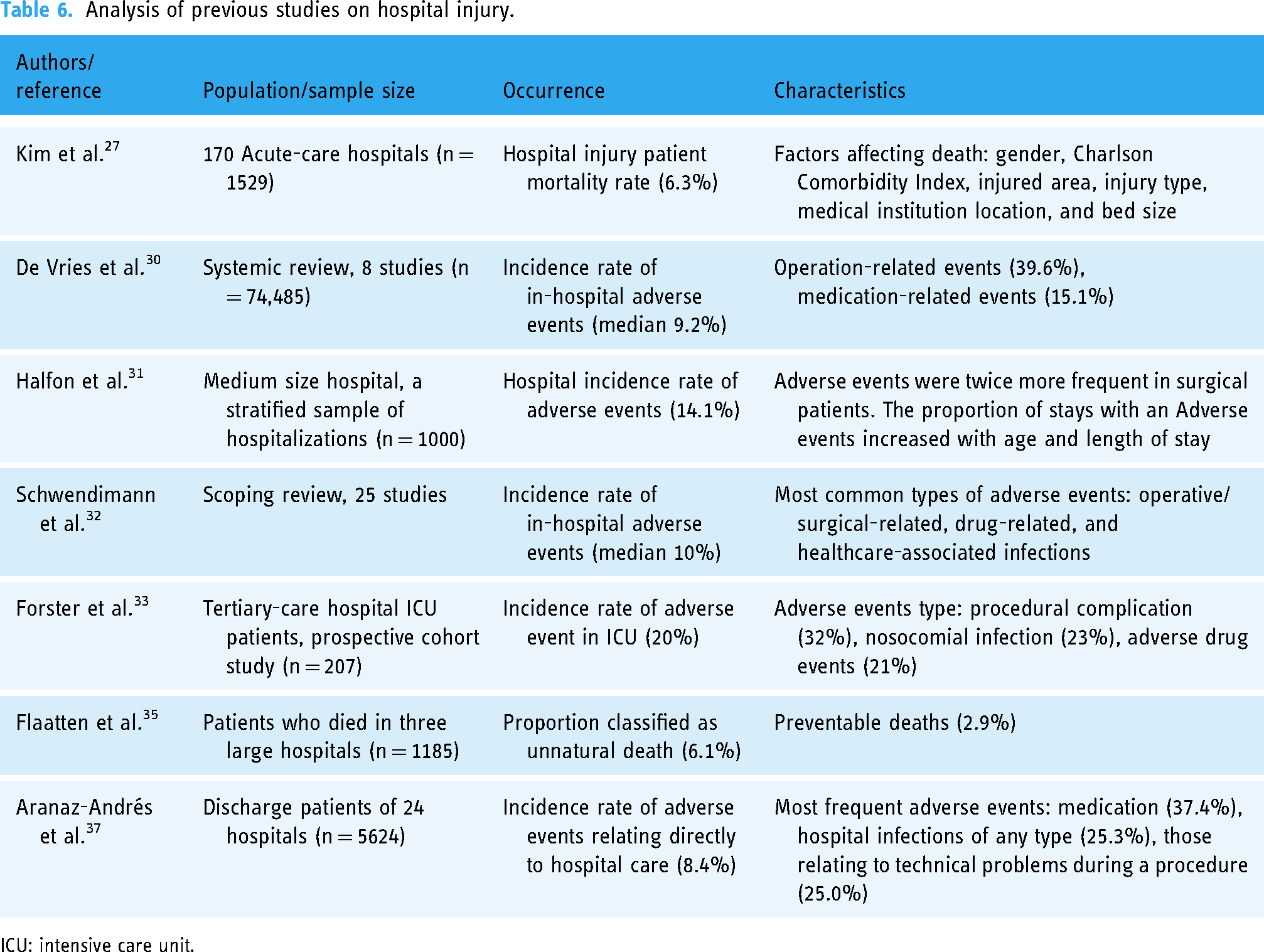
ICU: intensive care unit.
Considering the above results, it is believed that a hospital injury prevention policy that considers gender, age, hospitalization route, hospital injury type, and principal diagnosis group is necessary. Several previous studies have shown that there are many preventable hospital injuries and that preventive policies and reporting systems are needed for patient safety.32,37 However, various types of hospital damage still occur in many countries, and collection and research of various cases are continuously needed as basic research to establish a patient safety culture.32,35
Interest in patient safety is leading to interest in preventable hospitalization injuries. A preventable death is defined as a death that could have been avoided if the person had received appropriate diagnosis and treatment in a hospital with adequate staff and facilities. 38 Considering that there are many preventable deaths in hospital injuries, this study sought to contribute to improving patient safety and quality of medical care by identifying risk factors for deaths due to hospital injuries. According to the results of the study, it is necessary to do patient safety education to help medical personnel be more aware of groups of patients who had a high risk of death from hospital damage, such as male and elderly patients, patients who admitted through the emergency room, and patients whose principal diagnosis was neoplasm, circulatory system, or respiratory system disease.
The limitations of this study are as follows. First, although risk factors for death in patients with hospital injury accidents were analyzed, a clear causal relationship could not be confirmed as it was a cross-sectional study. Second, there is a limitation in that it does not reflect the characteristics of more diverse medical institutions and the clinical characteristics of patients as variables that can affect the death of patients with hospital injuries. Despite these limitations, the significance of this study is that it presented basic data to improve the quality of medical care by analyzing the characteristics and mortality risk factors of patients with hospital injuries using a representative sample that reflects the type of hospital injury and main diagnosis group.
Conclusion
This study used representative public data to identify the characteristics of patients who experienced hospital injuries and factors affecting death. As a result of the study, it was possible to suggest the need for an approach and healthcare policy to prevent patient safety according to the risk of death of patients who experienced hospital injury. In the future, it is believed that follow-up research will be needed to identify risk factors for each type of hospital injury, including patients’ clinical information.
Footnotes
Contributorship
JL conceptualized and designed the study, obtained funding and was involved in the data collection and data analysis, and wrote the first draft of the manuscript.
Declaration of conflicting interests
The author declared no potential conflicts of interest with respect to the research, authorship, and/or publication of this article.
Ethical approval
This study was conducted in accordance with the Declaration of Helsinki. Ethical review and approval were waived for this study because it used anonymous public open indicator data, not an individual's personal data.
Funding
The authors disclosed receipt of the following financial support for the research, authorship, and/or publication of this article: This work was supported by the Dong-A University research fund.
