




Abstract
Background
It is necessary to improve the knowledge and attitude of dental practitioners toward teledentistry for its implementation in the oral healthcare system. The objective of the current study was to investigate the knowledge and attitude of Iranian dental practitioners toward teledentistry.
Methods
This descriptive, cross-sectional survey was performed among 387 dental practitioners working in two big cities in Iran. An online self-structured questionnaire that included 34 questions was applied to collect information about the general profile of participants (age, sex, work experience, city of work, and dental specialty), their knowledge, and attitude about teledentistry.
Results
Most participants were males (57.9%) and general practitioners (79.6%). Dental practitioners expressed poor knowledge and only 23.50% of them were familiar with teledentistry. However, most of the participants, mainly in Zahedan city, expressed agreement on the potential benefits of teledentistry for patient care and access. More than 80% of dental practitioners agreed with the statement on the application of teledentistry in enhancing access to guidelines, recommendations, and preventive dentistry. However, the majority of dental practitioners believe that the diagnosis by teledentistry is not as accurate as the diagnosis in clinical practice.
Conclusion
Our study reveals a positive attitude toward teledentistry among Iranian dentists with a significant knowledge gap. This knowledge gap may be a barrier to teledentistry adoption. Educational programs tailored to address these knowledge gaps are necessary to pave the way for the successful integration of teledentistry into routine dental practice.
Introduction
Oral health is a major component of general health and strongly affects health-related quality of life.1,2 To achieve desirable oral health, public access to oral healthcare comprising diagnostic, preventive, and therapeutic strategies is essential. However, various factors such as low socioeconomic status or living in low-privileged geographical areas have caused inequality in access and use of oral health services.3,4 Teledentistry is considered an innovative and beneficial strategy to provide dental services for individuals with limited access to these services such as patients with low socioeconomic status or those residing in rural or remote geographical areas. 5 Teledentistry is defined as the use of information and telecommunication technology to provide oral healthcare services between an oral healthcare provider and a patient/recipient or other healthcare providers, who are separated by distance according to the e-oral health network of the International Association of Dental Research. 6 Teledentistry was first launched in 1994 by the U.S. Army to provide services to American soldiers worldwide, 7 and since then, many studies have reported its effectiveness in dental screening, diagnosis, consultation, and treatment planning mainly in oral medicine and pediatrics.8–10
Today, the widespread use of teledentistry and its benefits such as access to cost-effective oral healthcare services has become accessible due to rapid technological advances and broad public access to these technologies. Despite the high burden of oral and dental diseases in Iran, there are still no necessary foundations for teledentistry, as a critical component for public access to care, and establishment in the oral healthcare system. To create the capacity and necessary infrastructures for using teledentistry in the healthcare system, especially in developing countries such as Iran, it is critical to improve the attitude and knowledge of dental practitioners about teledentistry, its benefits, drawbacks, and usage in practice. In recent years, several studies have investigated the knowledge and attitudes of dentists and dentistry students about teledentistry in various countries.3,11–20 Most of these studies have reported that dental practitioners have poor knowledge and practical experience in teledentistry. Two previous studies among Iranian dentistry students have also reported undesirable knowledge and attitudes of these students.21,22 No prior studies have explored Iranian dental practitioners’ knowledge and attitudes toward teledentistry. This study aims to investigate these aspects to inform the implementation of teledentistry in Iranian dental care.
Methods
Study design and participants
This descriptive, cross-sectional study was performed between 2022 and 2023 among a convenient sample of dental practitioners working in two big cities of Isfahan and Zahedan, Iran. The study protocol was approved by the Ethics Committee of Isfahan University of Medical Sciences. All general and specialized dental practitioners of private and public settings willing to participate in the study were considered for inclusion. The online questionnaire, designed using a survey website (https://survey.porsline.ir/), began with an introduction about the objectives of the research, an invitation to participate, and an explanation that all collected information would be kept confidential. The phone numbers of dental practitioners were retrieved from the deputies of treatment in Isfahan and Zahedan cities, and investigators sent out the online questionnaire link using a text message and social media applications such as WhatsApp and Telegram. Participants had access to the questionnaire after studying the study objectives and consenting to participate. The study was performed over a 6-month duration, and reminder messages were sent to dentists to increase the participation rate.
Data collection
A self-structured 34-item online questionnaire was applied to collect data in the current study. The questionnaire was developed through a literature search both in English and in Persian languages. To examine the reliability and validity of the questionnaire, we performed a pilot pre-test study on 40 randomly selected dental practitioners. The questionnaire was modified based on the participants’ inputs. The data collection was performed following confirming the high level of internal consistency for knowledge (Cronbach's alpha: 0.90) and attitude domains (Cronbach's alpha: 0.87). The questionnaire encompasses three sections: (a) general traits of participants comprising age, sex, work experience, dental specialty, and place of work; (b) knowledge about teledentistry (questions 1 to 11); and (c) attitude toward teledentistry (questions 12 to 34). Items in both sections of the questionnaire were responded to a 5-point Likert scale (ranging from strongly agree (5) to strongly disagree (1)), and the total score of each domain was obtained by summing the score of each item with higher scores representing higher knowledge and attitude. The total score of knowledge and attitude ranged from 11 to 55 and 23 to 115, respectively.
Statistical analysis
The normality of quantitative variables was evaluated by the Kolmogorov–Smirnov test. Continuous (knowledge and attitude scores) and categorical variables (age, sex, work experience, city of work, and specialization) were presented as mean ± SD and frequency (percentage), respectively. All statistical analyses were performed by the Statistical Package for the Social Sciences (SPSS) version 20, and a P value <0.05 was considered statistically significant. Independent sample t-test was used to compare knowledge and attitude scores based on age, sex, dental specialty, work experience, and place of work in the total sample.
Results
As shown in Table 1, 387 dental practitioners completed the present study of whom 280 (72.3%) individuals worked in Isfahan city and 107 (27.7%) individuals worked in Zahedan city. Most participants in this study were males (57.9%) and general practitioners (79.6%). Additionally, the frequency of participants aged 41 to 50 years old and those with work experience of more than 20 years was higher in the study.
Basic characteristics of participants.

Overall, dental practitioners demonstrated a moderate level of knowledge (mean score: 34.45 ± 9.10) about teledentistry and a positive attitude (mean score: 80.23 ± 9.53) toward its potential benefits. The frequency of participants with a good knowledge of teledentistry ranges from 23.50% to 54.25% (Table 2). Only 23.50% of dental practitioners agreed with the statement about familiarity with teledentistry; however, 76.48% of dental professionals responded to this item with neutral, disagree, or totally disagree response options. In the knowledge subscale, most dental practitioners (54.25%) agreed with the item “Teledentistry can be useful in improving access to oral health care.” However, less than half of dental practitioners agreed with other statements in the subscale. In terms of attitude, the frequency of dental practitioners with a positive attitude toward teledentistry benefits and applications ranged from 29.19% to 84.48%. Although only 29.19% of individuals agreed with the item “Teledentistry provides the accurate diagnosis as in a clinical setting,” 84.4% of dental practitioners agreed with the item “Teledentistry increases access to guidelines, recommendations, and preventive dentistry.” Most dental practitioners also believed that teledentistry decreases the cost (64.32%) and time (69.24%) spent on oral healthcare and increases the accessibility to oral healthcare services in remote areas (75.7%). Most of the participants also believed that teledentistry shortens the waiting list (70.54%) and provides more time for dentists on patients’ visits (53.22%). Furthermore, more than half of dental practitioners agreed on statements regarding the usefulness of teledentistry in diagnosis, counseling, and treatment of patients using technology (60.97%), oral and dental hygiene education (78.55%), patients’ screening and evaluation (66.40%), monitoring the patients’ dental treatment (64.59%), removing patients’ doubts about some dental practices (71.83%), and providing emergency advice (75.70%). Respectively, 51.92% and 65.88% of dental practitioners also agreed with the items “Teledentistry can be a background for applying dental robotics” and “Teledentistry is added to the regular care provided by dentists.” Additionally, 55.03% of dental practitioners believed that participating in this survey increased their knowledge about teledentistry. However, less than half of the individuals agreed with other statements in the attitude subscale.
Frequency of respondents to questions in knowledge and attitude subscales.
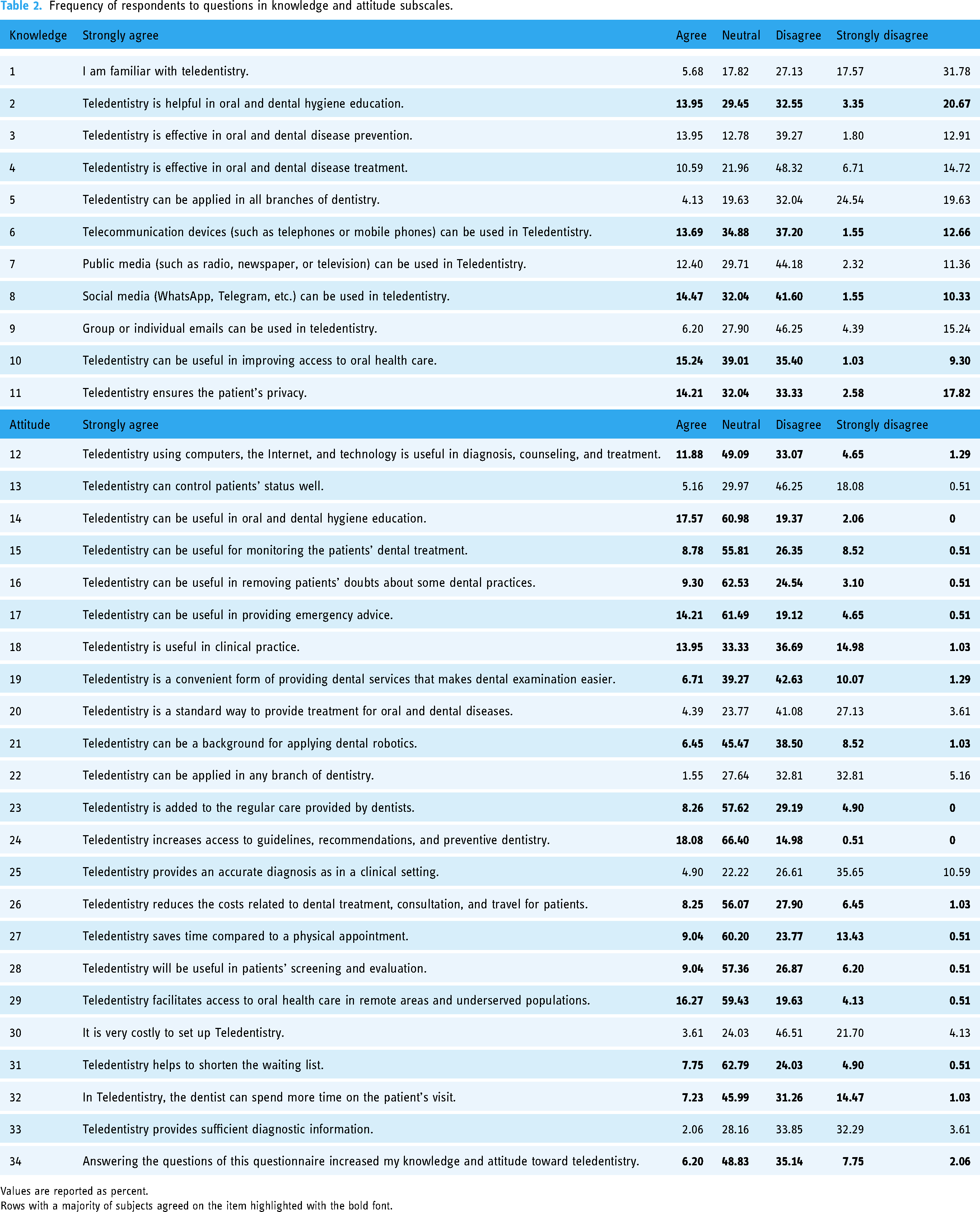
Values are reported as percent.
Rows with a majority of subjects agreed on the item highlighted with the bold font.
The scores of knowledge and attitude subscales based on socio-demographic variables have been presented in Table 3. The comparison of dental practitioners’ knowledge based on the socio-demographic characteristics of participants showed a significant difference in mean knowledge score based on age (P = 0.02). Such that dentists aged 31 to 40 years represented a higher mean score of knowledge. Our results also indicated that specialized dentists expressed higher knowledge about teledentistry compared to general practitioners (36.79 ± 9.17 vs. 33.85 ± 9.00; P = 0.01). According to our findings, the mean attitude score was significantly higher in females than males (81.19 ± 9.59 vs. 78.92 ± 9.34; P = 0.02) and in dentists who worked in Zahedan than those who worked in Isfahan (83.54 ± 9.91 vs. 78.97 ± 9.09; P = 0.001). No significant difference was observed in participants’ knowledge and attitude based on other socio-demographic variables (P > 0.05).
Mean knowledge and attitude of dental practitioners toward teledentistry based on basic characteristics.

P values obtained from one-way analysis of variance. Data are presented as mean ± SD.
Discussion
The findings of the present study indicated that dental professionals, mainly females and those who worked in Zahedan City, had a positive attitude toward the advantages and applications of teledentistry. Most dentists showed a positive attitude toward the application of teledentistry in enhancing access to guidelines, recommendations, and preventive dentistry. Nevertheless, they refused to agree that the diagnosis by teledentistry is as accurate as the diagnosis in clinical practice. In addition, the majority of dentists agreed with the statement that teledentistry increases access to oral healthcare services in remote areas. However, our results showed that dental practitioners had poor knowledge of teledentistry, and most of them were not familiar with the approach. Age and specialization were among the determinants of knowledge about teledentistry. Our findings showed that although Iranian dentists have found some applications of teledentistry desirable, they do not have enough knowledge about its application in the clinic which can be an important barrier to its adapting to the healthcare system. Thus, proper educational strategies such as appropriate university courses, periodic educational seminars, and conferences are necessary to make dental professionals, especially general practitioners, more familiar with teledentistry, its advantages, drawbacks, and applications in clinical practice. However, further qualitative studies are required to examine the assumption.
Some prior surveys have investigated the knowledge and attitude of dental professionals toward teledentistry with controversial findings. In contrast to our findings, some studies have reported satisfactory knowledge and positive attitudes toward teledentistry.13,15 For example, a descriptive survey in India showed that 80.57% of dental surgeons had sufficient knowledge about teledentistry, and 74% of them were likely to use it for temporary treatment of periodontal disorders. 13 The results of the study also indicated that most dentists had a positive attitude toward teledentistry. However, a majority of them were uncertain about its application in the diagnosis of periodontal diseases, suggesting the importance of examining the attitude of dentists in different branches of dentistry regarding teledentistry. Despite the negative attitude of dentists regarding the diagnostic accuracy of teledentistry compared to face-to-face diagnosis, the results of some previous studies indicated that teledentistry has a strong diagnostic function in the diagnosis of various oral and dental diseases.23–26 Anyway, to change the attitude of dentists in this regard, holding training courses related to diagnostics approaches and tools for teledentistry is advantageous. Another cross-sectional descriptive study in India also reported satisfactory knowledge and attitude toward teledentistry among postgraduate dental students. In this study, the majority of students were against the use of telemedicine in all branches of dentistry, which was similar to our study. However, more than half of the participants agreed with other items related to knowledge and attitude about teledentistry. In addition, around 80% of students stated that they plan to practice teledentistry in the future. 15 Similar to our findings, a study involving more than 5059 participants in France showed that more than half of dentists have not heard about teledentistry. However, most of the participants expressed that they are interested in educational programs for teledentistry and its practice. 17 In addition, in line with our findings, a study of 603 dentists in Saudi Arabia indicated poor knowledge about teledentistry with only 38% having heard about it. However, the study participants demonstrated a positive attitude toward this therapeutic approach. The participants in the study also represented a positive attitude toward the role of teledentistry in oral hygiene education, saving time for dentists, reducing costs for dental practices, and increasing accessibility to oral healthcare services. However, contrary to our results, most of the participants in this study did not agree with the usefulness of teledentistry in patient examination. 3 Few numbers of previous studies have also examined the knowledge and attitude of Iranian postgraduate dental students toward teledentistry. A previous study involving 133 dentistry students in Zahedan showed that the knowledge and attitude of participants toward teledentistry were unfavorable and age was a predictor of knowledge about teledentistry. Although the participants in this study agreed with some of the benefits of teledentistry, such as saving time and cost as well as increasing access to dental care, they had doubts about the accuracy and efficiency of teledentistry in diagnosing oral and dental diseases. 22 Another descriptive study also showed that dentistry students at the Kerman University of Medical Sciences had inadequate knowledge and a positive attitude about teledentistry. 21 However, our findings showed that the attitude of dental practitioners was almost positive toward many areas of teledentistry despite a lack of knowledge about it. This finding can be explained by the higher experience of dental practitioners compared to dental students, and as a result, their better understanding of the beneficial role of teledentistry in providing oral healthcare to patients, especially those with limited access to healthcare services. The contradictory findings of preceding studies can be explained by differences in the studied population, study design, and tools used for data collection. Furthermore, it is important to note that cultural and social differences as well as variations in the structure and facilities of oral healthcare systems in various societies can almost explain differences in the findings of previous studies.
To design more efficient educational programs on teledentistry, it would be helpful to identify variables that affect the knowledge and attitude of dentists about it. Preceding investigations that have investigated predictors of dental practitioners’ knowledge and attitude toward teledentistry have obtained different results. Work experience, qualification, and internet access have been reported as predictors of knowledge and attitude toward teledentistry in two previous studies.14,27 Our findings demonstrated age and specialization as predictors of knowledge. However, sex and place of work were identified as attitude determinants. However, further large-scale studies in dental practitioners of various fields are required to confirm these findings.
The present study had some limitations that should be noted before interpreting the study findings. First of all, the study was performed on a relatively small sample of dental professionals, mainly general practitioners, from two cities in our community, which prevents the generalizability of our findings. We also did not use a standard questionnaire to collect data on the knowledge and attitude of dental practitioners toward teledentistry. Furthermore, the differences in the questionnaires used in this study from other studies do not allow an accurate comparison of the results. However, the utilized questionnaire showed a favorable validity both in knowledge and attitude subscales in our populations. Despite the above-mentioned limitations, the study was among the first studies that investigated the knowledge and attitude of Iranian dental practitioners about teledentistry, and its findings can be used for designing future studies to explore determinants of dentists’ knowledge and attitude about teledentistry and their acceptance of teledentistry application in clinical practice.
Conclusion
In summary, our study showed that dental practitioners expressed mostly a positive attitude toward teledentistry. However, they represented poor knowledge in this field. Thus, it is necessary to train dental professionals about teledentistry and its applications in clinical practice to provide a suitable context for its implantation in the dental healthcare system.
Footnotes
Acknowledgment
We would like to thank all the individuals who agreed to participate in the present study.
Contributorship
ZS, AR, LS, and FSTK contributed to the conception, design, data collection, data interpretation, manuscript drafting, and approval of the final version of the manuscript and agreed on all aspects of the work.
Consent to participate statement
All individuals signed written informed consent forms, before participating in the study.
Data availability
The data that support the findings of the present study are available from the corresponding author upon request.
Declaration of Conflicting Interests
The authors declared no potential conflicts of interest with respect to the research, authorship, and/or publication of this article.
Ethical approval
The study protocol was approved by the Ethics Committee of Isfahan University of Medical Sciences (no. 3401722)
Funding
The authors disclosed receipt of the following financial support for the research, authorship, and/or publication of this article: This work received financial support for conception, design, data analysis, and manuscript drafting from the Isfahan University of Medical Sciences, Isfahan, Iran.
Guarantor
AR
