



Abstract
Objective
The objective of this study was to determine the most effective cut-off point for the Smombie Scale and evaluate its ability to screen for pedestrian safety risks among young adults.
Methods
Data were obtained from an online sample of 396 Korean young adults aged 18–39 years. Latent profile analysis was used to distinguish the risk group as a reference measure for the Smombie Scale. Discriminative power was assessed using sensitivity, specificity, receiver operating characteristic (ROC) curves, and the area under the ROC curve. The cut-off points were estimated from the Youden index and the balanced score.
Results
The latent profile analysis showed two different classes: “risk group” of 17.8% and “others.” Based on the latent profile analysis, sensitivity, and specificity analysis showed that an adequate cut-off point of 2.78 of five points or higher was associated with a high risk of distracted walking.
Conclusion
The Smombie Scale is a good predictor of problematic smartphone use on the road and can be used as a screening tool for assessing risk levels among young adult pedestrians.
Introduction
With the universalization of smartphones in daily life and work, distracted walking due to the use of mobile devices has gained growing public safety concerns. Pedestrians are one of the most vulnerable road user groups, with global estimates indicating that pedestrians account for ∼23% of annual road traffic deaths. 1 Moreover, among the working-age population (aged 15–44 years), more than 70% fall victim to road traffic accidents. 2 Several studies have found that a significant proportion ranging from 19% to 25% of pedestrians experience distractions caused by smartphone usage while walking.3–7
“Smombie” is a compound term derived from “smartphone” and “zombie” and refers to pedestrians using the road with their eyes fixed on their smartphones while not paying close attention to their surroundings. The concept originated in Germany in 2015 and was popularized following crashes involving pedestrians simultaneously walking and playing Pokémon Go, a mobile game released in 2016. 8 Previous research on the status of smombies shows that ∼19.4% of pedestrians look at their smartphones while walking instead of keeping their eyes on the road. 9 In Australia, ∼20% of pedestrians use smartphones while crossing the street. 4 As this could result in fatal injuries to pedestrians, various studies have assessed the severity of the problems of distracted walking. Smombie-related crashes have gradually increased in South Korea from 119 in 2014 to 225 in 2019. 10 Moreover, a recent study conducted in South Korea found that pedestrian fatalities resulting from smartphone use have increased by ∼30% over the past 5 years. 11 This evidence supports our argument that smombie-related crashes are a growing public health concern in South Korea and highlights the need for effective interventions to address the problem.
Recent research on smombies can be divided into three categories. The first is a considerable body of research investigating distracted pedestrian behavior and associated factors.5,12–14 Being younger, male, and living in metropolitan areas are associated with distracted pedestrian behavior. Second, studies suggest that walking while using a smartphone has adverse physical and cognitive effects. 7 Using smartphones while walking on the road or crossing the street narrows pedestrians’ field of vision and reduces their concentration. Furthermore, it lowers their cognitive ability to identify danger, thus leading to an increase in pedestrian crashes.15–19 Third, numerous studies have attempted to develop interventions to reduce pedestrian distraction.20,21 These interventions take the form of a system that predicts dangerous situations and shuts down the smartphone that is being used or sounds an alarm. Together, these studies indicate that it is important to screen the groups at risk for pedestrian distraction to predict safety risks in the current technological environment.
To assess smartphone-related pedestrian safety, the Smombie Scale was developed by Park and Kim. 22 It is a simple and efficient tool for measuring smartphone use while walking among young adults (Supplemental File 1). 22 Factors associated with smartphone use while walking can be divided into perceived risk, stationary smartphone use, pending instant message, and smartphone dependency, all of which are closely related to traffic crashes.13,22,23
After developing a new tool, it is essential to assess its sensitivity and specificity by targeting both problem and non-problem groups, thereby validating its diagnostic utility. While the Smombie Scale can identify individual smombie levels, it does not determine pedestrian safety. Therefore, there is a necessity to validate its screening utility for clinical application. The receiver operating characteristic (ROC) curve is used to compare the performances of two or more diagnostic tests and to select an optimal cut-off value for determining the presence or absence of a disease or problem. 24
Therefore, this study aims to validate the Smombie Scale's ability to identify high-risk groups and to establish criteria for categorizing smombies using the ROC curve analysis. The specific objectives of the study are as follows: (a) identify high-risk smombies as a reference scale using latent profile analysis (LPA); (b) assess the concurrent validity of the Smombie Scale in identifying high-risk groups compared to the reference scale; and (c) determine the optimal cut-off point for the Smombie Scale and evaluate its screening capability for pedestrian safety risk among young adults.
The findings of this study may contribute to identifying young adults who are at a higher risk of distracted walking and serious consequences. Furthermore, this study can inform the planning of educational interventions aimed at reducing risks associated with smartphone use on the road.
Methods
Participants
The previous study provides a comprehensive description of the enrollment procedure and outlines the objectives of the current study in detail. 22 The target population of this study consisted of young adult smartphone users between the ages of 18 and 39 residing in South Korea. Online recruitment of participants occurred over a period of 10 days (24 September to 3 October 2020) through paid advertising utilizing the Invite Panel Aggregator. This organization specializes in conducting social science research through online panel surveys. Prospective participants were contacted via smartphone text messages and invited to participate by accessing a screening questionnaire through an online link that was provided. This screening questionnaire was designed to assess their eligibility for the study. Written informed consent was obtained from all participants before starting the questionnaires. Participation was entirely voluntary, and participants had the option to withdraw at any stage of the study.
Measures
Demographic characteristics and smartphone use patterns
Gender and age were collected as demographic characteristics. Data on smartphone use patterns were gathered with two items. The first asked, “Have you ever used a smartphone while walking?” Those who answered “Yes” were then asked in the second question to indicate all the types of smartphone applications they use while walking.
The Smombie Scale
The Smombie Scale is a self-reported scale consisting of 15 questions across four factors for gauging the behavior and attitude of an individual's smartphone use while walking: six items of perceived risk; three stationary smartphone use; three pending instant message; and three smartphone dependency. 22 Each factor is assessed using a five-point Likert scale and reflects the respondents’ experiences over the past week, ranging from 1 (strongly disagree) to 5 (strongly agree). A higher score indicates a stronger resemblance between the individual's behavior and attitude than that of a smombie. The internal consistency when developing the instrument was adequate for each factor, with respective Cronbach's alpha values of 0.87, 0.78, 0.80, and 0.78. An overall Cronbach's alpha was 0.83. The average variance extracted values for each factor were 0.54, 0.71, 0.53, and 0.53, respectively. These values were all greater than the highest squared correlation of 0.30, confirming discriminant validity. 22
This study was conducted as part of a comprehensive project focused on the development and validation of the Smombie Scale. Permission to utilize the scale was obtained as required.
Reference scale for screening high-risk “smombies”
It was challenging to recruit participants who had experienced pedestrian accidents while using smartphones on the road. Therefore, we employed the latent profile analysis (LPA) to identify the latent high-risk group. This analysis utilized 15 items from the Smombie Scale to distinguish underlying subgroups characterized by multiple dimensions. The LPA offers a method to identify these subgroups, which can be useful for examining differential treatment effects.
Additionally, we included the first question from the Smombie Scale, addressing traffic crash experience, for reference purposes.
Ethical considerations
The study was conducted according to the Declaration of Helsinki and approved by the Institutional Review Board (IRB) of Yonsei University in 2020. All participants provided informed consent prior to the study.
Statistical analysis
In this study, the statistical analysis consisted of three phases. In Phase 1, the LPA was conducted to identify the pedestrian risk group using the scores on the 15-item Smombie Scale through Mplus 8.0. To select the best model, various goodness-of-fit indices, such as the Akaike information criterion (AIC), Bayesian information criterion (BIC), Lo–Mendell–Rubin likelihood ratio test (LMRT), entropy, and bootstrapped likelihood ratio test (BLRT), were examined. In determining the number of latent profiles, not only statistical figures, such as component ratio and distribution, but also the latent profiles plot, theoretical and conceptual validity of each latent group, and empirical categories of each profile pattern were comprehensively considered. Consequently, the concurrent validity of the LPA-derived measurements was evaluated by Pearson's correlation coefficients with an item on actual pedestrian risk experience.
In Phase 2, for the concurrent validity of the Smombie Scale, Pearson's correlation coefficients were examined between reference scales, the risk group based on the LPA, and four subscales of the Smombie Scale. This analysis determines whether the Smombie Scale effectively measures the target compositions as a test that screens pedestrians’ safety risks due to smartphone use on the road.
In Phase 3, a ROC curve analysis was conducted to determine the Smombie Scale's optimal cut-off score to predict the risk group. In the ROC curve analysis, the cut-off point was identified based on the sensitivity, the proportion of true positives within the risk group, and the specificity, the proportion of true negatives within the safe group. 24 In the current study, the area under the ROC curve (AUC), sensitivity, specificity, and Youden index were measured for the cut-off point. 25 The accuracy of the screening risk group in the AUC can be categorized as excellent (0.9–1.0), good (0.8–0.9), fair (0.7–0.8), poor (0.6–0.7), and fail (0.5–0.6).26,27 Statistical analyses of all data were conducted with SPSS Statistics 26.0 (IBM Corporation, New, York, NY, USA) and verified using the p < 0.05 standard.
Results
Descriptive statistics
There were 398 participants in this study, with an average age of 30.6 years (SD = 4.95) among them. Participants in their 20s had significantly higher Smombie scores than those in their 30s (Supplemental Table 1). Supplemental Table 2 shows smartphone usage experience and time while walking. Instant messaging or social networking services (SNS), listening to music, and news searches were the most common uses of smartphones on the road. Compared to women, men spent more time searching for news or using navigation while walking, whereas women spent significantly more time on SNS, instant messaging, online shopping, and entertainment. The use of smartphones while walking was higher in individuals in their 20s than those in their 30s.
Latent profile analysis
After iteratively adding one- to five-profile solutions and evaluating the results, a two-profile model was determined to be the best-fitting model based on the provided evaluative information in the LPA. During the evaluation of different profile solutions, the three-profile model had slightly lower AIC and BIC values compared to the two-profile model. However, the two, three-profile solution was deemed better than the four, five-profile solution, as indicated by the significance of the LMRT and BLRT values. Furthermore, the accuracy of categorizing individuals into their respective profiles, measured by entropy, was higher in the two-profile solution, with values closer to 1.0. 28 This finding suggests that the two-profile model provided a better fit for the data compared to the three-profile solution. The existing risk group profile added from three to five profiles showed similar characteristics to that of the two-profile solution from both statistical and interpretive perspectives (Supplemental Table 3).
The first comprised the “safe road user” (n = 328, 82.2%; hereafter “safe group”), who scored below the second profile. The second profile consisted of the “engaged road user at high risk” (n = 71, 17.8%; hereafter “risk group”), who scored above average. There were no significant age and sex differences between the risk and safe groups. The Smombie Scale scores were significantly higher in the risk group compared to the safe group (Figure 1 and Table 1). Furthermore, the LPA-derived measurements showed a strong positive correlation with the item measuring actual pedestrian risk experience (r = 0.80, p < 0.001), thereby confirming their concurrent validity.

Plot of two latent profile analyses.
Characteristics of latent classes.

Concurrent validity through Pearson's correlation analysis
Pearson's correlation analysis revealed significant positive correlations between the risk group based on the LPA and Smombie Scale and subscales 1, 3, and 4. There was no significant correlation between the reference scale and subscale 2. These findings suggest that the Smombie Scale has good concurrent validity, as it is positively associated with an established measure of a related construct (Table 2).
Pearson's correlation analysis for the concurrent validity of the Smombie Scale.
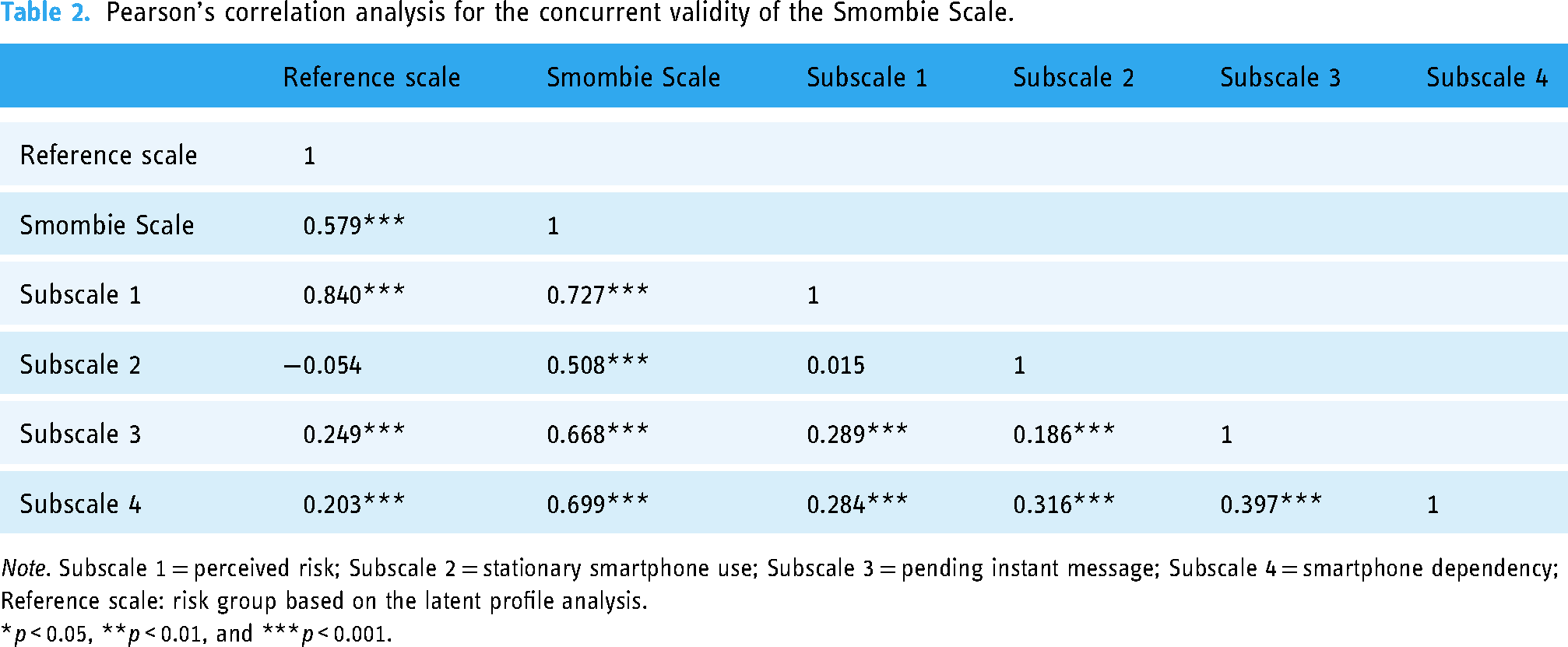
Note. Subscale 1 = perceived risk; Subscale 2 = stationary smartphone use; Subscale 3 = pending instant message; Subscale 4 = smartphone dependency; Reference scale: risk group based on the latent profile analysis.
*p < 0.05, **p < 0.01, and ***p < 0.001.
ROC curve analysis of the Smombie Scale
The ROC curve analysis indicated that the Smombie Scale was effective for identifying engaged road users at high risk (AUC value = 0.930) (Table 3). To find an optimal cut-off point, Youden's index values based on sensitivity and specificity were calculated for each cut-off point. As a result, the optimal cut-off point, which maximizes Youden's index, was 40.5 per 75 (equivalent to 2.70 of five points). This cut-off point based on the risk group obtained a sensitivity of 85.9% and a specificity of 86.5%, which means that 14.1% of the actual risk group and 13.5% of actual safety were misdiagnosed (Table 4 and Figure 2).

Receiver operating characteristic curve of the Smombie Scale.
ROC curve analysis of the Smombie Scale.

ROC: receiver operating characteristic; AUC: area under the ROC curve; SE, standard error; Sig: significance; Subscale 1: perceived risk; Subscale 2: stationary smartphone use; Subscale 3: pending instant message; Subscale 4: smartphone dependency.
The first one question “When using my smartphone while walking outside (sidewalk, street), I have had, or almost had, a traffic crash.”
Cut-off point of the Smombie Scale based on the “engaged road user at high risk” group obtained through latent profile analysis (N = 398).

ROC: receiver operating characteristic; AUC: area under the ROC curve.
Cut-off point based on Youden's index calculated using the formula “sensitivity + specificity − 1”; range of the Smombie Scale: 1–75; Subscale 1 = perceived risk (range 1–30); Subscale 2 = stationary smartphone use (range 1–15); Subscale 3 = pending instant message (range 1–15); Subscale 4 = smartphone dependency (range 1–15).
Discussion
This study's aim was to establish cut-off scores for the Smombie Scale to effectively identify pedestrians’ safety risks. The main finding was that a score of 40.5 of 75 (equivalent to 2.70 of five points) or higher was associated with a high risk of distracted walking.
In this study, the LPA was used to distinguish the latent risk group as a reference measure for the Smombie Scale. Latent groups were divided into two groups: risk and safe groups of smartphone users on the road. The proportion (17%) of the risk group was similar to that of the smartphone use rate while crossing the street in countries, such as South Korea and Australia.4,9
Furthermore, the Smombie Scale has an AUC of 0.930 on the ROC curve, which indicates that the scale has an excellent screening ability for identifying young adults who engage in distracted walking with their smartphones.26,27 The ROC curve is a visual representation that illustrates the performance of binary measures at different discrimination thresholds. This finding provides evidence supporting the validity and reliability of the Smombie Scale as a tool for identifying young adults at risk for pedestrian accidents and injuries due to distracted walking behaviors.
In the middle of the four subscales of the Smombie Scale, perceived risk had the highest screening ability in the risk group in contrast to pending instant message and smartphone dependency which were graded as “poor” and stationary smartphone as “fail” by the AUC. In the sensitivity of perceived risk, an accuracy of 99.7% was verified. In previous studies, safety behaviors were influenced by risk cognition, such as perceived seriousness and vulnerability. 29 Traffic risk perception played a significant role in influencing risky pedestrian behaviors, including traffic violations and aggressive behaviors. 30 Moreover, differences in risk perception may be more influenced by the types of potential hazards than the frequency or likelihood of injuries. 2 Although the exploration of risk perception in the context of distracted walking is limited, it is plausible that disparities in risk perception contribute to individuals’ choices to engage in distracted walking. 2 To facilitate a recalibration of risk perception in the digital era and promote pedestrian safety, safety practitioners should assess and evaluate risk perception thoroughly and suggest interventions to reduce pedestrian risks.23,31
Stationary smartphone use had the lowest prediction ability for screening the risky road user group. These findings align with Heitmayer's research, which suggests that individuals commonly utilize smartphones as a means of passing time, such as during periods of waiting or commuting, irrespective of the potential safety risks involved. 32 The results also revealed that checking the phone might be more automatic than users believe, irrespective of where they are. 8
Limitations and contributions
This study has several limitations. First, the data collected and analyzed were based on participants’ self-reported responses; thus, there is a possibility of self-report biases, such as social desirability or short-term recall. Second, the reference group used in the analysis was selected based on a statistical approach (LPA) rather than the actual experiences of pedestrian accidents while using smartphones on the road. Therefore, the results should not be generalized to individuals who have actually experienced such accidents. Future studies could validate the Smombie Scale with individuals who have been hospitalized or are in recuperative care after a smartphone-related traffic injury. Employing machine learning models could aid in predicting or clustering the at-risk group effectively. Third, there was a potential for sampling bias because convenience sampling was used to recruit young adults online. This recruitment method may have introduced bias and limited the generalizability of the results because participants who were active online were more likely to use smartphones. To enhance the diversity and generalizability of future study results, alternative sampling methods should be employed to recruit participants. Fourth, this study focused on young adults aged 18–39 years, which may constrain the generalizability of our findings. Future research could benefit from including a broader range of participants, such as adolescents or older adults, to enhance the applicability of the study's outcomes across various age groups.
Finally, this study used the same sample used in the first study on the Smombie Scale properties, which could have limited the generalizability of the findings. Future studies should include a representative sample, such as a nationally collected sample, comprising children, adults, and older adults. Additionally, more research is needed to test the scale's validity in other cultures and regions.
Despite the limitations, this study made a significant contribution to the literature because smartphones play an increasingly central role in people's daily and work lives, with concomitant increases in smombie-related crashes likely to follow, thus necessitating the availability of appropriate screening measures. The findings showed that the Smombie Scale could predict pedestrian safety risks related to smartphone use on the road with relative accuracy. These results have important implications for the development of public health policies, strategies, and intervention programs aimed at preventing pedestrian accidents related to smartphone use. However, it is crucial to acknowledge that additional research is needed to investigate the effectiveness of measurement aimed at reducing Smombie-related crashes and associated risks. Additionally, future studies could explore the use of intrinsic smartphone qualities, such as motion detection sensors, to measure pedestrian distraction and develop more precise risk assessment tools using machine learning models.20,21
Conclusions
This study's results provide strong evidence that the Smombie Scale is an effective screening tool for assessing pedestrian safety risk in young adults. A Smombie Scale score of 40.5 or higher is strongly associated with an increased risk to pedestrian safety resulting from smartphone use while walking. Identifying new thresholds of risk groups for the Smombie Scale is important from a traffic crash or safety risk viewpoint. This study provides a basis for educational planning for the safe use of digital devices on the road. For pedestrian safety, the installation of lights on the bottom or an alarm system for smombie on the road can be considered in urban planning. Most of all, this study provides suggestions for future directions for screening interventions in terms of increased awareness, targeting interventions, or methods of preventing risky behaviors. Despite this study focusing on young adults aged 18–39 years, future research could benefit from including a broader range of participants, such as adolescents or older adults, to enhance the applicability of the study's outcomes across various age groups.
Supplemental Material
sj-docx-1-dhj-10.1177_20552076241271851 - Supplemental material for Validity of the Smombie Scale: Sensitivity and specificity in identifying pedestrian risk group
Supplemental material, sj-docx-1-dhj-10.1177_20552076241271851 for Validity of the Smombie Scale: Sensitivity and specificity in identifying pedestrian risk group by Sumi Oh and Sunhee Park in DIGITAL HEALTH
Supplemental Material
sj-docx-2-dhj-10.1177_20552076241271851 - Supplemental material for Validity of the Smombie Scale: Sensitivity and specificity in identifying pedestrian risk group
Supplemental material, sj-docx-2-dhj-10.1177_20552076241271851 for Validity of the Smombie Scale: Sensitivity and specificity in identifying pedestrian risk group by Sumi Oh and Sunhee Park in DIGITAL HEALTH
Supplemental Material
sj-docx-3-dhj-10.1177_20552076241271851 - Supplemental material for Validity of the Smombie Scale: Sensitivity and specificity in identifying pedestrian risk group
Supplemental material, sj-docx-3-dhj-10.1177_20552076241271851 for Validity of the Smombie Scale: Sensitivity and specificity in identifying pedestrian risk group by Sumi Oh and Sunhee Park in DIGITAL HEALTH
Footnotes
Acknowledgements
None.
Contributorship
SP: Conceptualization, data curation, formal analysis, funding acquisition, investigation, methodology, project administration, resources, software, and writing. SO: Conceptualization, methodology, and validation
Declaration of conflicting interests
The authors declared no potential conflicts of interest with respect to the research, authorship, and/or publication of this article.
Ethical approval
The study was conducted following the Declaration of Helsinki and was approved by the IRB of Yonsei University in October 2020 (IRB number: 7001988-202010-HR-1008-02).
Funding
The authors disclosed receipt of the following financial support for the research, authorship, and/or publication of this article: This work was supported by the Ministry of Education of the Republic of Korea and the National Research Foundation of Korea (NRF—2021S1A5A806922111).

Supplemental material
Supplemental material for this article is available online.
References
Supplementary Material
Please find the following supplemental material available below.
For Open Access articles published under a Creative Commons License, all supplemental material carries the same license as the article it is associated with.
For non-Open Access articles published, all supplemental material carries a non-exclusive license, and permission requests for re-use of supplemental material or any part of supplemental material shall be sent directly to the copyright owner as specified in the copyright notice associated with the article.
