




Abstract
Objective
To systematically review the safety and the long-term mortality and morbidity risk-rates of the remotely-delivered cardiac rehabilitation (RDCR) interventions in coronary heart disease (CHD) patients.
Methods
The protocol was registered in the International Prospective Register of Systematic Reviews (CRD42023455471). Five databases (Pubmed, Scopus, Cochrane Central Register of Controlled Trials in the Cochrane Library, Cinahl and Web of Science) were reviewed from January 2012 up to August 2023. Inclusion criteria were: (a) randomized controlled trials, (b) RDCR implementation of at least 12 weeks duration, (c) assessment of safety, rates of serious adverse events (SAEs) and re-hospitalization incidences at endpoints more than 6 months. Three reviewers independently performed data extraction and assessed the risk of bias using the Cochrane Risk of Bias tool.
Results
14 studies were identified involving 2012 participants and a range of RDCR duration between 3 months to 1 year. The incidence rate of exercise-related SAEs was estimated at 1 per 53,770 patient-hours of RDCR exercise. A non-statistically significant reduction in the re-hospitalization rates and the days lost due to hospitalization was noticed in the RDCR groups. There were no exercise-related deaths. The overall study quality was of low risk.
Conclusions
RDCR can act as a safe alternative delivery mode of cardiac rehabilitation (CR). The low long-term rates of reported SAEs and re-hospitalization incidences of the RDCR could enhance the uptake rates of CR interventions. However, further investigation is needed in larger populations and longer assessment points.
Keywords
Introduction
Cardiovascular diseases (CVDs) appear as one of the leading causes of morbidity and mortality worldwide. 1 Coronary heart disease (CHD) is the most common type of CVDs, exhibiting a steady rise both in the total number of disability-adjusted life years (DALYs) and in the morbidity rates during the last decade 2 ; thus presenting a significant burden for the national health systems. 3 Secondary prevention interventions such as exercise-based cardiac rehabilitation (CR) are highly recommended as a significant tool orientated towards the reduction of cardiac-induced mortality, re-hospitalization rates and the enhancement of the cardiac patients’ quality of life. 4 CR is a safe, 5 multidisciplinary intervention that encloses various components, such as individually – prescribed exercise training, diet, nutritional and smoking counseling, psychological support and cardiac risk factor modification.6,7
Despite the well-documented efficiency of the CR interventions in the advancement of the cardiac patients’ health status, 8 the adherence rates appear low, with only 1 in 4 eligible patients finally enrolling. 9 Potential barriers leading to low participation and adherence to CR programs include multifactorial conditions, such as comorbidities, limited availability of CR programs, distance from rehabilitation facilities, high medical costs, and time commitment.10–12 Moreover, discriminations in CR participation related to sex, race, ethnicity, socioeconomic status, and geographic location are noticed. 13 Furthermore, the recent COVID-19 pandemic induced additional barriers to CR participation via the temporary cessation of many CR programs that led to additional deterioration of the cardiac patients’ cardiovascular function.14,15
To surpass the aforementioned barriers, the home-based CR (HBCR) is proposed as an efficient alternative for not only the enhancement of the uptake rates of the CR implementation but also for the overall improvement of the cardiorespiratory fitness, physical activity and psychosocial status of the cardiac population.16,17 The rapid proliferation of affordable and easy-to-use information and communication technologies (ICTs) has allowed the integration of telehealth components within the CR procedures. 18 Remotely delivered CR (RDCR) via the use of ICTs such as web-based platforms or applications, smartphones, wearable sensors and virtual reality is proposed to be used as a sufficient alternative CR delivery mode, equivalent to traditional center-based ones. 19 Several recent systematic reviews and studies have demonstrated the efficacy and feasibility of RDCR interventions in improving cardiac patients’ overall health status20–22 and reducing rehabilitation costs 23 and re-hospitalization rates. 18 Despite the several studies addressing the short or medium-term safety of RDCR interventions,24,25 scarce evidence exists regarding the long-term evaluation of serious cardiac adverse events (SAEs), re-hospitalization or all-cause mortality rates. Bearing in mind that the lifelong, safe continuance of the CR interventions is crucial for maintaining the benefits achieved, this systematic review aimed to further explore the safety and the long-term mortality and morbidity risk-rates of the RDCR interventions.
Methods
Study design
The present systematic review of randomized controlled trials (RCTs) is written according to the guidelines from the Preferred Reporting Items for Systematic Review and Meta-Analysis (PRISMA). 26 The protocol of this systematic review is registered in PROSPERO (International Prospective Register of Systematic Reviews) (registration number: CRD42023455471) prior to screening search results.
Search strategy
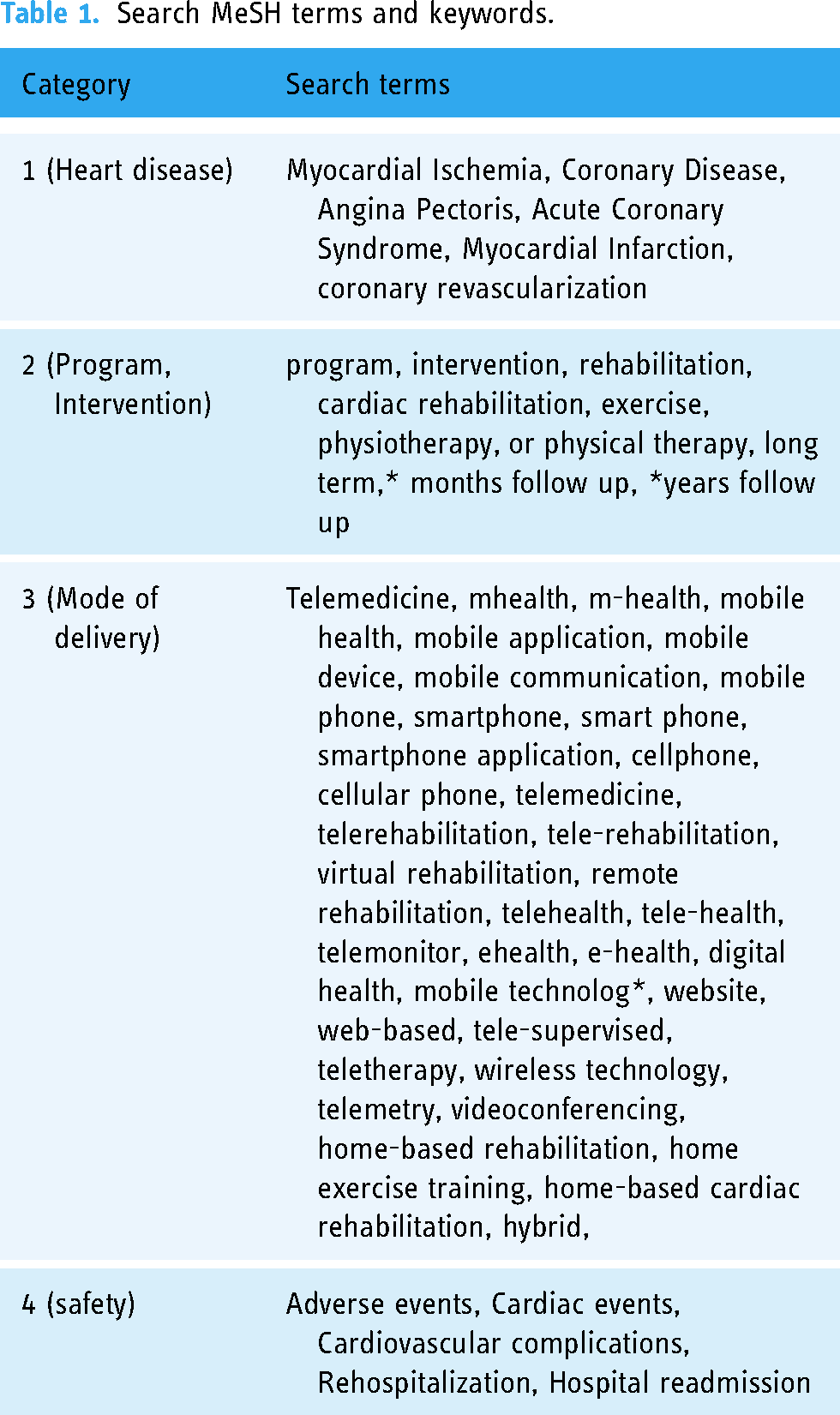
A thorough systematic electronic literature search was performed across five electronic databases to identify relevant studies: Pubmed, Scopus, the Cochrane Central Register of Controlled Trials in the Cochrane Library, Cinahl and Web of Science. Based both on the continuous rapid development of the ICTs and the aim of this systematic review to focus on the most up-to-date RDCR interventions, relevant for inclusion studies were searched within the last decade, from January 2012 up to August 2023. The systematic search strategy included the combination of the following four categories of relevant keywords: coronary heart disease, program/intervention, mode of delivery and safety. The list of relevant keywords is presented in Table 1. Only relevant, full-text articles, written in English were included in the final list of the systematic review. Manual searches were conducted on the reference lists of the retrieved papers, review articles and relevant conference lists.
Search MeSH terms and keywords.
Study inclusion criteria
Studies were included if they addressed the following inclusion criteria based on the PICO model.
Population: adults (≥18 years old), with no restrictions regarding sex, ethnicity and socioeconomic background, diagnosed with CVD [acute coronary syndrome (myocardial infarction) or post coronary revascularization, such as percutaneous coronary intervention (PCI) or coronary artery bypass grafting (CABG)] and eligible for phase III of CR. Intervention: implementation of RDCR, with a minimum of 2 exercise sessions a week and intervention duration of at least 12 weeks. At least 50% of the RDCR interventions should be delivered by any of the following modes: smartphones, wearable monitoring devices, virtual reality, videoconferencing or other internet interventions. RDCR should also include modes of delivering nutritional/dietary counseling, cardiac risk profile, smoking cessation and psychosocial support. Comparison: RDCR should be compared to either a usual care group or a centre-based CR (CBCR). CBCR applied to face-to-face, center-based or community-based CR. Usual care refered to any routine care for CHD patients, except of telehealth interventions. Outcome: Safety of the intervention as a primary or secondary outcome and adverse or cardiac events, re-hospitalization, mortality, and morbidity assessed at endpoints more than 6 months.
Narrative reviews, preclinical studies, duplicate studies, editorial or opinion articles, grey literature and conference papers were excluded. Additionally, systematic reviews, study protocols, studies with a follow-up time of less than 6 months and repeated publications were not eligible for inclusion. It needs to be mentioned though, that relevant systematic reviews were assessed as a guide and cited where appropriate to identify and retrieve additional relevant RCTs.
Study selection process
Potentially relevant papers, meeting the aforementioned search criteria, were exported to Endnote X9. Following the exclusion of duplicates, two reviewers (VA, GP) independently screened the title and abstract of the studies in the finalized search list. Those not meeting the eligibility criteria were removed. A full-text screening of the remaining relevant papers was conducted to determine the final eligibility with the review criteria. Any disagreements between the two reviewers, regarding either the inclusion of relevant papers or data extraction from each relevant study, were resolved by consensus with a third independent reviewer (EK), thus ensuring the minimization of bias.
Data extraction
Data extraction was performed on the selected studies including the following domains: (1) study design (first author, year of publication, country, study design, follow-up end-points), (2) participants (sample size, sex, age, diagnosis), (3) intervention (mode of delivery, frequency and duration, comparator), (4) outcomes, and (5) risk of bias (6) results.
Extraction of adverse events
The total number of patient-hours of RDCR rehabilitation was calculated, according to the methodological design of the included studies. One patient-hour was determined as one completed exercise session. The reported exercise adherence in the final results of each study was used to estimate the total patient-hours fully delivered during the intervention period. Adverse events (AEs) extracted were identified as mild or moderate-severe cardiac events that could lead to further hospitalization or emergency calls. 27 Mortality was defined as a severe adverse event. AEs were subsequently analyzed as exercise-related or not.
Risk of bias (quality) assessment
The Cochrane Risk of Bias tool for randomized trials 28 was used as a guide for the quality assessment of each included study. It consists of the following domains: random sequence generation, allocation concealment, blinding of participants and personnel, blinding of outcome assessment, incomplete outcome data and selective reporting. Two independent reviewers (AV, PG) conducted the quality appraisal individually. Any discrepancies were resolved via consultation with a third reviewer.
Data synthesis
Α descriptive narrative synthesis of the study design, the included population, the intervention (mode of delivery, wearables used) and the main outcomes (SAEs, re-hospitalization rates, mortality/morbidity rates) was conducted and further presented in a tabular format in order to highlight the more essential similarities and differences between the studies. We also recorded the inclusion and exclusion criteria for study participation as well as the drop-out and adherence rates The studies were then grouped by type of study population [intervention group (RDCR) and control group (CBCR or usual care)], outcome measures (SAEs, re-hospitalization rates, mortality/morbidity rates) and correlation of outcome measures to exercise implementation. Patterns were emerged and common aspects between the studies were translated into results. Synthesis of the recorded evidence followed in order to provide a narrative, relevant to the aim of the study.
Results
Study selection
The initial search of the five electronic databases identified 878 records, of which 44 duplicates were removed. Of the remaining 834 records that underwent title and abstract screening, 754 were excluded for not meeting the inclusion criteria; thus 80 records were further sought for full-text review. Full-text retrieval was accomplished for 62 records, from which, 48 records were excluded for reasons documented in Figure 1. Finally, 14 studies were included in this review.

Flowchart of the study.
Description of the included studies
A summary of the characteristics of the included studies is presented in Table 2. All included studies were RCTs, involving a total of 2012 participants (sample size ranging between 78 and 312 participants), with 1002 participants in the intervention group (IG) and 1010 participants in the control group (CG). A total of 383 females were included, accounting for 19% of the overall sample size. Three studies were conducted in Belgium29–31 and Netherlands,32–34 two in Canada35,36 and USA,37,38 one in China, 39 one in the New Zealand, 40 one in Denmark 41 and one in Germany. 42 Based on the World Bank database almost all studies were implemented in countries classified as high-income, according to their gross national income per capita 43 with the sole exception of China, classified as an upper-middle income country. Eligible participants in this review were all diagnosed with CHD such as angina, myocardial infarction (MI), acute coronary syndrome (ACS) or had undergone coronary revascularization. The mean age of participants ranged from 56.4 to 65 years and 53.6 to 65 years for the intervention and control groups respectively. The description of the usual care group varied but mainly referred to encouragement to be physically active, but no participation in supervised CR programs, self-initiated access to CR education sessions and psychosocial support. CBCR referred to CR interventions delivered, face-to-face- in hospitals facilities under the direct guidance of specialized staff. Three studies included a hybrid design that referred to a combination of center-based, supervised CR, subsequently followed by the implementation of RDCR interventions.31,37,44
Study characteristics.

6MWT, 6-min walk test;CAD, coronary artery disease; CPET, cardiopulmonary exercise testing; DBP, diastolic blood pressure; DHI, Digital health interventions; HbA1c, hemoglobin A1c; HR, heart rate; HRQoL, health-related quality of life; IPAQ, international physical activity Questionnaire; MACE, major adverse cardiovascular events ; MICT, Moderate-Intensity Continuous Training; PA, physical activity; QoL, quality of life; SBP, systolic blood pressure; SD, standard deviation; SMART-CR/SP, smartphone-based-cardiac rehabilitation/secondary prevention; VT1, first ventilatory threshold; VT2, second ventilatory threshold; vCRP, virtual cardiac rehabilitation program; VO2, oxygen consumption.
In all included studies, being an adult (>18 years) with a diagnosis of CHD and an ability to speak and understand the native language were set as the prerequisite criteria for the inclusion in the study sample. Furthermore in 8 studies29–31,34–36,39,40 the access to Internet or the possession of a smartphone were requested as additional inclusion prerequisites. Contrawise, the potential participants were excluded from the sample –mainly- based on the coexistence of any of the following criteria: (a) functional or mental disability that may limit exercise (in all included studies) (b) ventricular arrhythmia29–31,34 or myocardial ischaemia29–34,41 (c) NYHA IV (FEV1 < 50%)29–31,36 (d) acute or chronic inflammatory diseases or malignancy30,40 or pregnancy34,41 (e) no access, availability or insufficient knowledge of a computer with internet32,33,39 (f) implanted cardiac device (pacemaker, etc.)32,33,36 Only one study 38 didn’t report the exclusion criteria within its method section (Table 3).
Summary of the inclusion/exclusion criteria, drop-out and adherence rates reported in the included studies.
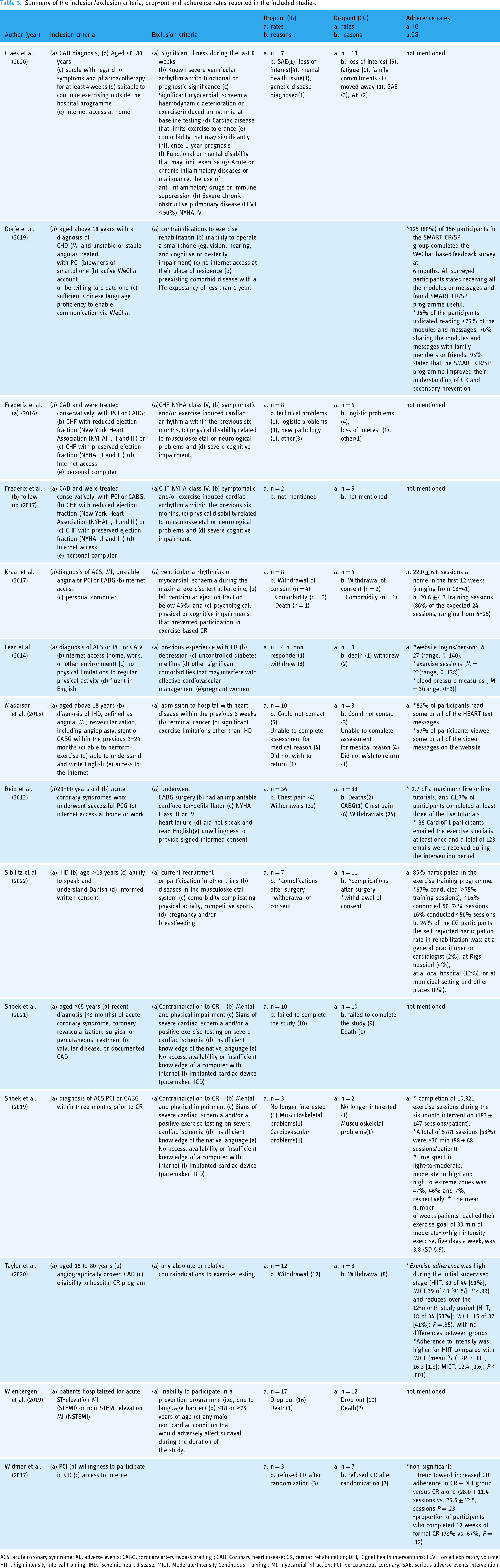
ACS, acute coronary syndrome; AE, adverse events; CABG, coronary artery bypass grafting ; CAD, Coronary heart disease; CR, cardiac rehabilitation; DHI, Digital health interventions; FEV, Forced expiratory volume; HITT, high intensity interval training; IHD, ischemic heart disease; MICT, Moderate-Intensity Continuous Training ; MI, myocardial infraction; PCI, percutaneous coronary; SAE, serious adverse events intervention.
Intervention characteristics
Based on the FITT model (frequency, intensity, time and type of exercise), a variety of features of the CR implementation were noticed among the several included studies. In particular, four studies reported a 3-month duration of RDCR,38,41,44,45 six studies reported a 6-month duration,31–33,36,39,40 one study had a 4 month duration 35 and one study had an 1-year duration period. 37 The frequency of the exercise sessions ranged from two to six sessions per week and the duration of each exercise session ranged from 16 to 60 min per session. The majority of the studies reported exercise intensity individually set at 70%–80% of each participant's heart rate reserve (HRR) and an 11–13 Borg score of perceived exertion. Only one study reported higher intensity levels corresponding to a rating of perceived exertion
(RPE) of 15 to 18 on the Borg 6 to 20 scale. 37 Taking into account that in almost all exercise interventions an individually-tailored exercise prescription was used, the volume of the exercise taken was difficult to be quantified. Furthermore, both the intensity and safety of the implemented exercise program and the amount of physical activity achieved in the RDCR groups were remotely monitored by electrocardiogram telemetry, wearable heart rate sensors, video platforms, accelerometers and pedometers. The most widely used wearable sensors were accelerometers or pedometers for the recording of the physical activity.29–31,34,36–40 The majority of the included studies, also, involved CR supported via Internet web applications or software30,33–35,39–41,44 and heart rate32,–35,37,39,41 blood pressure30,35,39 and electrocardiogram30,41 telemetry. The details of the included sensors are provided in Table 2. The follow up time across the included studies ranged between 6 to 24 months with a median of 11.3 months.
Randomization procedures were reported in all the included studies. The type of the comparators’ group to RDCR that was used differed among the studies. Four studies compared a RDCR group to a traditional CBCR group31,34,37,38 and ten studies compared RDCR to a usual care group.29,32,33,35,36,39–41,44,45 Both the CBCR and RDCR programs were orientated toward aerobic training, mainly walking and cycling. The sole exception was the study of Taylor et al. which included a High Intensity Interval Training (HIIT) mode for the RDCR intervention group. 37 Several forms of communication, such as text messages, phone or video calls and emails were utilized every week for educational, nutritional and psychological feedback between the participants and the intervention team. Additional feedback was given upon the adjustment of exercise modalities and features, the barriers to CR adherence and the incidence of adverse events. The drop-out rates and reasons for dropping-out were described in all included studies except one, 39 revealing a slightly higher drop-out rate in the intervention group when compared to the CG. More specifically from a sample of 869 RDCR participants, 82 individuals dropped – out of the intervention procedures (9.4%) due to various reasons; whilst among the CG the drop-out rate was 8.6%, since 83 individuals out of a total of 960 CR participants did not manage to reach the final study assessment endpoint. The main dropping out reason, for both RDCR groups and CGs, was the loss of interest or the withdrawal from the study (RDCR: 77 participants, CG: 61 participants).30,32–34,36,37,41 It is worth noted that only 2 deaths34,44 and 1 SAE 30 were reported in the RDCR group whilst in the CG the corresponding numbers were 632,35,36,44 and 3 30 respectively. Other common reasons for which the participants dropped-out of the study included musculoskeletal problems, 32 chest pain, 36 technical or logistical problems 29 (Table 3). Adherence rates were reported in nine studies33–37,39–41,44 indicating a quite high adherence compliance to the RDCR interventions with the sole exception of one study 37 that reported a decline in CR adherence during the RDCR period (Table 3). More specifically in the study of Dorje et al., 39 more than 95% of the RDCR participants had completed reading >75% of the WeChat modules and messages and had their understanding of CR and secondary prevention improved via the RDCR intervention. Similarly in another two studies40,41 the participation rate in the RDCR interventions was higher than 80%. Additionally, the participation in the RDCR interventions (exercise sessions/online tutorials) was reported to have reached more than 50% of the scheduled total intervention volume.34,36 Notably enough, a trend towards a higher adherence rate to RDCR participation, compared to CR alone, was noticed; though statistically non-significant. 38 All studies reported sources of trial funding; though none of them reported funding from any agency with a commercial interest in the results of their study.
Risk of bias of included studies
Selection bias regarding the generation of the random allocation sequence was considered low risk, as all 14 studies included an adequate description of the random sequence generation. Samewise, almost all trials, except one, 37 reported details, concerning the sample's allocation concealment and thus were assessed as low risk. Taking into account the methodological nature of these trials, achieving the participants’ or rehabilitation providers’ blinding to group allocation is impossible. It needs to be mentioned, though, that in such study designs, the blinding of the outcome assessment can be considered of greater importance. However, in only 8 studies details on measures taken for assessors’ blinding were mentioned.29,31,35,36,39–41,45 Considering attrition and reporting bias, both domains were mostly rated as low risk. Only one study reported increased attrition rates and was evaluated as at high risk. 38 A summary and a graph of the risk of bias are provided in Figures 2 and 3, respectively.

Risk of bias summary.

Risk of bias graph.
Incidence of adverse events
The incidence of the reported AEs within the included studies is documented in Table 4. Almost all studies reported the occurrence of AEs; except one that reported the absence of any AE during the intervention period. 39 However, only one study 40 reported one (n = 1) SAEs associated with RDCR exercise (cycling accident). Additionally, in another study, an increased occurrence of self-reported, non-serious, exercise-related AEs, primarily caused by musculoskeletal problems was identified. 41 The majority of the SAEs were reported in the CG as compared to the IG (38 and 33 respectively). In two studies no AEs 39 or SAE 34 were reported, either for the IG or the CG. The incidence rate of exercise-related SAEs was estimated at 1 per 53,770 patient-hours of RDCR exercise. A reduction in the re-hospitalization rates and the days lost due to hospitalization was noticed in the IGs; though not statistically significant.29,31–36,38,41 A smaller number of participants being re-hospitalized due to cardiovascular reasons in favor of the IG group was documented both in the 6 month [IG (7), CG (16)] and the 2 years endpoints [IG:32, CG:60].29,31 A similar reduction in readmission rates was noticed in another study at 6 month endpoint; though with non-significant effect at 24 months. 41 In total 51 hospital readmissions were reported for the RDCR participants in contrast to 105 readmissions within the CG. The major reasons for re-hospitalization were PCI,30,34,35 CABG,30,34 ablation, 30 chest pain36,40 Additionally a longer period for the first rehospitalization was maintained for the IG participants in a medium and long-term spectrum.29,31 There were no exercise-related deaths.
Adverse events/cardiac events/rehospitalization reported in the studies.
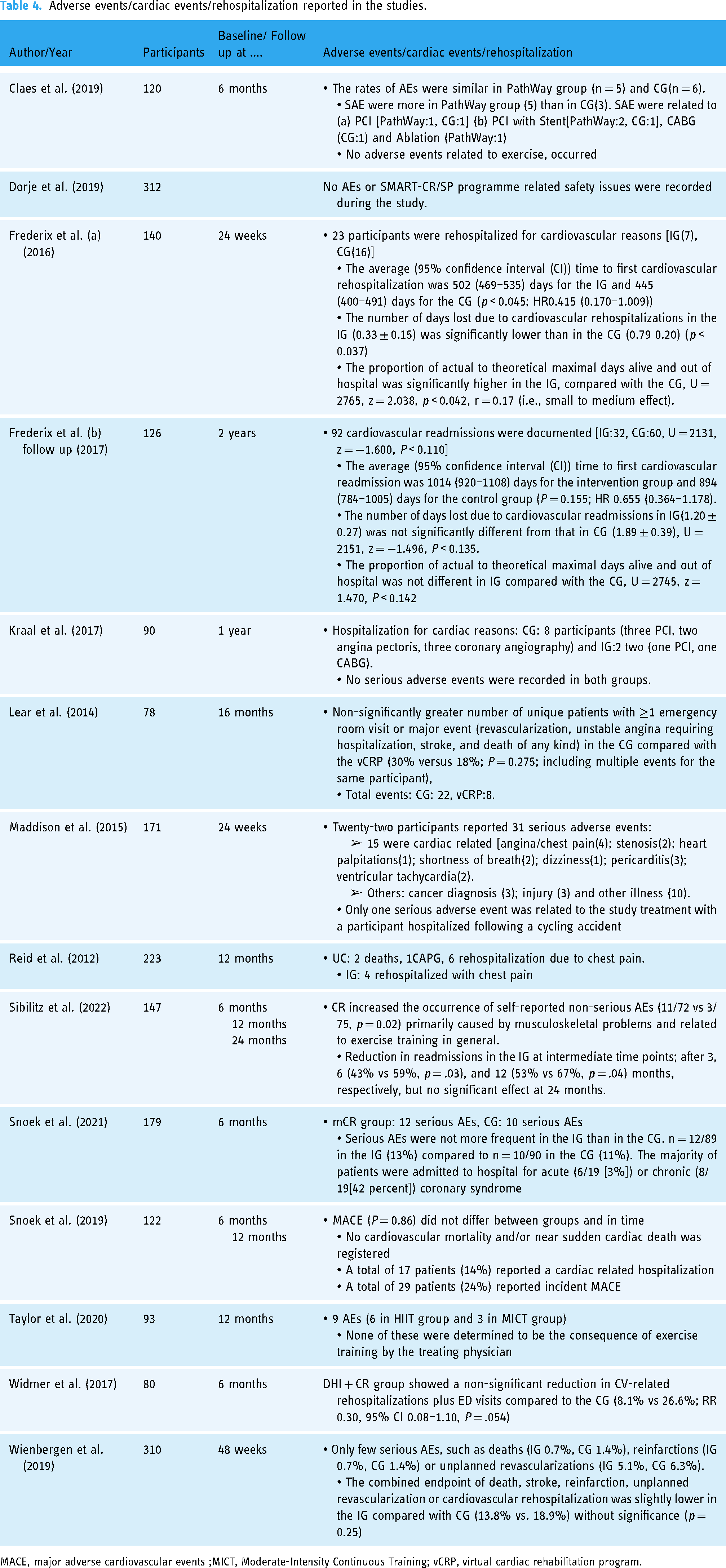
MACE, major adverse cardiovascular events ;MICT, Moderate-Intensity Continuous Training; vCRP, virtual cardiac rehabilitation program.
Discussion
The recent appearance and rapid spread of the COVID-19 pandemic acted as the trigger towards a necessary change in the delivery modes of CR. A transition from CBCR interventions to home-based, remotely-monitored ones has been proposed and adopted as an alternative CR adjunct. It needs to be mentioned though, that assuring safety is considered of vital significance for the effective outcome of an intervention. Thus, the investigation of the safety and the security of the shift from centre-based to home-based, RDCR interventions has been a controversial issue. Additionally, by considering that a lifelong continuance of CR is a prerequisite to maintain the beneficial effects on CHD patients’ health status, the assurance of the long term CR safety and the avoidance of CR-related cardiac relapse incidences are crucial factors.
Limited scientific data exist on the safety of RDCR interventions,5,46 mainly focusing on the short or medium-term safety; thus this present systematic review is the first one, to our knowledge, that addresses not only the safety of RDCR interventions among the CHD population but also focuses on the long term risk-rates of re-hospitalization and SAEs. Fourteen studies, with a total of 1002 CHD participants in the RDCR intervention groups, synthesized this systematic review. Notably enough, only 1 exercise-related SAE per 53,770 patient-hours of RDCR exercise was reported, indicating the safety of these interventions. In particular one participant had to be hospitalized due to a cycling accident during the RDCR. 40 Additionally, in two studies that involved almost 400 participants within the RDCR groups, no SAEs or safety issues were recorded.34,39 These results are similar to a previous systematic review that also reported the incidence of 1 SAE per 23,823 patient-hours of exercise among the HBCR groups. 5 However, the systematic review of Stefanakis et al. evaluated the general safety of the HBCR interventions and was not focused on the CHD population solely. 5 Furthermore, it is worth mentioning that even when a HIIT exercise program was implemented in the participants’ home settings, no SAEs were determined as a consequence of exercise training. 37
The low incidence of exercise-related SAEs reported in the included studies of this systematic review can be attributed to reasons such as the appropriate sample configuration and the thorough surveillance of the CR interventions. All included studies reported measures taken to ensure proper sample configuration according to inclusion and cardiac risk stratification criteria, thorough baseline evaluation procedures and remotely-delivered surveillance of exercise modalities via ICTs, digital health and wearable sensors technology. Results from a systematic review propose the potentiality of digitally delivered CR interventions to minimize the occurrence of SAEs related to CR implementation. 47 Similarly in another study the mobile-based CR group displayed significant reductions in rehospitalizations and emergency department visits. 48 Additionally, the delivery of individually-prescribed exercise programs, according to the results of the thorough baseline assessment of each patient's physical status (CPET, 6MWT, etc.), may have contributed to the minimization of the occurrence of SAEs during the RDCR interventions, in which the component of the direct (face-to-face) supervision of the exercise sessions is lacking. Same wise, in another recent systematic review assessing the long-term effects of RDCR interventions in 709 coronary artery disease patients, it was proposed that the most effective way to improve the safety of such interventions was to fully assess the patient's status, prior to implementation via CPET, noninvasive cardiac output or physical assessment. 49 However, it is necessary to emphasize that the above-mentioned systematic review evaluated the safety of RDCA interventions solely through the incidence of AEs. Whilst the present systematic review is differentiated by addressing as safety outcome measures not only the occurrence of AEs but also the long-term improvements in SAEs and the re-hospitalization and mortality/morbidity rates in CHD patients.
When comparing the safety of the traditional CBCR interventions to the RDCR ones, no statistically significant differences, regarding the incidence of SAEs, were noted. These results are consistent with a previous Cochrane systematic review that included 23 trials with 2890 randomized cardiac participants that found no evidence supporting important differences in mortality or cardiac events rates for patients receiving CBCR or RDCR, either in the short-term (3 to 12 months) or longer-term (up to 24 months). 17 Though it needs to be mentioned that this systematic review, in contrast to the current systematic review, involved - among others- RDCR interventions of a rather short duration(<12weeks), that could have affected the results concerning mortality and morbidity rates. Notably, in this systematic review, several studies reported a lower but not statistical significant rehospitalization rate among the RDCR groups when compared to CGs.29,31,34,35,37 Even more, in two studies a non-significant reduction in cardiovascular-related rehospitalization and emergency department visits for the RDCR group was reported.38,41 In a 2-year, follow-up study, a trend towards a lower cardiovascular readmission rate was noted, despite the partial relapse in the CHD patients’ cardiac profile after the termination of the RDCR 29 ; thus further reinforcing the potentiality of a long-term morbidity and mortality risk reduction of the RDCR interventions.
Moreover, the quality assessment of the included studies in this systematic review displayed a high quality of design and reporting; thus enhancing the scientific validity of their data and consequently of the present systematic review. Similar high-quality studies were reported in a previous systematic review regarding the safety of the home-based CR. 5
This current systematic review allows a deep insight into the capability of the RDCR programs to ensure safety and a long term mortality and morbidity risk-rate reduction for their CHD participants. Bearing in mind that CR is considered an indisputable structural component of the lifelong secondary prevention process of patients with CVD, the handling of the safety matters of CR implementation should be granted as priority. According to recent scientific advice from the American Heart Association, it is essential to examine the safety and security of the transition from RDCR interventions to home-based RDCR intervention. 50 The rather recent, wider utilization and proliferation of RDCR programs among the CHD population has not only enabled an increase in the CR uptake rates but has also highlighted the need to confront and adequately resolve any emerging safety-related issue. The results of this systematic review add evidence to the potentiality of the RDCR interventions to act as a safe alternative adjunct to conventional CBCR. However, there is a profound need, for all the scientists involved in the CR implementation, to further investigate, detect and subsequently counteract any possible factors that could put the long-term safety of RDCR interventions into jeopardy.
Study limitations
Even though this systematic review is probably the first one that investigates and evaluates the safety and the long-term mortality and morbidity rates of the RDCR interventions, it displays several limitations. Since, up to now, relatively few trials have investigated the aforementioned components of RDCR interventions, it was difficult to unify the trial research protocols based on different exercise delivery components, according to the FITT principle. Furthermore, limitations regarding small sample size and composition were detected. Many studies had fewer than 70 participants in the intervention groups and most of the patients in the included studies were males and of low cardiac risk; thus limiting the generalization of this systematic review results to the total cardiac population. Additionally, the inclusion criteria of only English-written papers and original published research articles might have led to missing other relevant literature in other languages or information available from the grey literature.
Conclusions
RDCR can act as a safe alternative delivery mode of CR, even in a long-term perspective. The low incidence of reported SAEs in the long-term assessment endpoints reinforces the potential of RDCR to increase the uptake rates of CR interventions; thus confront the several barriers that reduce CR participation
Footnotes
List of abbreviations
Acknowledgments
This study does not have any acknowledgements.
Author contributions
Conceptualization: VA, GP.; methodology: VA, EK, CHD, LD and GP.; writing – original draft preparation: VA, GP.; writing – review and editing: VA, EK, CHD, LD and GP.; visualization: VA, GP.; funding acquisition: LB. All authors approved the final manuscript to be published.
Declaration of conflicting interests
The author(s) declared no potential conflicts of interest with respect to the research, authorship, and/or publication of this article.
Funding
The author(s) disclosed receipt of the following financial support for the research, authorship, and/or publication of this article: This research was funded by the Ministry of Health, Czech Republic; conceptual development of research organization (FNBr, 65269705).
Ethical approval
Institutional review board approval was not required as this article was a systematic review of the literature and not original research.
Patient consent
Patient informed consent was not required due to the study design (overview of systematic reviews).
Guarantor
VA takes full responsibility for the article, including for the accuracy and appropriateness of the reference list.
