



Abstract
Objective
Mobile Health apps could be a feasible and effective tool to raise awareness for breast cancer prevention and to support women to change their behaviour to a healthier lifestyle. The aim of this study was to analyse the characteristics and quality of apps designed for breast cancer prevention and education.
Methods
We conducted a systematic search for apps covering breast cancer prevention topics in the Google Play and Apple App Store accessible from Germany using search terms either in German or in English. Only apps with a last update after June 2020 were included. The apps identified were downloaded and evaluated by two independent researchers. App quality was analysed using the Mobile Application Rating Scale (MARS). Associations of app characteristics and MARS rating were analysed.
Results
We identified 19 apps available in the Google Play Store and seven apps available in the Apple App Store that met all inclusion criteria. The mean MARS score was 3.07 and 3.50, respectively. Functionality was the highest-scoring domain. Operating system, developer (healthcare), download rates and time since the last update were significantly associated with overall MARS score. In addition, the presence of the following app functions significantly influenced MARS rating: breast self-examination tutorial, reminder for self-examination, documentation feature and education about breast cancer risk factors.
Conclusions
Although most of the apps offer important features for breast cancer prevention, none of the analysed apps combined all functions. The absence of healthcare professionals’ expertise in developing apps negatively affects the overall quality.
Introduction
One in eight women will be diagnosed with breast cancer in the course of life. Breast cancer is the most common type of cancer in women with approximately 71.400 cases in 2019 in Germany.1,2 Although mortality is decreasing in high-income countries, mostly due to improved treatments, incidence has been steadily increasing owing to the implementation of the mammographic screening for women of 50 to 69 years. 3 In 2018, around 2.86 million women participated in the mammographic screening programme in Germany and 17,377 of the screened women were diagnosed with breast cancer, 4 which otherwise might have been detected later and with advanced cancer stage. This further underlines the importance of effective preventive measures.
There are multiple risk factors associated with the development of breast cancer.5,6 Effective and active cancer prevention and screening programmes are particularly crucial for women harbouring such risk factors. Non-genetic factors such as age, race or ethnicity, personal history of breast pathologies, high mammographic density, age at menarche and menopause are also associated with increased breast cancer risk, and education about such risk factors is crucial.5–10 In addition, modifiable lifestyle factors, including dietary habits, body mass index, physical activity, alcohol and tobacco consumption, use of exogenous oestrogen and reproductive history such as age at first childbirth and breastfeeding, contribute to breast cancer risk.5–10 The individual risk of developing breast cancer can be quantified using risk assessment tools like the Gail and Claus model.11–13 Various strategies exist to decrease the lifetime risk of breast cancer, including risk reduction through pharmacotherapy, surgery and dietary and nutritional interventions.5,7,8 To enhance the effectiveness of preventive strategies aimed at personal behaviour, the adoption of healthy habits needs to be promoted and popularized both on an individual level and a societal level. 7
Nowadays, digital tools including mHealth apps are increasingly recognized as essential and widely used resources for provision of information and education. mHealth apps provide a range of functionalities and benefits, including tailored health information, interactive features, reminders and tracking tools and real-time monitoring of health behaviours, which are not typically available through traditional websites or other information sources.
In the context of breast cancer prevention, mHealth apps can support users in various ways: It has been shown that smartphone apps are a feasible and acceptable intervention for weight loss by tracking physical activity and nutrition,14–16 also specifically for breast cancer prevention in women, 17 increasing cessation rates of tobacco and alcohol consumption,18–20 teaching breast self-examination (BSE),21–23 increasing attendance and promoting breast cancer screening programmes. 24
However, there are little restrictions on who can develop and publish an app and regulatory organizations rarely check the validity of the health information provided in these apps.25,26 This has resulted in many websites27,28 and mHealth apps providing unclear quality of information for patients,3,28–33 which is particularly troublesome as patients who are not familiar with medicine topics often cannot differentiate between trustworthy, reliable and less relevant information, putting users’ health and safety at risk.27,28,33 While mHealth apps have a great potential to aid women in adopting healthier lifestyles, raising awareness about the significance of breast cancer prevention and offering dependable and accurate information, prior reviews about breast cancer apps are still subjected to various limitations. Some have only focused on breast cancer patients or survivors,30,34,35 while others conducted app store searches from other continents than Europe,35,36 or only analysed app content and not their quality.30,32,34–36 Consequently, we set out to provide a review of mobile apps available on the German Google Play or Apple App store covering particularly apps focusing on breast cancer prevention and education. This study aims to evaluate the characteristics, functionality and quality of these apps by using a multidimensional tool developed for classifying and rating the quality of mobile health apps.
Materials and methods
This review was conducted using the Preferred Reporting Items for Systematic reviews and Meta-Analysis (PRISMA) model to remain consistent with other published systematic reviews. 37 Furthermore, the protocol for this review was registered with the International Platform of Registered Systematic Review and Meta-analysis Protocols (INPLASY) under the registration number INPLASY202380101. 38
Systematic search
A systematic search of mobile apps focusing on breast cancer prevention and education accessible from Germany was conducted between March and June 2022. The search was performed using the search function within the Google Play and the Apple App store, respectively, and the search included the following search terms, either in English or in German: breast cancer, breast cancer help, breastcancer, Brustkrebs, Brustkrebshilfe and Mammakarzinom. We captured the app's title, developer, date of last update, price, language, categorization within the app store, download numbers and user ratings in the app store.
App selection process
All apps matching the search terms were categorized in the following five groups if the apps are, according to the app title, description in the app store, screenshots or user comments, related to breast cancer: prevention and enlightenment, therapy, aftercare, for professionals and others. Apps addressing breast cancer social network apps or diary apps were categorized in “Others”. Apps were excluded and defined as false hit based on the following criteria: (a) no relation to breast cancer, e.g. apps made for other types of cancer; (b) had a relation to breast cancer but did not fit in one of the above groups, e.g. apps without a benefit for the user itself like wallpaper apps; and (3) were not available in either English or German.
Duplicates within the results for the different search terms were removed, and only apps that were part of the prevention and enlightenment category, and were last updated after June 2020, were downloaded for further evaluation. Only duplicates within each of the app stores (Google or Apple) were removed. Apps available within both app stores were included for each app store individually. Downloaded apps were examined for their technical aspects including share on social media, an app community, registration necessary, in-app purchases, show advertisements and data management, prevention-related implemented functions like BSE tutorials, reminders for self-examination, documentation feature to note findings, information about breast cancer risk factors, mammography and screening programs, citation of scientific literature and reports of patients who have already undergone breast cancer therapy and rated using the Mobile Application Rating Scale (MARS). 39 Technical subgroup definition was inspired by Bardus et al. 40 Technical and prevention-related implemented features were captured and displayed as tables.
Functionality behind paywalls was not analysed
Two independent reviewers tested each app in a real-world setting. The apps were rated and reviewed in iOS 16.1 with an iPhone 12 and on Android 9 with a Samsung Galaxy S8. Second rater used an iPhone SE (iOS 15.6.1) and a Google Pixel 6 (Android 13).
Rating using the Mobile Application Rating Scale
Two independent reviewers rated each app using the MARS. The MARS is a simple, reliable and objective tool for analysing, classifying and evaluating the quality of mobile applications, which is also used in similar publications.39–41 It includes an app classification section to collect descriptive and technical information, an app quality rating section including 23 items in five sections:
Engagement – is the app fun, interesting, customizable, interactive (e.g. sends alerts, messages, reminders and feedback and enables sharing) and well-targeted to the audience? Functionality – app functioning, easy to learn, navigation, flow logic and gestural design of the app. Aesthetics – graphic design, overall visual appeal, colour scheme and stylistic consistency. Information – is the app containing high-quality information (e.g. text, feedback, measures and references) from a credible source? Satisfaction – app subjective quality
And an app-specific section to assess the perceived impact of the app on the user. Each item uses a 5-point scale (1, inadequate; 2, poor; 3, acceptable; 4, good; 5, excellent; from 1, strongly disagree to 5, strongly agree, respectively). Item 19 of MARS was excluded, since none of the reviewed apps was trialled before. The mean value between the values of both reviewers of each item in a section was calculated, and based on these mean values of each item, the mean values and standard deviations of the quality subscales (engagement, functionality, aesthetics, information and satisfaction) were calculated. 42 The mean overall score represents the mean overall objective subscales (engagement, functionality, aesthetics and information), while the mean value of satisfaction refers to the subjective quality.
The scores were presented as means ± standard deviation (SD). Interrater reliability was calculated using Cohen's kappa.
Statistical analyses
Association of MARS scores with app characteristics and breast cancer prevention-specific app features, respectively, were evaluated using the Mann–Whitney-U test to an exact significance level of p < 0.05 using the IBM SPSS Statistics (Version 28.0.0.0). The interrater reliability coefficient Cohen κ was calculated using R (Version 4.2.2). 43
Given our review's focus on app evaluation within app stores, traditional risk of bias assessment methods were not directly applicable; instead, we conducted a systematic analysis of app attributes, functionalities and user feedback to thoroughly assess their features and characteristics.
Results
Systematic search
The Google Play and Apple App Store search identified 391 and 189 apps, respectively (Figure 1). Apps were categorized as described above, 198 and 126 apps matched the described groups, and 193 and 63 were false hits, since they had no relation to breast cancer, did not fit in one of the categories or were not available in either English or German (Appendix 1). An app was assigned to the category “prevention”, if either the app title, app description in the app store, screenshots or user comments indicate that the app has preventive features such as a self-examination tutorial, reminders for self-examination, information about breast cancer risk factors and information about mammography and screening programmes. After excluding duplicates, 110 apps remained in the Google Play Store category, 53 of which were further categorized as apps associated with the topic “prevention”. Within the Apple App Store category, 67 apps remained and 20 could be assigned to the topic “prevention”. Apps not assigned to the category “prevention” were excluded. Apps last updated before June 2020 were excluded (n = 38). The criterion of including only apps updated within the last 2 years was employed to ensure the present-day relevance and accuracy of the analysed apps. Regular updates in the rapidly evolving landscape of health-related apps are indicative of ongoing development, medical accuracy and up-to-date IT and data security standards, aligning with best practices for evaluating the usability and functionality of such apps. 25 apps on Android and nine on iOS were included for further review and evaluation with MARS (Figure 1).

Systematic search for breast cancer prevention apps on Google Play and the Apple App Store.
At the time of download (October 2022), four apps (“Breast cancer – Symptoms & Prevention Tips”, “Breast Cancer, Causes and Prevention”, “Breast Cancer” developed by Active App Builder and “Breast Care – Take Care of Breasts the Right Way”) were no longer available. One app (“Bscan – Breast Cancer Screening”) was not available in English or German, although information on Google Play suggested an English app. These apps were excluded from further evaluation. Two apps (“Brexa” and “Know your lemons breast health app”) only worked for one rater, since the apps crashed when trying to use them on iOS16.1 with an iPhone 12 and on Android 9 with a Samsung Galaxy S8 (Figure 1).
Overall, we reviewed 21 different apps. 19 of those apps were available in the Google Play Store and seven in the Apple App Store. Five apps were available on both platforms and thus were evaluated using both operating systems, Android and iOS.
Features of breast cancer prevention apps
General characteristics of the evaluated apps are shown in Table 1. All apps were free for download. Most of the apps were assigned to the app store category “Health&Fitness” (43% of the apps from the Google Play Store and 58% from the Apple App Store) and Medicine (26% of the apps from the Google Play Store and 14% from the Apple App Store). 68% of the Android exclusive apps and all of the Apple exclusive apps were lastly updated within 1 year. There were only three apps in German on Google Play Store, of which one is also available in English; two German Apps were identified in the Apple App Store. Download rates were only accessible on Google Play, which were in a range from 1+ to 50,000+ downloads. The majority of the apps found on Google Play were developed by non-health organizations (68%), while in the Apple App store, 71% were developed by a health organization.
General characteristics of the apps.

Number of downloads was only available for Google Play Store.
Technical features of the reviewed apps are summarized in Appendix 2 and preventive functionalities are depicted in Table 2.
Technical subgroups were inspired by Bardus et al.
40
:
Social media: Allows sharing on social media App community: Has an app community for sharing information with other app users In-app purchase: Payments required for full app version or add-ins Registration: Registration necessary to have access to the app Advertisements: Shows advertisements for products or websites either via pop-ups or banners Data management: Needs agreement on a data consent form or informs the user about the apps data management like third-party involvement
List of identified breast cancer preventive functionalities with number of occurrences for each distribution platform.
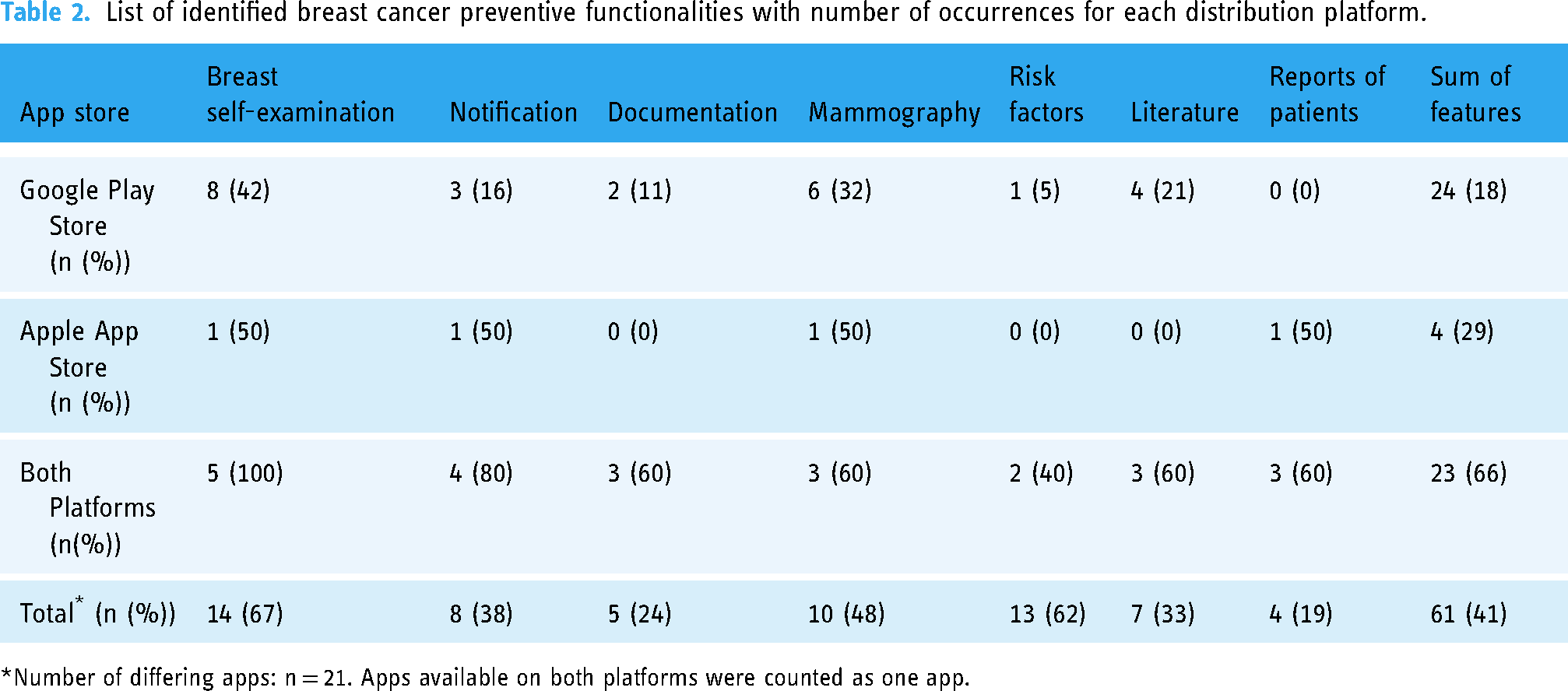
Number of differing apps: n = 21. Apps available on both platforms were counted as one app.
Preventive feature subgroups were defined according to found functionalities in all apps:
Breast self-examination: Has a tutorial for BSE either in written or visual form included Notification: Reminds the user of the next BSE or appointment for mammography Documentation: Allows documentation of BSE results or menstrual cycle tracking Mammography: Gives information about mammography in general and about mammography and screening programmes Risk factors: Gives information about breast cancer risk factors Literature: Shares the scientific references for the information about breast cancer or shares links for further reading Reports of patients: Shares stories of patients who already had breast cancer or are still undergoing therapy
Tables with each app and its implemented technical and preventive features listed are shown in Appendix 2 and Appendix 3, respectively.
None of the analysed apps had an app community; four (19%) apps allowed sharing on social media (Appendix 2). Only one required an in-app purchase for the full version. Registrations were necessary for two (10%) apps, and for two other apps, it was possible either to use them as a guest or to create an account. However, those apps were not customizable when logged in as a guest. One app requested permission for app tracking.
The majority of apps (67%, n = 14) had a tutorial for a BSE implemented, either in written form or via animations or videos (Table 2). Eight (38%) of these had also a notification function to remind the user for the self-examination in a weekly, monthly, period-dependent or independent recurrence. This function did not work for one app (“Stan Swasthya”). A diary function to note and track their findings and their menstrual cycle was implemented in 24% (n = 5) of the apps that had a tutorial for a BSE. 48% of the apps (n = 10) had information about mammography and screening programmes and 62% (n = 13) inform about risk factors for breast cancer, but only 33% (n = 7) of the apps shared their references or linked scientific literature for further information. Reports of patients who have already had breast cancer or are still undergoing therapy were included in 19% (n = 4) of the apps.
App quality
Table 3 shows the subscale and overall scores of apps rated with MARS. The mean overall MARS score was 3.07 (SD = 0.51) out of 5 ranging from 2.28 (SD = 1.03, “Brustkrebs”) to 4.18 (SD = 0.54, “Keep a Breast”) for apps available in the Google Play Store. The mean overall MARS score for apps available in the Apple App Store was 3.50 (SD = 0.36) ranging from 3.12 (SD = 1.04, “empower breast AR”) to 4.18 (SD = 0.54, “Keep a Breast”). Only two apps (“Keep a Breast” and “Dear Mamma”) met or bet the minimum acceptability score of 3.0 Satisfaction, which is the only complete subjective subscale that is not included in the overall MARS score. Functionality was the highest-scoring domain (Mean = 3.91 (SD = 0.45) for Google and Mean = 3.98 (SD = 0.17) for Apple) followed by Information (Mean = 2.97 (SD = 0.71) for Google and Mean = 3.69 (SD = 0.36) for Apple; Table 3).
MARS scores of the evaluated apps.

Values expressed as mean (standard deviation) of the items of each quality score (sorted by highest overall score for Google Play Store and Apple App Store).
Satisfaction is not included in the overall score calculation.
Comparison by app distribution platforms (Apple App Store and Google Play Store) revealed a mean Information MARS score of 2.97 (SD = 0.73) for apps from Google Play Store (n = 17) and 3.69 (SD = 0.39) for apps from the Apple App Store (n = 7) resulting in a statistically significant difference (p = 0.022; Table 4). Apps which had been developed by health organizations (N = 11) obtained better scores in all categories compared to those from other developers (n = 15, p < 0.001). Apps that had reported numbers of downloads above 10,000 had significantly higher MARS scores for the categories Engagement (p = 0.009), Aesthetics (p = 0.029), Satisfaction (p = 0.005) and the overall MARS score (p = 0.022) compared to apps with lower download numbers (Table 4). Similarly, apps that were recently updated (<1 year) had a significantly higher MARS score for Information category (p = 0.009, Table 4).
Association of mobile app rating scale evaluation with app characteristics.

Values expressed as mean (standard deviation) of the items of each quality score or number. HO: Health organization.
In addition, MARS scores were compared between apps with or without certain features relevant for prevention of breast cancer (Table 5). Significant differences were observed for the MARS scores Engagement, Aesthetics, Information and Satisfaction as well as the overall MARS score, between apps that include a BSE tutorial (Overall, p = 0.002), a reminder (Overall, p < 0.001) or documentation (Overall, p = 0.003) function or provide education about breast cancer risk factors (Overall, p = 0.001) and those that lack these features (Table 5).
Association of mobile app rating scale evaluation with breast cancer prevention specific app features.

Values expressed as mean (standard deviation) or numbers. BSE: Breast self-examination tutorial either in written or/and in visual (pictures, animations, videos) form. N: Push-notification to remind for self-examination and healthcare appointments. D: Documenting results of self-examination, physical condition and menstrual cycle. M: General information about mammography. RF: General information about breast cancer risk factors. L: References for evidence-based information and literature.
The mean κ coefficient for the five MARS domains was 0.79 (Table 6). A coefficient between 0.61 and 0.80 indicates a substantial agreement between the two raters. The only two items with a score below 0.61 were accuracy of the app description in the app store and subjective overall star rating of the app (Table 6).
Kappa score and interrater reliability for the mobile app rating scale domains.

Discussion
This study represents the first analysis and review of mobile apps focused on breast cancer prevention and education available through either the German Google or the German Apple app platforms. We searched the app stores, categorized the apps and used the MARS tool to rate those focused on breast cancer prevention and education.
Our findings show that “Keep a Breast” is the best breast cancer prevention app in the Google and Apple App Stores, based on the highest MARS scores. “Dear Mamma” and “breastcare – Brustbewusstsein” scored highest in the information section, thus being an enrichment for breast cancer prevention strategies. Regarding all analysed MARS domains, functionality was the highest scoring MARS domain, indicating that developers pay attention to create an easy-to-use, internally consistent and logical app. This aligns with the conclusions drawn from earlier review studies, which emphasized the significance of usability and functionality in app development.40,41,44 The overall objective score of all identified apps only narrowly reached the minimum acceptability score and highlights the need for improvement. Others have similarly identified many apps with just about acceptable scores among breast cancer prevention apps.41,45
Most of the reviewed apps provide tutorials for BSE, reminders and general information, but none combined all these functions. More than 60% of the apps originated from sources with questionable legitimacy or trustworthiness, none were trialled before release and, although the information section achieved the second-highest MARS score in our study, the mean achieved score has to be considered as low. Almost half of the apps (43%) were below the minimum acceptability score within the information section. In addition, only 33% shared their references, indicating a lack of academic and medical input. A general deficiency regarding trustworthy references within eHealth apps was also demonstrated by others.30,32,36,44 This goes in line with the absence of the involvement of healthcare professionals throughout the app development and raises concerns regarding the credibility of medical information within such apps. Involving medical personnel in mHealth app development is essential in order to provide a comprehensive expertise on the relevant topics, yet this rarely occurs.30,36 Our data indicates that apps developed in collaboration with healthcare professionals are of higher quality compared to others, highlighting the need for medical expertise and knowledge. Particularly in areas such as breast cancer prevention and early detection, an active participation from healthcare organizations and governmental agencies is required to ensure reliable, up-to-date evidence-based and scientific education within eHealth apps.28,31,33
It has been shown that mHealth apps can be effective and well-received tools for promoting weight loss by tracking physical activity, diet and nutrition, to increase cessation rates for alcohol or tobacco consumption, to teach practices like BSE or to remind for regular screening appointments.17–24 However, none of the reviewed apps included other preventive strategies besides BSE practice and provision of information about risk factors and mammography screening. Additionally, none of the apps allowed for tracking of physical activity, diet or nutrition. As the implementation of tracking features is associated with a big workload and, thus, high costs, the financing of such projects is problematic. Since the German regulations does not allow prevention apps to be labelled as a regular health insurance service, developers of prevention mHealth apps are not able to receive health insurance funding. 46 However, a study investigating the cost-effectiveness of lifestyle-related interventions for primary prevention of breast cancer found evidence that diet and physical activity-related interventions were cost-effective. 47 Moreover, e-health interventions for treatment of adolescent overweight and obesity demonstrated very good cost-effectiveness potential. 48 This underscores the significant potential of preventive health apps and highlights the necessity of a comprehensive discussion regarding funding mechanisms, involving both policy makers and insurance entities.
Also, none of the apps could be personalized based on individual risk factors such as age, family history or lifestyle habits. Therefore, all analysed apps lacked personalized prediction of breast cancer risk and personalized suggestions for cancer prevention. Personalization is essential for mHealth apps designed to support patients affected by more complex diseases, and customization should be fully configurable to meet individual needs.49,50 To keep users engaged, it is suggested to enhance interactivity between the user and the app.49–52
Despite the rigorous methodology employed in this study, some limitations should be noted. First, the search was limited to the Google Play Store and Apple App Store, and apps from other sources may have been missed. Furthermore, since the search was only in Germany, the findings might not apply elsewhere. Due to the study including apps in both German and English languages, but the app search being conducted within a German context only, there is a possibility that not all English-language apps were comprehensively captured, which might introduce an additional potential source of bias. Second, we only considered apps updated after June 2020, possibly excluding relevant older apps. However, it can be assumed that older apps might not be up-to-date regarding provision of information, are mostly not suitable for current versions of smartphone operating systems and would show even worse MARS rating. Third, the study only assessed app quality using the MARS tool, which may not capture all aspects of app functionality and user experience. And lastly, our review focused on publicly available apps only, in order to provide a comprehensive overview of apps which might be used by the German population. Therefore, we did not include apps meant for research or limited to specific healthcare providers.
Conclusions
In conclusion, this study showed that the majority of apps designed for breast cancer prevention offer tutorials for BSE, reminders or general information on breast cancer risk factors and screening. However, none of the apps comprised tracking functions or breast cancer risk assessment tools. Quality assessment using the MARS tool revealed poor quality of total content and information provided by these apps, indicating a lack of comprehensive, trustworthy and evidence-based information, and little involvement of medical personnel in their development. The reviewed apps also lacked personalized risk prediction and suggestions for cancer prevention. Personalization, interactivity and involvement of healthcare professionals are recommended to improve the quality and credibility of such mHealth apps and should be considered for future developments.
Footnotes
Acknowledgement
The authors would like to thank Lukas Carl (Medical Valley, project management) for his contributions to the digiOnko project.
Contributorship
Conceptualization, H.H.; methodology, S.A.; formal analysis, S.A. and M.F., resources, P.A.F and M.W.B.; writing – original draft preparation, S.A. and H.H..; writing – review and editing, S.A., M.F., M.B., B. M. E., M.W.B., P.A.F. and H.H.; supervision, P.A.F.; funding acquisition, M.W.B. All authors have read and agreed to the published version of the manuscript.
Data availability
The template data collection forms, data extracted from included apps, and data used for all analyses that support the findings of this study are available from the corresponding author, H.H., upon reasonable request.
Declaration of conflicting interests
The authors declared no potential conflicts of interest with respect to the research, authorship, and/or publication of this article.
Ethical approval
Not applicable.
Funding
The author(s) disclosed receipt of the following financial support for the research, authorship, and/or publication of this article: This project was supported by the Bavarian State Ministry of Health and Care, project grant no. MGP-2008-0003-digiOnko.
Guarantor
H.H.
Informed consent
Not applicable.

Appendix

| App store | Search string | Found apps | False hits | Prevention /enlightenment | Therapy | Aftercare | Professional use | Others |
|---|---|---|---|---|---|---|---|---|
| Google Play Store | Breastcancer | 243 | 141 | 51 | 16 | 2 | 5 | 29 |
| Breast cancer | 29 | 1 | 13 | 5 | 1 | 1 | 8 | |
| Breast cancer help | 28 | 1 | 13 | 6 | 1 | 1 | 6 | |
| Brustkrebs | 30 | 15 | 6 | 5 | 1 | 1 | 2 | |
| Brustkrebs Hilfe | 29 | 17 | 2 | 8 | 1 | 0 | 2 | |
| Mammakarzinom | 30 | 18 | 4 | 4 | 0 | 1 | 3 | |
| Apple App Store | Breastcancer | 63 | 18 | 15 | 8 | 14 | 3 | 5 |
| Breast cancer | 74 | 24 | 17 | 9 | 6 | 2 | 16 | |
| Breast cancer help | 4 | 0 | 1 | 1 | 0 | 0 | 2 | |
| Brustkrebs | 39 | 20 | 4 | 9 | 2 | 0 | 4 | |
| Brustkrebs Hilfe | 2 | 0 | 1 | 1 | 0 | 0 | 0 | |
| Mammakarzinom | 7 | 1 | 0 | 4 | 0 | 0 | 2 |

| App | Social media | In-app purchase | Registration | Advertisements | Data management | |
|---|---|---|---|---|---|---|
| Google Play Store | Beat Cancer - 100 Cancer Prevention Tips | |||||
| Breast cancer (Focus) | x | |||||
| Breast Cancer (Guide) | x | |||||
| Breast Cancer (Yazan Halawi) | ||||||
| Breast Cancer Survival Guide for Patients | x | |||||
| Breast Disorder | ||||||
| Breast Health Care (BHM) | x | |||||
| BREAST TEST | ||||||
| Brustkrebs | x | |||||
| Brustkrebs - Bewusstsein (Breast Cancer) | x | |||||
| In The Pink PH | ||||||
| NextGen Breast Examination: Breast Cancer | x | |||||
| Selbstuntersuchung der Brust | ||||||
| Stan Swasthya | ||||||
| Apple App Store | breast Aware - BCI | |||||
| empower Breast AR | ||||||
| Both Platforms | Boot Out Breast Cancer | |||||
| breastcare - Brustbewusstsein | x | |||||
| DearMamma | x | x | ||||
| Keep a breast | x | x | x | |||
| Young Breast Cancer Warriors | x | x | ||||
| Google Play Store (n (%)) | 4 (21) | 1 (5) | 2 (10) | 4 (21) | 0 (0) | |
| Apple App Store (n (%)) | 0 (0) | 0 (0) | 0 (0) | 0 (0) | 0 (0) | |
| Both Platforms (n (%)) | 4 (80) | 0 (0) | 2 (40) | 1 (20) | 1 (20) | |
| Total * (n (%)) | 4 (19) | 1 (5) | 4 (19) | 5 (24) | 1 (5) | |
Number of differing apps: N = 21. Apps available on both platforms were counted as one app.
List of identified breast cancer preventive functionalities sorted by number of occurrences for each distribution platform.

| App | Breast self-examination | Notification | Documentation | Mammography | Risk Factors | Literature | Reports of patients | Sum of features | |
|---|---|---|---|---|---|---|---|---|---|
| Beat Cancer - 100 Cancer Prevention Tips | x | x | x | x | 4/7 | ||||
| BREAST TEST | x | x | x | x | 4/7 | ||||
| Breast Cancer Survival Guide for Patients | x | x | x | x | 4/7 | ||||
| In The Pink PH | x | x | x | 3/7 | |||||
| Stan Swasthya | x | x* | x | 3/7 | |||||
| Breast Health Care (BHM) | x | x | 2/7 | ||||||
| Breast Cancer (Guide) | x | x | 2/7 | ||||||
| Breast Disorder | x | x | 2/7 | ||||||
| NextGen Breast Examination: Breast Cancer | x | x | 2/7 | ||||||
| Brustkrebs - Bewusstsein (Breast Cancer) | x | x | 2/7 | ||||||
| Brustkrebs | x | x | 2/7 | ||||||
| Selbstuntersuchung der Brust | x | x | 2/7 | ||||||
| Breast cancer (Focus) | x | 1/7 | |||||||
| Breast Cancer (Yazan Halawi) | x | 1/7 | |||||||
| Apple | breast Aware - BCI | x | x | x | x | 4/7 | |||
| empower Breast AR | 0/7 | ||||||||
| Both Platforms | breastcare - Brustbewusstsein | x | x | x | x | x | x | 6/7 | |
| Keep a breast | x | x | x | x | x | 5/7 | |||
| Young Breast Cancer Warriors | x | x | x | x | x | 5/7 | |||
| Boot Out Breast Cancer | x | x | x | x | 4/7 | ||||
| DearMamma | x | x | x | 3/7 | |||||
| Google Play Store (n (%)) | 8 | 3 | 2 | 6 | 1 | 4 | 0 | 24 | |
| (42) | (16) | (11) | (32) | (5) | (21) | (0) | (18) | ||
| Apple App Store (n (%)) | 1 | 1 | 0 | 1 | 0 | 0 | 1 | 4 | |
| (50) | (50) | (0) | (50) | (0) | (0) | (50) | (29) | ||
| Both Platforms (n (%)) | 5 (100) | 4 (80) | 3 (60) | 3 (60) | 2 (40) | 3 (60) | 3 (60) | 23 (66) | |
| Total ** (n (%)) | 14 | 8 | 5 | 10 | 13 | 7 | 4 | 61 | |
| (67) | (38) | (24) | (48) | (62) | (33) | (19) | (41) | ||
Notification feature was implemented, but did not work.
Number of differing apps: N = 21. Apps available on both platforms were counted as one app.