



Abstract
Background
Human immunodeficiency virus (HIV) screeners have limited experience of interacting with trans people. The application of communication platforms between them to empower HIV screeners’ trans-related cultural competence remains unknown.
Objective
This study aims to qualitatively explore the follow-up interviews of HIV screeners regarding their opinions on the feasibility of an online platform group discussion and web page to enhance communication between them and trans people and to explore their perspectives on how these components enhanced their promotion of cultural competence.
Methods
This study was conducted between October 2020 and June 2021. Purposive and snowball sampling were applied to recruit 6 trans persons and 11 HIV screeners. Six online platform group discussions were held on weekday evenings, each group meeting for 60 min, 360 min in total within 3 months, via a video chat room of Google Meet; this was supplemented by a closed web page. The major results were presented through content analysis of the HIV screeners’ follow-up interviews.
Results
The HIV screeners identified the facilitators of participating in the communication platforms, which included a reminder message, easy-to-use interface, visible–audible and readable interaction, recalled and reviewable content and group belonging; the barriers included time and space limitation, device restrictions and operation problem. Two categories of trans-related cultural competence – trans awareness and action taken – were revealed, from which five major themes emerged: provoked to ask questions, improved cognition, reflection, trans-sensitive communication and self-enhancement.
Conclusion
The results revealed that the communication platforms could facilitate the mutual and vivid discussion between HIV screeners and trans people and empower the trans-related cultural competence of HIV screeners. The highly feasible intervention design of this research can be applied to digital training courses related to gender diversity issues.
Background
Testing for human immunodeficiency virus (HIV) is a priority and the most important case finding strategy for HIV prevention and treatment, while screening personnel are the key promoters for delivering testing resources to high-risk groups, including the transgender or ‘trans’ population.1–3 Compared to other gender minority population, trans people are more marginalized in accessing HIV prevention resources4,5 and often encounter discriminatory experiences from healthcare providers, which negatively affect their motivation to seek care and willingness to have an HIV test.6–9
Nonclinical studies have examined the epidemiological features of trans or gender dysphoria in Taiwan, as official clinical data are currently unavailable. The prevalence of trans women is 8.5 per 100,000 persons and trans men is 3.6 per 100,000 persons in Taiwan.10,11 Statistics on HIV infection in Taiwan are presented as binary gender categorization; the overall situation of people living with HIV within the trans community is still unclear. 12 HIV screeners could be healthcare professionals, such as clinicians, nurses and case managers, or non-healthcare providers, such as peers, who must be trained in HIV screening course under the guidance of Taiwan Centers for Disease Control before providing HIV testing and counselling services in medical and community environments.13,14 However, the current training provided to HIV screeners may be insufficient to address trans-related cultural competence.
To provide trans-affirming care and avoid discrimination, it is necessary to optimize HIV service providers’ trans-related cultural competence.15,16 Trans-related cultural competencies involve a range of cognitive, awareness and behavioural aspects that are broadly defined as the ability to understand, appreciate and interact with the trans population and their belief systems.17–19 Past research has found that improving HIV service providers’ understanding of the background and care needs of the trans population could increase trans people's access to healthcare resources.20–22 However, HIV screeners generally have limited experience of interacting with trans people, and the translation of trans-related knowledge into enhancing trans-affirming attitudes and providing appropriate care that meets trans people's expectation remains limited.23,24 New communication technologies provide an opportunity for healthcare providers and clients to engage with each other in virtual environments to discuss health-related issues. 25 The application of multiple modes, such as direct online interaction through communication platforms, could be a feasible strategy for filling this knowledge gap.
Owing to the outbreak of the Coronavirus disease 2019 (COVID-19), the application of web-based courses and/or virtual conferences has increasingly replaced face-to-face methods and become a trend for learning and activities.26,27 Online platform group discussions, a form of virtual meeting through a digital platform that reduces geographic restrictions, facilitates participation and maintains adequate privacy with appropriate cybersecurity protection, are an appropriate way to maintain online group interaction and learning.28,29 Currently, the application of online platforms for communication between HIV screeners and trans people and its effectiveness remain uncertain.
The purpose of this study was to qualitatively explore the follow-up interviews of HIV screeners regarding their opinions on the feasibility of using online group discussion platforms and a web page for interaction between them and trans people and the consequent perspectives on the promotion of trans-related cultural competence.
Theoretical framework
The research design was based on empowerment theory. It had been proved that empowering trans-related cultural competence among HIV screeners could improve healthcare outcomes for trans women. 30 Empowerment is a continuous process of understanding one's own situation through listening and reading and then triggering a process of dialogue involving mutual participation; the continuous cycle of this process elicits reflection concerning one's consciousness and self-awareness and subsequent action to overcome difficulties and obstacles, and finally, empowerment leads to a feeling of improving one's ability.31,32
Methods
This was a qualitative research study used to evaluate the impact of an intervention on HIV screeners’ trans-related cultural competence. The trans speakers and HIV screeners were recruited using purposive and snowball sampling. The intervention included online platform group discussions via Google Meet, with functions for multiple people to video chat and send text messages at the same time. These discussions were held on weekday evenings for 60 min per session, totalling 360 min. Saturation data could be obtained in this frequency,33,34 supplemented with a closed web page (Figure 1) for collecting and sharing multimedia information, including the personal information of each invited trans speaker, the records of video and text files of each online platform group discussion, a message board and related articles. A message reminding to use the web page and the meeting time would be sent through an instant messenger application (LINE app), email and text message via mobile phone to the participants. The members of each group were one moderator, one assistant moderator, one trans speaker and several HIV screeners. The number of members in each group ranged from 7 to 9, with an average of 7.3 (SD = 1.5).

A screenshot of the closed web page.
One month after the completion of all online platform group discussions, we conducted hour-long follow-up interviews according to a prepared interview guide with each HIV screener using video chat. The results were presented through content analysis of the verbatim transcribed data of the HIV screeners’ follow-up interviews.
Trans speakers
The inclusion criteria for the trans speakers included self-disclosing their gender identity as trans person, being over 20-years-old and being willing to share their experiences and interact with the HIV screeners. To increase the diversity and richness of the group topics, different backgrounds of trans experience, as well as different ages and occupations, were considered (Appendix I) in the selection process.
HIV screener participants
The inclusion criteria of the HIV screeners included being Taiwanese and aged 20 years or older, qualified to conduct HIV testing or interested in HIV testing practice and interested in participating in HIV prevention work in the future. The exclusion criteria for HIV screeners were those who had participated or were currently participating in video courses on trans issues.
Ethical consideration
This study was approved by an ethics committee in Taiwan. After the participants signed a paper consent form, including consent to be recorded and videotaped, the data were processed anonymously. To protect participants’ privacy and confidentiality, they received a unique nickname and password in the beginning, and the password could be reset after logging into the web page. All participants were told their participation was voluntary and they could drop out at any point and informed about any possible harms that could come to them and its compensation. Only the two researchers had access to and could manage the back-end of the platform. HIV screeners received a gift voucher equivalent to $16.81 after the interviews, and trans speakers involved in various study activities, including online group discussions, website question responses, pre-discussion meetings, material reviews and 5 months of continuous collaboration, received a $302.51 voucher as a research incentive.
Study procedures
This study was conducted between October 2020 and June 2021. The communication platform was applied within 3 months. The participants were recruited via a fan page of Facebook and were referred through their social networks. The topic of each group was jointly formulated with the moderator and each trans speaker based on their unique life stories (Appendix I). One week before the group meeting, a message was sent to remind the HIV screeners to login to browse the personal information of the trans speakers and the topic through the web page, so as to elicit the HIV screeners’ thoughts about relevant questions. The open-ended questions elicited from the screeners were collated and provided to trans speakers for referencing and preparation.
The moderator was responsible for the progress of the online platform group discussion, and the assistant moderator was responsible for observation and content recording. Before the group discussion, the reminder messages, with a link to enter a video chat room that could be accessed using a mobile phone or computer, were delivered via LINE app, email and text message at the same time to the HIV screeners. The group discussion was divided into three stages:
Warm-up and introduction for 10 min: the moderator specified ground rules, reminded participants to maintain confidentiality, explained the topic and guided the group members to introduce themselves. Interaction and discussion for 40 min: the moderator led the group discussion according to the open-ended question on the topic. Feedback and conclusion for 10 min: the moderator summarized the debriefing of the group process.
Throughout the study period, a web page was made available for the textual summaries and full videos of each topic, which could be accessed by non-participating HIV screeners to review and facilitate their learning of trans-related cultural competence.
Follow-up interview guide
Guiding questions for the interview included the following: What do you think about the feasibility of participating in the online platform group discussions and using the web page? How has your thinking and understanding of trans people increased or changed after participating the group discussion? What kind of reflections did the above intervention elicit given the discussion? What changes and improvements have you made in your actions on trans people or trans issues after the above intervention?
Data analysis
The open-ended questions elicited from the HIV screeners were compared and selected in terms of their relevance to the topic and then categorized. A content analysis of the follow-up interview transcript was then conducted. The important keywords were summarized and coded. Through the cross-comparison of keyword occurrences, various aspects of the sub-themes, themes and category were inferred and confirmed.35,36 We conducted simultaneous text analysis and continuously compared the data until thematic saturation was achieved, which was defined as the point when no new categories or themes could be identified and there was repetition of information.
Rigour
The researchers have studied trans people issues in recent years and have experiences in conducting online platform group discussion and eHealth-related research. The original qualitative data of verbatim transcripts, image backups and screenshots were all well preserved; the two researchers discussed all the analysed and coding contents to ensure the auditability of the data. 37 Finally, two HIV screeners who were randomly selected to check the qualitatively analysed results on their own follow-up interview transcript; two experts with healthcare experience of trans person, including a social worker and a nursing professor; and two trans speakers who were randomly selected were invited to conduct a content validity review of the same two analysed follow-up interview transcripts. 38 The agreement on clarity, consistency and relevance of the analysed theme was calculated out of 100. The average score of agreement between the HIV screeners was 99.2, between the experts was 94.2 and between the trans speakers was 94.0.
Results
Characteristics of HIV screeners
A total of 12 HIV screeners participated in the study. One (1/12; 8.3%) of the HIV screeners was lost without a reason at the follow-up stage during the study period; however, 11 (11/12, 91.7%) screeners complete the study. Some of the notable characteristics were as follows: the average age was 33.72 (SD = 9.93); they were mostly cisgender male (8/11; 72.7%); their main sexual orientation was either sexual minority (5/11; 45.5%) or heterosexual (5/11; 45.5%); most had a partner but were not married (6/11; 54.5%) and had no child (8/11, 72.7%); the highest education was university or college (8/11; 72.7%); their main occupation was HIV case manager (8/11; 72.7%) with a working experience of <3 years (5/11; 45.5%); most were religious (6/11, 54.5%); and most lived in the north of Taiwan (8/11; 72.7%). Prior to the group meeting, most HIV screeners (9/11; 81.8%) had no experience in conducting HIV screening for trans people, most (8/11; 72.7%) did not participate in training courses focused on trans issues, and all of them (11/11; 100%) reported a lack of knowledge and confidence in interacting with trans people (Table 1).
Demographics of the HIV screeners (n = 11).

Qualitative results
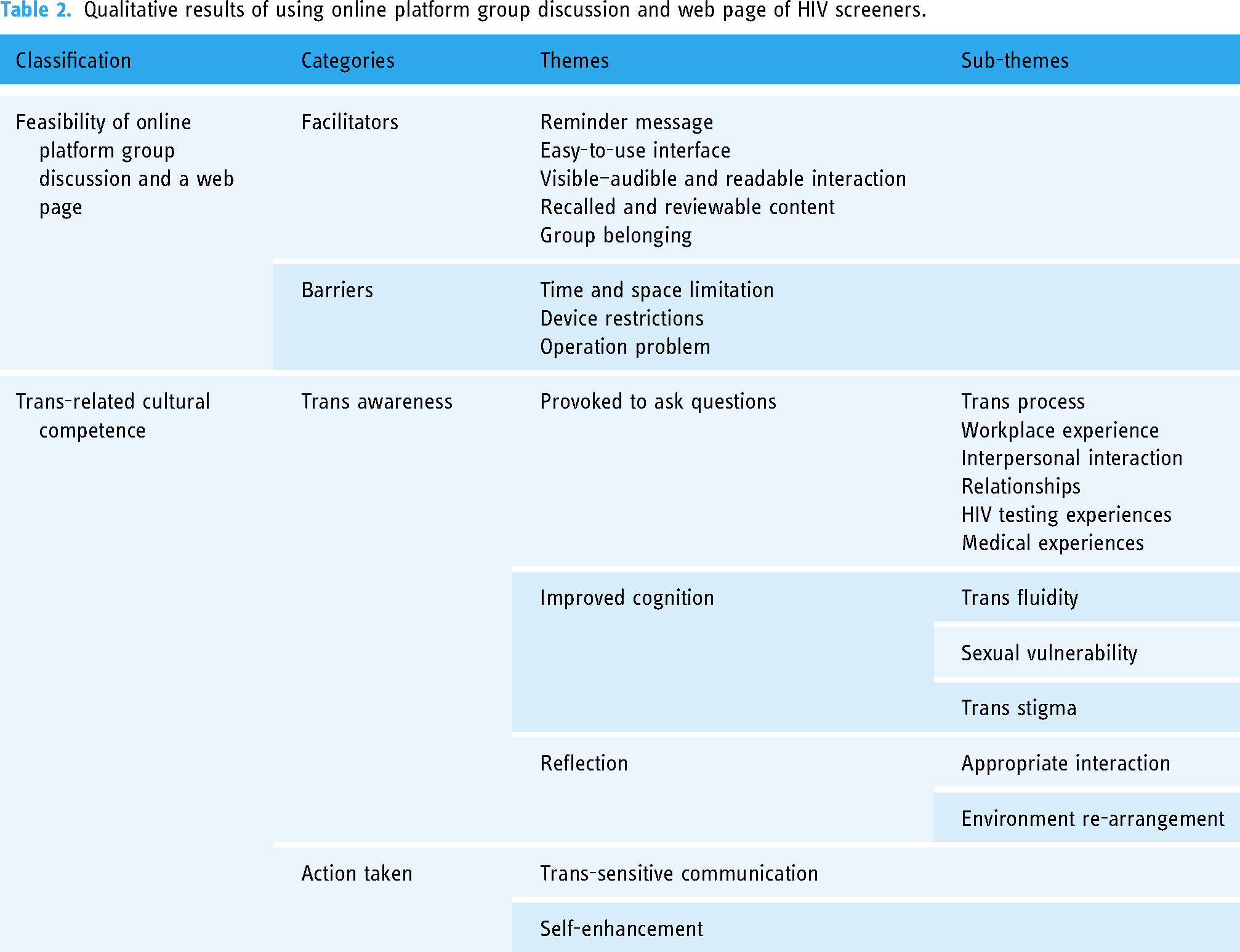
The details of the qualitative interview results are presented in Table 2. In analysing the responses to the question ‘What do you think of the feasibility of participating in the online platform group discussions and using the web page?’, two categories of feasibility emerged: facilitators and barriers. The facilitators included the following themes: reminder message, easy-to-use interface, visible–audible and readable interaction, recalled and reviewable content and group belonging; the barriers included the following themes: time and space limitation, device restrictions and operation problem.
Qualitative results of using online platform group discussion and web page of HIV screeners.
Facilitators
Reminder message
A total of 81.8% (n = 9) of the HIV screeners confirmed that the reminder messages could immediately achieve the notification effect. The HIV screeners rated the reminder function on the LINE app better than text messaging and email. The messages could be pinned on the top of the LINE app on the mobile phone, thereby increasing the chances of reading the message and stimulating participatory behaviour. I always use the group of LINE app, so that I have the latest information at any time, and it helps me not to miss any message. I join the online platform group discussion when I receive a message with a link. (Screener B)
Easy-to-use interface
All HIV screeners (100%, n = 11) considered that the platform functions were intuitive and easy to operate, and they could also easily log in to the web page to review information. All the functions of online platform group discussion on Google Meet were automatically set, and participants could use voice and text messaging to interact with all group members or an individual member. I have used this platform before. It was easy to use and convenient for many people to chat with each other at the same time; I feel the operation is user-friendly. (Screener L)
Visible–audible and readable interaction
A total of 90.1% (n = 10) of the HIV screeners believed that the function of online platform group discussion via Google Meet enabled the members to interact directly by looking at, talking to and typing to each other at the same time across geographical restrictions. Those who had not participated in the online platform group discussion on time could also achieve the learning effect through visual–audio viewing the textual and video records on the web page. It's almost the same as a real meeting. Being able to see the different trans people, hear them tell their real experiences, and ask questions and seek feedback through members’ speaking or typing, I was impressed and moved by this group. (Screener E)
If it was not convenient to open the microphone to respond, I could also ask questions by typing. The whole process was more convenient than the offline online platform group discussion. (Screener B)
Recalled and reviewable content
In total, 81.8% (n = 9) of the HIV screeners believed that if they could appear in the video records of the group discussion, and their own questions and responses could be reviewed in the textual records, it would stimulate their motivation to participate in this group and log in to the web page to review. I feel excited when I see myself in the video and my questions are answered. I would like to review all the information on the platform, and the contents of the articles could also make me think more. (Screener F)
Goup belonging
All HIV screeners (100%, n = 11) believed that, through a period of engagement, members had developed a sense of security, trust and being involved in the closed group and web page. Therefore, participants were more willing to express their own private and sensitive questions and thinking. I think the greatest thing about this group was that everyone had a common purpose and we did trust and respect each other. In such an atmosphere, it was more easy to speak out loud and promote mutual understanding, regardless of whether it was in the group discussions or asking questions on the web page. (Screener C)
Barriers
Time and space limitation
A total of 27% (n = 3) of the HIV screeners had either forgotten or were temporarily unable to participate. The privacy of online platform group discussions was influenced by the environment around the participants. Members may not be able to discuss the sensitive topics when there are other people nearby. I need to deal with many messages in my daily work…sometimes I would have to ignore the group notifications and miss participating in the group discussion on time. (Screening A)
When there are other people around me, I need to be more careful about speaking while using video, about sexual and stigma issues, to avoid arousing the curiosity of others and exposing members’ privacy. (Screener H)
Device restrictions
The online platform group discussions required mobile phones or computers with both video and voice function. A total of 18.2 (n = 2) of the HIV screeners had been unable to watch and listen at the same time because of the device's limitation. The smoothness of the online platform group discussion would be affected by the network speed and quality of video equipment. I used a computer in the workplace to participate, but this computer was quite dated…I didn’t have a video device myself, which was a little inconvenient to operate. Sometimes I could only participate the activities by text. (Screener I)
Operation problem
A total of 27.2% (n = 3) of the HIV screeners expressed that the screen and operation of logging in to the web page using mobile phones and computers were different, and it took time to adapt to the operation. Generally, I used my mobile phone to log in; if the platform had an App version on the mobile phone, it would have been more convenient to use. (Screener D)
Trans awareness
Three sub-themes were subsumed under trans awareness: provoked to ask questions, improved cognition and refection.
Provoked to ask questions
All HIV screeners (11/11) had provided the open-end questions. On the web page, 8 questions were posted by HIV screeners about trans speakers’ profiles and 24 replies were posted by trans speakers in response to the questions. There were 74 questions from HIV screeners related to the topic of group discussions, of which 55 questions came up after reviewing each topic introduction on the web page and 19 questions came up during the group discussions. The 74 questions were categorized into six sub-themes: trans process, workplace experience, interpersonal interaction, relationships and HIV testing and medical experiences.
Improved cognition
There were three sub-themes under improved cognition: trans fluidity, sexual vulnerability and trans stigma.
Trans fluidity
In total, 72.7% (8/11) of the HIV screeners recognized that the gender identity of a trans person is not fixed but fluid; during their growth, they may first consider themselves homosexual because of lack of trans information. After that, they find their gender identity and sexual orientation in their community. I only knew about gays, lesbians, bisexuals, and so on in the very beginning and now I know that trans [people] are very diverse, including trans women, trans men, non-binary, trans lesbian, trans gay! Gender identity and sexual orientation may be changed from time to time. (Screener I)
Sexual vulnerability
About 63.6% (7/11) of the HIV screeners showed a deep comprehension of the process and hardships of gender transitioning that they had never understood before. They learned that gender affirmation surgery (GAS) is a necessary condition for changing one's gender on Taiwan's identity card; some trans people undergo extremely high economic pressure due to the cost of surgery, and therefore, some may engage in sex work. It makes me notice that not every trans [person] can get GAS, and there are many complex considerations and disturbed feelings involved. Changing gender puts them in a high-risk situation. (Screener J)
HIV screeners understood that whether to disclose trans identity to one's partner can lead to painful struggles, and trans people often experienced being refused, betrayed and abandoned by partners; therefore, to maintain a relationship, they have to sometimes give up the dominance of safe sexual behaviour to meet the partners’ demand for going condomless. They almost got divorced because of her trans status… She had to choose a compromised way to maintain her relationship for the sake of her beloved and …, such a relationship is aggrieved and unequal. (Screener J)
Trans stigma
In total, 90.9% (10/11) of the HIV screeners contributed to the contents of trans stigma. These HIV screeners understood that trans people often experienced being excluded and underwent sexual harassment and humiliation from their family, classmates and community after coming out; in the workplace, trans people often have hurtful experiences including being asked to complete surgery before applying for work, verbal discrimination or being unable to choose a uniform and toilet. I know the social environment is quite harsh for [the] trans group. Being trans or non-binary [people] means that you are constantly being hurt by others. (Screener C)
HIV screeners found that gender stereotypes in the HIV testing process affected screening; for instance, trans women are considered and treated the same as gay men due to the higher possibility of bareback anal sex, which makes trans women feel embarrassed to discuss it and possibly miss out risk assessment at the very beginning. HIV screeners also learned that trans people have less access to sexual health resources and HIV screening because of their concerns about inconsistency between physical appearance and gender identity and being stigmatized as freakish. It is precisely because of the eyes and attitude when I don’t know what to call them, that may make trans [people] feel discriminated. (Screener A)
Reflection
There were two sub-themes of reflection: appropriate interaction and environmental re-arrangement.
Appropriate interaction
Through introspection, 90.9% (10/11) of the HIV screeners realized that they should respect gender self-determination when clients’ appearance does not match their documentation. The HIV screeners found that compared to over politeness and neglect, a sincere but neutral attitude and normal interaction that avoided micro-aggressive language and invasion of privacy could be the most suitable and comfortable manner when interacting with a trans person. I used to ask them a stupid question, like did you fill in the wrong gender column? The trans [population] is no different from other people. Just interact with them in a normal way, rather than turning them away. (Screener J)
Environmental re-arrangement
About 81.8% (9/11) HIV screener revisited their workplace and found a need to add more trans-friendly facilities, such as unisex restrooms, a non-binary gender column on relevant documents and gender-sensitive decorations, such as trans flags. Healthcare organizations, especially government agencies, should pay more attention to the trans [community], like presenting trans-friendly items or propaganda, rather than deliberately ignoring or refusing to demonstrate trans-friendly ideas. (Screener G)
Action taken
There were two themes in action taken: trans-sensitive communication and self-enhancement.
Trans-sensitive communication
All (11/11; 100%) of the HIV screeners reported experiencing improved trans-sensitive communication. Through the online platform group discussions, the HIV screeners obtained real practice of interaction with trans people, they felt closer and more comfortable with them, and the confidence regarding trans-sensitive interaction was enhanced. I am more careful in my wording, like if a trans woman came on the screen, I now ask ‘what would you like me to call you? What's your preference for using him or she or any other [pronoun]?’ (Screener B) Now, I actively talk more about what are and why he/she /they has these … emotional states. (Screener E) Trans women are not the same as MSM [men who have sex with men]. In addition to condomless anal sex, I consider the risks of vaginal sex after surgery, and I talk to her from a woman's point of view. (Screener A)
Self-enhancement
Over half (6/11, 54.5%) of the HIV screeners revealed that they were motivated to learn more about trans issues and acquire actions for self-improvement from other resources. The sharing of real-life experience of the trans [person] makes me want to know more about them. So, I find and listen to trans podcasts to improve my sensitivity to trans issues. (Screener F)
I remind myself not to forget why I became an HIV case manager and must focus on the case. I became more open to talk to my colleagues about the screening needs of trans people, and more willing to help my gender minority colleagues to find resources. (Screener G)
Discussion
Main findings
This is one of the first studies to apply a communication platform to engage HIV screeners and trans people and examine its acceptability and feasibility. After six online platform group discussion meetings and access to a closed web page within a 3-month period, the feasibility of the above design was confirmed, and HIV screeners had been empowered in terms of their trans-related cultural competence.
Our results reveal that the feasibility of engaging in discussions between HIV screeners and gender minorities through online platforms could be high. However, group events inevitably come with challenges where participants cannot be present every time. The main reason for not attending the online platform group discussion in this research was non-availability during the time schedule, which is similar to other studies.28,33 Another finding consistent with past research was that reminder messages could increase participants’ engagement in the intervention. 39 To reduce the possible influences of low participation, we provided non-attendees a convenient way to view video recordings of each group discussion and text summaries through the web page, and all participants had logged in to the website to watch and read it. Complete preservation and high accessibility of the process records for each HIV screener to review provided an auxiliary effect on the improvement of trans-related cultural competence.
The speaking order of the trans speakers and HIV screener participants in our online platform group discussion proceeded smoothly. The reason lies in the function of the system itself and the group dynamics. 28 Google Meet has an instant imaging function of raising one's hand and turning on and muting the microphone, which could be intuitively operated. Under the host's instructions, each of the participants could turn on the microphone and speak one by one or type the words on the message board without interrupting the speaker. In response to the barriers which were found in the study, while using communication platforms, the development of both web and mobile versions should be considered. In addition, at the time of recruitment, it should be determined whether the participant has the required equipment, including camera lens, earphones and microphone.
The application of communication platforms in teaching and training of trans-affirmative care for healthcare providers is inadequate, as gender-diverse issues are not part of required courses in school education and formal training programme in healthcare facilities.40–43 Besides, a holistic understanding of being trans is currently expected from professionals and from trans people themselves. 44 In this research, a self-introduction page with personal photo and stories of trans speakers and an interactive message function were applied, which not only provided the HIV screeners a sense of group belonging but also aroused their interest to actively provide different aspects of open-ended questions for trans speakers. Therefore, in addition to HIV screening and medical experiences, the topic and contents in our group were tailored to trans people's concerns and covered a wide range of issues including difficult life situations, struggles in interpersonal interaction and intimacy and risk, which were of interest to the HIV screeners. Such proactive questioning of trans people was an important beginning to the empowerment process of HIV screeners and made the progress smoother for the moderator guiding the online platform group discussion. In addition, our qualitative results, e.g. consideration while taking sexual risk assessment, appropriate communication skill to avoid stigma and the reflection of environment re-arrangement, provide clear material that can be incorporated into courses to promote trans-related culture competence of healthcare givers. 45
Unlike other group discussion designs on trans issues, wherein healthcare workers and trans people are not in the same group,29,46–49 in this study, trans speakers with different trans backgrounds and HIV screeners were jointly involved in the group discussions via a video chat room. This enabled the group members to interact directly by seeing and hearing one another. The mutual interaction and vivid discussion via the video camera, the real-time sharing and provision of feedback and communication practices deeply impressed the HIV screeners and empowered their inner reflections, and explicit action could take place.33,50,51 The suggested core contents of improving trans-related culture competence should include the fundamental information, e.g. terminology and health disparities, facilitation of learners’ self-awareness and communication skills and recognition of the unacceptable environments and policies for trans people. 16 Our main qualitative analysis results showing that online platform group discussions empower HIV screeners to concurrently have a voice and promote self-awareness, re-examine their own perceptions of power and behaviour and then trigger the action toward their professional goals were consistent with the previously mentioned core contents and achieved the purpose of improving trans-related culture competence.
Limitations
This study has certain limitations that must be acknowledged. First, the participants were self-selected and had an interest in trans issues, which may not be representative of those who are not interested and were not recruited. Second, the small sample size of the study limits the generalizability of the findings. Third, online platform group discussions require the internet and 3C equipment, which may make it difficult for individuals with low socioeconomic status and older adults to participate, thereby limiting the applicability and generalizability of the results. Fourth, the study predominantly recruited young adults and may not fully represent or infer the experiences of older trans individuals and HIV screeners. Fifth, only one interview session was conducted 1 month after the online platform group discussions, and no further follow-up assessments were conducted of the effectiveness of improving trans-related cultural competence, making it difficult to confirm the sustainability of the effects.
Conclusions
The qualitative results of this study revealed that through online platform group discussions and a web page shared by trans people and HIV screeners, HIV screeners could be empowered in terms of their trans-related cultural competence. The closed web page increased the acquisition of multimedia information and the motivation of participating in the group. The high-feasibility design can be applied in trans-specific curriculum across various professions to promote the service quality for the trans population. Future studies may extend the duration and frequency of follow-up interviews to assess the continued influences of communication platforms on trans-related courses.
Footnotes
Acknowledgements
The authors are very grateful to all the participants, especially the trans speakers and HIV screeners, and the Netsoft Co., Ltd, for the sophisticated web page design and service. The authors are also grateful to the Ministry of Science and Technology of Taiwan for providing the research funding.
Contributorship
P-YC was responsible for the research design and data analysis and made critical and intellectual contributions to the manuscript. S-JC, W-WT and J-MY contributed to the participants’ recruitment, data collection and analysis and manuscript preparation. All authors reviewed and edited the manuscript and approved the final version of the manuscript.
Declaration of Conflicting Interests
The authors declared no potential conflicts of interest with respect to the research, authorship, and/or publication of this article.
Ethical approval
The ethics committee of National Taiwan University approved this study (REC number: 202004HM006).
Funding
The author(s) disclosed receipt of the following financial support for the research, authorship, and/or publication of this article: This research was supported by research funding from the Ministry of Science and Technology of Taiwan (grant number MOST 109-2629-B-002 −002).
Guarantor
P-YC.

Notes
Appendix I. The personal information of trans speakers and the topic of each online platform group discussion

| The Trans Speakers | Topics |
|---|---|
| Age: 20s Occupation: psychologist, used to worked for HIV community screening Gender identity: trans woman |
A trans woman's experience as an HIV screener and helping others |
| Age: 30s Occupation: lawyer Gender identity: non-binary |
Life story of a non-binary queer |
| Age: 50s Occupation: academic researcher, tour guide Gender identity: trans woman |
Life story and intimacy experiences of a middle-aged trans woman |
| Age: 30s Occupation: service industry Gender identity: trans man |
The journey of a trans man who lived in the straight world |
| Age: 20s Occupation: nurse, bar girl Gender identity: trans women |
The coming out experience and family revolution of a trans youth |
| Age: 20s Occupation: bar girl Gender identity: trans woman |
A trans woman's experience of working in a hostess bar |