




Abstract
Background
The fast-paced development of digital technologies in the areas of social media, pet robots, smart homes, and artificial intelligence, among others, profoundly influence the daily lives of older adults. Digital technology can improve the well-being and quality of life of older adults, older immigrants and refugees who suffer migration-associated stress, loneliness, health and psychosocial challenges.
Aims
The aim of this scoping review is to map out extant empirical literature that has examined the implication of digital technology among older refugees and immigrants.
Methods
Using a 1 five-stage framework, we conducted a scoping review of peer-reviewed empirical studies published in English with no time restrictions. We searched nine databases for the reviews, and abstracts were reviewed using Rayyan QCRi(c) before the full-text review. The comprehensive database search yielded 4134 articles, of which 15 met the inclusion criteria.
Results
The results of the review suggest that digital technology is essential to the well-being, quality of life of older immigrants and refugees, especially for maintaining and building new social support networks, navigating opportunities, coping with migration-induced stress through e-leisure, and staying connected to their culture. The literature also revealed poor utilisation of digital technologies amongst older immigrants and refugees, suggesting barriers to access.
Conclusion
The study concluded by highlighting the need for more research and interventions that focus on multiple strategies, including education for increased access to and utilisation of digital technology to ensure that more older migrants can benefit from the advantages of digital technology in a safe way.
Introduction
Global immigrants have increased from 150 million recorded in 2000 to 214 million in 2010, reaching 281 million in 2020,2,3 with a projected estimate of 405 million by 2050. 4 Although the documented rise in the population of immigrants in Western or developed countries is associated with the increase in the number of international students, friendly and boisterous economy, and attractive immigration policies, 4 a significant number of immigrants are persons forcibly displaced from their home regions as a result of persecution, human rights violations, repression, conflict and natural and human-made disasters/environmental hazards.5,6 A 2017 report estimated that 44,400 persons were forced out of their homes every day, reaching 68.5 million at the end of that year. 7 More so, the Russia–Ukraine war, which has continued for over a year, has dramatically increased this number, accounting for more than 13 million people uprooted from their homes. 8
Older migrants (immigrants and refugees) aged 65 years and over account for 12% (34.3 million) of the global 281 million international migrants. 9 However, with the continued worldwide increase in the population of older adults,10,11 and given that by 2050, it is estimated that 80% of these older adults will live in Low- and Middle-Income Countries, which are typically the countries of origin of international migrants, 12 there is a possibility of an unprecedented increase in the number of older immigrants 13 and refugees. 14 Regardless of this concern, older immigrants and refugees have drawn very sparse scholarly and humanitarian attention as the bulk of efforts are targeted towards women and children.14,15
Older immigrants and refugees, whom we may refer to with the umbrella term ‘older migrants’ are highly in need of assistance and humanitarian efforts. Ageing in migration and migrating later in life can be an extremely stressful life event, 16 and older migrants are usually impacted by the stress of events leading to migration, the migration process, and post-migration challenges. 17 Substantive evidence from research has noted the varieties of age-specific disadvantages faced by older migrants. For example, they face challenges adapting to new cultures in their host countries, accompanied by language barriers, which impose challenges in accessing public services 2 ; they are at greater risk for loneliness and are also predisposed to social exclusion, depression, anxiety, and disconnection from socioeconomic resources. 18–24 The use of digital technologies has been proposed as a tool for supporting older migrants by promoting inclusivity, connection, easier communication with families, and access to resources in host countries.25,26
Following the position of Matlin et al., 27 who suggested that the challenges that older migrants face cannot be viewed as short-term issues leading to the exclusive reliance on ‘exceptional’ or ‘emergency’ responses. Digital technology is therefore proposed as a means to help older migrants integrate into the new society with the aim of simplifying contact with their country and culture of origin. 16 Empirical evidence suggests that the use of digital technology in various settings is helpful in reducing loneliness among older adults living in residential care homes 28 and among community-residing older adults who live alone. 29 Further, the utilisation of digital technology is a germane tool for the survival and resettlement of older migrants25,26,30 as it alleviates their challenges and enhances their well-being in the new countries. 31 Khvorostianov et al. 16 also added that older migrants who utilise digital technology position themselves for successful ageing, as it affords them the needed agency to cope not only with the challenges associated with ageing but also with the tremendous difficulties and losses posed by immigration.
However, despite the increasing evidence on the utilisation of digital technology, Goodall et al. 30 opined that extant literature on the application of digital technology shows that there is still a wide margin between those who use and those who do not use digital technologies to meet their information and communication needs. More recently, in 2017, Pew Research Center reported that only four in 10 older adults used smartphones in the United States. 32 In Sweden, Tinghög et al. 26 also reported that younger refugees utilise digital technology to maintain social networks as opposed to older refugees who do not utilise these technologies. This evidence, although somewhat dated, signifies that the existing age-related digital divide, limited access, and lack of needed literacy to use digital technologies may be a barrier to the successful integration and settlement of older migrants.
Using digital technology as an umbrella term encompassing many different devices, software, and supportive products, including social media, 33 there is a need to understand how digital technology is adopted by older adults in situations of migration.34,35,36 Hence, guided by these research questions: 1. What is the impact of digital technology on the well-being of older immigrants and refugees? 2. How does digital technology aid in the resettlement and information access needs of older migrants? This scoping review seeks to understand the impact of digital technology on the well-being of older immigrants and refugees. The aim of this study is to map out extant empirical literature that has examined the implication of digital technology among older refugees and immigrants. The findings of this study may also illuminate the inherent benefits of digital technology in refugee and immigrant situations in a globalised society. We will also highlight some of the potential risks in the use of digital technology by older immigrants and refugees.
Methods
A detailed protocol for this scoping review has been published elsewhere 37 and registered at (http://osf.io/67t4k). Arskey and O’Malley's 1 five-stage framework for developing methodologies was adopted. The stages involved formulating research questions, identifying cogent studies, sorting articles, charting and extracting data, collating data, summarising, and reporting results. Our results were presented in line with the ideal reporting format used in a systematic review and the extension of meta-analysis employed in scoping review (PRISMA-Scr). 38 The PRISMA checklist, which includes a list of items to include when conducting a scoping review, was adopted to validate and improve our review. The PRISMA-Scr checklist, according to Tricco et al., 38 comprises the title, abstract or structured summary, rationale, objective, protocol and registration, eligibility criteria, information sources, search strategy, selection process, data charting, data items, study risk of bias assessment, synthesis of result, study selection, study characteristics, critical appraisal within sources of evidence, results of individual studies, summary of evidence, limitations, conclusions, and funding.
The following nine databases were searched for this review: Social Work Abstract, Social Service Abstract, Abstract of Social Gerontology, International Bibliography of the Social Science, Sociological Abstracts, Science Direct, Web of Science, PsycINFO, and PubMed. The basis on which studies were included/excluded and the format for data extraction used in this study are clarified in detail in the scoping review protocol. 37 All the literature cited was exported to Zotero to enable accurate sorting and removal of duplicates. After sorting and deleting duplicates, the citations were exported to Rayyan QCRi(c) for the title and abstract review.
The inclusion and exclusion presented in Table 1 below guided the preliminary review involving abstract and title review done by two reviewers (TO and FN). Given that we are focusing on the impact of the use of digital technology on older refugees and older immigrants, we excluded studies that focused on the impact of technology on older adults with the help of third parties like nurses and other caregivers. We adopted the chronological age of 50 because there is evidence that the chronological age of 65 may be inappropriate for understanding the experiences of older immigrants and refugees because the trauma and challenges associated with migration expedite their ageing process. 39 Finally, participants’ consent was not necessary for our study. This is because the nature of our study, which is a scoping review, did not directly involve human participants.
Inclusion and exclusion criteria for study selection.

We included studies that contained older immigrants and refugees, irrespective of the age distribution of the participants in the studies. Studies that included older adults only and not immigrants or refugees were excluded. Three reviewers (TO, FN and OO) independently reviewed the articles, and the other reviewers (PE, CW) resolved discrepancies and provided clarifications for the primary reviewers. All articles that were not peer-reviewed or empirical were excluded. Data extraction included country of origin and host countries of older immigrants and/or refugees, population sample, research country, research methodology and research design, major findings, conclusion, recommendations, and further research. Data analysis was based on an inductive thematic approach, which enabled the authors to draw inferences based on evidence from the extracted data/findings from the included studies rather than make results to align with the authors’ preconceived opinions or biases. Identified themes were critically reviewed, and themes with parallel ideas were harmonised/merged into one theme. Themes that could not stand alone were grouped as sub-themes.
After data extraction, the researchers read, interpreted, and synthesised the extracted data. The reviewers carried out charting and sorting of data to address the aim of the scoping review and answer the research questions. The PRISMA-Scr 38 guided our reporting of the findings.
Results
Duplicates were removed, and the inclusion and exclusion criteria were applied to review the 4134 downloaded articles; the final sample consisted of 15 studies on the impact of technology on older immigrants and refugees. The process started with exporting the 4134 articles to Zotero for the removal of duplicates. One hundred forty-two duplicates were found and expunged. We resolved four extra duplicates manually and excluded 3927 articles in the abstract and title review with Rayyan QCRi(c). Twenty-one articles were included, while 40 were highlighted as ‘maybe,’ giving us 61 articles, each of which underwent a full-text review. Consequently, 46 articles were excluded, leaving 15 articles remaining in the final analysis (see Figure 1).
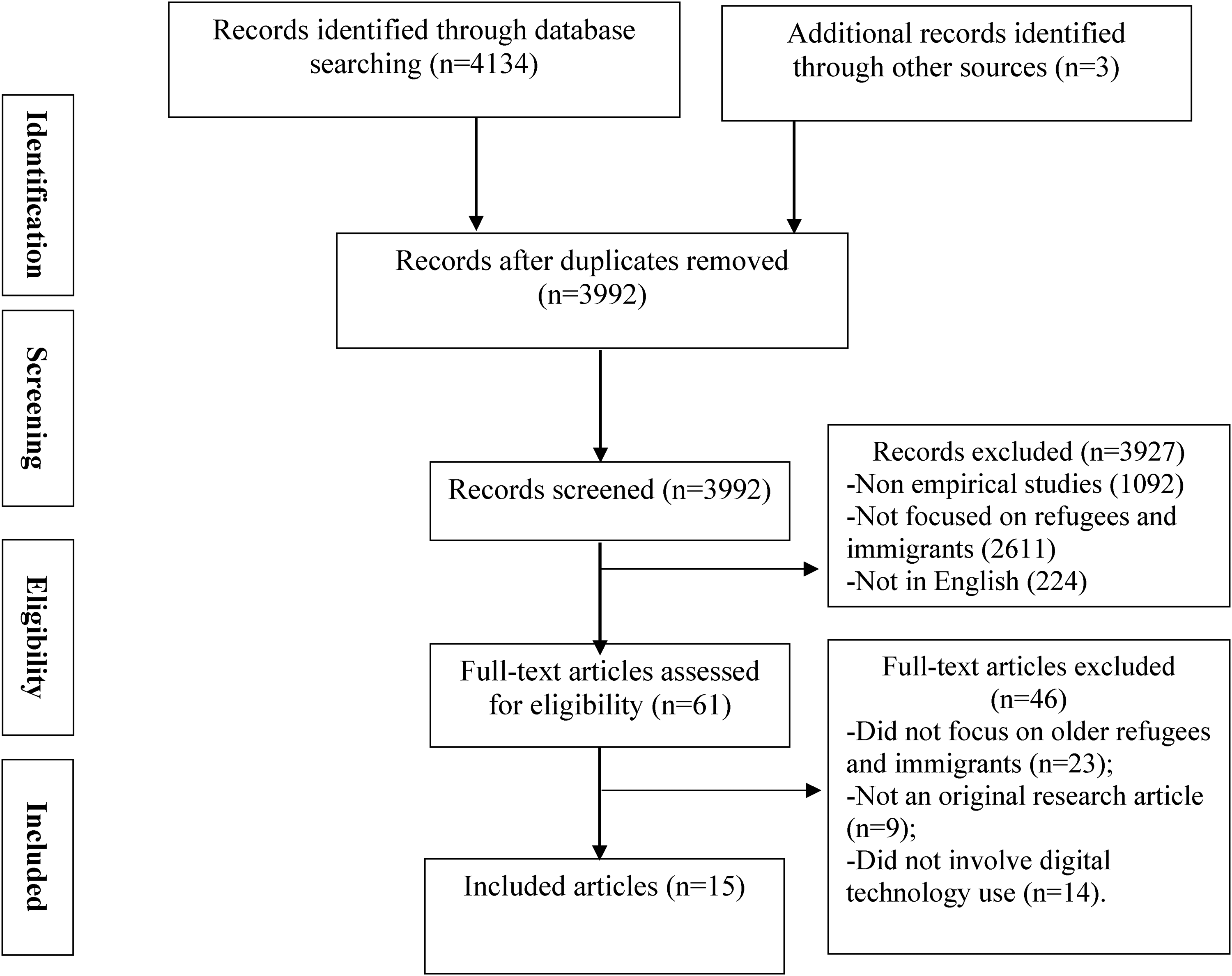
PRISMA flow diagram.
Characteristics
The characteristics of included articles were summarised in Table 2. The table shows that thirteen of the articles sampled only older immigrants and refugees aged 50 years and over, with three of them having respondents of lower age. A significant number of the studies in our scoping review (n = 6) had the immigrants’ and refugees’ host countries be the United States of America, with two in Finland (n = 2), one each in Australia, Canada, Germany, Israel, New Zealand and Sweden. Five of the included articles were quantitative studies using cross-sectional, longitudinal, and quasi-experimental active control study designs; four were qualitative studies that utilised cross-sectional and exploratory study designs; one article used mixed method with qualitative photovoice design; four qualitative studies did not include study design. The older migrants in the study were from diverse populations, including those of Hispanic origin, Chinese origin, Italian and Greek origin, Former Soviet Union, Russia, Tajikistan, Belarus and Ukraine, Vietnam, South Asia, South Korea and Cambodia.
Characteristics of studies focused on older immigrants and refugees.

Digital technology and well-being
Our review found an association between digital technology and well-being across several domains, including a reduction in social isolation and loneliness, e-leisure and personal growth and physical activities. Each of the domains will be described in detail below.
Reduction of social isolation and loneliness
Social connection through the internet has been one of the significant advantages of digital technology. This is evidenced by the majority (n = 9) of the studies reviewed in this article highlighting the importance of digital technology to the social network support of older immigrants and refugees.26,33,40–46 For instance, the majority of participants (n = 161, 93.1%) in the cross-sectional study by Chiu et al., 43 which sampled 173 Chinese immigrants aged 43–87 in New Zealand, revealed an increase in acceptance and use of digital technology to address loneliness and social isolation. The authors also reported that the majority, 60.1%, of the participants (n = 104) had used the internet for over 10 years. The study concluded that digital technology helped them keep in contact with friends and family members. Interestingly, it was further revealed that the participants reported more acceptance of companion robots than pets. However, they preferred using apps and the internet for social engagements more than companion robots. It is critical to note that the survey methodology was online, which may have led to bias associated with a self-reporting bias, as many older immigrants without access to the internet may be excluded impacting generalisation.
The mixed method study by Andonian, 42 which sampled nine Russian-speaking older immigrants in the United States aged 65 years and over, showed that digital technology was used to develop social relationships and engagement with others. Participants reported connecting with relatives and friends through email and Skype. They also reported feeling part of the digital exchange, as some participants described writing about their lives and connecting with others through digital technology. However, this study's findings must be interpreted with caution because of the small sample size (n = 9) and the use of interpreters who may have misrepresented the participants’ views. Further limits to generalisation are a due to selection bias, the study was limited to the immigrant experiences of those only from Eastern Europe. The quasi-experimental study by Pandya 46 evaluated the impact of an Internet-based Mediation Program (IMP) on 172 older South Asian widows who migrated to the United States in later life. Study findings revealed that the IMP group demonstrated greater adaptive coping, post-migration socio-cultural adaptation and enhanced quality of life compared to the control group. Of note, other factors like having a college degree, financial independence, belonging to Buddhist and Hindu religions, having social networks, and living with adult daughters impacted the efficacy of the IMP, as the participants within these categories reported higher scores on intended outcomes. Similar to the study by Chiu et al., 43 using online intervention may inherently be biased as it favours people who can use the internet. Again, this quasi-experimental study did not control the self-reported outcome, which may have led to response bias.
Older migrants who struggled with in-person social connection found digital technology as a viable tool for making friends. According to a cross-sectional study by Gil-Clavel et al., 45 which used traditional and new data from The Survey of Health, Ageing and Retirement in Europe (SHARE) in addition to Facebook data, the authors found that being an older immigrant is associated with having close friends online. Older migrants compensated for their lack of offline friends by making close friends on Facebook. This process was found to be more prevalent amongst older immigrant women compared to men. However, this study was limited to countries represented in SHARE and only Facebook users. This may have excluded people who interact in other internet spaces and people from other parts of the world. Research has also established that older adults are willing to try new and emerging technologies if it helps them build social connections with their family and friends. For example, a study by Fritz et al., 44 which sampled 55 older Asian immigrants aged 55 years and above, revealed that older immigrants from different Asian traditions are willing to start using smart homes if it will improve connections among family members. However, they understood that smart homes and social connections are not mutually exclusive and remained sceptical about using them if they affect in-person connections with their family. A major drawback of this study was that participants did not live in the smart homes, but the smart homes were introduced through pictures and conversations, which limited the use of the senses.
Digital technology presents a source of social support for older immigrants and refugees. In a study of 150 older Korean immigrants aged 60 years and over in the United States, Jun et al. 33 indicated that participants reported the use of smartphones as a significant indicator of social support from family. Older Korean immigrants in the study connected with their family and friends through social media and received social support, which significantly increased their life satisfaction. This study is limited by the potential selection bias given that all the participants were recruited from Korean churches, excluding non-Christine and church attendees. The study by Lin et al. 41 also showed that older refugees aged 45 to 85 years in their sample of 29,679 respondents who used online social networking to develop quality relationships recorded reduced social isolation and depression. However, importantly 42.1% of the respondents in the sample were younger at a reported age of 45–55 years, which may have significantly impacted the findings. Similarly, studies by Adam et al. 40 and Tinghog et al., 26 which sampled refugees from Syria (n = 21), Iraq (n = 8), Iran (n = 4), Afghanistan (n = 3), Palestine (n = 1), Eritrea (n = 1), Uzbekistan (n = 1), Tajikistan (n = 1) aged 17–71 in Germany, and 720 Iraqi and Iranian refugees in Sweden, respectively, reported that digital technology played a fundamental role on refugees the ability to maintain a relationship with family and friends in other parts of Germany. Participants in these studies used Skype, telephones, emails and WhatsApp to keep in touch with fellow refugees and avoid migration-induced loneliness. The lack of disaggregation of digital technology benefits amongst older and younger refugees also influenced these findings.
E-leisure and personal growth
Immigration and refugeeism can be characterised by losses and trauma, leading to frequent anxiety and depression; this may be compounded by normative later life losses such as widowhood and health decline.16,42 Older migrants can use the internet to search for e-leisure activities to help them cope with their negative feelings of depression and anxiety and enhance their sense of well-being and life satisfaction. 16 Khvorostianov et al., 16 in their study of 32 older Russian immigrants in Israel, found that they used the internet for entertainment and to foster their intellectual interests and hobbies. They searched for songs, jokes, and comedies to satisfy their entertainment needs while also pursuing established and newer intellectual interests and hobbies. Andonian's 42 mixed-method study adopted a photovoice and Computer Proficiency Questionnaire to study nine Russian-speaking older immigrants in the United States aged 65 and over. The researchers found that participants experienced personal growth and self-expression from their use of digital technology to continue learning things like writing, teaching, cooking, pottery, and singing. However, it is essential to indicate that participants of this study have privileged experience with digital technology as they were recruited from computer skills classes. Another study of 17 Russian-speaking older immigrants in Finland by Safarov 47 also revealed that older migrants used digital technology for entertainment, watching YouTube videos and the news. However, the findings of the study by Andonian 42 and Safarov 47 may have been affected by sampling bias because the participants were educated, technologically savvy and had access to the internet, which is not the reality of many older immigrants and refugees.
Physical activities
Physical activities have been documented as critical for the well-being of older adults by increasing muscle strength for the continuation of daily activities and delaying or reducing age-related diseases. 48 Digital technology has played a crucial role in assisting older adults in monitoring their physical activities with devices like the Apple Watch monitoring heart rate, sprints, walks, swimming strokes, etc. 49 Researchers have also adopted digital technology for building prediction models for physical activities amongst older immigrants. For instance, Yoon et al. 50 adopted data mining to explore the predictors of physical activities among 2514 older adults, including older immigrants aged 55 to 100 in the United States. The study found that being an immigrant born outside the United States and having a place to exercise, anxiety, and time were the predictors of physical activities. Compared to non-immigrants, immigrants were also less likely to engage in physical activities as a form of transportation. The study concluded by recommending using technology to identify and design interventions to address modifiable factors at environmental and individual levels, especially for vulnerable populations like immigrants. Worthy of note in this study is using self-reports of physical activity, which may under or overestimate actual physical activity levels.
Digital technology and information needs
Information for daily living
Older refugees and immigrants also adopt digital technology to fulfil their information needs, as shown by two studies in this review.30, 42 For example, Goodall et al. 30 sampled first-generation older immigrants aged 55 years and over who migrated to Australia from Italy and Greece in the 1950s and 60s and reported that participants used digital technology to access a wide range of information needed for daily living and quality of life. The study participants also showed an ability to recognise expert sources of information, limiting the impact of misinformation that plagues the internet. However, it is essential to note that many of the participants of this study reported indirect use of digital technology as they asked members of their social networks to assist them with computers for e-trade and to send emails on their behalf. A mixed method study which employed a photovoice and Computer Proficiency Questionnaire by Andonian 42 with nine Russian-speaking older immigrants aged 65 years and over in the United States showed that participants used digital technology to access instant and multiple sources of information. They also appreciated the freedom of access to different sources of information, with one of the respondents specifically highlighting how it reduces the bureaucracy of the Russian consulate.
Healthcare information
Given the deteriorating health associated with ageing, digital technology plays a vital role in accessing healthcare information for older immigrants.51,52 In another study that sampled 1082 Russian-speaking older immigrants aged 50 years and above in Finland, Shin et al. 52 found that the majority of the participants indicated that digital technology was essential to their well-being, as they accessed health and healthcare information through the internet. In the study, respondents with high digital technology use were found to have significantly higher healthcare use than those with low technology use. In Nguyen et al.'s 51 study of 104 older Vietnamese immigrants aged 50 to 70 in the United States, digital technology was integral for cancer information-seeking and scanning behaviours. However, the study also showed that older Vietnamese immigrants in the United States reported lower health-related internet use compared to white and African Americans. Hence, they were observed to have lower use of electronic and interpersonal sources for cancer-seeking and scanning behaviour. These findings may have been influenced by the differences in educational attainment levels between Vietnamese American immigrants compared to African American and White participants.
Digital diasporans
Transnational connections with home country and culture
Compared to younger refugees and immigrants, older refugees and immigrants are more attached to the culture of their home countries. 15 Results from the study by Khvorostianov et al., 16 which interviewed 32 older Russian immigrants aged 69–89 in Israel, revealed that younger people utilise the internet to keep abreast with recent happening in Russia, while older Russian immigrants preferred to access the internet to hang onto the memory of a Soviet culture that is no longer in existence. Results from the study further revealed that digital technology helped older Russian immigrants virtually visit significant places in their home country and also collected information about their biographies and family history, reflecting on two aspects of their identities (Jewishness and Russianness).
Transnational opportunities
The use of digital technologies for economic opportunities is primarily associated with younger people.16,52 However, the study of 32 older Russian immigrants in Israel by Khvorostianov et al. 16 discovered that older immigrants could also take advantage of transnational professional opportunities provided by the internet to bring about a host of financial benefits and social and psychological impacts. The study further revealed that while younger and more established immigrants enjoyed a transnational lifestyle in the past, digital technology and the internet have empowered and better integrated older immigrants to reap these benefits. Digital technology use was associated with accessing transnational healthcare by Russian-speaking older adults in a study of 1082 older immigrants in Finland. 52
Discussion
Digital technology plays an increasingly significant role in the resettlement and well-being of migrants.26,40,52 Recent studies have also shown its importance to the quality of life and life satisfaction of older adults 16 and the COVID-19 pandemic has both cast a light on the importance of access to digital technology for older adults and revealed the digital gap and its consequences on their well-being (Authors). In this scoping review, we have mapped out extant empirical literature to help us understand the impact of digital technology on the well-being of older immigrants and refugees. As technology continues to proliferate, it is essential to understand how it serves older adults -especially those made more vulnerable by immigration and refugeeism, and what we can do to help them safely take advantage of this technology to improve their well-being and quality of life.
Maintaining social connections with relatives and friends was found to be the most widely accepted use of digital technology by older adults and refugees, according to research in this review. Loneliness and social isolation amongst older immigrants and refugees are well documented. 19 ,. 20–24 ; Relatedly, our scoping review showed that digital technology plays a crucial role in helping older refugees and immigrants address the problem of loneliness and isolation.42,43,44 Digital technology has been shown to help them connect and interact with their families in their home countries and in other parts of the world. 33 Other studies reported that older immigrants and refugees who struggle to create social connections in their new environment turn to social media to develop meaningful new relationships. 45 The acceptance of emerging technologies like smart homes and robot pets were also found to help older immigrants and refugees address loneliness and social isolation.43,44 The acceptance and use of both old and emerging technology within a population that typically has new technology anxiety and stress 53 for the purpose of social connection and addressing loneliness shows the invaluable importance of social networks to older immigrants and refugees. Hence, emerging technologies designed to help humans build social connections can be targeted at older immigrants and refugees. Having older immigrants and refugees as a target population in designing networking technology can make it easier and eliminate technology-related stress and anxiety.
Digital technology also helped older immigrants and refugees engage in physical activities, both for the purposes of leisure and personal growth. Many refugees and immigrants used the Internet to find leisure and physical activities of interest to them.16,50 This is very important for the enhancement of the well-being of older immigrants and refugees as leisure activities help them cope with the stress of migration, and physical activities improve their overall health. 16 Many also consider themselves life-long learners, and digital technology provides them with the resources to keep learning and growing. 42 All this shows that digital technology has huge implications for older immigrants’ and refugees’ well-being, helping them cope with distress, build resilience, and improve their physical and mental well-being.
Older immigrants and refugees also use digital technology to address their information needs, getting information about their health and daily living. Older migrants use the Internet to find information about their health, including where to access healthcare.51,52 They also use it to conduct business and e-transactions. 30 Rapid access to information was found to be especially appealing to this population. 42
As revealed by HelpAge International, 15 compared to younger people, older immigrants and refugees have more connections to their home countries. Digital technology provides them with the platform to maintain relationships with their home countries and stay connected to their culture.16,52 This connection with their home countries further enables them to reflect on their histories, virtually visit sites that they are familiar with and love, and access business opportunities in their home countries.16,52
However, the reviewed studies have shown limited use of digital technology by older immigrants and refugees, 26 ,30,41,47 with the study by Goodall et al. 30 showing that older Italian and Greek immigrants in Australia had a low rate of digital technology use, showed little interest in learning to use computers and found mobile phones costly and complicated to use with small keys and multiple functions. Similarly, Nuriiar's (2021) study of 17 Russian-speaking older immigrants in Finland revealed that on the second and third levels of the digital divide, which examines skills and patterns and outcomes of digital engagement, older immigrants are still experiencing difficulties adopting and using internet technologies. While the studies by Adam et al. 40 , Lin et al. 41 and Tinghog et al. 26 all reported limited use of digital technologies among older refugees compared to younger refugees. Therefore, seeing the importance of digital technology to the well-being of older migrants with emerging new technologies like artificial intelligence, pet robot companions, and smart homes raising new potentials for the care and support of older adults, it is important to improve their access to and utilisation of digital technologies. This can be achieved through a dyad approach. While older migrants are educated on how to take the best advantage of these technologies, technology companies should also be encouraged to produce ageing-friendly technologies, which are technologies that aid older adults age actively while limiting the stress of technology among older migrants.
Nevertheless, the dependence on digital technology can expose older immigrants and refugees to health and financial risks. 54 An example of the health risks can be observed in the misleading information prevalent during the COVID-19 pandemic, termed infordemic by the World Health Organisation, 55 which put many older adults at increased health risk. E-trading can also expose older migrants to online fraud. Therefore, to continue protecting older migrants, there should be continuous education and training on the recognition of expert sources of information in the web space. Again, while recognising the importance of digital technology in building and maintaining relationships, these online relationships can expose older immigrants and refugees to online scams and abuse 54 ; hence, there is a need to continue educating them on the safe use of digital technologies.
In summary, reviewed studies show that digital technology is increasingly critical to older immigrants’ well-being and quality of life. However, there is still a significant digital divide between older and younger immigrants in technology use, and none of the reviewed studies addressed this gap. Therefore, there should be more scholarly investment in advancing digital technology use amongst older immigrants and refugees. Again, disaggregating the data in this scoping review reveals a significant gap in studies exploring digital technology use amongst older refugees. This may be because many studies do not separate older refugees from older immigrants, neglecting their realities differences. Digital technology use found that the few studies that accounted for older refugees came from serendipity. Hence, there is a need for more studies focused exclusively on digital technology use amongst older refugees. Finally, the included studies did not disaggregate the data by time of migration (before or after 50). The experiences of older immigrants and refugees who aged after migration and those who migration in later lifer may vary, requiring more nuanced studies.
Limitations
Although this review is the first, to the best of our knowledge, to identify and map out empirical studies to help understand the impact of digital technology on the well-being of older immigrants and refugees, we recorded some limitations. Some pertinent literature may have been omitted from the study, given that our inclusion criteria were limited to studies in English, empirical studies, and peer-reviewed studies. Excluding studies written in languages other than English may have denied us relevant findings in countries and cultures where English is not the official language. Hence, we recognise the limits to the generalisation of our results and that some ‘voices’ of older immigrants and refugees in some cultures are not represented in the studies we reviewed. We deliberately omitted practice reports and grey review literature, which were not peer-reviewed and could have also omitted articles in non-indexed databases which could have added to the applicability of this review. 56 It is also important to note that there was little to no disaggregation of the types of older migrants in most of the studies, as the authors grouped refugees into immigrants. This also led to the limited inclusion of studies focusing exclusively on refugees, as only three studies concentrated on refugees alone.26,40,41 Hence, we encourage caution in interpreting our findings because older refugees’ realities may differ from older immigrants. This also calls for more research on the use of digital technology by older refugees as a disaggregated sample.
Conclusion
This scoping review shows that digital technology is becoming more essential to the well-being, quality of life and life satisfaction of older immigrants and refugees. Digital technology helps older migrants maintain old, and build new social support networks, address loneliness, and remain connected to their home country and culture. A few studies in this review found that it helps in accessing health-related information, coping with migration-induced stress through e-leisure and physical activities and engaging in online business opportunities. However, extant literature still shows poor access to and utilisation of digital technologies amongst older adults, including immigrants and refugees. Given the importance of these technologies to their well-being and overall life satisfaction, there is a need to continue improving access and use of these technologies through education and focusing on this vulnerable population in designing and producing emerging technologies. There is also a need for more consultation with older adults directly need to understand the barriers and challenges to digital technology and develop strategies to enhance the proliferation of digital technology use.
Footnotes
Contributorship
PC conceptualised the research idea and had major contribution in the development of the manuscript. TJ, FB and OO researched literatures and contributed in developing the introduction and methodology, while CW was the research supervisor and final editor. All authors agreed on the design of the study and approved the final version of the manuscript.
Declaration of conflicting interests
The authors declared no potential conflicts of interest with respect to the research, authorship, and/or publication of this article.
Ethical approval
Ethical approval is not applicable as this is a scoping review.
Funding
The authors received no financial support for the research, authorship, and/or publication of this article.
Guarantor
OTJ
