




Abstract
Objective
The use of media profoundly affects people's sports participation behavior. Past research has presented mixed results on the relationship between media use and sports participation behaviors. Therefore, the relationship between media use and sports participation behavior should be revisited.
Methods
A meta-analysis of 17 independent studies from 12 literature was conducted to determine whether (a) media use positively influences sports participation behaviors, and (b) form of media, media measurement methods, study subjects, and culture moderated these relationships. Pearson's correlation was used to conduct a random-effects meta-analysis and examine the moderating effects.
Results
The results showed a positive correlation between media use and sports participation behaviors (r = 0.193, 95% CI = [0.047,0.329]). Traditional media showed stronger correlations and moderating effects than new media; however, the time variable (in media measurement methods) and primary and secondary school students (in study subjects) showed negative correlations between media use and sports participation behavior. The positive and moderating effects on this relationship were higher in Eastern cultures than in Western cultures. These results suggest that media use and sports participation behavior were positively correlated, moderated by the form of media, media measurement methods, study subjects, and culture within studies.
Conclusions
From the effect test results, a significant positive relationship was found between media use and sports participation behavior (both physical participation behavior and consumption behavior). The two were influenced by several moderating variables including the form of media, media measurement methods, study subjects, and culture, and the influence of media measurement methods was the greatest.
Introduction
Physical fitness is a critical health indicator that can be assessed using physical activity. 1 However, today, a significant proportion of the population does not meet the minimum exercise standards required by the human body.2,3 Appropriate levels of the most common form of daily physical activity, that is, walking, which is used for recreation, work, and transportation, 4 are often not achieved. A report from the German Child and Adolescent Health Survey (2009–2012) showed that only slightly more than a quarter (27.5%) of children and adolescents aged 3–17 years exercise at least 60 min per day, as recommended by the World Health Organization. 5
Scientists predict that over time, the spread of COVID-19 will continue, although likely at a manageable level. COVID-19 outbreaks have forced the development of medical treatments and vaccines in various countries, and people are responding to the virus by strengthening their environmental health and personal immunity. 6 Sports participation is an important means of enhancing such immunity; however, as previously mentioned, the importance of sports participation in ensuring physical health and immunity has been largely ignored. This is largely because the media influence perspectives on sports, 7 providing a didactic narrative approach to discussions of the importance of sports. 8 Therefore, a more in-depth view of the relationship between media and sports participation behaviors is needed in order to more effectively improve human physical health and immunity in the current virus-ridden environment.
Social media was first used in 1994 in the Tokyo online media environment, named Matisse. 9 In the early days of Internet commerce, the first social media platforms were developed and brought to the market and the first generation of users emerged. Businesses then turned their targets to social media platforms, changing traditional ways of interaction where the customer is a passive player. 10 Social media is often viewed as an overarching discourse to describe various online platforms, including blogs, business networks, corporate social networks, forums, microblogs, photo sharing, social games, and video sharing. 11 In general, social media are communication tools and new media technologies, based on the Internet, that allow organizations and individuals to interact, exchange, and share information and content in real time or asynchronously. 12
Over the past three decades, sports participation has increased significantly in many countries, with 22% of adults engaging in sports in 1975 and 38% in 2000. Governments actively promote sports participation among their citizens, mainly because sports participation, whether physical or through consumption, can contribute to improving underlying health problems, 13 and even the lightest exercise can reduce mortality and improve health.14,15 In addition to the well-known physical health benefits of sports participation, such as improved bone density, physical fitness, and muscle strength and reduced cardiovascular disease risk, sports participation also influences psychological and social health. 16 In addition to improving health, participation in sports can help governments significantly reduce economic expenditures. A Swiss survey showed that 1.4 million cases of disease and 2.4 billion Swiss francs in treatment costs (1.6 billion direct and 800 million indirect) could be attributed to a lack of physical activity.
The development of business and technology in the sports and media industry has contributed to rapid growth in sports consumption opportunities. 17 The sports industry has rapidly globalized, and it is now used by billions of people worldwide. 18 Moreover, commercialization has led to an increase in the number of teams and leagues vying for the hearts and wallets of consumers. 19 Furthermore, in such a crowded market, consumers have more choice on what to spend their time and money. 20 At the same time, sports shifted from leisure activities to business practices. Currently, the production of sporting goods is an important industrial sector with growing segmentation. Sports tourism, sports companies, large sports conference organizations, sports clubs, and sports sectors are all significant economic areas in sports. 21 Thus, as a reescalation of sports participation, sports consumption deserves more detailed attention.
One of the essential factors contributing to physical inactivity among young people is the use of media, such as the Internet. Previous research has shown an important link between reduced physical activity and increased time spent on the Internet.22,23 The decrease in face-to-face communication during the COVID-19 era has led to an increase in screen use and an unprecedented increase in the use of media, especially social media. It has been argued that Internet use is achieved at the expense of physical activity. However, studies have also shown that media use not only impedes physical activity but can also promote this behavior. One study found that sitting in front of a computer for long periods did not reduce physical activity, which is inconsistent with the conventional wisdom that time spent online is spent at the expense of activities such as physical activity. 24 In addition, mass media plays a vital role in promoting and popularizing sports. 25 For example, sports can be advertised through the mass media to attract more attention. 26 A study showed that in Pakistan, mass media and marketing significantly affected local women's sexual exercise and played a central role in promoting it. 27
Although the COVID-19 pandemic has affected physical exercise, it has also accelerated participation in sports consumption. Sports consumption includes sports, sports-related products and services, sports information, news, and other sports-related topics. Sports consumers are people who engage in amateur sports, follow sports media, work in the sports industry, and operate. 28 Therefore, sports consumers are loyal to their teams. They come to the field to watch games, and are willing to spend large sums on their teams. Sports is not only seen as a consumer product but also as an industry that attracts fans, spectators, and participants, and becomes a key consumption factor when it is produced by mass consumers. Overall, sports consumers can be considered individuals who consume sports-related services and products. Sports consumers can be divided into two categories: practitioners (active participants) and spectators (passive participants). Passive participants can consume sports events through mass media. 29 In recent decades, sports spectatorship has gained enormous popularity as a leisure activity and is part of the largest global industry, 30 thus driving the development of sports consumption.
Thus, the above discussion reveals that with changing times, the current sports behavior is no longer simply sports activity behavior, but also includes non-sports activity behavior such as sports consumption, and all of these are important components of sports behavior, regardless of whether they are sports activity behavior or non-sports. As subjects of sports behavior, when people engage in sports activity or sports consumption, they actually engage in a kind of participation behavior around sports, the former using their bodies to participate, and the latter using money or thoughts. However, in the end, it is all a kind of sports participation behavior.
It is worth mentioning that physical activities and sports activities differ. Physical activity tends to be a purposeless bodily action, which occurs as physical activity whenever the body produces an action, such as household activities, occupational work, transportation, or recovery. This includes sports activity, which points to a purposeful form; sports activity carried out around a certain sports event, such as playing basketball, football, etc. 31 This study mainly focused on purposeful sports activities; therefore, it concerns sports activity rather than physical activity. In addition, as sports consumption also targets specific sports activities, sports participation behavior refers to purposeful sports activity behavior and sports consumption behavior that occurs around sports.
The inconsistency of results regarding the relationship between media use and sports participation behaviors was found based on a review of existing studies, with some results suggesting a positive relationship 32 and others suggesting a negative one, 33 creating a point of contradiction. Often, this is due to differences in subject identity (age and culture).34,35 and differences in measurement co-instruments. 36 Therefore, this study concluded that there is a need to explore whether these factors act as moderating variables. Previously, research on media and sports participation was mostly empirical and often used methods such as questionnaires. Such research results usually only analyzed the situation of the surveyed subjects. The innovation of this study lies in the fact that there is currently no research using meta-analytical methods to analyze research on media use and sports participation behavior among different populations and ages in mainstream databases using a unified standard. This study is thus more diverse than previous studies in terms of sample size, countries, populations, and types of media involved, and therefore the correlation between the two is more general. In addition, compared to previous studies, this research innovatively proposes that the form of media, media measurement methods, study subjects, and culture can serve as moderating variables in the relationship between media use and sports participation behavior.
Methods
The relationship between media use and sports participation behaviors, both physical and consumer, has been explored by scholars in several countries. In the context of the current global COVID-19 pandemic, studies have shown that the frequency of media use has increased, physical health and mental satisfaction are highly sought after, and sports participation behaviors are being increasingly valued. In light of this, it is necessary to revisit the relationship between media use and sports participation behavior. Current research on this relationship is inconsistent, with positive, negative, and uncorrelated findings regarding physical participation and positive correlations regarding consumption participation. Contradictory results between such studies may be due to the subjects’ nationalities, genders, and ages. The current study sought to investigate the influence of media use on sports participation behavior, hypothesizing that media use and sports participation as a whole are positively correlated. To test whether the association between them is moderated by the study subjects, media tools, media measurement methods, or culture, a meta-analysis was used. This study followed the PRISMA 2020 guidelines.
Eligibility criteria
Because of the significant variation in research across the literature, the criteria required for inclusion in the meta-analysis were: (a) the language was Chinese and English; (b) the study specified information about the study population, sample size, and measurement-related procedures; (c) the data results demonstrated the relationship between media use and sports participation behavior and were not purely theoretical or review articles; (d) the data analysis presented Pearson effect sizes; (e) the medium used was specifically mentioned; (f) at least one sport participation behavior was included; and (g) if the same study was published multiple times, only one instance was included in the analysis. A total of 12 literature that met the meta-analysis requirements were finally obtained. The specific inclusion processes are shown in Figure 1.

Flow diagram for inclusion in meta-analysis.
Information sources and search strategy
Literature related to this topic was collected through a literature search. The studies were mainly collected from EBSCO, JSTOR, PubMed, SPECIASCI, ELSEVIER, Google Scholar, Embase, CINAHL, Sports Discus, and CNKI. Relevant manual searches were conducted on the references of published review articles to ensure that the data in the meta-analysis were as representative and complete as possible. The selected keywords related to media use were: “media,” “media use,” “mass media,” “Internet,” “computer,” “TV,” and “smartphone,” while those related to sports participation were “sports,” “sports participation,” “physical activity,” “exercise”, “sports consumers,” “online,” and “offline.” The keywords were searched one by one and in combination.
Selection process and data collection process
For the extraction of literature data, in order to ensure the quality of the literature, the selection process was completed by three researchers. The first researcher extracted articles according to the structured table, then the second researcher checked their accuracy. Their work was not carried out simultaneously but rather was sequential. When there was a disagreement, firstly, the two researchers would negotiate to come to a resolution. In situations where an agreement could not be made, the corresponding author made the final decision.
Data items
The 12 literature included in the meta-analysis were coded as follows: literature information, sample size, gender, study population, sports participation behavior, media, media instrument, media measurement method, culture, and effect size. According to the previous section, sports participation behaviors were divided into online physical behaviors, offline physical behaviors, online consumption behaviors, and offline consumption behaviors. Media were uniformly divided into two categories: new and traditional media. Media tools concretized new media and traditional media, including the Internet, television, and newspapers. According to the classification of related studies, the measurement of media use were divided into two categories: type (type of media) and time (frequency of media use). Culture was mainly divided into three types based on region: East Asia, Western Europe/North America, and others. 37 East Asia mainly includes Asian countries such as China (including Hong Kong, Macau, and Taiwan), Japan, and South Korea. Europe/North America includes countries such as the United Kingdom, Switzerland, Germany, the United States, and Canada, while others refer to other countries not included in the above classification, such as Thailand, the Philippines, Turkey, and Iran. The study population was divided into primary and secondary school students, college students, and others (others mainly included adult groups and mixed groups of adults and students). Effect sizes for each independent sample were coded independently according to the sample itself or separately if more than one independent sample existed in a study. The effect sizes for this study were all direct Pearson effect sizes, as explicitly presented in the original literature, and were not converted otherwise. This study ultimately obtained 17 independent studies from 12 literature, as shown in Supplemental Table 1.
Research quality assessment
Literature quality was assessed using the Medical Education Research Study Quality Instrument (MERSQI). 38 Although MERSQI was developed for medical education, it can also be applied in non-medical teaching research because of its relative neutrality and objectivity. 39 The ten items of the MERSQI cover six domains: (a) study design, (b) sampling, (c) data types, (d) validity, (e) data analysis, and (f) outcomes. The maximum score for each domain is three, with a total score of 18. A mean of 14.26 was obtained with a standard deviation of 0.35 and a median of 14, which indicates the overall sound quality of the literature included in the study. The specific MERSQI values for each piece of the literature are listed in Supplemental Table 1.
Synthesis methods
After comparing different data processing software in this study, a more comprehensive CMA 3.0 (Comprehensive Meta-Analysis 3.0) was selected for analysis. The sample size (k), weighted effects (r), and 95% confidence intervals were calculated to test the study hypotheses. Studies were tested for significant differences in mean effect sizes by Cochrane's Q and I2 (heterogeneity test), and effect sizes were determined to show significant heterogeneity if the I2 exceeded 75. 40 In addition, this study used a random-effects model, which is more suitable for meta-analysis than a fixed-effects model (in a random-effects model, the selected studies are considered as a random sample from a larger population as a way to generalize the findings). 41 In the literature included in this study, the subjects were of different ages. They used different measurement instruments and methods, making the use of a fixed-effects model inappropriate, and the need for the study to discuss the role of moderating variables in this, making a random-effects model more appropriate. To test for publication bias, we used funnel plots, Rosenthal’s Fail-Safe N test, and Egger’s test after synthesizing related studies
Results
Heterogeneity test
After filtering the literature, correlation operations were performed on 12 literature with 17 effects. The forest plot in Figure 2 shows a more pronounced heterogeneity. Figure 3 shows the Q-value was 916.42 with a degree of freedom of 16, p < 0.001, indicating that the effect sizes in the meta-analysis were heterogeneous. The I-squared value was 98.254, indicating that 98.254% of the observed variation was highly heterogeneous due to actual differences in the effect values. A T-squared value of 0.094 indicated that 9.4% of the study space variables were available for the weight calculation. The heterogeneity test results indicated that the random-effects model was accurately chosen for the study.

Study forest map.
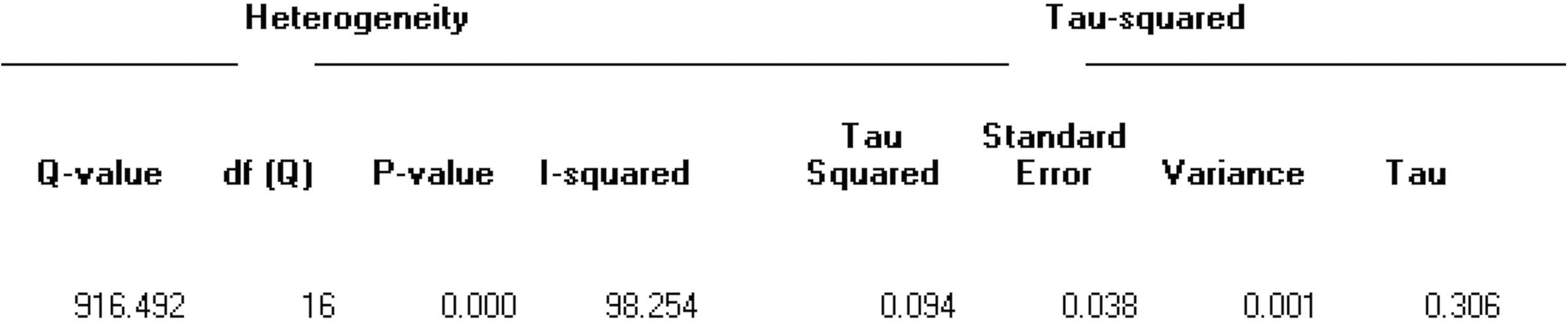
Heterogeneity test results.
Publication bias test
Figure 4 shows publication bias tests were performed on 17 effect sizes, and according to the funnel plot, the studies were relatively symmetrical overall. However, they were only partially distributed on the left side. An Egger's test (Figure 5) was conducted to obtain more accurate and relevant data, and it showed that there was no publication bias in the studies, p = 0.47586 > 0.05. In addition, Rosenthal’s Fail-Safe N results (Figure 6) showed that an additional 1704 references involving media use and sports participation behaviors would need to be included for the total effect to be insignificant; therefore, there was no severe publication bias.
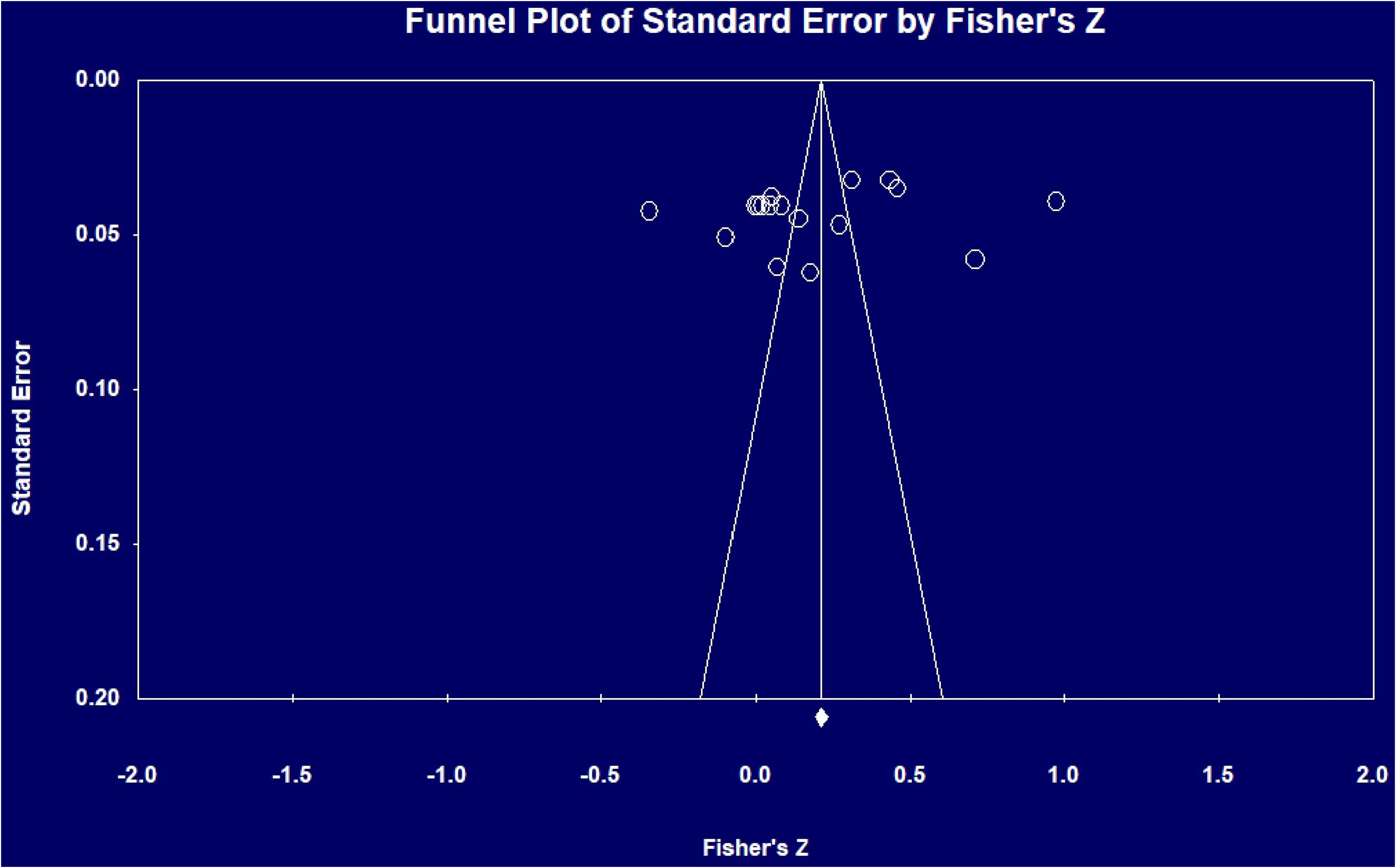
Research funnel diagram.

Egger's test results.

Rosenthal's fail-safe N test results.
Main effect analysis
According to the results of the random-effects model, Figure 7 shows the main effect between media use and sports participation behavior was r = 0.192, with a 95% confidence interval of (0.047,0.329), p = 0.01, thus indicating a significant positive relationship between media use and sports participation behavior.

Main effect results.
Test for moderating effects
Form of media (Internet, TV, Radio, Newspaper, Magazine), media measurement methods (type, time), study subjects (college students, primary and secondary school students, others), and culture (East Asia, Europe/North America, others) were tested for moderating effects, and the results are shown in Supplemental Table 2.
Correlation coefficients for the form of media indicated that media-specific form differences produced a moderating effect between media use and sports participation behavior; that is, they influenced the relationship between the two and showed a significant positive relationship (Q = 19.927, r = 0.063, p = 0.015 < 0.05). The moderating effect was most pronounced, and the correlation was most significant for newspapers (r = 0.365, p = 0.000), television (r = 0.330, p = 0.015), and the Internet (r = 0.242, p = 0.009).
The media measurement method correlation coefficients indicate that differences in the way media performance is measured can only moderate the effect between media use and sports participation behavior (Q = 1.556, r = 0.198, p = 0.006 < 0.01). However, it was found through the data that when measured by the type of media used, a positive relationship was presented, that is, the more types of media used, the more positive the sport participation behavior (r = 0.232, p = 0.003 < 0.01). However, when measured by the duration of media use, it was found that the longer the time spent using media, the more it inhibited sport participation (r = −0.036, p = 0.861 > 0.05). However, there were no significant correlations between the two variables.
A significant positive effect for the study subjects’ indicated that differences in study subjects created a moderating effect between media use and sports participation behavior (Q = 12.285, r = 0124, p = 0.009 < 0.01). However, primary and secondary school students showed the opposite (r = 0.146, p = 0.279 > 0.05), indicating that elementary and middle school students did not have a moderating effect on the relationship between media use and sports participation behavior.
Culture correlation coefficients indicated that cultural differences have a significant positive moderating effect on the relationship between media use and sports participation behavior (Q = 12.470, r = 0.171, p = 0.001). This was most significant for East Asian countries (r = 0.129) than European/North American countries (r = 0.042), indicating that in terms of culture, Eastern countries have a stronger correlation between media use and sports participation than Western countries.
Discussion
The relationship between media use and sports participation behavior
This study combined previous research on the relationship between media use and sports participation behavior and found a significant positive relationship, consistent with previous research.
Media use influences physical participation in sports. This means that watching TV or playing games may replace high-intensity physical training among young people. In theory, because a person's time is limited, apart from work, study, or rest, it is difficult to do one thing if one chooses to do another. Once an individual invests in media, it becomes difficult to participate in sports activities. 42 Related studies in Germany have shown that intensive use of digital media is incompatible with sports participation. Moreover, the more time spent on the media, the less time spent exercising. 43 However, in fact, when social media is used in sports, their time increases. 44 Young people can reach 78.6% participation in sports and present good attitudes toward sports after watching online videos or articles. Sports celebrities on the Internet also positively influence youth participation in sports. 45 Overall, there is an ambiguous relationship between media and physical activity in sports, where the influence of participation or independence counteracts alternative utility in quantitative studies. However, the use of social media can enhance sports participation. 46 In addition, informational and trend-based sports are more beneficial in social networks than organized sports and are integrated into “medicine and physical activity.” 47
In terms of sports consumer engagement, marketers use social media to engage youth and actively introduce them to the benefits of sports, creating a desire to buy sports products. Sporting goods companies advertise their products on forums, and sports training companies advertise their programs and promotions through pictures and videos. 48 For example, sports drink merchants use media to deepen the psychological perceptions of adolescents, which in turn leads to consumer behavior, with some studies showing a positive correlation between the two. 49 This is true not only for physical sports consumption but also for some virtual sports consumption. Viewing behavior is a type of sports consumption participation, as social media determines, to some extent, the attitudes of sports fans towards sports programs and events. Furthermore, sports fans obtain information about games and players through social media and use social media to discuss them extensively, 50 thus forming a so-called “circle culture,” which leads to deeper sports participation. Currently, because sports fans’ media use is not limited to one medium, organizations should utilize more than one social media platform, which will deepen the perceived power of the brand 51 and thus, sports consumption behavior. However, this is not absolute; one study that analyzed the relationship between attitudes toward social media and sports consumption among a group of adolescent sports fans born after 2000 found that attitudes toward social media do not influence their desire or willingness to consume sports. 52 Instead other external environmental seem to influence their desires, suggesting that, to some extent, the medium also has limitations.
Meanwhile, the value of r = 0.19 also shows that, although the relationship between media use and sports participation behavior was significant, it was relatively weak. This means that although media use improves sports participation behavior, its influence is not strong. The main reason for this is that, whether sports activities or sports consumption, it is mainly purposeful behavior, which is often generated independently by humans for reasons of health or weight loss or to satisfy inner desires. For example, a study conducted a cross-sectional survey of 2527 Norwegian teenagers found that changing their bodies was an important reason for their participation in sports activities. 53 That is, a considerable number of people, even without the role of the media, still engage in sports participation behavior, and the impact of the media on their sports participation behavior is very weak. What truly affects the use of media is that those who originally did not have the intention to participate in sports begin to participate in sports activities or to engage in sports consumption through the media. However, this is problematic. In addition to the media, there are many other factors that may lead to sports participation, such as friends, leaders, and promotions. Research has shown that the participation of 15-year-old children in sports activities is largely influenced by family culture, 54 so the media is only one of the inducing factors and its influence is limited. These two reasons result in a relatively weak correlation between media use and sports participation, although the correlation is in fact significant.
The role of moderating variables in media use and sports participation behavior
In addition, as suggested in a previous study, some moderating variables also played an essential role in the final results. First, in terms of the form of media, both new media and traditional media show a positive relationship, but the specific magnitude varied. Although the results of this study show that traditional forms of media have more influence than new media, combined with previous research, it indicated that new forms of media (in many forms, including the Internet) are more significant than traditional forms of media, such as TV. 36 This is primarily because the Internet, as the most widely used form of media, has broken the barriers of time and space and significantly increased the rate and frequency of information dissemination, thus deepening people's perceptions and implementing these perceptions into behavior. Second, the measurement of media presents conflicting results, with some studies finding that the more time spent on media per day, the less time spent doing exercise per week, indicating that excessive media use may lead to low activity levels and decreased motor skills.33,34 Such results only apply to physical participation in sports and are not evident in sports consumption participation. There is also variability in the results for primary and secondary school students, which can be related to the time mentioned above, where primary and secondary school students have limited time due to their studies and cannot choose between media and sports functions, thus creating a relationship between the inverse effects of both. Finally, looking at the cultural domain, the characteristics of different cultures create differences in preferences for physical activity. In general, Western countries are more prominent in the field of sports, especially physical participation in sports, compared to Eastern countries. The r-values in various studies showed that Europeans and North American are more susceptible to media images influencing their sports participation than East Asians (0.043 > 0.129). However, there are also studies showing that Eastern countries are mostly collectivist cultures where adolescents may have a more solid social group than Western individualistic adolescents whose decisions are more independent. Eastern collectivism is more susceptible to media influence than Western individualism. 55 Thus, the role of moderating variables is not absolute and can produce numerous variations.
In summary, based on the research results, compared with previous studies, we obtained the following new findings: First, although there is a significant relationship between media use and sports participation behavior, unlike previous studies, this study found the relationship to be weak. The main reason for this is that some people are subjectively willing to participate in sports rather than being influenced by external factors such as the media, while others may be influenced by external factors but not necessarily by the media; thus, the role of the media is not significant. Second, the research suggests that some factors may play a moderating role in media use and sports participation behavior, which has not been previously proposed, which constitutes a new finding. In terms of the form of media, although traditional media still has a greater influence than new media, with the passage of time, the new media will become more important than the traditional media. In terms of the measurement of media use, the longer the time spent on media, the less time spent participating in sports. However, this applies only to sports activities and not to sports consumption, and does not apply to primary or secondary school students. Due to school arrangements, their sports activities are obligatory and fixed and will not be affected by the time spent using the media. Third, in terms of culture, Europeans and North Americans are more susceptible to media influence than East Asians are, which has not been reported in previous studies.
Conclusion
In this study, the results obtained from the meta-analysis of 17 independent studies showed that there was heterogeneity between studies, which could be caused by differences in study factors, such as form of media studied, media measurement methods, study subjects, and cultural differences. Publication bias, funnel plot, Rosenthal's Fail-Safe N, and Egger's tests showed that there was no publication bias. This proves that the research design and results were accurate and feasible. Moreover, from the effect test results, a significant positive relationship was found between media use and sports participation behavior (both physical participation behavior and consumption behavior). The two were influenced by several moderating variables including the form of media, media measurement methods, study subjects, and culture, and the influence of media measurement methods was the greatest. Additionally, the inclusion of other moderating variables will likely also affect the final results, so these need to be controlled in future studies.
Although the studies included above mainly focused on youth, media influences sports participation behavior in all people who have active or forced contact with the media. Therefore, if the government and other organizations want to enhance sports participation behavior, the media is a critical factor that cannot be ignored. The results of this study provide some insights.
From a theoretical perspective, this study confirms the positive relationship between media and sports participation and creatively analyzes the role of media form, media measurement methods, study subjects, and culture as moderating variables. In practical applications, this research can provide guidance to governments, sports companies, schools, and other institutions. The results of this study indicate that the impact of media use on sports participation is limited. Therefore, when formulating policies and plans, institutions should not overly exaggerate and value media factors but should consider social relations, marketing, and other factors to enhance mass sports participation. In addition, the moderating variables indicate that, if an attempt is made to enhance sports participation in the media, the institution should focus on expanding the types of media used and on controlling media use time.
However, at the same time, research still faces certain limitations, first in terms of language. Due to the inclusion of literature mainly in Chinese and English without considering other languages, it was not possible to cover a considerable body of research in other languages. Second, there were limitations to the search with keywords. Although the researchers have attempted to cover as many keywords and collocations as possible, it cannot guarantee comprehensiveness, resulting in relatively limited results. Finally, there are limitations of the databases. This research has mainly focused on mainstream databases, and owing to the inability to search across all databases, some important studies might have been omitted.
Supplemental Material
sj-docx-1-dhj-10.1177_20552076231185476 - Supplemental material for The relationship between media use and sports participation behavior: A meta-analysis
Supplemental material, sj-docx-1-dhj-10.1177_20552076231185476 for The relationship between media use and sports participation behavior: A meta-analysis by Yu Tian, Pengfei Yang and Desheng Zhang in DIGITAL HEALTH
Supplemental Material
sj-docx-2-dhj-10.1177_20552076231185476 - Supplemental material for The relationship between media use and sports participation behavior: A meta-analysis
Supplemental material, sj-docx-2-dhj-10.1177_20552076231185476 for The relationship between media use and sports participation behavior: A meta-analysis by Yu Tian, Pengfei Yang and Desheng Zhang in DIGITAL HEALTH
Footnotes
Contributorship
Conceptualization: Y.T. and D.Z.; methodology: Y.T.; software: Y.T.; validation: Y.T.,P.Y. and D.Z.; formal analysis: Y.T. and P.Y.; investigation: P.Y.; resources: D.Z.; data curation: Y.T.,P.Y. and D.Z.; writing—original draft preparation: Y.T. and P.Y.; writing—review and editing: D.Z.; visualization: Y.T.; supervision: D.Z.; project administration: D.Z.; funding acquisition: D.Z. All authors have read and agreed to the published version of the manuscript. All authors approval of the version to be published and agreement to be accountable for all aspects of the work.
Data availability statement
All data generated or analyzed during this study are included in this published article and its supplemental information files.
Declaration of conflicting interests
The author(s) declared no potential conflicts of interest with respect to the research, authorship, and/or publication of this article.
Ethical approval
As the article is a systematic review and does not involve animal and human experiments, there is no need for ethical approval.
Funding
The author(s) disclosed receipt of the following financial support for the research, authorship, and/or publication of this article: This work was supported by the The National Social Science Fund of China, Project Title: Research on the Construction of Sports All-Media Communication Pattern in the New Era (grant number 21&ZD345).
Guarantor
DZ

Supplemental material
Supplemental material for this article is available online.
References
Supplementary Material
Please find the following supplemental material available below.
For Open Access articles published under a Creative Commons License, all supplemental material carries the same license as the article it is associated with.
For non-Open Access articles published, all supplemental material carries a non-exclusive license, and permission requests for re-use of supplemental material or any part of supplemental material shall be sent directly to the copyright owner as specified in the copyright notice associated with the article.
