




Abstract
Objective
This study examines how those who were born outside the United States and migrated to the country in the past decade used social media and other online sites to deal with uncertainties around the coronavirus disease 2019 pandemic. In particular, we examine how they used digital communication technologies to tap into online resources and social connections both in the United States and their origin country and how various aspects of online information management were associated with their willingness to get vaccinated against the virus.
Method
We conducted an online survey and in-depth interviews with international migrants aged 18–64 years who moved to the United States in 2011 or later and were living in two neighboring states in the US Midwest as of spring 2021. Since this research involves understanding how these international migrants dealt with uncertainties related to coronavirus disease 2019 vaccinations, we collected the survey and interview data when each state had a vaccination rate of less than 10% and very limited vaccination eligibility for those aged 64 years and below.
Results
Our results show that international migrants” perceived uncertainty, positive and negative emotions, efficacy, and outcome expectancy affect their information seeking related to the coronavirus disease 2019 vaccination. In addition, issue salience moderates the effect between information seeking and vaccine willingness.
Conclusion
This research provides relevant and timely scholarly and policy implications that help advance research in this area and better support international migrant communities during public health crises such as the coronavirus disease 2019 pandemic.
Keywords
Introduction
Throughout the coronavirus disease 2019 (COVID-19) pandemic in 2020 and 2021, people have dealt with uncertainties in various contexts—for example, how the virus is spread, when international sanctions on travel will be lifted, when vaccines will become available, and if, once available, vaccines will be safe and effective. As of spring 2021, uncertainties related to efficacy and availabilities of COVID-19 vaccines were of particular relevance to many people living in the United States.1,2 These uncertainties were often amplified among international migrants 1 who have recently settled in a different country, as they have to deal with unfamiliarity with the health care system in the new country as well as cultural differences and language barriers. In the United States, the pandemic and responses from the federal government in 2020 severely disrupted the US immigration system causing added stress and concerns among international migrants in the country. 3
This study examines how those who were born outside the United States and migrated to the country in the past decade used social media and other online sites to deal with uncertainties around the COVID-19 pandemic. As the world's number one in terms of number of international migrants, the United States has a diverse population, both culturally and ethnically.4–6 As the US population becomes increasingly diverse, the systemic and income inequality among different international migrant populations has risen accordingly.6,7 In particular, economic challenges, changing governmental policies, and language barriers, as well as limited experience with the US medical system, have made it difficult for international migrant communities to interact with health care providers and institutions in the United States.8,9 This has left many international migrants particularly vulnerable to the COVID-19 pandemic. Some studies pointed out that international migrants who have resided in the United States for less than 5 years are at higher risk, compared with those who have lived in the United States for a longer period of time. 10
In particular, we examine how international migrants used digital communication technologies—digital tools enabling people to communicate with one another (e.g., social media, email, and text messaging)—to tap into online resources and social connections both in the United States and their origin country and how various aspects of online information management were associated with their willingness to get vaccinated against the virus. Specifically, based on the Theory of Motivated Information Management (TMIM),11–13 we analyze how international migrants” demographic characteristics affect their perceived uncertainty surrounding the COVID-19 vaccination, and how perceived uncertainty, positive and negative emotions, efficacy, and outcome expectancy influence their information seeking related to vaccination. Outcome expectancy refers to anticipated consequences as a result of making a particular decision,14–16 whereas efficacy means the ability to perform a task as desired.13,17
For decades, uncertainty theories have served as useful frameworks to understand individuals” decision-making processes in relation to uncertainty surrounding challenging issues such as the pandemic.18,19 In particular, the TMIM provides helpful guidance in examining individuals” information management related to the COVID-19 pandemic. Based on multiple theoretical perspectives from different disciplines, the TMIM is a relatively new theoretical framework that explains active information management efforts in response to uncertainty through a three-phase process: interpretation, evaluation, and decision-making.11,13,17 In addition, we examine how to issue salience—how important the issue (in this case, COVID-19 vaccination) is to the participant—and exposure to online misinformation might moderate the effect between information seeking and vaccine willingness.
Research question and hypotheses
Below are our research questions and hypotheses derived from our review of previous studies. Figure 1 shows our hypothesis model.

Hypothesized model.
RQ1: How are demographic characteristics associated with perceived uncertainty related to COVID-19 vaccinations and exposure to online misinformation about the topic? H1: Perceived uncertainty related to COVID-19 vaccinations would influence positive (H1a) and negative (H1b) emotions concerning such information.
H2: Positive (H2a) and negative (H2b) emotions concerning COVID-19 vaccination information would affect outcome expectancy and efficacy related to such information.
H3: Outcome expectancy (H3a) and efficacy (H3b) related to COVID-19 vaccination information would influence information seeking regarding COVID-19 vaccinations.
H4: Information seeking would influence vaccine willingness with issue salience and online misinformation exposure moderating the main effect.
Methods
To examine online information behaviors and perspectives on COVID-19 vaccinations among international migrants in the United States, we conducted an online survey and in-depth interviews with international migrants aged 18–64 years who moved to the United States in 2011 or later and were living in two neighboring states in the US Midwest as of spring 2021. We used a mixed-method approach of combining qualitative interviews and a quantitative survey to provide a more comprehensive analysis of the research topic. Studies in health communication and other fields have used mixed-methods approaches to understand social phenomena in a more holistic manner with the number of published academic journal articles using mixed-methods growing significantly in the past decades.20,21 All research processes described below followed protocols reviewed and approved by the Institutional Review Board (IRB) of the lead author's university.
Sampling
To recruit participants for our survey and interviews, we reached out to nonprofit organizations in the two states that support those who relocated to the United States from other countries. These organizations were identified through each state's webpage on refugee and immigrant services. These organizations distributed the participant recruitment information for the research and the online survey link to their clients through their email listserv and social media platforms. We included several screening questions in our online survey to ensure only those who are qualified for the research are included in the study. Interview participants were recruited through recommendations from these organizations as well as personal contacts of research team members.
According to the 2018 US Census data, each Midwestern state under study had more than 200,000 international migrants. 22 International migrants in the states worked in the areas of educational services, manufacturing, accommodation and food services, health care and social assistance, and construction, among others. Top countries of origin for international migrants in each state included Mexico, China, and India, which is in line with the characteristics of US international migrants overall.5,22
Online survey
We conducted an online survey of international migrants in the two neighboring Midwestern states in March 2021. All survey questions were in English. The review of previous studies discussed in the Literature Review section informed the construction of our survey questionnaire. After developing our initial set of questions, we conducted a pretest of the survey questionnaire with a sample of 15 international migrants in the states. Based on the feedback from the pretest, we finalized the survey questionnaire and created it on Qualtrics, an online survey platform. The final survey questionnaire included a total of 37 multiple-choice questions some of which were branching questions. We used regression to analyze relationships between demographic characteristics (i.e., age, the highest level of education completed, region of origin, and a number of years living in the United States) and perceived uncertainty and level of trust in social media information. Specific question items used to measure concepts and topics in this study are described below.
Interview research
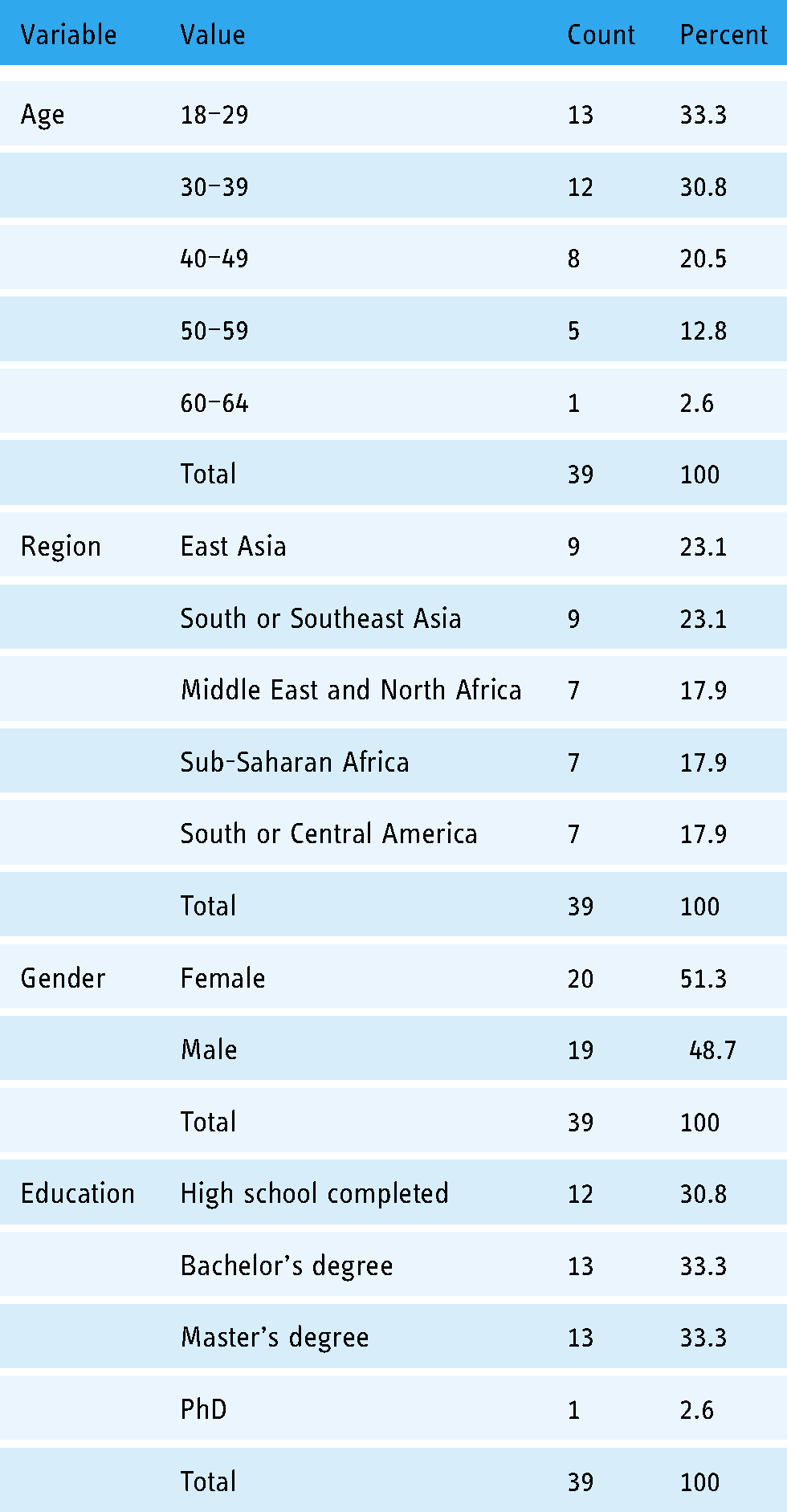
As discussed above, the interview portion of this research study is aimed at providing more contextual understanding of the research topic. We conducted a total of 39 interviews in spring 2021 using a semi-structured interview method. Each interview was conducted and transcribed by a research team member who received the university's IRB human subject research certificate. Interviews were conducted in English or the participant's native language depending on participant preference (34 out of the 39 interviews were conducted in English). Our open-ended interview questionnaire covered their immigration experiences in the United States, social media use, health information seeking in general, use of online information sources for COVID-19 information, and vaccine willingness. We conducted interviews until we reached the theoretical saturation of themes.
In analyzing the interview transcripts, we utilized Dedoose 8.0.35, an analytics platform for qualitative or mixed-methods research. Specifically, we developed codes using a constant comparison technique based on grounded theory.27–30 This inductive approach allowed us to identify patterns in transcripts related to themes of health information seeking online and misinformation related to COVID-19 as well as new and emergent themes.
Results
A total of 200 international migrants responded to the survey. Of these, 13 respondents, who indicated that they received COVID-19 vaccination at the time of data collection in spring 2021, were removed from the final analysis. Only those who were not vaccinated at the time of research were included in the final data analysis, as this study focuses on how international immigrants dealt with uncertainties surrounding whether to get vaccinated or not. When we collected the survey and interview data, each state had a COVID-19 vaccination rate of less than 10% and very limited vaccination eligibility for those aged 64 years and younger. At that time, those who are 65 years or older, live and work in congregate settings, or were considered “essential” workers were eligible to be vaccinated. 31
The following results are based on survey responses from 187 international migrants and interviews with 39 international migrants living in two bordering Midwestern states at the time of the data collection in spring 2021. Participants, aged 18–64 years, were not vaccinated against COVID-19 at the time of data collection.
Demographics of study participants
Demographic characteristics of survey participants.

In terms of gender, about 55.1% identified themselves as male and 44.9% as female. About 43.3% of the participants were aged 18–29 years, 35.8% were in their 30s, 13.9% were in their 40s, and 7% were 50–64 years of age. In terms of the highest level of education completed, 16.6% said high school degree, 37.9% bachelor's degree, 37.5% master's degree, and 8% PhD About 57.3% said they were single or never married, 34.7% married or domestic partnership, 6.6% divorced or widowed, and 1.3% preferred not to answer the marital status question.
Demographic characteristics of interview participants.
COVID-19 uncertainty and social Media misinformation (RQ1)
Our first research question asked how international migrants” demographic characteristics are associated with their perceived uncertainty related to COVID-19 information and perceived level of exposure to pandemic-related misinformation on social media. With regard to perceived uncertainty related to COVID-19 information, education was the only variable that was significantly associated with perceived uncertainty (β = −0.37, t = −2.91, p < 0.01). Specifically, the more educated the survey respondent was, the less uncertain the respondent felt about the COVID-19 situation. However, there was no significant relationship between any of the demographic variables and with perceived level of exposure to misinformation related to COVID-19.
When asked to indicate on a scale of 1 (Not at all) to 5 (Very much) how much they were exposed to misinformation related to COVID-19, international migrants who participated in the survey reported a relatively high level of exposure to misinformation online (M = 3.41, SD = 0.96). In terms of misinformation exposure on specific social media platforms, WhatsApp (M = 3.48, SD = 1.19) was considered the most significant source of misinformation about the pandemic, followed by Facebook (M = 3.30, SD = 1.22), TikTok (M = 3.24, SD = 1.53), and YouTube (M = 3.11, SD = 1.12). In comparison, their perceived exposure to pandemic-related misinformation on national (M = 2.60, SD = 1.16) and local (M = 2.51, SD = 1.15) news sites was lower than those on social media platforms.
Our interview data provide additional insights into uncertainties international migrants faced during the pandemic as well as exposure to online misinformation, as many of them had to deal with unfamiliarity with the US health care system and lack of related resources. They relied on online resources and family and friends in the United States and their origin country to deal with the situation. For example, a 26-year-old woman from Bangladesh, said “I don’t have any insurance here. If I get sick or if I have a problem, I try to solve it with Google. Also, I try to find home remedy that is easy for me here because I don’t have any insurance and it is very expensive for me to get medical care here.” She added that she follows Facebook pages focusing on health issues and “try to consult with doctors who are the admins of those Facebook pages.” Also, many interviewees expressed concerns about uncertainties around visiting their origin country, with the desire to get vaccinated for COVID-19 often associated with this concern. A 19-year-old woman working in a large Midwestern city said she looked for COVID-19 vaccination information online in hopes of visiting Mexico where she is from. She said, “I’m looking online to look for information to check if I’m eligible to get the vaccine. To be honest, I think I’m going to need the vaccine to fly and go to Mexico to [see] my family and I’ll need it.”
In terms of misinformation online related to COVID-19, international migrants were exposed to misinformation widely spread both in the United States and their origin country and demonstrated different strategies for assessing the quality of information online. A 52-year-old woman from Brazil said she “panicked” reading on Facebook about people dying of getting vaccinated for COVID-19, which she later learned was false. A 32-year-old woman from South Korea said that she saw misinformation on Facebook and KakaoTalk (a popular messaging app in South Korea) intended to discourage people from getting a COVID-19 vaccine. “They were saying it is not effective or it will alter human DNA. When I see information like that, I try to look it up on news sites or health information sites like WebMD. I have recently found that WebMD and other organizations are doing something like VaxFacts to fight misinformation around COVID vaccinations.” Other interviewees also mentioned that they look up online resources popular in the United States or their origin country or talk with family or friends if they are unsure of the validity of information online.
Perceived uncertainty and emotions (H1)
Figure 2 shows the results of our hypothesis testing based on path analyses. Our first hypothesis posited that perceived uncertainty related to COVID-19 information influences positive (H1a) and negative (H1b) emotions concerning such pandemic information. The positive emotion and negative emotion variables were measured by how much the respondent felt excited, interested, alert, and attentive (positive emotion) and worried, anxious, scared, and afraid (negative emotion) in thinking about how much/little they knew about COVID-19 vaccinations. Participants expressed higher levels of positive emotions related to COVID-19 vaccinations compared with their responses to negative emotions. Specifically, when asked on a scale of 1–5 (1: Strongly disagree; 5: Strongly agree), the means for positive emotion items were higher than those for negative emotion items: alert (M = 3.88, SD = 0.92), interested (M = 3.82, SD = 0.98), attentive (M = 3.73, SD = 0.88), and excited (M = 3.45, SD = 1.09); worried (M = 2.53, SD = 1.18), anxious (M = 2.32, SD = 1.18), scared (M = 2.18, SD = 1.26), and afraid (M = 2.03, SD = 1.25). In addition, our results show that perceived certainty is negatively associated with positive emotions (β = −0.43, t = −4.59, p < 0.001). Therefore, H1a is supported. In contrast, there was no significant relationship between perceived uncertainty and negative emotions measured (β = 0.13, t = −1.27, p = 0.21).

Path analysis results.
Effects of emotions on outcome expectancy and efficacy (H2)
Our second hypothesis proposed that positive (H2a) and negative (H2b) emotions concerning COVID-19 information influence outcome expectancy and efficacy related to such information. Overall, survey participants demonstrated high levels of outcome expectancy. The means and standard deviations for the three measurement items are: Searching for more information online about COVID-19 will have positive outcomes (M = 3.52, SD = 0.99); There are a lot more benefits than there are problems associated with information online about COVID-19 vaccination (M = 3.55, SD = 0.93); and (3) The benefits associated with searching for more information online about COVID-19 vaccination are important (M = 3.67, SD = 0.86). In terms of efficacy, communication efficacy was highest (M = 3.96, SD = 1.13), followed by coping efficacy (M = 3.82, SD = 1.22) and target efficacy (M = 3.45, SD = 1.19). Results show that positive emotions affect outcome expectancy (β = 0.30, t = 2.98, p < 0.01) with negative emotions not significantly related to outcome expectancy (β = −0.17, t = −1.26, p = 0.21). Similarly, efficacy was significantly associated with positive emotions (β = 0.28, t = 2.79, p < 0.01), whereas it had no significant association with negative emotions (β = −0.06, t = −0.67, p = 0.51). Therefore, only H2a is supported.
Roles of outcome expectancy and efficacy in COVID-19 information seeking (H3)
Our third hypothesis posited that outcome expectancy (H3a) and efficacy (H3b) would influence information seeking related to COVID-19. Participants indicated that they are likely to seek online resources for COVID-19 vaccination information. Specifically, they reported looking for information online about COVID-19 vaccinations (M = 4.04, SD = 1.48), being likely to watch/listen to/read a story about vaccinations if they see something on the news online (M = 3.84, SD = 1.35), and actively searching for information about the topic (M = 3.41, SD = 1.51). We found that both outcome expectancy (β = 0.25, t = 2.95, p < 0.05) and efficacy (β = 0.53, t = 5.88, p < 0.001) were positively associated with information seeking. Thus, both H3a and H3b are supported.
Information seeking, vaccine willingness, issue salience and misinformation exposure (H4)
Finally, our fourth hypothesis posited that international migrants” information seeking would influence their vaccine willingness with issue salience and exposure to online misinformation moderating the effect. The participants demonstrated a high level of vaccine willingness: likely to agree to be vaccinated if an FDA-approved vaccine is available right now (M = 4.32, SD = 1.08) and confident that they will be protected from being infected from COVID-19 (M = 3.93, SD = 1.09). While there was no direct effect of information seeking on vaccine willingness (β = −0.02, t = −0.25, p = 0.80), our moderation analysis (Aiken & West, 1991) shows that issue salience moderated the effect of information seeking on vaccine willingness. Specifically, among the low issue salience group (COVID-19 vaccination is not an important topic for them), the more they seek online information on COVID-19, the less likely they are to get a COVID-19 vaccine. In contrast, the relationship between information seeking and vaccine willingness was positive among the high issue salience group. There was no moderating effect of online misinformation exposure on the relationship between information seeking and vaccine willingness.
It should be noted that 76.4% of our survey participants indicated that they were willing or very willing to get a COVID-19 vaccine. However, about 8.3% of the survey participants indicated that it is unlikely that they will get vaccinated with 15.3% indicating they were undecided. This is in line with our interview findings that about 20% of our participants either opposed or were hesitant to get vaccinated against COVID-19. Comments from our interviewees shed some light on their thinking. Concerns about genetic modification and “insufficient” data on vaccine efficacy were some of the primary reasons cited by those not wanting to get vaccinated. With regard to a lack of sufficient data on vaccine efficacy and side effects, a 19-year-old woman from South Africa said, “I don’t want to put anything into my body at this point if I haven’t seen enough information on the vaccine.” She added that she thinks “the pharmaceutical industry developed the vaccine too quickly and there's not enough information about what happens about the symptoms and side effects of the vaccine.” Several women expressed their concerns about COVID-19 vaccines potentially affecting their fertility. Some participants opposed the idea of vaccination itself. When asked about his willingness to get a COVID-19 vaccine, a 21-year-old man from Uganda said: “Ok for me personally, if it is by law … is compulsory, then I will take it. But if it is not by law and it is personal willing, I’m not taking it because I don’t believe I will get this virus and it is not something that I am scared of … I don’t believe in taking any vaccine.”
Discussion
Based on a survey and in-depth interviews with international migrants living in the US Midwest in spring 2021, our study analyzed how the group utilized online resources popular both in the United States and their origin country as they dealt with uncertainties surrounding the COVID-19 pandemic. Our results show that international migrants” perceived uncertainty, positive and negative emotions, efficacy, and outcome expectancy affect their information seeking related to COVID-19 vaccinations. In addition, issue salience moderates the effect between information seeking and vaccine willingness. This research provides relevant and timely scholarly and policy implications that help advance research in this area and better support international migrant communities during public health crises such as the COVID-19 pandemic.
Scholarly/policy implications
Our research shows that international migrants face challenges when it comes to online misinformation during public health crises such as COVID-19, especially as they are exposed to such information widespread not only in their host country but also in their country of origin. Our findings indicated that misinformation related to COVID-19 was shared with international migrants in the United States through social media platforms popular in the United States (e.g., Facebook or Instagram) or those more specific to their origin country (e.g., KakaoTalk, Telegram, or WeChat). Indeed, both our survey and interview research participants indicated a relatively high level of exposure to misinformation online. For example, a 25-year-old interviewee from Mexico said that people living in Mexico “were saying on Facebook that health workers are killing people and COVID didn’t exist … I think there is a lot of fake news online and I think it's hard to tell what's actually being genuine and what is being used for political use or fake news just to get people talking.” A 35-year-old woman from Vietnam said she read articles published in Vietnam about eating hardboiled eggs to kill the virus, whereas a 31-year-old man from China said he read posts on WeChat about 5G spreading COVID-19. A 30-year-old man from Iran reported seeing “so much false information” about the pandemic on Telegram. Some interviewees reported getting “anxious” or “stressed” after being exposed to such misinformation and deciding to stay away from social media for a while. The findings are in line with previous studies that showed that many international migrants see social media as a hotbed of misinformation and conspiracy theories, and ultimately sources of anxiety and stress. 32 In recent years, anti-vaccine movements have been amplified through misinformation and conspiracy theories shared via social media globally.33,34 The findings from our research highlight the importance of understanding cross-country/cultural flows of misinformation to develop a more holistic approach to fighting against misinformation, especially on topics as significant as vaccination. 35
The results of this study show the significant effect of issue salience on vaccine willingness, indicating the importance of raising public awareness of the issue to encourage more people to get vaccinated against COVID-19. Vaccination is one of the most effective and successful public health interventions and a cornerstone for the prevention and treatment of communicable infectious diseases in human history. 36 In particular, vaccine acceptance among the public is required to maintain herd immunity, prevent disease outbreaks, and treat illnesses. 37
Our study found no evidence for a moderating effect of online misinformation exposure on the relationship between information seeking and vaccine willingness. While widespread misinformation about COVID-19 may potentially decrease the perceived relevance and salience of the topic among some individuals, this study suggests that perceived exposure to COVID-19 misinformation itself did not deter this study sample's intention to look for COVID-19 information and did not influence how their information seeking is related to vaccine willingness. This finding suggests this study sample feels relatively well equipped to assess misinformation and thus their perceived exposure to misinformation did not influence how they approached COVID-19 information seeking or their vaccine willingness. As previous studies have shown, strengthening citizens” abilities to assess the quality of information online and nurture civil dialog on related topics is one of the most important ways to fight against online misinformation.38–41 It is also important for social media platforms and other relevant entities to work together to develop comprehensive measures that more effectively handle misleading information about COVID-19 vaccination. 41
About 76.4% of our survey participants in spring 2021 indicated that they were willing or very willing to get a COVID-19 vaccine. This figure is similar to that of the US national sample: According to a Gallup survey in May 2021, 74% of people in the United States said they would be willing to get a COVID-19 vaccine. 42 Another important similarity between our findings and those from the US national random sampling surveys is that trust in the vaccine research and development process was significantly associated with willingness to get vaccinated. 43 While there are no national data to compare with regard to our findings on international immigrants” misinformation exposure, various reports suggested that the US general population was also concerned about the widespread misinformation about COVID-19.38,44 For example, the claim that COVID-19 vaccines using new mRNA technology can potentially affect genetic makeup was a widely circulated false assertion.29,45
As there is insufficient research in this area, this study fills an important gap. In particular, theoretical and methodological approaches used in this research should be helpful for future research examining international migrants” use of digital communication technologies during a pandemic or other public health crisis situations. Practically, findings from this study can help policymakers and practitioners in the areas of international communication and health communication develop more tailored and holistic strategies to support international migrants.
Limitations and future research
As with any social science research, this study has several limitations. We decided to study international migrants in two neighboring states with similar COVID-19 developments to control for extraneous variables such as vaccination rates. Therefore, the results of this research cannot be generalized to a larger international migrant population in the United States. Future research with a larger and nationally representative sample will be able to produce more generalizable findings. While our interviews were conducted in the language choice of our participants (English or their native language), our survey was conducted in English only. Future research in this area should consider implementing survey research in multiple languages to include a broader group of international migrants. In addition, about 75% of participants in our study had a bachelor's degree. This relatively high education level may be associated with the fact that our survey was conducted only in English. Moreover, international migrants with lower formal education levels may demonstrate different perspectives or behaviors related to online health information seeking.
Finally, we included only unvaccinated international migrants in the final analysis, and this may have influenced the relationships between the variables analyzed. As mentioned earlier, only 13 out of 200 respondents to our survey indicated they were vaccinated as of spring 2021, and our examination of demographic characteristics of vaccinated (13) and unvaccinated (187) individuals did not suggest meaningful differences between the two groups. Moreover, given a significantly smaller proportion of vaccinated international migrants in the survey respondents, inferential statical analysis for comparing the two groups would not yield any meaningful findings. A future study conducted in the later stages of the COVID-19 pandemic may benefit from comparing vaccinated and unvaccinated international immigrants with regard to their online health information use and vaccination willingness.
Conclusion
While the number of international migrants in the United States is increasing, there is still insufficient research about this international population's information-seeking processes regarding health-related issues. The COVID-19 pandemic provides an important opportunity to analyze international migrants” perspectives on uncertainties, online information use, and willingness to take necessary health actions during a public health crisis. By applying the Theory of Motivated Information Management and a mixed-methods approach to the COVID-19 pandemic situation, this research helps both scholarly and policy communities better understand how to evaluate international migrants” challenges and needs in online information seeking and developed tailored communication strategies to support them.
Footnotes
Acknowledgment
The authors would like to thank the KU Center for Digital Inclusion for its support of this research.
Author contributions
HS conceived the study. HS developed the survey questionnaire and gained ethical approval. HS, YL, MI, FS, and UK collected the data. HS cleaned and analyzed the data. All authors contributed to different sections of the manuscript. HS finalized the manuscript. All authors reviewed and edited the manuscript and approved the final version of the manuscript.
Declaration of conflicting interest
The authors declared no potential conflicts of interest with respect to the research, authorship, and/or publication of this article.
Ethical approval
This study was approved by the University of Kansas Institutional Review Board (00002312).
Funding
The authors received no financial support for the research, authorship, and/or publication of this article.
Guarantor
HS.
