



Abstract
With the approval of the vaccine in mainland China, concerns over its safety and efficacy emerged. Since the Chinese vaccine has been promoted by the Chinese government for months and got emergency approval from the World Health Organization. The Chinese vaccination program is yet to be identified from the perspective of local populations. The COVID-19 vaccine-related keywords for the period from January 2019 to April 2021 were examined and queried from the Baidu search index. The searching popularity, searching trend, demographic distributions and users’ demand were analyzed. The first vaccine enquiry emerged on 25th January 2020, and 17 vaccination keywords were retrieved and with a total BSI value of 13,708,853. The average monthly searching trend growth is 21.05% (p < 0.05) and was led by people aged 20–29 (39.22%) years old. Over 54.93% of the demand term search were pandemic relevant, and the summed vaccine demand ratio was 44.79%. With the rising search population in COVID-19 vaccination, education programs and materials should be designed for teens and people above the 40 s. Also, vaccine-related birth safety should be alerted and further investigated.
Introduction
In December 2019, a few cases of pneumonia were reported outbursting in Wuhan city, China. 1 Soon, this unprecedented SARS-CoV-2 associated infectious disease affected over 90,000 families, taken over thousands of lives and developed into a worldwide pandemic. 2 Immediately after declaring the citywide lockdown from the Wuhan municipal government on January 23, 2020, the World Health Organization's (WHO) Emergency Committee has reckoned the COVID-19 epidemic and declared it a global health emergency. 3 Till December 2020, over 79 million infection cases and 1.7 million deaths were identified as COVID-19 caused in countries and regions from all 6 continents.2,4 To date, there is no generally proven effective and specific treatment against SARS-CoV-2 infection, despite that some effective therapies against COVID-19 were reported.2,5 In response to the ongoing public health emergency, the WHO approved over 50 vaccine clinical trials, and few candidates have been approved for emergency use to control the spreading pandemic. At the same time, in December 2020, the National Medical Products Administration (NMPA) of China approved the first inactivated SARS-Cov-2 vaccine after the trial approval.3,6
With the vaccination approval in mainland China, concerns over its safety and efficacy emerged. Recent surveys have revealed that the public will in trials participating and intention to vaccination against COVID-19 were moderately optimistic.7–10 However, these investigations only recruited thousands of respondents from college or leading developed cities in mainland China. It is worthy deciphering public concerns on current vaccination and the underlying causes for the vaccine hesitancy for the public pandemic intervention could be rightly conducted.
Since the outbreak of COVID-19, the internet platform and social media have substantially impacted users’ understanding and counter-pandemic activities. Because the big data platform enabled rapid information delivery and users’ perceptions, the public's comments are also reflected on these platforms.11,12 This makes investigations based on these data, the infodemiology research, a practical way to monitor disease incidence,13,14 report pandemic outburst15,16 and analyzes public awareness regarding a health issue.17,18 As a part of the global response to COVID-19, WHO defined infodemic management as a “key component” of the Health Emergency Programs’ risk communication efforts and established the Information Network for Epidemics (EPI-WIN) intending to provide regularly evidence-based updates, answering the pertinent questions and, updates and advice for the general public and the decision-makers. 19 Hence, data from the searching platform and social media have been successfully used in unrevealing public perception, users’ behaviour, vaccine hesitancy and acceptance toward COVID-19 and the vaccination.20,21 In mainland China, the COVID-19 vaccine acceptance was investigated before the administrative approval. From the leading local social media platform, Weibo, it was revealed that the collective misunderstanding of the vaccine among populations and the affordability are the main issues for vaccine-promoting policymaking. 22
Nevertheless, it has been months since the national office launched the social vaccination program. On May 7, 2021, the WHO has approved the Sinopharm manufactured vaccine, the mainly applied vaccine in mainland China, for the emergency application. 23 A timely examination of the Chinese vaccination program from the perspective of local populations by far is crucially needed. Therefore, this investigation aims to examine the popularity, perception, and inquiries related to the current vaccination program to identify public concerns or hesitancy existence with the data from the leading searching platform – Baidu.24,25
Material and methods
Keyword selecting and data retrieving
This study was mainly based on the temporal search trends of COVID-19 vaccination-related Chinese keywords by referring to the definition of Chinese Center for Disease Control and Prevention (CCDC). 20 According to the definition and interpretation of the official guideline, the Chinese COVID-19 vaccine describing words are compounded with the comprising morphemes and could be identified as the following four: I, the “新冠” -Novel Coronal (short for ‘新型冠状病毒肺炎’, the COVID); II, “新型冠状病毒”-SARS-Cov-2; III, “新冠肺炎”-COVID; IV, “疫苗”-Vaccine. In the Baidu search index, the system will auto examine the imputed keywords and list all the available searching keywords. To avoid inclusion omission, additional measures were followed as the previously described screening and selecting methods.13,14,25,26,27 (See Supplementary Figure 1)
We identified and examined 17 available keywords on the Baidu index platform. Hence, the possible difference and bias originate from language habits, synonym and complex derivatives terms were kept minimal. For the timeline reference of each event, the main keywords of pandemic description were also included in the trend search. (All available keywords related to COVID-19 vaccination were listed and translated in the Supplementary Table 1).
From the Baidu search, three major modules, the searching trend module, the geo-demographic module and the search-demand module were available for infodemiology investigation.13,14,25 From the trend module, searching popularity for each keyword was recorded daily with a numerical value, the Baidu search index (BSI). The recorded searching popularity collect data range from municipal, provincial, and is summable to represent popularity nationwide. Therefore, the national and subnational scaled BSI values for each COVID-19 vaccination keyword were collected from 1st January 2019 to 30th April 2020.13,14,25 In the demographic portrait module, the distribution of user age, gender and region were also available for each searching keyword. In the search-demand module, each keyword was sorted with the top 10 related words or phrases representing users most concerned issues regarding the keywords. Therefore, the popularity, user's demand, public awareness about COVID-19 vaccination were manifestable by the data from the above-mentioned modules.
Daily vaccination data were collected from the National Health Commission of the Peoples’ Republic of China Daily Report. (Available at: http://www.gov.cn/xinwen/2021-03/26/content_5595955.htm)
Data analysis
For each COVID-19 vaccination keyword, the trend of public attention was described as the sequentially plotted BSI data. The daily search index of each keyword was sequentially sorted, and the overtime trend change was determined by the Percent Change (PC) model monthly. This PC model is designed to examine the overtime trend change based on the average incidence of a specific duration.28–31 Integrated with the Weighted Least Squares method, the SEER*Stat software can calculate the PC with given average and standard errors (SD) data for a specific duration, though usually use the Annual Percent Change, APC.29,32,33 In our case, the pandemic has been outbreaking for less than two years, and one of our goals is to decipher the searching trend regarding vaccine popularity in detail. The PC model could be optimally calculated based on the average data of the monthly cases.30,32,33 Hence, the average monthly BSI were generated from the daily BSI and were sorted for PC calculation to demonstrate the searching trend.
The PC was calculated by the Joinpoint Regression model, SEER*Stat software, program version 4.7.0.0 (Statistical Research and Applications Branch, National Cancer Institute, USA). Detailed information regarding SEER*Stat software is available at “https://seer.cancer.gov”. Correlation between the daily vaccination and daily search BSI during the data available days (23rd Mar 2021 to 30th Apr 2021) was estimated using the Spearman test A p < 0.05 was considered statistically significant. The user demand related keywords were reviewed and categorized by two individual investigators. In the event of a discrepancy, a consensus with a third investigator arbitrated the disagreement.
Statistical analysis
All database was constructed with Excel 2019 (Microsoft Corporation). We used Prism 8 for macOS (version 8.4.0 (455), GraphPad software, SanDiego, CA) to conduct statistical analysis and create figures.
Results
Web-Based data trends in COVID-19 vaccination
We collected and summarized the total BSI of COVID-19 vaccination keywords from 1st January 2019 to 30th April 2021. No data was available from the pandemic and vaccination search trend before 30th December 2019. Hence the search trend data after 1st December 2019 were included for analysis. The retrieved 17 vaccination keywords mainly expressed the concerns of vaccine feature, price, reservation and safety, with a total BSI value of 13,708,853. The first vaccine enquiry emerged on 25th January 2020 with the keyword “Novel Coronavirus Diseases vaccine” and follow by the brief keyword “COVID Vaccine” on 25th February 2020. Notably, a searching pike was observed on 23rd-24th September 2020 with the keyword “The made in China vaccine has been proved effective”. The monthly time-series curves of BSI for the pandemic description keywords, the vaccination keywords and the vaccination searching PC trend lines were demonstrated in Figure 1. According to the average count of the monthly BSI, the search trend for COVID-19 vaccination was on the rise (Figure 2), with a PC of 21.05% (p < 0.05). With reference to the government announcement, the coefficient of correlation (r) values is 0.38 (p < 0.05).
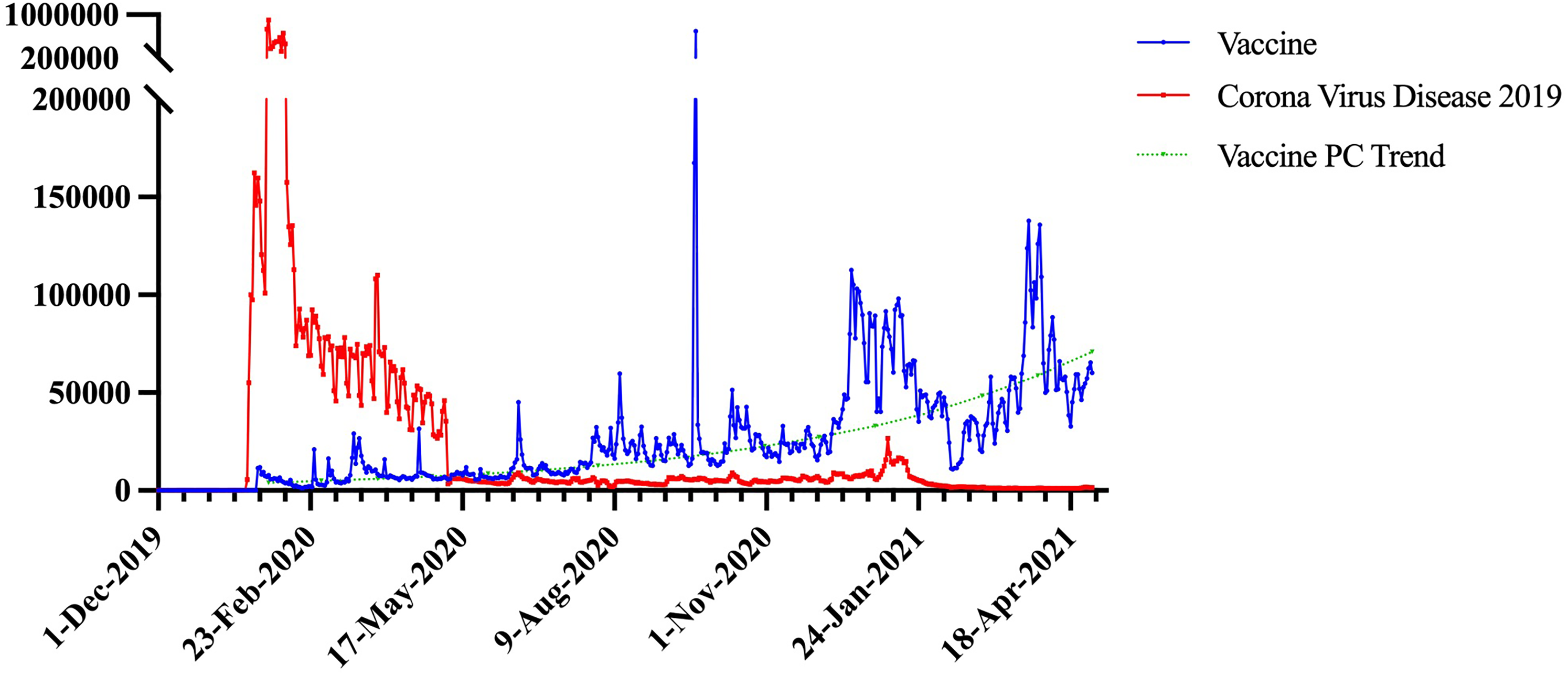
Search population trend in COVID-19 vaccination topics.
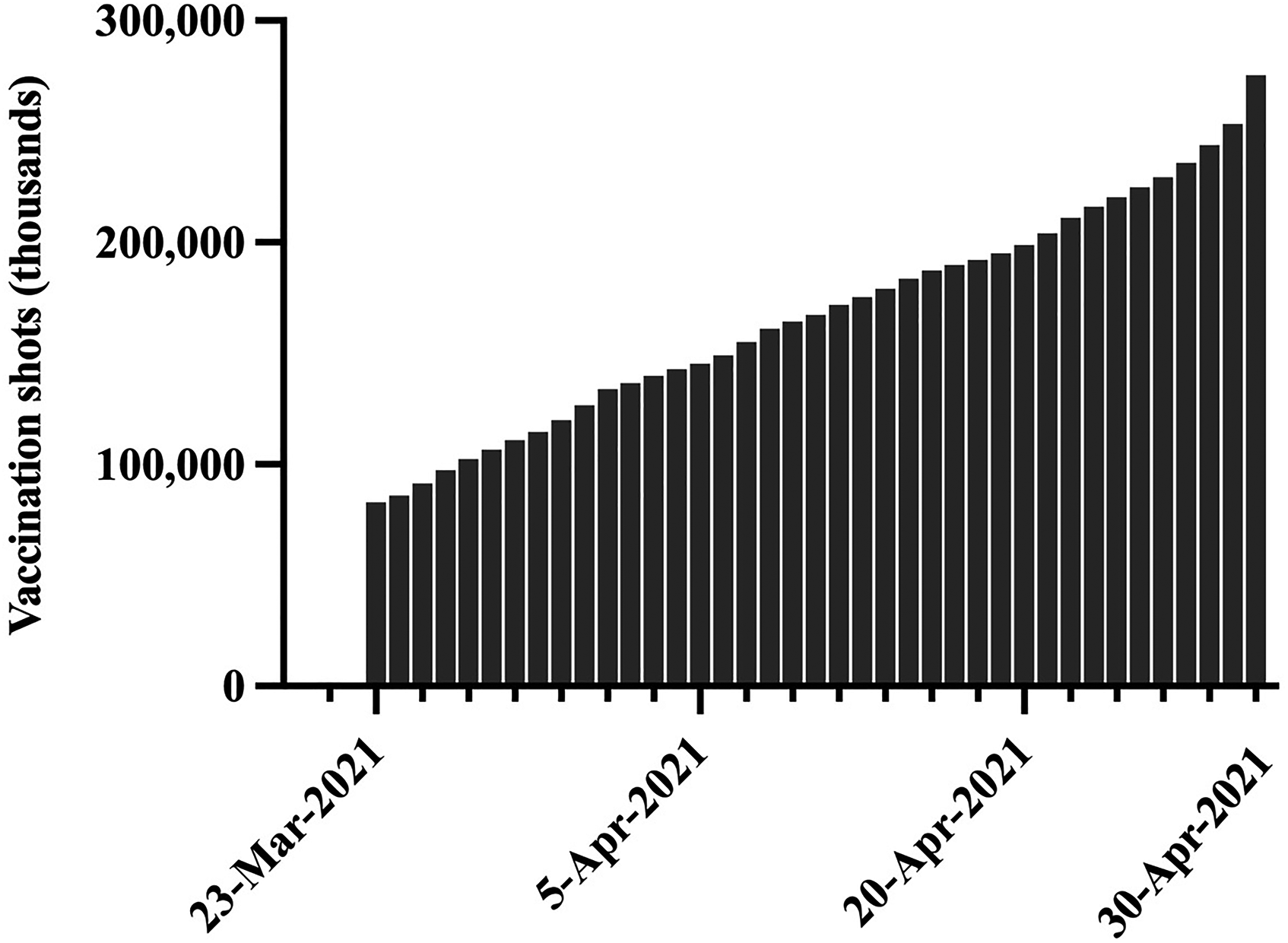
The Chinese government reported summed daily vaccination cases.
Geo-Demographic differences
The COVID-19 vaccination searching geo-demographic distribution was calculated based on provincial data, 7 geographical regions are identified to sort rank the regional data. These regions are northeast (8.21%), north (18.47%), east (31.84%), south (10.88%), southwest (11.68%), northwest (8.19%) and central (10.73%) China. Figure 3 shows the regional geographic distribution according to the official Baidu Index website. Notably, people from east China made over 30% of the total search queries. North China ranks second with a searching volume of 18.47%. Nevertheless, the queries from other regions are evenly distributed, with an average volume of 10%. Figure 4 demonstrated the searching demographic distribution. No significant difference was observed in the gender preference of the vaccine enquiry. Though 55.59% of enquiries were recorded from the male gender, this rate is only 11% more than the female gender. As to the age distribution, 39.22% of the search were from people aged 20-29 years old and dominated the vaccine enquiry. Followed are the 33.00% from aged 30-39 years old, 14.34% from aged 40-49 years old, 9.26% from aged under 19 years old and 4.18% from aged over 50 years old.

Official baidu Index maps for all the key words by geographical regions distribution, 2019–2021.
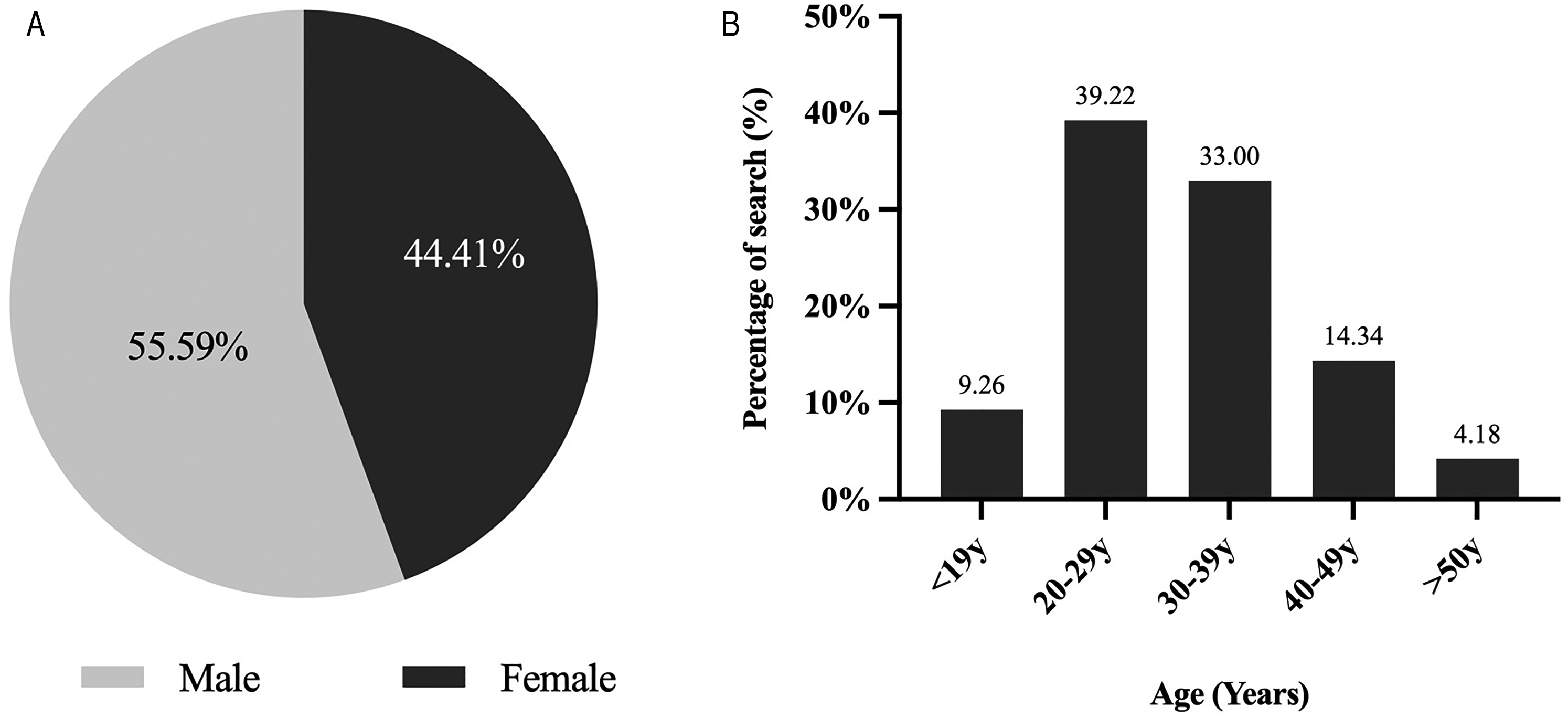
Demographic distributions COVID-19 vaccination search. (a) Gender distribution, (b) Age distribution.
Keywords related to term and search frequency
In the user demand platform, the user's demand and concern were manifested as the data of top-searched keywords related terms. Base on the content of the retrieved keywords related terms, the public concern in COVID-19 vaccination could be categorized into the following 13 themes and the irrelevant (Figure 5). These themes are A) Pandemic; B) Vaccine; C) Pricing & Medicare; D) Efficacy & Complications; E) Indications & Contraindications; F) Symptom Confirmation; G) Symptoms & Complaint; H) Manufacturer & Researchers; I) CDC & Hospital; J) Policy & News; K) Decision making; L) Stock & Investment; M) Non-Covid. With only 2.9% of irrelevance, the total valid BSI of the vaccine demand terms were 3,843,325,561, which is over 280 folds of the vaccine enquiry. Though over 54.93% of the demand term search were pandemic relevant, the vaccine demand was detailed manifested with a summed ratio of 44.79%. The Top 3 related terms and their BSI for each theme were listed in Table 1.

The Themes categories related to COVID-19 vaccination search in the Baidu index user demand module.
Top 3 keywords of users’ demand and concern searching in COVID-19 vaccine.
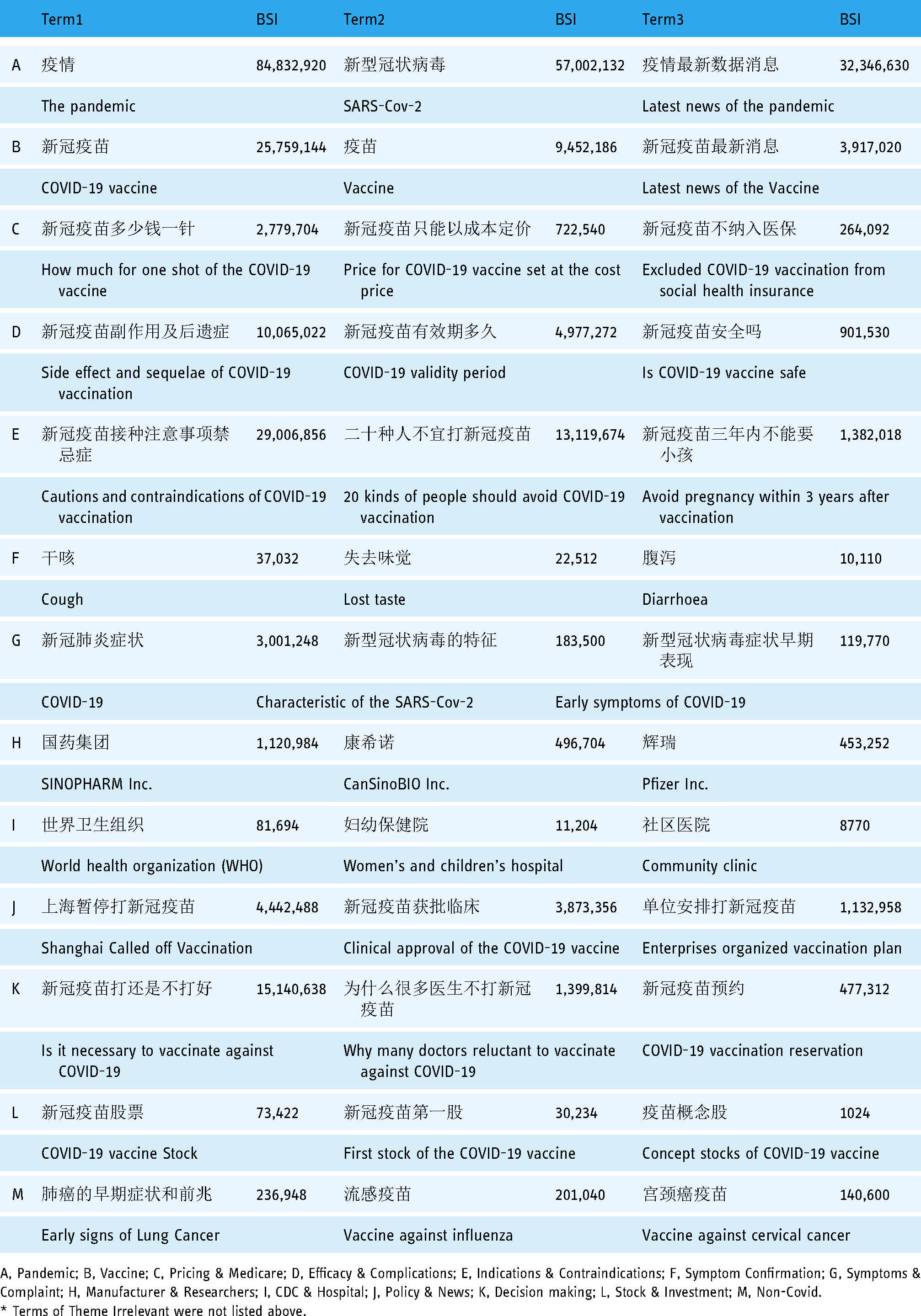
A, Pandemic; B, Vaccine; C, Pricing & Medicare; D, Efficacy & Complications; E, Indications & Contraindications; F, Symptom Confirmation; G, Symptoms & Complaint; H, Manufacturer & Researchers; I, CDC & Hospital; J, Policy & News; K, Decision making; L, Stock & Investment; M, Non-Covid.
* Terms of Theme Irrelevant were not listed above.
Discussion
Principal findings
In this study, 17 searching keywords were identified in the local leading searching platform for the COVID-19 vaccine topic. With the continuous daily enquiry records of these keywords, the rising searching trend was well presented. From the user geo-demographic data, the overall queries were detailed sorted by regional and age distribution. Moreover, in deciphering public interest and concerns, the user demand data about COVID-19 vaccines topic could be categorized into listed 13 themes and other irrelevant theme. Hence, this work reveals the public perception of the vaccine and facilitates deciphering the progress and challenges toward current vaccination promoting efforts in general.
Enquiry popularity and trend
Together with the government published vaccination data, the correlation between the daily vaccination cases and the daily search index is weak. This result may mainly be due to the limited timescale, hence, the longer observing time is required. Whereas, from the search trend data, the total BSI for the COVID-19 vaccine has reached 13,708,853 within 462 days. According to Yin et al. they collected over 1.75 million COVID-19 vaccines Weibo messages from a 200 million active users’ platform. 8 Also, within 10 months, these messages have been read billion times. Hence, the vaccine issue has been a topic not long after the pandemic outbreak. With an average monthly growth rate of 20% and a low irrelevant user-demand rate, these data revealed that the Chinese inhabitants have clear recognition and pay more attention to current vaccination work.
Population structure and geographical distribution
We noticed the enquiry volumes difference among the geographic distribution. East China and north China leads the COVID-19 vaccine enquiry while other regions are evenly distributed. This fact is somewhat in line with the current population distribution and economic development level in mainland China. The top developed cities located in east China and north China and have better socioeconomic status, public health awareness, and healthcare policy. 14 It is also suggested that people from the above regions are more concerned about health issues and vaccination. In the subgroup analysis examining the age difference, the search was mostly from the age 20-29 years old and 30-39 years old. Not surprisingly, according to the National Internet Report in 2020, the pooled proportion of internet users aged 20-29 years old and 30-39 years old was 19.9% and 20.4%, which is in consistent with our result. Also, as the main social labour force, people aged 25-45 years old are the main decision-makers for their own or family. 34 The lower rate from people aged 40 older probably manifested their lower vaccination interest. From Ali's online pooled survey, the respondents aged over 35 years old are either not interested or likely to accept vaccination. 20 Therefore, we believe the above three factors contribute to the final result, and vaccine promotion should stress work on making more accessible and comprehensible information for those with older age.
Public perception and concerns
There are 14 themes identified in the user demand section, except 1 theme was irrelevant, the pandemic information is the most demanded from the population. As to the vaccine, the related themes ranged from “Pricing & Medicare”, “Symptoms & Complications” to “Stock & Investment”. Aside from inquiring about the theme in vaccine or the latest news, people are most concerned about the indication and contradictions. While people wonder about vaccination contraindications, particular attention was given to the childbirth quality and its adverse effects. Though it seems interesting, this concern reveals a grave and practical problem. To date, the SARS-CoV-2 has been identified for less than two years, yet the phase 3 clinical trial for vaccines were all pregnant persons excluded. 35 The existing data only revealed no observed congenital disability or pre-term birth in the exposure of COVID-19 infection and the treatment. 36 Whereas for vaccination on pregnant persons, clinical data and trial results from the vaccinated pregnant person were needed for future COVID-19 vaccination decision-making and guideline making. 37
We noticed that the inquiry in “Symptom & Complaint” and “Symptoms Confirmation” only account for 0.88% of the total searching request, revealing that the vaccine-related user demand in symptom descriptions is less than 1%. The top three ranked described symptoms are cough, taste loss and diarrhoea. Also, the symptoms confirmation keywords are mainly in a quiz and non-specific. On 28th May 2021, the CCDC released the first report on the COVID-19 vaccination adverse reaction as of 30th April 2021. From this report, the incidence of adverse reactions is 11.86/100,000 shots.38,39 The most reported symptoms are dizziness, fatigue, nausea, and fever over 38.6°C, yet none of these symptoms is recorded in the user demand module due to their lower popularity. In supporting the CCDC reported incidence rate, the symptoms enquiries from the users manifested that the public is mainly concerned about the pandemic, whereas the vaccine-related complaints are low.
Recent surveys revealed the COVID-19 vaccination hesitancy in citizens have resulted from safety concerns, anti-vaccination conspiracy theories misbelieving and knowledge lacking.8,10,11 Whereas more cases and evidence of vaccine safety and efficacy were demonstrated, the willingness to undergo vaccination is on the rise. 21 From Yin et al. the Chinese individuals are less inclined to doubt the vaccine, and the principal determinate for vaccine acceptance is the cost and healthcare policy. 22 In our investigation, concerns in decision-making only account for 5%. The search phrase “Why many doctors reluctant to vaccinate against COVID-19 ?” ranked second and revealed a sceptical hesitancy towards the vaccination. It is rational to have hesitation in receiving the newly developed vaccine due to safety and effectiveness concerns. 40 Hence, the administrations and officials should promptly release the latest vaccine information and organize education campaigns. 40 Nevertheless, from the 1st and 3rd phrases, the contents are mainly decision making and reservation enquiries, revealing the public vaccination willingness can be properly guided with appropriate measures and pertinent policies.
Limitations
Several limitations of this study should be addressed. Firstly, Baidu is only a search engine. Though users’ searching keywords could be documented, counted and recorded, the content relevance is still the user's behaviour-based structure and lacks logic. Further, despite the relevant terms that could be used for user's demand. These terms are mostly a single word or a short sentence that could not convey complicated expressions. Users’ demands and attitudes could not be analyzed in depth. Again, each searching keyword is only available on the Baidu index when it reached an established searching volume by the quantity of users’ access. Hence, some peculiar expressions with low usage could not be included in the trend analysis. Nevertheless, the searching data is daily updated. This feature enables prompt situation analysis in real-time and makes instant adjustments during the vaccine promoting period.
Conclusion
The rising search population in COVID-19 vaccination revealed elevated public interest and focus. Vaccine related birth safety should be alerted and further investigated. Vaccine education programs and materials should be designed for teens and people aged over 40 years old to reduce public vaccine hesitancy.
Supplemental Material
sj-docx-1-dhj-10.1177_20552076211070454 - Supplemental material for Online Public Attention of COVID-19 Vaccination in Mainland China
Supplemental material, sj-docx-1-dhj-10.1177_20552076211070454 for Online Public Attention of COVID-19 Vaccination in Mainland China by Lisha Jiang, Qingxin Ma, Shanzun Wei and Guowei Che in Digital Health
Footnotes
Abbreviations
Acknowledgements
We gratefully thank the help of the 1.3.5 project for disciplines of excellence, Sichuan University West China Hospital.
Author Contributions
Lisha Jiang, Shanzun Wei and Qingxin Ma searched literature, contributed to the statistical analysis, interpretation of data, and manuscript preparation. Lisha Jiang and Shanzun Wei draft the first edition manuscript. Guowei Che reviewed and revised the manuscript. All authors reviewed and edited the manuscript and approved the final version of the manuscript.
Declaration of conflicting interests
The author(s) declared no potential conflicts of interest with respect to the research, authorship, and/or publication of this article.
Funding
The author(s) received no financial support for the research, authorship and/or publication of this article.
Ethical approval
Not applicable, because this article does not contain any studies with human or animal subjects.
Informed Consent
Not applicable, because this article does not contain any studies with human or animal subjects.

Trial Registration
Not applicable, because this article does not contain any clinical trials.
Supplemental material
Supplemental material for this article is available online.
References
Supplementary Material
Please find the following supplemental material available below.
For Open Access articles published under a Creative Commons License, all supplemental material carries the same license as the article it is associated with.
For non-Open Access articles published, all supplemental material carries a non-exclusive license, and permission requests for re-use of supplemental material or any part of supplemental material shall be sent directly to the copyright owner as specified in the copyright notice associated with the article.
