




Abstract
Objective
Social media has been recognized as a promising tool for delivering health interventions and facilitating study recruitment. However, research is needed to understand how social media might be used to enhance the experiences of adolescent participants in ongoing studies. In a prospective cohort study addressing social and structural influences on health trajectories among 599 adolescents in a California agricultural community, we evaluated the effectiveness of and engagement with a human-centered, Instagram-based outreach campaign, with a focus on study retention, enhancement of participants’ experiences, and increasing community awareness of the study.
Methods
We adopted a youth-centered approach to design a three-month pilot study, which included participatory design sessions, a geo-targeted Instagram campaign, and in-person events at schools. We conducted pre-/post-pilot surveys with study participants, analyzed social media metrics, and collected process measures, such as study visit show rates.
Results
After three months, the study Instagram account had 209 followers and 806 total engagements. Survey responses showed little change in study participants’ attitudes about the study; most survey respondents agreed that the study is very important for the community (54% pre-pilot and 52% post-pilot). However, the study’s Instagram account appeared to influence study participation, with 43% of post-pilot respondents who use Instagram (n=65 of 153) indicating that the Instagram account influenced their decision to continue coming to study visits.
Conclusion
Despite little change in the participants’ attitudes about the study, the findings of this pilot study suggest that Instagram is a promising tool to support engagement of adolescent participants in ongoing research, particularly if the content is designed with adolescents as partners. In addition to assessing the effectiveness of an Instagram outreach campaign to support retention, this paper also presents suggestions and insights for creating similar social media interventions targeting youth.
Introduction
Social media use is pervasive among teens and only continues to grow as access to smartphones expands and the number of social media platforms increases. According to the Pew Research Center (2018), 95% of teens have access to a smartphone, and 45% say they are online “almost constantly.” YouTube and Instagram are the most popular social media platforms among adolescents, with 85% and 72%, respectively, of 13–17-year-olds using them. 1 Use of social media has been recognized as a promising tool to enhance and facilitate research with adolescents. Systematic reviews by Yonker et al. 2 and Guse et al. 3 show that social media is an effective mechanism for delivering or complementing health interventions targeting adolescents. In addition, researchers continue to evaluate how targeted social media advertisements can facilitate recruitment of adolescents for research, with mixed results. 4 , 5
Research on the use of social media in ongoing epidemiological research with adolescents is limited. To date, most uses of social media have been to support recruitment of participants. A few longitudinal studies have experimented with social media to support participant retention and generated short-term engagement, including the Just/Us Study and the National Children Vanguard Study, but more research is needed to assess the effectiveness and sustainability of using social media to support retention throughout a study follow-up period. 6 , 7 In addition, research is needed to determine whether social media can enhance the experiences of adolescent study participants and help build awareness of and support for studies in the communities where they are conducted.
To help address these gaps, we designed a three-month pilot study to assess how Instagram might be used to support study retention and enhance research experiences among 599 adolescents participating in A Crecer, a prospective cohort study in Salinas, the urban center of an agricultural region in California. We created the social media intervention using a human-centered design approach to meet adolescents where they are and provide value that they can easily integrate into their real lives. 8 Human-centered design, which is a participatory research framework, considers people’s wants and needs at every step of the design process, from understanding the problem to delivering the intervention. 9
We adopted a youth-centered approach to design our social media strategy, meaning we engaged adolescents in the development of the account, content, and messaging, and leveraged them as co-creators in designing in-person and online engagement strategies. Evidence shows that co-creation may help ensure the salience of the solution and help experts stay focused on being user-centered. 8 , 10 , 11 Co-design also may lead to a greater number of ideas, leading to greater innovation. 12 A study by Taylor et al. 13 found that involving adolescents in the design and optimization of retention strategies increased retention from 30% to 58% in a longitudinal study examining cancer care for young people.
This social media pilot study was shaped to address the following two research questions: 1) How can a research study Instagram account focused on local health, culture, and social issues support study engagement and boost positive attitudes about the study and community? 2) Does utilizing a study Instagram account elevate community support for the study and attract interest from non-enrolled adolescents? We hypothesized that engaging Salinas adolescents and community members on Instagram would increase visibility of the A Crecer study and subsequently increase enrolled adolescents’ behavioral intention to stay actively involved and support positive attitudes about both the study and their community. In addition, we expected that making the Instagram account public and geo-targeted to Salinas would increase community members’ awareness about the study and engagement with the research team.
Methods
Setting and study population
A Crecer, the Salinas Teen Health Study, is a prospective cohort study led by researchers at RTI International and conducted in partnership with the Monterey County Health Department. 14 A Crecer (meaning “to grow” in Spanish) followed 599 teens in Salinas, California, from eighth to 10th grade. The study aimed to determine what social and structural factors influence health trajectories in early and middle adolescence, and identify promising directions to promote positive health outcomes and prevent risks tied to violence and sexual health.
Students in the eighth grade were recruited for A Crecer from all four middle schools that make up the city’s secondary school district on a rolling basis beginning in November 2015. Although study retention was high at the time that we initiated this Instagram pilot study (94% at 12-months follow-up), we aimed to sustain engagement, facilitate retention efforts, enhance participants’ experiences, and examine the effectiveness of social media as a tool to support epidemiological research. The Instagram pilot was initiated after enrollment into A Crecer was complete; thus, all participants were in ninth or 10th grade. Consequently, we targeted only high-school-aged youth (13–19 years old) with our account.
Justification for Instagram
Numerous retention strategies for longitudinal studies are well established and used effectively to attain high retention, including incentives, reminder letters, and multiple methods of data collection (e.g. office and home visits). 15 However, methods for innovative, technology-based engagement with study participants may need to expand as adolescents’ interaction with technology evolves. In a meta-analysis of retention strategies in longitudinal cohorts, Teague et al. 16 found that studies that used a greater number of “emerging retention strategies” (e.g. social media and SMS) achieved higher retention rates.
We selected Instagram as an emerging retention strategy because it is the most popular platform used by 13–17-year-olds (72% nationally are estimated to use Instagram), and is the second most popular platform among Latinx teens (72% say they use Instagram) after YouTube (86%). 1 Nearly half of teens (45%) say they are online almost constantly, and 44% say they access the Internet several times a day at least. 1 In addition, youth share that social media helps them feel more connected to their friends, diversify their interactions with others, and experience more emotional support and acceptance. 17 Because of these use trends and perceptions about Instagram, we wanted to examine whether the platform could be used as a communication channel to reach participants with study information.
Instagram is a free, online photo-sharing application and social network platform that allows users to upload, edit, and customize (e.g. with text and graphics) photos and videos. Instagram posts are photos and videos that are shared to the profile feed. These posts remain on a profile forever unless the account manager deletes them. The posts appear in an active user’s feed when he or she follows that particular account or sees a promoted post targeting them (i.e. paid advertisement). Instagram and other social platforms, including Facebook, Snapchat, and TikTok, also offer Stories, which last up to 15 seconds and allow users to add augmented reality-based face filters, stickers, text, drawings, emojis, links, and geotags directly to photos and videos. Instead of being displayed in the Instagram user’s vertical scrolling feed, they are displayed horizontally at the top of an active user’s app, which the user can tap through to view. Unlike posts, Stories disappear after 24 hours but can be added to a “highlights” reel to live permanently on a profile. The A Crecer Instagram campaign drew on all of these capabilities to include posts, Stories, and paid advertisements.
Design of social media campaign
To inform development of the Instagram campaign, we conducted three design sessions (10–25 participants each) at one high school in Salinas to better understand how adolescents use Instagram, what types of content they like and share, and what they would like to see on the study’s Instagram account. Session participants were not necessarily A Crecer study participants, given that they were recruited through a school-based club. From these sessions, we learned that teens like posts with inspirational quotes, color, prizes, funny memes, selfies, and photos of friends and families. We used this feedback to craft our content strategy for the Instagram account, including our top-level messaging, content categories, tone, and visual design. 18
In addition, four in-person school-based events (ranging from tabling activities to an Instagram photo booth) were conducted to further guide our content strategy, such as our Instagram handle name and hashtag: @NuestroSalinas and #NuestroSalinas (Figure 1). We also developed a positioning statement to clarify the account’s purpose: The @NuestroSalinas Instagram account provides interesting and age-appropriate tips, community resources, and engagement opportunities for Salinas high schoolers to boost social cohesion and self-efficacy to achieve goals, strengthen community identity, and support informed decisions about health and safety.

Illustrative youth engagement activities.
Furthermore, a youth ambassador was recruited from one high school to co-create content. The youth ambassador was responsible for drafting captions and designing graphics (e.g. memes, GIFs, videos) for Instagram posts or Stories, as well as engaging Instagram followers through online activities (e.g. “answer a poll” activity in an Instagram story). In total, our team published 37 posts and three to four Stories per week during the pilot study period. See Figure 2 for sample posts.

Instagram content categories and sample posts.
Language of the campaign
Although the youth selected a Spanish-language handle (i.e. username) and hashtag for the Instagram account, most of the posts and story content were developed in English. In the A Crecer study sample, most participants were bilingual. When given a choice to conduct their study interviews in English or Spanish, less than 3% chose Spanish. Among study participants who responded to either the pre- or post-Instagram pilot survey, 21% reported that they spoke English only, 50% said they spoke English better than Spanish, and 22% indicated that they spoke English and Spanish equally. On average, the five bilingual Instagram posts shared during the pilot received a similar number of likes as those in English.
Promotional methods
We aimed to reach the study participants where they are: in school and online. In addition to school events, we paid to boost three video posts targeting youth in Salinas. We reached out to community-based organizations on Instagram, asking them to promote our account in return for us promoting theirs. We also shared the account with the A Crecer study’s Community Advisory Board, other local partners, and study participants.
Instagram pilot study design and framework
To examine our two research questions, we used three data collection methods that collectively provided results we synthesized for each question: (1) a pre-/post-pilot survey sent to study participants via SMS; (2) Instagram metrics; and (3) process measures, including in-person event attendance and study visit retention. To guide the development of our survey questions and the selection of Instagram metrics and process measures, we created an evaluation framework using the Exposure, Engagement, Influence, and Action model developed by Don Bartholomew (2008)19. We defined measures for each of the four domains. See Table 1 for the complete evaluation framework, with measures organized by research question, evaluation domain, and data collection method. Research Question 1 is assessed across all four evaluation domains, whereas Question 2 is assessed through exposure and engagement.
Evaluation metrics.

Pre- and post-pilot survey
A Crecer study participants were invited via text messaging to participate in a brief online survey hosted in Qualtrics. 20 Participants who had provided a mobile phone number as part of their contact information were invited directly. Participants who did not provide (or have) mobile numbers were invited by sending a text message to their parent’s mobile number and/or by email. The pre-pilot survey was conducted before the official launch of our Instagram account and included questions on social media usage and attitudes about study participation and the community. The post-pilot survey was conducted two months later and included additional questions on awareness of and attitudes about our Instagram account. All study participants, regardless of whether they responded to the pre-pilot survey, were invited. Both surveys were open for one week and were available in English and Spanish. A reminder text or email was sent three days after the initial invitation to non-responders. To encourage survey participation, those completing the surveys were entered into a raffle, and five participants were randomly chosen to receive gift cards.
Instagram metrics
We analyzed metrics from the Instagram campaign because we were curious whether social media engagement was related to overall retention. To collect Instagram metrics on exposure to and engagement with the content, we established an Instagram Business account through Facebook. This approach allows for real-time access to analytics. We also scheduled and published Instagram posts through the Hootsuite social media management tool, which provides analytics pertaining to the total numbers of followers and engagements with specific posts that can be filtered and compared by specific time periods.
Process measures
We collected process measures to assess behaviors and actions taken by study participants and teens in Salinas, including attending in-person events at schools. We also reviewed retention data collected as part of A Crecer’s ongoing study monitoring.
Analysis
Survey data were analyzed using Stata 15.0. 21 Descriptive analytic methods were used to examine the exposure and engagement domains of the evaluation framework. Mixed-effect regression models were used to estimate changes in influence measures over time; models included a random effect for participant to account for the longitudinal structure of the data. Analysis of Instagram metrics included tabulating numbers of story and post views and engagements and account followers, as well as reviewing the content with highest engagement. To evaluate the action domain, we compared the pre-pilot visit show rate for the two months prior to launch with the show rate during the pilot.
Ethics review
Integrating social media into an ongoing research study is an uncommon practice. As such, we worked in partnership with our Institutional Review Board (IRB) to develop procedures to protect study participants’ privacy. For instance, we established a requirement that we meet a threshold of non-targeted, public followers (n = 50) for our Instagram account before targeting outreach to study participants. Our in-person outreach efforts and boosted (paid) posts targeted the general population of Salinas teens to protect study participants’ privacy. We developed a social media management and research plan, which outlined our outreach approach and sample content, and a social media comment policy documenting how we would respond to inappropriate comments. We used photo/video release forms to secure teen consent before sharing their images from in-person events. The study protocol was approved by RTI International’s IRB.
Results
Survey response rates
Of the 599 students enrolled in A Crecer, 576 were invited to participate in the Instagram pilot survey (23 were not in contact with the study team when we launched the campaign). We sent 461 invitations to the participants’ mobile phones, 119 to parents’ mobiles, and 76 via email. For the 28 participants with mobile numbers deemed undeliverable, we also sent invitations via email and/or by parent’s mobile. Among the 244 participants who responded (42%) to the pre-Instagram pilot survey invitation, 228 (93%) completed all survey questions. Of the 216 students who responded (38%) to the post-pilot survey, 187 (87%) completed all questions. In total, 274 participants (48% of the cohort) completed at least one survey, and 141 (25%) completed both. The A Crecer study participants who responded to at least one survey had completed 96% of their expected study visits compared with 91% of study visits completed by participants who did not respond to either survey invitation (p = 0.04). However, the study visit completion was high among both groups. Table 2 compares the demographic characteristics of participants who completed at least one online survey with those who did not.
Sociodemographic characteristics of A Crecer study participants who completed the Instagram pilot survey compared with those who did not complete the survey.

GED: general equivalency diploma; IQR: interquartile range.
aIncludes Medi-Cal, unemployment benefits, food stamps.
Results are organized by the four domains in our evaluation framework: exposure, engagement, influence, and action. Evidence for the effects on study participant engagement and attitudes toward the research study are presented across all four domains. Evidence of engagement with community members, including adolescents, beyond the study population is presented in exposure and engagement.
Exposure
A Crecer study participants indicated on the pre-Instagram-pilot survey (n = 228) that the most commonly used social media platforms were Snapchat (90%) and Instagram (84%), with most (53%) using Instagram for at least one hour per day. This finding supported our decision to use Instagram as the social media mechanism and suggests an opportunity to explore Snapchat to enhance research in the future.
At the end of our three-month pilot, the @NuestroSalinas Instagram account had 209 followers, the majority of whom were from Salinas (65%), between the ages of 18 and 34 years (64%), and female (69%); 7% of the followers were reportedly within our target age group of 13–17 years.
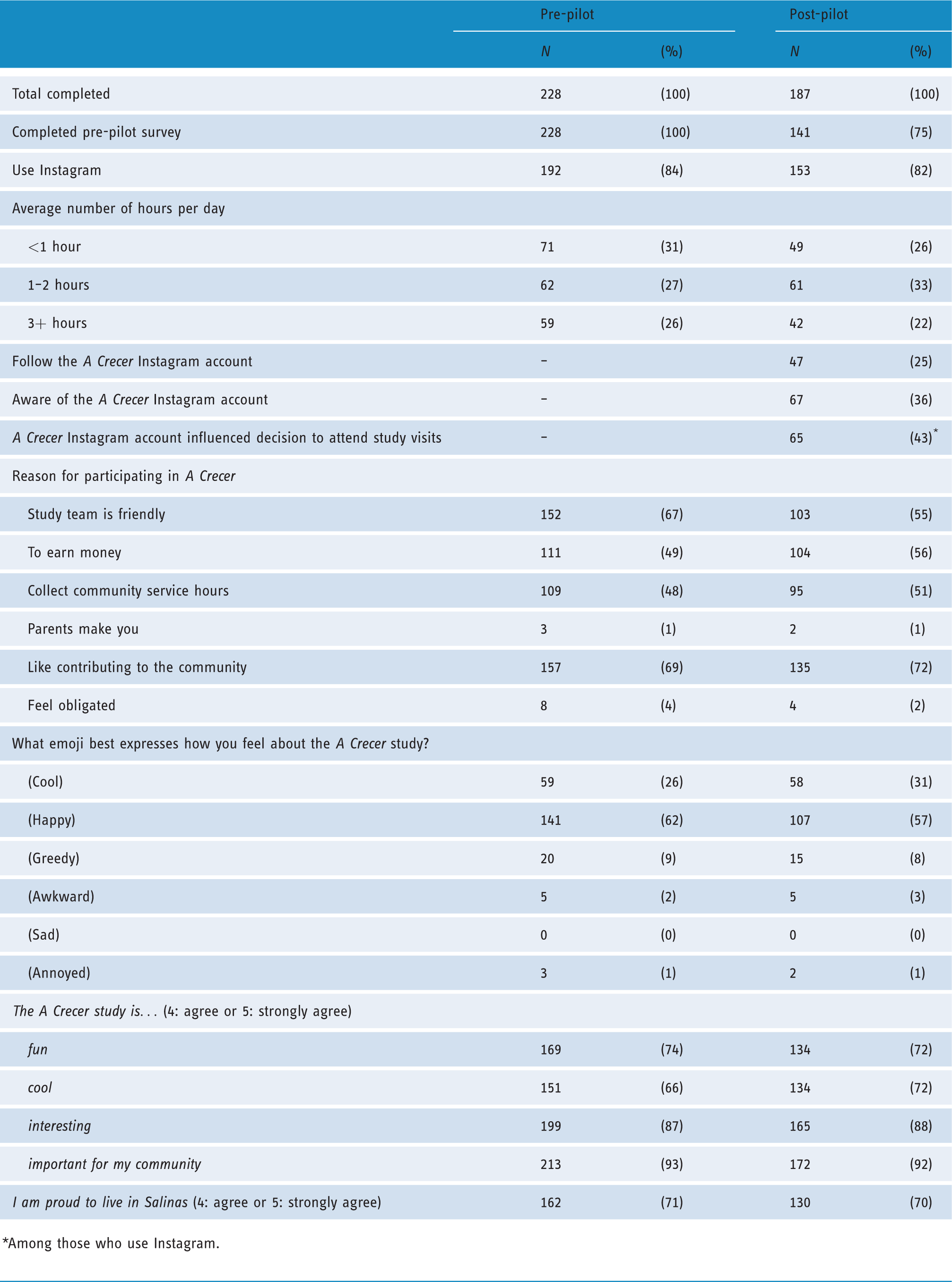
Among the 187 study participants who completed our post-Instagram-pilot survey, one-third (34%) said they knew about the @NuestroSalinas Instagram account, and nearly a quarter (23%) said they follow the account; another four (2%) said they had followed but stopped (Table 3). Those who followed the Instagram account learned about it from the study team (81%), a school event (34%), and/or friends (9%). It is important to note that some A Crecer study participants may have viewed and engaged in our content without actually following the account. With a public Instagram account, like @NuestroSalinas, a user can visit the profile, view stories, and like or comment on posts without becoming an official “follower.” This is demonstrated by the fact that our posts often received a greater number of views than our number of followers. For instance, one post we shared reached 216 accounts, 16% of which were not following us, whereas another reached 195 accounts, and 30% were not following us. 22
Results from A Crecer study participants who responded to the pre- and post-Instagram pilot survey (N = 274 individuals).
*Among those who use Instagram.
Our efforts to increase exposure to the account through paid promotions varied in effectiveness (Table 4). Paid promotions increase the likelihood that a user will see an Instagram account in their feed. We used two US$10-boosted video posts and one US$20-boosted video post. The most successful post focused on unique facts about Salinas, whereas the other two focused on goal-setting and acting as good role models for their peers.
Performance of three promoted video posts.

Engagement
Our Instagram Stories received more engagement than our posts, on average, receiving 45–106 views per story. Meanwhile, our Instagram posts received 806 total likes and comments over the three-month pilot period, ranging from 12 to 45 engagements per post. The most engaging posts featured photos of the A Crecer research team, humorous memes (a humorous image, video, and piece of text, that is modified/copied and spread rapidly by Internet users), inspirational quotes or messages, and ways to get involved in the community.
More than 400 teens participated in the four in-person events that our research team held at high schools, and 10% of study participants who responded to the post-pilot survey said they participated in the events.
Influence
Instagram pilot study survey responses reflected positive attitudes about the A Crecer study and the Salinas community, with little or no change before and after the Instagram pilot (Table 3). Sixty nine percent of pre-pilot survey respondents and 72% of post-pilot respondents said they participated in the A Crecer follow-up interviews because they like “contributing to the community.” Similarly, 54% of pre-pilot and 52% of post-pilot respondents strongly agreed that the study is important for the community.
There was a slight decrease in the percentage who said the study made them feel “happy” (62% to 57%) and a slight increase in the percentage who said it made them feel “cool” (26% to 31%), p = 0.09. “Happy” and “cool” are proxies for the smiling and sunglasses emojis we used to gauge how the study makes them feel. There were no significant differences in sentiments about the study or community among the participants who completed both pilot study surveys compared with those who completed only one (all p > 0.10). Most notably, among the post-pilot survey respondents who use Instagram, 43% (65/153) said awareness of the @NuestroSalinas Instagram account influenced their decision to continue completing study visits. Further, 63% (42/67) of those who were aware of or follow the @NuestroSalinas account said it had influenced their decision to come to study visits.
During the pilot, we had 19 comments (including five team comments) and three tags. All comments were positive (e.g. “this pic looks very cool!”). We received eight positive responses to our Stories; for instance, followers and community organizations responded to our Stories by using emojis (heart, thumbs up) or wrote in text (“thank you, keep up the good work”) to express support for A Crecer.
Action
The majority (84%) of post-pilot survey respondents said they would participate in future A Crecer events. Seventy-five (40%) also shared qualitative feedback on what would prompt them to follow our Instagram account, including more promotion of the account, updates about the study and past or upcoming events, opportunities to earn community service hours or prizes, information about Salinas and local events, and “cool” or “funny” posts.
In the two months before the pilot, the average completion rate for follow-up study interviews was 91.4% (212 interviews completed of 232 expected). The completion rate during the pilot was comparable: 94.9% of interviews were completed (166 of 175 expected).
Discussion
Research shows that teens spend considerable time using social media applications like Snapchat, YouTube, and Instagram. 1 Findings from the pre-/post-Instagram-pilot study survey support that trend, with the majority of A Crecer respondents saying they spend 1–3 hours each day on these social media platforms. These findings underscore the potential for social media as a tool to facilitate and enhance research with adolescents in a youth-friendly way.
Despite the popularity of Instagram among study participants, less than a quarter of those who answered the post-pilot survey said they followed our Instagram account, two months after it was established, and less than 7% of our followers were reportedly within our target age group. This finding underscores the difficulty we faced in motivating youth to follow an account about research and the community. Youth in particular may be less likely to follow an educational account because they want to appear “cool” to their peers and maintain a higher follow ratio (number of followers compared with number of accounts someone is following), occasionally referred to as the “Cool Ratio.” 22 In addition, the discrepancy between those who reported following the Instagram account and the metrics analyzed based on followers suggests that some of our account followers may not have included their actual age in their Instagram profiles or, alternatively, that some participants reported following us when, in fact, they did not.
The low follow rate for our account may be due to the limited number of study participants (36%) who said they had heard of the account. Study participants who said they followed the Instagram account heard about it mainly through the study team and events, suggesting that in-person promotional efforts at study visits and participating schools should be continued and a stronger emphasis should be placed on encouraging participants who follow the account to share it with their peers. Although we notified participants of the Instagram account via text message (SMS) during the pilot period, only about half of participants were due for a study visit; thus, the others would not have interacted in person with members of the study team during the Instagram pilot study period. In addition, more time may have been needed to generate awareness of and engage youth in following the Instagram account.
Most notably, 43% of the survey respondents who said they use Instagram affirmed that our study account influenced their decision to continue their participation, which aligns with the finding from Teague et al. 16 that using more social media and other emerging retention strategies has been shown to strengthen retention. Though this finding was unexpected given that a substantially lower proportion of participants said they were actually following the account, it is possible that knowing the study used Instagram affected perceptions of the study being youth friendly, thereby increasing their likelihood to continue participating.
Overall, study retention was high before the pilot, which made it difficult to measure short-term improvements in retention. Follow-up study visit monthly completion rates and participant retention did not change, despite feedback that Instagram would motivate them to participate in future activities. In addition, participants’ attitudes about the A Crecer study and Salinas community remained consistently high before and after the Instagram pilot. Thus, although having the account was generally viewed favorably by participants and was indicated as positively influencing study attitudes and participation, we were unable to measure these effects directly using the metrics evaluated. In guiding the use of social media as an engagement and retention tool in future longitudinal research, additional work is needed to understand the direct relationship between the social media presence in a study and participant behaviors related to study involvement. Insights into whether and why the Instagram account motivates adolescents to remain engaged and how it affects their experiences with the study overall would be informative in shaping use of social media in future research with adolescents.
Most of our Instagram followers during the pilot were from Salinas, which suggests that our content and geo-targeted boosted posts achieved our aim of reaching the Salinas community without too broad a geographic scope. In addition, we received positive feedback (e.g. “thank you” messages or “likes”) from the community-based organizations that we featured in Stories and posts, which we hope translates into increased awareness and support of the A Crecer study and its mission among community stakeholders. A few community organizations messaged us directly with requests to spread the word about their upcoming events. Parents and youth in the community also used the account to ask about local resources, such as LGBTQ meetings and interview opportunities for the youth ambassador role.
For research studies considering the use of Instagram to engage youth participants and support retention efforts, an important challenge to consider is visibility in users’ feeds. In 2016, Instagram replaced the reverse-chronological feed of posts with a feed that responds to users’ behaviors; for instance, it prioritizes posts from accounts that the user interacts with frequently (i.e. leaving comments, direct messaging) and content related to their interests. Users may not see a post that an account just shared at the top of their feed, as timeliness is no longer the most important factor. In addition, users may never reach an account’s posts in their feed if they stop scrolling after the top-ranked items. One potential tactic to “cut through the noise” of the Instagram feed to be seen is leveraging Stories. As demonstrated by our pilot, the Stories were more engaging among youth (i.e. more views than likes received on posts). Once users click an account’s Stories icon at the top of their feed, they have the opportunity to tap through all of their Story content at once, back-to-back. In addition, Stories are intended to be more spontaneous, realistic, and unedited, which might be used for study behind-the-scenes video footage or friendly reminders about upcoming events on a more regular basis. The use of Instagram Stories is growing exponentially; as of January 2019, Instagram Stories was being used by 500 million users daily, 23 up from 100 million users in October 2016. As illustrated here, the effective use of social media requires both a keen understanding of the platform and user behaviors, alongside the identification of nimble strategies that adapt to design and technological changes of the platform itself.
Co-creation and youth-centered design is one strategy to help capture this information and adapt content and engagement strategies accordingly. Our campaign content and engagement approaches were shaped by the target audience itself through co-creation and design sessions prior to creating the account, as well as engagement of a youth ambassador to create the content. This strategy reflects the assertion made by some in the field of adolescent health, including the National Academies of Science (2019), that youth “have the capacity to make meaningful contributions to the design and execution of research.” 24 In fact, a 2019 study of HIV and intimate partner violence prevention in southern Africa argues that to move beyond the status quo and “support real innovation,” interventions need to be co-developed and implemented with youth, 25 so that they consider and reflect young people’s priorities.
Limitations
Several limitations should be considered in interpreting the findings of this pilot study, nested within the A Crecer cohort study. First, the pilot period was only three months, with the pre-post survey conducted two months after the launch of the campaign. Though we examined short-term outcomes, this design decision limited our ability to consider longer-term engagement with the Instagram account and effects on study participation. Second, the pre-/post-pilot surveys focused on perceptions about the study and intentions about ongoing participation without linking these data directly to Instagram account engagement metrics. Third, the pilot was initiated well into the A Crecer study period when retention was already high, making it difficult to detect improvement and re-engage those youth already lost to follow-up. However, one intent was to lessen the intensity of some of the follow-up study outreach strategies while simultaneously sustaining high engagement; better quantitative measures might have more clearly elucidated these benefits. Soliciting Instagram campaign design input from those youth who were more difficult to follow and engage using traditional approaches might have also yielded content that would have appealed more directly to this small, but important, subgroup of the study population. Nonetheless, within a short time period, we were able to reach our target population and to gain insights on the types of posts they found most engaging, thereby informing use of social media in future research.
Conclusion
This pilot study involving the development and integration of an Instagram campaign into an ongoing prospective cohort study of adolescents in an agricultural community in California found that Instagram has the potential to be an influential tool to promote participant engagement and build community support within a research study. Although we achieved 209 followers in a three-month time period, reach within the existing study participants was low during this short pilot period. Nonetheless, a substantially high proportion of participants viewed the study’s Instagram account as positively shaping their perceptions of the study, and engagement with the broader Salinas community was achieved through Instagram. Future evaluations of social media as a retention tool would be strengthened by assessing effects on multiple aspects of study implementation, including staff time spent on participant tracking, number of times study visits need to be rescheduled, and ease of communication with participants; by engaging hard-to-reach participants, specifically, in the social media campaign design; and by integrating the social media presence and a rigorous evaluation design from the outset of the study. Identifying ways to most strategically use and evaluate the added value of social media in the context of a prospective study constitutes an important contribution to understanding how social media can be leveraged to enhance research with adolescents.
Footnotes
Conflict of interest
The authors declared no potential conflicts of interest with respect to the research, authorship, and/or publication of this article.
Funding
The authors disclosed receipt of the following financial support for the research, authorship, and/or publication of this article: this work was supported by the Eunice Kennedy Shriver National Institute of Child Health and Human Development and the Office of Behavioral and Social Sciences Research of the National Institutes of Health (grant number R01HD075787). The content is solely the responsibility of the authors and does not necessarily represent the official views of the National Institutes of Health.
Ethical approval
This study did not require ethics committee review and approval. However, we did receive approval from RTI’s IRB.
Guarantor
Veronica Thomas.
Contributorship
Veronica Thomas, Marisol Chavez, and Alexandra Minnis reviewed the literature and conceived and designed the study. Veronica Thomas and Marisol Chavez led the development of the youth-centered design research and social media management. Erica Browne conducted and analyzed the pre-/post-Instagram-pilot survey. Veronica Thomas wrote the first draft of the manuscript. All authors reviewed and edited the manuscript and approved the final version of the manuscript.
Acknowledgements
We would like to thank Carol Offen and Merrie Aiken for their support in editing and preparing the document and figures for submission, as well as youth from Alisal High School, who provided valuable input that informed the design of the Instagram account and campaign.

Peer review
This manuscript was reviewed by reviewers who have chosen to remain anonymous.