




Abstract
Fitness trackers are becoming a popular way to encourage physical activity and impact health behaviors. Although many college students may own and use fitness trackers, they remain a high-risk group in terms of rates of obesity and lack of physical activity. In this study, college students were provided with fitness trackers to self-monitor step count. Pre- and post-measures of body composition, resting heart rate and blood pressure, knowledge of physical activity behaviors and perception of wellness were used to determine the impact of the fitness trackers. The research was completed in two phases: phase one with completely voluntary participation and phase two as a part of a required general education wellness course. Results did not indicate a significant change in step count over 12 weeks nor did they show positive change in body measurements; however, there were indicators of activity benefits. Knowledge and perception of wellness were not positively impacted in the voluntary study; however, when the education component was required, some increases in knowledge and perception of wellness were shown in the general education course. Many lessons were learned in the study that should be considered when planning future research with fitness trackers in the college-age setting.
Keywords
Introduction
Obesity and a lack of physical activity continue to be a significant health problem in the USA. The most recent data indicate that 30% of all young adults are obese. 1 Although we have not seen an increase in obesity levels since 2002–2003, we also have not seen a decrease. According to the National College Health survey, 2 35% of college students are overweight or obese. Forty-six percent of all college students believe they need to lose weight and, of those, two-thirds have never received any information on healthy eating or the importance of physical activity. 3
In addition, we know that adult physical activity levels are low. Less than half of all adults meet the physical activity guidelines. 4 Physical activity tends to decline from childhood and adolescence through adulthood, with a rapid decline occurring during the college years. Only 3 of 10 high school students get 60 minutes of physical activity every day. 4 Although younger adults are more likely to meet the physical activity guidelines than older adults, physical activity levels appear to track, therefore the habits that are started in earlier years continue into later years.5,6 Therefore, if students graduate from college and have not yet adopted healthy physical activity patterns, the chances drastically decrease that those behaviors will be adopted. The dangers associated with low to no physical activity and obesity are significant in young adults including early onset type II diabetes, high blood pressure, risk factors for cardiovascular disease, bone and joint problems, sleep issues, and increased risk of heart disease and cancer in adulthood. 7
This study focused on college students in a small, northern, mid-western, public university. The students volunteered or participated in a general education course, thus providing students from many majors on campus. The purpose of this study was to determine if the use of fitness trackers would have a positive impact on the physical activity behavior, body measurements, and wellness knowledge or perceptions of wellness in the general student population. In addition, we examined the use of an educational component in conjunction with the fitness trackers to see if the combination of strategies would have a greater impact on theses outcomes.
Literature review
The Department of Health and Human Services recommends that adults participate in a minimum of 30 minutes a day of moderate physical activity, 5 days a week. 8 The Centers for Disease Control states that adults can achieve this moderate level of activity by taking at least 10,000 steps a day. 9 Adults can also meet their physical activity recommendation by accumulating 75 minutes of vigorous physical activity per week. Less than 40% of college students participate in vigorous activity at least three times a week. 3 A meta-analysis of college student physical activity behaviors found that physical activity in college students was a highly neglected subject, even though physical activity and diet are two critical factors in determining health. 10 These findings support the need for physical activity promotion programs for college students.
This research study was grounded in the self-determination theory. Self-determination can be used to describe factors of motivation for many behaviors, including physical activity. 11 In applying the self-determination theory, one must first consider the difference between autonomous (intrinsic) and controlled (extrinsic) motivation. Intrinsic motivation is an individual being physically active based on the pleasure or enjoyment they find in participating in physical activity. Extrinsic motivation for physical activity includes things such as the desire to look good or gain social acceptance. Physical activity goals can also be intrinsic or extrinsic. Intrinsic goals include the desire for health and well-being, where extrinsic goals may include a grade in a physical activity course or rewards from a coach. Intrinsic motivation has been associated with more long-term adherence to physical activity whereas extrinsic motivation may motivate an individual to be physically active for a short amount of time, but the results are not typically lasting. 11
In developing intrinsic motivation, the self-determination theory includes autonomy, competence and relatedness. Autonomy in physical activity includes the level of control and choices an individual believes they have to be physically active. Individuals must also feel competent and confident in their ability to perform and benefit from physical activity. Relatedness includes the importance of the social context of exercise in motivation. According to the research, health promotion activities should promote these tendencies of competence, autonomy and relatedness in order to increase motivation and long-term physical activity adherence.11,12 In a literature review of 66 studies on physical activity, there was a positive relationship found between self-determination or autonomous motivation and increasing physical activity. 13
Applying the self-determination theory to this particular research, one can view the use of fitness trackers as an opportunity to provide support for autonomy of activity and effective feedback for self-monitoring. When individuals receive immediate feedback on their progress, they experience a sense of competence. By providing self-monitoring, fitness trackers can foster a sense of autonomy in the process of goal setting. Having a sense of autonomy has been found to be effective in increasing physical activity levels. 14 Fitness trackers also allow for individuals to feel autonomous in that the participant may choose whichever type of physical activity they find rewarding in order to reach their goals, versus being required to engage in a specific type of physical activity that is dictated by the instructor or health promotion expert.
Using digital tools to track physical activity levels and encourage behavior change has been effective in increasing activity levels in worksite wellness programs 15 and on college campuses. 16 In a 12-week worksite wellness study, utilizing a pedometer and computer-based educational program with 120 participants, a slight improvement in body mass index, blood glucose and total cholesterol was observed and the program had a moderate effect on fitness, mood, health awareness, nutrition and health. 15 In a study of 290 college students enrolled on a general education course for 12 weeks, the students who were required to wear a pedometer increased their daily steps, although not significantly, but did show a significant difference in steps from the group not wearing the pedometers. 16 Likewise, in a meta-analysis of 32 studies utilizing pedometers as a motivational tool for at least 4 weeks, pedometers were shown to have an overall positive effect as a motivational tool to increase physical activity. 17 In addition, a review of 51 studies utilizing any form of digital technologies to prevent cardiovascular disease risk factors suggested a 40% relative risk reduction in cardiovascular disease when digital technologies were used. 18
Wearable activity trackers are also being used more, but with mixed results. Jakicic and colleagues examined 417 adults in a study utilizing wearable technologies to increase weight loss and found incorporating a wearable technology device to an existing behavior intervention resulted in improvements in body composition, fitness, physical activity and diet, but decreased weight loss compared to standard weight loss approaches. 19 Wearable devices have shown positive outcomes on increasing average steps, but limited effect on health outcomes. 20 In a large study utilizing cash incentives and wearable technologies to increase physical activity levels, 800 employees in companies in Singapore were randomly assigned fitness trackers and cash incentives to increase physical activity levels. No improvement in health levels such as weight and blood pressure were shown; however, the use of fitness trackers resulted in maintenance of physical activity over a 12-week time frame. Additionally, in a study of 56 college students utilizing Fitbit fitness trackers in an introductory college health course, there was a significant increase in steps per day over the control group; however, no health outcomes were measured. 21
Utilizing these findings as a guide, a wellness initiative was implemented for college students, involving the use of a fitness tracker to set activity goals and self-monitor progress. Similar to pedometers, fitness trackers provide a step count measurement, but can offer additional activity information such as activity intensity, sleep patterns, heart rate and miles walked. The fitness tracker is also more wearable, with a wrist-worn option. Most pedometers only have the hip-worn option, which is less appealing due to the challenge to securely attach the pedometer at the waist and difficulty in seeing the display to monitor daily progress. These features made the idea of a fitness tracker incentive attractive to college students and helped garner volunteers for the project.
Various fitness trackers have been tested for reliability and validity over the last 5 years as the technology has emerged. In a study of 17 fitness trackers, including the Garmin Vivofit, it was found that fitness trackers are relatively accurate for measuring step count. 22 Additionally, in a study comparing the Garmin Vivofit to similar devices, the Vivofit was a valid and reliable means to track physical activity. 23
The purpose of this study was to determine if the use of fitness trackers would have a positive impact on the physical activity behavior, body measurements, wellness knowledge and perceptions of wellness in the general student population. Ultimately, this research sought to answer the following question: does the use of fitness trackers increase physical activity, improve body measurements, and increase the level of wellness knowledge and perceptions of wellness in college students? In addition, we examined the use of an educational component in conjunction with using the fitness trackers to determine, does the combination of fitness trackers with an education component have a greater impact on these outcomes than the fitness tracker alone?
Methods
This project was conducted in phases. Phases 1 and 2 have been completed and are presented in this paper.
Phase 1
Participants
Participants for phase 1 were recruited from the general student population. Recruitment occurred in the university commons, in general education courses, and through posters and flyers posted throughout the university. Fifty-four college-age participants (42 females and 12 males) agreed to participate in phase 1 of this study. The national average for percentage of body fat is 34% in the United States. 24 In the phase 1 group, the average percent body fat for the participants was 28.2%, below the national average.
Procedures
A university grant provided the resources necessary to purchase the fitness trackers for use in the research. Participants were brought into the lab for the following assessments: body composition, resting heart rate and resting blood pressure. During this visit, the fitness trackers were given to the participants. Upon completion of the lab procedures, three surveys were emailed to the participants and participants were directed to the step log (Appendix A) used to track their physical activity. The step log allowed the participant to record steps for the week and then provided an increased goal for the subsequent week based on their average steps for the previous week. Weekly reminders were sent to the participants to submit their weekly steps. After the 12 weeks, students returned to the lab for post-testing and the surveys were emailed out for completion.
Phase 2
Participants
Eighty students (49 females and 31 males) enrolled in a general physical education/wellness course participated in phase 2 of this study. The students in the study represented all four colleges and many of the academic departments on campus. With regard to gender, this sample is representative of our campus population with 61% being female. The phase 2 participants had an average percent body fat of 26%, also below the national average.
Procedures
In phase 2, participants came to the lab for body composition, resting heart rate and resting blood pressure assessments before the class began, and again at the end of the semester. During the lab visit at the beginning of class, a fitness tracker was signed out. Then surveys were sent to students via email. Over the 8-week course, participants were required to complete online educational modules on overall wellness, physical activity, fitness, nutrition and stress. As part of the course, the students were asked to complete all pre-tests, post-tests and step tracking information. In addition, grades were not submitted until the fitness tracker had been returned.
Assessments and measures
In order to measure the impact of the fitness tracker intervention, a number of direct and indirect measures of physical activity were used. The traditional college student population poses a significant challenge as young college students are sometimes viewed as adolescents and sometimes as young adults. Some college students are still developing and growing into their eventual adult bodies. They also display a wide range of maturity in handling responsibility and motivation. These factors were considered when determining the assessment measures. In similar studies assessing young adults, it was noted that feasibility is critical in choosing appropriate assessment techniques when considering age-appropriate methods.25,26 Direct observation of physical activity is not always feasible in young adults, so wearable devices can be considered a direct measure. 27 Based on our population, a combination of self-reports, inventories, physical measurements and wearable devices were used to provide the best data on the effect of the intervention. Physical measurements included pre- and post-resting heart rate, resting blood pressure and body composition, and the fitness trackers provided direct evidence on step count. The use of pedometers and electronic pedometers has been shown to be an appropriate measure of assessing physical activity.28,29 A direct measure of knowledge of wellness practices, PE Metrics, was utilized to assess participants’ knowledge of physical activity content. PE Metrics is designed for high school seniors and is used in physical education assessment and practice. 30
In addition to direct measures, indirect measures were used. These indirect measures included self-reports and wellness inventories. Used in combination with objective measures, self-reports can provide additional documentation on types and context of physical activity. 31 Self-reported data was collected using the International Physical Activity Questionnaire (IPAQ). 32 In addition to the IPAQ, we surveyed participants’ perceptions of wellness using a wellness inventory. Research has demonstrated that wellness inventories can provide a reliable method to assess levels of wellness and areas of improvement. 33
For both phases, three assessments were completed pre and post in the lab, using specific digital tools. Resting heart rate and blood pressure were assessed using an Omron 5-series BP742N upper arm blood pressure monitor. Body composition was measured using the COSMED BodPod, a system that utilizes air displacement plethysmography. Participants wore fitted clothing, swim caps, and removed all jewelry to obtain the most accurate measure.
Three surveys were administered to the participants both at the beginning and end of the semester through Qualtrics survey software. The IPAQ is a seven-item survey used to identify levels of health-related physical activity. PE Metrics is a 29-item instrument that assesses level of cognitive knowledge with regard to physical activity and fitness. 34 In addition, a wellness inventory was used to assess perceptions of personal wellness on five components of wellness; fitness, nutrition, medical self-responsibility, stress and emotional wellness. 35
Objective physical activity was measured by a fitness tracker. In phase 1, the Fitband fitness tracker was given to the participants to track daily steps. In phase 2, the Garmin Vivofit fitness tracker was used to track steps. In both phases, daily step totals were submitted at the end of each week.
Intervention and data collection
In phase 1, after all pre-tests were complete, participants were given a fitness tracker and instructed to track their physical activity level daily. Participants recorded their daily steps in the step log. At the end of each week, participants were instructed to reflect on their physical activity level and set a new step goal. The step log calculated a new weekly goal based on the prior weeks’ step counts. The new goal reflected a 10% increase in steps to help guide participants with a realistic goal for improvement in physical activity. Neither phases of the research required that participants actually reach that step goal. Participants could set an increase they felt was achievable. This was left entirely up to the participants and did not impact their ability to participate in the research or their standing in the class. After the 12-week self-monitoring intervention, participants returned to the lab for post-tests and completed final surveys.
Phase 2 resembled phase 1 with regard to the pre-tests, post-tests and physical activity tracking requirements. In addition to the self-monitoring and recording of physical activity, the intervention for phase 2 included an educational component. Participants completed online educational modules on general wellness, physical activity, fitness, nutrition and stress. The modules included lecture content and application, self-assessments and quizzes.
The self-determination theory was used to guide this intervention as participants were allowed to choose their own types of physical activities and exercises. 11 This reflects the component of autonomy, having control over their own behavior. In addition, the focus was on their autonomous motivation to be physically active and increase steps.
Data analysis
A one-way repeated measures analysis of variance was used to measure changes in average steps per week over the 12 weeks. Paired sample Student’s t-tests were used to measure changes in perception of wellness, physical activity level, cognitive knowledge, body composition, resting heart rate and resting blood pressure. Finally, correlational analyses were used to compare step changes to both post-cognitive knowledge and post-wellness inventory scores. Steps were compared based on the three, 4-week groups. Participants with complete data for 3 of the 4 weeks (within a group) were included in that grouping. To be included in the analyses, participants needed to have complete data in two of the three, 4-week groups. Thirty-five participants had complete data and were used for analyses.
Results
During phase 1 (n = 54) of the research, in which participants volunteered from all over campus to take part in the research, the results indicated a trend in change in average steps taken each week (Wilks Lambda = 0.831; F (2, 30 = 3.055, p = 0.062)), but not a significant change in steps. Pairwise comparisons indicate that the trend is between average steps for the first 4 weeks and the last 4 weeks of the project (p = 0.058) (Figure 1). According to the IPAQ results, vigorous physical activity stayed relatively consistent in duration (164 to 172 minutes/week, p = 0.784) and frequency did not change significantly (3.46 days vs. 3.14 days, p = 0.314). The frequency of moderate physical activity did not change significantly (3.43 vs. 3.29 days, p = 0.722) nor did the minutes of moderate physical activity (38 vs. 47 minutes/session, p = 0.571). Although not statistically significant, this results in moving from not meeting the recommendation (130 minutes/week) to meeting the recommendation (155 minutes/week). There was a statistically significant difference in minutes spent walking (33.5 vs. 55.5 minutes/session, p = 0.0001), although the days per week remained consistent (6.18 vs. 5.89 days/week, p = 0.245). In phase 1 there were no significant differences in the wellness inventory and perceptions of wellness scores, and no difference in cognitive knowledge of physical activity based on the PE Metrics assessment. Participants had a slight increase in percentage of body fat (Pre = 28.28, Post = 29.43, p = 0.028), and no change in resting heart rate or blood pressure. There was not a significant correlation between any of the wellness components (r = 0.104–0.269) or cognitive knowledge (r = 0.045) and step change. Finally, neither cognitive knowledge nor any components of wellness accounted for the variance in step change across the program (p = 0.846). Sample size, means and standard deviations (SDs) for phase 1 are provided in Table 1.
Average step change across the semester for phase 1. Sample sizes, means and SDs for phase 1. indicates significant at p < 0.05. DBP: diastolic blood pressure; HR: hear rate; SBP: systolic blood pressure; SR: self-report.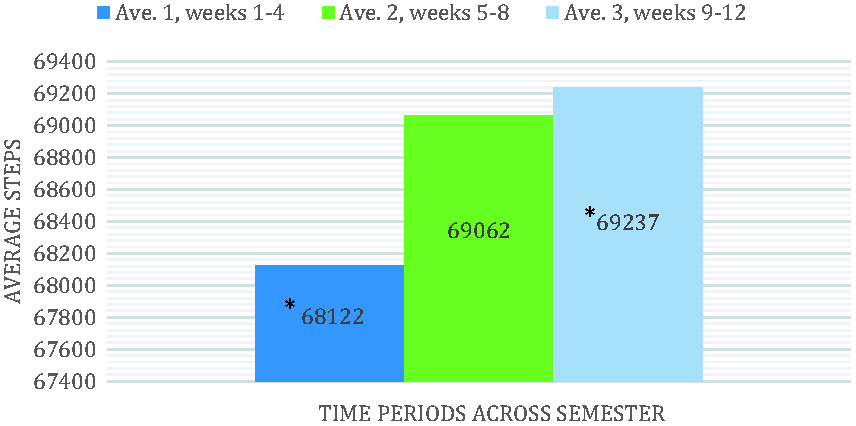

In phase 2 (n = 80) of the research, where participants were solicited through a general education wellness course, vigorous activity stayed relatively consistent in duration (94 minutes each week to 108 minutes each week, p = 0.108) and frequency did not significantly change (2.09 days vs. 2.22 days, p = 0.718). The frequency of moderate activity each week did not change significantly (3.5 days vs. 3.1 days, p = 0.119), nor did the duration (60 minutes vs. 47.7 minutes/session, p = 0.263). Although not statistically significant, this represents a change from 210 minutes each week to 147.8 minutes per week, or a difference of meeting the physical activity recommendation to being slightly below the recommendation. Finally, there was not a statistically significant change in walking frequency or duration either (p = 0.777 and p = 0.098, respectively). However, this change represents a decrease from an average of 288 minutes of walking to 220.4 minutes of walking each week. Average steps taken each week did not change significantly across the semester (Wilks Lambda = 0.966; F (2, 61 = 1.085, p = 0.344)). Figure 2 shows the change in average steps across the three time periods.
Average step change across the semester for phase 2.
Sample sizes, means and SDs for phase 2.
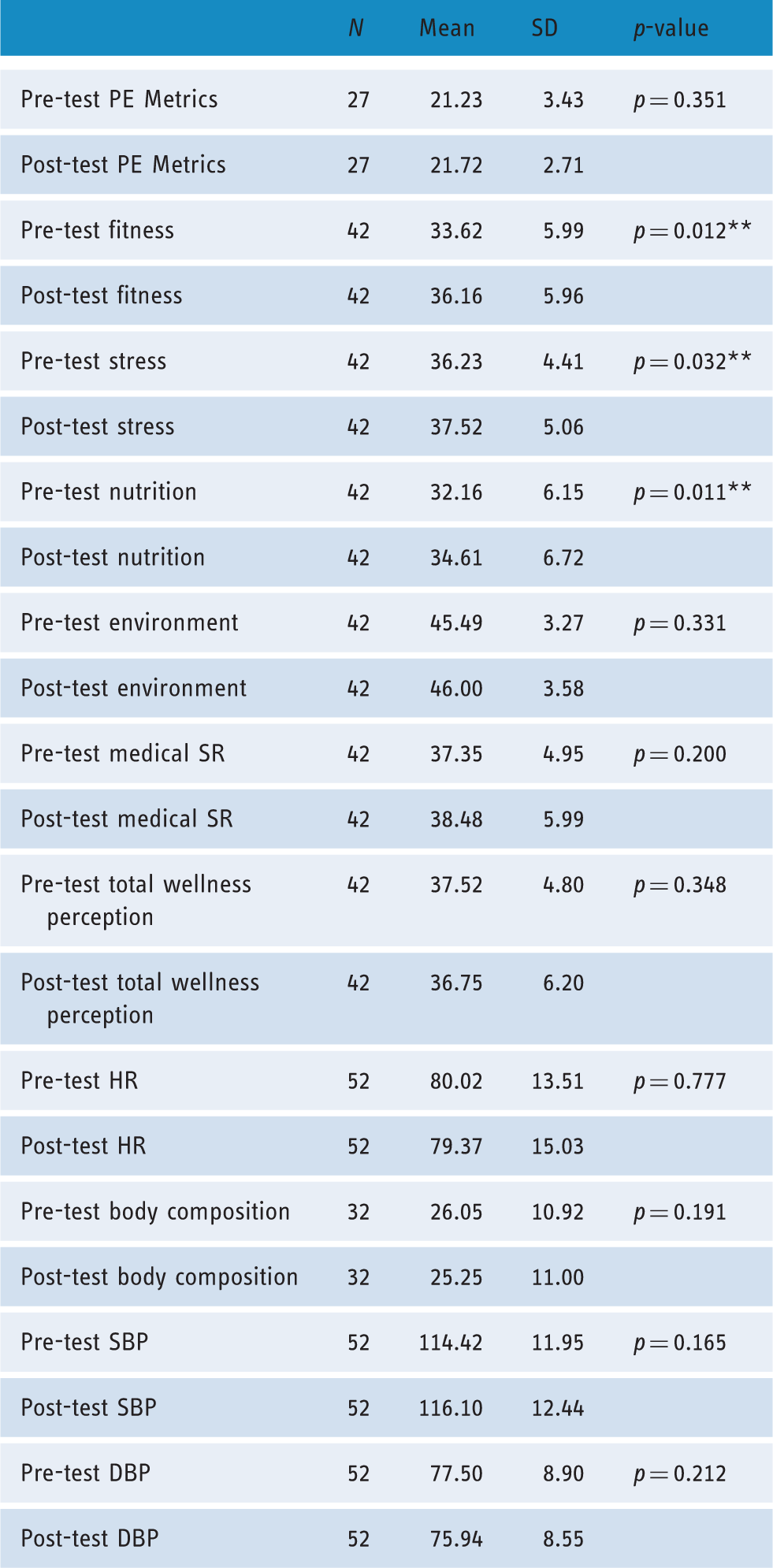
indicates significant at p < 0.05.
DBP: diastolic blood pressure; HR: hear rate; SBP: systolic blood pressure; SR: self-report.
Discussion
The use of self-monitoring to promote physical activity paired with a general education course that provides content knowledge appears to have a positive impact on students’ wellness perceptions, but limited and inconsistent impact on physical activity behavior. In phase 1, there was a trend towards an increase in physical activity based on the average step data from the tracker, but that increase plateaued after week 8, while self-reported data showed an increase in time spent walking. This discrepancy is not uncommon as light to moderate physical activity tends to be less robust with self-report measures, 36 but self-report is still an acceptable assessment. 37 Additionally, although no significant difference was found in moderate physical activity, the results indicated a trend towards increasing physical activity. The self-determination theory indicates that autonomy, relatedness and competence are important criteria to experience intrinsic motivation. In phase 1, participants self-selected into the interventions and often came with a friend or friends, thus potentially enhancing intrinsic motivation through autonomy and relatedness. These aspects were not present in phase 2. Phase 2 of this project was conducted as part of a general education course during a fall semester at a northern, mid-western university, in which temperatures fall drastically and snow accumulation is high. It is well documented that physical activity levels change depending on the season. Matthews et al. 38 found that adult males accumulated 51 more minutes of physical activity per day in the summer while females accumulated 16 more minutes of physical activity in the summer. Likewise, in a systematic review by Tucker and Gilliland, 39 they found 37 primary studies, which accounted for 291,883 participants, that documented that poor or extreme weather conditions are a barrier to physical activity. Therefore, based on this typical pattern, the maintenance of steps through the end of the semester provides some optimism for self-monitoring and education as a way to preserve physical activity levels, and counteract the impact that poor or extreme weather conditions may have on physical activity levels. Thus, although no conclusive findings emerged, at a minimum fitness trackers do not appear to have a negative impact on physical activity behavior.
Consistent with Tucker and Gilliland, 39 it is a decline in moderate levels of physical activity that are typically seen as a result of poor weather. Our results support these findings. Although not a statistical difference, there was a decline in minutes of moderate physical activity and walking in phase 2, but the vigorous physical activity remained consistent across the semester. This could be due to less walking across campus or leisure-time activity, but maintenance of structured physical activity such as running or group fitness classes was sustained across the semester.
Results also indicate that the educational intervention that occurred as part of the class modules were key in enhancing one’s personal perception of wellness. In phase 1, the participants did not receive any wellness education and there were no changes in perceptions of wellness. In phase two, the participants were recruited as part of a general education wellness course, thus receiving education on general wellness, physical activity/fitness, nutrition and stress. The difference between the two phases was the educational component. Phase 2 saw a positive change in perceptions of wellness for fitness, nutrition and stress, all of which are components covered in the course. There were no significant changes in emotional, environmental or medical self-responsibility, which were not covered in the content. Lima de Melo Ghis et al. 40 conducted a review of studies examining cardiac rehabilitation patients’ knowledge and the educational interventions they participated in. The findings support the benefit of educational interventions in positively impacting patients’ knowledge and behavior change. 41
The findings of this study show a statistically significant increase in percentage of body fat during phase 1. Previous studies have examined the relationship between physical activity and body composition. The relationship between physical activity and body composition has been shown to be inversely related: as physical activity increases body composition decreases. 42 Kemmler and colleagues found that the most deleterious impact on an increase in fat mass in 18–24-year-olds is a corresponding decrease in volume and intensity of physical activity. 43 The results of the current study have conflicting findings, as the trend of increased physical activity in phase 1 was also associated with an increase in percentage of body fat, while the decrease in moderate physical activity of phase 2 corresponds to no change in body fat. This could be a result of the maintenance of vigorous physical activity that we saw in phase 2 accounting for a maintenance of physical activity intensity.
This study sheds some light on potential strategies to impact physical activity levels of college students, but the results should be considered with the study limitations in mind. Neither phase had a control group, therefore, it is difficult to know how physical activity levels, body composition, fitness knowledge or perceptions of wellness would have changed without the use of a fitness tracker or the educational modules. Having a control group would have enhanced the ability draw more definitive conclusions. However, college students are an understudied segment of our population. Recent findings indicate that the prevalence of obesity in young adults is greater than that for adolescents (12–19 years of age): 32.3 and 20.5%, respectively. This may provide evidence that young adults are in the midst of an important transition characterized by weight gain and the development of obesity. 44
In addition, during phase 1, when the students were completely recruited based on a desire to increase physical activity, our sample was skewed towards females, which was not representative of our population. Likewise, phase 1 had voluntary participants that were given fitness trackers that they were not required to return, therefore, there was little accountability and we were challenged with collecting post-assessment data. We found a great deal of attrition of participants as they were not held accountable to a grade. In phase 1, the participants found some frustration with the Fitband fitness tracker based on accuracy, battery life and display capabilities. Finally, because there was not an instructional component in phase 1, it was not surprising that there was no change in cognitive knowledge around physical activity or around perceptions of overall wellness.
In phase 2, we realized that it is important to determine motivation factors for students in a required general education course. Although these students were more motivated to complete the pre- and post-assessments, they may not have been motivated to increase physical activity levels simply because they were required to take a general education wellness course. However, this course did demonstrate the need to have an instructional component in order to increase knowledge of physical activity and perceptions of overall wellness. These findings indicate the need to look into research on intrinsic versus extrinsic motivation and college students. Finally, phase 1 took place during the spring semester, when the climate in the northern state in which the research took place moved from cold to warm and phase 2 took place during the fall semester when the climate moved from warm to cold. Weather can be a significant motivator for physical activity and should be considered when implementing a physical activity program.
Conclusions
Increasing physical activity among college students needs to continue to be a focus, as obesity, overweight and sedentary levels in the college-age groups continue to rise. There is limited data regarding college students and their physical activity and health status. University research into the motivational factors that increase the likelihood that college students will engage in physical activity is well served by using fitness trackers and other digital measures of assessment.
The self-determination theory was used to inform this study with the idea that autonomous choices and constant feedback would increase physical activity levels. In phase 1, where students came to the study with their own motivating factors and no extrinsic pressure related to grading, the step count increase was greater than the group that participated as part of a required general education course. This certainly reinforced the concept of intrinsic versus extrinsic goals and motivation. However, the use of fitness trackers may not be the only mechanism that is required for individuals to feel motivated to engage in physical activity. Although the participants may feel a sense of autonomy, those students in phase 2 may experience less relatedness or social fulfillment, while those that self-selected to participate in phase 1 often came with friends. Thus, it may have been a combination of autonomy and relatedness that lead to the increased physical activity. But, it should be noted that the trackers may have also served as an extrinsic motivating factor rather than a means to intrinsic, autonomous motivation.
In addition, the use of fitness trackers along with wellness education appears to be an effective strategy to initiate the behavior change process by changing perceptions and beliefs. Opportunities and facilities need to be provided, including instruction on techniques and practices, to ensure that students are engaging in a wide range of healthy activities. Simply providing a fitness tracker may not be enough to increase physical activity, but self-monitoring in combination with a number of other effective techniques may be what is needed to improve the overall health and well-being of our college students.
Footnotes
Contributorship
JS and SF researched literature, conceived the study and were involved in participant recruitment. JS was involved in protocol development, gaining ethical approval and data analysis. SF wrote the first draft of the manuscript. All authors reviewed and edited the manuscript and approved the final version of the manuscript.
Declaration of Conflicting Interests
The author(s) declared no potential conflicts of interest with respect to the research, authorship, and/or publication of this article.
Ethical approval
The ethics committee of the University of Wisconsin-River Falls approved this study (H2014 - T173 and H2015-T100).
Funding
The author(s) disclosed receipt of the following financial support for the research, authorship, and/or publication of this article: This project was funded internally by a college and university faculty development grant.
Guarantor
Jodee Schaben.
Peer review
This manuscript was reviewed by two individuals. The author(s) have elected for these individuals to remain anonymous.