



Abstract
Objectives
The aim of this study was to compile commercial reference laboratory data over a 10-year period to determine the distribution of Aelurostrongylus abstrusus, commonly known as feline lungworm, within the USA based on widespread fecal testing in cats.
Methods
The results of 3,610,455 feline ova and parasite (O&P) zinc sulfate centrifugation fecal flotation tests performed at IDEXX Reference Laboratories in the USA from January 2008 to December 2017 were compiled and sorted for tests positive for A abstrusus larvae. The results of 3625 Baermann tests, currently considered the gold standard diagnostic for feline lungworm, were also retrieved from the same period.
Results
Of the tests performed, 4721 (0.13%) feline O&P zinc sulfate centrifugation fecal flotation tests and 75 (2.07%) of the Baermann tests conducted were positive for the presence of A abstrusus larvae. The O&P data revealed a significant association between infection status and sex, while male cats in both the O&P and Baermann data sets had a higher risk of A abstrusus infection than females. Significant variation in positive rates were observed by region and most positive cases were clustered in the Northeast, Midwest and West regions of the USA.
Conclusions and relevance
This study highlights the distribution of feline lungworm in the USA and the limitations of using current testing to diagnose this infection. The introduction of higher throughput, less labor-intensive diagnostic methods could help increase awareness of this parasite among veterinary professionals, achieve a greater understanding of epidemiological factors, and improve the care and treatment for clinically ill feline patients.
Introduction
Aelurostrongylus abstrusus, commonly known as feline lungworm, is a globally distributed parasitic nematode that resides in the terminal bronchioles, alveoli and alveolar ducts of domestic cats. 1 Adult A abstrusus worms in the lungs of an infected cat will lay embryonated eggs that hatch to motile first-stage larvae (L1s). These L1s use the cat’s mucociliary clearance mechanisms to travel from the lung to the pharynx where they will be swallowed and released through the cat’s feces into the environment. In the environment, L1s are taken up by mollusk or slug intermediate hosts and mature into infectious third-stage larvae (L3s) within 2 months. 2 Cats can acquire A abstrusus by ingesting infected snails or by eating paratenic hosts such as rodents and birds that have ingested infected snails. Once inside the cat, L3s penetrate the intestinal epithelium and migrate to the lungs via the circulatory and lymphatic systems. 3 While many infected cats may not show noticeable clinical signs, 4 others exhibit coughing, dyspnea, anorexia and diarrhea. 5 The severity of clinical signs is consistently proportional to parasite burden and is also affected by the cat’s age and immune status.6,7 Delays in diagnosing feline lungworm infection could lead to the creation of severe pulmonary lesions in the lung, as well as bacterial or other parasitic coinfections.8,9
The Baermann method, which utilizes a fecal sample, is the current gold standard for diagnosing A abstrusus infections in cats. 10 Diagnosing A abstrusus can be difficult as the Baermann method is not widely used in US veterinary clinics owing to its long incubation time. Fecal flotation methods such as sugar or zinc sulfate centrifugation cannot consistently detect A abstrusus larvae owing to the larvae’s irregular shape, which impedes its movement through flotation solutions. In addition, the high-specific-gravity solutions used in flotation methods increase osmotic pressure, causing distortion of the larvae until they are unrecognizable. 11 Still, the results of fecal flotation can play an important role in determining the prevalence of feline lungworm infection, especially when the gold standard Baermann method is underutilized. To offer an epidemiological perspective on this disease, commercial reference laboratory data were compiled over a 10-year period to determine the distribution of A abstrusus within the USA based on zinc sulfate centrifugation and Baermann results.
Materials and methods
Data collection
The results of 3,610,455 feline ova and parasite (O&P) zinc sulfate centrifugation and 3625 Baermann tests performed at IDEXX Reference Laboratories in the USA over a 10-year period from 2008–2017 were obtained. Following the precedent set by Blagburn et al, 12 states were coded into four geographic regions as follows: South (AL, AR, FL, GA, KY, LA, MS, NC, OK, SC, TN, TX, VA, WV); Northeast (CT, DC, DE, MA, MD, ME, NH, NJ, NY, PA, RI, VT); Midwest (IA, IL, IN, KS, MI, MN, MO, NE, ND, OH, SD, WI); and West (AK, AZ, CA, CO, HI, ID, MT, NV, NM, OR, UT, WA, WY). At least 557,676 and 406 feline fecal samples from every region in continental USA were submitted to an IDEXX Reference Laboratory for O&P or Baermann testing, respectively. If a Baermann test was requested by a veterinarian, an O&P test was also run in conjunction.
Data analysis
Data were mined using multiple queries to obtain results from the years of interest. Data, including age, sex, seasonality and infection status, were analyzed using Microsoft Excel 2016 for Windows and SAS Software Version 9.4. Data analysis, such as relative risk, standard error, 95% confidence interval and χ2, were calculated using SAS, with P <0.05 considered significant. The figure was created using Tableau Software.
Results
After excluding 429,253 and 301,363 results where age and sex were not identified, respectively, we obtained the O&P results of 1,039,827 cats aged 1–12 months and 2,141,375 cats older than 12 months, as well as 1,619,005 male and 1,690,087 female cats. Additionally, we obtained Baermann results of 855 cats aged 1–12 months and 2612 cats older than 12 months, as well as 1880 male and 1647 female cats after excluding 158 and 98 results where age and sex were unspecified, respectively. Of the 3,610,455 feline O&P tests performed at IDEXX Reference Laboratories from January 2008 to December 2017, 4721 (0.13%) were positive for the presence of A abstrusus larvae. Of the 3625 Baermann tests, 75 (2.07%) were positive for A abstrusus.
As shown in Table 1, 0.28% of cats aged 1–12 months and 0.05% of cats older than 12 months were positive for A abstrusus, based on O&P. Additionally, 5.15% of cats aged 1–12 months and 0.65% of cats older than 12 months were positive for A abstrusus on Baermann, making age a significant risk factor, with cats aged 1–12 months having a relative risk of 5.94 and 7.91 for O&P and Baermann tests, respectively.
Epidemiological variables in the populations evaluated for A abstrusus infections

Data are n (%)
O&P = ova and parasites; CI = confidence interval; NA = not available
Regarding sex, 0.13% of male and 0.12% of female cats were positive for A abstrusus on O&P, while 2.02% of male and 1.82% of female cats were positive on Baermann (Table 1). The O&P data revealed a significant association between infection status and sex, while male cats in both the O&P and Baermann data sets had a higher risk of A abstrusus infection than females (1.07 and 1.11, respectively).
Excluding two results where the date of fecal collection was unspecified, A abstrusus infections also showed significant variation in seasonality (χ2 <0.001), as shown in Table 1, with a higher percentage of cats testing positive for infection during autumn (September–November, 2.30% [1.43–3.49%, 95% confidence intervals (CI)]) and winter (December–February, 3.38% [2.34–4.71%, 95% CI]) vs spring (March–May, 0.72% [0.26–1.56%, 95% CI]) and summer (June–August, 1.69% [0.95–2.77%, 95% CI]).
There was a significant variation in positive rates observed by region, with most positive cases clustered in the Northeast, Midwest and West regions of the USA (Table 2 and Figure 1).
Geographical distribution of Aelurostrongylus abstrusus based on ova and parasite (O&P) and Baermann fecal testing in the USA

O&P = ova and parasites
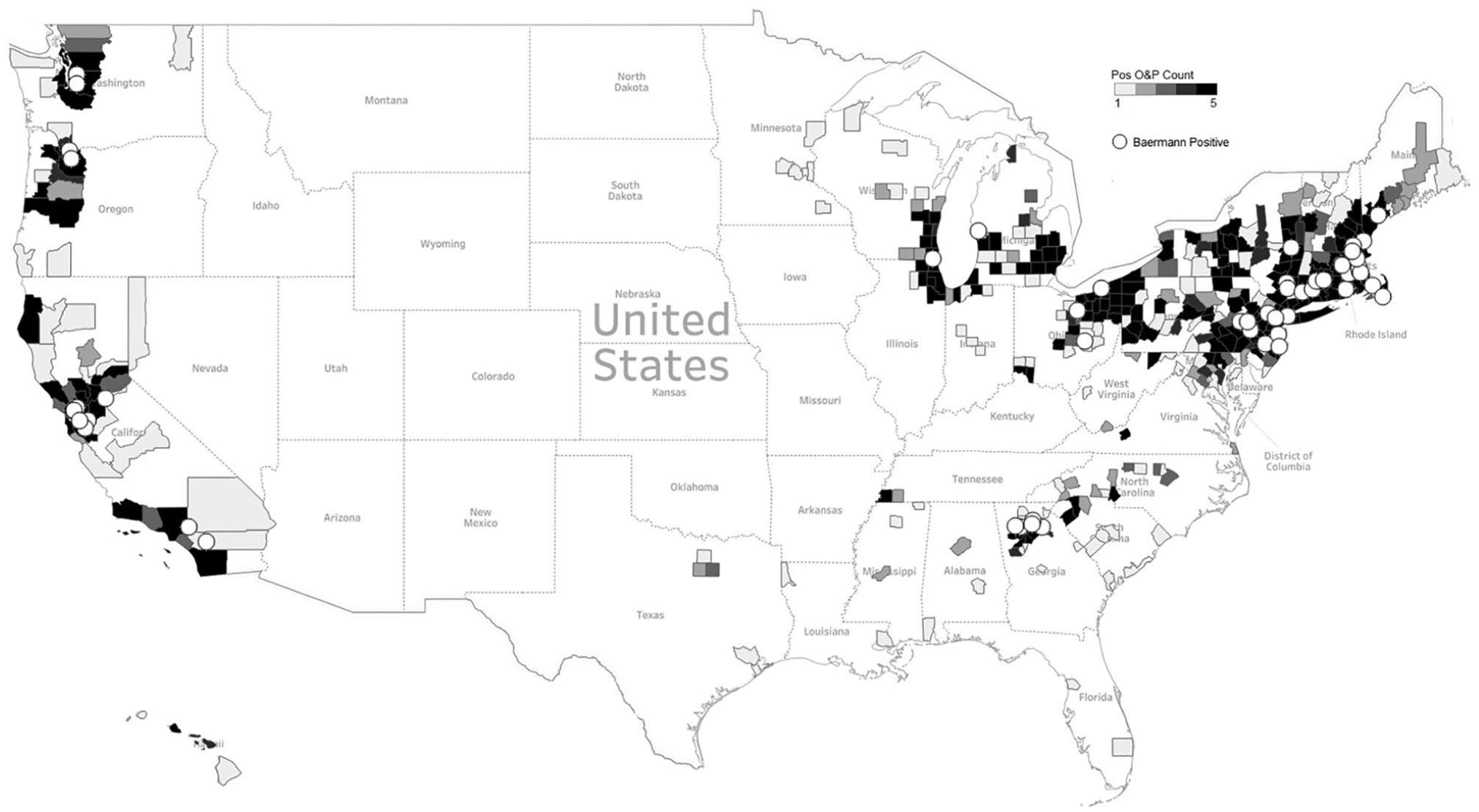
Map showing the US distribution by county of samples positive for Aelurostrongylus abstrusus by fecal flotation along with the distribution of Baermann-positive samples (based on postal code). O&P = ova and parasite
Furthermore, according to the O&P test, 42,821 cats (12.74%) were positive for any parasitic infection, either A abstrusus and/or other, while 190 cats (5.24%) were positive for any parasitic infection using the Baermann test. Of the 4721 A abstrusus O&P positives, 2870 cats (60.79%) were positive for A abstrusus and at least one other parasitic coinfection based on the O&P test, while of the 75 A abstrusus Baermann positives, 23 cats (30.67%) were positive for A abstrusus and at least one other parasitic coinfection based on the Baermann test. Therefore, cats that were Baermann positive for A abstrusus were six times more likely than Baermann-negative cats to have a coinfection with another parasitic species.
Of 781 samples tested by both Baermann and O&P, 10 were positive for A abstrusus by Baermann, of which seven also tested positive by O&P. In total, 770 samples were negative by both methods, while one sample was discordantly negative by Baermann and positive by O&P.
Discussion
Previous information on the prevalence of A abstrusus among cats in the USA was only available in certain states, such as Alabama, New York, Hawaii, Connecticut, New Jersey and Pennsylvania. Infection rates ranged from 0.1–18.5%, focused on a single shelter or stray cat population, and used either fecal flotation or the Baermann method to diagnose infections.13–18 This is the first report to offer insight into the prevalence of A abstrusus within the entire USA based on fecal testing and to use these data to construct an analogous epidemiological distribution.
In this study, Baermann-positive A abstrusus infections overlapped with the areas of O&P-positive infections. This level of overlap is a good indication of the presence of true infections within a specific feline population. It is interesting that the infections are present in areas with diverse climates. This could be attributed, in part, to the robustness of L1s. Once shed, L1s can live for a month in natural conditions until an intermediate host arrives and a higher percentage of L1s mature to L3s in warm climates.2,19–20 Furthermore, not only can L3s survive in hibernating Helix aspersa snails, but L3s can also survive in paratenic hosts, thereby increasing the probability of being ingested by a cat.21,22
Another important aspect of the distribution of A abstrusus is its proximity to water. It has been shown that infected snails release L3s into the environment through their mucus trails and L3s can be found in water where infected mollusks have died. 23 Additionally, harvesting L3s from experimentally infected aquatic Biomphalaria glabrata snails routinely yielded more L3s than terrestrial H aspera snails, 24 and have been successfully used as experimental intermediate hosts in other studies.25,26 Perhaps these aquatic intermediate hosts are more permissive to infection than their terrestrial counterparts.
Other studies have also found that cats aged less than 12 months had a higher risk of contracting A abstrusus than those older than 12 months.6,27 The significance between infection status and age could be attributed to the permissiveness of the younger cat’s developing immune system. As young cats are not adept hunters, it may also be postulated that they acquire the infection from ingesting or licking items contaminated with mucous trails containing L3s from infected snails.20,24,28,29
As fecal flotation does not diagnose A abstrusus infection as well as the Baermann method, as shown here and in other studies, 11 the distribution of A abstrusus presented in this study is most likely underestimated. The positive infection rate reported with the Baermann method is higher than the O&P positive rate, yet both methods share similar geographical overlap. While it is encouraging that the Baermann- and O&P-positive infections share geographical overlap, it is quite likely that infections could also exist in regions that, in our current study, were negative by both methods. Furthermore, it is possible that the distribution of infections in the USA could be significantly different if more Baermann tests were performed. To obtain a true distribution of this parasite, much could be learned from the canine lungworm Angiostrongylus vasorum. Recent epidemiological surveillance of A vasorum has been enhanced by the introduction of high-throughput serological tests. 30 Similarly, the introduction of higher throughput and less labor-intensive diagnostic methods could help increase awareness of A abstrusus among veterinary professionals, achieve a greater understanding of epidemiological factors, and improve the care and treatment for clinically ill feline patients.
Conclusions
This study highlights the distribution of A abstrusus in the USA and the limitations of using current testing to diagnose this disease. Compared with the gold standard Baermann method, fecal flotation is significantly less sensitive for detecting A abstrusus larvae, 11 and likely underestimates the true infection rate in a population of cats.
Footnotes
Conflict of interest
AJC, JSB, JCB and RC are employees of IDEXX Laboratories. DDB is a consultant for IDEXX Laboratories.
Funding
The authors received no financial support for the research, authorship, and/or publication of this article.
Author note
This paper was presented, in part, at the 2017 ACVIM conference.
Ethical approval
This work did not involve the use of animals and therefore ethical approval was not required.
Informed consent
This work did not involve the use of animals and therefore informed consent was not required. No animals or humans are identifiable within this publication, and therefore additional informed consent for publication was not required.