



Abstract
Although self-efficacy beliefs are an important predictor of physical activity, the origins of self-efficacy beliefs remain unclear, and a comprehensive joint perspective regarding the sources of self-efficacy is lacking. The present study investigates whether distinct profiles emerge in the sources of self-efficacy regarding physical activity. In a sample of 324 participants, latent profile analysis revealed that a five-profile solution fitted the data best. Significant differences were observed between these profiles concerning self-efficacy and physical activity. Discriminant analysis substantiated the profile assignments. Findings of this study suggest that multiple configurations of self-efficacy sources yield commendable levels of self-efficacy and physical activity. However, elevated levels of negative affect seem to have a detrimental effect on self-efficacy and physical activity, nearly irrespective of the other sources of self-efficacy. Implications of these findings for promoting self-efficacy in a person-centered manner to address the issue of physical inactivity and the concomitant health restrictions are discussed.
Keywords
Introduction
Self-efficacy, a fundamental concept in Albert Bandura’s social cognitive theory, refers to an individual’s beliefs in their ability to perform a specific task or to achieve a goal. Bandura introduced this concept in the early 1970s, recognizing that people’s perceptions of their own abilities significantly impact their behavior, motivation, and overall psychological well-being (Bandura, 1982). Self-efficacy was shown to enhance performance, support stress management, and foster positive educational and health outcomes (Moritz et al., 2000). Furthermore, the role of self-efficacy in influencing and modifying health behaviors is a recurring topic in many studies. As evidenced early by a meta-analysis conducted by Holden (Holden, 1992), self-efficacy beliefs have been identified as a consistent predictor of subsequent health-related outcomes, including physical activity, healthy eating habits, smoking patterns, and alcohol consumption (Hevey et al., 1998). Concerning physical activity behavior, which is strongly associated with health (OECD and World Health Organization, 2023), self-efficacy was frequently identified as the strongest predictor (Egele et al., 2025; Egele and Stark, 2024; Rovniak et al., 2002; Warner et al., 2011; Young et al., 2014).
According to Bandura (Bandura, 1997), self-efficacy beliefs are derived from four primary sources: mastery experiences, vicarious experiences, verbal persuasion, and physiological and affective states. Each source plays a crucial role in shaping an individual’s sense of efficacy, influencing their actions, motivation, and overall performance. The present analysis explored each of these sources of self-efficacy, offering insights into their mechanisms and impact.
Mastery experiences are the most powerful and direct source of self-efficacy. These are the experiences of success that individuals achieve through their own efforts and perseverance. According to Bandura, successfully mastering a task increases one´s belief in the ability to perform similar tasks in the future. The more an individual accomplishes, the more self-efficacy is enhanced. In contrast, failure, especially when it occurs early in the learning process, can undermine self-efficacy, leading to doubts about one´s capabilities. The key to this process is the interpretation of success and failure. Bandura argued that individuals are more likely to develop strong self-efficacy when they attribute their success to their own efforts, skills, and strategies rather than to external factors such as luck. On the other hand, a failure that is seen as a result of personal incompetence or a lack of effort can lead to reduced self-efficacy. However, failure that is interpreted as an opportunity for growth, learning, or improving strategies can serve as a steppingstone toward stronger self-efficacy. Mastery experiences are cumulative; small successes build over time, leading to greater confidence in one’s abilities. For example, students who consistently perform well in mathematics may begin to develop the belief that they can succeed in more complex mathematical tasks. The key is that the task at hand should be challenging yet achievable. A task that is too easy may not offer sufficient challenge to reinforce efficacy beliefs, while a task that is too difficult may lead to failure and thus reduced self-efficacy. Importantly, Bandura emphasized that mastery experiences are not just about success but about the experience of overcoming obstacles. Individuals who face and overcome challenges, particularly those that seem insurmountable at first, tend to develop higher self-efficacy because they view their perseverance and problem-solving abilities as essential components of success.
Vicarious experiences, or social modeling, are another important source of self-efficacy. This source involves learning by observing others perform tasks or face challenges. If individuals see others that are similar to themselves succeed at a particular task, they are more likely to believe that they can also succeed. The process of social comparison is central to vicarious experiences: observing someone who is perceived as similar or comparable in terms of abilities can enhance one’s self-efficacy. Bandura described this phenomenon as social modeling. For example, if an individual watches a peer successfully complete a difficult task, the observer may come to believe that they, too, can accomplish that task. The power of social modeling is enhanced when the model is perceived as similar to the observer in terms of skills, abilities, or life circumstances. This similarity makes the success of the model seem more relatable and achievable in the eyes of the observer. However, Bandura cautioned that the effect of vicarious experiences on self-efficacy depends on the nature of the observed performance. Seeing someone fail at a task, particularly when the failure is attributed to a lack of effort or ability, may negatively influence the observer’s own self-efficacy. In contrast, witnessing others overcome difficulties, especially when they are seen as having faced similar struggles, can inspire individuals to believe in their own ability to succeed despite challenges. Vicarious learning also plays a role in reinforcing social norms and expectations. When people observe others succeeding or failing in a particular context, they internalize societal standards of competence and achievement. These standards, in turn, shape their own self-perceptions and motivation.
Verbal persuasion refers to the encouragement, support, and feedback that individuals receive. This source of self-efficacy involves verbal and emotional persuasion from external sources such as teachers, parents, coaches, friends, or colleagues, or from themselves. When individuals are told that they can succeed, they are more likely to believe in their potential to achieve their goals. This external validation can be particularly powerful when individuals have doubts about their own capabilities. The effectiveness of social persuasion is contingent on the credibility and trustworthiness of the source. For example, feedback from a respected and knowledgeable mentor may be more influential than encouragement from someone with less expertise or authority. When individuals perceive the persuader as credible, they are more likely to internalize the positive feedback and believe in their own abilities. On the other hand, when persuasion comes from an untrustworthy or unreliable source, the impact may be minimal. Bandura noted that social persuasion can also work to build resilience in the face of challenges. For instance, a coach who encourages an athlete to push through difficulties can enhance the athlete’s belief in their ability to persevere and succeed. This type of persuasion is most effective when it is specific, constructive, and accompanied by a recognition of the person’s effort and progress. While social persuasion can positively influence self-efficacy, Bandura warned that negative or unsupportive feedback can have the opposite effect. For example, criticism that undermines an individual´s abilities or self-worth can diminish self-efficacy and decrease motivation. Thus, the quality and nature of the feedback play a crucial role in shaping an individual’s self-efficacy beliefs.
The fourth source of self-efficacy are physiological and affective states. Bandura argued that people often interpret their physical and emotional reactions to certain situations as indicators of their ability to perform a task. For example, feelings of anxiety, tension, or fatigue may be interpreted as signs of inadequacy, causing individuals to doubt their ability to succeed. Conversely, positive emotional states, such as feelings of calm or excitement, can enhance self-efficacy by signaling that a task is manageable. These physiological and emotional responses are often unconscious and automatic. Individuals may not always be aware of how their emotional or physical states influence their perceptions of competence. However, people’s interpretations of their emotional reactions are critical in shaping their self-efficacy beliefs. For instance, individuals who experience nervousness or anxiety before giving a presentation may interpret these feelings as a sign of impending failure, which can undermine their confidence. On the other hand, individuals who view these same feelings as a natural part of the process—signaling that they care about the task at hand—are more likely to perform well and maintain a positive sense of self-efficacy. Bandura emphasized that individuals could learn to regulate their emotional responses through cognitive strategies, relaxation techniques, or reframing their perceptions of stress. By managing their physiological and emotional states, individuals can increase their self-efficacy and improve their performance in stressful situations.
In addition to these theoretical assumptions, there is scientific evidence indicating connections between the respective sources and self-efficacy or physical activity behavior. For example, it has been shown that the implementation of mastery experiences in interventions constitutes a highly efficacious method for the augmentation of individuals’ self-efficacy beliefs regarding physical activity engagement (Ashford et al., 2010; Parschau et al., 2013, 2014; Wiedenman et al., 2024). Conversely, empirical research has revealed that self-efficacy concerning physical activity can be enhanced by means of vicarious experiences (Ashford et al., 2010; Kim et al., 2021; Rowland et al., 2020; Selzler et al., 2020). Research results concerning the effects of persuasion provide evidence for a positive relation between persuasion and physical activity behavior (Aldenaini et al., 2020) and self-efficacy for physical activity (Woodgate and Brawley, 2008). Additional research on the topic of self-talk has revealed that self-persuasion is a dependable catalyst for self-efficacy within a range of exercise disciplines (Galanis et al., 2016; Hardy et al., 2005). Positive affect was found to explain levels of physical activity (Lawton et al., 2009; Rhodes et al., 2009; Whitehead, 2017), however, research is scarce concerning the effects of affective states on self-efficacy beliefs (Samson and Solmon, 2011). While each of these four sources—mastery experiences, vicarious experiences, verbal persuasion, and affective states—has an independent role in shaping self-efficacy, they are often interrelated and work together to influence an individual’s beliefs and behaviors (Samson and Solmon, 2011). For example, an individual who experiences success (mastery experience) while observing others succeed (vicarious experience) and receives positive encouragement (social persuasion) is likely to develop a strong sense of self-efficacy.
Empirical research on the sources of self-efficacy in physical activity behavior has examined the validity of the theoretical framework proposed by Bandura, concerning a hierarchical structure for these sources. While mastery experiences have consistently been identified as an important contributor, the relevance of the other three sources remains unclear in previous literature, indicating a need for further investigation (Kleppang et al., 2023; Warner et al., 2011, 2014).
There is, however, a consensus that there are interindividual variations in the sources of self-efficacy postulated by Bandura (Bandura, 1990). Individuals seem to differ in the sources of self-efficacy they use and the extent to which they rely on the sources when forming their self-efficacy beliefs. In the domain of physical activity, interindividual differences in the use of the sources of self-efficacy were shown for example by Chase and Sampan (Chase, 1998; Sampan and Gomez, 2015).
In light of these inter-individual differences, a cursory examination of the sources in isolation seems insufficient for a comprehensive analysis. Instead, a holistic approach seems imperative, entailing a joint consideration of the sources of self-efficacy. It is essential to ascertain the presence of discernible, uniform patterns in the origins of individuals’ self-efficacy beliefs. Furthermore, it is crucial to determine whether diverse combinations of these sources influence both individuals’ self-efficacy and their physical activity levels.
In other domains, configurations of sources of self-efficacy have already been investigated, with the finding that different profiles can be discriminated from one another (Chen and Usher, 2013). Therefore, a crucial but yet unexamined question is whether distinct profiles emerge in the sources of self-efficacy with regard to physical activity. This inquiry holds considerable interest in research and has the potential to yield significant insights. A more comprehensive understanding of the sources of self-efficacy would be advantageous for more effectively designing future studies to promote self-efficacy through a person-centered approach as the sources of self-efficacy provide a comprehensive framework for understanding how individuals develop beliefs about their own capabilities and how each source plays into shaping self-efficacy.
The present study therefore aimed at investigating the following research questions: (1) Which specific profiles of sources of self-efficacy can be identified by latent profile analysis in the present sample? (2) To what extent do the profiles differ concerning self-efficacy and physical activity behavior of the participants? (3) To what extent can the assignment to a profile be confirmed by discriminant analysis of the sources of self-efficacy?
Methods
Sample and procedure
The conduct of this study complied with the local legislation and institutional requirements of Saarland University as part of approval 24–32 of the Ethics Committee of the Faculty of Empirical Human and Economic Sciences of Saarland University. All hypotheses were specified before the data were collected. Based on reference values by Ferguson et al. (2015), a sample size of at least 300 participants was pursued. A variety of recruitment strategies were employed to reach potential participants, including the placement of notices on the University campus and other cultural centers in Germany, as well as online advertisements. Inclusion criteria included individuals over 18 years of age who were not suffering from any medical conditions that would preclude participation in physical activity.
The study was conducted as a cross-sectional online study. In the online questionnaire, participants first gave informed consent before taking part and agreed to the data protection regulation. Then, they provided information on their physical activity. Thereafter, self-efficacy concerning physical activity was assessed. Finally, the sources of self-efficacy were recorded. In this vein, we adhered to the recommendations of Warner et al. (Warner et al., 2014) who suggested that inquiring about sources of self-efficacy before assessing perceived self-efficacy may introduce a distortion in the latter.
Instruments
Sources of self-efficacy were assessed using the Scale of Sources of Self-Efficacy for Physical Activity (Warner et al., 2014). This scale was specifically developed to assess the sources of self-efficacy in Germany using 18 items in total. The psychometric properties of the scale were satisfactory, Cronbach´s Alpha ranged between .715 and .890. The scales assess the respective sources with three items each and for each subscale, a mean of the three items was calculated.
Self-efficacy concerning physical activity was assessed by five items by Egele and Stark (Egele and Stark, 2024). The self-efficacy subscale is tailored specifically to self-efficacy related to physical activity and showed good psychometric properties in terms of reliability: Cronbach’s Alpha = .902. The scale assesses self-efficacy beliefs on a rating scale from 0 (not at all) to 10 (totally). A mean of the five items was calculated.
Physical activity was measured using the International Physical Activity Questionnaire – Short Form in German (IPAQ-SF) (Craig et al., 2003). The IPAQ-SF assesses physical activity over the past 7 days by open-response format retrospective self-report. The number of days and the average time (hours and minutes) spent on moderate and vigorous physical activity and walking, are assessed. IPAQ-SF was selected based on its parsimonious nature, its established psychometric properties, and its application in numerous preceding studies (Craig et al., 2003; Hagströmer et al., 2006). The metabolic equivalent of task (MET) was calculated according to the formulas provided in the IPAQ manual. To get a total score of physical activity, the METs for walking, moderate, and vigorous physical activity were added.
The demographic variables included gender, age, relationship status, employment status, and highest level of education.
Statistical analyses
For research question 1, Latent Profile Analyses (LPAs) were conducted to investigate the profiles (Vermunt and Magidson, 2002). Latent profile analyses are a method of grouping participants who provide similar responses into homogeneous profiles. The objective is to maximize between-profile dissimilarity, thereby identifying distinct profiles. Exploratory latent profile analyses using the robust maximum-likelihood estimation approach (MLR) were conducted using MPlus 8.4 (Muthén and Muthén, 1998-2017) to investigate models with one to six latent classes. Subsequently, the Bayesian information criterion (BIC), the entropy measure (E), and the Lo-Mendell-Rubin test (LMRT) (Marsh et al., 2009) were used for model evaluation assuming that a lower BIC value indicates a better model fit, whereas a higher entropy value indicates a more reliable clustering of individuals into subgroups. A statistically significant p-value (p < .05) for the Lo-Mendell-Rubin test (LMRT) indicates that the estimated model with k classes provides a superior fit to the data than the model with k-1 classes. As an additional criterion, the size of the latent classes was considered as a further selection criterion since an insufficient number of individuals within each class would render interpretation difficult. As stated by Marsh et al. (Marsh et al., 2009), it is beneficial to investigate solutions with varying group numbers and select the most appropriate one concerning theory, prior research, the nature of the groups, and the interpretation of the results. Full information maximum likelihood algorithm was used to address missing data.
Subsequently, separate univariate analyses of variance (ANOVAs) were conducted with the six sources of self-efficacy as dependent variables and profile groups as the independent variable.
For research question 2, we conducted separate ANOVAs to investigate differences in self-efficacy and physical activity, with the profile groups serving as the independent variable to detect to what extent the profiles differ concerning their self-efficacy and their physical activity behavior. Scheffé Tests were conducted to investigate post hoc pairwise differences between the profiles.
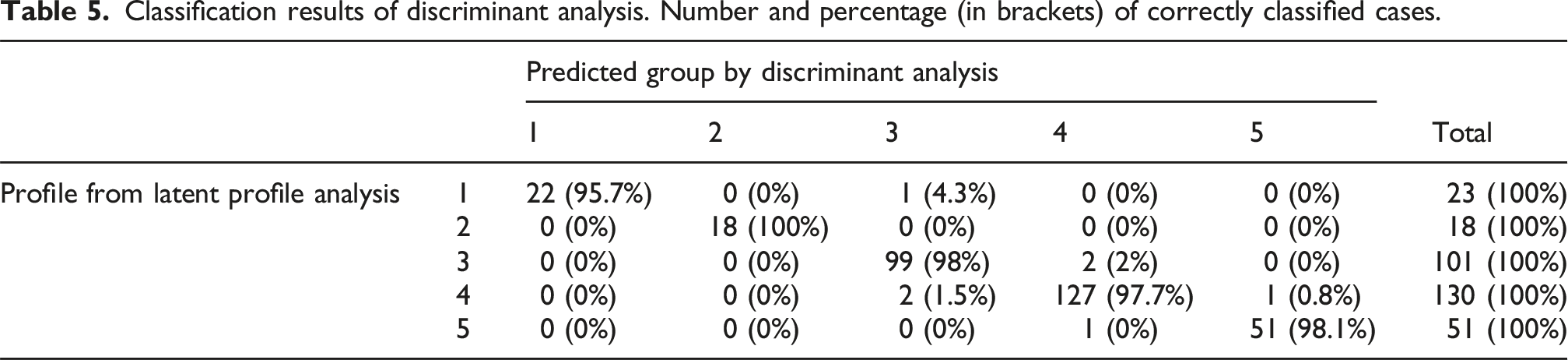
For research question 3, a discriminant analysis was conducted to investigate the prediction of the profile groups by the sources of self-efficacy as predictors. As the LPA had revealed groups that differed considerably in terms of group size, group size was employed as the a priori probability rate for the group prediction. Furthermore, group-specific covariance matrices were used, and the sources of self-efficacy were regarded simultaneously in the analysis. All analyses were conducted with a nominal significance level of α = 0.05. Data available on request from the authors.
Results
Descriptive statistics
The present study was based on the data of 324 German participants (169 women, 155 men) between the ages of 18 and 69 (M = 35.1, SD = 13.0). 90% of the participants were employed more than part-time. A total of 8.3% of participants reported having a lower qualification than a general university entrance qualification. 63.3% reported a general university entrance qualification as their highest educational qualification, while 22.5% reported having a university degree. 47.5% of the sample reported being single or widowed, while 52.5% reported being in a stable relationship.
Participants reported an average of 6441 MET minutes (SD = 8847) of activity per week. Participants reported an average of 6.727 points (SD = 2.227) on a scale ranging from 0 to 10.
Research question 1: Which specific profiles of sources of self-efficacy can be identified by latent profile analysis in the present sample?
Latent profile analyses results for the sources of self-efficacy for physical activity.

Note. BIC = Bayesian information criterion; SABIC = Sample-Size Adjusted BIC; LMRT = Lo-Mendell-Rubin test. Based on the model fit indices, we decided on the 5-cluster solution, therefore typed in bold.
Group size, means, and standard deviations for indicator variables of the profiles.

Note. a, b, c, d, e, f Same letters within one column indicate that this pairwise comparison was significant (p < .05).
Figure 1 depicts the profiles in a hexagonal chart, while Figure 2 illustrates a profile plot with the sources of self-efficacy for the five profile groups. The spider chart is presented here to illustrate the profiles. Consequently, the sequence of the sources of self-efficacy differs marginally from the customary sequence. Moreover, the axes have not been labeled for the sake of clarity. Figure 1 is intended solely to illustrate the profiles and facilitate comprehension of our interpretation. Conversely, Figure 2 presents the profile plot in its conventional form. Spider chart of the five profiles. Note. To facilitate interpretation, the spider chart diverges from the conventional sequence of sources of self-efficacy. Profile plot of the five profiles.

Concerning the ANOVAs with the six sources of self-efficacy as dependent variables and profile groups as the independent variable, all tests yielded statistically significant differences between the five profiles, Wilks-Lambda = .059, F (24, 1096.625) = 57.022, p < .001, eta2 = .507. When all profile groups were compared with each other, Scheffé post hoc tests revealed that almost all groups exhibited statistically significant differences from each other, with the exceptions illustrated in Table 2.
Research question 2: To what extent do the profiles differ concerning self-efficacy and physical activity behavior of the participants?
Means and standard deviations for self-efficacy and physical activity depending on profile group as well as results of the ANOVA.

Note. a,b,c,d Same letters within one row indicate that this pairwise comparison was significant (p > .05). To enhance the readability of the presented data, the physical activity values were transformed and displayed by a factor of 1/1000.
Taking the results of the latent profile analysis and the subsequent ANOVAS into consideration, a clear distinction emerged among the five profiles identified in this study, characterized by notable variations in the sources of self-efficacy, but also levels of self-efficacy, and physical activity. Taking these three indicators together, the first profile can be categorized as “driven by distinct negative affect” as members exhibited relatively high scores on negative affective states and below-average levels on the other sources of self-efficacy. This profile has been demonstrated to be associated with the lowest observed levels of self-efficacy and physical activity. In contrast, the second profile demonstrated notably high levels of positive affective states, mastery experiences, and self-persuasion, but a low mean on sources of self-efficacy influenced by other people. We, therefore, named this profile “acting in a self-regulated manner”. This profile has been demonstrated to be associated with the highest observed levels of self-efficacy and physical activity. The third profile showed an average score in four dimensions, and below-average concerning mastery experiences and positive affective states. We, therefore, named it “driven by missing positive affect”. The fourth profile exhibited slightly positive means on five dimensions, only concerning negative affect, its members scored below average. We, therefore, call it “driven by moderate positive affect”. The fifth profile showed a resemblence to the fourth profile. Members reported high values on all sources of self-efficacy except negative affect, where the mean was exceptionally low, we call it “driven by multiple positive sources”.
Research question 3: To what extent can the assignment to a profile be confirmed by discriminant analysis of the sources of self-efficacy?
For research question 3, the results demonstrated that four discriminatory functions made a significant contribution to profile differentiation. Discriminatory functions are a linear combination of the predictor variables that separate between the groups. Their aim is to maximize the differences between the groups. The first function accounted for 91.5% of the variance, with a lambda value of .059, χ2 (24) = 897.194, p < .001. The second function accounted for 7.5% of the variance, with a lambda value of .548, χ2 (15) = 191.093, p < .001. The third function accounted for 0.5% of the variance, with a lambda value of .920, χ2 (8) = 26.399, p < .001. The remaining 0.4% of the variance were explained by the fourth function, with a lambda value of .966, χ2 (3) = 11.047, p = .011.
Standardized canonical discrimination coefficients for all discriminant functions and weighted discrimination coefficient for each learning strategy indicator.

Note. The standardized canonical discriminant coefficients indicate the relative contribution of each variable to the function’s ability to discriminate between groups.
Classification results of discriminant analysis. Number and percentage (in brackets) of correctly classified cases.
Discussion
The study sought to provide a holistic perspective on the sources of self-efficacy for physical activity. The objective of this study was to examine systematic interindividual differences in how the sources of self-efficacy combine to form self-efficacy beliefs in the area of physical activity. Results show that five profiles of sources of self-efficacy could be differentiated, which were characterized by notable variations in the sources of self-efficacy, but also levels of self-efficacy, and physical activity.
Three profiles (profile 3 “driven by missing positive affect”, profile 4 “driven by moderate positive affect”, and profile 5 “driven by multiple positive sources”) were characterized by rather low expressions on negative affective states, and rather high expressions on mastery experience, vicarious experience, positive affective states, verbal persuasion by others, and verbal self-persuasion. Based on the patterns of the profiles, it might seem possible to subsume them into one profile. However, the profiles demonstrated significant variation in reported levels of the respective sources of self-efficacy, and the fit values supported the differentiation of five distinct profiles.
Still, given the observed similarity between these three profiles, an additional review of the alternative profile solutions was conducted, to examine whether content based considerations would indicate a different profile solution. Details on these considerations of the alternative profile solutions can be found in the supplemental material. Neither the two-profile solution nor the three-profile and four-profile solution nor the six-profile solution were found to adequately reflect the data, and given their comparatively inferior fit values, the five-profile solution was retained.
The two remaining profiles were profile 1 “driven by distinct negative affect”, and profile 2 “acting in a self-regulated manner”. Members of profile 1 exhibited relatively high scores on negative affective states and below-average levels on the other sources of self-efficacy. This profile was also characterized by the lowest observed levels of self-efficacy and physical activity. In contrast, profile 2 demonstrated high levels of positive affective states, mastery experiences, and self-persuasion, but a low mean on sources of self-efficacy influenced by other people. Fewer participants belonged to these two more extreme profiles.
The validity of the five-profile solution was furthermore subject to scrutiny since the profile groups exhibited notable disparities in their respective population sizes. An examination revealed that fewer individuals were assigned to profiles 1, and 2, whereas a greater proportion was allocated to the seemingly more usual profiles 3 and 4. The majority of individuals were assigned to profile 3 “driven by missing positive affect” and profile 4 “driven by moderate positive affect”. As these profiles appear to be average (more mainstream) profiles, it does not seem surprising that most participants were classified into these two profiles. Members of these two profiles reported average self-efficacy and average physical activity levels, suggesting a general sense of moderation in their responses. It therefore seems intuitively plausible that more individuals belong to a moderated than extreme profile.
This phenomenon has also been reported in other studies conducting LPA in the domain of health behavior (Vaughan et al., 2018). For example, Vaughan et al. (Vaughan et al., 2018) examined latent profiles of attitudes and barriers to healthy diet and physical activity. Similar to the profiles of sources of self-efficacy, they also found a large profile of “moderate overall” attitudes, and a large profile of “positive overall”, that was characterized by relatively positive attitudes toward healthy diet and physical activity. They further reported two profiles with less members, of which one profile characterized by negative attitudes and one profile characterized by highly positive attitudes. As the constructs on which the profiles were built vary considerably because Vaughan et al. (Vaughan et al., 2018) examined social-cognitive factors, whereas we examined the sources of self-efficacy, these results are not entirely comparable. However, it is interesting to note that both profile analyses suggest that moderate expressions are quite prevalent, while positive and negative affect in particular appear to be pivotal characteristics.
Implications for research and practice
It is plausible that the constructs selected for the basis of the grouping may have influenced the number of different groups identified. We based our analysis on the conceptualization of the sources of self-efficacy as presented by Warner and colleagues (Warner et al., 2014), which represents a further development of Bandura’s originally assumed sources of self-efficacy. It might be beneficial to explore the replication of this study with other sources of self-efficacy, such as Bandura’s four original sources or additional sources that have since proven useful in the literature (Ashford et al., 2010; French et al., 2014). This could contribute to a more nuanced and comprehensive understanding of the different homogeneous groups of sources of self-efficacy.
As posited by Bandura (Bandura, 1997), individuals often demonstrate a limited capacity to integrate information from multiple sources. When confronted with a multitude of information, individuals tend to prioritize the information that is most immediately accessible, often overlooking more distal information that requires more effort to retrieve. The pivotal role of positive and negative affect in the latent profile analyses could indicate that affective states might be especially salient in the context of health behavior. Future research could investigate the salience of the different sources of self-efficacy and examine whether the salience of the sources varies. Additionally, the subjective importance of the sources of self-efficacy might influence their relevance for the development of self-efficacy beliefs, indicating another potential for further research.
Further, the findings of the present study indicate that pronounced negative affective states seem to be disadvantageous for self-efficacy and physical activity, nearly irrespective of the expression of other sources of self-efficacy. Future research could be initiated to examine whether negative affect is a stable trait, or an acute state immediately preceding the potential behavior. Ecological momentary assessment studies that examine the temporal stability of the sources of self-efficacy might therefore be suitable for further investigations in this context. Examining the temporal stability would also be interesting for the profiles as a whole to gain a better understanding of the profiles and their potential for person-centered interventions. Future studies could also provide insights concerning the permeability of the profiles. At present, it is still unclear whether and how a person can switch to a different profile and which source of self-efficacy should be addressed in order to achieve this. Future studies could explore the effectiveness of promoting or reducing specific sources of self-efficacy. It seems possible that the most salient source, or the relatively most important source, might be the most efficient starting point for interventions. Previous research shows that interventions to foster self-efficacy by targeting sources of self-efficacy are effective (French et al., 2014; Williams and French, 2011). Consequently, the promotion of self-efficacy and the modification of one’s profile may hold promise, provided that the starting point is clearly defined: The source of self-efficacy to be addressed must be identified, as well as the approach to be adopted: a compensatory or strength-oriented strategy. The most salient conclusion derived from our findings for practice seems to be that multiple configurations of self-efficacy sources can yield commendable self-efficacy levels and physical activity behavior. Therefore, the hypothesis that there is a single target profile to be achieved appears to be unfounded. This is evidenced, for example, by the existence of the two distinct profiles, “acting in a self-regulated manner” (profile 2) and “driven by multiple positive sources” (profile 5) which, despite their marked differences, are associated with high levels of self-efficacy and physical activity. The results of the present study thus suggest the potential for the development of functional self-efficacy with a diverse configuration of sources of self-efficacy.
Strengths and limitations
A distinguishing feature of our study is its holistic, person-centered approach. Conventionally, the sources of self-efficacy have been regarded as discrete entities, a methodological approach that may not fully align with ecological validity. By employing a person-centered approach, it is possible to gain a more profound understanding of the interindividual variations in the sources of self-efficacy and their correlation with self-efficacy and physical activity behavior.
However, some limitations must me mentioned.
The most salient limitation pertains to the self-selected sample and it seems essential to consider whether the results would vary if a different sample had been examined. For instance, the nature of our sample, which was a randomized, but self-selected group, might suggest that the survey was primarily responded to by especially active individuals with higher levels of self-efficacy. This assertion is partially corroborated by the sample characteristics: Although the reported self-efficacy was not notably elevated, participants in our study reported an average of 6441 MET minutes (SD = 8847) of activity per week. In contrast, similar studies report average MET minutes of 2478.30 MET minutes (SD = 2687.70) (Egele et al., 2025), thus, when comparing the observed levels of physical activity to the averages reported in similar studies in Germany (Egele et al., 2025), the level of physical activity of the participants seems very high. A thorough reexamination of the data has been conducted to ensure adherence to the established protocol for the IPAQ scoring. This analysis revealed no mistakes, so it seems like the participants in this study in fact exhibit notably high levels of physical activity. However, the possibility that the retrospective self-report may be an unreliable method of measuring physical activity behavior cannot be discounted. Some studies have shown that social desirability can influence the reporting of physical activity behavior (Egele et al., 2021).
The subjects in our study were also relatively young and highly educated, both factors have been shown to be related to high physical activity levels (Bauman et al., 2012). Furthermore, the inclusion criteria for participation in our study specified that only individuals not prevented from physical activity due to illness or physical limitations would be eligible. Therefore, the high levels of physical activity seem to be compatible with this larger lifestyle context.
It is nevertheless plausible that the elevated levels of physical activity and related sample characteristics might have distorted the characteristics of the individual profiles and the number of subjects assigned to each profile. For example, as profile 1 was associated with the lowest self-efficacy and physical activity levels, in a sample of less active people, potentially more people might be categorized as belonging to this profile. In the interest of methodological rigor and the exploration of potential ceiling effects among our very active and self-efficacious participants, a replication of our study with a larger and more heterogeneous sample seems pertinent. On the one hand, it is important to ensure the durability of the five profiles, given that two of them were relatively thinly populated, and the small sample sizes potentially undermine the confidence in the five profile solution and its interpretation. Therefore, it would be beneficial to demonstrate the stability of these five profiles. On the other hand, replicating the study with a representative sample would likely provide valuable insight into the generalizability of the profiles reported in the present study as future studies might allow for deeper insights into the profiles of sources of self-efficacy by using a stratified analysis to examine if different demographic groups show different latent profiles. The statistical analyses conducted in the present study did not consider such stratification, which remains an analytical limitation.
Appropriate replications could further allow for the investigation of additional third-party variables that may offer a more comprehensive explanation of the observed profile affiliations. The characterization of profiles is constrained due to the paucity of variables that would provide more detailed insights into profile membership. Replications could include the examination of the relevance of physical activity behavior, the influence of the trait locus of control, and the association with general self-efficacy.
Conclusion
The present study identified five profiles of sources of self-efficacy which also exhibited significant differences in terms of self-efficacy and physical activity. Future research should validate these findings and test the reproducibility and transferability of the five profiles to other domains. Concerning self-efficacy in the context of physical activity behavior, however, the five profiles suggest that future interventions to increase self-efficacy could benefit from a person-centered approach.
Supplemental Material
Supplemental Material - A latent profile analysis of the sources of physical activity-specific self-efficacy
Supplemental Material for A latent profile analysis of the sources of physical activity-specific self-efficacy by Viktoria S. Egele and Robin Stark in Health Psychology Open.
Footnotes

Ethical considerations
The study was conducted in accordance with the Declaration of Helsinki and was approved by an Ethics committee. See details under Methods.
Consent to participate
Written informed consent was obtained from all participants before their participation in the study.
Consent for publication
Written informed consent for publication was provided by the participants of the study.
Authors contributions
VSE: Conceptualization, Methodology, Investigation, Data Curation, Formal Analysis, Validation, Writing – Original Draft, Writing – Review & Editing, Visualization, Project Administration, RS: Validation, Writing – Review & Editing, Supervision.
Funding
The authors received no financial support for the research, authorship, and/or publication of this article.
Declaration of conflicting interests
The authors declared no potential conflicts of interest with respect to the research, authorship, and/or publication of this article.
Data Availability Statement
Data is available upon reasonable request.
Supplemental Material
Supplemental material for this article is available online.
References
Supplementary Material
Please find the following supplemental material available below.
For Open Access articles published under a Creative Commons License, all supplemental material carries the same license as the article it is associated with.
For non-Open Access articles published, all supplemental material carries a non-exclusive license, and permission requests for re-use of supplemental material or any part of supplemental material shall be sent directly to the copyright owner as specified in the copyright notice associated with the article.
