




Abstract
This study investigated the relationship between emotional intelligence and stress coping style in a group of 265 students, using Goleman’s Theory of Emotional Intelligence. Findings indicated highest mean value of emotional intelligence for motivation and empathy. Majority students showed active problem and emotional coping behavior; however, a strong, positive correlation between emotional intelligence and stress coping style was found for the domains associated with Active Emotional and Problem Coping (α ⩽ 0.05). It revealed that students are efficient in utilizing stress coping strategies and recommended that professors should provide guidance to students regarding emotional intelligence and stress coping styles.
Introduction
The understanding of the concept of emotional intelligence and methods of coping with psychological stress is very important, since both of them are highly influential in the success growth and development of an individual. The relationship was first identified by Salovey and Sluyter (1997), who indicated that emotional intelligence enables a person to understand his feelings and emotions resulting in directing his actions (Cherniss, 2000; Jones and Hutchins, 2004). For Goleman and Cherniss (2000), emotional intelligence is the individual’s ability to curb negative emotions of anger, low self-esteem, and anxiety and replacing them with positive emotions such as confidence, empathy and friendship (Gayathri and Vimala, 2015).
Individuals with weak emotional intelligence face several difficulties in managing stress-related issues. This fact is endorsed from different studies which suggest a strong association between stress and emotional intelligence (Sharma and Kumar, 2016). An uncontrolled stress is often associated with physical and mental disorders that ultimately lead to psychological issues including conflicts, aggressive behavior and poor compatibility. Stressed individuals are unable to adopt the appropriate positive methods and techniques needed to minimize the negative effects of stress on physical and mental health (Yousuf, 2007).
An effective response to stress often involves using coping strategies which develop important behavioral patterns that are highly favorable in such situations (Kovaþeviü et al., 2018). An individual uses several ways to cope up with stress in the state of severe tension (Gayathri and Vimala, 2015). Several studies examined the methods used by individuals to cope with stress (Kulkarni et al., 2016; Sharma and Kumar, 2016). Al-Yamani and Zu’bi (2011) studied the strategies adapted by undergraduate students to cope with stress and showed medium to high level variation in the application of stress coping strategies. Similarly, Pierceall and Keim (2007) recruited a sample of university students in Bangalore, India and showed that 76% students had an average level of stress management strategies, whereas, 16% showed a high level of stress management strategies.
Bar-On (2010) showed that emotional intelligence exercises a significant impact on an individual’s capacity of positive social interaction. However, an individual’s ability to cope up in a stressful situation depends on different factors such as; emotional competence, empathy, self-monitoring, and intensity and duration of distress among individuals (Brink, 2009). Kovaþeviü et al. (2018) indicated that stress coping strategies are either adaptive or maladaptive. In adaptive behavior, a person successfully deals with the stressful situations to minimize any danger, whereas, in maladaptive behavior, results may not be significantly beneficial as it makes even more difficult for a person to survive in his surroundings. Adaptive strategies contribute toward an individual’s overall wellbeing in health, productivity, personal satisfaction, and growth. Wang et al. (2016) identified a direct influence of self-leadership with active coping style. Another study indicated that emotional intelligence and stress-coping strategies significantly affect individual’s self-efficacy (Morales-Rodríguez and Pérez-Mármol, 2019).
Since the concept of emotional intelligence and coping strategies is essential for an individual’s wellbeing, investigations regarding the level of stress and emotional intelligence faced by students is critical. Therefore, the current study aimed to identify the nature of relationship between emotional intelligence and methods of coping with stress faced by the students. This study contributes significantly in the domain of student psychology as it analyzed psychological variables necessary for a student’s effective academic performance and wellbeing. This study is also important as it has used students as a study sample, who, as per researcher’s knowledge, have not been studied before on the basis of variables included in this study: gender, specialization, study level, and marital status. Considering this, the present study attempts to answer the following research questions:
What is the level of emotional intelligence in students?
What is the level of methods of coping with psychological stress in students?
Is there a correlation between the degree of emotional intelligence and degree of methods of coping with stress?
Is there a significant difference in the level of emotional intelligence in students on the basis of gender (male, female), specialization (Arts and Sciences, Business, Law), and marital status (single, married)?
Hypothesis development
Considering the aim of this study, following hypothesis were tested.
H0 = There is a strong correlation between the degree of emotional intelligence and methods of coping with stress in students.
H1 = There is a weak correlation between the degree of emotional intelligence and methods of coping with stress in students.
H2 = Differences in the level of emotional intelligence in students are related to gender, specialization and marital status.
H3 = Differences in the level of emotional intelligence in students are not related to gender, specialization, and marital status.
Theoretical background
Emotional intelligence is related to the individual’s ability to deal with stress. People face different challenges in: (a) defining and meeting their goals and needs, (b) achieving personal and social harmony, and (c) developing interaction with the environment. A continuous process of alignment between individual’s personal characteristics and external conditions is essential. This type of alignment is achieved and maintained via activating an individual’s potential of utilizing stress coping strategies through which he seeks to create balance between himself and his external circumstances. He does this by modulating the external factors such as mobilization of energies, modification of objectives, aspirations, and change in the environment itself (Albesher and Alsaeed, 2015).
According to Epstein (1998), emotionally intelligent children are healthier, happier and are more adaptable and these traits lead them to desired academic achievements. Goleman (1995) noted that in certain cases, low emotional intelligence skills are characterized by an increased in rate of violent crime and teenage suicide as well as episodes of anxiety, depression, high aggression ratio, social problems, school dropouts, and disinterest in religion. Understanding of an individual’s personal competence mainly self-awareness, self-regulation and motivation is critical as it determines how an individual manages his affairs.
According to Belanger et al. (2005) methods of coping may include ideas or actions that are used in highly stressful situations. Some of these strategies are positive, such as trying to solve the problem effectively. In other cases, however, methods used by an individual to cope with stress may become spontaneous reaction during a stressful position. However, routine coping strategies become ineffective during severe stressful situations. Consequently, the individual becomes emotionally and psychologically exhausted until new methods are devised and practiced for positive outcomes (Seaward, 1999).
Effective coping strategies such as meditation, sports, good nutrition, relaxation, humor, and fun-filled activities help in reducing the effects of stress (Ugoji, 2012). The methods of coping with stress vary according to different variables which include personality, emotional stance during exposure to the stressful situation and an individual’s interpretation of the situation (Borys et al., 2003). Several methods were identified by Cohen (1994) to cope with stress which are listed below:
Rational thinking: an individual’s attempt to think logically about the sources and causes of stress.
Individual imagination: an attempt to think about future prospects and consequences of current situation.
Humor: stimulation of positive emotions during confrontation.
Other three methods pointed out by Higgins and Endler (1995) are related to orientations including emotions, avoidance, and performing interactive task. Emotional coping acts as the emotional response that an individual perceives and reflects on while dealing with the problems like feelings of distress, tension, anxiety, annoyance, anger, and despair. Coping strategies based on avoidance include individual’s attempts to avoid direct confrontation with the positions of stress by withdrawing from the situation. On the other hand, task-oriented coping strategies include the active behavioral attempts to directly deal with the problem in a realistic manner. This includes knowing the causes of the problem, taking advantage of the experience in previous situations, suggesting alternatives to cope with the problem and selecting the best immediate plan to address the ongoing situation.
Empirical review
Baqutayan and Mai (2012) indicated coping strategies as cognitive and behavioral efforts to control, reduce and sustain requirements, being imposed from outside (family, friends, work, or university) or from inside (emotional conflict, setting standards or high expectations). These strategies are helpful to mitigate the burden of these demands. Moradi et al. (2011) confirmed that the level of EI helps in predicting useful coping strategies with stress. Kim and Han (2015), on the other hand, identified that increased emotional control and efficiency help students to adapt and practice the effective strategies when coping with stress.
Understanding of the correlation that exists between emotional intelligence and health and well-being of individuals has gained much interest. Better interactions with health professionals lead to interpersonal emotional intelligence that increases an individual’s tendency to seek for help and follow the advice. An emotion-focused coping strategy regulates emotions by changing the meaning of stressful situations cognitively without changing the stress-producing situation. Shah and Thingujam (2008) and Matthew and Zeidner (2001) suggested that successful coping with stress is the foundation of good mental and physical health and a successful coping strategy helps in providing a balanced emotional response in highly stressful situations.
Albesher and Alsaeed (2015) pointed that contributions of EI dimensions are instrumental in predicting methods of coping with stressful events. Marinaki et al. (2017) outlined the relationship between coping strategies and the characteristics of EI in the academic staff of public universities in Greece. The findings showed different emotional characteristics among respondents associated with the use of diverse coping strategies. Besides, a significant correlation was found between characteristics of emotional intelligence and coping strategies which ranged between high and low scores (Marinaki et al., 2017). Wang et al. (2016) studied the effects of emotional intelligence and self-leadership on coping with stress on a sample of 575 students from two Chinese universities and showed a significant relationship between emotional intelligence and active methods to cope with stress. The results further indicated a direct and positive impact of self-leadership on stress management techniques.
Marinaki et al. (2017) examined the association between trait, emotional intelligence and coping strategies in the academic staff employed at the public universities. Coping Scale such as the occupational stress indicator (OSI) was used and trait emotional intelligence was measured through trait emotional questionnaire. Findings of the study indicated high level of emotional stress with a considerable diversity in stress coping strategies used by teachers. Another study was conducted by Ran and Jeong to understand the relationship between emotional intelligence and stress management skills in a sample of 219 nursing students at Konyang University in Korea. Findings indicated that emotional intelligence was positively associated with two key factors: problem solving skills and skills required for getting social support. In addition to that, it was found that effective control and emotional efficiency helped students in adopting useful strategies when coping with stress. Similarly, Vein studied the relationship between emotional intelligence and stress coping methods in the students of the University of Delta in Nigeria and results showed a positive correlation between emotional intelligence and methods of coping with stress. The research further highlighted that that people with higher intelligence had greater ability to withstand stress.
Moradi et al. (2011) analyzed the impact of relationship between emotional intelligence and stress management skills on a sample of 200 students from Razi University in Iran. Results revealed a statistically significant and positive correlation between emotional intelligence and all the five components of coping responses inventory (CPI). Moreover, the emotional intelligence was found to be an effective predictor for each dimension of strategies of coping with stress. Al-Astal (2010) determined the relationship between emotional intelligence and psychological stress skills among students at Gaza University. Results indicated a statistically significant correlation between the level of general emotional intelligence and the overall score of stress coping skills. The study also found a significant correlation between statistical skills of coping with stress and the level of emotional intelligence. Geng (2018) indicated a positive association between emotional intelligence, gratitude and subjective wellbeing of the undergraduate students. He identified that family is another important factor that stimulates the emotional intelligence trait among youth (Alavi et al., 2017).
The above discussion clearly indicates a gap in similar previous researches and reveals that, none of the previous studies have focused on studying the students’ level of emotional intelligence and coping strategies on the basis of variables included in this study.
Methods
Study design and population
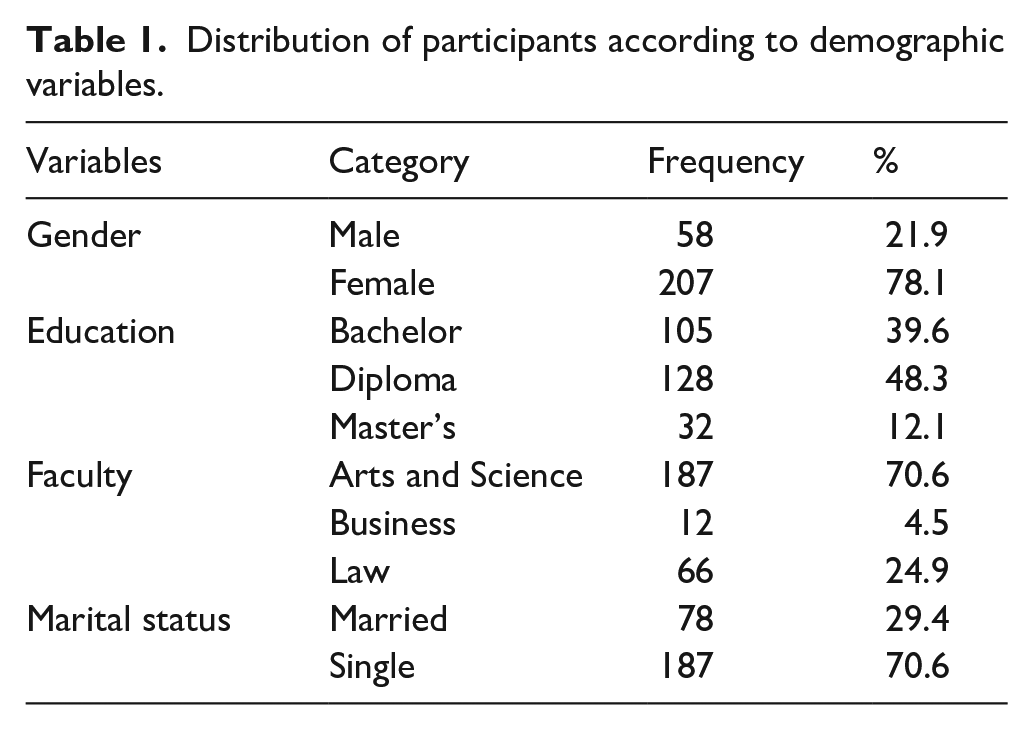
This study followed a cross sectional design. Population of this study included 4965 undergraduate students enrolled in the academic year 2016–2017. From the overall population, 265 students were recruited as a study sample. In accordance with the inclusion criteria, currently enrolled students of Arts, Business and Law were included in the study sample while the postgraduate students and students who belonged to other fields of studies were excluded from the group. Table 1 shows the distribution of sample participants according to their demographics.
Distribution of participants according to demographic variables.
Study instruments
Emotional intelligence scale
Emotional intelligence (EI) scale was used in this study. Participants’ emotional intelligence was measured on the basis of Goleman’s Theory of Emotional Intelligence. The identification and determination of the level of emotional intelligence in the study sample was carried out according to the following procedure:
Dimensions of emotional intelligence that included self-awareness, self-organization, motivation, empathy, and social skills were identified.
Several items were developed for each dimension which corresponded to the age at which the scale was applied.
In particular, 34 items were formulated and listed under the relevant dimensions as given: 7 items for self-awareness, 6 items for motivation, 6 items for self-regulation, 8 items for empathy, and 7 items for social skills.
Validity of the instrument and its appropriateness for data collection was checked through content and construct validity. To increase the readability and understanding, the questionnaire was translated from English to Arabic. The constructed scale was then presented to eight experts of educational psychology and counselling to verify the clarity of items along with their extent of relevance to the dimension to which it was listed. The wording of some items was modified as per experts’ suggestions to retain the real meaning. About 80% experts indicated high relevancy of scale to measure emotional intelligence and its dimensions.
A pilot testing was also conducted in which scale was applied to a random sample of 40 individuals that fall in the inclusion criteria other than the original sample population. This was done to extract the indicators of construct validity of the emotional intelligence scale. Table 2 shows the correlation coefficients between each item and the domain to which it belonged. Correlation coefficients between each of the emotional intelligence scale items and their dimension ranged between 0.493 and 0.821 are further presented.
Values of correlation coefficients for emotional intelligence scales between each item and the scale as a whole.

Statistically significant at (0.05).
The reliability coefficient of the scale was computed using the internal consistency coefficient provided through Cronbach-Alpha and a reliability coefficient of 0.90 was obtained. Following are the reliability coefficients of all the domains: self-awareness (0.74), self-regulation (0.81), motivation (0.79), empathy (0.85), and social skills (0.87). A sample of 50 students that did not belong to the study sample was selected to extract the coefficient of reliability in a retest method. The scale was applied twice in the time interval of 3 weeks. Pearson correlation coefficient was computed between the two applications to extract the stability of the return of scale. Following were the reliability coefficient for other domains: self-awareness (0.73), self-regulation (0.80), motivation (0.81), empathy (0.86), and social skills (0.88).
Stress Coping Style Inventory
Stress Coping Style Inventory to the UAE environment was also adopted in which 28 items were divided into four dimensions (Lin and Chen, 2010):
Active Problem Coping consisted of 8 items and referred to the method of dealing with stress by analyzing the root cause of the problem, examining the main reason of stress, following a calm and optimistic approach through ongoing planning and, if required, attaining help from external sources such as teachers or friends.
Active Emotional Coping included 6 items. This dimension referred to the method in which different strategies were adopted during stress. The strategies included positive feelings of thinking and self-promotion, developing emotional balance by diverting attention, changing emotion, searching for external resources to help in gaining emotional control and seeking ways to get rid of tension.
Passive Problem Coping included 8 items. It referred to the method where individuals reflected an emotional detachment, escape avoidance (to have wishful thinking to avoid the problem), distancing and self-control behavior to escape problem.
Passive Emotional Coping included 6 items and it is related to the negative attitude of an individual that he shows when facing stress and includes emotional panic such as restricted emotions, self-blame or blame on God and others and loss of emotional control such as irritability.
The instrument was presented to eight experts in educational psychology for verification of wording, translation of the items and the extent to which its items are linked with the dimension to which it was developed. About 80% of the experts indicated that the scale is good for measuring stress coping style. Consequently, the scale was applied to a survey sample of 40 participants to extract the indicators of validity for all the measures of style of coping with stress.
Table 3 shows the correlation coefficients between each item of the style of coping with stress ranged from 0.476 to 0.801. The correlation coefficients between each stress and scale measures ranged from 0.405 to 0.781, which were acceptable and relevant correlation coefficients for this study.
The correlation coefficients between each item.

Statistically significant at (0.05).
The instrument reliability was verified by Internal Consistency using the Cronbach-Alpha method. The value of the coefficient of stability was 0.7 for the scale. The dimensions were as follows: active emotional coping (0.72), passive emotional coping (0.84), active problem coping (0.73) passive problem coping (0.75).
Ethical consideration
The study was approved by the Institutional Review Board. An informed consent was obtained from the study participants before commencing their participation in the study sample. Purpose and objective of the study were also explained to the participants. They were also given the right to withdraw themselves from the study any time during their participation. Confidentiality of the participants’ information was strictly maintained and data were stored in a password protected folder.
Results
The mean and standard deviation values were computed for each domain of “emotional intelligence” and the scale. Table 4 shows the scores calculated for the level of emotional intelligence. Highest mean value (M = 4.31) was achieved for “motivation,” whereas, smallest mean value (M = 4.01) was attained by the second domain, that is, “self-regulation.” Therefore, the overall mean value of emotional intelligence was M = 4.16.
Means and standard deviations of “emotional intelligence” scale domain, and the scale (n = 265).

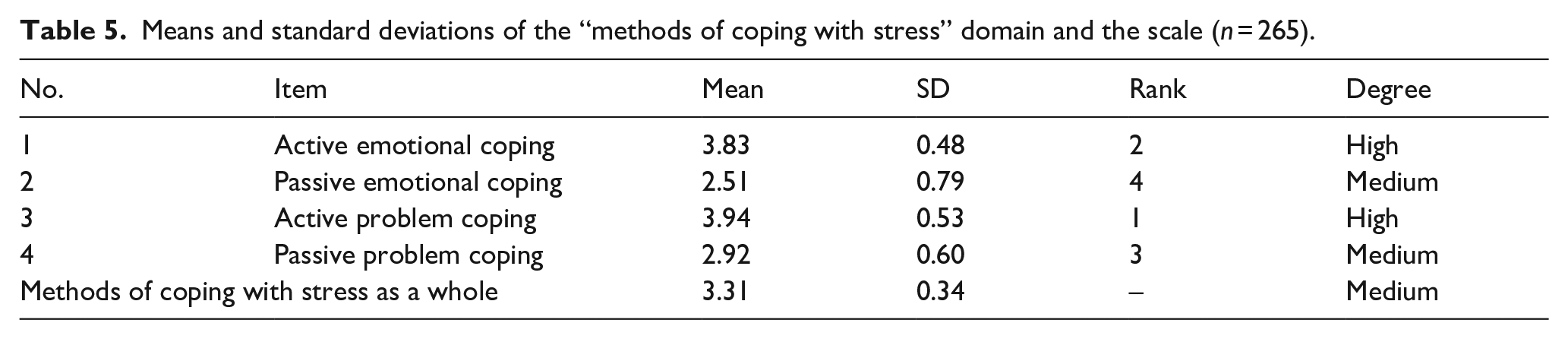
Mean and standard deviation values were computed for each of the “methods of coping with stress” and the scale. Table 5 shows the mean values calculated for “stress coping style,” where the highest value, that is, M = 3.94 was for “active problem coping” and the lowest value was for “passive emotional coping” that is, M = 2.51. Finally, the overall mean value for “style of coping with stress” was M = 3.31 at medium degree.
Means and standard deviations of the “methods of coping with stress” domain and the scale (n = 265).
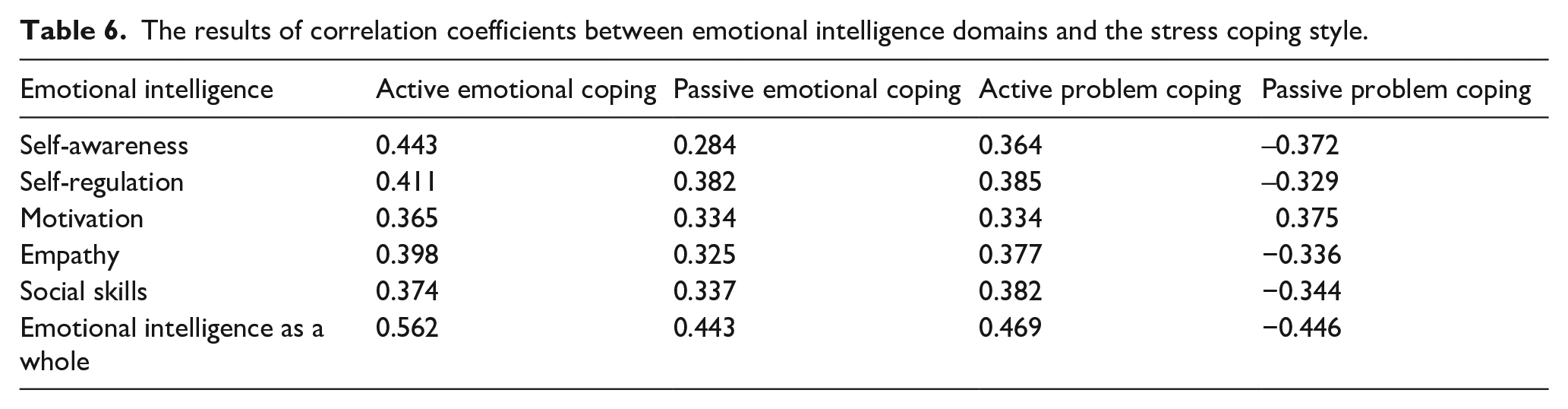
Correlation coefficients between emotional intelligence and stress coping style were computed in the participants. Table 6 shows that all correlation coefficients calculated for the domain of emotional intelligence scale and stress coping style of active emotional coping and active problem coping were positive. Whereas, the correlation coefficients between the domains of emotional intelligence scale and the stress of coping style of passive emotional and problem coping were negative. These results indicated the validity of H0 according to which, there is a strong correlation between the degree of emotional intelligence and methods of coping with stress in students.
The results of correlation coefficients between emotional intelligence domains and the stress coping style.
The 4-Way ANOVA was applied to detect differences between the emotional intelligence according to the gender, specialization, educational level, and marital status. Table 7 showed no statistically significant differences at (α ⩽ 0.05) in emotional intelligence for gender, specialization, educational, and marital status variables.
Results of (4-Way ANOVA) to detect differences in emotional intelligence according to the variables.

The 4-Way ANOVA was applied to detect differences between mean values of stress coping styles according to the gender, specialization, educational level and marital status. Table 8 shows no statistically significant differences at (α ⩽ 0.05) in the stress coping styles according to the variables which include gender and marital status. These findings resulted in the validity of H2 according to which, differences in the level of emotional intelligence among students were related to gender, specialization, and marital status.
The results of (4-Way ANOVA) to detect differences in stress coping style according to the variables.

Discussion
The present study showed that the majority students had high level of emotional intelligence. The age group focused in this study was characterized by instability and emotional imbalance in the beginning, which lead to the stage of awareness and emotional maturity as they exceed the stage of adolescence. It is also linked with the interest of university in demonstrating ways for identifying their level of emotional intelligence through various methodological activities associated with the curriculum. Findings indicated a positive correlation between the emotional intelligence and active and passive problem coping. Besides, an inverse relationship between emotional intelligence and passive emotional coping and passive problem coping was observed. These results are consistent with the study of Albesher and Alsaeed (2015) as they suggested that increase in emotional intelligence increases the use of positive coping methods. These results are also in line with those proposed in the study of Moradi et al. (2011), and Noorbakhsh et al. (2010).
According to the current study, there were no statistically significant differences in the methods of coping with psychological stress and the level of emotional intelligence among participants based on their gender and marital status. Noorbakhsh et al. (2010) showed that there were no significant differences in emotional intelligence and coping skills with respect to the gender variable. The results were also consistent with the study of Al-Freihat and Momani, which showed that gender does not have a significant role in determining the level of psychological compatibility and skills in case of facing stress.
The university students are generally exposed to different types of psychological stress caused by multiple underlying sources such as financial problems, academic incompetence, peer evaluation, and strained relationship with the supervisor. The transfer of students from schools to the institutes of higher education may lead to multiple psychological, academic, and social changes on account of changed environments. Thawabieh and Qaisy (2012) added that students encounter new methods of teaching and experience a new pattern of student-teacher relationship and that change leads to the academic stress. Kai-Wen (2009) supported similar idea, according to him, university stage is critical as it molds youngsters into well-behaved individuals of the society. These young people not only need to adapt themselves in the new environment but also to learn about new people and event. Therefore, it is important to get information about the methods, the university students used to cope with stress during their academic tenure.
The current study is significant since it identifies the existing conditions of students regarding their level of stress and emotional intelligence. To propose valuable conditions, certain limitations were taken into account in the study. First, a small size of the study sample may reduce the probabilities of generalization of the results for a much a larger group. Secondly, the study sample comprised students of only three fields of studies, and this condition suggests the possibility that the conditions of emotional intelligence and stresses could be different for students of other departments. The results were further limited as this cross-sectional study failed to acknowledge the prevailing mood and motivation level of students to participate in the process of data collection. Moreover, self-administered questionnaire was used that demanded individuals to imagine a hypothetical situation and present their reactions to that situation.
Conclusion
The relationship between emotional intelligence and stress is a well-established fact. However, keeping in view the growing concern in this field of interest, the present study examined the relationship between emotional intelligence and the style of coping stress in university students. Findings of the study indicated no significant difference between the stress coping styles with respect to the variables such as gender and marital status. However, a statistically significant difference was found in the stress coping styles depending upon education and specialization constructs. On the basis of the study findings and above-mentioned discussion, it can be concluded that students were capable of efficiently utilizing stress controlling strategies. It is, however, strongly suggested that researchers should conduct a more comprehensive study by using a much larger study sample that should include students of different fields of studies and of different universities.
The current study investigated the relationship of emotional intelligence and the style of coping with psychological stress in university students. The study highlighted that stress coping styles are important adaptable skills which should be an integral part of the personality of students of all levels. It has mainly focused on the changes in student’s academic and social environment. The study also recommended that the university professors should be well aware of the concept of emotional intelligence, stress coping styles and its dimensions and their importance so that they can give comprehensive guidance to students about ways of dealing with stress.
Therefore, future studies need to address the concepts of emotional intelligence and stress with respect to other samples and environments while linking them to different study variables. Moreover, it is also suggested that educational seminars and awareness campaigns should be conducted on regular basis to strengthen social bonds in different university students and introduce the concept of emotional intelligence and its dimensions to them.
Footnotes
Acknowledgements
The author is highly thankful for all the associated personnel who contributed in the completion of the study.
Declaration of conflicting interests
The author(s) declared no potential conflicts of interest with respect to the research, authorship, and/or publication of this article.
Funding
The author(s) disclosed receipt of the following financial support for the research, authorship, and/or publication of this article: The author declares that the study is self-funded.
