




Abstract
Contemporary research investigating obesity has focused on grazing (i.e. an uncontrolled and repetitive consumption of small amounts of food). Meanwhile, constructs such as mindfulness, mindful eating and self-compassion have received much attention in assisting individuals with eating behaviours and weight regulation. The association between those constructs and grazing, however, has not been explored. In a cross-sectional study, university students (n = 261) were recruited to explore the relationship of mindfulness, mindful eating and self-compassion with current weight and grazing. Results indicated that all constructs were negatively related to grazing, but only mindful eating related negatively to current weight. In addition, mindful eating mediated the relationship between grazing and current weight. Possible explanations and future directions are discussed further with an emphasis on the need for more empirical work.
Introduction
Overweight and obesity prevention has become a worldwide concern, with rates of associated diseases steadily increasing (World Health Organization (WHO), 2004). Much attention has been paid to childhood obesity and related eating behaviours (Demir and Bektas, 2017; Newby, 2007), and how it can lead to obesity in adulthood (Rössner, 1998), while college and university graduates have been largely disregarded (apart from studies who used convenience sampling). The transition from home to independent living brings a change in support networks and social norms (Tanton et al., 2015). These changes can also include the development of less healthy eating behaviours, leading to weight gain (Racette et al., 2005); this is particularly evident in students who live on campus (Tanton et al., 2015).
University students’ eating behaviours are of course influenced by the same factors as for others; however, academic stress in addition to first time independent living presents a challenge in maintaining or developing healthy eating behaviours. There is a large body of evidence demonstrating that students eat an unhealthy diet with not enough fruits and vegetables and too much fat (Deliens et al., 2014; Silliman et al., 2004). Much less is known about the ways in which students eat and in particular the occurrence of grazing.
Grazing is defined in eating literature as the uncontrolled and repetitive eating of small amounts of food, which has been associated with obesity in specialised population (e.g. bariatric surgery patients). While the assumed loss of control over eating in grazing is questionable (Fairburn, 2008), the distinct behaviour of eating smaller amounts of food repetitively has been recognised as an important eating behaviour (e.g. Lane and Szabo, 2013; Saunders, 1999, 2004), which lies somewhere between other problematic eating behaviours or patterns such as binge eating (e.g. Darby et al., 2007) and ‘between meal snacking’ (O’Connor et al., 2008); all of which add to the aetiology of obesity.
Despite the identification of grazing as a risky behaviour for weight regulation over a decade ago, attention on the topic has been minimal, a recent systematic review (see Parker and Brennan, 2015) identified only seven studies reporting grazing as an outcome. Accounts of grazing in both qualitative and quantitative studies range from 26 to 60 per cent (Colles et al., 2008; Saunders, 1999; see also Opolski et al., 2015), and these figures suggest that obesity interventions focused on grazing may be useful. Research on grazing outside of clinical populations is scarce, with only one study in a community sample (Holzner and Szabó, 2014), one with students (Lane and Szabo, 2013) and none with children. More importantly, grazing is not an element that has been currently addressed in contemporary interventions that relate to weight regulation. Elements that have been found to enable and assist weight regulation, such as mindfulness, mindful eating and self-compassion, have not yet been examined in relation to grazing.
The practice of mindfulness is defined as an awareness that emerges through purposefully paying attention in the present moment, non-judgementally (Kabat-Zinn, 1990). The practice usually entails mindfulness meditation, which involves actively observing the present moment by attending usually to the breath, moment-to-moment. Being mindfully aware has been beneficial in reducing anxiety and depression (Hofmann et al., 2010), eating disorders (Wanden-Berghe et al., 2011) and food cravings (Alberts et al., 2010). This cycle of attentive processing assists people who observe the constant flow of information to systematically develop an ability of acceptance (instead of judgement) and move on to more multi-layered indirect benefits, such as compassion and empathetic concern, which are indirect parts of secular mindfulness practice (Grossman, 2013; Grossman and Van Dam, 2011; Kabat-Zinn, 2006). Recent interventions have identified self-compassion as an assimilated and inclusive construct within mindfulness to enable greater weight regulation.
Neff (2003a, 2003b) described self-compassion as a kinder approach towards oneself, with a mindful awareness and understanding of one’s experiences as part of shared reality that all people go through during personally challenging times (see Neff, 2003a, 2003b, for review). Furthermore, self-compassion consists of three main elements: self-kindness, common humanity and mindfulness, which combined create the construct of self-compassion (see Neff, 2003b, 2011). Self-compassion, however, is underexplored in the context of eating behaviours. Adams and Leary (2007) suggested that receiving a short self-compassionate induction to cope after the experience of breaking the diet enables further regulation to occur (which was not true without the self-compassionate induction). Following this work, further research explored self-compassion as a determinant for maintaining weight (see Mantzios et al., 2014), losing weight (Mantzios and Giannou, 2014, 2015a) and the utilisation of different practices apart from meditation (i.e. mindful diaries – see Hussein et al., 2017; Mantzios and Wilson, 2014). Overall, mindfulness and self-compassion appear to complement each other in ways that translate into better outcomes for both mental and physiological health (see Keng et al., 2011; Mantzios and Wilson, 2015b). However, the combination between mindfulness and eating has created a new imperative for researchers who are specifically interested in investigating eating and how well it conforms to the principles of mindfulness: namely, mindful eating.
Mantzios and Wilson (2015b) in a recent review suggested that the investigations and interventions need to be more explicit and specific to eating. Mindful eating is the application of mindfulness fundamentals on food-related experiences; that is, purposeful attention to the present meal with a non-judgemental or accepting attitude. Mindful eating has been related to healthier eating (Jordan et al., 2015) and has been beneficial in treating eating disorders, including binge eating disorder (Kristeller and Hallett, 1999) and bulimia nervosa (Proulx, 2008). Research has identified that mindfulness practices for binge eating assist in the reduction of binge eating episodes and enhance control over eating (e.g. Baer et al., 2005; Kristeller et al., 2006). Theoretically, it could be assumed that enhancing control and decreasing the frequency and durations of grazing may be feasible with modified mindfulness-based interventions developed for binge eating (see Kristeller and Hallett, 1999). However, without the fundamental associations between mindfulness, mindful eating and self-compassion with grazing, the initiation of intervention research may potentially be detrimental to participants or patients, who may find that mindful eating interferes with other elements of healthier lifestyles such as exercise (see, for example, Moor et al., 2013). This study set out to explore the association between mindfulness, mindful eating and self-compassion with grazing within a student population. Based on previous literature, we would expect mindful eating to have the most significant negative relationship to grazing and mindful eating to mediate the relationship between grazing and body mass index (BMI).
Methods
Participants
A total of 261 students were recruited through various online invitations, using a volunteer sampling technique to take part in a study investigating eating behaviours, and the participants were not rewarded for their participation. Four participants did not complete the questionnaires in a satisfactory manner (i.e. failed to answer all questions), and as a result were excluded from the final sample. The final sample included 241 females and 16 males. Participants (Mage = 21, standard deviation (SD) = 5.1; MBMI = 24.8, SD = 5.5) were mainly social science students, and as females tend to outnumber males studying such subjects, this may explain the gender divide within the present sample (‘2017 cycle applicant figures-June deadline’, 2018). The ethnic breakdown of the sample was 72 per cent White, 7.7 per cent Pakistani, 6.1 per cent Black, 6.1 per cent Mixed, 3.4 per cent Indian, 1.5 per cent Bangladeshi, 1.5 per cent Chinese and 0.8 per cent Arab.
Materials
Participant information form
Answers related to age, gender, ethnicity, socio-economic status, and frequency of smoking and exercise were recorded. Participants also reported their height and weight in order to assess BMI. Height was recorded using participants’ official identification, that is, national identity card, passport or driver’s licence. Weight was recorded using a regular scale, participants were asked to weigh themselves barefoot and without any heavy or excess clothing. Participants’ BMI was calculated using the following formula: weight in kg/height in m2. Participants were also asked a range of questions related to medication, health status and eating disorders in order to determine whether they were suitable and eligible to take part in the research.
Self-Compassion Scale
The Self-Compassion Scale (SCS) consists of 26 items which assesses an individual’s tendency to be self-compassionate during times of distress and disappointment (Neff, 2003a). On a 5-point Likert-type scale, responses range from 1 (almost never) to 5 (almost always) and scores range from 26 to 130. Sample items include ‘I’m disapproving and judgemental about my own flaws and inadequacies’ (i.e. self-judgement) and ‘I try to be loving towards myself when I’m feeling emotional pain’ (i.e. self-kindness). The scale yields six subscales which contained the following number of items and produced the following alphas: self-kindness (5 items; α = .879), self-judgement (5 items; α = .859), common humanity (4 items; α = .846), isolation (α = .831), mindfulness (4 items; α = .823) and over-identification (4 items; α = .822). This study produced an alpha of (α = .947) for the original SCS. Along with the total scale score, subscales were also analysed because the potential for individual differences in behavioural enactments of self-kindness may propose a different rationale of association (Mantzios and Egan, 2017). For example, while for some, self-kindness may involve having a long bath or eating a healthy meal, for others it may consist of over-indulgence of food or binge drinking (Mantzios and Egan, 2017). Although the former consists of positive health behaviour and relates to being kind to the mind, the latter can lead to negative health consequences and refers to being kind to both mind and body. Therefore, understanding the element of self-kindness within self-compassion in association with eating behaviours requires further in-depth investigation.
Five Facet Mindfulness Questionnaire – Short Form
The Five Facet Mindfulness Questionnaire – Short Form (FFMQ-SF) is a 24-item questionnaire which measures five main characteristics of mindfulness (Bohlmeijer et al., 2011). On a 5-point Likert-type scale, responses range from 1 (never or rarely true) to 5 (very often or always true) and scores range from 24 to 120 with higher scores indicating higher levels of mindfulness. Sample items include ‘I tell myself that I shouldn’t be feeling the way I’m feeling’ and ‘I make judgements about whether my thoughts are good or bad’. The five facets contained the following number of items and produced the following alphas: observing (4 items; α = .806), describing (5 items; α = .869), acting with awareness (5 items; α = .848), non-judging (5 items; α = .753) and non-reactivity (5 items; α = .777). This study produced an alpha of (α = .837) for the FFMQ-SF.
Mindfulness Eating Scale
The Mindfulness Eating Scale (MES) is a 28-item scale (Hulbert-Williams et al., 2013). On a 5-point Likert-type scale, responses range from 1 (never) to 5 (usually) and scores range from 28 to 112, with higher scores indicating higher levels of mindful eating. Sample items include ‘I eat something without really being aware of it’ and ‘When I get hungry, I can’t think about anything else’. The MES yields six subscales which contained the following number of items and produced the following alphas: acceptance (6 items; α = .587), awareness (5 items; α = .457), non-reactivity (4 items; α = .754), routine (4 items; α = .339), act with awareness (4 items; α = .634) and unstructured (4 items; α = .436). This study produced an alpha of (α = .870) for the MES.
Grazing Scale
The grazing scale is an 8-item scale (Lane and Szabo, 2013). On a 5-point Likert-type scale, responses range from 1 (rarely) to 5 (all of the time) and scores range from 8 to 32, with higher scores indicating higher levels of grazing. Sample items include ‘Have you ever felt compelled or driven to eat, even when not hungry?’ and ‘Do you have a feeling that you have lost control over your eating while “grazing”?’. This study produced an alpha of (α = .880) for the grazing scale.
Procedure and design
Prospective participants responded to online invitations from a university in Birmingham, United Kingdom. Participants were able to access a link which directed them to a participant information form, which included all study information and researcher contact details. Thereafter, participants were directed to a consent form, followed by the questionnaires and the demographic form. Once the study was complete, participants were directed to a debriefing form, which informed participants of this study and presented participants with the contact details of the researcher, if they wanted to withdraw or find out the results of the study at a later date. Ethical approval was granted by the Research Ethics Committee based within the University, and the study was strictly assessed to ensure compliance to guidelines set by the British Psychological Society.
Results
Inter-correlations between self-compassion, mindfulness, mindful eating, grazing and BMI are presented in Table 1. Findings suggest that there is a significant positive relationship between BMI and grazing (p < .001) and a significant negative relationship between BMI and mindful eating (p < .001), while non-significant negative relationships were observed between BMI and self-compassion (p = .40), and mindfulness (p = .78). Grazing displayed a significant negative relationship towards self-compassion (p < .001), mindfulness (p < .001) and mindful eating (p < .001).
Means, standard deviations and bivariate correlations between mindfulness, mindful eating, self-compassion, grazing and BMI.

BMI: body mass index; GQ: Grazing Questionnaire; SCS: Self-Compassion Scale; FFMQ: Five Facet Mindfulness Questionnaire; MES: Mindful Eating Scale; SD: standard deviation.
Correlation is significant at the .01 level.
Inter-correlations between the self-compassion subscales, BMI and grazing are presented in Table 2. Grazing displayed significant negative relationships with self-kindness, self-judgement, isolation and over-identification.
Means, standard deviations, bivariate correlations between BMI, grazing and self-compassion subscales.

BMI: body mass index; GQ: Grazing Questionnaire; SK: Self-Kindness Subscale; SJ: Self-Judgment Subscale; CH: Common Humanity Subscale; I: Isolation Subscale; M: Mindfulness Subscale; OI: Over-Identification Subscale; SD: standard deviation.
Correlation is significant at the .05 level.
Correlation is significant at the .01 level.
Inter-correlations between mindfulness and mindful eating subscales, as well as BMI and grazing are presented in Table 3. The BMI displayed a significant negative relationship with acceptance, distractibility and unstructured eating subscales of the mindful eating questionnaire, as well as the non-judgement subscale of the mindfulness questionnaire. Grazing displayed significant negative relationships with act awareness and non-judgement subscales, along with acceptance, non-reactivity, distractibility and unstructured eating subscales.
Means, standard deviations, bivariate correlations between BMI, grazing, mindfulness and mindful eating subscales.
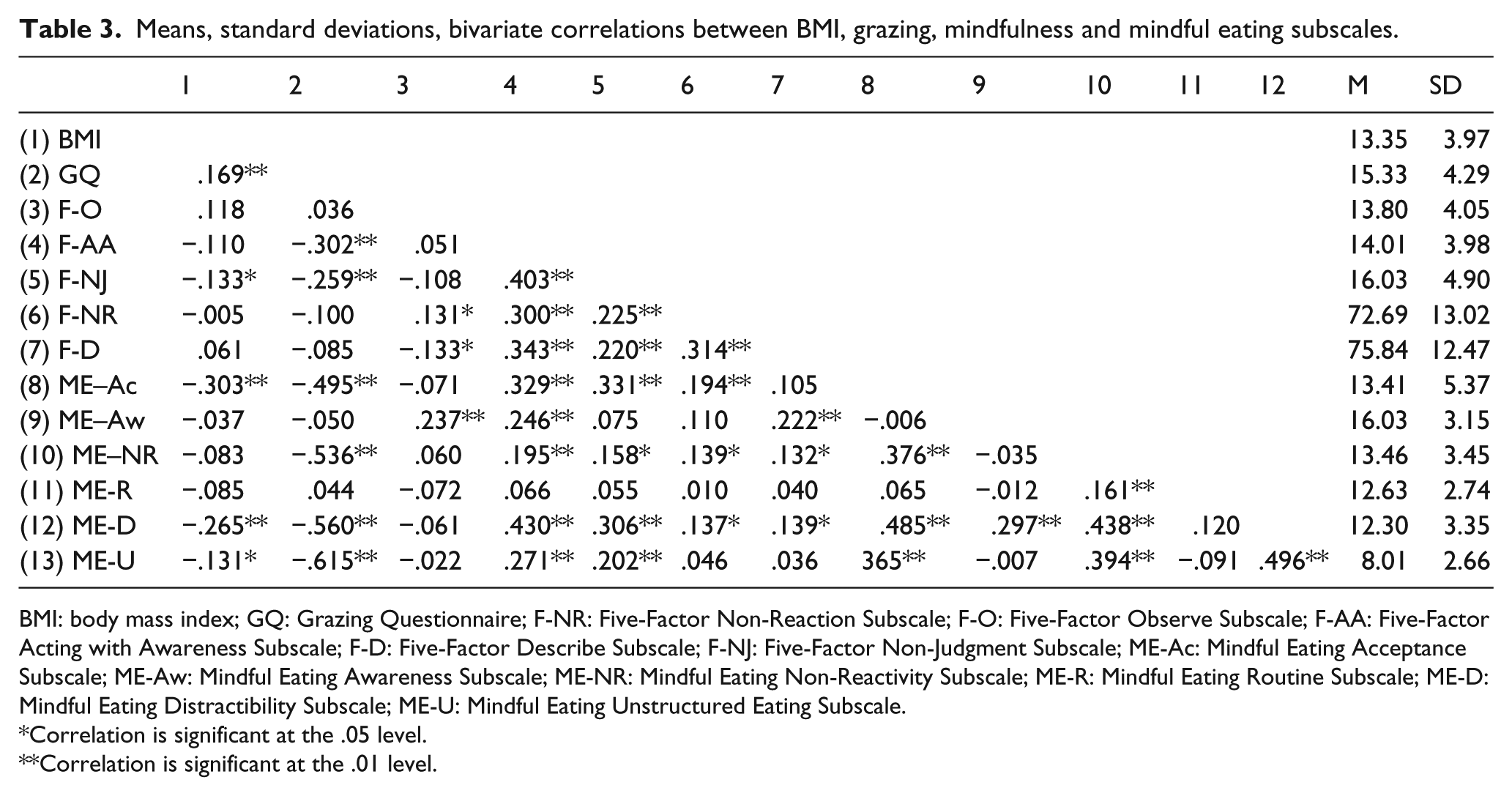
BMI: body mass index; GQ: Grazing Questionnaire; F-NR: Five-Factor Non-Reaction Subscale; F-O: Five-Factor Observe Subscale; F-AA: Five-Factor Acting with Awareness Subscale; F-D: Five-Factor Describe Subscale; F-NJ: Five-Factor Non-Judgment Subscale; ME-Ac: Mindful Eating Acceptance Subscale; ME-Aw: Mindful Eating Awareness Subscale; ME-NR: Mindful Eating Non-Reactivity Subscale; ME-R: Mindful Eating Routine Subscale; ME-D: Mindful Eating Distractibility Subscale; ME-U: Mindful Eating Unstructured Eating Subscale.
Correlation is significant at the .05 level.
Correlation is significant at the .01 level.
We used the PROCESS macro (Hayes, 2013, Model 4) to test the indirect effect (denoted as ab) of grazing on BMI via mindful eating and trait mindfulness (10,000 bootstrap samples). This analysis confirmed that the indirect effect of grazing on BMI via mindful eating was significant (ab = 0.16, standard error (SE) = 0.03, 95% confidence interval (CI) = 0.10 to 0.22). The direct effect was non-significant (B =–.05, SE = 0.05, 95% CI = –0.15 to 0.05).
Discussion
This study aimed to explore the association between mindfulness, mindful eating, self-compassion and grazing. All mindfulness, mindful eating and self-compassion displayed a significant negative relationship with grazing. Regarding self-compassion subscales, the negative items that relate to (a) less kindness (i.e. self-judgement), (b) less collectively self-reflective (i.e. isolation) and (c) less mindful (i.e. over-identification) positively and significantly related to grazing. For mindfulness subscales, acting with awareness and non-judgement were the subscales that were significantly related to lower levels of grazing, while for mindful eating, the acceptance, non-reaction, distractibility and uncontrollability were negatively associated with grazing.
Results from mindfulness, mindful eating and self-compassion constructs translate into differing interventions that could be utilised. For example, the overarching component of non-judgement is expressed through all scales, regardless of the relational framework. For example, with self-compassion, it is expressed through self-judgement and theoretically is assessed on grounds of responding to suffering, while with mindful eating, acceptance (or non-judgement) is assessed at an event-based level (i.e. in association to eating and food). Several interventions have been utilised in the field that target non-judgement (or acceptance) to aid weight regulation (e.g. Kristeller et al., 2006; Mantzios and Giannou, 2014). Another way of interpreting the results is the overall lack of self-compassion, which dictates the benefits that could potentially derive from a mindful self-compassionate intervention (Germer and Neff, 2013; Mantzios and Wilson, 2014, 2015a; Neff and Germer, 2013). As suggested by Mantzios and Wilson (2014), more relevant questionnaires that associate mindfulness and eating may be more predictive of eating behaviours. Mindful eating in this research displayed a mediation effect on the relationship between grazing and BMI, which was not found with mindfulness or self-compassion (see also Mantzios and Egan, 2017).
Importantly, males and females may differ in relation to mindfulness facets and eating behaviours. For instance, De Vibe et al. (2013) found that 7 weeks of mindfulness training benefitted students differently when explored by sex. Mindfulness training helped male students become more aware of their distress, while the training assisted female students with handling their distress better. Similarly, males and females differ greatly is eating behaviours, where some studies reported greater food cravings in females compared to males, and this has been specifically related to calorie-dense palatable foods (Cepeda-Benito et al., 2003). In addition, studies have also noted that females score higher on emotional eating (Waller and Matoba, 1999) and restrained eating (Neumark-Sztainer et al., 1999) when compared to males. Even the reasoning for eating differs between males and females, where males often report environmental reasons, bodily sensations and hunger, while females tend to report social reasons, thoughts, emotions and cognitions as reasons for initiating eating (Tuomisto et al., 1998). Collectively, future research should investigate these findings further by incorporating a larger and comparable male population.
Four limitations were identified with this study. First, the average BMI was within the normal range, and findings could be significantly different among overweight and obese participants. To draw stronger conclusions, this research should be replicated with obese and bariatric surgery samples. Second, the study presents cross-sectional data, which makes any further interpretations less robust. Future research should look into experimental and longitudinal studies to explore the variation of mindfulness-based constructs and grazing within weight loss interventions to allow causal and directional interpretations. Third, males are underrepresented within this study, making it difficult to apply findings to male populations. Future research should aim to recruit more male participants. Fourth, the physiological measurements were dependent on participants’ vigour to report with accuracy, which has been problematic in past research.
Findings are even more complicated when we aimed to interpret whether grazing is an aware and attentive process, and if there are any corresponding emotional and cognitive elements that may interfere with this eating pattern. We could speculate that grazing is an eating behaviour that is accompanied by personality traits that are descriptive of inattentiveness to the present moment and judgemental and uncompassionate perception of oneself. The literature around grazing and psychological health has been instigated, but the published literature in the field is minimal. The ability of mindfulness-based interventions to assist other concerns that co-exist with grazing, such as anxiety, stress and/or depression, may be another element that encompassed a possible predicting/mediating effect. Perhaps, we need to take another step back and explore mental health and well-being in association to grazing, before enabling a full understanding of grazing itself and the potential of impact of the interventions suggested in this discussion. For now, it is safe to assume that mindfulness, compassion and acceptance interventions are useful in decreasing grazing in a student population.
Footnotes
Funding
The author(s) received no financial support for the research, authorship and/or publication of this article.