




Abstract
This study investigated the psychometric properties of the Japanese version of the WHOQOL-BREF among 10,693 community-based married Japanese men and women (4376 couples) who were either expecting or raising a child. Analyses of item-response distributions, internal consistency, criterion validity, and discriminant validity indicated that the scale had acceptable reliability and performed well in preliminary tests of validity. Furthermore, dyadic confirmatory factor analysis revealed that the theoretical factor structure was valid and similar across partners, suggesting that men and women define and value quality of life in a similar way.
Introduction
Japan is a highly developed country with the longest life and healthy life expectancies globally (World Health Organization (WHO), 2003). This is due in part to reduced socioeconomic disparities (Marmot and Smith, 1989; Ohtake, 2005; Wilkinson, 1992) and a weak relationship between socioeconomic status (SES) and healthy lifestyles (Anzai et al., 2000; Nakamura et al., 1994). However, Japan ranks near the middle of nations in happiness and is the unhappiest of industrialized countries (Inglehart, 1990). Also, happiness rates have remained steady since the 1960s (Veenhoven, 2004). Because of the disparity between physical and economic indicators and subjective life evaluations, studies that measure happiness and well-being in multiple domains have drawn greater attention (Asada and Ohkusa, 2004; Tokuda et al., 2008).
Quality of life (QOL) refers to one’s satisfaction in important domains of life as judged by one’s own standards and culture (WHOQOL Group, 1995). The World Health Organization Quality of Life (WHOQOL) working group has developed a comprehensive QOL assessment, the WHOQOL-100, which consists of 100 items representing 24 facets of life organized into six domains (WHOQOL Group, 1998b). Its abbreviated version, the WHOQOL-BREF, contains 26 items and is used for epidemiological surveys and clinical trials (WHOQOL Group, 1998a). Psychometric studies support the WHOQOL-BREF’s validity for general populations (Saxena et al., 2001; Skevington et al., 2004; WHOQOL Group, 1998a) and in many countries (Min et al., 2002; Noerholm et al., 2004; Xia et al., 2012; Yao et al., 2002). However, some international studies failed to replicate the original item structure (Moreno et al., 2006; Yao et al., 2008). In Japan, the psychometric properties of the WHOQOL-BREF have not been replicated since the original field trial (Skevington et al., 2004), and the factor structure has not yet been validated. Further studies on well-being require a thorough psychometric assessment of the Japanese WHOQOL-BREF.
Another important question regarding the WHOQOL-BREF construct is whether men and women define QOL similarly. Close relationships work to provide a key context for well-being (Reis et al., 2000). As people get married, have children, and age together in a shared life circumstances (e.g. social interactions, diets, lifestyles), one person’s satisfaction with life can affect their partner’s well-being. On the other hand, as QOL is a subjective experience (WHOQOL Group, 1995), the perceived satisfaction with the living circumstances may vary across partners. Among sparse literature investigating similarity in QOL conceptualization across partners, Wang et al. (2006a) showed that mothers and fathers of children with disabilities did not differ in assessments of family QOL in terms of measurement construct, weighted importance of factors, or level of satisfaction. Nevertheless, whether QOL similarity is generally true for a normative sample of married couples with children is unknown. Thus, this study aims to provide empirical evidence to validate the content equivalence of the WHOQOL-BREF across married partners with children. If the instrument measures the underlying QOL construct equally across husbands and wives, further study to investigate possible differences or similarities between husbands’ and wives’ assessments of their well-being is theoretically warranted.
This study used a large sample of married adults at different stages in their childrearing to thoroughly examine the psychometric properties of the Japanese WHOQOL-BREF and determined the construct validity of the instrument by testing whether the factor structure had similar fit for husbands and wives.
Method
Participants
Participants came from two studies. The Survey on Pregnancy, Childbirth, and Child-Rearing assessed the well-being of first-time parents and their experiences of conception, birth, and childrearing, and their impact on daily life. First-time pregnant women in the second half of their pregnancies and their husbands as well as heterosexual couples raising their first-born child (between 0 and 2 years of age) were randomly selected from Benesse Educational Research and Development Institute’s database (Benesse Child Sciences and Parenting Research Office, 2013). The survey was conducted in two rounds, and in each, 8000 survey packets containing two identical questionnaires for a couple were mailed to eligible households. Two postage-paid envelopes were included so that partners could return their forms separately. In 2006, 4479 individuals responded (the response rate was 28.0%; 2588 wives and 1891 husbands), and in 2011, 4737 individuals responded (29.6%; 2750 wives and 1987 husbands). Participants were given a baby care gift worth ¥500. Combining analyzable data yielded 9143 individuals (3738 matched couples, 1568 wives, and 99 husbands). The mean age of the participants was 32.01 years (men: M = 33.05, standard deviation (SD) = 5.25, range = 18–57; women: M = 31.27, SD = 4.55, range = 16–47), with a median education duration of 14 years and a median adjusted household income of ¥5.79 million (as of March 2014, ¥1 million was the equivalent of US $7142).
The second sample was from an ongoing longitudinal study, QOL and Mental Health across the Life Span Survey (Sugawara et al., 2014). Heterosexual couples expecting a child were recruited at hospitals and public health centers in Kawasaki City and were followed periodically through mailed surveys and interviews. Between October 2013 and March 2014, 1550 individuals (638 matched couples, 263 wives, and 11 husbands) participated in a follow-up survey. Participants were each given a bookstore gift certificate worth ¥500. This study was approved by the ethics committee at Ochanomizu University. Participants had a mean age of 50.12 years (men: M = 51.62, SD = 7.67, range: 34–71; women: M = 49.03, SD = 6.65, range: 30–66), a median education of 14 years, and a median adjusted household income level of ¥9 million. The babies at the time of recruitment had since grown and were between 10 and 30 years old (median age, 18).
Instrument
The WHOQOL-BREF (WHOQOL Group, 1998a) consists of 24 items, one each from the 24 facets of the WHOQOL-100. These items are assumed to assess four important domains of life: physical, psychological, social relationships, and environment QOL. In addition, the instrument contains two general items assessing general QOL and general health. The Japanese WHOQOL-BREF has been tested for content equivalence with the original English version (Tazaki and Nakane, 1997). Scores for each item range from 1 (poor) to 5 (good), with higher scores indicating greater QOL.
Statistical analysis
Normality, reliability, and validity were assessed using standard psychometric methods (Skevington et al., 2004; WHOQOL Group, 1998b). Together with skewness and kurtosis coefficients, the normality of the items was examined. Specifically, items were checked for floor and ceiling effects, which were considered present if more than 15 percent of respondents belonged to the lowest/highest response category (McHorney and Tarlov, 1995). Internal consistency was assessed using Cronbach’s α, which is conventionally considered acceptable if it exceeds .70 (Cohen, 1988). Criterion-related validity was evaluated by correlating each item with its respective domain score (corrected for overlap). To assess discriminant validity, we examined the difference in mean scores of each item between the upper and lower 30 percent of participants with domain scores as criteria (Findley, 1956). All analyses were conducted separately by gender. Statistics were calculated using SPSS for Windows version 22.0 (IBM Corporation, 2013).
We followed guidelines provided by Kenny et al. (2006) for dyadic confirmatory factor analysis (CFA). We correlated the error terms of husbands and wives for each item to account for the potential influence of marital interaction on each partner’s responses. The dyadic CFA also includes a correlation between the latent factors of the two persons. Next, we examined the factor invariance for husbands and wives by comparing a model in which loadings on each measure were free to vary for both husbands and wives to a model where the paths from the first-order factors to the second-order factor were set as equal for the two members. If the latter model demonstrated equal or better fit than the unconstrained model, then the model was assumed to fit similarly between the husbands and wives.
Several goodness-of-fit indices were examined to assess and compare model fit. Comparative fit index (CFI) values greater than .90 were considered to indicate a good fit (Kline, 1998), whereas root mean square error of approximation (RMSEA) values ranging from .05 to .08 were preferred (Kenny and McCoach, 2003). Significant chi-square comparisons of model fit indicate that the simpler model (with fewer free parameters) should be rejected (Kenny et al., 2006). Data were organized in a pairwise dyadic structure, and CFA was conducted with AMOS (Arbuckle, 2013) for Windows version 22.0, using the maximum likelihood estimation method.
Ethical considerations
Permission to use the Japanese WHOQOL-BREF (Tazaki and Nakane, 1997) was granted by paying a fee to the distributor. Data collection was conducted by survey companies in Tokyo, which carry the PrivacyMark certification for personal information protection in compliance with Japanese Industrial Standards. Participation was voluntary and informed consent was obtained by filling out questionnaires. Responses were anonymously indexed so that personal information was not disclosed to the researchers.
Results
Characteristics of study sample
Combining surveys, the overall sample size was 10,693 (including 4376 couples). The sociodemographic characteristics of the sample are shown in Table 1.
Characteristics of the participants.

SD: standard deviation.
Adjusted household annual income (in million yen). One million yen was the equivalent of US$7142 as of March 2014.
Data quality
Table 2 presents descriptive statistics for each WHOQOL-BREF item for husbands and wives. Seven of the 26 items had ceiling effects for both sexes, six of which were common for couples: pain and discomfort (Q3), medication dependency (Q4), energy (Q5), spirituality (Q6), negative feelings (Q26), and safety (Q8).
Descriptive statistics of the WHOQOL-BREF (N = 10,693).

SD: standard deviation.
Negatively framed questions indicated with asterisk (*) were reverse-coded. Husbands’ scores are on the left and wives’ scores are on the right of the slash (/). All correlation coefficients are significant at p < .01 (two-tailed).
Coefficients of skewness fell between −1.0 and 1.0 for almost all items; two items for husbands (Q3 and Q4) and one item for wives (Q4) had skewness coefficients slightly beyond this range. Similarly, kurtosis coefficients for both sexes were satisfactory, with exception of a few items exceeding this range (Q3 and Q4 for husbands, and Q4 for wives). The mean and median item scores further confirmed that participants considered their QOL to be positive (Table 2). Less than 1 percent of participants (n = 93, .9%) had missing data on more than five items.
Internal consistency
Cronbach’s α values are shown in Table 3. These were acceptable for physical, psychological, and environment domains (.72–.77), but poor for the social-relationships domain (.61). Although removing one item regarding sexual satisfaction (Q21) somewhat improved internal consistency estimates, given that this domain has only three items and that similar α values have been reported in a previous study (Skevington et al., 2004), this item was retained in further analyses.
Reliability and validity tests results.

W: wives’ responses; H: husbands’ responses.
Negatively framed questions indicated with an asterisk (*) were reverse-coded. Criterion-related validity denotes the strength of the Pearson r correlation between each item and general facet items (Q1 and Q2). Discriminant validity was tested for each item score comparing the lower and upper 30 percent of participants.
p < .01.
Two of seven items in the physical domain had low correlation coefficients with the other items in this domain for both husbands and wives (Q4 and Q15; rs = .27–.34). In the psychological domain, one item assessing negative feelings (Q26) showed lower corrected item-total correlations for husbands and wives. The sexual-activity item also showed low correlation with other items in the social domain, suggesting again that it might not be a good measure of social-relationship quality.
Validity
As shown in Table 3, all items and domains were significantly correlated with the generic items, general QOL (Q1) and general health (Q2), for both husbands and wives. All domain scores were moderately correlated with Q1 (r = .33–.49) and Q2 (r = .28–.54). All individual items were also fairly to moderately correlated with Q1 (r = .08–.44) and Q2 (r = .17–.44). These results indicate that all items and all four derived domain scores exhibited reasonable criterion validity. The results of t-tests for item discrimination indicated that item scores significantly differed between the upper and lower 30 percent of participants (Table 3). Thus, all items were able to successfully discriminate between two groups of participants for husbands and wives.
Dyadic CFA
The WHOQOL-BREF assumes a hierarchical structure in which the four first-order domains are influenced by the second-order factor, QOL. As recommended for CFA with paired data, we constructed two identical QOL models for husbands and wives and correlated the QOL factor and errors across the same observed variables between couples (Kenny et al., 2006). The initial model fit poorly: χ2 (1047) = 19723.87, CFI = .740, and RMSEA = .064. We then modified the model by adding two pairs of error covariance—between Q3 and Q4, and Q8 and Q9, as indicated by previous studies (Li et al., 2009; Xia et al., 2012). Although this modified model fit was still unsatisfactory, χ2 (1044) = 16454.41, CFI = .785, and RMSEA = .058, a chi-square difference test indicated a significant improvement, Δχ2 (Δdf) = 3269.46 (3), p < .01. Further modifications were performed to explore possible improvements. Modification indices suggested adding three more pairs of error covariance (i.e. Q5 and Q6, Q12 and Q13, and Q18 and Q19) to significantly improve model fit, χ2 (1038) = 12814.61, CFI = .826, and RMSEA = .052, with Δχ2 (Δdf) = 3639.8 (6), p < .01.
Next, we tested whether the second-order WHOQOL-BREF factor structure fit for both husbands and wives. We tested a model in which the paths from the first-order factors to the second-order factor were constrained to be equal for both husbands and wives. We then compared this model with a model in which paths were free to vary between husbands and wives. The constrained model demonstrated a better fit than the unconstrained model, Δχ2 (Δdf) = 28.38 (2), p < .01, suggesting a similar factor structure between husbands and wives.
The final model is depicted in Figure 1 and standardized estimates are shown in Table 4. For both husbands and wives, all items had substantial factor loadings on corresponding factors (.19–.77) and first-order factors had high loadings on the common factor (.60–.99). In addition, first-order factor loadings were similar between partners. The correlation between second-order latent factor scores was significant, r = .29, p < .01, indicating that husbands’ and wives’ QOL reports correlated weakly, but significantly.

Second-order confirmatory factor model for WHOQOL-BREF using dyadic data (see Table 4 for the standardized estimates). Dotted lines were added for modification of model fit. Covariance of errors across the same indicators for the two members of the dyad is omitted.
Standardized estimation of second-order confirmatory factor analysis for men and women.
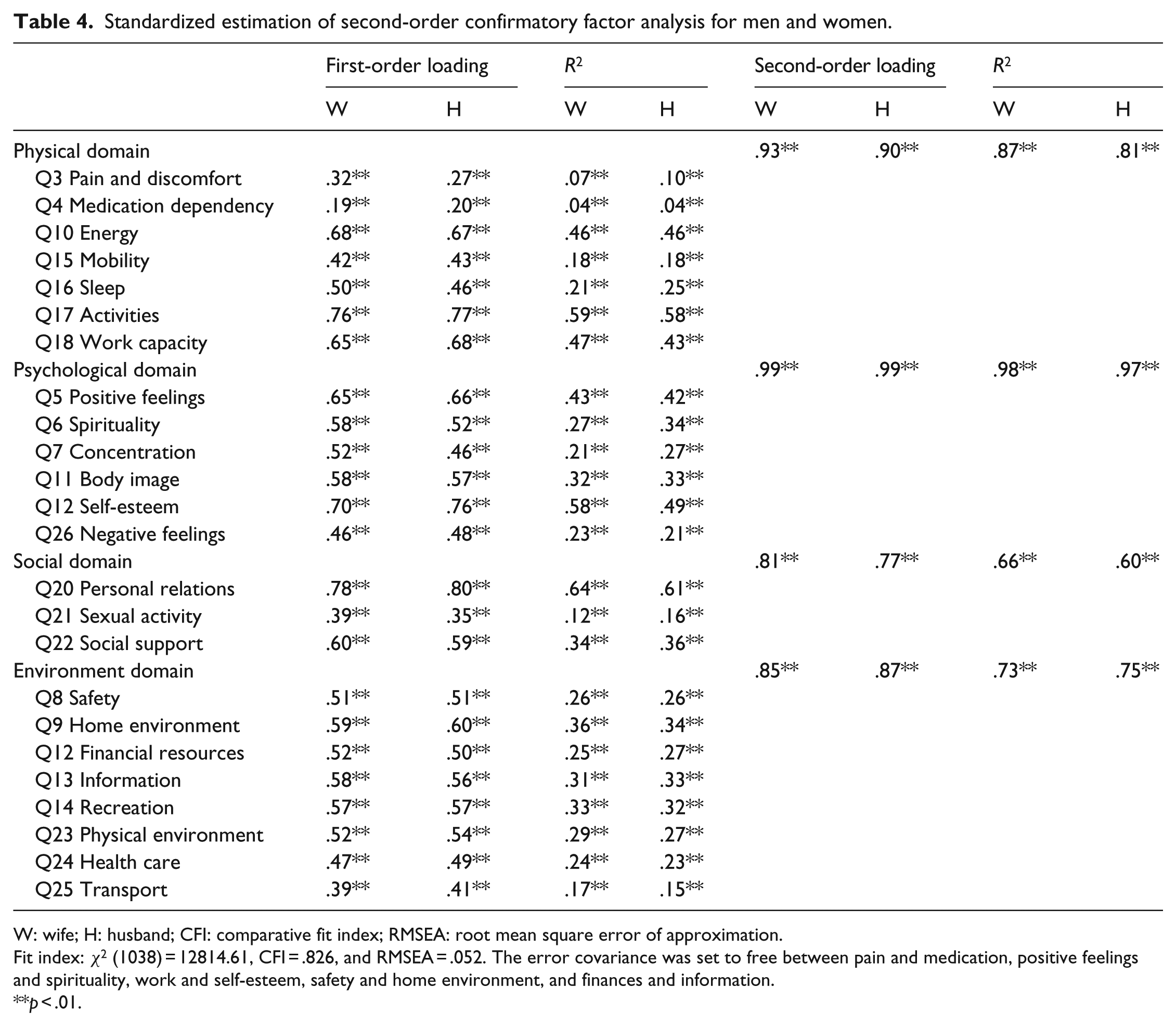
W: wife; H: husband; CFI: comparative fit index; RMSEA: root mean square error of approximation.
Fit index: χ2 (1038) = 12814.61, CFI = .826, and RMSEA = .052. The error covariance was set to free between pain and medication, positive feelings and spirituality, work and self-esteem, safety and home environment, and finances and information.
p < .01.
Domain scores within a couple
We examined the relationships and differences between husbands’ and wives’ domain scores. We first assessed the degree of homogeneity of QOL scores among partners by testing the intraclass correlation coefficient (ICC: R1). The ICCs were R1 = .16, .20, .16, and .34, for physical, psychological, social, and environment domains, respectively. This indicated non-independent data clustered by dyads. We then examined spousal profile similarity in QOL domain scores by computing Pearson product moment correlations separately by gender. The domain scores showed moderate positive correlations both within (husbands, r = .50–.68; wives, r = .42–.64) and across gender (r = .16–.35). Partner similarity was especially high for environment QOL reports. Additionally, significant differences in all domain scores were found between husbands and wives, except for the physical domain (men: M (SD) = 14.35 (2.25), women: M (SD) = 14.30 (2.27), t = 1.17, n.s.). Husbands scored higher in the psychological domain than did wives (men: M (SD) = 14.06 (2.43), women: M (SD) = 13.83 (2.35), t = 4.90, p < .01), whereas wives reported better conditions in social and environment domains than did husbands (social domain, men: M (SD) = 13.0 (2.47), women: M (SD) = 13.73 (2.28), t = 16.55, p < .01; environment domain, men: M (SD) = 13.19 (2.27), women: M (SD) = 13.52 (2.21), t = 8.41, p < .01).
Discussion
We examined the psychometric properties of the Japanese WHOQOL-BREF in a large sample of married adults expecting or raising a child and compared the instrument’s factor structure between partners. The instrument performed well at assessing QOL of Japanese married adults, although some areas require further attention.
Distribution analyses showed that 7 of the 26 items exhibited ceiling effects and skew toward higher scores. These positive QOL scores may reflect how most participants were in good health. However, “pain and discomfort” (Q3) and “medication dependency” (Q4) are of concern because nearly half of responses reached ceiling for both husbands and wives. Furthermore, the contribution of these items to the physical health domain was limited: the variance explained by Q3 was 7 percent for husbands and 10 percent for wives and by Q4 was 4 percent for both. Considering the low dependency on medical treatment and morbidity among adults aged 30–50 years, these items may not serve to differentiate individuals in our sample. Adding an error covariance term between these items and additional four error covariance terms were necessary to gain satisfactory fit. These paired items may have similar content and their adjacent placement may lead to similar responses.
The social-relationships domain demonstrated insufficient internal consistency for husbands and wives, in part because of the small number of items in that domain (Skevington et al., 2004) and the low sensitivity of Q21. As in other Asian countries (Leung et al., 2005; Min et al., 2002; Nedjat et al., 2008; Wang et al., 2006b), “sexual activity” did not work reliably with other items in the social domain. The item’s contribution to the domain was low: 12 percent for husbands and 16 percent for wives, and the high kurtosis may indicate that sexual life is a sensitive topic (Tokuda et al., 2008; Xia et al., 2012). Therefore, survey confidentiality should be emphasized (Li et al., 2009). Alternatively, this item may need rephrasing to better fit the social domain or reorganizing as an independent domain (Wang et al., 2006b). Future studies need to validate the social domain by investigating correlations with other relationship measures.
Discriminant and criterion-related validity analyses demonstrated that the instrument effectively assessed QOL in Japanese married couples with children, in line with previous studies (Li et al., 2009; Skevington et al., 2004; Xia et al., 2012). The construct validity was assessed using dyadic CFA, which allows testing of the instrument’s structure using couples. The fit of the theoretical structure was acceptable, as shown previously (Min et al., 2002; Skevington et al., 2004). Additionally, the similar factor structures for husbands and wives suggested that both interpreted items similarly. Thus, gender differences in QOL can now be interpreted as more than merely differences in how husbands and wives define QOL. Finally, QOL reports were weakly but significantly correlated within couples. Partners agreed strongly in the environment domain, likely because a married couple shares a home environment. Perceptions of health and social relationships, however, were more independent.
This study has several limitations. First, the data were a combination of two distinct groups of married Japanese couples—one with a mean age of 32 and the other with a mean age of 50, and each with their children at considerably different ages. Although the diversity of the sample was warranted, the possible differences among the groups may limit the generalizability of our study. Second, our validation results should be considered preliminary because their verification was based on data distributions and may be arbitrary. Further studies of the Japanese WHOQOL-BREF should examine participants in various relationship stages, including couples without children and unmarried adults. The temporal stability should also be tested and the discriminant validity replicated using other outcome measures such as depression scales, generic health assessments, and screening interviews.
This study has practical implications. Although the Japanese WHOQOL-BREF has been widely used for the elderly and patients, studies among the general population are rare. We revealed acceptable psychometric properties and usefulness of the WHOQOL-BREF to assess QOL of all Japanese adults, especially with families. This is the first study to support the content validity of the WHOQOL-BREF for both husbands and wives, indicating that partner differences are likely to be true differences in QOL. Our results support using the Japanese WHOQOL-BREF among married adults to quantify QOL. This will help researchers study QOL determinants in healthy couples and improve implementation of the instrument.
Footnotes
Declaration of conflicting interests
The author(s) declared no potential conflicts of interest with respect to the research, authorship, and/or publication of this article.
Funding
The QOL and Mental Health across the Life Span Survey, of which the third author is the principal investigator, was funded by the Japan Society for the Promotion of Science, Grants-in-Aid, 24243064.