




Abstract
Background:
Well-established performance measures for organ donation programs do not fully address the complexity and multifactorial nature of organ donation programs such as the influence of relationships and organizational attributes.
Objective:
To synthesize the current evidence on key organizational attributes and processes of international organ donation programs associated with successful outcomes and to generate a framework to categorize those attributes.
Design:
Scoping Review using a mixed methods approach for data extraction.
Setting:
Databases included PubMed, CINAHL, Embase, LILACS, ABI Business ProQuest, Business Source Premier, and gray literature (organ donation association websites, Google Scholar—first 8 pages), and searches for gray literature were performed, and relevant websites were perused.
Sample:
Organ donation programs or processes.
Methods:
We systematically searched the literature to identify any research design, including text and opinion papers and unpublished material (research data, reports, institutional protocols, government documents, etc). Searches were completed on January 2018, updated it in May 2019, and lastly in March 2020. Title, abstracts, and full texts were screened independently by 2 reviewers with disagreements resolved by a third. Data extraction followed a mixed method approach in which we extracted specific details about study characteristics such as type of research, year of publication, origin/country of study, type of journal published, and key findings. Studies included considered definitions and descriptions of success in organ donation programs in any country by considering studies that described (1) attributes associated with success or effectiveness, (2) organ donation processes, (3) quality improvement initiatives, (4) definitions of organ donation program effectiveness, (5) evidence-based practices in organ donation, and (6) improvements or success in such programs. We tabulated the type and frequency of the presence or absence of reported improvement quality indicators and used a qualitative thematic analysis approach to synthesize results.
Results:
A total of 84 articles were included. Quantitative analysis identified that most of the included articles originated from the United States (n = 32, 38%), used quantitative approaches (n = 46, 55%), and were published in transplant journals (n = 34, 40.5%). Qualitative analysis revealed 16 categories that were described as positively influencing success/effectiveness of organ donation programs. Our thematic analysis identified 16 attributes across the 84 articles, which were grouped into 3 categories influencing organ donation programs’ success: context (n = 39, 46%), process (n = 48, 57%), and structural (n = 59, 70%).
Limitations:
Consistent with scoping review methodology, the methodological quality of included studies was not assessed.
Conclusions:
This scoping review identified a number of factors that led to successful outcomes. However, those factors were rarely studied in combination representing a gap in the literature. Therefore, we suggest the development and reporting of primary research investigating and measuring those attributes associated with the performance of organ donation programs holistically.
Trial Registration:
Not applicable.
Introduction
Health care systems must prioritize effective organ donation programs for people requiring life-saving transplants. Accompanying the increasing number of people 65 years plus 1 come chronic diseases such as diabetes and high blood pressure more prevalent in this population. 2 These conditions are major risk factors for end-stage kidney disease,2,3 and kidneys are the most frequently transplanted organs since they can be donated by living or deceased persons. Currently, more than 50 000 Canadians are being treated for kidney failure; 58% receive some form of dialysis. 4 The average cost of dialysis treatment per year in Canada is $56,000 to $107,00. 5 The estimated cost of a kidney transplant in Canada is $100,000 per patient in the first year, and $20,000 in subsequent years for follow-up and drugs, representing a potential cost savings of $116,000 in comparison to dialysis treatment over six years. 6 As kidney transplants are the most common transplant performed, we have a better understanding of the public economic costs of chronic treatment of end-stage organ failure patients versus transplantation than for other organ transplants. However, when the benefit of transplantation is measured with quality-adjusted life-year gained by the procedure, individuals receiving other organs such as heart, 7 lung,8,9 and liver10,11 also benefit. Thus, both people and systems benefit from organ transplantation.
To fulfill every opportunity for donation and reduce the waiting list, organ donation programs must operate optimally. However, well-established performance measures for organ donation programs (ie, number of deceased donors, rate of organs offered and accepted, estimated potential donors, number of cases of brain death per institution, etc.) 12 do not fully address the complexity and multifactorial nature of such programs 13 that include the influence of relationships and organizational attributes. For this reason, we need to consider the organ donation system as a whole rather than as small parts or sectors to identify the components of successful organ donation programs. 13
Objective
This study sought to conduct a scoping review to collate and synthesize the available literature on key organizational attributes and processes of international organ donation programs associated with successful outcomes and to generate a framework to categorize those attributes. This article outlines our review methodology and results, including the identification of the research gap and recommendations for future research. Our review question was: What are the organizational attributes and processes of international organ donation programs associated with success?
Methods
A scoping review can be undertaken for different reasons that include examination of the extent, range, and nature of research activity; dissemination of research findings or identification of gaps in the existing literature 14 ; and clarification of a complex concept and refinement of subsequent research inquires, 15 which is the purpose of this research. This systematic scoping review was conducted in accordance with the Joanna Briggs Institute methodology for scoping reviews.16,17 The research protocol was not published, but the protocol was developed and reviewed by researchers from the Queen’s Collaboration for Health Care Quality JBI Centre of Excellence.
Identifying Relevant Studies
We performed a 3-step search strategy to find both published and unpublished studies. First, we undertook an initial limited search (keywords used were organ donation, program, legislation and policy, effectiveness, and success) of PUBMED and Cumulative Index of Nursing and Allied Health Literature (CINAHL) to identify the best search terms and keywords. Second, a librarian with expertise in systematic reviews assessed the search parameters and then applied by the first author to 6 databases, PUBMED, CINAHL, EMBASE, LILACS, ABI Business ProQuest, and Business Source Premier (Table 1). Third, we searched grey literature on organ donation association websites, Google Scholar (first 8 pages), and Research Gate. Finally, we scanned the reference lists of all identified reports and articles for additional papers, purposely keeping the search broad to capture all possible strategies. We conducted the search in January 2018, updated it in May 2019, and lastly in March 2020. We established no year limit for searches, but only studies published after 1980 were examined as it was around this time that organ transplantation started to become a more common and successful treatment for end-stage organ failure; policies and practices began to be developed and the need for the coordination of organ donation and transplantation was identified. 18 We considered full texts available in Spanish, Portuguese, and/or English.
Search Strategy.

Note. OR = odds ratio.
Study Selection
We exported search results from each database to an EndNote file and then uploaded it into an online data review portal (Covidence). Two reviewers conducted screening and selection for inclusion in accordance with the inclusion criteria described below. Both reviewers also carried out full-text reviews for all potential articles. Both reviewers voted independently to include or exclude each record, resolved their disagreements through discussion, and consulted a third reviewer when required.
Inclusion Criteria
We examined definitions and descriptions of success in organ donation programs in any country by considering studies that described (1) attributes associated with success or effectiveness, (2) organ donation processes, (3) quality improvement initiatives, (4) definitions of organ donation program effectiveness, (5) evidence-based practices in organ donation, and (6) improvements or success in such programs. Specifically, we reviewed documents that described in any level the evaluation of deceased organ donation programs and/or processes. Examples included if a study described national or local organ donation organizations (ODOs) evaluated, a potential organ donor identified, potential organ donors referred from the hospital to the ODO, organ donor maintenance, brain death diagnosis, family interview for organ donation, organ allocation, and/or organ retrieval surgery.
This scoping review considered any research design, including text and opinion papers and unpublished material (research data, reports, institutional protocols, government documents, etc.).
Data Extraction and Charting
We extracted relevant descriptive information from papers included using a template developed specifically for this review. The data extraction included details about the type of research, year of publication, origin/country of study, type of journal published, and key findings. We tabulated the type and frequency of the presence or absence of reported improvement quality indicators. We used NVIVO to perform a qualitative directed content analysis to summarize and synthesize the results from the scoping review. 19 Data were extracted by 2 independent reviewers and the data analysis was an iterative process, in which we used a combination of inductive and deductive coding approaches. Emergent coding was used for emerging themes. 20 During the analysis process, the codes were recorded and matched to find the majority consensus across the data. Data from the qualitative analysis was presented descriptively.
Results
Figure 1 summarizes search results and study selection in an adapted Preferred Reporting Items for Systematic Reviews and Meta-Analyses Extension for Scoping Reviews (PRISMAScR) flow diagram. 21 Of the 10 391 articles identified, we considered 84 papers eligible for this review. Included articles contained direct and indirect descriptions of the effectiveness/success of organ donation programs. The majority of included articles originated from the United States of America (USA) (n = 33, 39%), used quantitative approaches (n = 46, 55%), and were published in transplant journals (n = 33, 39%). Table 2 contains additional information from the included papers.
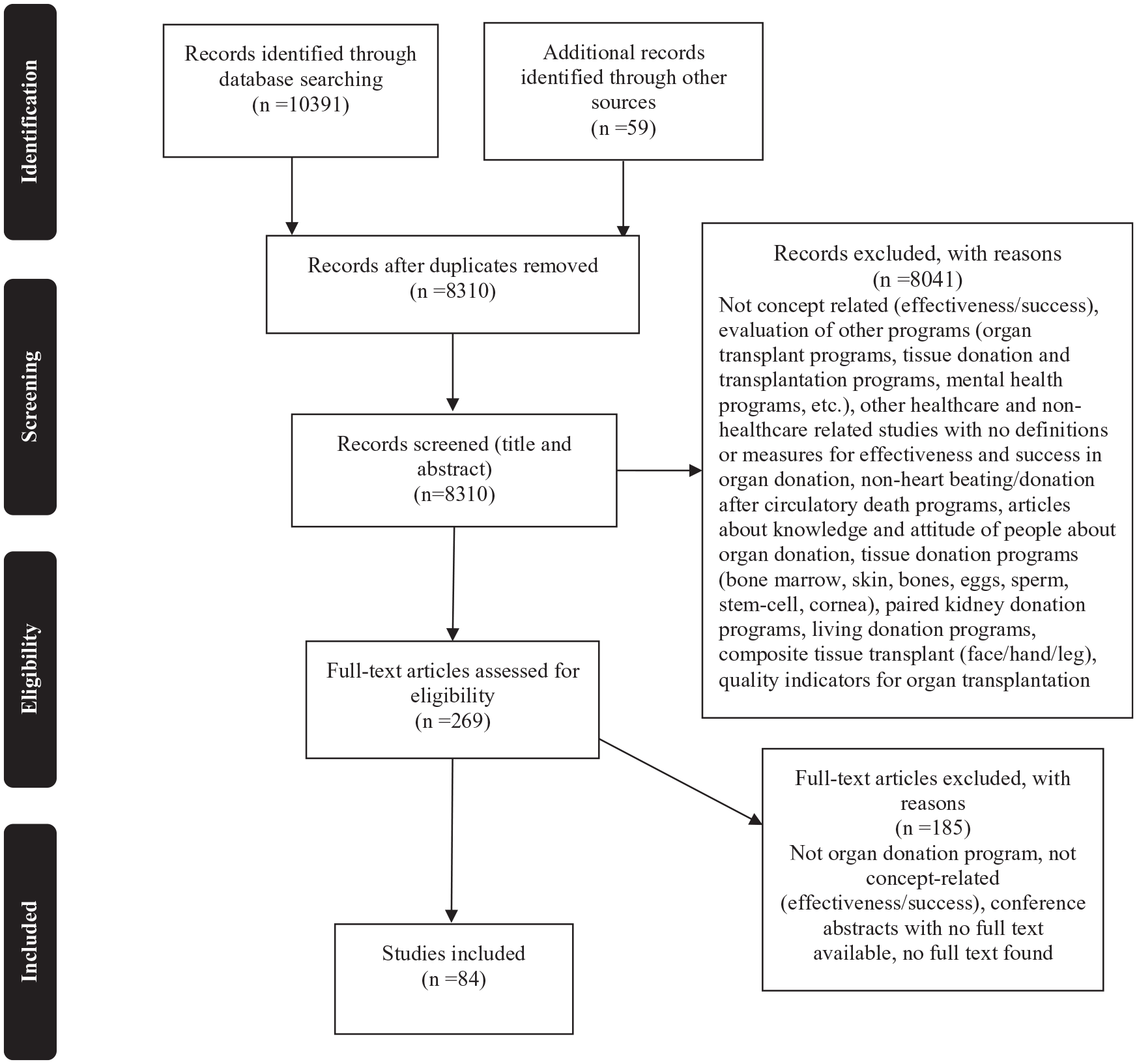
Scoping review results in a modified Preferred Reporting Items for Systematic Reviews and Meta-Analyses Extension for Scoping Reviews (PRISMAScR) diagram.
Data Extracted from the Included Papers.
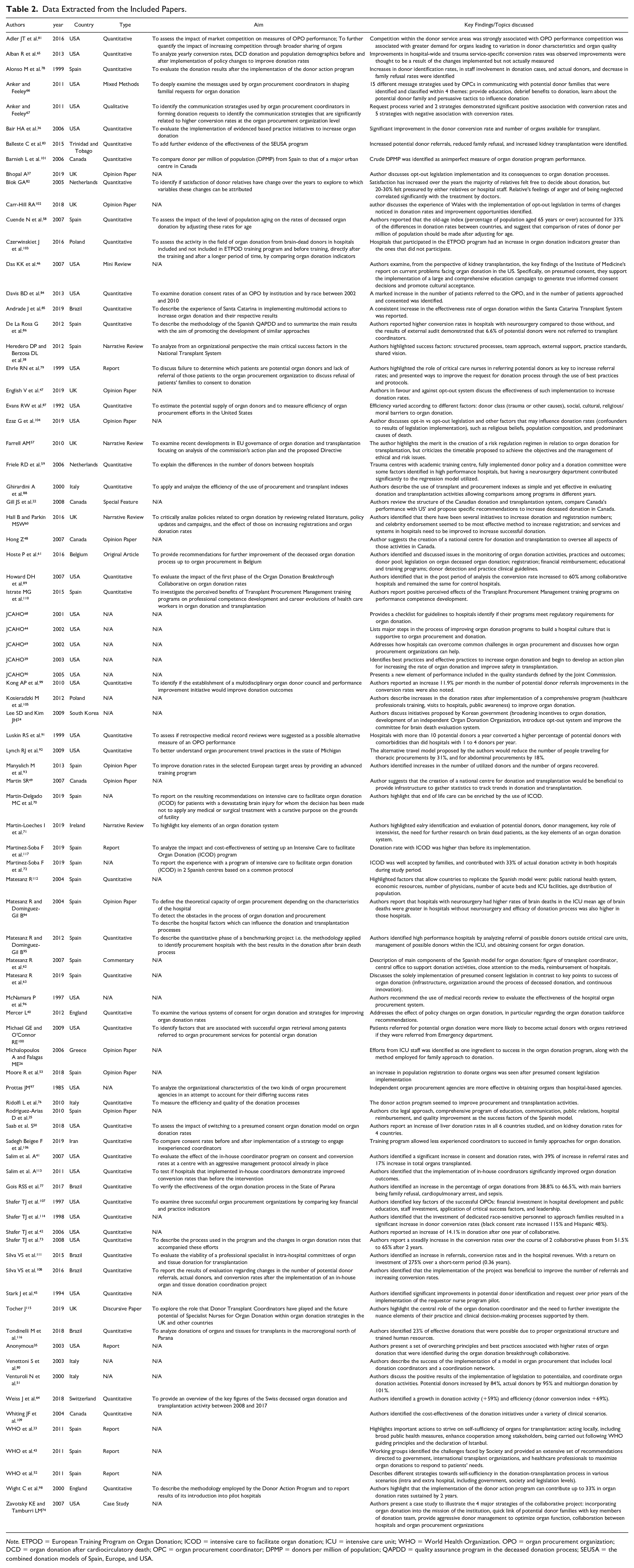
Note. ETPOD = European Training Program on Organ Donation; ICOD = intensive care to facilitate organ donation; ICU = intensive care unit; WHO = World Health Organization. OPO = organ procurement organization; DCD = organ donation after cardiocirculatory death; OPC = organ procurement coordinator; DPMP = donors per million of population; QAPDD = quality assurance program in the deceased donation process; SEUSA = the combined donation models of Spain, Europe, and USA.
Figure 2 presents 16 attributes across 84 articles identified by our thematic analysis. We grouped these into the following 3 categories influencing the success of organ donation programs: (1) context describes the external or organizational environment in which the programs are embedded that might have an impact (positive or negative) on their performance; (2) process denotes any organizational steps or procedures used to facilitate the process; and (3) structures defines any organizational structural components such as financial and human resources, technologies, specialty physicians, etc.

Articles mentioning context, process, or structural factors.
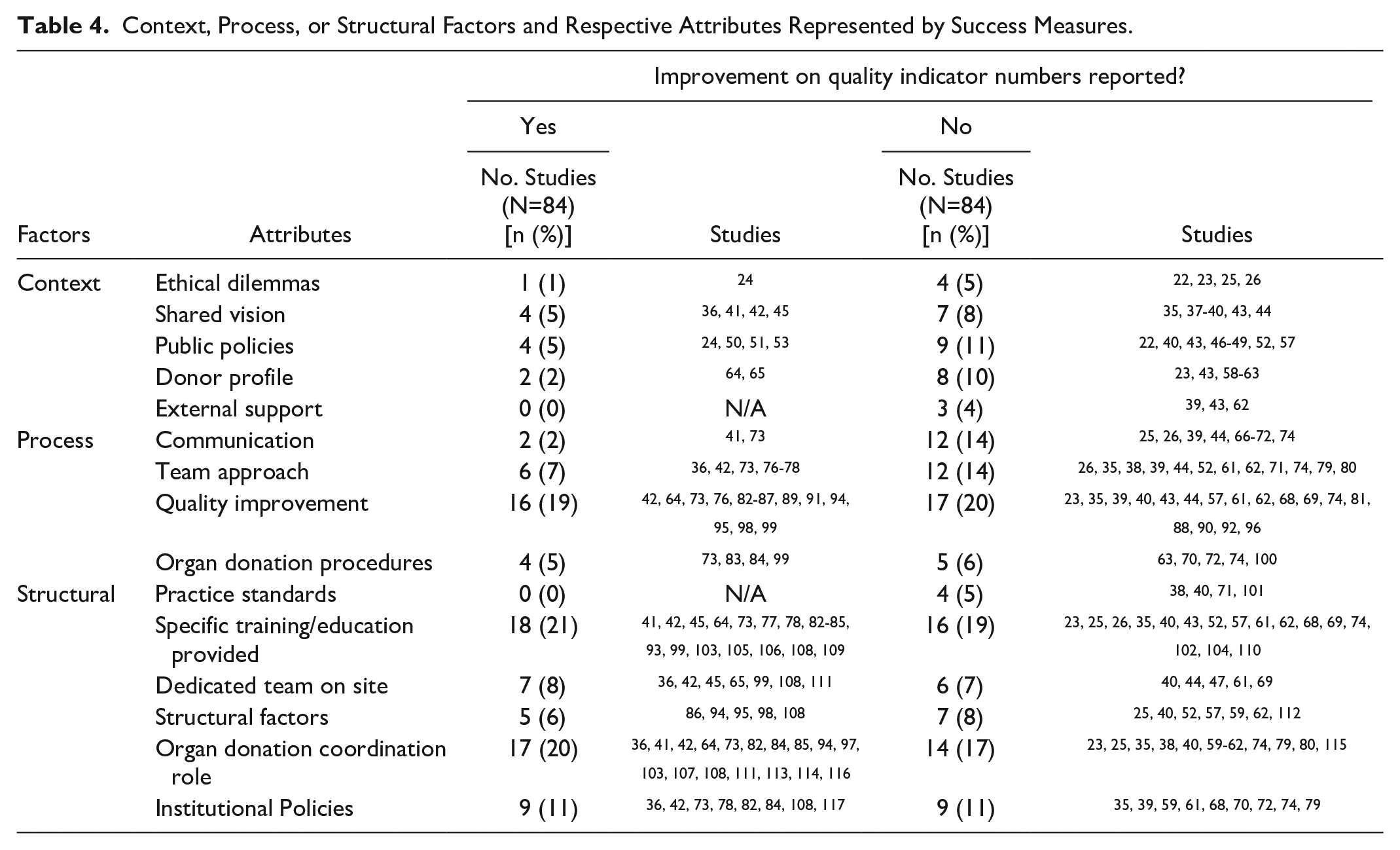
For each category, Table 3 shows relevant attributes collated for each retrieved article and Table 4 highlights the frequency of reporting and if the effects of these attributes were assessed in relation to quality indicators. We developed a conceptual map to better illustrate the results of this scoping review (Figure 3).
Attributes Identified in Retrieved Articles.
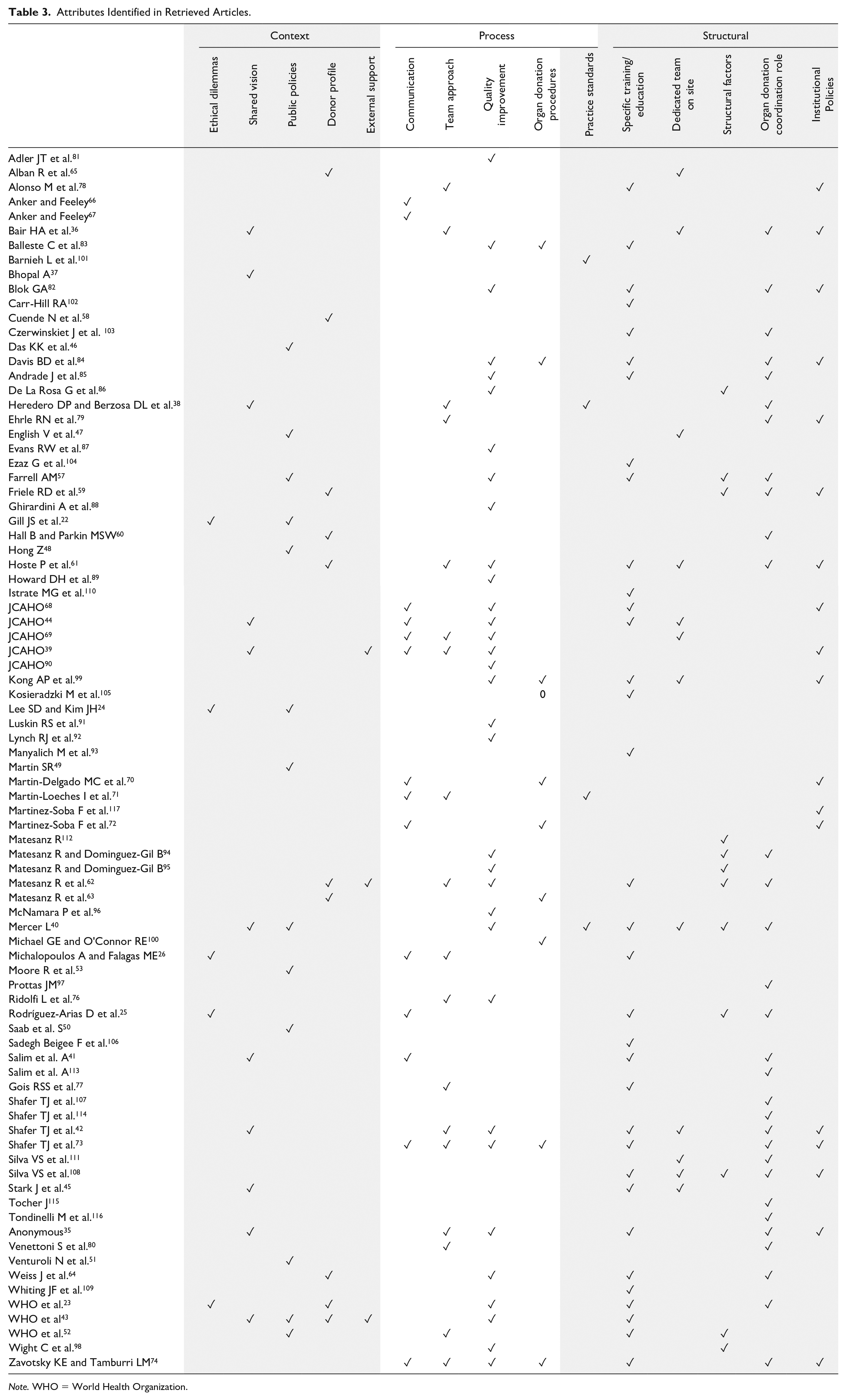
Note. WHO = World Health Organization.
Context, Process, or Structural Factors and Respective Attributes Represented by Success Measures.

Concept map.
Themes and Discussion
Context
Ethical dilemmas
Ethical dilemmas, which we identified in 5 papers,22-26 included reports of practices that could be interpreted as ethically inappropriate or potentially harmful. Inequities in access to transplant programs may influence patients to seek unethical and potentially harmful alternatives: transplant tourism.22,23 Organ donation and transplantation, groups worldwide have been working to either find ways to increase the availability of organs for transplantation or to prevent negative consequences to healthcare systems and patients. 23 Organ selling and lack of control over living donations and over brain death diagnosis prevented an increase in legitimate organ donation rates in South Korea before legislation regulated organ donation and transplantation. 24 In addition, despite worldwide concern regarding the unethical use of monetary incentives to organ donor families, the literature reported this practice,24,25 as well as that of persuading families to donate. 26 ODOs must monitor and employ ethical use of initiatives to improve donation rates. Other ethical dilemmas were not captured with our search strategy, but are worth mentioning. The ethical and moral dilemmas surrounding the motives of people who donate their organs following medical assistance in dying, 27 the fairness of directed organ donation,28,29 the time of death for organ donors after circulatory determination of death patients,30-32 and the family veto on the deceased’s donation decision33,34 are some of the various examples of dilemmas that healthcare professionals working in organ donation programs face.
Shared vision
In 9 papers35-43 we identified shared vision, which included reports of an institutional culture that openly supports and promotes organ donation efforts through incorporating organ donation into policies, procedures, medical records systems, training, staffing, finances, data collection, and/or quality improvement actions. Embedding organ donation with institutional beliefs or mission increases organ donation rates.36,41,42 Heightened awareness of the importance of organ donation sensitizes people to the need and likely leads them to identify potential donors, refer donors to ODOs, influence other colleagues, and collaborate with the organ donation coordinator/organizations during donation processes.35,44 A culture of donation provides seamless integration of organ donation processes 39 as it becomes a usual part of end of life care. 40 Consensus in the design of organ donation processes and a quality improvement program support program goals. 38 Some strategies to implement shared vision include adding the topic to employees’ training and orientation or to organizational messages. 45 In addition, the literature also discusses the importance of developing a culture of donation beyond institutions through engaging not only health professionals but also the general public to increase awareness and overcome misconceptions and cultural/religious barriers.37,43
Public policies
In 12 papers22,24,40,43,46-53 we identified this attribute, which included reports of developing and implementing national or local policies to regulate and organize organ donation and transplantation activities and set actions to improve organ donation rates. National and local policies may lead to successful outcomes in organ donation programs. Even though the president of Spain’s National Transplant Organization states that success in their country’s organ donation rates is not believed to result from opt-out policies, 40 presumed consent may be an alternative to countries that experience consistently low rates. 50 For example, donation rates increased in Wales after presumed consent legislation was implemented. Even though reports about other countries’ experiences with presumed consent legislation did not meet the inclusion criteria for this scoping review, they provide further context. An increase in donation rates was identified in Belgium, Austria, and Singapore, but it was not possible to identify if the increase was a direct consequence of the legislation changes or with the increased publicity and infrastructure improvements implemented at the same time, 54 whereas for other countries such as Chile 55 and Brazil, 56 the implementation had negative effects on donation numbers. When evidence-based strategies to improve donation rates are promoted through publicity, public education, and infrastructure improvements, increased donation rates are more likely to occur.46,47,51 National transplant organizations that provide national oversight and supportive legislation effectively manage regulations, professional standards and ethics,21,23,42,51 monitoring and evaluating organ donation and transplantation programs,47,48 and quality and safety, 56 and consequently increase organ donation rates. National standardization of quality improvement policies for organ donation across different jurisdictions increases government accountability and the quality of the organ donation program. 22 Therefore, a combination of national, standardized policies, coupled with appropriate program investment, contributes to successful outcomes.
Donor profile
In 9 papers23,43,58-63 we identified this attribute, which included reports of the type of organ donor (neurological determination of death or donation after circulatory determination of death—DCD), or any information pertaining to the individual donor (ie, age, sex, race, etc). The scarcity of transplant organs often influences the transplant community to seek alternatives. Even though donation potential increases with aging populations, younger donors have higher conversion rates. 58 Therefore, programs that consider donation after cardiocirculatory determination of death increase the donor pool for potential organs.23,43,59-62,64,65 Also, since using organs from expanded criteria donors and nonstandard risk donors contributes to the pool,43,63 such use may be cautiously considered a beneficial practice.
External support
In 3 papers39,43,62 we identified this attribute of external institutions such as ODOs, external organ and tissue donation coordinators (OTDCs), and laboratories providing organizational support to hospitals for organ donation programs and/or activities. Hospitals benefit from an external support system to manage organ donation. A central office to support the activities of organ donation such as transportation and developing the donation and transplantation process has been essential to the success of such activities especially in small hospitals lacking the capacity to solely develop and sustain donation activities. 62 Centralized support is recommended by working groups of the Third Global Consultation on Organ Donation and Transplantation, organized by the World Health Organization in collaboration with the Spanish National Transplant Organization (Organización Nacional de Transplantes) and The Transplantation Society. 43 The literature describes integrated donation process management as one strategy to improve donation conversion rates as ODOs providing resources for donation-related activities while receiving leadership support from the hospital. 39
Process Factors
Communication
We identified this attribute, which included reports of the ability to communicate effectively or not with families, the healthcare team, and ODOs, in 14 papers.25,26,39,41,44,66-74 Effective communication may impact the performance of organ donation programs positively or negatively. Family interviews related to organ donation present a challenging step in the organ donation process. Trained professionals perform a smooth family interview and provide adequate information for families to make an informed decision.25,39,44,68-70,73 But even trained professionals should be aware that some topics, such as talking about benefits of organ donation before familial consent and asking about patients’ character traits when alive, may negatively impact family consent.66,67 However, as the organ donation program in Greece illustrates, communication strategies can be used to both obtain consent and discuss the merit and importance of organ donation. 26
Continuous sharing of information facilitates family involvement in the process. Communication regarding the confirmation of irreversible brain injury and death is difficult. Each family needs its own time, to hear, understand, and internalize confirmation of death before proceeding with donation discussions.41,71,72 After the donation, communication with family should continue through the sharing of personal matters such as important phone numbers and how to prepare for funerals and empathetic documents such as a sympathy letter and a nondenominational bereavement poem sent to donor families. 74 We should also highlight a report of recommendations of leading practices in offering the opportunity for organ donation that was not yielded in our search strategy, but that supports the importance of effective communication during end-of-life conversations. 75 Examples of recommendations included effective conversations with families by using collaborative, compassionate, and supporting approach, and providing meaningful information regarding donation and its value; planning family conversations in a team huddle with members of healthcare team beforehand; communicating grave diagnosis or death prior and separate from conversations about donation; ensuring informed decisions of families; using confident and positive approach rather than a guarded apologetic approach; sensitively discussing reasons for refusals; supporting families during all steps of the donation process and postdonation. 75
Team approach
In 17 papers26,35,36,38,39,42,52,61,62,71,74,76-80 we identified this attribute that included the involvement of intensive care unit (ICU) teams and organ donation coordinators in the donation process. Ongoing collaboration among hospital and ODO staff is considered key to the success of various donation programs.36,62,69,76 Increasing the rates of staff involvement with organ donation procedures,26,42,52 as well as having a multidisciplinary team involved seems to be an important step toward increasing organ donation rates. 78 That is because early referral was identified as essential to successful organ donation processes, 39 and low donor identification, or referral rates, or lack of donor referral are the main barriers organ donation programs face.61,79 Studies recognized the importance of donor coordinators defining and maintaining a network of interpersonal relationships with various individuals at the hospital level.35,42,74 Performance of organ donation programs depends on effective communication and a working relationship between the organ donor coordinator and hospital staff for joint and shared work.71,80 Ideally, a horizontal relationship working jointly toward improving the donation process should recognize the value of each team member’s contribution, integrate activities, and give staff responsibilities and autonomy in decision-making.38,77
Quality improvement
We identified this attribute, which included any initiatives hospitals and ODOs and programs implement to increase quality in organ donation processes, in 34 papers.23,35,36,39,40,42-44,57,61,62,64,69,73,74,76,81-98 Initiatives that improve quality and safety include using internal and/or external audits of organ donation activities and quality indicators to measure program performance to identify improvement opportunities in the donation processes,61,62,83,86 and establishing a structured quality improvement/assurance program that incorporates audits and evaluates program performance through various methods such as death record reviews, outcomes review (analysis of quality indicators), and efficiency indexes.23,35,39,40,42-44,57,61,64,68,69,73,74,76,81,85,86,88,91,94,96,98,99 Implementing collaborative programs84,89 or benchmarking methods, 95 to discharge interventions associated with higher levels of performance in high-performing ODOs, improved efficiency. 92 In addition, a comprehensive and standardized approach to quality and safety in organ donation and transplantation was highlighted as a key factor in overcoming the challenge of increasing organ availability worldwide, including adequate donor management throughout donation process steps. 23 Conversion rates have been used as measures of efficiency of donation programs, 87 but the inclusion of other measures of success, such as the satisfaction of donor relatives about the treatment received during the donation process, should be considered. 82 Including patient partners in research, as well as clinicians and OTDCs, would support a more thorough investigation as it would bring knowledge users and researchers together to discuss their practice needs, research methods development, and interpretation of results.
Organ donation procedures
We identified this attribute, which included any recommendations or actions within the context of the role of OTDCs in acute care settings in any part or the whole deceased organ donation process, in 8 papers.23,61,63,66,67,73,74,83,84,94,99,100 One action, to implement interventions in organ donation procedures to improve referral rates, is to use an electronic system to report potential donors to organ donation coordinators in the early stages of a case. 83 Another tool used in the USA is the use of clinical triggers (physiologic and anatomic criteria) to allow easier and timely identification of organ donors by ICU staff. 84 In addition, a review system to evaluate all aspects of the donation process (family approach, donor maintenance, and acceptance of organs for transplantation) was shown to improve timely notification rates. 99 Improving notification rates is one of the key strategies in Spain’s successful donation rates. Equally important is incorporating discussions about organ donation in the context of end-of-life care.63,100 Also highlighted, early referral should be implemented in low performer hospitals to increase donation rates in the USA, 73 as well as early linkage of potential donor families with organ donation coordinators.73,74
Structural Factors
Practice standards
We identified this attribute, which included any description of standardized organ donation practices, evaluation, and measurements, in 8 papers.23,25,38,40,63,71,85,101 Literature highlighted the importance of standardized measures to evaluate a program’s effectiveness. Population demographics may influence the crude measure of donor per million of population, and the definition of effective donors varies worldwide. 101 If not standardized worldwide, that variation in organ donation practices and measurements might inflate or underestimate a program’s performance. As an example, some organ donation programs consider as effective donors those with organs retrieved but not necessarily transplanted, whereas other programs consider that measure only if at least one organ was transplanted. 101
Standardization of organ donation practices is also one of the factors that may influence the excellence of organ donation programs. Proper assignment of tasks and procedures allows individuals involved in the donation processes to anticipate potential deviances from the normal processes with timely communication to the OTDC to rapidly respond with solutions to correct the deviations. 38 Besides, guidelines outlining clinical triggers for donor referral 40 and goal-directed checklists have been reported as important tools to decrease donor loss. 71 Finally, developing a common accreditation system for organ donation and transplantation programs provides minimum quality and safety requirements such as traceability of organs and reporting of adverse events. 23
Specific training and/or education
We identified the attribute of either formal academic or professional training for OTDCs or healthcare professional involved in the organ donation processes in 35 papers.23,25,35,40-43,47,52,57,61,62,64,65,69,73,74,77,78,82-85,93,99,102-109 Successful outcomes in organ donation programs depend on ensuring that involved individuals are well-informed. Training programs are cost-effective 109 and have positive perceived effects on healthcare professionals’ practices. 110 While educating employees allows them to recognize and refer possible donors earlier in the process45,52,74 and facilitate steps, 52 training programs should be adapted to each level, that is, basic knowledge to hospital staff, in-depth training to donation coordinators.23,25,57,62,64,73,78,83-85,99,103,104,108 Furthermore, specific training (ie, on effective and empathetic communication with donor relatives) boosts the number of consent rates and organ donors,61,77,82,93,102,105,106,109 donor relatives’ satisfaction with the donation process, 82 and is recommended as one key strategy to improve donation numbers.40,68,69 Specific training inspires hospital staff to become committed to the organ donation cause and increase conversion rates. 26 Thus, training sessions should be offered at least every 1 to 2 years,35,41,42,103 or yearly (ie, during organ donation awareness month) 74 to ensure their effectiveness. There is also a need for public education through school curricula and health professional schools to increase awareness. 43
Dedicated team on site
In 15 papers we identified the attribute of dedicated team on site, meaning having hospital staff either nominated as support personnel to organ donation cases or who volunteer into this role in addition to their usual activities.24,35,36,40-42,45,47,65,77,84,99,108,111 Studies highlighted the formalization of a team of ICU healthcare providers to support organ donation as contributing to increased donation rates. The role of “donation champions” or “certified nurse requestors” contributes to improve conversion rates,36,40,42,45,47,65 donation rates, 84 and organ donation programs in general.35,44 In addition, studies report that implementing organ donation committees contributes to increasing donation rates.61,85,99,108,111 One study suggested identifying and utilizing the strengths and experiences of critical care and intensive care staff usually passionate about organ donation to improve compliance in other areas such as emergency departments. 69
Structural factors
We identified this attribute, which includes factors embedded in the physical, economic, or organizational structures of hospitals and organ donation programs, in 15 papers.23,25,40,43,57,59,60,62,83,86,94,95,98,108,112 A structured donation program reduces costs and maximizes organ donations.23,109 The development of a donation committee may help increase hospital staff support to organ donation. 98 Successfully implementing a deceased organ donation program includes establishing dedicated human resources to organ donation activities40,83 and a central administrative agency to coordinate and support all processes of organ donation (ie, an ODO).40,57 Ideally, adequate reimbursement of hospitals’ procurement and transplant activities25,62,108,112 and overall financing of organ donation programs 52 should be provided. Hospital characteristics, such as having a neurosurgery department,59,62,86,94,95,112 availability of ICU beds,62,94,95,112 computerized tomography,62,94,95,112 concentration of population,62,94,95,112 and number of nurses and physicians per acute care bed25,62,94,95,112 were identified as positively influencing the number of organ donors.
OTDC role
We defined the OTDC role as a trained professional dedicated to managing the entirety of the organ donation process, represented either in the role of the OTDC or a transplant coordinator, an attribute we identified in 32 papers.23,25,35,36,38,40-42,57,59-62,64,68,73,74,79,80,82,84,85,94,97,103,107,108,111,113-116 Five articles mentioned physicians filling the role,57,61,62,80,94 and 10 in which nurses did,40,41,60,61,108,111,113-116 but 18 articles did not specify the coordinator’s profession.23,25,35,36,38,42,59,64,68,73,74,79,82,84,85,97,103,107 Leadership is key in organ donation success. The role of a full-time transplant coordinator benefits organ donation rates’ increase41,42,57,59,62,73,74,80,84,94,97,107,108,111,113-115 because the coordinator’s expertise in liaising between hospital staff and ODOs 36 allows early identification of potential organ donors 25 and increases the quality and safety of organs retrieved. 61 In addition, not only are families more satisfied with the donation process in the presence of an OTDC, 82 but also studies support and recommend the role.23,40,103 Therefore, studies advocate appropriate remuneration of transplant coordinators’ work particularly in some programs where coordinators work voluntarily in parallel with other roles in the hospital such as ICU nurse.64,85 Ideally, OTDCs should have critical care training and knowledge of donation and transplantation processes, as that allows better management of the donation process 38 and increased rates of success for donation requests.35,60,79,116
Institutional policies
In 19 papers we identified this attribute as (1) documenting the specifics of operationalization of organ donation processes in institutional policies, and (2) describing the roles, responsibilities, steps of organ donation, and processes to have access to specific laboratory or image exams, etc.35,36,39,42,57,59,61,68,70,72-74,78,79,82,84,99,108,117 Reports indicated implementing guidelines and policies to describe the different parts of the donation process (including DCD policies) as one of the solutions to overcome challenges such as low rates of staff involvement in donation procedures, low donor identification rates, in-hospital organizational problems, 78 improvement of organ donation rates,35,36,59,73,84 and family satisfaction with the donation process. 82 Examples of protocols include the description of procedures for timely referral of potential donors,39,61,68,70,72 processes to inform potential donors’ families about the option to donate,39,61,68,72 description of intensive care measures for organ donor maintenance,39,61,68,72,74,108,117 and management of DCD donors. 99 In addition, studies noted that implementing practice protocols for requesting consent for organ donation enhanced the sensitivity and effectiveness of the organ donation and procurement process.42,79
Limitations
Limitations of this scoping review include the possible omission of evidence in languages other than English, Portuguese, and Spanish and the focus on breadth rather than depth of evidence. Therefore, consistent with scoping review methodology, the methodological quality of included studies was not assessed. Even though this method was appropriate for this review, given our objective of mapping the evidence on indicators related to organ donation success, the search strategy employed may have omitted evidence. The results of this scoping review have identified the multi-factorial nature of the processes and structures within the organ donation process.
Conclusions
This scoping review did not identify a single path to success in organ donation programs, but did identify a number of processes as well as structural and contextual factors that contribute to the success of such programs. However, studies examined those factors independently not accounting to the potential association between them to the performance of organ donation programs demonstrating an important gap in the literature. Therefore, further research is needed to holistically identify and measure attributes associated with successful organ donation programs. We recommend wide reporting of primary research, including in peer-reviewed journals, investigating the combination of factors described in this scoping review and the performance of organ donation programs in terms of quality indicators including aspects such as family satisfaction with the process. That would enable performance of systematic reviews, development of evidence-based protocols for clinical guidance, and implementation of behavioural interventions in organ donation teams to improve process quality.
Footnotes
Acknowledgements
Data or materials are not available for this article.This scoping review was part of a doctoral project that contributed toward a PhD (Nursing) from Queen’s University, Ontario, Canada. We would like to acknowledge Queen’s Collaboration for Healthcare Quality at JBI Centre of Excellence team that guided the development of this scoping review.
Ethics Approval and Consent to Participate
Ethics approval and consent to participate was not required for this publication.
Consent for Publication
All authors have given their consent for publication of this article
Availability of Data and Materials
Data or materials are not available for this article.
Declaration of Conflicting Interests
The author(s) declared the following potential conflicts of interest with respect to the research, authorship, and/or publication of this article: Vanessa Silva e Silva received a doctoral fellowship from the Kidney Foundation of Canada and the KRESCENT Program to complete this study as part of her doctoral thesis work.
Funding
The author(s) disclosed receipt of the following financial support for the research, authorship, and/or publication of this article: The doctoral student’s salary was funded by Kidney Foundation of Canada and the KRESCENT Program.
