



Abstract
Objectives
The aim of this study is to investigate potential inter-continental mental health differences in journalists covering climate-related events.
Design
Descriptive, cross sectional.
Setting
Internet-based study.
Participants
Journalists recruited from the Oxford Climate Journalist Network: 268 of 561 (48.6%) journalists from 89 countries completed the study.
Main Outcome Measures
Questions related to physical threat and loss secondary to climate change. Symptoms of anxiety (Generalized Anxiety Disorder-7-item scale [GAD-7]), depression (Patient Health Questionnaire-9 [PHQ-9]), posttraumatic stress disorder (PCL-5) and Moral Injury (Toronto Moral Injury Scale for Journalists [TMIS-J]).
Results
More African and Asian journalists felt physically threatened than journalists in Europe (p < .001 and p = .002, respectively). More journalists in Africa had lost a family member to climate change than journalists in the Americas (p = .009), and Asia and Europe (p < .001 for both). More journalists in Africa, Asia, and the Americas had lost a friend to climate change compared to journalists in Europe (p < .001, p = .003, and p = .001, respectively). There were higher PTSD-intrusion scores in African and Asian than European journalists (p = .001 and p < .001, respectively) and higher PTSD-avoidance scores in African and Asian than European journalists (p = .014 and p = .001, respectively. African and Asian journalists were less likely to receive psychotherapy than European journalists (p < .001 for both).
Conclusions
Given the enduring challenges posed by climate change, addressing these inequalities in journalists’ care should not be delayed any further.
Climate change is considered an existential threat. 1 The health-related consequences that come with it are considerable, encompassing an array of physical and mental health difficulties.2,3 The psychological concerns generated by extreme weather have spawned a new lexicon to describe what people are feeling: ecological grief, eco-distress, eco-anxiety, climate anxiety, global dread, and generation dread reflect the current zeitgeist. 4
While no part of our planet has escaped climate change, there are some countries affected more severely than others. COP27 (the 27th session of the Conference of the Parties to the United Nations Framework Convention on Climate Change) identified 10 countries considered particularly vulnerable, seven of which are in Africa. As the International Rescue Committee, a humanitarian organisation that was the brainchild of Albert Einstein amongst others, trenchantly noted, none of these countries is a major contributor to the crisis that now threatens their future. 5
Journalists play a key role in keeping us informed about climate change. The work can prove dangerous. According to a UNESCO report, 749 journalists from 89 countries reporting on environmental issues between 2009 and 2023 have been attacked. In half of these cases, the perpetrators were state actors. Over 300 of these attacks occurred in the last five years. Since 2009, 44 journalists from 15 countries reporting on climate topics have been murdered. In only five of these cases, was there a conviction. The threats confronted by climate journalists extend beyond assault and murder. State actors have resorted to Strategic Lawsuit Against Public Participation (SLAPP) to silence journalists. Thirty-nine journalists covering climate issues have been imprisoned between 2009 and 2023 as a result. Journalists’ concerns about their personal safety, the harm that might come to their sources and the possibility of their climate coverage conflicting with the interests of their employers and advertisers have led to self-censorship. 6
To date, there are little psychological data that focus on climate change journalists and their responses to the hazards that come with this work. This contrasts with numerous studies describing the psychological state of journalists covering war, the migration crisis, natural/man-made disasters and the COVID-19 pandemic.7–10 In addition, this lack of data extends to determining whether differences in the regional impact of climate change extend to regional differences in the stressors, threats and psychological difficulties for journalists covering climate events.
Given the above gaps in our knowledge, the aim of the present study is to investigate potential inter-continental mental health differences in journalists who cover climate-related events. We hypothesise that journalists exposed to greater dangers in their line of work are more likely to reside in the regions more vulnerable to the effects of climate change and that this exposure will be associated with more severe symptoms of emotional trauma.
Method
Journalists were recruited from the alumni community of the Oxford Climate Journalist Network at Oxford University.
Procedures: An email invitation to take part in the study provided the journalists with a link to a website created for the study. Informed consent was collected through an online form by clicking on the consent button before journalists were granted access to the survey. The survey was completed by 268 (48.6%) of the 561 journalists contacted.
Measures
Demographic data: age, sex, marital status, continent of residence, and years working as a journalist. Climate change questions:
Is climate change journalism a significant part of your work? How important is climate change journalism to you? Do you cover climate change mostly in the field or at your desk? Are you exposed to climate disinformation in your work? Have you ever taken a break from covering climate due to the impact on your mental health? Have you changed your job in order to focus more on climate change topics? Do you feel your work is influencing the discussion on climate change? Have you been threatened online or harassed in response to your work on climate change? Do you feel physically threatened because of your work covering climate change? Have you been affected personally by climate change (been evacuated, lost a family member, friend, or home)? Do you experience the following emotions when you think about climate change in relation to your work? (anger, shame, guilt, disgust, despair). Psychometric data:
Symptoms of anxiety over the past two weeks measured by the Generalized Anxiety Disorder-7-item scale (GAD-7), consisting of seven questions scored on a 4-point Likert scale.
11
GAD-7 scores are stratified into four levels of symptom severity: minimal, mild, moderate, and severe anxiety. Cronbach’s α = .911. Symptoms of depression over the past two weeks measured by the Patient Health Questionnaire (PHQ-9) consisting of nine questions scored on a 4-point Likert scale.
12
Scores on the PHQ-9 are stratified into five symptom severity levels: none-minimal, mild, moderate, moderately severe, and severe depression. Cronbach’s α = .898. Symptoms of posttraumatic stress disorder (PTSD) over the past month measured by the PTSD Checklist for DSM–5 (PCL-5) consisting of 20 questions scored on a 5-point Likert scale.
13
The PCL-5 contains four symptom groups: Intrusion, Avoidance, Negative Thoughts, and Hyperarousal. The wording of the PCL-5 stressor criterion was adjusted to instruct journalists to focus on their climate work. Cronbach α = .965. The nine-item Toronto Moral Injury Scale for Journalists (TMIS-J) was used to measure moral injury.
14
Responses were scored on a 5-point Likert scale. Instructions were adjusted slightly to instruct journalists to focus on their climate work. Cronbach α = .905. Questions on stress and employer support:
What is the level of psychological support given to you by your news organisation in relation to your climate change work? This was rated on a 0 to 10 scale, with higher scores indicating more support. Have you ever seen a mental health professional (no, never; yes, for work trauma-related problems; yes, for personal reasons, yes, for both trauma-related and personal reasons)? Have resources for mental health and physical safety been made available to you through your news organisation? Does your news organization have protocols for mental health to prepare for and cope with potentially distressing climate assignments (e.g. pre-assignment counselling, debriefing sessions, and access to mental health professionals)?
Statistical plan
The sample of journalists was divided according to the continent in which they were working and covering climate change events. Given that only three journalists resided in Oceania, they were excluded from further analysis. This left four groups of journalists from Africa (n = 69), Asia (n = 68), Europe (n = 79), and the Americas (n = 49). The latter group included journalists from South (n = 25) and North (n = 24) America. They were combined to give a sample size roughly equivalent to the three other continental groups. Of note is that there were no statistically significant differences between journalists from the two Americas when it came to sex (p = .812), age (p = .998), years worked as a journalist (p = .727), online threats and harassment (p = .326), physical threats due to climate coverage (p = .470), and whether they had been affected personally by climate change through evacuation (p = .576), loss of family (p = .302), friends (p = .072), or home (p = .302).
Between group comparisons were undertaken with One-way ANOVA with post-hoc Tukey analysis for continuous and chi-square analysis for ordinal variables. Correlations were sought with Pearson's and Spearman's coefficients according the nature of the data being analysed. Significance was set at p = .01 to control for multiple comparisons.
Results
A group of 268 journalists from 89 countries across five continents agreed to take part. There were no missing data as all questions were mandatory. The mean age of our sample was 38.50 (SD = 8.23) years and mean duration of work as a journalist was 13.82 (SD = 7.85) years. The breakdown according to sex and marital status was as follows; 159 (60%) women and 161 (60.8%) married.
Demographic comparisons: There were no significant inter-continental demographic differences between journalists (see Table 1).
Demographic data.
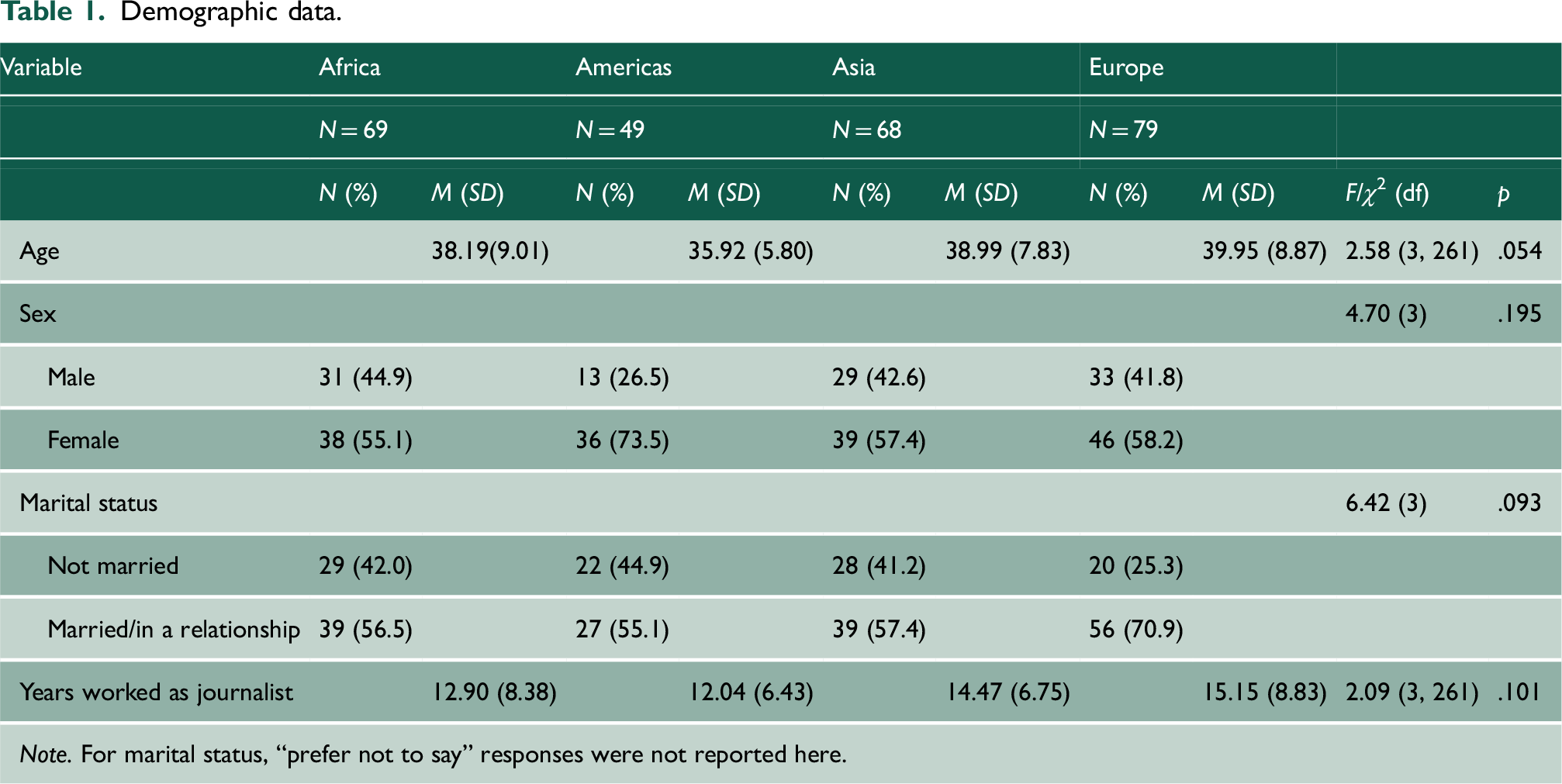
Note. For marital status, “prefer not to say” responses were not reported here.
Climate change data: Between group statistically significant differences were present with respect to the following questions: How important is climate change journalism to you; Do you cover climate change most in the field or at your desk; Do you feel physically threatened by your climate change work; Have you personally been affected by climate change through the loss of a family member or friend (see Table 2). Post-hoc analyses revealed that journalists in the Americas viewed climate change work as more important than their colleagues in Europe (p = .008). African, Asian, and American journalists were more likely to cover climate change stories in the field rather than the office compared to journalists in Europe (p < .001 for Africa and Asia, p = .001 for the Americas). More African and Asian journalists felt physically threatened than journalists in Europe (p < .001 and p = .002 respectively). More journalists in Africa had lost a family member than journalists in the Americas (p = .009) and Asia and Europe (p < .001 for both). More journalists in Africa, Asia and the Americas had lost a friend compared to journalists in Europe (p < .001, p = .003, and p = .001, respectively). While there was no significant difference across journalists in the four continents when it came to being evacuated because of climate change (p = .075), a post hoc analysis revealed evacuation was more frequent in Asian than European journalists (p = .014).
Climate change data.

Note. The question “How important is climate change journalism to you?” was rated on a scale from 0 (not important) to 10 (extremely important).
Psychometric data: There were no significant differences in symptoms of anxiety and depression or features of moral injury between journalists on the four continents (see Table 3). Between group differences in PTSD symptoms were present on the PCL-5 with post-hoc Tukey analyses revealing higher intrusion scores in African and Asian than European journalists (p = .001 and p < .001, respectively), higher avoidance scores in African and Asian than European journalists (p = .014 and p = .001, respectively) and higher hyperarousal scores in Asian than European journalists (p = .003). The emotions associated with moral injury, in decreasing order of frequency were despair (77.6%), anger (73.9%), guilt (48.5%), disgust (43.3%), and shame (31.3%).
Psychometric data.

Note. GAD-7 = Generalized Anxiety Disorder-7-item scale. PHQ-9 = Patient Health Questionnaire-9 total scores. PCL-5 = PTSD checklist for DSM-5 total scores. TMIS-J = Toronto Moral Injury Scale for Journalists total scores.
Stress and employer support: Journalists across the four continents rated the level of psychological support provided by their news organisations as poor, with mental health protocols seldom in place (see Table 4). Significant differences across continents were present when it came to psychological therapy with post-hoc analyses showing that African and Asian journalists were less likely to receive it than European journalists (p < .001 for both). A similar result pertained to African journalists in relation to their colleagues in the Americas (p < .001).
Stress and employer support.

Note. The item “Level of psychological support by your news organization in relation to climate change work” was rated on a scale from 0 (none) to 10 (a lot).
Discussion
Our study revealed significant intercontinental differences between journalists who cover climate change events. In keeping with our hypothesis, we found that journalists in regions more vulnerable to climate change, particularly in Africa and Asia, are under more threat physically than their colleagues in Europe and the Americas, are more likely to cover climate events out in the field rather than the news room, and in the case of Africa alone, more likely to have lost a relative to the direct effects of climate change. These work-related differences are associated with more severe symptoms of PTSD. Adding to this troubling profile, journalists in Africa and Asia are less likely to receive psychological help for these difficulties than their colleagues elsewhere.
While our study is predominantly descriptive and not designed to elucidate etiological factors, certain associations are notable for their potential etiological significance. Two of these in particular deserve further comment. First, direct exposure in the field to climate related stressors is potentially more traumatic than vicarious exposure in a newsroom. Proximity to traumatic stressors is considered a major determinant of PTSD symptoms in general and our data would seem to support this. 15 Second, the above observation meshes with our finding that African and Asian journalists feel physically more threatened than their colleagues elsewhere when it comes to their climate change work. Threat, which in the case of some African journalists has translated into loss of friends and family, is another potentially significant causative factor for symptoms of PTSD in the broader psychological trauma literature. 16 This finding has been replicated in studies of veterans, natural disasters and civilian accidents.9,17,18 Taken collectively, heightened physical threats, proximity to stressors and traumatic loss of loved ones provide clues as to why journalists in Africa and Asia report more PTSD symptoms than their colleagues in Europe and the Americas. Notwithstanding these regional differences, African and Asian journalists compared to those in Europe and the Americas were not more likely to have taken a break from climate reporting due to the impact of work on their mental health.
The inter-continental differences in PTSD symptoms between the journalists were not present when it came to symptoms of anxiety or depression. This should not, however, obscure the fact that moderate to severe symptoms of anxiety and depression were present in 129 (48.1%) and 113 (42.2%) journalists respectively. Furthermore, while moral injury did not differ between the four groups, the phenomenon generated an array of negative emotions, foremost amongst them being despair and anger. A possible explanation for this is that the moral injury literature reveals that shame and guilt are more likely to arise when individuals behave in ways that transgress their own moral compass, whereas anger is more closely linked to the morally egregious behaviour of others.19,20
Our findings of greater threat and more trauma-related psychopathology in African journalists mirrors the broader climate change literature in general. While no geographical region is immune to the effects of global warming, Africa is considered especially at risk despite contributing negligibly to the problem. 21 The reasons for this continent's vulnerability can be traced to three main factors, low socioeconomic development, high dependence on climate-sensitive sectors like agriculture, and limited adaptive capacity.22–24 Some of these factors are applicable to Asia as well. Climate change made Asia the world's most disaster-hit region in 2023. Floods and storms wreaked havoc, causing extensive death and destruction while the impact of heatwaves became even more severe. 25
A finding common to journalists across all regions is that they rate the level of psychological support provided by their organisations as poor. In keeping with this, our data also show that few news organisations have protocols in place to prepare for, and cope with, potentially distressing climate assignments. This situation is compounded for journalists in Africa and Asia by the relative scarcity of access to a mental health specialist if the need arises. This observation is in keeping with the broader global mental health landscape. Low and middle-income countries have far fewer mental health resources than wealthier nations. 26 In low-income countries in particular, data show that three-quarters of people with a severe mental illness will not have received treatment for it in the past year. 27 It is therefore not surprising that journalists in distress escape attention. This uneven playing field is given clinical salience by data showing that therapy provided to journalists if needed while covering traumatic news significantly reduces symptoms of depression, anxiety, and PTSD. 10
While our data point to an association between the hazards of climate journalism work and metrics of emotional trauma and distress, most notably in Africa and Asia, these findings should viewed with a broader lens. We were careful in structuring our questions to make specific reference to the journalists’ climate work, but studies show that journalists face an array of threats that may be unrelated to their climate work. A number of the African and Asian journalists in our study work in countries that have a poor record of press freedom and where intimidation is common.28,29 It is therefore possible that an intolerant environment has also negatively affected the psychological health of our participants by contributing independently and/or synergistically to the hazards that come with their climate work.
Our study is not without limitations. The absence of structured interviews meant we could not arrive at formal psychiatric diagnoses. As such, we have referred throughout our study to symptoms of PTSD, for example, and not PTSD. Another potential limitation is also one of our strengths. Data were obtained from journalists working in 89 countries to ensure a global reach. However, cultural nuances can influence psychiatric data, something that we were not able to control for in the absence of structured psychiatric interviews and with our reliance on psychometric scales developed with a Western population in mind. A third limitation was our response rate of 48.6%. While this exceeds the average response rate of 44% reported in a meta-analysis of 1071 online studies, it does leave open the potential for selection bias. 30 In this regard, requests to participate in our study were sent to 552 journalists, but we do not know whether the lack of response from 284 journalists indicates refusals or email requests that were not received. Finally, journalists from North and South America were included in a single group. This was considered necessary from a statistical power perspective. The limitations of this approach were, however, offset to a degree by the absence of statistically significant demographic and stressor differences between journalists from the two continents.
In summary, our findings reveal that journalists from Africa and Asia covering climate change are exposed to greater physical threat than journalists from Europe and the Americas. They report more symptoms of PTSD and are less likely to receive psychological help for this compared to their colleagues elsewhere. These results indicate that the burden on journalists of climate change reporting, just like the burden of climate change in general, is differentially distributed. News organisations need to be aware of this. Given that the challenges posed by climate change will be with us for a long time, addressing these deficits in care should not be delayed any further.
Footnotes
Declaration of conflicting interests
The author declared the following potential conflicts of interest with respect to the research, authorship, and/or publication of this article: Anthony Feinstein reports grants from the MS Canada, book royalties from Johns Hopkins University Press, Cambridge University Press, Amadeus Press and G Editions, and speaker’s honoraria from Novartis, Merck and Roche. All other authors report there are no competing interests to declare.
Funding
Thie website for this study was funded by the Reuters Institute for the Study of Journalism.
Ethical approval
The study (Project Identification Number for this study is 6465) was approved by the Research and Ethics Board at Sunnybrook Health Sciences Centre, fully affiliated with the University of Toronto.
Data availability
The data that support the findings of this study are available from the corresponding author (AF) upon reasonable request.
Author contributions
AF was responsible for obtaining funding study design, data acquisition, data analysis, data interpretation, and manuscript preparation. JM was responsible for data acquisition, data analysis, data interpretation, and manuscript preparation. DAO was responsible for study design, data acquisition, data interpretation, and manuscript preparation. GC was responsible for study design, data acquisition, data interpretation, and manuscript preparation. KD was responsible for study design, data acquisition, data interpretation, and manuscript preparation. MM was responsible for obtaining funding, study design, data acquisition, data interpretation, and manuscript preparation.
Acknowledgements
This study was conducted in co-operation with UNESCO's Section of Freedom of Expression and Safety of Journalists.
Consent to participate
All participants provided informed consent, with written (electronic) consent obtained as part of the study process.
Provenance
Peer reviewed by Josefina Nunez Sahr.
Competing Interests
None
Guarantor
Anthony Feinstein, as Principal Author, is the guarantor for the work.
