



Abstract
Summary
Mobile technology has emerged as a potentially useful application in the process of facilitating weight loss management. While several empirical studies have demonstrated the positive effects of mobile-based interventions, the extent of such effectiveness is still a topic of debate. Thus, the current systematic review involved searching electronic databases for studies on the use of mobile app-based interventions in the management of overweight and obesity among adults over 18 years of age in a primary and secondary care setting. The results of the review revealed that mobile apps are effective tools for weight loss management and sustaining such loss when compared to standard interventions. However, further research is needed to consider the sustained benefits and the applicability of mobile app-based interventions for large-scale population coverage.
Introduction
Mobile technology is increasingly being recognised as an effective platform to improve behaviour change. Moreover, the use of mobile computing, mobile devices and information and communications technology is increasingly expanding into the health care industry as platforms for behaviour change. 1 Promising results have been demonstrated across a variety of populations2,3 through the development of new evaluation and deployment paradigms within the context of health care practice and management. 4 Furthermore, the use of mobile technology has gained momentum over the recent years as a technique to facilitate weight loss among overweight and obese people. Globally, the prevalence of obesity has almost tripled between 1975 and 2016. 5 In addition to that, the direct costs (inpatient care and ambulatory care) associated with obesity account for 3.0% to 7.5% of the total health care budget in many developed countries.6,7 Despite the fact that the reporting of mHealth practices has stemmed mainly from developed countries, there is an increased employment of mobile technologies in the health care sector of developing nations. 8
The rationale behind the use of mHealth interventions in health behaviour change is the widespread use of mobile devices globally, allowing for the scalability and accessibility of such interventions at the local level. 1 In addition to that, the global statistics on mobile penetration reveal a 63% global subscriber penetration and indicate that there were 7.6 billion (4.7 billion unique subscribers) mobile connections in the year of 2015. 9 Similarly, earlier research has highlighted the role of mobile technology in the future of public health promotion, indicating that the social mix of the product, price and the convenience of mobile devices enable health care professionals to offer their services at any time and place. 8
Research on the use of mobile technology in modifying health behaviour has largely focused on smoking cessation. Also, a meta-analysis revealed that smart phone interventions increase smoking quit rates. 10 Similarly, several systematic reviews have shed light on the application of mobile devices in weight loss management.8,11–13 In addition, such reviews sought to determine the effectiveness of cell phones in the delivery of weight loss interventions among overweight and obese adults. Subsequently, it was deduced that cellular phones were successful in delivering weight loss interventions, but there was limited evidence on the sustainability of such interventions. 13
A meta-analysis reiterated the potential use of mobile devices in facilitating weight loss among obese individuals. However, the study emphasised the need to understand whether the aforementioned interventions have sustained benefits and how these mHealth tools could be more effective at a larger scale. 12 Compared to standard intervention controls, mobile devices were more potent inducers of weights loss. Furthermore, mobile-based interventions are heavily embedded in behaviour change techniques and theory, where the use of theoretical frameworks effectively improves the levels of constructs targeted by such interventions. 11
Against this background, there is a lack of aggregated evidence on the most recent mobile technology interventions for weight loss. In addition to that, there is a deficiency of systematic reviews on the key outcomes of mobile-based weight loss intervention in the primary and secondary health care practices. Also, it is vital to further comprehend the effectiveness of such applications in sustaining weight loss and their impact on the patient–doctor relationship and satisfaction, which would be critical and very informative to health psychology research and health promotion practice. Earlier research determined the 1-year effectiveness of weight loss by mobile phones and concluded that cellular-based weight loss programs can be sustained for the long-term. 14
Therefore, this review is expected to add to the growing literature on mobile applications in obesity and weight loss management at the primary and secondary health care settings. The primary objective of this review is to evaluate the effectiveness of mobile app use in the management of overweight and obesity by health care workers in primary and secondary care. The secondary objectives are to assess the usability and acceptability of mobile applications in managing overweight and obesity at the primary care setting, to assess the patient–health care workers' relationship after using these applications, to evaluate the patients' and doctor's satisfaction and to determine the time saved on mobile apps rather than paper work.
Methods
Data sources and search strategy
A predetermined unpublished protocol was used to perform this systematic review in accordance with standardised literature review guidelines. 15 Two reviewers performed independent literature searches from Medline, Global Health and Embase databases. The search included articles published between 2010 and 2016. The search was performed using the following keywords and MESH terms: ‘mobile application’, ‘mobile applications’, ‘smart phone’, ‘Mobile’ AND ‘Application’, ‘mobile phone’, ‘telemedicine’, ‘cell phone’, ‘m-health’, ‘mobile health’, ‘smart phone applications’, ‘smart-phone application’, ‘portable software applications’, ‘portable software apps physical activity’, ‘exercise’, ‘activity’, ‘inactivity’, ‘weight’, ‘obesity’, ‘body mass index’, ‘waist circumference’, ‘body weight’, ‘overweight’, ‘weight loss’, ‘diet’, ‘nutrition’, ‘lifestyle’, ‘health care worker’, ‘health personnel’, ‘doctors’, ‘nurses’, ‘health work force’, and ‘community health worker’. The study identification included both manual and electronic search strategies. Therefore, the reference lists of past systematic reviews and identified search articles were hand-searched for more literature.
Study selection
Two reviewers independently evaluated articles for eligibility through two stages. During stage I, the titles and abstracts of the articles that were identified using the electronic search strategy were reviewed. This initial selection was broad and ensured that as many studies as possible were assessed for their relevance to the review. During stage II, a full-text review was carried out on all articles that met the predetermined inclusion criteria as well as all the journal articles whose eligibility was uncertain. If the reviewer determined that an article was eligible for the review, it was included in the full-text review.
Inclusion and exclusion criteria
Inclusion criteria.
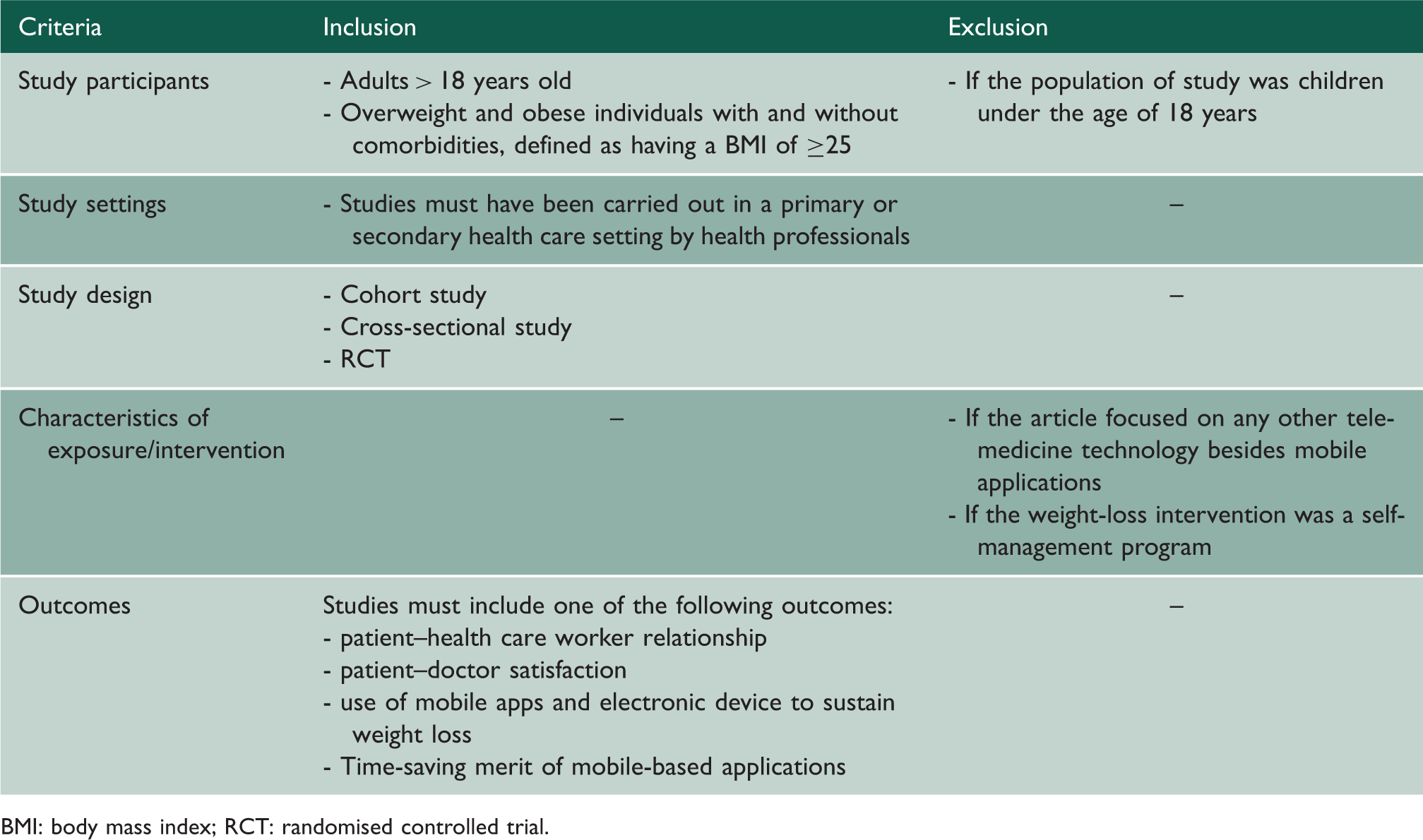
BMI: body mass index; RCT: randomised controlled trial.
Moreover, for an article to be included in this review, it had to be reporting on empirical studies. Furthermore, included studies must have used mobile applications as interventions for weight loss.
The flow diagram (Figure 1) is a summary of the study selection strategy depending on the inclusion and exclusion criteria.
Flow diagram for study selection procedure.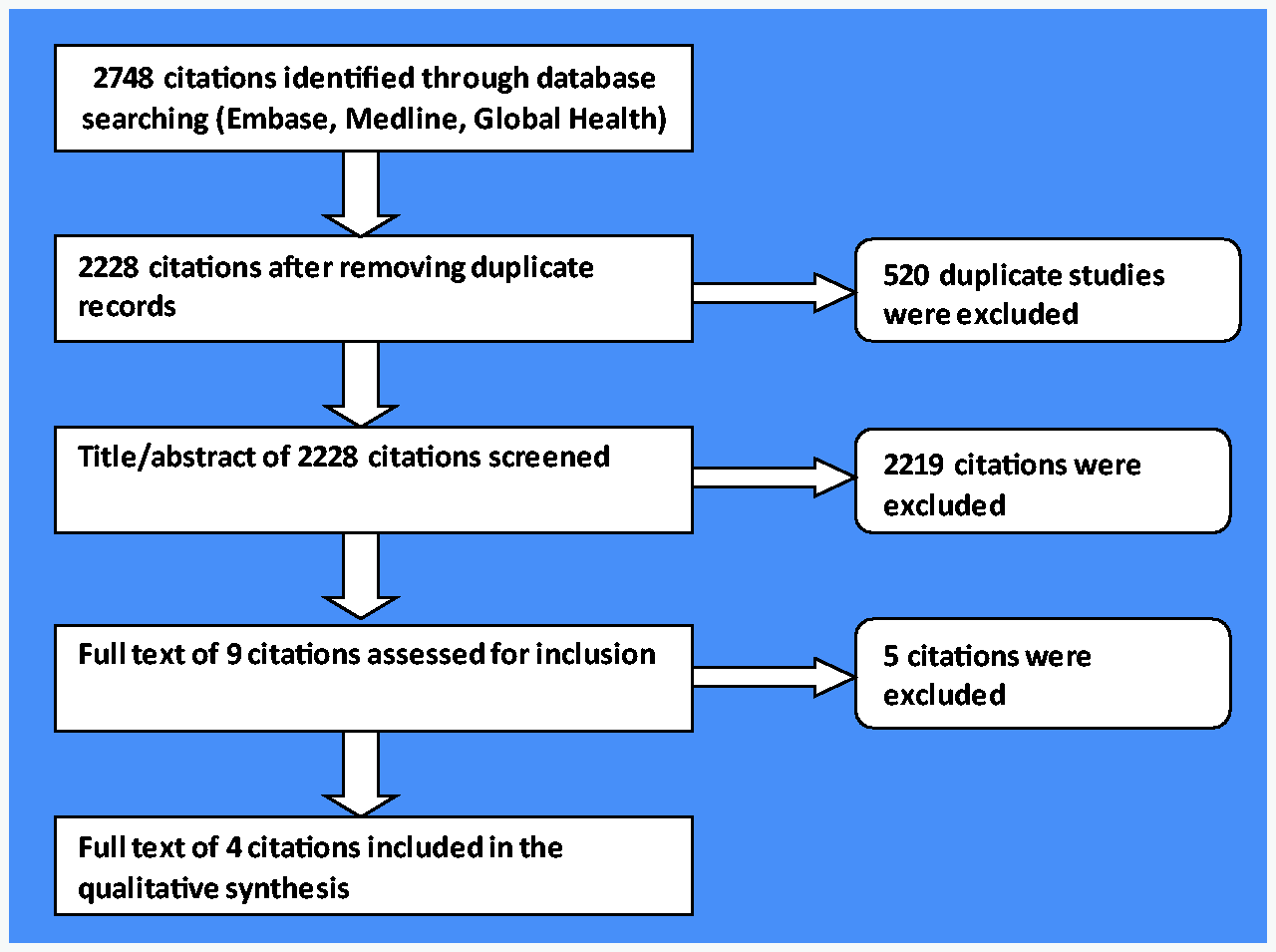
Data management and quality assessment
Two reviewers independently extracted the data from all articles that satisfied the inclusion criteria. The extracted data were entered using Endnote X7.3, in which the inclusion and exclusion processes were reordered and the titles or abstracts reviewed. Each of the reviewers summarised the most important results from the included studies. The summaries made by the two reviewers were compared and discussed, and the agreements between them on the inclusion and exclusion criteria of a study were assessed. Any disagreement in regard to the selection of a study and/or data extraction was resolved through further discussion between the two reviewers.
Several study characteristics were extracted including the sample size, study population demographics, primary outcomes and results. The measures of methodological quality assessment were conducted independently by the two reviewers using the 10-point criteria described by the National Heart, Lung, and Blood Institute. 16
Results
Study selection
The initial search identified 2748 unique studies. After checking for duplicates, 520 articles were excluded. Among the remaining 2228 citations, the titles and abstracts were screened resulting in the exclusion of 2219 studies. Furthermore, the full-text articles of the remaining nine papers were obtained for a detailed evaluation and five articles were excluded due to their failure to meet the inclusion criteria. Thus, four unique articles were deemed appropriate for inclusion in the systematic review (see Figure 1).17–20
Study characteristics
Study characteristics.

BMI: body mass index; RCT: randomised controlled trial.
Regarding their geographic origin, two studies originated from the USA and utilised randomised controlled trial as the study design.18,19 In contrast, the study by Rossi et al. was a longitudinal pre-post comparison study and originated from Italy. 20 Finally, the study by Choo et al. was set in Korea and utilised a pre-post single-group study design. 17
Study features
All the included papers were empirical studies of mobile-based interventions aimed at promoting weight loss. Moreover, the participants were required to adhere to a certain weight loss program in two randomised controlled trials18,19 and monitored by primary health care professionals in the four studies.17–20 Similarly, all study participants followed a structured program with no self-management or self-reporting. Finally, two studies employed a reminder-enabled mobile application to alert the health care professionals on recording the corresponding participants' weights.17,19
Quality assessment
Study quality characteristics.

Use of mobile applications in the management of overweight and obesity
Among the included scientific papers, two studied the effectiveness of mobile applications in sustaining weight loss.19,20 One of the aforementioned studies favoured the use of mobile apps as an effective tool in attaining sustained weight loss. In this study, the intervention group lost a mean of 3.9 kg more when compared to the control group (95% CI, 2.2–5.5 kg). 19 Similarly, the intervention group of the second study reported a 2.5 kg mean (95% CI, 1.8–3.2 kg) reduction in body weight in comparison to that of the control group at 0.01 kg. 20
One of the included papers measured the acceptability and usability of a mobile application, linked with an accelerometer as a tool, in supporting a clinic-based weight loss program. The paper also documented any changes in the patient–doctor relationship as a result of employing the mobile app. Subsequently, it was discovered that the application was useful and acceptable for weight loss management but displayed less favourable effects on the patient–doctor relationship. Also, the acceptability was measured in terms of participant's satisfaction with the mobile app and revealed 75% positive responses. Similarly, the vast majority (93%) of participants responded positively to the usability of the app in managing weight loss. Moreover, three-quarters (75%) of the participants indicated that they were willing to recommend the application to their friends and family. A similar percentage of respondents (79%) expressed their willingness to continue using the app for weight loss management. On the other hand, the depth of the patient–doctor relationship, as measured by a scale, witnessed a decrease during the intervention period from 27.6 (SD 4.8) to 25.1 (SD 4.5) (p = .02). 17
On the other hand, two studies reported on the satisfaction of patients and doctors in regard to the use of mobile-based applications for weight loss. Subsequently, one study revealed that the majority of patients (95%) and three-quarters (75%) of health care workers conveyed their satisfaction level as ‘excellent’ or ‘good’. Furthermore, more than two-thirds (70%) of the participants indicated that the system was ‘extremely useful’ or ‘very useful’ as a weight loss management program, while 76% of the subjects were ‘definitely’ or ‘probably’ interested in purchasing such a program once it is introduced to the market. 20 Another study described that the users of the MyFitnessPal were highly satisfied with the application. After six months of using the aforementioned application, the majority of participants stated that they were ‘somewhat’ or ‘completely’ satisfied with the app (79%) and would recommend it to their friends (92%). Despite the fact that most participants (80%) indicated their intention to continue using the MyFitnessPal application, its use decreased during the study with the participants citing that it was tedious or that they were too busy or too stressed. 18
Discussion
The current systematic review summarises the results for the use of mobile apps in the management of overweight and obesity by health care workers in the primary and secondary care settings. The focus in this review was to assess the effectiveness of mobile applications for weight management in sustaining weight loss, their usability and acceptability, their effect on the patient–health care worker relationship and the patient and doctor satisfaction following such use. The data analysis reiterates what was shown in earlier studies in terms of the fact that mobile-based weight loss interventions are effective in achieving weight loss. In addition, the data were very consistent with low statistical variations, suggesting the usability of mobile-technology in weight loss management though the intervention content varies from one study to another.
Three key results can be drawn from this review. First, this review revealed that the use of mobile apps is an effective tool in sustaining weight loss among intervention groups when compared to control groups. Second, mobile apps for weight loss management may negatively affect the patient–health care worker among overweight and obese individuals. Third of all, mobile apps have been found to enhance patient satisfaction with weight management programs.
The aforementioned results corroborate those of previous reviews evaluating the change of health behaviour among populations with other conditions when exposed to mobile-based applications. Similarly, the use of mobile phones in managing and monitoring diabetes has been found to be an effective tool among patients with type I diabetes. Even though many studies lacked the sufficient intervention length or size to determine whether the results might be clinically significant, the cumulative incidence of type II diabetes was lower among patients who used mobile technologies. 2 Apart from diabetes, the use of mobile applications has been found to be effective in promoting smoking cessation as well as adherence to preventive medicine and asthma management.10,21,22
In this systematic review, several forms of mobile application have been used such as mobile software helping patients with a dietetic program, 20 a mobile app linked to an accelerometer to support a weight loss program, 17 a mobile fitness application 18 and a personal digital assistant. 19 In addition to that, the usability of mobile apps to promote weight loss among overweight and obese cohorts have been demonstrated in this review; however, further information is required on the combination of mobile application-related aspects that would yield the desirable results.
Since the use of mobile applications in primary and secondary health care among obese and overweight populations remains novel, the current review is foundational in informing the advancement of efficient and appropriate mobile-based interventions to promote weight loss among those who are obese or overweight. To date, research focusing on the use of mobile technology in diabetes management appears to be the most developed while the evidence base focusing on other health conditions is still scant. 23 The most peculiar and beneficial feature of mobile apps is the increasing ease of use, particularly smart phone-based applications. 12
Strengths and limitations
There are several limitations associated with this review. Regarding the quality, the included studies lacked any blinding of the investigators to the participants' intervention, which may have introduced bias when estimating the effects of the mobile application. Also, the sample size was small ranging from 30 to 212 among the four studies, and this may have limited the statistical power of the review's findings. Nevertheless, the review's analysis was successful in identifying potential usability of mobile apps in managing weight loss at the primary and secondary health care setting. Despite the identified limitations, the current review employed the most recent published studies on the use of mobile apps through the PRISMA flow diagrams. 15 To advance in-depth knowledge and understanding of mobile-based application benefits, it is essential to standardise the interventional studies in this area.
Recommendation for future reviews
This review demonstrates the need for further research as well as a standardised reporting approach of interventional empirical studies in order to enable comparisons across different mobile-based interventions. Subsequently, the interrelationship between the study features such as psychological support provided by a health care worker, automatic feedback, monitoring of adherence, reminder alerts, exercise prescriptions and weight loss should be studied further. Understanding such associations will enable the development of tailored interventions that have in the past been known to be appropriate approaches for weight loss management according to the ideologies of the Social Marketing Model and the Social Cognitive Theory. 24
Conclusion
This review suggests that mobile apps have the potential to facilitate the management of weight loss among overweight and obese individuals by health care workers at the primary and secondary health care settings. However, further research is required to comprehend if these interventions have long-term sustainable benefits and can be effectively utilised on a large scale. As primary and secondary health care fields increasingly use innovative mobile technology, the focus must shift from the type of technology used towards the most appropriate integrated use of such technology in the measurement and understanding of health behaviour. As mobile technology continues to advance, the potential use of mobile apps on the global health care industry is enormous. More controlled intervention studies with larger participant numbers should be conducted to look at the financial and technical feasibility of adapting such m-health applications in real clinical settings.
Footnotes
Declarations
Acknowledgements
The Department of Primary Care and Public Health at Imperial College London is grateful for support from the National Institute for Health Research (NIHR) Collaboration for Leadership in Applied Health Research & Care (CLAHRC) Scheme, the NIHR Biomedical Research Centre scheme, and the Imperial Centre for Patient Safety and Service Quality.
Provenance
Not commissioned; peer-reviewed by Simon Howard.