



Abstract
Objective
To explore general practice staff views of managing childhood obesity in primary care.
Design
A qualitative study to elicit the views of clinical and non-clinical general practice staff on managing childhood obesity.
Setting
Interviews were conducted at 30 general practices across England. These practices were interviewed as part of the Quality and Outcomes Framework Pilot Study.
Participants
A total of 52 staff from 30 practices took part in a semi-structured interview.
Main outcome measures
Key themes were identified through thematic analysis of transcripts using an inductive approach.
Results
Three themes were identified: lack of contact with well children, sensitivity of the issue, and the potential impact of general practice. Identifying overweight children was challenging because well children rarely attended the practice. Interviewees felt ill equipped to solve the issue because they lacked influence over the environmental, economic and lifestyle factors underpinning obesity. They described little evidence to support general practice intervention and seemed unaware of other services. Raising the issue was described as sensitive.
Conclusion
General practice staff were unconvinced that they could have a significant role in managing childhood obesity on a large scale. Participants believed schools have more contact with children and should coordinate the identification and management of overweight children. Future policy could recommend a minor role for general practice involving opportunistically identifying overweight children and signposting to obesity services.
Keywords
Introduction
Childhood obesity is a growing global health problem associated with increased risk of long-term health issues. 1 In England, prevalence has increased over the past 20 years to 16% for boys and 15% for girls. 2 General practice is viewed as an appropriate setting to offer a brief weight management intervention by the Department of Health in England. 3 National Institute for Health and Care Excellence guidance recommends that general practitioners should be involved in obesity management including raising awareness and referring children to weight management services.4,5
Evidence on the effectiveness of treating childhood obesity in general practice is mixed. However, a systematic review found improvements in body mass index and behavioural outcomes following various multicomponent interventions. 6 The two most useful components were training for health professionals and encouraging behaviour change through individually tailored interventions.
Some qualitative studies have explored general practice staff views of managing child obesity.7–11 Practitioners described how the complex social and family causes of obesity limited their influence on addressing the issue. They also lacked time and resources to work with the family effectively. Interviewees in one study stated obesity was not a medical problem and outside their professional domain. 7 Some felt that they did not have relevant knowledge and expertise to treat obesity, and a systematic review showed many lacked confidence in their ability to manage the issue. 12 However, these studies were limited to specific states within Australia and America and small geographical areas in England. The three English studies were also undertaken prior to the publication of National Institute of Health and Care Excellence public health guidance. 5
The present study aimed to explore the views of general practice staff of managing childhood obesity in general practices across England. This was conducted as part of a wider study developing and pilot testing potential new indicators for the Quality and Outcomes Framework.
Methods
Quality and Outcomes Framework pilot study
Quality and Outcomes Framework is a pay for performance scheme for general practices in England which has been in place since 2004. Since 2008, National Institute of Health and Care Excellence have been responsible for developing and testing potential new quality indicators. Indicators are piloted in general practices for six months prior to inclusion, and data are collected evaluating their acceptability, reliability and validity. Between October 2014 and March 2015, seven indicators were piloted for serious mental illness, adult obesity, immunisations, vulnerable patients, depression and anxiety. Practices did not pilot indicators for childhood obesity; however, we elicited their views of managing this in general practice. This issue was explored because National Institute of Health and Care Excellence and Public Health England had expressed an interest in developing indicators related to obesity management.
General practice recruitment
Target number of practices in each recruitment strata and the number of practices actually recruited.

Higher scores indicate greater levels of deprivation. IMD = Index of Multiple Deprivation.
Data collection
Semi-structured interviews with practice staff were conducted by two researchers (JOD and RFT) in March and April 2015, either in the interviewee’s workplace or by telephone. Interviews lasted around an hour and were conducted individually or in small groups. All participants gave informed consent. The topic guide included two questions related to childhood obesity:
their perceptions of the barriers and enablers to general practitioners taking a more active role in childhood obesity their views on what was needed to improve integrated local pathways to manage childhood obesity.
Follow-up questions were used in response to issues raised by interviewees.
All interviews were audio taped, professionally transcribed verbatim and checked for accuracy. Copies of transcripts were available to interviewees, although none requested to see them.
Data analysis
A thematic analysis was performed following the framework of Braun and Clarke. 14 This involved six steps to identify and report patterns in the data: (1) familiarisation with the data, (2) generation of initial codes, (3) initial identification of themes, (4) reviewing these themes, (5) naming of themes and (6) writing up. All transcripts were read and coded independently by two of the authors (JOD and RFT) using an inductive approach aiming to generate an analysis from the bottom up (the data). 15 Initial codes were discussed and combined to form themes which were discussed until agreement was reached that these reflected the data. Results are based upon a synthesis of all the interviews.
Results
Distribution of interviewed practices across PCRN and CCG areas.

PCRN = Primary Care Research Network; CCG = Clinical Commissioning Group; NHS = National Health Service.
Demographic characteristics of general practice staff interviewed.

GP = general practitioner.
aThese data were collected for general practitioners only.
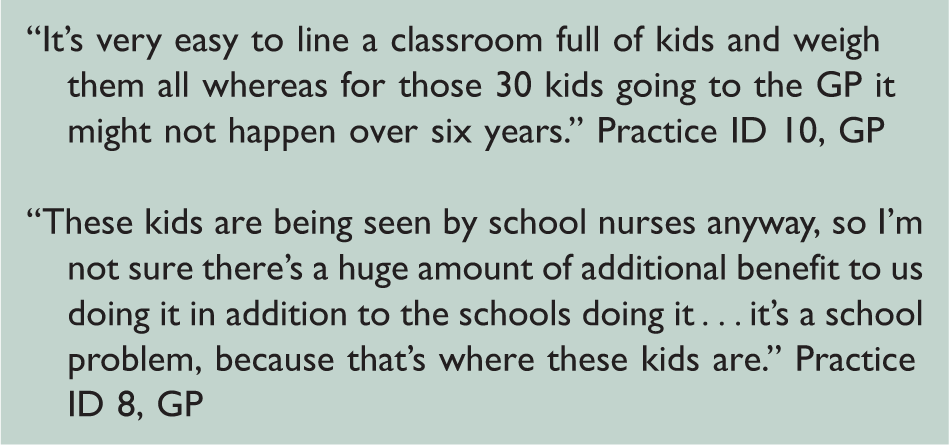
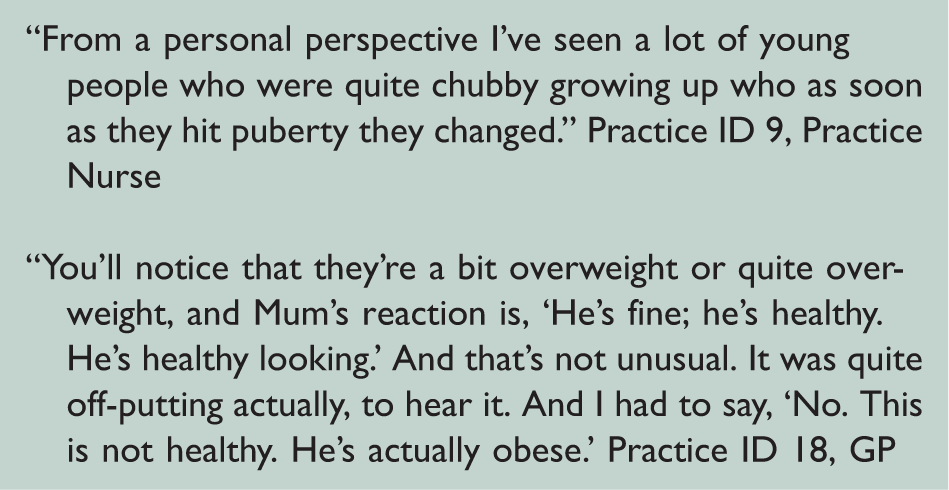
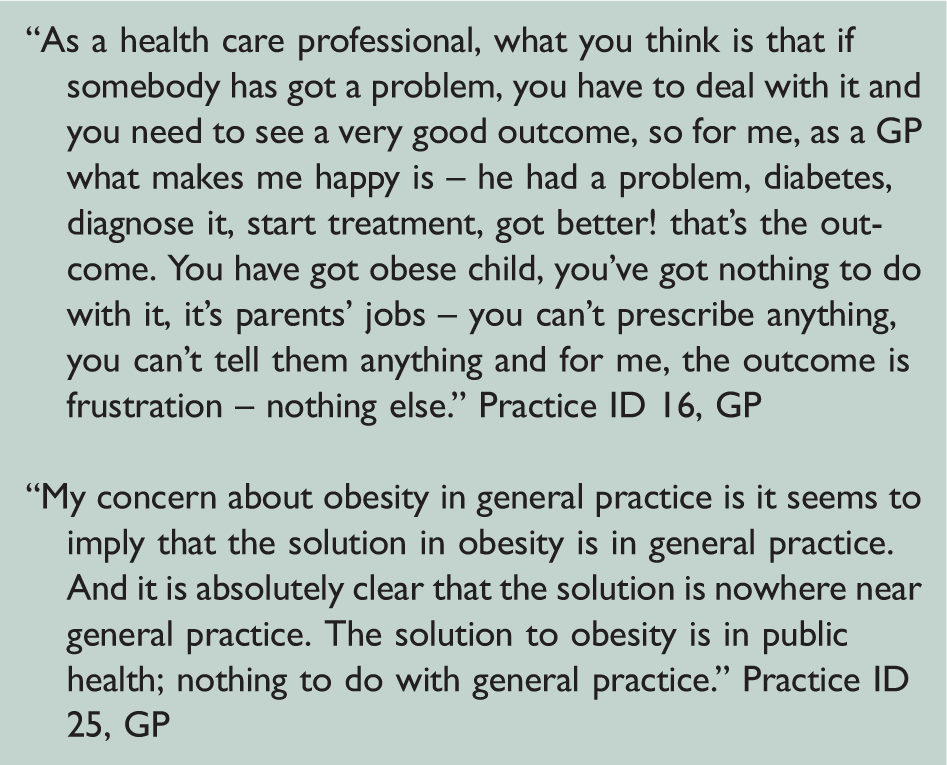
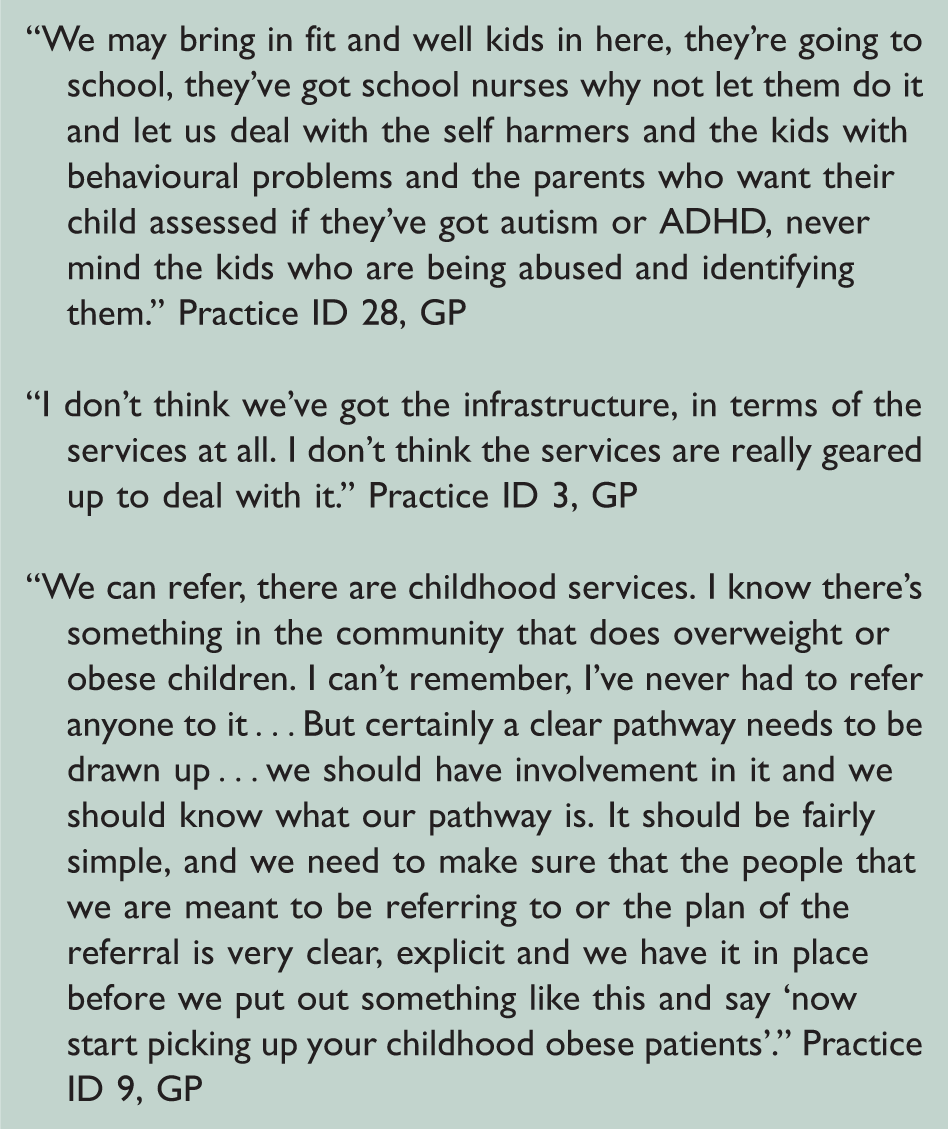
Almost all interviewees identified childhood obesity as an increasingly important issue with potential long-term health implications. However, most did not frame it as a medical problem in itself or view its management as a general practice responsibility. The themes are organised into three interrelated areas: lack of contact with children, sensitivity of the issue and can general practice make a difference.
Theme 1: lack of contact with well children
Lack of contact with well children.

Lack of contact with well children.

Lack of contact with well children.
Theme 2: sensitivity of the issue
Sensitivity of the issue.

Sensitivity of the issue.

Sensitivity of the issue.
Sensitivity of the issue.

Sensitivity of the issue.

Sensitivity of the issue.

Theme 3: the potential impact of general practice
The potential impact of general practice.
The potential impact of general practice.
Discussion
Summary
This study suggests that interviewees viewed childhood obesity as an important issue with the potential to impact on health outcomes. However, it was regarded as a public health rather than a medical issue. General practice lacked influence over the environmental, economic and lifestyle factors underpinning obesity and therefore would have little impact on changing health behaviour. There was a perception of a lack of evidence demonstrating the benefits of general practice involvement coupled with anxiety over raising the topic of a child’s weight with both parents and children.
Interviewees were concerned that their limited contact with children meant that they were unsuitable to undertake population surveillance of childhood obesity. Limited opportunities were identified for opportunistic identification and referral to specialist services. Schools were viewed as being better placed to address the issue on a population basis due to their regular contact with children.
Strengths and weaknesses of the study
There are several strengths and weaknesses of the present study. A main strength compared to other qualitative studies in this area is our sample characteristics. Compared to other studies,7–11 we interviewed staff from a large number of practices in different geographical areas across England where access to child obesity services may vary. Other studies are limited to specific states in Australia, 10 America, 11 and smaller geographical areas in England such as Bristol primary care and community settings, 9 Rotherham Primary Care Trust, 8 and an inner London primary care trust. 7 During sampling, we ensured practices were broadly representative of general practices in England in terms of practice list size, clinical Quality and Outcomes Framework score and deprivation (Index of Multiple Deprivation score). Furthermore, we obtained views from a range of practitioners and administrative staff of both genders. These practices volunteered to take part in a wider study testing potential indicators for the Quality and Outcomes Framework pay for performance scheme. The first part of the interview focused on the feasibility of implementing seven potential indicators which practices piloted in the preceding six months. Interviewees may therefore have been concerned that the research team were eliciting their opinions with a view to childhood obesity indicators either being piloted in future or formally included in the Quality and Outcomes Framework. These anxieties may have resulted in a negative reaction from practices aiming to guard against childhood obesity becoming a pay for performance area.
Comparison with existing literature
The study findings show that in this sample of practices across England, general practice is viewed as having only a minor potential role in managing childhood obesity. This role would primarily be centred on the opportunistic identification of overweight children and signposting to obesity services. This is in line with previous research on this issue which also suggested a minor role for practices.8–10 One study suggested a small role could involve raising the issue of the child’s weight and providing basic diet and exercise advice. 8 Across all studies, childhood obesity was viewed as a social, family and public health issue rather than a medical issue to be addressed in primary care. Other concerns consistent with our study were workload, limited contact with children and ensuring a sensitive approach with families.8–11
A key challenge across studies was engaging with families to manage weight. In our study, interviewees highlighted that parents rarely initiated this discussion so a practitioner would need to raise this. Other research suggests parents are apprehensive about working with their general practitioner to address their child’s weight. One study reported a low uptake when families of obese children were invited to discuss possible referral to a secondary care clinic with their general practitioner. 16 Interviews with parents show that they are hesitant due to fear of being blamed, concern for the child’s mental well-being and feeling general practitioners are ill equipped with knowledge and resources to treat the problem.17,18 Legitimate concerns in light of our findings. Other research shows many primary care clinicians lack specific knowledge about childhood obesity such as prevalence, and guidelines for diet and exercise and confidence in their ability to treat it.12,19 In the context of adult obesity management, clinicians feel more empowered to manage the issue if they have had appropriate training so they can support patients through education and non-judgemental care. 20 This sense of being supported has been shown to increase patient empowerment and engagement with general practice. These studies suggest general practitioners may need further training to manage child obesity, or alternatively they could utilise services or health professionals with specialist knowledge. Further research should also explore suitable strategies for health professionals to raise the issue sensitively with parents.
Our participants identified schools as being critical to the prevention, identification and management of childhood obesity. In England, schools already record a child’s body mass index at ages 5 and 11 for the National Child Measurement Programme with intention of the resulting data informing planning and commissioning of local services. 21 A Cochrane 22 review of child obesity prevention interventions found beneficial effects of implementing strategies in schools. Successful strategies are increased physical activity sessions, education focusing on healthy eating, body image and physical activity, improved nutritional quality of food in schools and support for teachers to implement health promotion activities. Research shows parents feel schools and school nurses have an important role,17,23 although participation of school nurses in obesity management is inconsistent. 24 From the perspective of head teachers, there may be barriers to increased school involvement which need further attention before implementing a formal initiative. 25 These centre on time, academic pressures, the requirement for more expert support and better facilities and resources within schools. It was also recognised that for obesity prevention in schools to be successful, it needed to be an integral part of the education agenda rather than an additional initiative. A sensible solution could be to increase support towards schools and expand the National Child Measurement Programme to include either a direct referral to obesity services or a letter to the child’s GP requesting this referral. This would also need to consider recent research showing that parents currently perceive there to be a lack of sensitivity surrounding the feedback of their child’s measurements for the National Child Measurement Programme. 26 Training was recommended for both practice staff and school staff to improve their approach to discussing a child’s measurements and obesity management with the family. Due to their regular contact with children, schools could also be provided with more information on public health resources and encouraged to signpost to them. Existing public health campaigns such as Change4Life and Mind, Exercise, Nutrition, Do it (MEND), a multicomponent community-based childhood obesity intervention, have shown success in encouraging healthy lifestyles.27,28
Implications for research and practice
Our findings suggest that policies recommending a significant role for general practitioners in prevention, identification and management of childhood obesity at a population level are unlikely to be successful. Practices did not see well children regularly enough to identify everyone who was overweight, and parents rarely raised the issue. It was described as a sensitive topic, and further research could explore strategies for health professionals to engage with families as their involvement was crucial. Interviewees felt policy in this area should be directed towards services that regularly engage with children such as schools. They identified a minor role for themselves centred on opportunistic identification of overweight children and signposting to obesity services.