




Abstract
Farmers and agri-food movements are responding to rapidly changing trends related to digitalization and datafication in agriculture. However, there is a lack of consensus on the potential of common ‘best practices’ to resolve agricultural data governance challenges and achieve data justice. To explore these complex dynamics, we present analysis from 40 workshops, conferences, and community dialogue events related to digital agricultural technologies and data governance between 2020 and 2023, involving the participation of farmers, farming organizations, government policy and programs staff, civil society, and academic researchers. We use a data justice lens to reorient the treatment of data governance challenges and approaches. We apply multiple dimensions of justice to examine the power relations and capabilities of diverse agri-food system actors to navigate the changing landscape of agricultural datafication. We find that many common practices in agricultural data governance have fundamental limitations to achieving data justice. Overcoming these limitations will require structural change, including new laws and regulatory frameworks, novel governance structures, capacity building, and solidarity across movements.
This is a visual representation of the abstract.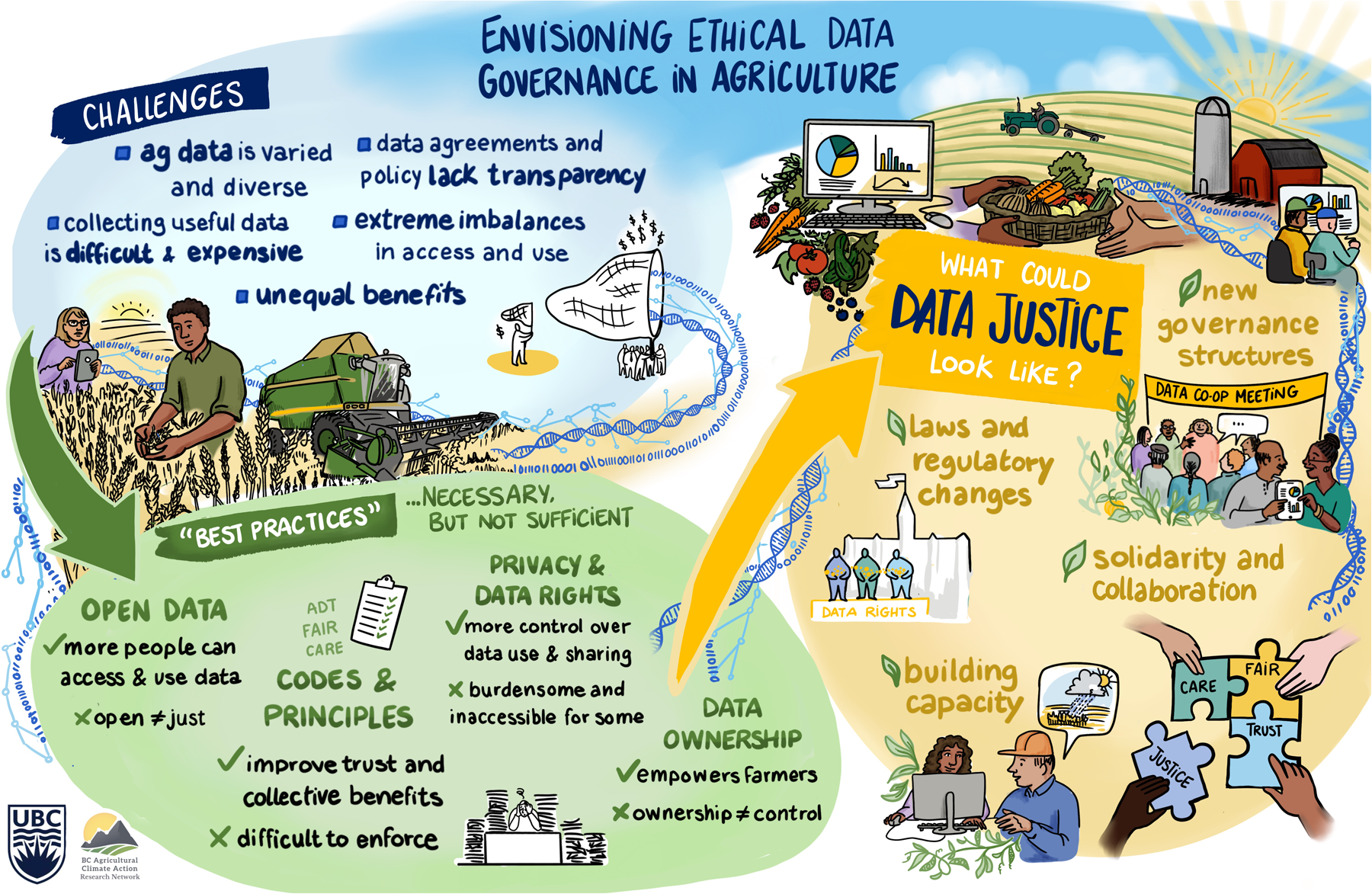
Art by Annalee Kornelsen for Drawing Change
Introduction
Over the last several decades, the global food system has experienced increasing technological intensification, marked by advances in mechanization, genomics, and digitalization, that is significantly re-shaping the future of food. Data generation, access, sharing, and use are at the core of ‘Agriculture 4.0’ and the ‘digital transformation’ of agriculture (Jouanjean et al., 2020; Klerkx and Rose, 2020). There is growing interest in the potential of (big) data in agriculture to help address food insecurity, climate change and environmental problems, and other food system challenges (FAO, 2019, 2021). At the same time, there are concerns about who has control over the data and how it should be governed (de Beer et al., 2022; Nyéléni, 2019). Given the persistent and structural power imbalances in the agri-food context, there is good reason to be concerned about the possible injustices entrenched by digitalization and datafication in agriculture (Montenegro de Wit and Canfield, 2023; Rotz et al., 2019; Ruder, 2024).
This paper presents the results of a data justice project which engaged farmers and others working in agri-food contexts to scope international data governance challenges in agriculture from the perspective of data and digital technology users. What began as a smaller proposed study with in-person workshops and conferences in Western Canada in early 2020 expanded with the onset of the COVID-19 pandemic to include virtual conferences across Canada and internationally. We also extended the geographic scope in response to collaborations with our community partners in Canada, the US, and Latin America, with some in-person engagement once possible. It became clear that there was an appetite for capacity building and community engagement on data governance in agri-food contexts.
From February 2020 to August 2023, we conducted 14 workshops and attended 26 conferences, both virtually and in person. Throughout these engagements, we asked: What is most important to farmers and agri-food organizations regarding agricultural data governance? What are the principles and best practices available for farmers and agri-food organizations to address data governance challenges? What are the strengths and limitations of these approaches? We identified unique individual and societal risks stemming from agricultural data uses and misuses, while advancing a data justice framework for capacity-building with diverse groups working in agri-food systems.
Agricultural data governance and data justice
Beyond agri-food contexts, there has been significant attention to data governance in academic and public discourse, especially related to personal data and its use in artificial intelligence. Yet, data governance lacks a universal definition, leading to varied interpretations. For instance, Google Cloud defines data governance as the processes of ‘setting internal standards–data policies–that apply to how data is gathered, stored, processed, and disposed of [and] complying with external standards set by industry associations, government agencies, and other stakeholders’ (Google 2023). Definitions like this one suggest that the standards, decision-making structures, and processes of data governance could be independent from their social and technological infrastructure; however, from a critical data studies perspective, this is impossible. In this field, the dominant view is that data governance emerges from and (re)produces socio-technical assemblages (Iliadis and Russo, 2016; Kitchin and Lauriault, 2019; Liu, 2022).
In a recent review, Jun Liu (2022) examines several approaches to data governance, framing the term ‘social data governance’ to capture the variations in data governance across societies, and highlighting the need to attend to social context when formulating governance strategies in specific jurisdictions and domains. Similarly, Marina Micheli and colleagues (2020) examine models of data governance and identify a relatively narrow focus in the literature on corporate platform data collection practices and the uses of personal data. Our approach follows Micheli and colleagues' definition of data governance, which encompasses ‘the power relations between all the actors affected by, or having an effect on, the way data is accessed, controlled, shared and used, the various socio-technical arrangements set in place to generate value from data, and how much value is redistributed between actors’ (2020: 3). However, even with power relations in the definition, it is possible for data governance research to overlook some justice elements. We draw on data justice scholarship for its ‘systemic critique that levies efforts at broader transformations in society and the role of technology within them’ (Dencik et al., 2022: 5).
Data justice scholarship attends to power vis-à-vis data along various dimensions of justice – procedural, instrumental, distributive, rights-based, and structural (Heeks and Shekhar, 2019). Procedural data justice refers to data subjects' inclusion in decision-making and management elements of data governance, whereas instrumental and distributive data justice focus on fairness in data uses and outcomes, respectively. Rights-based data justice applies legal concepts of rights for data privacy and other interactions with data, such as the right to data portability. Finally, structural data justice takes a broader view to examine interactions within and between existing power structures, such as relationships between states and citizens. Structural (in)justice determines ‘power over’ resources, knowledge systems, and institutions, as well as ‘power to’ enact agency and effect outcomes (Heeks and Renken, 2018; Kennedy et al., 2020).
Our study of data governance in agriculture takes an explicit data justice approach to investigate power imbalances and support capacity building (Dencik et al., 2022; Taylor, 2017). We explore multiple dimensions of justice and how they interact. Further, data justice scholars emphasize that individuals must have the capacity, means, and opportunities to achieve freedoms across diverse contexts and positionalities (Heeks and Shekhar, 2019; Kennedy et al., 2020). For example, someone can exercise agency in choosing to give up data privacy in return for services or benefits with informed consent, while another person could make the opposite choice in their enactment of data justice.
Data governance and data justice in agri-food contexts
Critical data studies scholars highlight the need for greater attention to diverse data use cases, as well as the ethics and justice dimensions of data governance – particularly for workers and technology users (Browne et al., 2024; Knox, 2024; Richey and Fejerskov, 2024). The agri-food sector is deserving of special attention in critical data studies (Gugganig et al., 2023; Hackfort et al., 2024; Ruder, 2024), as data collection and use in this sector is particularly complex. Agricultural data can include information about plants and animals, ecological processes, agronomic practices, technologies, finances, and people. However, most regulatory policy and legislation focus primarily on personal data. In Canada, for example, there is no legal definition or regulation of agricultural data, which is often distinct from personal data (Dagne, 2022; Ruder, 2024).
Globally, most existing governance frameworks for agricultural data are voluntary and fragmented (de Beer et al., 2022; Jouanjean et al., 2020). Remarking on the lack of regulation of agricultural data internationally, a World Bank report states that ‘the definitions of ownership, access, and control rights are now left to contractual agreements, which are not perfect safeguards of farmers' rights over their data’ (Schroeder et al., 2021: 5). There is global recognition that the current data governance approaches and regulations are insufficient mechanisms to protect farmer and worker rights (Bergstrom et al., 2022; Jouanjean et al., 2020; Wiseman et al., 2019).
Farmers, as users and subjects of agricultural data, have little power compared to other actors in the global food system, and farmworkers are at an even greater disadvantage (Kaur et al., 2022; Miles, 2019; Montenegro de Wit and Canfield, 2023). Indeed, the companies that sell agri-chemical inputs and equipment – and who now trade in data – were ‘Big Tech’ long before Silicon Valley (Bronson and Sengers, 2022). Moreover, these companies have historically used their inequitably large market shares to wield power over farmers and workers via technologies (Clapp, 2025; Howard, 2016). For example, agricultural input companies have used restrictive licensing agreements around GMO seed and chemical input systems to solidify commercial relationships with farmers, tying farmers to the use of a specific firm's product offerings (Bronson, 2015). Because of the unique political economy of the global food system, a small handful of individual companies access data from hundreds of millions 1 of farm acres around the world and benefit from its uses in product development, targeted marketing, predictive modeling, and many other possible uses in line with their business interests (Hackfort et al., 2024; Montenegro de Wit and Canfield, 2023; Ruder, 2024).
Despite the work broadly outlining farmer concerns about data and privacy issues (e.g., Brown et al., 2022; Carolan, 2018; Wiseman et al., 2019), there is very little community-engaged research with farmers and others working in agri-food contexts to build capacity among vulnerable food system actors to know their rights and engage with lawmakers or companies. Only a small handful of research projects have worked on data justice in agri-food contexts, with a focus on injustices and obstacles to data justice (Dagne, 2020; Masiero and Das, 2019). Others discuss farmer rights to data access, ownership, privacy, and security, without referencing data justice (e.g., Cue et al., 2021; van der Burg et al., 2021; Zhang et al., 2021). For instance, working with the dairy sector in the US, Roger Cue and colleagues propose a ‘Farmer Bill of Rights’ (2021) to address the challenges and lack of regulation in agricultural data governance. In response, we engaged marginalized workers in the food system in the development of capacity-building events and tools for awareness and advocacy on farmer and worker data rights. This informed a critical assessment of proposed solutions and possible avenues for data justice in agriculture.
Methods
In this paper, we analyze data from 40 workshops, conferences, and community dialogue events related to digital agricultural technologies and data governance, hosted from February 2020 to August 2023 (in person and virtual). Table 1 presents the distribution of the workshops and conferences over time and location. Details about all workshops, conferences, and events are listed in the Supplemental Material.
Summary of workshops and conferences.
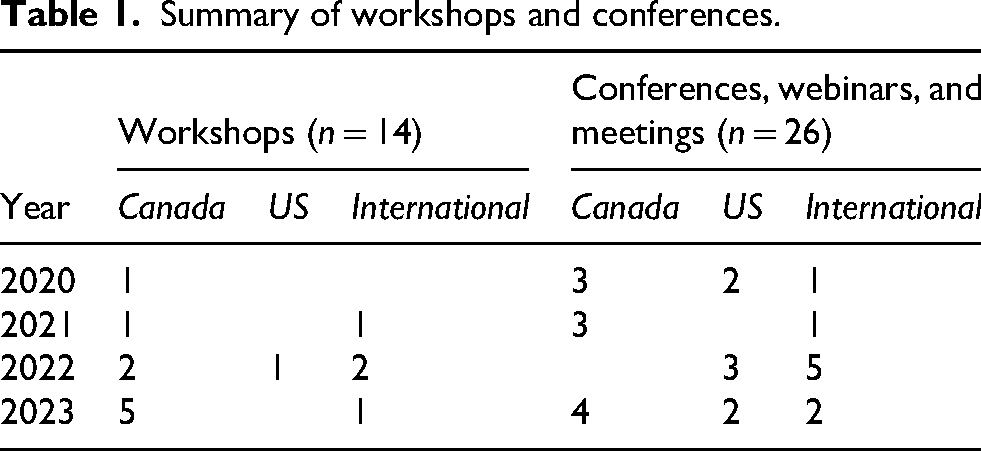
The research team led 14 workshops with diverse agri-food organizations, including nine workshops based in Canada, one in the US, one in Mexico, one in Ecuador, and two with an international organization affiliated with the Food and Agriculture Organization of the United Nations (FAO) and the Research Data Alliance. Some workshops were part of a larger event or conference, such as the ‘Ag Smart’ conference and trade show in Canada. 2 Other workshops were independent, by request of a community partner. 3 For example, we facilitated the workshops in Mexico and Ecuador by request of the Construyendo Caminos agroecological certification network with representatives from seven countries in Latin America, with whom Hannah Wittman has worked since 2017. We ran most of the workshops ourselves and coordinated external speakers when the topic demanded it (e.g., Indigenous Data Sovereignty). Our conceptualization of data governance in agriculture was consistent across all workshops, but the specific framing and examples used in the events varied depending on the intended audience and requests of the host organization. Workshops were oriented towards mixed audiences including farmers, farmer and farmworker organizations, government policy and programs staff, civil society, and academic researchers. We used the label ‘agri-food organizations’ to describe this heterogenous community of actors working with and for farmers.
In addition, one or both authors participated in 26 conferences and events about digital technologies and data governance in agriculture during the project timeframe. Many of the participants at the conferences were active farmers but joined as representatives of agri-food organizations, such as commodity organizations or conservation authorities. Other participants included academic researchers, government policy and programs staff, civil society, and companies that develop and sell digital agricultural technologies.
Throughout these engagement activities and events, we conducted participant observation, as well as facilitation methods and structured conversations, which were systematically described in physical and digital research notebooks (Kawulich, 2005; Manolchev and Foley, 2021). In both in-person and virtual workshops, we gathered information about what perspectives were represented among the participants (e.g., Zoom polls and sticky notes), made notes on questions and discussions, and facilitated engagement using interactive media (e.g., collaborative discussion boards).
We conducted an applied thematic analysis (Guest et al., 2014) of the transcripts of recorded workshops and presentations at the conferences and our detailed notes. In our analysis, we included compiled summary reports from conferences and meetings on these topics, as well as reports referenced at the events. The findings presented below emerge from manual thematic analysis of all data sources. Our first stage of thematic analysis was inductive to identify primary data-related challenges and governance approaches identified by actors, noting their distinct positionalities. We subsequently evaluated how and to what extent the most common approaches to agricultural data governance, as identified in the literature, can both identify and address the challenges and advance data justice. Although we identified themes based on all the evidence, we chose to only include names and illustrative direct quotations here where the session recording is publicly available on YouTube.
As part of the capacity-building outputs we developed for these projects, we produced a ‘Discussion Guide’ based on the facilitation plan for our workshops in partnership with the British Columbia Agricultural Climate Action Research Network (BC ACARN) and OpenTEAM, as well as an advisory group (See Supplemental Material). We translated the guide into six languages and included it with a suite of free open access resources in a ‘Toolkit for Ethical Data Governance in Agriculture’ hosted on the BC ACARN website (BC ACARN, 2024).
Agricultural data governance challenges
After over three years of engagement with farmer and agri-food organizations convening discussions on agricultural data and digitalization, we distilled key themes for what is most important to farmer and agri-food organizations regarding data governance. We present five data governance challenges specific to agri-food contexts: practical and technical challenges; not all data is equal; information asymmetries; trust and transparency; and winners and losers.
Practical and technical challenges with agricultural data
Farmers, academics, policymakers, and civil society actors working on digitalization in agriculture need to contend with the relatively unique complexity of farm environments, which presents practical and technical challenges. Vineet Singh from Digital Green reminded participants in one of our workshops that ‘collecting the [agricultural] data is difficult; it is time-consuming; it is error-prone; and it's also costly, especially for small-holder farmers’ [Workshop-10]. Given farms are situated in rural environments, we repeatedly heard concerns about the lack of reliable, high-speed internet connection (i.e., broadband) in these areas [e.g., key educational session at Conference-26].
For governments and other organizations who want to use agricultural data, the quality and validity of data, as well as the format and assumptions, matter. For example, there are different approaches to measuring yield or soil health that influence interpretation and analysis (e.g., different indicators, units, tools or instruments; variability across the field and season). To effectively assess the impact of a ‘best management practice’ in farming requires clear reporting on these considerations and whether the practice suits the socio-ecological context. In response, groups like the BC Living Lab are working with government agencies and farm organizations to coordinate a standardized approach to measure soil organic carbon [Conference-19]. Annual conferences for the Improving Global Agricultural Data (IGAD) Community of Practice included several panel sessions on standardization of agricultural data (e.g., vocabulary, ontology, semantics) [Conferences-3, 12, and 22]. This theme, voiced by participants, also appeared to build on the attention to interoperability across tools and platforms (e.g., being able to transfer data collected by one tool into the data analysis apparatus of another).
The conferences and workshops highlight the immense learning required to benefit from digitalization in agriculture, which is a kind of ‘digital divide’ facing farmers and workers. For instance, KaZoua Berry, a farmer and Program Manager at Big River Farm, argues that farmers need ‘skills before tech’. In her Organic Confluences Summit presentation, she explained: ‘It's not so much about having the best technology or creating an app that's going to make things efficient. […] It's really the behaviour and identifying those basic skills that farmers need to know’ [Conference-11]. At the 2023 IGAD Annual Meeting, Gerard Sylvester from the FAO stressed the need to build individual and institutional capacity in data management and digital literacy [Conference-22]. Similarly, a director at a small agricultural technology service provider expressed frustration about lack of infrastructure and skills for data storage and use on farms: many farmers are collecting data automatically every pass through the field when using precision agriculture machinery, but they are not using or benefitting from it [Conference-20]. Participants highlighted the fact that digital technologies will not serve farmers and other food system workers unless these actors have access to data and, importantly, the capacity to determine how can be used, by whom, and for what purposes.
Not all data is equal
While often presented as a singular and universal phenomenon, digital agriculture or datafication is not experienced equally by all food system actors. Even within a single farm operation, for example, there exists great variety in data types, sources, and qualities. Not all agricultural data needs to be, or can be, handled in the same way. Moreover, the parameters of acceptable data sharing for farmers depend on the data types and qualities. There is a range of more sensitive or private information (e.g., income data) whereas other data (e.g., weather) does not raise concerns among farmers and food system workers if these data are being made publicly accessible.
In the workshops we facilitated, the distinction between the personal data of farmers and workers and other data types was a source of confusion and concern [Workshops-3, 4, 6, 7, 10–12]. We heard that farmers' expectations of privacy and concerns over data sharing are broader than the usual categories of personal data that are most often the subject of government regulation (e.g., names, addresses, and phone numbers). In practice, farms could become identifiable through the combination of de-identified datasets or repositories. For instance, a dataset of de-identified crop information and soil type within a geographic quadrant combined with publicly available satellite imagery, like Google Earth, and soil type maps published by governments could identify farms. Both in the workshops and conferences [Workshops-5, 7–9, 10, 14; Conference-12, 20, 25], other sensitive information of concern to farmers included biodiversity, especially for endangered species; soil quality and soil organic carbon; animal health; and input use, especially fertilizer, because of the possibility of associated government interventions (e.g., taxes, regulatory fines) or negative consumer perceptions. We also heard concerns about sharing financial information, which was linked to farmers' perceptions of the power that agricultural input and technology companies have over them. Specifically, farmers were concerned that farm data would allow companies to fix prices, which could threaten their ability to remain competitive in their markets.
Beyond personal information, speakers and participants at conferences expressed that the heterogeneity of agricultural data needs to be considered in data use agreements and consent agreements [Conference-10, 12, 17, 19, 23, 24]. It is important to categorize the information, including data type (e.g., soil carbon, pesticide prescriptions, weather data), the resolution of the data (e.g., pixels in a map) and level of data aggregation (e.g., raw data, summarized reports for an individual farm, aggregated data across a group of farms) [Conference-23, 24]. Willingness to share different data types, resolution, and level of aggregation also varies depending on the recipient and their intended use of the data. For example, farmers have different expectations for data use by the public sector, academic research, and the private sector.
Information asymmetries
Another theme emerging from analysis of the workshops and conferences was information asymmetries, where one party has much more information than the other in a transaction or interaction involving the exchange of agricultural data. First, there is an imbalance in the terms of use or service for most digital agricultural technologies. When farmers use digital tools or mechanical tools with data collection integrations (e.g., tractor with sensors and a yield monitor), the many other possible uses of the data and means for the technology or service provider to benefit from the data are often unclear. There was a pervasive acknowledgement across the workshops and conferences that most farmers do not stop to ask questions about the power relations entrenched in the tools they use (e.g., Who owns the data? Who has access to it? What can they do with it?). In part, there is often no space to negotiate terms had farmers wished to engage further vis-à-vis their data rights.
To overcome information asymmetries, several government and academic participants emphasized that public offices and civil society need a better understanding of what agricultural data exist, who can access it, who can use it, and for what purposes [Workshop-5, 6, 10, and 11; Conferences-2, 5, 6, 8, 10, 11, 16, 18, 19–25]. A variety of agri-food organizations expressed a desire for greater data collection and open sharing of agricultural data. For example, Serena Black, a Professional Agrologist and the Manager of the BC Forage Council, advocated for the importance of quality baseline agricultural data for policy and farm management decisions [Workshop-11].
Another prominent concern pertains to whose knowledge counts and how positionality influences the use and interpretation of agricultural data. Participants highlighted potential vested interests in the advice being driven by data and algorithms that are housed among powerful agribusinesses. The context of agricultural data influences the analysis and knowledge that can be generated. In our workshop, Black explained: There is this mistrust that if you [a farmer] are getting your data and recommendations from the dealer [stores with sales teams and technicians for agricultural technology or machinery companies] … it might not be exactly what you need. There might be a different reason pushing through it. So, I really resonate with the idea of needing to ground truth the data that is being collected. [Workshop 11]
This excerpt highlights that there are information gaps and insufficient capacity to generate the data through a trusted relationship or even a neutral third party, such as with an independent agrologist. In addition, Black used the phrase ‘ground truth’, which was common in the workshops and conferences. Even though digital technologies can generate data, the knowledge and insight coming from these data depend on direct observation and the expertise of agriculturalists to validate. In many cases, data insights are not open to evaluation by farmers or other agronomic experts, which erodes trust among farmers. In the workshops and conferences, farmers' expertise and knowledge were held in high esteem across various contexts and geographies; a common phrase to describe this aspect of expertise was the need for ‘boots on the ground’. This kind of expertise in data policy and practice remains contested and depends on broader power structures. At the 2020 Certified Organic Association of BC Conference [Conference-1] and the 2022 US Organic Confluences Summit [Conference-11], several speakers prioritized uplifting Indigenous knowledges and racialized voices who are and have been excluded from the development of agricultural policy, as well as the specialized knowledge of farmworkers.
Trust and transparency
Related to information asymmetries, many farmers mistrust others who want to access and use their data. For those developing and selling digital technologies, farmers' distrust is a huge obstacle for adoption (regardless of the business model). During a webinar panel convened by CityAge, Chris Vanthuyne from Farm Credit Canada (FCC) said: ‘If a user doesn't trust who you are as a company or as a software provider, it's not likely they're going to make the leap and start using your solution no matter how good it is’ [Conference-9]. Ketan Kaushish, CEO and Co-Founder of Ukko Agro, another panelist, agreed: ‘building trust [with farmers], that's the toughest part’.
Across countries and contexts, we heard that farmers are concerned about sharing data with technology and service providers, governments, banks and lenders, and consumers. At the 2020 Advancing Digital Agriculture and Conservation Conference, Christy Slay, Sustainability Consortium CEO, shared results from a farmer survey in the US (Trust In Food, 2020), stating that more than half of the respondents surveyed do not trust the federal government or private companies with their data [Conference-2]. When we began this research, the most recent FCC survey on farmer perceptions of digital technologies and data, which indicated a similar level of distrust, was often mentioned at conferences and meetings (FCC, 2018). However, at a conference in 2023, Fred Wall from FCC proudly stated that the survey disseminated four years later with the same questions indicated that 66% of farmer respondents feel ‘good’ or ‘excellent’ about ‘the companies they work with and how they handle their data’, a 31% increase from the 2018 survey (FCC, 2023). For some farmers, trust in data sharing is improving. Nonetheless, concerns around data sharing remained consistent across the workshops and conferences. In this respect, farmers want more transparency in the conditions of data sharing or use arrangements with other actors and to maintain control to keep some information private.
Winners and losers
Finally, the theme of ‘winners and losers’ in the process of digitalization and datafication was prevalent across all our engagements, even as speakers and participants perceived it to be missing from broader agri-food discussions. At the 2022 Organic Confluences Conference, Erik Nicholson, who worked for United Farm Workers of America for 17 years, introduced his presentation by making this point: ‘There is not an honest conversation about who the winners are going to be, and more importantly, who the losers are going to be’ [Conference-11]. One of the most common concerns is around corporate control and ownership of data and, consequently, power over farmers and farm practices. Nicholson went on to explain: A robotic harvester is as much about harvesting apples as Facebook is about connecting friends and family. It is a way to harvest a tremendous amount of data off of farms across North America, wherever the technology is being deployed. That data is being given away for free, and it will be to the exclusive benefit of the companies who own it. [Conference-11]
Many participants view agricultural data as a ‘valuable asset’ or commodity. The distribution of benefits and risks in this technological transition depends on who controls data and its possible uses. Furthermore, there is power in the data aggregates – accumulation at scale – which currently is in the hands of powerful corporate actors in the agricultural input and farm machinery sectors, as well as traditional ‘Big Tech’ (e.g., Google).
At conferences convened by farming organizations, like Canada's National Farmers Union, discussions of the impacts of digitalization and datafication often included corporate power and industrialization in the food system. For example, the NFUniversity session ‘Big Data, Big Questions’ featured Jim Thomas from the ETC Group [Conference-7] and built on several of the organization's recent reports on digital technologies and big data in agriculture (ETC Group, 2021, 2022). Speakers from the ETC Group were featured in several of the conferences we attended. Their message is well summarized in a recent ETC Group report: Every sector of the Industrial Food Chain is in the process of transforming into a digital enterprise. At the same time, Big Tech is becoming tightly entangled with industrial food production. Data extracted via digital technologies is now itself a commodity: The Industrial Food Chain relies on Big Data to grow, process, trade, track, sell and transport its products. (2022: 9)
In other words, the processes of digitalization and datafication in agriculture impact and are impacted by trends of growing industrialization and corporate concentration in the global food system.
Discussion
The workshops and conferences reveal agriculture-specific data governance challenges across multiple jurisdictions and positionalities. There are some similarities between data governance challenges in other sectors, such as the information asymmetries between companies and technology users. However, discussions in the workshops and conferences consistently underscored unique data governance challenges in agricultural contexts. For example, farmers and workers are often simultaneously data subjects and data users. Agricultural data is heterogenous, with some overlap with personal data and other data types (e.g., biodiversity and input use) that are unregulated, despite being sensitive for farmers.
In addition to the challenges presented above, the workshops and conferences commonly discussed ‘best practice’ options for data governance in agri-food contexts. Based on our community engagement, we placed common strategies and movements to address data governance challenges into four categories: open agriculture, data ownership, privacy and data rights, and voluntary codes of conduct. We discuss the strengths and limitations of each, as well as compatibility with procedural, instrumental, distributive, rights-based, and structural elements of data justice (Heeks and Shekhar, 2019), given the unique features of data use and power structures in the agri-food context (summarized in Table 2).
Summary of agricultural data governance approaches.

Open agriculture movements
Among participants, we saw optimism in the power of open data to inform solutions to global challenges, including food insecurity, climate change, and health crises, which is corroborated by wider enthusiasm in the literature for ‘open agriculture’ or increasing the access to agricultural data. We view this as related to the broader ‘open data’ and ‘open access’ movements (Mayer-Schönberger and Ramage, 2022). One of the most prominent and well-resourced organizations for open agriculture, Global Open Data for Agriculture & Nutrition (GODAN), states: The GODAN Partner Network and Secretariat advocates for open data, FAIR data and open access policies in both public and private sectors, whilst respecting and working to balance openness with legitimate concerns in relation to privacy, security, community rights and commercial interests. (GODAN, 2018: 3)
Open access and open source communities are growing among grassroots farming organizations. In many of these organizations the datasets are open and so is the development and adaptation of digital tools. Chris Giotitsas (2019) conceptualizes ‘Open Source Agriculture’ as a new social movement that combines existing movements (e.g., open source software movement, appropriate technology) and principles of collaborative decentralized development: free access and distribution of knowledge and resources; transparency and openness; and flexible meritocratic hierarchies. In what might be termed an ‘Open Agriculture Movement’, farmers, designers, engineers, and activists (not mutually exclusive groups) work together to develop bottom-up alternatives to dominant proprietary tools (Bronson, 2022).
Increasing access to data, knowledge, and tools can improve fairness in the use of data (instrumental data justice), as well as a more equitable distribution of opportunities to benefit (distributive data justice) (Heeks and Shekhar, 2019). Farm Hack, an international community and platform launched in 2010, is a commonly discussed case study for the Open Agriculture Movement (Bronson, 2022; Carolan, 2018). Farm Hack is a free open source library of farming tools, knowledge, and ‘hacks’ with Creative Commons licences (Farm Hack, 2018). Other well-known open source agriculture communities in North America include the Gathering for Open Agricultural Technology (GOAT) and the Open Technology Ecosystem for Agricultural Management, more commonly ‘OpenTEAM’, which foster collaboration on open source, open access technologies, like farmOS and LiteFarm (farmOS, 2023; LiteFarm, 2022; OpenTEAM, n.d.). All the above were mentioned at the conferences we attended. Another decentralized international civil society group advocating for open agricultural data at the conferences we attended is the Open Food Network and its national chapters for cooperative online marketing of local food products using an open source platform.
The call for open data is often related to another common challenge for farmers and an example of structural data injustice: access to reliable broadband internet and cell service (Mehrabi et al., 2021). Before farmers can access and use data for farming insights, they need access to infrastructure. An American survey (n = 2054) found that 60% of farmers and ranchers do not have adequate internet connectivity to run their businesses (United Soybean Board, 2019). Without internet and broadband connectivity, digital agricultural technologies can function poorly or not at all (e.g., not being able to access/download data needed or upload data in the field, inability to make use of real-time analysis). Farm size matters. According to Zia Mehrabi and colleagues, there are significant differences: ‘only 24–37% of farms of <1 ha in size are served by third generation (3G) or 4G services, compared to 74–80% of farms of >200 ha in size’ (2021: 154). These inequities are, of course, also related to broader structural injustices in local and global food systems, including systemic racism and colonialism. Across the US, 82% of farms have access to the internet, but the proportion of farms is smaller for racialized farmers: Latinx- (70%), Indigenous- (66%), and Black-owned (62%) farms (Arnold, 2021).
Overall, open access for agricultural data can help address practical and technical challenges faced by farmers and workers. Greater access to agricultural data is important for addressing the information asymmetries that were so often discussed in the workshops and conferences. Increasing access to agricultural data can also benefit researchers and government staff for a variety of social and environmental goals. Nonetheless, open data is not inherently more just (Carolan, 2018; Dencik et al., 2022; Fairbairn and Kish, 2023). Even prominent open data advocates see that ‘opening access to data is at best a necessary, but not sufficient, prerequisite’ of the democratic and economic transformations they work to advance (Mayer-Schönberger and Ramage, 2022: 148–149).
While earlier work on data justice focused primarily on open data (see: Taylor, 2017), more recent critical scholarship highlights how GODAN and other mainstream approaches for open data in agriculture ‘propagate an anti-political neoliberal vision’ and could reinforce or worsen injustices (Bronson, 2022; Fairbairn and Kish, 2023: 1935; Rotz et al., 2019). Similarly, Jeremy de Beer and colleagues assert: The promotion and adoption of open data principles alone will not guarantee better outcomes for smallholders. In fact, the open distribution of increasingly large and complex new data sources may exacerbate the productivity gap between small and large farms. (2022: 21)
In other words, the potential benefits for instrumental and distributive data justice are limited by persistent structural injustices. For example, even if agricultural data is more open, or there are fewer restrictions to access, smaller farms and farms owned by Black, Indigenous, or Latinx farmers face structural barriers through inequitable servicing for cellular data and internet, as well as inequitable access to land and capital necessary to take advantage of data-driven farming services (Arnold, 2021; Mehrabi et al., 2021). Or consider the differences between a farmer owner-operator and a corporate enterprise using open agricultural data, in terms of the capabilities to analyze and derive benefit from the data. Farmers and workers will likely need further capacity building to develop the necessary data literacy and skills to benefit from increased access to data (Giotitsas, 2019).
For open data and open agriculture approaches to successfully address agricultural data governance challenges, interventions must contend with practical considerations and the specific rules and definitions for each case (What does ‘open’ mean? How ‘open’ will the data be? For whom? Who decides?). To support data justice, open data movements must center the experiences and needs of workers, peasant farmers, and Indigenous peoples (Dencik et al., 2022; Heeks and Shekhar, 2019; Montenegro de Wit and Canfield, 2023). Further, work on open agriculture should be accompanied by interventions in the structural injustices, such as improving digital infrastructure and those who have been historically excluded.
Data ownership
The next most common potential solution is about data ownership. Data ownership has the potential to support instrumental data justice or fairness in how the data is used. Greg Austic, a farmer, open technology advocate, and technologist working with OpenTEAM, proposed a clear vision of good governance of agricultural data, founded on farmer data ownership: ‘As a producer, I should own my data, and I should have the ability to share it. […] We can talk about all the details, but at the end of the day, it's just that simple’ [Workshop 12]. When farmers ‘own’ the data they generate or maintain about their farms, they may have more control over how data get used as well as the ability to be compensated fairly for external data uses.
The EU Code of Conduct for Agricultural Data Sharing defines data ownership as the ‘right to determine who can access and use the data attributed to this operator’ (COPA and COGECA, 2020: 8). There are several potential legal mechanisms to assert and protect data ownership, including copyright, database rights, patents, and trade secrets (Dagne, 2022; de Beer et al., 2022). The uses of these legal mechanisms could vary; while trade secrecy was initially developed to empower employees to act in service of justice, it can also be used to protect corporations' abilities to hoard data (Bronson, 2022).
However, there are several limitations to the data ownership approach from a data justice perspective. Data ownership is typically framed in service of corporations or individuals, both compatible with the neoliberal status quo. The focus on the individual can distract from the structural and systemic forces at play in the food system. Evidently, even when farmers ‘own’ data generated through their use of a farm management platform, corporate actors can use the aggregated anonymized data in line with any business interests, without negotiating with or informing the data ‘owner’ (Hackfort et al., 2024; Ruder, 2024). Therefore, in practice, farmer data ownership does not guarantee procedural justice or counter structural injustices because, for the most part, farmers cannot set the terms of data access and use –– to the benefit of already powerful actors in the food system.
Further, who owns agricultural data is not always clear. Data use agreements or corporate data policies often mention data ownership, but the terms can be misleading. There is also ambiguity regarding whether data can legally be ‘owned’ and how to determine its ‘value’ (de Beer et al., 2022; Dencik et al., 2022; Jouanjean et al., 2020). This ambiguity on data ownership may be an opportunity to advance an alternative concept that is more precise (see: Hummel et al., 2021 on quasi-ownership for data). For data ownership to support data justice, it would need to be accompanied with capacity building for farmers and workers on what permissions they have regarding data and structural interventions, as well as a way to enforce these decisions.
Strengthening privacy protection and data rights
Across many of this study's workshops and conferences, the solutions to agricultural data governance challenges focused on strengthening privacy within current regulatory frameworks or adding new legislation to advance farmer data rights. Given the absence of agriculture-specific policy, both goals were commonly associated with the European Union's General Data Protection Regulation (GDPR) as a gold standard. The GDPR, adopted in 2016, was the first binding international law concerning individuals' rights to the protection of their personal data. The GDPR garnered global attention for its comprehensiveness and commitment to articulating and defending privacy rights. It offers mechanisms for individuals to control and limit how data about them is processed by others, including the right to be forgotten, the right to data portability, and data protection impact assessments. Moreover, the GDPR ‘expands and refines the notion of consent by defining it as an ongoing and actively managed choice, rather than a one-off compliance box to tick’ (Dencik et al., 2022: 94).
Overall, data rights can support rights-based data justice approaches, but they do not offer a sufficient remedy to the current capacity issues and structural data injustice facing farmers and workers. For example, data rights place the burden of privacy protection on the ‘data subject’ –– the individual farmer or worker –– who may not have the time, resources, or expertise required to understand and enact their rights as defined by the GDPR or similar policies. For example, legal analysis by Lilian Edwards and Michael Veale (2017: 18) concludes that the GDPR is ‘restrictive, unclear, or even paradoxical’ in its treatment of the ‘right to explanation’, and that transparency and consent in the GDPR are not successfully articulated in a realistic and enforceable way. Again, like the previous approaches, the ability to benefit from data rights depends on structural power and capabilities, which are extremely imbalanced in the current agri-food system with power and capacity weighted almost entirely in favour of large agricultural equipment and input supply companies.
The structural data justice critiques of open agriculture and data ownership apply to strengthening privacy protections too. Like open data, privacy protections and data rights can exist within the neoliberal status quo. The GDPR and similar approaches do not address structural justice issues with analysis finding that ‘efforts to strengthen data protection and expand citizen control over data can exist alongside intensified data exploitation’ (Dencik et al., 2022: 103). Indeed, increased privacy protection can serve to entrench further data extraction and use against the interests of farmers and other agri-food actors, such as targeted marketing and price fixing (Dencik et al., 2022; Edwards and Veale, 2017; Hackfort et al., 2024).
As an additional challenge for the effectiveness of strengthening privacy protection and data rights for improving agricultural data governance, these policies primarily focus on personal information. There are many other data types generated and used in agri-food contexts that are not covered by these policies. In the absence of agriculture-specific legislation, there are movements for data rights in farming. For example, OpenTEAM led the collaborative co-design of an ‘Agriculturalists’ Bill of Data Rights’ (OpenTEAM, 2023). Another ‘Farmer Bill of Rights’ addresses data governance challenges in the dairy sector (Cue et al., 2021).
Voluntary codes of conduct and principles
Outside of regulatory changes, voluntary codes of conduct and guiding principles are commonly proposed to address agricultural data governance challenges. These approaches can increase trust between farmers and technology providers. For example, in Canada and the US, there is growing attention to Ag Data Transparent (ADT). ADT is a paid voluntary certification process, where agricultural technology providers self-nominate to be evaluated for their adherence to the ADT Core Principles (ADT, 2021). According to the 2022 FCC survey of farmers in Canada mentioned above, ‘companies that ranked as the most trustworthy by customers are also certified as Ag Data Transparent’ (FCC, 2023). ADT is often cited by industry as a symbol of ‘good’ data governance, despite its rather low bar. Providers submit their data policies for review along with the answers to 11 questions that should be addressed in their policy; if the answers match with the policy, they are considered ADT compliant (ADT, 2021). The program was established by the American Farm Bureau Federation in 2016, but the Board of Directors and evaluation committee include a diversity of perspectives, including agricultural technology companies (such as John Deere), commodity group association representatives, farming organizations, civil society, and lawyers in the US and Canada.
Internationally, there are several other codes of conduct that pertain to data governance in agriculture, including the Charter on the Digitalisation of Swiss Agriculture and Food Production, the EU Code of Conduct on Agricultural Data Sharing by Contractual Agreement, the French ‘Charte sur l’utilisation des données agricoles’ (Charter on the use of agricultural data), the GODAN Code of Conduct, the National Farmers' Federation Australian Farm Data Code, and the New Zealand Farm Data Code of Practice (de Beer et al., 2022; Jouanjean et al., 2020). Much like the GDPR, many of these codes use data rights frameworks to enhance privacy protections, focusing on personal information. This is a potential issue because data governance challenges in agriculture exceed concerns over personal privacy, especially regarding data on biodiversity, carbon emissions, and input use.
In addition to codes of conduct, there are guiding principles for data governance that could be applied in agri-food contexts. The set that received most attention at the workshops and conferences is the FAIR Guiding Principles for Findable, Accessible, Interoperable, and Reusable data (Wilkinson et al., 2016). However, advocates of FAIR often ignore power differentials, such as historic and ongoing settler colonialism, which are entangled with many of the data governance challenges in agri-food. The Global Indigenous Data Alliance proposed the CARE Principles of Indigenous Data Governance: Collective Benefits, Authority to Control, Responsibility, Ethics (Carroll et al., 2021; Walter et al., 2020). CARE builds upon but has different objectives than FAIR. For example, based on Indigenous communities' rights to self-determination, Indigenous databases and content management systems can uphold the CARE Principles in a way that contradicts with keeping the data findable and accessible without barriers (essential to FAIR) (Carroll et al., 2021). Even though CARE was developed by Indigenous Data Sovereignty leaders for the governance of Indigenous Data, there can be relevance and uptake in other contexts including agri-food (Carroll et al., 2021). For example, OpenTEAM's ‘Agriculturalists' Bill of Data Rights’, incorporates elements of CARE (OpenTEAM, 2023).
Best applied, codes of conduct and principles could ‘affect the range and legitimacy of available regulatory options’ by being used to guide the setting of legal priorities and generating ‘debate on what should, and should not, be done’ (Dencik et al., 2022: 102). However, the most common example in North America, ADT, is primarily about transparency and clarity in communicating terms, rather than regulating what data management decisions are acceptable or advocating for farmer data rights or data justice. There are also important limitations to the ability of codes and principles to change behaviour or the distribution of risks and benefits toward a truly just food system. Unlike laws and regulations, which neoliberal governments may be hesitant to pursue, codes and principles are usually non-binding and difficult to enforce.
Both voluntary codes of conduct and guiding principles can increase trust and transparency and reduce information asymmetries, while also attending to the fact that not all data is equal. The examples above relate to several different types of justice. ADT and the FAIR Principles aim to improve fairness in how data is accessed and used, with the potential to improve instrumental and distributive data justice. The CARE Principles of Indigenous Data Governance, focus on procedural data justice, or meaningful inclusion in data governance decision-making, and target structural injustices of ongoing colonialism. However, once again, we emphasize that the success of these approaches for data justice will depend on interventions for structural justice. For example, Simone van der Burg and colleagues argue that data sharing contracts can only maintain trust when three additional conditions are met: (a) information is comprehended by the more vulnerable party in this relationship who has to sign the contract, (b) the more powerful partner takes responsibility to provide that information, and (c) information is tailored to the information needs of the party signing the contract, even when data are re-used over a longer period. (2021: 195)
These conditions point to the importance of considering procedural and structural data justice. Data justice in the food system will require a redistribution of power, such that farmers and workers have capacity, means, and opportunities to enact data governance arrangements in line with their interests and powerful corporations face restrictions in their ability to use and benefit from this data.
Conclusion
Following over three years of community-engaged research in North America and internationally, we conclude that the common ‘best practices’ and movements are unlikely to resolve important agricultural data governance challenges or advance data justice, especially because they do not disrupt structural data injustices. Crucially, interventions for agricultural data governance must not lose sight of the power relations at play in datafication and the food system more generally. For instance, while greater access to agricultural data could support evidence-based policy decisions and climate solutions or empower farmers with the information they need to take up best management practices, opening access to data does not necessarily produce more just or sustainable outcomes given the long-standing power imbalances in the agri-food sector, namely the oligopoly of corporations in agricultural inputs and farm equipment sectors.
So, what could data justice look like in agri-food contexts? In closing, we offer four areas for further research for their potential to support structural interventions for data justice, acknowledging that each still comes with its own limitations. Of course, no single data governance approach will lead to data justice. First, we propose that laws and regulatory changes will be essential to support structural data justice in agri-food systems (Ruder and Bronson, 2024). This will likely need to include greater protections and enforcement of data rights, like the rights to be forgotten and data portability, for farmers and workers to advance rights-based data justice. It will also require greater clarity on the overlap and differences between personal information and agricultural data, as there are many types of data relevant to farmers and workers that are not included in most data policies. In addition to these interventions, structural data justice demands an intervention into the extreme power imbalances between actors, such as agri-tech corporations and farmers or farmers and migrant workers on farms (Doggett et al., 2024; Montenegro de Wit and Canfield, 2023).
Next, we suggest that structural data justice will likely require alternative data governance models. Data trusts, data cooperatives, data sharing pools, and data localization are worth exploring further in future capacity-building research with farmers and agri-food organizations, learning from other sectors (Micheli et al., 2020; Solano et al., 2022). For instance, governance models, like trusts and cooperatives, support collective ownership, stewardship, and decision-making, rather than the individualism inherent to common data rights and data ownership approaches in neoliberal contexts (de Beer et al., 2022; Dencik et al., 2022). Legal and public policy scholars working in the African context have outlined specific frameworks for agricultural data cooperatives and alternative data ownership models for farmers (See: de Beer et al., 2022; Fulton et al., 2021). Agricultural data cooperatives also have emerged internationally, including Ag Data Coalition in the US and JoinData in the Netherlands (Jouanjean et al., 2020). Provided these governance models engage with capacity-building and attend to power imbalances, they could support data justice.
There are also creative capacity-building tools emerging to enable farmers and food workers. For instance, based on their community engagement, Digital Green affirms that data sharing and digital services for farmers should be accessible and intuitive in format (e.g., https://farmer.chat ‘chat bot’ for best practices and farm advising) and that data use agreements and consent mechanisms must be accessible and legible for farmers (e.g., video consent summary and icons instead of lengthy legal document where literacy rates and language barriers are a challenge). 4 We offer our community-engaged ‘Toolkit for Ethical Data Governance’ as another example (BC ACARN, 2024).
Finally, while data justice may be essential for farmers to achieve agricultural data governance in line with their goals and priorities, enacting data justice cannot serve farmers alone. Data justice must foreground Indigenous communities, smallholder farmers, immigrant and migrant workers, and others who are already leading food sovereignty and justice movements (Doggett et al., 2024; Fairbairn and Kish, 2023; Montenegro de Wit and Canfield, 2023). Ultimately, advancing data justice in agriculture opens the lens of analysis to ongoing historic struggles and injustices, with the potential to foster change and solidarity across movements.
Supplemental Material
sj-docx-1-bds-10.1177_20539517251330182 - Supplemental material for Agricultural data governance from the ground up: Exploring data justice with agri-food movements
Supplemental material, sj-docx-1-bds-10.1177_20539517251330182 for Agricultural data governance from the ground up: Exploring data justice with agri-food movements by Sarah-Louise Ruder and Hannah Wittman in Big Data & Society
Supplemental Material
sj-pdf-2-bds-10.1177_20539517251330182 - Supplemental material for Agricultural data governance from the ground up: Exploring data justice with agri-food movements
Supplemental material, sj-pdf-2-bds-10.1177_20539517251330182 for Agricultural data governance from the ground up: Exploring data justice with agri-food movements by Sarah-Louise Ruder and Hannah Wittman in Big Data & Society
Footnotes
Acknowledgements
This article reports on public scholarship and community-engaged research. The knowledge we co-produced and share in the article is influenced by our working relationships with Shauna MacKinnon from the British Columbia Agricultural Climate Action Research Network and Anna Lynton, Nat Irwin, and Dorn Cox from OpenTEAM, as well as the Advisory Group for the SSHRC Connection Grant (Grant number: 611-2022-2003) that funded this research. We were invited to deliver the workshops in Mexico and Ecuador through Hannah Wittman's role in the Construyendo Caminos agroecological certification network in Latin America (including: APRO, Centro Campesino, CEPAGRO, CETAP, FUNDASYRAM, MESSE, MMV, Titjoca).
Sarah-Louise Ruder and Hannah Wittman designed the study together. Ruder led primary data collection, with facilitation and administrative support from Wittman (Canada, Mexico, and Ecuador), Dana James (Mexico), Shauna MacKinnon (Canada), Delanie Austin (Canada), Susanna Klassen (Canada), and Jessica Mukiri (Canada). Ruder analyzed the data and drafted the manuscript. Wittman revised the manuscript for publication. Terre Satterfield, Kelly Bronson, Dana James, and Martina Propedo reviewed earlier versions of this manuscript and provided helpful comments. We also thank the anonymous reviewers and editor, Matthew Zook, for their feedback.
The illustration for the visual abstract was produced by Annalee Kornelsen for Drawing Change, in coordination with Ruder. This study received approval from UBC's Behavioural Research Ethics Board under H19-01482 (‘LiteFarm Pilot’) and H17-03121 (‘UBC Farm Digital Technology’).

Funding
Social Sciences and Humanities Research Council of Canada, The University of British Columbia, (grant number CGS-Doctoral, Connection Grant, UBC Four Year Doctoral Fellowship, UBC Public Scholars Initiative).
Conflicting interests
The authors declared no potential conflicts of interest with respect to the research, authorship, and/or publication of this article.
Supplemental material
Notes
References
Supplementary Material
Please find the following supplemental material available below.
For Open Access articles published under a Creative Commons License, all supplemental material carries the same license as the article it is associated with.
For non-Open Access articles published, all supplemental material carries a non-exclusive license, and permission requests for re-use of supplemental material or any part of supplemental material shall be sent directly to the copyright owner as specified in the copyright notice associated with the article.
