



Abstract
With the popularisation of dockless bicycle sharing in cities around the planet in the recent years, studies have increasingly focused on its intrusion to privacy through the extraction and monetisation of users’ personal data and travel trajectories. This raises the concern of surveillance capitalism that is often embedded within urban mobility platforms. While some research has analysed the business models of dockless bikeshare and identified data extraction as their core value proposition, how bikeshare users themselves perceive and interact with data extraction has so far remained unexplored. Using survey data and interview data with dockless bike users in Shenzhen, China, this study explores users’ perspectives on data extraction in dockless bikeshare with both quantitative and qualitative methods. The result indicate that socio-demographic backgrounds, mobility patterns and location of residence have significant impacts on users’ attitudes to sharing data with dockless bike operators. In addition, a considerable portion of bikeshare users in Shenzhen on the one hand normalise data extraction while on the other problematise receiving financial compensation for their data. Users’ acquiescence to data extraction is likely to sustain and reinforce the extractive model of surveillance capitalism in dockless bikeshare.
Introduction
In the most recent decade, China has witnessed a resurgence of urban cycling in major metropolitan areas spearheaded by different bicycle sharing schemes. Dockless bicycle sharing was introduced in major Chinese cities in 2016 and has proliferated rapidly. Compared to traditional public bikeshare schemes, dockless bikeshare requires no fixed docks and allows for picking up and parking almost anywhere, which provide users with more flexibility (Jia and Fu, 2019; Sun et al., 2024). While traditional public bicycle sharing schemes in China are fully or partially funded by the local government and rely on IC cards for borrowing and returning bikes, dockless bicycle sharing schemes are run by private operators that platformise the service on their mobile APPs, which require real-name verification and link to the user's other profiles. In addition, in order to track the bikes and verify parking spots, GPS tracking is installed on both the dockless bikes and their APPs. The platform-based business model and the collection of locational data enable dockless bicycle operators to collect much more user information than traditional public bicycle operators.
Thus, despite its presumed benefits of reducing carbon emissions (Zhang and Mi, 2018), facilitating last-mile transit (Chu et al., 2021) and offering affordable mobility (Qian et al., 2020), dockless bikeshare has been scrutinised because of the behavioural data extraction and monetisation embedded in its business model (Lin and Spinney, 2021; Spinney and Lin, 2018, 2021). Spinney (2020: 188) has argued that revenue from bicycle rental alone is unlikely to sustain the business model of dockless bikeshare in China and the monetisation of users’ personal information and behavioural data in the form of ‘behavioural surplus’ (Zuboff, 2019) may be playing a significant role in how dockless bike firms (seek to) make profit and attract investment. In addition, through their acquisition of dockless bike firms in recent years (Spinney and Lin, 2021), Chinese internet platform companies could potentially benefit from cyclists’ personal and behavioural data by using it to train artificial intelligence algorithms, which can be applied to tailor advertisements to individuals or social groups (Creutzig, 2021; Spinney, 2020). This raises the concern that instead of a new means of micromobility provision, dockless bicycle sharing could be ultimately focusing on extracting users’ data, serving as a vehicle for what Zuboff (2019) termed ‘surveillance capitalism’.
While there have been detailed studies on the mechanism of data extraction embedded within dockless bike sharing (Spinney and Lin, 2018, 2021), they mostly relied on interviews with representatives of operators and the government. How dockless bike users themselves perceive and interact with the data extraction practices remains unaddressed. As Big Data has been increasingly framed as human subject data in Critical Data Studies (Dalton et al., 2016; Iliadis and Russo, 2016), a critical and comprehensive understanding of data extraction in dockless bikeshare cannot be achieved without considering the voices and experiences of data subjects themselves. In addition, almost all studies on data extraction of urban mobility platforms have focused on the business model, while the mobility aspect is often neglected. As mobility is inherently political and every specific aspect of mobility has its own politics (Cresswell, 2010; Squire, 2010), incorporating users’ mobility enables this study to speak to the literature that criticises data extraction by platforms from a political-economic perspective (Srnicek, 2017; Zuboff, 2019). Since users constitute the nexus between dockless bikeshare's mobility and personal data extraction sides, an investigation into their perceptions and experiences can provide further insight into how users interact with data extraction practices by mobility platforms.
This paper aims to achieve a nuanced understanding of users’ perceptions of and experiences with dockless bike's data extraction by adopting a mixed-method approach that combines quantitative data from an online survey and qualitative data from interviews with dockless bicycle users in Shenzhen, China. With three major operators and more than 1 million trips daily (Shenzhen Transport Bureau, 2022), Shenzhen is one of the largest dockless bikeshare markets in China. The city also strictly regulates the business and was the first in the world to pass legislation on dockless bikes, stipulating detailed management rules and restricting the size of fleets (The standing Committee of the seventh Shenzhen People's Congress, 2021a). In terms of data privacy standards, Shenzhen is the first Chinese city to legislate for personal rights to data and restrict online platforms’ handling of sensitive personal data (The standing Committee of the seventh Shenzhen People's Congress, 2021b). Users of dockless bikes in this ‘Silicon Valley of China’ (Cheng, 2021) also tend to be younger and have higher digital literacy than the average user in other cities. All these factors make Shenzhen a particularly relevant site to investigate users’ perceptions of and experiences with dockless bike's data extraction.
Literature review
Platform economy and data-driven capitalism
Studies on the political–economic relations between data, online platforms and capitalism have proliferated in the recent years (Sadowski, 2019). Several terms have been coined to describe those relations, including ‘surveillance capitalism’ (Foster and McChesney, 2014; Zuboff, 2019), ‘platform capitalism’ (Srnicek, 2017) and ‘informational capitalism’ (Fuchs, 2010). A common emphasis among these concepts is the rising value of user data and modern capitalist organisations’ internal demand to extract and monetise this value as much as possible (Fourcade and Healy, 2016) under a strong monopolisation drive (Yeşilbag, 2022). Compared to platform capitalism's emphasis on online platform-based monopoly and informational capitalism's emphasis on surplus proliferation and exacerbated exploitation through information technology, the concept of surveillance capitalism is deemed the most suitable analytical framework for this paper. This is because this concept denotes a form of accumulation based on extraction and commodification of user data and it revolves around the ‘behavioural surplus’ that platforms accumulate through tracking users’ mundane behaviours (Zuboff, 2019). This idea fits the model of extracting and monetarising users’ behavioural data through tracking their commutes and other trips through GPS involved in some bicycle sharing platforms and it has been invoked by previous works such as Spinney (2020) to conceptualise bicycle sharing platforms as vehicles for surveillance capitalism.
Under surveillance capitalism, the extraction of behavioural surplus can be efficiently carried out through platforms, which have a ‘unique ability to link together and consolidate multiple network effects’ (Srnicek, 2017: 95). A typology of platform trajectories offered by Stehlin et al. (2020) suggests that while this ability enables platforms to coordinate existing assets and increase resource use efficiency, it also exacerbates marginalisation and exploitation. Thus, there are criticisms of surveillance capitalist platforms creating threats to civil rights and liberty (Foster and McChesney, 2014), as well as exacerbating systematic digital risks through its incessant imperative to collect and connect (Curran, 2023). Thatcher et al. (2016) termed the alienation process of users in data collection ‘data colonialism’, while Harvey’s (2004) concept of ‘accumulation by dispossession’ has also been invoked to describe capital's valorisation of previously non-commodified personal data and movements (Sadowski, 2019; Spinney and Lin, 2021).
The use of cycling data
A common justification for the collection of cycling data is its high value for urban transport and infrastructure planning (Gössling, 2018). For instance, user-generated cycling data from the fitness tracking app Strava provide valuable resources for research on urban cycling patterns (Musakwa and Selala, 2016), bicycle safety incidents (Ferster et al., 2021) and cyclists’ exposure to air pollution (Lee and Sener, 2021). Similarly, GPS-based tracking data generated by dockless bikeshare users have served to aid operation and urban planning by describing spatial and temporal patterns of dockless bike usage (Ma et al., 2020), exploring route choice by cyclists (Scott et al., 2021) and forecasting demands for dockless bike (Xu et al., 2018). However, Spinney and Lin (2018) found that instead of being open source for research and planning, bikeshare data in Shanghai was only accessible to a few research institutions and the government. They also speculated that dockless bikeshare operators could possibly have leveraged data as a strategic resource to navigate public relations and influence policymaking by only providing data to district governors who publicly supported the brand. These findings challenge the proclaimed public-oriented use of cycling data.
One major commercial usage of cycling data is to make profit by extracting the ‘behavioural surplus’ from users’ trips (Spinney and Lin, 2018, 2021; Zuboff, 2019: 127). While raw locational data itself is of little economic value, its combination with users’ personal data from other platforms can be used to train algorithms for tailored advertisement (Frith, 2013; Spinney and Lin, 2018). This encourages a business model of dockless bike operators engaging in the collection and selling of raw personal behavioural data. Meanwhile, Internet platform giants may purchase these data, merge them with data from their platform and create the end product of detailed personal information for advertisers. Thus, compared to crowdsourced cycling data, which is usually anonymised in a discretised format (Raturi et al., 2021) and only used for public purposes (Lee and Sener, 2021), dockless bike data may be commercialised to a greater degree. Both Han (2020) and Lin and Spinney (2021) have suggested that the drive for accessing personal travel data could be the rationale for the active investment in and acquisition of dockless bikeshare businesses by Chinese Internet giants such as Tencent and Meituan.
Users’ experience with data extraction
According to Srnicek (2017), the invasion of personal privacy is the foundation of the platform capitalism business model and platform companies are constantly attempting to push the envelope of socially acceptable levels of data collection. Previous research on self-tracking fitness apps have critiqued how platforms extract data from users by encouraging self-surveillance and datafication of the body (Couture, 2021; French and Smith, 2016). Similarly, a recent study of the women's health software Femtech found that its users’ sensitive information, including period cycles, had been shared with third-party data aggregators for targeted advertising purposes (Erickson et al., 2022). Compared to data generation through voluntary self-tracking, data collection by dockless bikeshare platforms is arguably more extractive due to the non-existence of opting-out options. Looking at the platform users themselves, studies have depicted them as both active generators of behavioural surplus and passive victims of data extraction who hand over personal data to operators without even knowing (Duarte, 2016; Spinney and Lin, 2018, 2021; Zuboff, 2019). In this way, users have effectively been portrayed as ‘prosumers’ that are infinitely exploitable as they both pay for the service and produce data to be exploited (Fuchs, 2010; Thatcher et al., 2016).
Research in the fields of management science and digital studies has sought to understand users’ experiences with the collection of their personal data through online interfaces. Debates have evolved around whether and how users care about the terms and conditions of data collection. For instance, Vitale et al. (2018) suggest that transparency is a critical factor affecting users’ experiences with data collection and that clearer explanations of how the data will be used are likely to increase their willingness to share data. In addition, Zhang and Sundar (2019) argue that customisation of privacy settings improves users’ experience by giving them a sense of control. However, other researchers have challenged the idea that users’ agreement to data collection terms is a free and voluntary move. For instance, both Zuboff (2019) and Lin et al. (2012) have concluded that terms and conditions regarding privacy were rarely read by smartphone users due to the complexity of these documents.
When it comes to mobility data, previous studies have explored users’ perceptions of locational data collection. For example, Cottrill and Thakuriah (2015) found that smart mobility users are much more willing to share their locational information such as trip origin and destination than their regular personal information such as name and address. They also discovered that users’ willingness to share information is impacted by their sociodemographic attributes, trust towards collecting agency and perceived benefits of data-sharing. Similarly, Cabalquinto and Hutchins (2020) highlighted the critical need to understand how users with different socio-technical literacy levels approach and understand geolocation data collection through smartphones. Furthermore, Leszczynski (2015) suggested that users tend to be more concerned about transparency in location data collection than the specific practice of data capture and their eventual monetarisation process. In a more practical sense, other studies on users’ awareness on privacy related to their location data have informed the designs of various location-based services, such as mobility pricing systems (Iqbal and Lim, 2007) and location-sharing services (Abbas, 2011). These studies highlight the significance and usefulness to understand data collection embedded within platform mobility from the users’ perspectives. However, how bicycle sharing users perceive and interact with personal data collection remains unclear. Spinney and Lin (2018, 2021) have been the first to look into the use of cyclists’ data in bike sharing, but they mostly focused on how data extraction shaped the interactions between dockless bike operators and the local government. While touching upon the changing social relationship between users that resulted from data extraction, their work has largely neglected the users’ own attitudes and responses to giving away their personal data.
Literature gaps
This paper addresses two gaps in the literature. Firstly, as most political economy studies of digital platforms and data are highly critical of capitalism, they tend to focus on the platform companies rather than the users of the services those companies offer. How users perceive and interact with the data extraction by platforms is understudied. Secondly, while some studies on users’ opinions on data and privacy have mentioned urban mobility platforms (e.g. Cabalquinto and Hutchins, 2020; Leszczynski, 2015), they have not focused on mobility data or the interaction between surveillance capitalism and mobility. It is therefore unclear how data extraction by urban mobility platforms shapes, or is shaped by, individuals’ mobility in cities. This study addresses these two gaps by looking into how users perceive and interact with personal data collection in dockless bikeshare and how this interaction is mediated by their mobility.
Methodology
This study is based on a mixed-method approach consisting of an online survey and a series of interviews. The online survey was conducted first to examine cyclists’ general attitudes to sharing personal data with dockless bike operators and identify correlates of those attitudes. In order to obtain more in-depth understandings of users’ perspectives on sharing data, interviews were then conducted with dockless bicycle users in Shenzhen. Since the study was conducted by a researcher at the University of Oxford, which requires research ethics clearance for all research involving human participants, it has received approval from the Central University Research Ethics Committee (CUREC) at that University.
Online survey
An online survey targeting adult Shenzhen residents was conducted in July 2021 to collect respondents’ views on dockless bikeshare in general and its data collection practices in particular. The survey intends explore how users’ willingness to share data and their attitude to compensation for data are affected by a wide range of variables. The first three parts of the survey collects information on demographic variables, use pattern of dockless bicycle and attitude to dockless bicycle. The specific variables were informed by previous studies focusing on the use pattern of bicycle sharing schemes (Bernatchez et al., 2015; Jia and Fu, 2019). An additional set of variables on users’ opinions on data collection were then designed by the author and added to the survey to explore whether there are correlations between users’ willingness to share data and their attitudes on various aspects of dockless bicycle sharing. The survey was experimented with 15 participants in a pilot test before being distributed via a Chinese online survey platform Wenjuanxing. This platform was chosen due to the age verification and geographic positioning functions it offers. Eventually, the survey received valid responses from 425 individuals, almost all (98%) of whom had used dockless bike sharing services in Shenzhen. Table 1 shows that the survey sample was relatively younger and more educated; included more women; and had higher socio-economic status in terms of income, education and hukou (household registration) than the wider Shenzhen population.
Demographics of survey sample compared to wider Shenzhen population.

aSource: Shenzhen Bureau of Statistics (2021).
Interviews with cyclists
60 semi-structured street interviews have been conducted with dockless bicycle users. To obtain a geographically balanced sample, the city was first divided into three parts: core sub-districts (all sub-districts in the three downtown districts), inner-suburb sub-districts (all sub-districts adjacent to core sub-districts) and outer-suburb sub-districts (all other sub-districts). 6 target sub-districts for interviews were randomly selected, with 2 in each part of the city (Figure 1). 10 interviews were conducted in each sub-district, with 7 in weekdays and 3 in weekends to control for temporal difference. Interviewees were randomly selected and approached when they were locking or unlocking a dockless bike near metro or bus stations. Most of the interviews were conducted in the morning or afternoon, and each interview took approximately 15 minutes. Since most interviews took place at an outdoor setting with busy commuters in summer, the interview structure was designed to be concise in order to increase the rate of acceptance (Vindrola-Padros et al., 2020) and overcome barriers related to time and environment (Walshe and Law, 2024).

Sites of street interview.
The semi-structured interview asked questions about respondents’ opinion on and experience with dockless bicycle sharing in general and data-sharing with dockless bicycle operators in particular. In the interview, respondents were first asked about their use pattern and opinions on the operation and management of dockless bicycles. Then, they were asked about their attitude to sharing personal data with dockless bikeshare operators, as well as their ideas on and experiences of sharing different types of data. Lastly, they were invited to consider a hypothetical situation where they could be rewarded with a discount for using dockless bike if they agreed to share personal data with the operators. Interviews were conducted in either Mandarin Chinese or Cantonese. They were transcribed in Chinese and then translated into English for further analysis.
Analysis
The questionnaire data were used to obtain insight into two issues, namely participants’ willingness to share data with dockless bike operators and to exchange their data with those operators for a service discount. The first issue was analysed through participants’ reported willingness to share data on a ten-point scale. The second issue is relevant in light of the literature on platforms, data extraction and surveillance capitalism because the extractive nature of data collection by dockless bike firms is largely based on the lack of appropriate compensation to users (Sadowski, 2019; Thatcher et al., 2016). It was analysed through users’ responses to a series of statements regarding receiving compensation. The quantitative analysis of survey data was performed using SPSS version 28.
Analysis on the qualitative interview data was then carried out with NVivo version 12 using inductive coding. Reflexive thematic analysis was utilised to identify, analyse and report patterns and themes related to dockless bicycle users’ opinions on and experiences with data collection (Braun and Clarke, 2006). Among the many categories of thematic analysis (Braun et al., 2019; Fugard and Potts, 2020), reflexive thematic analysis was selected because it enables an organic, unstructured and inductive coding process that codes information directly from participant's responses without pre-established categories (Hsieh and Shannon, 2005). Emerging themes from transcripts were coded into nodes under either of the two major thematic blocks: ‘attitude to data sharing’ and ‘attitude to compensation’. This has resulted in several emergent themes under both blocks, which was further coded in multiple iterative coding cycles. Subsequent analysis is performed by both identifying comments and interpretations of data sharing that is common among respondents and closely examining viewpoints that are distinct from others (Couture, 2021: 188). In addition, based on the results of the regression models, quotes that can help to illustrate quantitative results were identified and stored in a separate node.
Findings
Users’ willingness to share data
Respondents’ willingness to share data with dockless bikeshare operators (Figure 2) can be roughly categorised into three levels: unwilling [1–4]: 26.6%, somewhat willing [5–7]: 39.3% and very willing [8–10]: 34.1%.

Distribution of survey respondents’ willingness to share personal data with dockless bikeshare operators.
A regression analysis was conducted to understand the most important correlates with the survey participants’ willingness to share data with dockless bikeshare operators. Three sets of variables are considered – socio-demographic variables, mobility variables and attitude-related variables – because demographic variables, use pattern of the service and perception of data-collection process have been commonly used as independent variables in regression models to analyse willingness to share data with a service provider (Ackermann et al., 2022; Wenz et al., 2019). The second and third set of variables were added in a stepwise manner in order to understand how the coefficients for variables already included in the model may change.
Willingness to share data with dockless bike operators is only weakly correlated with sociodemographic factors (Table 2, Model 1). The latter only explain 3% of the variation in that willingness. Personal income is most strongly related to willingness to share, with people on higher incomes being generally more willing to share their data. The effect of education is weaker and has the opposite sign, meaning that those with higher educational attainment are less willing to share their data. Age, gender and household registration status are not associated with willingness to share once income and education are considered.
Regression models for willingness to share personal data with dockless bike operators (n = 425).

Mobility and spatial variables are much more strongly correlated with willingness to share data than sociodemographic variables (Table 2, Model 2). Use frequency appears to be strongly correlated with willingness to share, which suggests that frequent users of dockless bike are more likely to be willing to share their data. In addition, bike owners tend to be more willing to share data with dockless bike operators. As previous research has suggested that bicycle owners tend to view bike sharing more positively and be more willing to use the service (Chen et al., 2022; Fishman et al., 2013), it is a distinct possibility that their willingness to share data to some extent reflects their more positive attitudes towards the dockless bikeshare business. The fact that the effect of bike ownership is diminished by a third once attitudes towards dockless bikeshare are included in model 3 is consistent with this argument. Model 2 also shows that respondents who live in neighbourhoods with denser metro stations and further away from the CBD tend to be more willing to share their data. Collectively the spatial variables and use frequency indicate that regular users who live in sub-urban commuter neighbourhoods are particularly willing to share their data. This may reflect that they have a strong and relatively inelastic demand for dockless bikeshare services, which could have positive impacts on their willingness to share.
Adding attitudes towards dockless bikeshare in general and beliefs regarding operators’ data collection practices further improves the explanatory power of the model; the R2 more than doubles to 0.277 (Table 2, Model 3). Those who find dockless bike in Shenzhen to be more well-managed, more affordable, or like dockless bikeshare more were significantly more willing to share personal data. Taken together, this reflects the role of overall trust in dockless bicycle firms as a critical factor in shaping data-sharing decisions. This is also manifested through another factor that was not considered during the preparation of the online survey: the size of the dockless bike platform. One in every 12 cyclist interviewees explicitly stated that they trusted bigger operators: I am confident about giving my personal information to Meituan Bike because they seem to be more formal. They have a bigger platform, and their company is more famous, so compared to other brands, Meituan is more reliable. (Female, 30–40, uses 1–2 times every week, accountant)
This greater trust in bigger platforms might imply that dockless bike operators’ strategy to oversupply and achieve local monopoly in Chinese cities (Jian and Nie, 2019; Tu et al., 2019) could in effect establish their brand as reputable among local cyclists and thereby reduce the cost of data collection.
To conclude by taking three models together, it can be inferred that dockless bike users’ willingness to share data is negatively correlated with the level of suspicion to privacy issues, which tends to be higher for the more well-educated individuals, while positively correlated with the level of trust in dockless bike (as reflected by bike ownership, attitude to dockless bike and perceived trustworthiness of the brand) and the level of dependence on dockless bike (as reflected by use frequency and walk distance to the CBD).
Users’ interpretations of sharing different types of data
This section examines users’ interpretations of sharing different kinds of data. Apart from geographic data, other sensitive personal information such as personal ID and phone number were frequently highlighted in the street interviews. The analysis suggests that at least four logics shape users’ interpretation of sharing different types of data: necessity, indifference, sensitivity and safety.
Necessity and indifference
Interviewees were generally more reluctant to share their data if they believed the data was unnecessary for using the dockless bikeshare service. For instance, registration of the Chinese personal ID, which is the combination of name and a serial number assigned by the state to identify the person, is required for accessing dockless bicycle in Shenzhen. Some cyclists drew on arguments of necessity to justify the sharing of this information: It is fine to register some of my personal ID information for the real-name registration system. It is definitely necessary because it can hold people responsible for their parking behaviour. (Male, 40–50, uses 2–3 times every week)
This cyclist's justification through the practical need to regulate parking suggests that data collection is inseparable from the mobility side of dockless bikeshare, especially its use and management. Dockless bike operators’ failure to effectively manage their fleets has given rise to urban nuisances such as randomly parked bikes and clogged sidewalk in China (Guo et al., 2017; Spinney and Lin, 2018). However, this very failure could help dockless bike operators justify the collection of personally identifiable data by implying it as the only way to improve parking.
A similar argumentation focusing on necessity for operation can be observed in the following quote: If I do not give them any GPS information, maybe they will not be able to manage their bike fleets or improve their bike distribution. I want to make sure that the information I provided is solely used for benefitting the users. (Female, 20–30, uses once every week, student)
This cyclist justified the sharing of geographic information by referring to the necessity for managing fleets and implied that her data serves the greater good. Both examples of sharing personal IDs and sharing GPS positions indicate that the perceived purpose of collecting a certain type of personal data has a significant impact on cyclists’ judgement on whether such collection is necessary and thereby the willingness to accept it. Moreover, users’ judgements regarding necessity also have a temporal dimension: It is okay if they use my information like GPS position when I am using the bike. However, when I am not using the bike, I do not want them to access my location data. (Female, 40–50, uses 7–8 times every week, office clerk)
In this quotation the necessity of collecting geographical data depends on whether the respondent is using the bike, which reflects the user's fear of the dockless bikeshare smartphone app acting as ‘spyware’ that tracks her location and movement incessantly. However, as it is an inherent requirement for the commodification of data to link it across time and space (Thatcher et al., 2016), tensions are likely to rise between users’ desire to limit data-sharing to specific times and purposes they deem necessary and operators’ natural drive to push the limit of ‘necessity’ further.
While some cyclists drew on a logic of necessity in determining what data to share, others were more indifferent. Indifference is usually the result of a lack of knowledge about the data collection or a lack of interest, as reflected by the following quote: I have no concern over sharing specific kinds of data. I just directly click accept all, no matter with dockless bike or with other (platforms). I don’t know about all these, and I don’t think this will be a problem. (Male, 20–30, uses twice every day, shop assistant)
This cyclist is neither aware of the specificities of data collection nor motivated to understand them, as he does not perceive data collection by dockless bike or other platforms to be a problem. There are, however, other cyclists who understands data collection but still expressed indifference due to a sense of disempowerment: I don’t care about what types of data are being collected because they are the same. If I say you (dockless bike operator) cannot collect a specific type of data, will it really count? I am just a small citizen and what I say is useless, because it will remain the same. (Female, 20–30, uses once every day, tutor)
While this cyclist also does not ‘care’ about sharing specific types of data, her indifference originates from her belief that her choice will not be taken seriously and her voice as a ‘small citizen’ will not make a difference. This suggests that individuals’ interpretation of data sharing are related to not only knowledges about data collection, but also personal beliefs about the general power dynamic within the bikeshare system and the greater society.
Sensitivity and safety
Interviewed cyclists also referred to the logics of sensitivity and safety on their decisions of data-sharing. While their interpretations of what counts as ‘sensitive’ vary, they all centred around the characteristics of Personally Identifiable Information (PII): the information that is directly linkable to an individual's identity (McCallister et al., 2010). For some cyclists, however, the criterion of sensitive information depended not only on practical privacy concerns, but also on social norms and common practices: I can accept giving them my phone number. Nowadays you give out phone number everywhere, so it is fine. However, I am quite uncomfortable that they collect my personal ID information. It is more private and sensitive, and I don’t know why they need this. (Male, 20–30, uses 8–10 times every week, engineer)
In China, a phone number can easily be used to identify the owner. Although both phone number and personal ID are used for real-name verification, this cyclist perceives the two types of information with significantly different levels of sensitivity. He is used to sharing his phone number and understands it to be more acceptable, which illustrates the effect that societal and cultural customs can have on sensitivity. The previously discussed logic of necessity also mediated his reasoning, as his reluctance to share personal ID information rested upon a lack of understanding of why such information was required.
For some individuals and under some circumstances, their sensitivity of data sharing are explicitly expressed through the more serious concerns over safety. The safety concern is reflected by the significant negative correlation between perceived extent of location data collection and the willingness to share data in Table 2. This is in line with the findings of a previous study that out of 52 types of personal information, American consumers viewed sharing their ‘GPS location’ to pose the greatest risk (Milne et al., 2017). The relevance of this finding in the Shenzhen context is suggested by responses in the cyclist interviews, as some users explicitly linked the sharing of geographic location with physical safety concerns: I am afraid that if I leak too much locational information, maybe someone would be able to find me by knocking my door one day. (Male, 20–30, uses over 10 times every day, deliveryman)
Apart from location data, phone number also raised the safety concerns of some respondents due to fears of fraud calls. By describing fraud calls as ‘uncomfortable’ and ‘dangerous’, they elevated giving away their phone number to dockless bike operators from a matter of privacy to a personal security issue: I registered my phone to (dockless bike) operators, and now my phone frequently receives unknown phone calls or messages for no reason. This makes me uncomfortable and worried about my safety. (Female, 30–40, uses once every week, beauty salon owner)
The gendered nature of the logic of safety is also worth highlighting. Previous research in the US and Taiwan has found that men are more likely to provide their phone number and address on their social media profile (Tufekci, 2008), while women tend to express greater privacy concerns due to different perceptions of security and vulnerability (Tifferet, 2019). When discussing the types of data that they considered suitable or unsuitable for sharing with dockless bike operators, the majority of interviewees who explicitly considered personal safety in the current study were female. Moreover, in the case of sharing their phone number, all interviewees who considered fraud calls or unknown calls to be dangerous were female. This could result from gendered differences in perceptions of social safety related to mobility practices, as women tend to be more aware of social risks when cycling (Xie and Spinney, 2018). In addition, it could suggest gender differences when it comes to the linkage between privacy and social safety (Froomkin and Colangelo, 2020).
In the context of Shenzhen, the rising level of attention to one's phone number is also grounded in the rampant fraud call crime nationwide. A report by the China Internet Network Information Centre (2016) found that over 1 billion spam calls and over 0.3 billion fraud calls were reported in China in 2015. Large-scale leakage of telephone numbers through Internet-based platforms was believed to be a core reason for the spike of spam and fraud calls in recent years (Li and Yuan, 2017; Zhao et al., 2018). In response to this, the Chinese government launched an anti-fraud awareness campaign in 2021 that sought to reduce data leakage from the users’ side (Houweling, 2021; Xinhua, 2021). This awareness campaign clearly had an impact on cyclists’ growing attention to fraud calls as a source of danger: The community police have reminded us not to give away our telephone number to avoid fraud calls. The anti-fraud campaign radio broadcast on the street says similar things. (Male, 20–30, uses once every day, security guard)
The interviewee's concerns on sharing telephone number shows the impact the external environment, in this case the anti-fraud awareness campaign, could have on individual's interpretations of what data is safe/unsafe for sharing.
Users’ attitudes to monetary compensation for data: Normalisation and problematisation
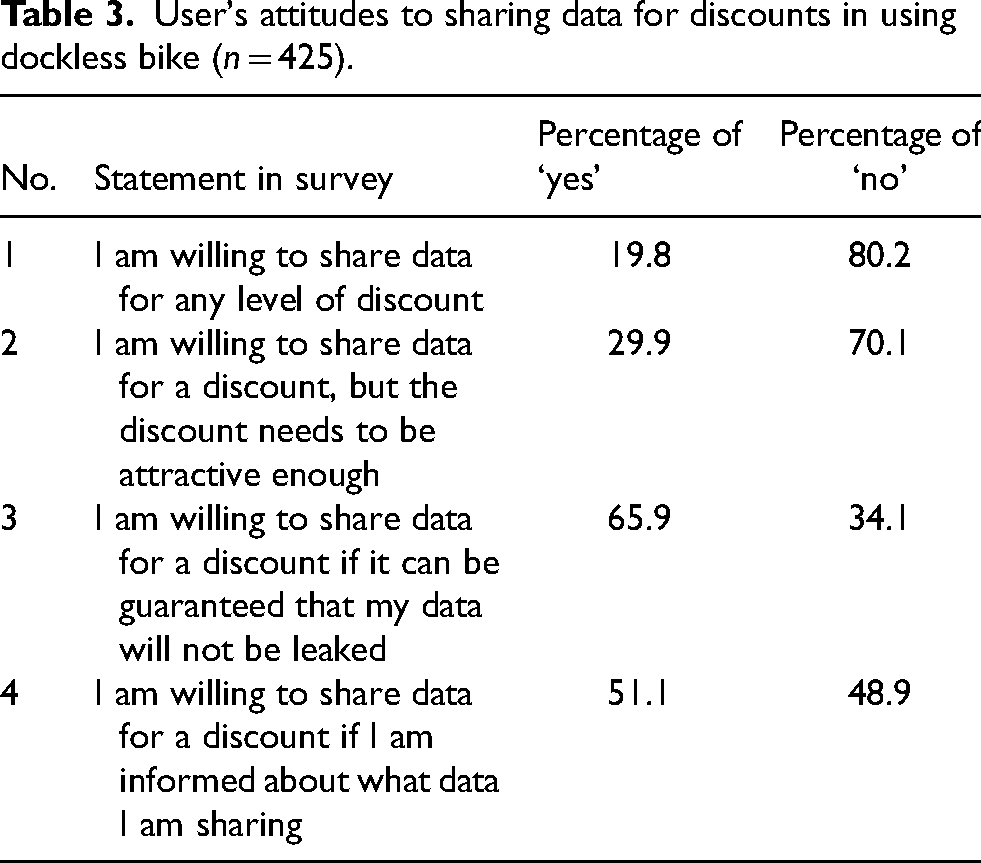
This section explores dockless bike users’ attitudes to potential monetary compensation for data sharing. Table 3 shows an overview of responses to the four statements regarding monetary compensation that were included in the survey. The idea behind the statements was to identify whether a financial compensation can increase users’ willingness to share data and the conditions that users tend to place upon such compensation. The table indicates that only a small percentage (19.8%) of respondents will accept data-sharing whenever a discount is offered and the increase of the value for discount has only resulted in a modest increase in willingness (statement 2). On the other hand, compared to the scenario in which they are only offered a discount (statement 1 and 2), users are much more willing to share data if the purpose of using their data is articulated (statement 4) or if data security is guaranteed (statement 3). This is in line with the significance of necessity and safety on data-sharing decisions that the previous sub-section has illustrated.
User's attitudes to sharing data for discounts in using dockless bike (n = 425).
The question about compensation for data-sharing was also structured in the cyclist interviews, which revealed a particularly interesting phenomenon. There seems to be a tension between interviewed cyclists’ willingness to share data and their attitude towards monetary compensation for data. 25 out of 60 (40%) interviewees said they were either unaware of or did not care about personal data collection, but then refused the hypothetical deal of sharing data to receive discounts. This discrepancy in attitude can be attributed to two aspects: viewing current practices to be ‘normal’ and ‘inevitable’ and viewing compensation for data collection as ‘abnormal’ and ‘problematic’. The normalisation usually occurred through references to the prevalence of data collection in contemporary society: Data collection is normal. Even if you go to the bank or you go to the government, I don’t believe that they will handle your personal information properly. That being said, how can I have any expectation about the data standards of dockless bicycle providers? (Male, 40–50, uses 3–5 times every week, service industry)
This cyclist believed that data leakage is already prevalent, even within organisations that are usually seen as more trustworthy than dockless bike operators. Thus, he adopted an attitude of indifference and normalised data collection practices. Other interviewed cyclists, however, have taken normalisation to a larger scale, referring to modernity and the big-data era for justification: I don’t care (about data collection). I work in the IT industry, and I know how the industry is like. If you are a modern person, you are losing your privacy every day. This is how the era of information intelligence works, so you have to adapt to it. (Male, 20–30, uses twice a day, programmer)
The era of IT was used as a discursive resource to argue that omnipresent data extraction is the norm and that individuals have to adapt. The referral to a ‘modern person’ also highlights the tension between digital modernity and privacy (O’Hara, 2018), hinting that privacy is a price that people have to pay in order to adapt to current trends. In China, the more relaxed regulations of data privacy have sometimes been equalled to a more open mind towards modernity and progress (Hess, 2019), as Alibaba's chief AI engineer claimed ‘Chinese people have less concern with privacy, which allows us to move faster’ at the World Summit AI in 2017 (Revell, 2017). The positive notions attached to modernity and big-data era could discursively prompt users to justify and normalise giving away data, especially in a city like Shenzhen where IT is a pillar industry.
The other part of the tension is the problematisation of receiving monetary compensation for sharing data. In the online survey, 12.5% of participants have indicated their problematisation of sharing data for compensation by selecting the option ‘I am not willing to share my data with dockless bicycle operators for a discount under any occasion’. Table 4 summarises the difference between the problematisation group (those who choose ‘Yes’ for this option) and the rest of participants in their attitude towards dockless bike and their willingness to share data. A subsequent one-way ANOVA test has confirmed that there was a statistically significant difference between the two groups in terms of their attitude towards dockless bike (F(1423) = 4.54, p = 0.03) and their willingness to share data with dockless bike operators (F(1423) = 43.43, p < 0.001). A more negative attitude towards dockless bike and a lower willingness to share data with operators could indicate a lower level of trust in dockless bicycle platforms, which could have effects on participants’ problematisation of sharing data for compensation.
Descriptive statistics on participants’ problematisation of sharing data for compensation.

This problematisation was much more prevalent in the cyclist interviews, as 44 interviewees out of the 60 rejected the hypothetical compensation for data. Among the 25 of them who also normalised data collection, their problematisation of compensation is mainly based on three reasons. Firstly, some cyclists considered safety and privacy to be a non-negotiable, non-exchangeable ‘hard’ demand that is inelastic to price: The issue of safety is the foremost, and it cannot be used to exchange with money. (Female, 20–30, uses 2–3 times every week, teacher)
As this respondent considers safety to be paramount and objects the monetary compensation to data collection, it seems paradoxical that she is still using dockless bikeshare regularly and has agreed to all of its data-sharing conditions. This could be related to the second reason of problematising compensation: the change of attitude when a ‘choice’ is perceived to be given: I can accept if I am asked to provide it, but I will not voluntarily provide it for discount if I am given a choice over whether to provide or not. (Male, 30–40, uses once every week, service industry)
The key to this cyclists’ differing attitude between data sharing with and without compensation seems to be whether he perceives he is ‘given a choice’. Monetary compensation for data can possibly evoke a conception of voluntary exchange, which presents a more equal power dynamic between users and operators. The observed problematisation of monetary exchange for data by some respondents can therefore also be viewed as a changing attitude to data extraction once they feel their autonomy over personal data is restored by being given an exchange option.
Finally, some respondents have problematised compensation for data collection based on a fundamentally different value system, which amounts to the resistance against the commodification and marketisation of data: I am not willing to accept. I will not explicitly say that you can take away this and that information, and you give me this cash. This is weird. (Male, 40–50, uses 3–4 times every week, after-sales service) I cannot accept this deal because I cannot sell it. Me handing my privacy over to them in exchange of some discount, this is a different thing (from them collecting from me). (Female, 20–30, uses twice every day, foreign trade)
Both respondents have problematised monetary compensation for data by stating the ‘selling’ of data to be ‘weird’ and ‘different’ from normal data collection. In this case, it could be that they are not objecting to data collection per se, but to the commodification of their data in a capitalist set of relations. However, the very business model of dockless bikeshare is inseparable from ‘exchanging privacy for money’ that many cyclists have problematised. Most users of dockless bikeshare in China have their data extracted and commodified regardless of compensation (Spinney and Lin, 2018, 2021) and this problematisation could further benefit dockless bike operators by absolving them from the responsibility of data compensation (Sadowski, 2019). Nevertheless, the resistance against commodifying data that some problematisation entails also raises the question of whether monetary compensation is the only justifiable way to compensate users. Given the previously discussed different valuation of personal data related to social safety by men and women (Sun et al., 2017), a unified renumeration for personal data could also induce gender-based discrimination and injustice.
Moving forward, this lack of equivalence between data and remuneration could potentially open the space for exploring non-monetary ways that enable users to benefit from their data. One possibility for addressing this issue is what Creutzig (2021) termed the ‘digital urban commons’ approach, which utilises a public integrated user data platform to de-commercialise behavioural data and use them for public welfare purposes such as transport system optimisation. In this case, users are able to enjoy the benefits from improved operation of bicycle fleets, which ensures that mobile big data is used for the social good (Poom et al., 2020). While this approach is clearly in clash with the surveillance capitalist business models, local authorities could leverage the licensing of shared mobility operation to set conditions for data-sharing, thereby pushing shared mobility platforms to publicise data and channelling these data to ways of use that benefit users. This is especially relevant in the Shenzhen case, where the municipal government has strong management and control over the licensing and fleet quotas of dockless bicycle sharing platforms.
Conclusion
The objective of this paper is to shed light on how dockless bikeshare users in Shenzhen perceive and interact with the personal data collection practices by dockless bikeshare operators and platforms. Three main findings have been discussed in the preceding section. Firstly, while users’ willingness-to-share was indeed correlated with certain socio-demographic characteristics such as income and education, these correlations turned out to be relatively weak. Users’ mobility patterns and personal attitudes to dockless bikeshare had more significant impacts on willingness to share. Those with higher and more inelastic mobility demands for dockless bikeshare and higher level of trust on the sharing platform tended to be more willing to share data, while those who perceive greater risk of data safety tended to be less willing to share. Secondly, analysis on users’ interpretations of sharing different types of data has illustrated that they are impacted by two groups of logics: necessity/indifference and sensitivity/safety. Cyclists interviewed tend to be more willing to share the types of data that they believe to be necessary for using the dockless bikeshare service, while being more cautious when sharing what they consider unnecessary, sensitive, or could pose threat to their safety.
Thirdly, this study has identified a tension between some dockless bike users’ normalisation of data collection and problematisation of monetary compensation for data. Normalisation occurred in the interviews through participants repeatedly referring to practices positioned as common and ‘modern’, including ubiquitous data collection in an era of big data. Such references were most common among frequent users, regular long-distance commuters and IT industry workers, which illustrates the impact of mobility demand and occupation on users’ interpretations on data collection. When such normalisation is combined with the problematisation of monetary compensation for data, it could possibly reduce users’ incentive to demand further compensations and sustain the current data extraction and monetarisation model.
Given the results, this study makes a threefold contribution to the literature. Firstly, this study contributes to the urban platform mobility literature by furthering Spinney and Lin’s (2018, 2021) analysis of personal data extraction within dockless bikeshare through examining the nexus between data extraction and urban mobility from dockless bikeshare users’ side. It presents a case study of users’ interaction with data extraction in China and highlights specific demographic, mobility and perception factors that influence both users’ willingness to share data and users’ interpretation of data collection. The result of this study contributes to the debates around the commodification of urban mobility and its implications for the process of capitalist exploitation.
Secondly, this study contributes to the conceptual debate around surveillance capitalism by analysing how the data extraction and monetarisation practices of a for-profit urban shared mobility platform is interpreted, normalised and sustained from the users’ side. While most studies of surveillance capitalism focused on political-economic and structural factors, this study has identified some users’ normalisation of data collection and problematisation of monetary compensation for data as factors that consolidate and sustain data extraction, highlighting the highly entrenched nature of surveillance capitalism. The findings suggest that different from the traditional, global online platforms such as Google and Facebook that have informed the surveillance capitalism literature (Netchitailova, 2012; Zuboff, 2019), shared mobility platforms could be a new frontier where surveillance capitalism interact with individuals’ everyday mobility to further its agenda of behavioural surplus extraction. Thirdly, on a related note, this study contributes to the evolving debate around big data and data justice (Dencik et al., 2016; Heeks and Renken, 2018; Taylor, 2017) by engaging with monetary compensation as a means to reduce extractivism in data collection, and how users have perceived and interpreted such compensation. This study has questioned the justifiability of monetary compensation for personal data from the users’ perspective and proposed the data commons approach based on public intervention as a possibility for change.
Finally, while this study has explored users’ attitude to monetary compensation for data sharing, the effect of the amount of compensation offered has not been tested. Future research can use economic experimental methods, such as choice experiments (Ladenburg et al., 2022), to analyse cyclists’ willingness to accept payment for data sharing. In addition, only dockless bike users have been sampled in the field interview, which may create selectivity bias if non-users’ beliefs on sharing data and receiving compensation differ from those articulated by users. Thus, a broader follow-up study targeting non-users can reveal whether dockless bike users have significantly different attitude to data extraction from non-users. Furthermore, although this study has identified the effect of users’ mobility patterns on their attitude to data sharing, it remains unclear whether data extraction could also shape the mobility of certain individuals by limiting their access to dockless bike. It can be in dockless bike operators’ interests to concentrate services in neighbourhoods with a wealthier and more digitally active population. Whether the business logic of data extraction will simultaneously induce mobility injustice (Sheller, 2018) and data injustice (Taylor, 2017) by producing the closely interweaving of virtual and physical mobility (Sheller and Urry, 2006) through spatially differentiated dockless bike service provision should be more thoroughly investigated by future research. Lastly, future research can also test the generalisability of results in this study by examining other mobility platforms that potentially profit from data extraction, such as ride hailing and e-scooter sharing and other platforms used to offer and consume everyday services.
