




Abstract
This article examines the public response to mandatory location disclosure (MLD), a new surveillance technology implemented on China's Sina Weibo. Initially introduced to geo-tag posts related to the Ukraine War, the MLD eventually expanded to encompass all posts and comments on the platform. Drawing on a large-scale dataset comprising over 0.6 million posts and 24 million comments, this study uncovers political asymmetry observed during the initial implementation of MLD. Users with different political orientations were subjected to different levels of geo-tagging. Pro-Ukraine users were most frequently geo-tagged, followed by Pro-Russia and liberal-leaning users, while conservative-leaning users are least likely to be tagged. This selective surveillance approach, however, backfired among Pro-Ukraine and Pro-Russia users, pushing them to publish more war-related content, while its impact on liberal- and conservative-leaning users appeared to be minimal. When selective surveillance was replaced by universal surveillance, the backfire effects ceased to exist and people's interest in war-related topics declined. Furthermore, privacy cynicism prevails among commenters across opinion groups. Neither the introduction nor the expansion of MLD deterred audiences from engaging with the geo-tagged posts. These findings suggest that prolonged surveillance makes people less sensitive to privacy threats and more experienced in neutralizing surveillance's influence on themselves. Privacy cynicism, though widely considered toxic to democracy, can function as a source of resilience that shields people from the fear of coercion and undercuts the marginal utility of state surveillance in an authoritarian context.
Keywords
This article is a part of special theme on Digital Resignation and Privacy Cynicism. To see a full list of all articles in this special theme, please click here: https://journals.sagepub.com/page/bds/digitalresignationandprivacycynicism
Introduction
In 1983, the Florida Department of Corrections Community Control embarked on a pioneering experiment employing electronic tagging as a substitute for traditional custody measures (Lyon, 1994). As part of the experiment, individuals placed under home detention were tagged with wrist or ankle monitors that tracked their movements and alerted the authorities in cases of unauthorized departures. The experiment proved highly successful. Electronic tagging garnered broad support from both judges and detainees and quickly became a common practice in various criminal justice systems across the globe (Nellis, 1991; Papy and Nimer, 1991).
Four decades later, the electronic tagging program has found an unexpected successor in China, whose targets, however, are no longer criminal defendants but ordinary users on social media. On 4 March 2022, Sina Weibo activated the mandatory location disclosure (MLD) feature, which automatically revealed users’ provincial-level locations below posts mentioning the Ukraine War 1 (Weibo Management Team [@微博管理员], 2022a). After seven weeks of implementation, this feature was expanded to encompass all users and all content on Sina Weibo (Guo et al., 2023). In August 2022, MLD was formally codified by law and rolled out to other major social media platforms in China.
The implementation of MLD marks the most sweeping escalation of surveillance measures in China since the activation of the real-name registration system in 2012. It has raised significant concerns about user privacy, online anonymity and freedom of speech (Baptista, 2022; Shen, 2022). However, despite extensive discussions in popular media, there is a notable lack of scientific research that empirically examines how individuals adapt their expression of opinions in light of this new surveillance technology.
In a bid to fill this gap, the current study draws on a large-scale dataset of public discussions about the Ukraine War on Sina Weibo. It employs a natural experiment to investigate how individuals’ self-disclosure behaviors are affected by the imposition and escalation of MLD. The findings of this study suggest that state surveillance is subject to a law of diminishing marginal utility. Although geo-tagging is overt and intrusive, MLD only has minimal influence on public opinion expression. It is argued that in a society where surveillance has already penetrated almost every nook of life, many people would have grown apathetic to surveillance escalation and become accustomed to the reality of mass surveillance.
The making of surveillance state
The surveillance system in China has been expanding at an alarming rate since the advent of the Internet. To sustain its rule in the digital realm, the Chinese government has been fortifying its surveillance infrastructure in the public sector (Creemers, 2017b; Stockmann, 2018) while simultaneously delegating power to commercial enterprises and turning them into an extension of the surveillance system in the private sector (Jiang, 2016; Lagerkvist, 2012). Through such concerted efforts, the surveillance apparatus in China has become increasingly sophisticated. Before the introduction of MLD, it was already made up of five major building blocks: (a) the golden shield (and its successor Skynet); (b) the great firewall; (c) platform content censorship; (d) social credit system and (e) real-name registration system.
The surveillance infrastructure in the public sector is underpinned by two gatekeeping measures: the Golden Shield (GS) and the Great Firewall (GFW), which regulate offline and online traffic, respectively. The GS, first proposed in 1998, is an all-encompassing cyber police system that incorporates several surveillance tools, such as street cameras, ID tracking systems, and traffic monitoring systems (Open Society Institute, 2009; Su et al., 2022; Walton, 2001; X. Xu, 2020), to improve police effectiveness. Its online counterpart, the GFW, came into the public eye in 1996 (Barme and Ye, 1997; Griffiths, 2019); it scrutinizes information flow on the internet and blocks websites that authorities deem objectionable (Feng and Guo, 2013). As a boundary regulation tool, the GFW seals off Chinese cyberspace to form a closed ecosystem that is largely impervious to external influences (M. Jiang, 2010; Pan, 2017).
In the private sector, authorities delegated surveillance power to individual ISPs (Lagerkvist, 2012; Miller, 2018; Xiao, 2023) and mandated they establish their on-site censorship schemes to monitor the messages circulating on the platforms. 2 A censorship industry is thriving, which is believed to have amassed hundreds of thousands of censors in 2022 (H. Xu, 2022). Unlike GS and GFW, which put all internet traffic under radars indiscriminately, content censorship is highly selective of topics, users, and locations. Posts related to collective actions, criticisms of censors, pornography (King et al., 2013, 2014) and other political events (Bamman et al., 2012; Fu et al., 2013) often face higher censorship rates. Besides, users with liberal stances (Y. Jiang and Kuang, 2021; T. Zhu et al., 2013) or from outlying regions, such as Tibet and Qinghai (Bamman et al., 2012), are also more heavily censored.
Later in 2012, Sina Weibo launched the Real-Name Registration (RNR) system (M. Jiang, 2016; Zhao, 2011). The RNR system requires all account holders to register their telephone numbers 3 and prohibits those who fail to pass identity verification from posting and commenting. Despite its profound influence, the RNR system is designed and deployed with adherence to the “frontstage voluntary, backstage mandatory” tenet. Sina Weibo stores users’ identity information in the backend and avoids disclosing them in the frontend. Thus, users can still preserve their frontstage anonymity to peer users, even though their real identities have been revealed to firms and governments.
A year later, the central government started exploring the possibility of establishing a social credit system (SCS) to promote social compliance and regulatory enforcement (Chinese State Council, 2014; Engelmann et al., 2021; Trauth-Goik and Liu, 2023). This led to the development of various SCS applications by both governmental and non-governmental agencies. Alibaba and Tencent introduced their commercial SCSs and attracted a substantial number of voluntary users by gamifying the credit rating process and distributing material incentives (M. Chen et al., 2023; Kostka, 2019; X. Xu et al., 2022). At the same time, governments implemented official redlists and blacklists to showcase trustworthy and untrustworthy individuals, respectively (Engelmann et al., 2021; Trauth-Goik and Liu, 2023). Both state-run and commercial SCSs draw on extensive financial records and other social behavior data, such as charitable donations, educational attainment, and personal networks (Creemers, 2017a; M. Jiang and Fu, 2018; Kostka, 2019; Liang et al., 2018). Much concern has been raised regarding the possibility of these integrated data being misused for unauthorized purposes (F. Liang et al., 2018).
Generally speaking, as digital technologies advance, China's surveillance apparatus has grown increasingly capable of scrutinizing voluminous data in an individualized and routinized way. In Chin and Lin's (2022) words, authorities have revived the totalitarian techniques of the past and blended them with futurist technologies in an effort to re-engineer the party-state. The ensemble of surveillance technologies across the public and private sectors allows the regime to monitor where you go with the golden shield, what websites you intend to access with the great firewall, what social media accounts you have with real-name registration, and to track your financial and social conduct through the social credit system. As a result, the anonymity of cyberspace is gradually deteriorating, and personal privacy is being encroached upon step by step, pushing Chinese society closer to the architype of “total institution,” as per Erving Goffman, where surveillance is everywhere and backstage is nowhere (Goffman, 1961; Shreeya, 2018).
Mandatory location disclosure
On top of the already tightened control, Chinese cyberspace authorities made a sweeping move to mandate MLD on major social media platforms in 2022. Sina Weibo was the first to experiment with this new surveillance technology. On 4 March 2022, Sina Weibo activated the MLD feature, revealing users’ locations under posts mentioning the Ukraine War (Weibo Management Team [@ 微博管理员], 2022a). For users within China, MLD indicates their provinces, while for those outside China, respective countries would be displayed. Moreover, if a post was geo-tagged, all comments under it would also be geo-tagged (Figure 1). Despite widespread privacy concerns, the company and the pundits maintained that MLD could help safeguard information integrity and curtail the spread of disinformation about the Ukraine War (Hu and Zhao, 2022; Jin, 2022).
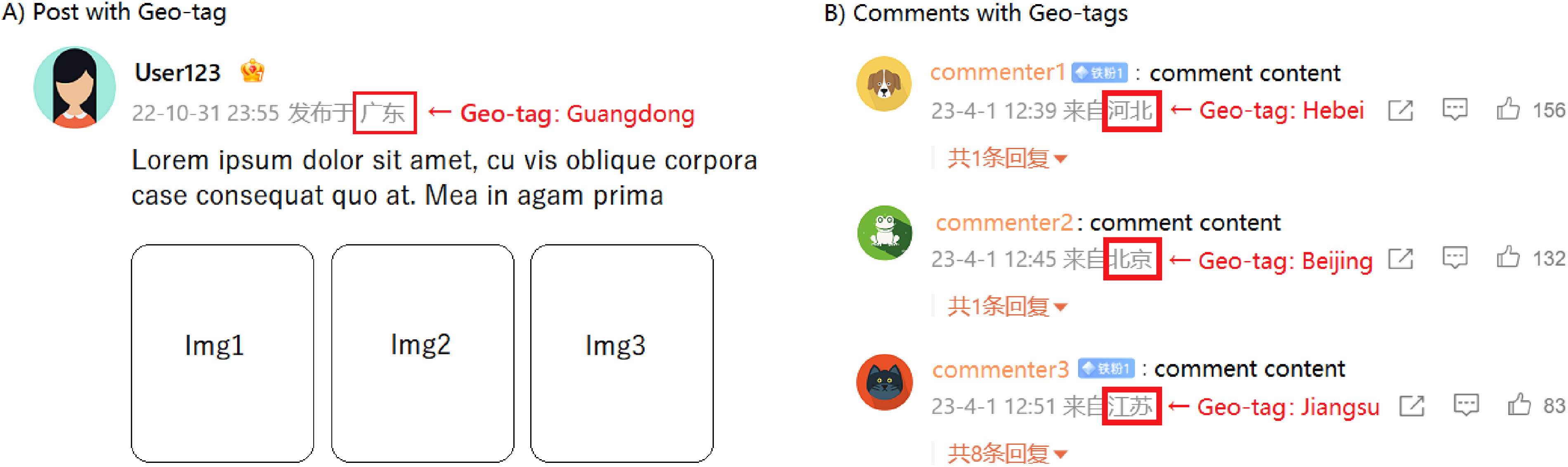
Examples of Weibo posts and comments with geo-tags.
After a seven-week trial, Sina Weibo further stepped up MLD to encompass all users, posts and comments from April 28, 2022 onwards (Wcueibo Management Team [@微博管理员], 2022b). Geo-tags are displayed indiscriminately, regardless of the topics discussed. This marks a watershed moment between the Selective Disclosure (Phase 1) and Universal Disclosure (Phase 2) phases in Figure 2. 4

Implementation process of MLD feature on Sina Weibo.
Among the expanded portfolio of surveillance tools, MLD exhibits three distinct characteristics that set it apart from its predecessors. Firstly, MLD is particularly intruisive compared to other surveillance tools, as it significantly affects the physical and spatial anonymity of individuals, which is one of the most fundamental privacy rights (Lutz and Ranzini, 2017; Madden et al., 2013). Numerous studies have shown that individuals tend to refrain from disclosing their locations publicly (Asuquo et al., 2018; H. Liang et al., 2017) for fear that such information can facilitate doxing and social profiling (Elwood and Leszczynski, 2011). Secondly, breaking with the tradition of “frontstage voluntary, backstage mandatory,” MLD displays users’ locations to the public without seeking their prior consent. Extraordinary attention might be channeled to individuals from regions stereotyped as insufficiently patriotic, making them more vulnerable to incivility (Guo et al., 2023). Thirdly, a phase-in strategy was adopted in implementing MLD. The surveillance intensity was escalated step by step, which allows us to assess public reaction to not only the initial introduction but also the subsequent expansion of MLD.
Surveillance escalation and opinion expression
Existing studies have identified two distinct outcomes of surveillance on the expression of opinions: the chilling effect and the backfire effect. The chilling effect suggests that surveillance is a political disincentive that will discourage people from exercising their rights to free speech (Büchi et al., 2020, 2022; Marthews and Tucker, 2014; Stubenvoll and Binder, 2024; Wacker, 2003; Y. Zhu and Fu, 2021). According to Chen and Yang's (2019) research, university students in China exhibit little interest in uncensored information after being exposed to GFW for an extended period. When given free access to the unblocked internet, half of the participants did not use it at all and those who did mostly avoided approaching foreign websites blocked by GFW. By comparing user activities before and after the RNR, Fu et al. (2013) noted that although there was no significant change in overall post volume, RNR can exert chilling effects selectively on users who had a stronger interest in politics. Besides, the chilling effect is not unique to China. In the United States, the revelation of the PRISM project had a similar chilling effect on the American public. This led to a reduction in the internet traffic towards privacy-sensitive articles on Wikipedia and Google, as indicated by Penney (2016) and Marthews and Tucker (2014). Collectively, these studies show that surveillance can nudge people to stay away from sensitive topics, especially when political stakes and privacy risks run high.
In contrast, the backfire effect implies that being aware of surveillance can provoke people to become more interested in the censored topics that they might have otherwise ignored (Roberts, 2018, 2020; Worchel et al., 1975). Censorship attempts can end up being counterproductive, inadvertently popularizing the blocked content (Nabi, 2014). This phenomenon has been dubbed the “Streisand effect” (Jansen and Martin, 2015). Over the past few years, numerous occurrences of the Streisand effect have been documented. Hobbs and Roberts (2018) observed a surge in downloads of virtual private networks (VPNs), Twitter and Facebook, when Instagram was suddenly blocked in China. Chang et al. (2022) corroborated that the COVID-19 pandemic spurred censorship circumvention and increased access to websites blocked in China. Roberts (2018) substantiated that after experiencing censorship, Chinese people tend to seek more information, write more about the censored topic, and complain more frequently about censorship. Zeng et al. (2017) found that content censorship led to a subsequent increase in discussions about the 2015 Tianjin Blasts on Sina Weibo. Zhu and Fu (2021) revealed that removing a user's posts about social protests will provoke them to be more outspoken on this issue. Similar instances have also been recorded in Turkey, Pakistan, and Iran (Nabi, 2014; Woollacott, 2014). In contrast to the chilling effect, this strand of studies suggests that all strategies of control call forth counterstrategies on the part of subordinates. Surveillance leads not only to a loss of privacy but also a loss of freedom and human dignity, which triggers psychological reactance (Brehm, 1966) and frees people from guilt and fear to engage in resistance (Marx, 2003).
Despite a large body of research on the chilling and backfire effects, there remains a vast middle ground of minimal effects that is often disregarded in the existing literature. I hypothesize that after living with surveillance for a long time, many Chinese people have adapted to the surveillance realism (Dencik and Cable, 2017) and have become less sensitive to surveillance escalation. Newcomers such as RNR, SCS and probably MLD are less likely to trigger strong reactions and aversions among people. Hence, as time passes, minimal effects may become more prevalent, and we would be more likely to observe a greater continuity in people's behaviors before and after the implementation of new surveillance technologies.
A few studies have provided evidence for the minimal effect hypothesis. For instance, Roberts et al. (2020) demonstrated that Weibo users are not deterred from posting after experiencing censorship. On average, censored users posted 600 posts in the four weeks after censorship, while uncensored users posted 588 posts. The difference is not statistically significant. In another study, Roberts (2018) drew on a representative survey of urban residents and showed that Chinese people are accustomed to regular censorship with only 5% reporting fear but 35% reporting indifference after experiencing censorship. M. Jiang (2016) found that, due to the widespread use of electronic ID cards in China, many people considered RNR as a mundane extension of ID tracking system and therefore expressed minimal concern about it. Longitudinal consumer surveys also revealed a significant rise in privacy apathy over time (Boston Consulting Group, 2020; Rose et al., 2014).
Gary Marx (2003, 2009) proposed the concept of “surveillance neutralization,” which offers a compelling lens for understanding the rationale behind the minimal effects of surveillance. He observed that individuals had been actively developing and utilizing a broad repertoire of neutralization tactics to mitigate the effects of surviellance on their daily lives. One such action is refusal: People consciously maintain the status quo and refuse any change in their behaviors in face of surveillance. He further argued that although the action of surveillance refusal may not constitute overt opposition, it can help enhancing people's resilience. By pursuing normalcy despite being monitored, surveillance refusers could regain a sense of agency and abate the fear and anxiety that surveillance is meant to instill. A common mindset arising therein is: “I know big brother is watching me; censors come after me; the government knows all about me. But there is nothing I can do about it. If there is no way out, I can only turn a blind eye to it even though I don’t agree with it.” The lack of control promotes a sense of cynicism toward surveillance and perpetuates a distrustful feeling about its commanders. Therefore, Marx asserted that even though neutralization actions were admittedly low-cost and low-profile, they should be considered a form of resistance rather than compliance toward surveillance.
To shed light on the inconclusiveness of surveillance effects, this study will examine the extent to which users’ opinion expression is influenced by MLD, after seeing so many episodes of surveillence escalation.
Methods
Data collection
A total of 650,745 posts and more than 24 million comments were collected between February 24, 2022 and December 10, 2022 from Sina Weibo. The posts were created by 196 high-profile Weibo handlers who have been outspoken on public issues, especially on the Ukraine War. The choice of handlers considers five types of opinion leaders: Pro-Russia, Pro-Ukraine, conservative-leaning, liberal-leaning and the official accounts of Western embassies in China.
Pro-Russia or Pro-Ukraine opinion leaders are users who devote most of their posts to discussing war-related issues and garner considerable attention for that, whereas conservative- and liberal-leaning opinion leaders are those who actively discuss a wider range of political issues, including but not limited to the war. Previous studies suggest that institutionally established metrics, such as account verification status and follower numbers, are effective proxies for identifying opinion leaders (Lei, 2018; Nip and Fu, 2016; Y. Su, 2019; Zhang et al., 2018). Hence, I conducted an extensive search on Sina Weibo, targeted a set of high-quality posts in terms of constructiveness, justification and civility (Jaidka et al., 2021), and looked into the users’ homepages to see if they met the following criteria:
As a Pro-Russia/Pro-Ukraine opinion leader, the handler should have more than 5000 followers, should have devoted more than half of recent posts to war-related issues (details regarding the identification of war-related posts will be provided in a subsequent section), and should have shown apparently supportive attitudes toward Russian/Ukrainian government, respectively. As a conservative-/liberal-leaning opinion leader, the handler should be verified, should have more than 10,000 followers,
5
should have weighed in on a wide range of political issues including the war, and should have apparently endorsed the supremacy of state/liberal freedom, respectively.
6
A total of 174 opinion leaders from different segments were identified.
7
Then, I expanded the list to include another set of 22 official accounts of Western embassies, which have been voicing support for Ukraine and received tens of thousands of comments in their comment sections.
8
These 196 handlers are serving as the research subjects as well as the research venues for this study. As research subjects, they could inform us about how high-profile users with different political stances react to surveillance. As research venues, I look into their comment sections and try to uncover how their audience altered their commenting behaviors in response to the installation and expansion of MLD.
To collect the posts and comments, I deployed automatic web crawlers using the Selenium package in Python to visit the sampled handlers’ homepages every day and retrieve the posts as well as the comments therein. This dataset has been updated at least once a day and thereby includes posts later removed by the platform or the authors. Numerous time delays were inserted to ensure the crawler can pause periodically. The overall response rate was controlled mindfully at most two requests per minute, which is indistinguishable from the rates of human browsing activities and therefore avoid causing any harm to the website being scrapped.
Measures
Account activity
War_postsij gauges the number of posts containing war-related keywords that user i published in week j. To identify war-related posts, a comprehensive dictionary consisting of 746 unique keywords was developed (see Supplemental Note S1). Posts mentioning these keywords were extracted and their war-related values were validated through computer-assisted text analysis (see Supplemental Note S2).
Commentsij measures the average number of comments user i obtained for his/her war-related posts in week j. %Fans_Commentsij measures the average percentage of comments written by the “highly committed followers.” The “highly committed followers” are identified based on the “铁粉(super fans)” labels attached to commenters who had shared/commented/liked the posts by a handler for three days or have watched the handler's 90% of videos in the last 30 days.
Engagementsij denotes the average sum of likes, comments, and reposts user i obtained for his/her war-related posts in week j.
Surveillance factors
There are notable differences in how individuals perceive surveillance intensity across the two phases of MLD implementation. During the selective disclosure phase, only a fraction of posts were geo-tagged. Therefore, users whose posts were more frequently geo-tagged than others would have a heightened sense of being targeted under MLD. In the universal disclosure phase, MLD transitioned to an untargeted approach, equally affecting all users. Given this distinction, surveillance intensity was measured differently, with a proportional approach employed in the selective disclosure phase and a dichotomous approach used in the universal disclosure phase.
Selective Disclosure Intensityij is measured by the share of war-related geo-tagged posts generated by user i in week j.
Universal Disclosure is a dummy variable, equal to 1 if the post was created on or after April 28, 2022.
Account characteristics
Verified is a dummy variable, whose value is 1 if user i is a verified account.
Gender is another dummy variable, equal to 1 when user i is male. 9
Allow comments is also a dummy variable, equal to 1 if user i allows all people, including followers and non-followers, to comment on his/her posts.
#Followers gauges the number of other users that are following user i. #Friends gauges the number of other users who are both following and being followed by user i.
Variables War_postsij, Commentsij, #Followers and #Friends were positively skewed.
Therefore, logarithmic transformation was applied to make them conform to normality. Since the log-transformation can only be applied to positive value, I added constant 1 to all observations to escape the zero. Compared with raw numbers, the log-transformed indicators were found to contribute more to the model's statistical power as measured by R-squared metrics.
User Type is a categorical variable with five possible values, indicating user i's opinion group affiliation. Based on this variable, I created four dummy variables, namely Pro-Ukraine, Pro-Russia, Conservative, and Western Embassy, each representing one user category and coded with 1 if user i falls in that category. To avoid collinearity, the Liberal category is omitted, which in effect will serve as the reference category.
External factor
People's opinion expressions are presumably associated with the perceived severity and valence of the war (Muelle, 1973). Previous studies have substantiated that wartime casualty is a valid proxy for perceived war severity and is the most important predictor for public support of the war efforts (Gartner et al., 2004; Gartner and Segura, 1998). Therefore, another variable Casualtyj was included, which is gauged by the daily casualties, including the killed and the injured, in week j, based on the data published by the Office of the United Nations High Commissioner for Human Rights (OHCHR).
Data analysis
In many situations, the strongest way to estimate the causal effect is to run a randomized controlled experiment in the lab, where a researcher randomly assigns a treatment to some participants but not others and sees how treated and untreated participants react differently. However, when it comes to politically sensitive issues such as surveillance, this approach is often invalid; the lab environment creates a political vacuum that is safe and strictly controlled and therefore can hardly replicate a society with entrenched surveillance. To overcome this weakness, I opted to employ a natural experiment that leverages observational data to approximate lab experiments (Curtice, 2021; Masterson and Yasenov, 2021; Roberts et al., 2020). I passively observed the occurrences and influences of MLD without applying any manipulation. Since the implementation of MLD is exogenous, which affected some users while leaving others intact, it bears a similarity to randomized controlled experiments. The geo-tagged users are equivalent to treated participants, and the untagged users are equivalent to untreated participants in control groups. The causal effects of MLD can be yielded by contrasting treatment group with control group using regression models.
Given that the disparity between treated and untreated users could be confounded by users’ inherent tendency to discuss war and their regular rhythm of sharing on Sina Weibo, I incorporated individual fixed effects in the models to control for these time-invariant individual factors. Besides, observations of the same user are often correlated. So, I also included the lagged outcome variables to adjust for the self-correlation.
Findings
Mechanics of selective disclosure
Target: who is more susceptible to selective disclosure?
Who is more susceptible to MLD during the selective disclosure phase? To answer this question, I performed one-way analyses of variance (ANOVA) to assess how often opinion leaders with different political stances were geo-tagged for their war-related posts. The results indicate that the selective disclosure intensity varies significantly across opinion groups (see Table 1). Pro-Ukraine opinion leaders were subjected to the most intensive surveillance. As can be seen in Figure 3, 54% of war-related posts by Pro-Ukraine users were geo-tagged, surpassing the second-place Pro-Russian users by a large margin. Following the Pro-Russia group was the liberal-leaning users, whose war-related posts were tagged 29% of the time. The difference between Pro-Russia and liberal-leaning users is not statistically significant, according to the post hoc analysis (see Table 2). The conservative-leaning users are the most intact. Only 15% of their war-related posts were tagged, much lower than any other group.
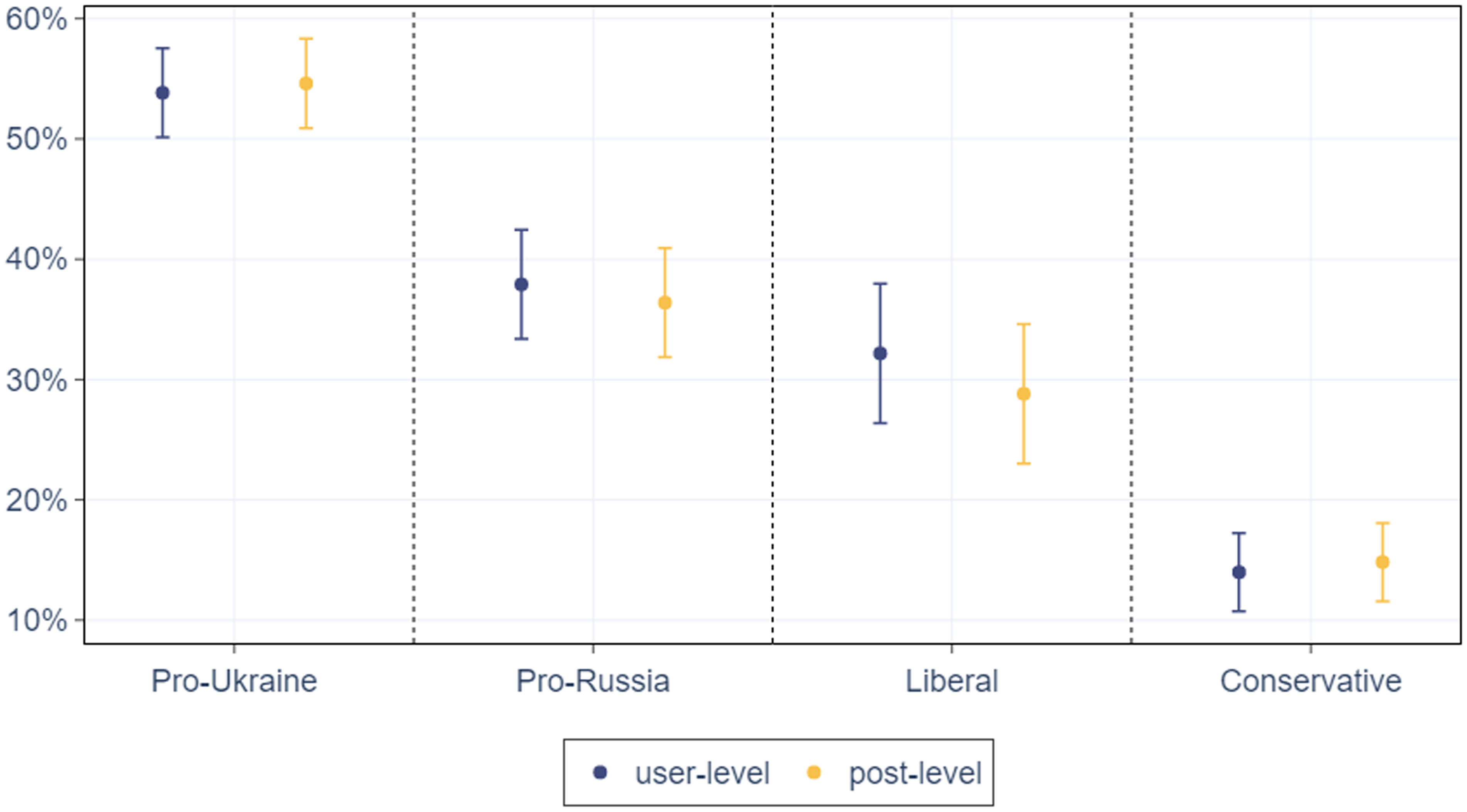
Selective disclosure intensity by political stance. User-level censorship rates are measured by the average percentages of geo-tagged posts out of all war-related posts per user within a specific group. Post-level censorship rates are measured by the average percentages of geo-tagged posts out of all war-related posts created by all users within a political group.
One-way ANOVA test of location disclosure intensity.

Note. Levene's test suggested the assumption of variance homogeneity was violated in both user-level and post-level analyses. To adjust for the inhomogeneous variance between the comparison groups, Brown–Forsythe tests were adopted.
Post hoc comparisons (Tukey HSD).

*p < .05, **p < .01, ***p < .001.
Trigger: which words could lead to location disclosure?
To identify keywords that trigger selective disclosure, I calculated the relative risks (RR) 10 (Fu et al., 2013) of words appearing in the geo-tagged group versus in untagged posts. The top 20 keywords with the highest RRs are listed in Table 3. The inclusion of these keywords would make a post more susceptible to geo-tagging.
Top 20 keywords with the highest relative risks of geo-tagging.
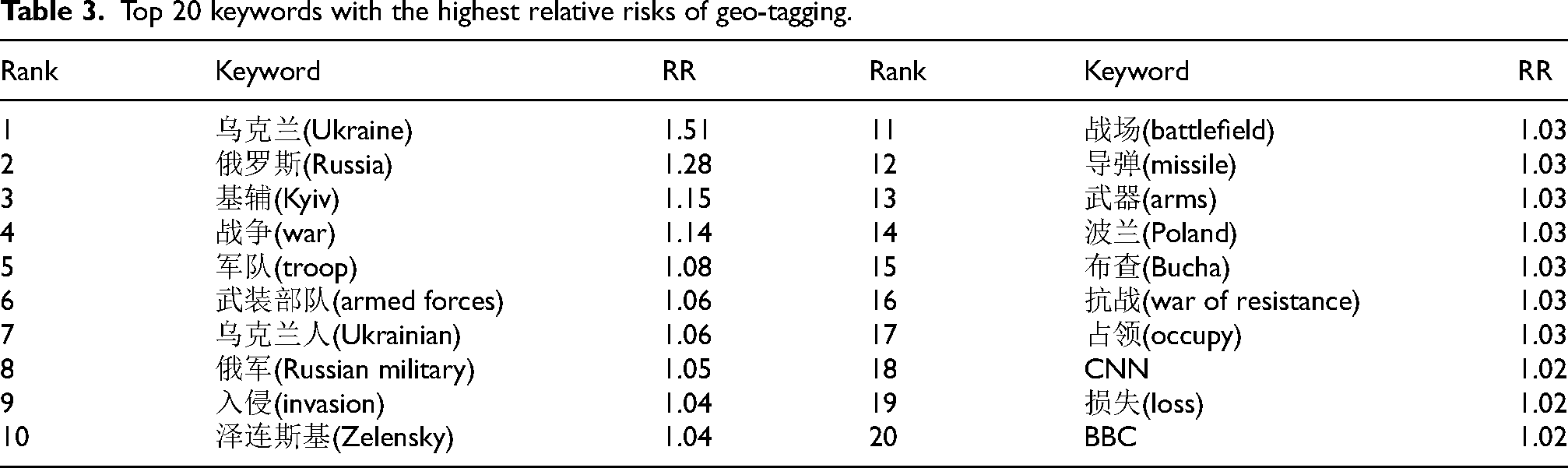
It is clear that most of the heavily tagged words are either directly related to Ukraine or reflect the Pro-Ukraine attitude. For instance, the word “入侵 (invasion)” was mentioned in 871 posts, of which 649 (74.5%) were tagged. In contrast, the word “纳粹 (Nazi)”—a key allegation adopted by Kremlin in justifying its military intervention—was mentioned in 1504 posts, but only 396 (26.3%) were tagged. Words such as “布查 (Bucha)” and “抗战 (war of resistance),” which are important narrative devices that Pro-Ukraine opinion leaders used to motivate public empathy, were also hit hard by selective disclosure.
Time trend: how does the selective disclosure intensity change over time?
In terms of temporal trends, I found that the surveillance intensity declined consistently for all groups over the course of 8 weeks in Phase 1 (Figure 4). The downturn was most pronounced among the Pro-Ukraine opinion leaders, who saw an average of 25% decrease in disclosure intensity. In contrast to a common belief that selective surveillance gradually expands until it reaches the point of becoming universal surveillance, this finding suggests that the actual dynamic of surveillance is rather interrupted and anticlimactic. Selective surveillance was lifted suddenly to its peak at the beginning, leaving people (especially the dissenters) with a strong first impression of suppression, and then petered it out until it was made universal.
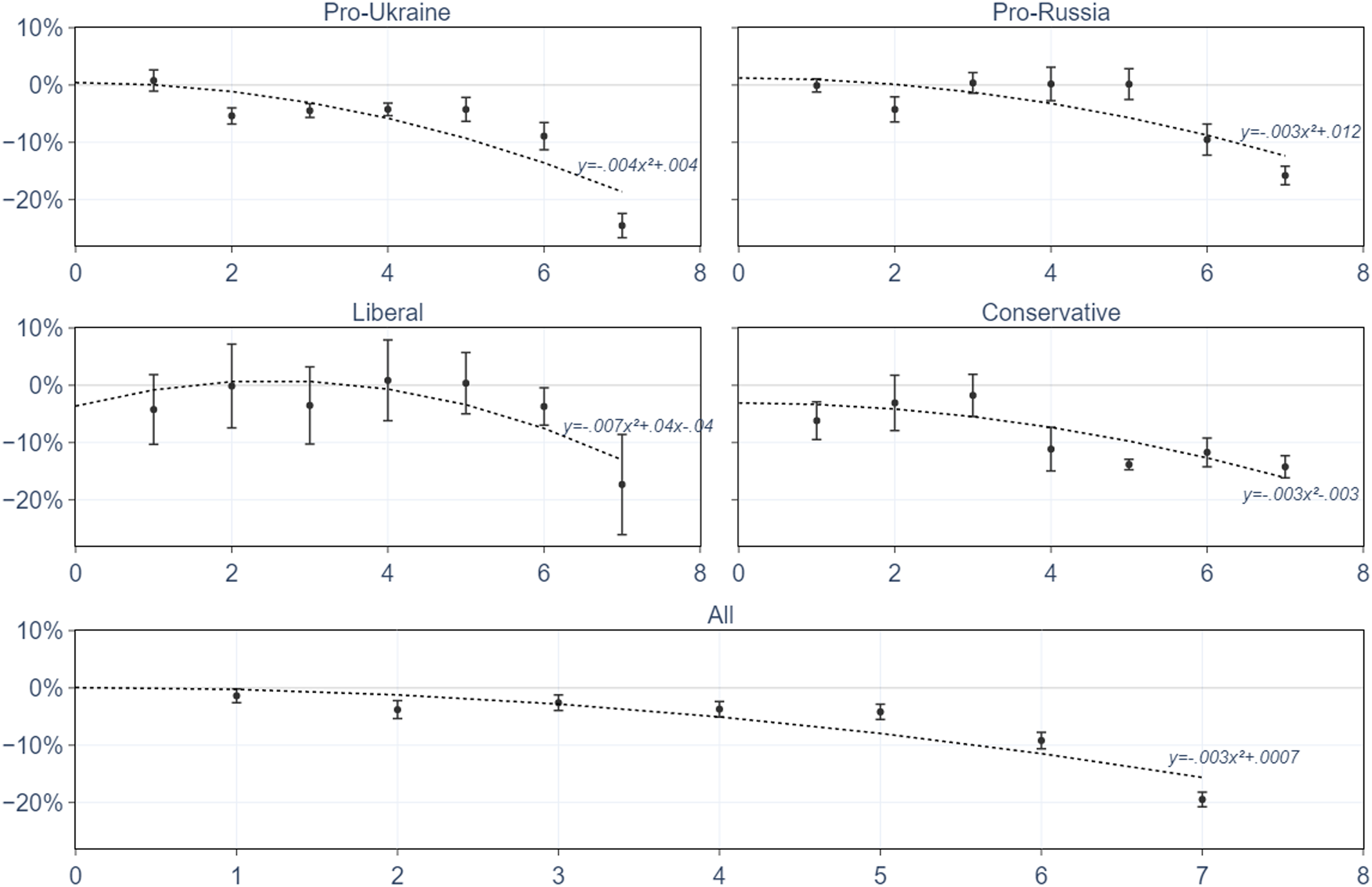
Time trends of the first-differenced disclosure intensity over the 8 weeks in Phase 1. Numbers represent the average within-individual differences between the disclosure intensity in week n and that in week 0 for the same user.
There are at least three possible explanations for this anticlimactic dynamic. First, regulators might only want to test the water and see if the MLD system worked well, while not aiming to tag every relevant post. Therefore, after a smooth launch, it might stop maintaining its algorithm, leading to a declined performance over time. Second, if surveillance is meant to signal state strength (Huang, 2015, 2018), it will be most effective when set on full blast, which assures that as many people as possible will receive the signal. Reach is more important than persistence in this sense. Hence, setting off MLD with its full capacity and then declining is a good way to strike a balance between the return and cost of surveillance operations. Finally, it could also be that people are gaining more knowledge and becoming more capable of escaping surveillance.
Diminishing utility of surveillance
Multiple regression models were implemented to shed light on the effects of surveillance on opinion leaders’ posting behaviors and their audience's commenting behaviors.
Resilience to surveillance among posters
First, as can be seen from Model 1 in Table 4, selective disclosure intensity can positively predict war-related posting in the following week. A fully tagged user (Selective Disclosure Intensityij = 1) will increase war-related posts in the next week by 23%. That is, selective surveillance backfired, provoked interest in censored topics, and increased users’ willingness to share sensitive information.
Model predictions of posting behaviors by opinion groups (DV: War_postsij).

Note. Dependent variable in the models is the log-transformed number of war-related posts user i published in week j.
The group-by-group breakdowns (Models 2–5) further indicate that the backfire effect was equally observed among Pro-Ukraine and Pro-Russia opinion leaders. The variables Selective Disclosure Intensityij in Models 2 and 3 are of similar size and significance. Therefore, selective surveillance triggered a similar degree of backfire among both Pro-Ukraine and Pro-Russia opinion leaders and prompted them to increase post frequency by a similar margin. As for the liberal- and conservative-leaning opinion leaders, the statistical powers of Selective Disclosure Intensityij in Models 4 and 5 diminished to an insignificant level. This means that liberal- and conservative-leaning users were apathetic to selective surveillance. They did not adjust their post frequency after they got tagged. Selective surveillance had a backfire effect primarily on highly committed discussants and had no effect on the less committed opinion leaders.
Furthermore, as indicated by the consistently negative coefficients of Universal Disclosure in all models, the universal disclosure phase witnessed a decrease in expression level across all opinion groups. According to the difference-in-differences analysis (see Supplemental Note S3), this decline can be interpreted by not only a natural decay in attention on the war but, more importantly, a direct impact caused by the cessation of selective surveillance. Selective surveillance can stimulate deeper cynicism and distrust, impelling highly committed users to voice their opinions in face of the rising risk of privacy breaches. Nevertheless, when selective surveillance was replaced by universal surveillance, such stimulation ceased to exist and people's interest in the topic declined.
In terms of account characteristics, verified and male users tended to be more outspoken on the war issues. Account age and follower number had mixed impacts. Newer and more followed Pro-Ukraine accounts were inclined to generate a large number of war-related posts, whereas among the other three opinion groups, newer and more followed accounts are less inclined to speak out on the Ukraine War.
Finally, the engagement metrics in week j − 1 negatively predicted the war-related post frequency in the subsequent week j. This means that opinion leaders tend to decrease their post frequency and avoid over-exposing their audience to the same topic after they have achieved some milestones in engagement metrics.
Resilience to surveillance Among commenters
In addition to posting, commenting is another form of opinion expression that is also critical to public deliberation. Another five models were developed to examine if MLD deterred people from commenting on geo-tagged posts. The results are summarized in Table 5.
Model predictions of commenting behaviors by opinion groups (DV: commentsij)note.

Note. Dependent variable in the models is the log-transformed average number of comments the user i obtained for his/her war-related posts in week j.
The regression models reveal that selective disclosure does not influence the number of comments received. None of the coefficients of Selective Disclosure Intensityij were statistically significant. A heavily censored user would have an equal chance as an uncensored user to receive the same number of comments for a war-related post. This means commenters were indifferent to being geo-tagged in the comment section. Moreover, commenters were also apathetic to surveillance expansion. When MLD was expanded to cover all topics, the comments received by a war-related post did not change significantly.
Neither the introduction nor the expansion of MLD deterred audiences from engaging with the geo-tagged posts. Some people were even joking—a common cynical reaction—about MLD by saying ironically: Everyone is concerned about the whereabouts of Ukrainian President. I think we should invite him to open an account on Weibo. With the support of this new feature [of location disclosure], as long as he mentions Russia every day, we will know where he is. What an easy solution! (You can also know our locations by commenting on this post).
Besides, the models also suggested that the more war-related posts a user publishes, the more comments he/she would obtain for each post. Commenters did not intentionally distance themselves from those opinion leaders who were outspoken on war issues. Instead, opinion leaders who insisted on disseminating war-related information would get additional recognition and engagement from audiences.
Conclusion and discussion
The right to privacy and freedom of expression are two sides of the same coin. They have a common goal—to find the best boundary between the public and private spheres—but different ways of realizing it. While the right to privacy claims for passive freedom to be free of public view, freedom to express aims for active freedom to engage in public sphere. The democratic ideal requires these two types of civil rights to be protected without compromising either. However, in reality, people's privacy concerns can hinder them from exercising their rights to free speech, forcing them to weigh the value of privacy against that of free expression. It is this tradeoff between the protection of passive freedom and the exercise of active freedom that constitutes the main ingredient of the privacy calculus for people living under authoritarian surveillance. However, these closely intertwined constructs are often studied in isolation, cultivating two separate bodies of literature on privacy and online political participation that stand far apart in the field of Internet research (Hoffmann and Lutz, 2023).
To bridge this gap, the current study represents a comprehensive analysis of Chinese netizens’ reactions to the implementation and escalation of a new surveillance technology MLD. The results make it clear that Sina Weibo's MLD was highly selective of topics as well as political stances. Opinion leaders who were not aligned with the official ideology or were highly committed to discussing sensitive issues were subject to more severe surveillance. Such selective surveillance backfired, provoking the highly committed users to post more war-related posts in the following week, whereas it had no observable effect on less committed users. In either case, users have demonstrated considerable resilience to surveillance escalation in the face of rising privacy risk.
In terms of commenting behaviors, the regression results corroborate that privacy cynicism prevails among commenters across opinion groups. Commenters were not swayed by the introduction nor the expansion of MLD. Prolonged surveillance makes people less sensitive to privacy threats and more experienced in neutralizing surveillance effects on themselves. They share critical commonalities with the Palestinian people, who are trying to carry on with normal life under the long-lasting war (Richter-Devroe, 2011). As documented by Pearlman (2011), Palestinian people believe that “refusing to emigrate, staying in Palestine, enduring all the difficulties, the lack of freedom, the restrictions placed upon us, the wall, this is resilience” (p. 96). For people under surveillance and occupation alike, getting on with daily life and pushing aside concerns despite all odds is a way to neutralize the misery imposed on them. By turning a deaf ear to the bombardment and turning a blind eye to mass surveillance, they could distract themselves from the fearful feeling and restore a sense of self-determination. Surveillance may finally become its own “enemy,” whose periodical escalation makes people more apathetic, thus reducing surveillance utility in inducing compliance and suppressing dissent.
Based on these findings, I argue that privacy cynicism can function as a source of resilience, shielding people from the fear of coercion and undercutting the marginal utility of state surveillance in an authoritarian context (Hoffmann et al., 2016). It can lower hurdles for political expression and abate fear of self-disclosure. Privacy cynicism, which leads to disengagement from privacy coping behaviors (Choi et al., 2018; Hoffmann et al., 2016; Lutz et al., 2020), may further result in a re-engagement in politics. With cynicism, people may resign themselves to surveillance, but they were also more emboldened in disclosing their opinions, a crucial step toward further political participation.
Such findings might not be unique to authoritarian societies. A recent study on German Internet users shows that privacy concerns are positively, albeit weakly, associated with higher-threshold political participation, while having no significant influence on lower-threshold political participation (Hoffmann and Lutz, 2023). In the United States, government monitoring is found to provoke widespread outrage from the public and thereby enhanced their political engagement (Best and Krueger, 2011). The deterrent effect of state surveillance is capped by people's critical consciousness, and privacy concerns do not necessarily result in political disengagement, no matter in authoritarian or democratic regimes. Together with these studies, the research presented here offers a new lens through which the nuances of privacy concern and privacy cynicism, including their intrinsic values and action tendencies, can be better understood.
There are several limitations worth noting. First, the account samples are made up of high-profile users, which may deviate from the whole user population of Weibo. Second, this study is built on observations of user behaviors. Observational data is relatively free of the social desirability bias that is commonly seen in self-report or experimental data. However, it is impossible to directly solicit people's opinions and attitudes. The link between privacy cynicism and minimal effects of surveillance is inferred speculatively. Finally, despite the implementation of an automated algorithm to visit the sampled homepages at least once a day, posts and comments generated between two consecutive visits could have been removed before the web crawler recorded them. As a result, the data used in this study may be incomplete, potentially leading to an underestimation of the true magnitude of resilience.
That said, this study contributes to the extant literature in several ways. Theoretically, it advances our understanding of surveillance effects and clarifies the resistant nature of privacy cynicism. It also sheds light on the role of state power on privacy issues, filling in the gap left by extant research that focuses primarily on business surveillance. Furthermore, using China as a testing ground, we can effectively extrapolate future trends in a world where democratic backsliding is experienced in various locations.
Supplemental Material
sj-pdf-1-bds-10.1177_20539517241242450 - Supplemental material for Privacy cynicism and diminishing utility of state surveillance: A natural experiment of mandatory location disclosure on China's Weibo
Supplemental material, sj-pdf-1-bds-10.1177_20539517241242450 for Privacy cynicism and diminishing utility of state surveillance: A natural experiment of mandatory location disclosure on China's Weibo by Yuner Zhu in Big Data & Society
Footnotes
Declaration of conflicting interests
The author declared no potential conflicts of interest with respect to the research, authorship, and/or publication of this article.
Funding
The author disclosed receipt of the following financial support for the research, authorship, and/or publication of this article: This work was supported by the Hong Kong Baptist University (grant number 162842).

Supplemental material
Supplemental material for this article is available online.
Notes
References
Supplementary Material
Please find the following supplemental material available below.
For Open Access articles published under a Creative Commons License, all supplemental material carries the same license as the article it is associated with.
For non-Open Access articles published, all supplemental material carries a non-exclusive license, and permission requests for re-use of supplemental material or any part of supplemental material shall be sent directly to the copyright owner as specified in the copyright notice associated with the article.
