



Abstract
Data has become a key format for activists to visibilizar (make visible/call attention to) and denounce social issues. Drawing on the concept of “artivism,” we name as data artivism those works that visually intervene in the contestation around an issue by mobilizing art and craft as a form of resistance and as a method to visualize data. In this commentary, we share three examples of data artivism on the issue of feminicide. Our aim is to inspire the fields of critical data and data visualization studies to engage more deeply with art and find common language with artists, activists and advocacy groups (particularly those in Latin America), who are going beyond conventional visualization to reveal a range of alternative ways to mobilize data.
This article is a part of special theme on Critical Data Studies in Latin America. To see a full list of all articles in this special theme, please click here: https://journals.sagepub.com/page/bds/collections/critical_data_studies__in_latin_america
Data has become a key format for activists to visibilizar (make visible/call attention to) and denounce social issues, and feminicide is no exception. In this commentary we introduce the notion of “data artivism” to describe how feminicide activists go beyond conventional data visualization to take action with data and propose different visibilities for feminicide.
Feminicide names the gender-related killing of women and girls. 1 It is the lethal outcome of the violent intersection of gender inequality with other oppressions, including racism, classism, homophobia, transphobia, ableism, and/or xenophobia. The term originated in English as “femicide” (Radford and Russell, 1992), and in the 1990s Mexican anthropologist and politician Marcela Lagarde y de los Ríos (2008) translated it into Spanish as feminicidio (feminicide). Since then, Latin American feminist activists have used the term as a tool to visibilizar the issue and counter the persistent invisibility of feminicide and other forms of gender-related violence.
Latin America has been a laboratory for joining art and political practice since at least the late 1950s, when social movements generated public interventions and new forms of theater, from the Zapatistas’ use of art and digital means (Berti, 2021) to recent forms of feminist artivism, such as the protest-performance “Un violador en tu camino” (a rapist in your path) by Chilean group Las Tesis (de Fina Gonzalez, 2021). Latin American feminist activists are also pioneering the use of data for activism against feminicide (D’Ignazio, 2024).
Drawing on the concept of “artivism” (Sandoval and Latorre, 2008), born from Chicano engagements in art and activist practices, and inspired by activist-artists who visualize data to denounce and reject feminicide, we define data artivism as works that mobilize art and craft as tools of social contestation and (de)construction and as methods to engage with and visualize data. Artivism is a hybridization where art becomes a vehicle to communicate an energy towards change and transformation (Aladro-Vico et al., 2018). Artivism is fundamentally process-based and collaborative; it entails public locations and participatory reactions, and its aesthetic forms and relationality emphasize action (Berti, 2021). Like cyberactivism, artivism intends to activate consciences (Maldonado Zamudio, 2019), and its more contemporary forms have strong links to digital cultures (Raposo, 2015: 11). We situate data artivism within this context.
The production of “counterdata” (D’Ignazio and Klein, 2020) on feminicide—a careful practice that involves researching, recording, and remembering the lives of women lost to violence (D’Ignazio et al., 2022)—has been a key practice for activists to visibilizar the issue. With their data, activists hope to move society from silence and indifference to outrage and action (Suárez Val, 2021). They also aim to contest the hegemonic visuality of feminicide: “an aesthetic order […] made up of structures of visibility and invisibility that classify and separate individuals into grievable, political lives and culturally objectified lives” (Blaagaard, 2019: 253) that is dominated by often glamorized mainstream representations of violence against women, such as crime shows or news coverage.
Feminicide data intervene in this visuality because they are, like all data, almost always encountered visually. As Gitelman and Jackson (2013: 12) explain, “to be used as part of an explanation or as a basis for argument, data typically require graphical representation and often involve a cascade of representations.” But conventional data visualizations, such as charts and graphs, coexist with other formats—photography, craft, video, and performance—that participate in building the issue's visuality. This is where we locate data artivism: in “data-inflected visions of feminicide” (Suárez Val, 2023) where data provide motivation and support to create different “pictures of the world [… allegories] of elaborate specificity and difference and the loving care people might take to learn how to see faithfully from another's point of view” (Haraway, 1988: 583).
Data artivism may overlap with data activism and data art. Data activism names any use of data and software by people and social movements to support collective action and exercise political agency (Milan, 2017). It does not necessarily comprise visual or artistic elements. Data art “seeks to engage with the increased datafication of society” (McGarrigle, 2020: 75) and visualizes or transforms data into an artistic act, as a critical commentary on our world of information (Venturelli and Melo, 2019). Though data artivism uses data as a foundation to create interventions into social issues, it does not (necessarily) center technological critique. Yet, just as artivism “[subverts] the very idea of an aesthetic object” (Sheikh, 2017), data artivism proposes new ways to see data. Our claim is that data artivism contests issues by intervening in their visuality and challenges conventional understandings of data, opening up the political and affective potentials of data and raising questions about “the processes of symbolic and imaginative work that underlie coming to think of something as ‘data’ in the first place” (Dourish and Gómez Cruz, 2018: 2).
In this commentary, we share three examples of Latin American feminicide data artivism (though their authors may choose other names for their work). They illuminate the political and affective potentials of data used to visibilizar beyond conventional data visualization. Our aim is to inspire the fields of critical data and data visualization studies to engage more deeply with data-inflected arts and crafts, as well as to find common language with artists, activists, and advocacy groups—particularly those in Latin America—who mobilize data in alternative ways.
Feminicide data artivism
The works discussed here were presented at “Visibilities: Feminicide Data and Art,” a conversation hosted in November 2022 by the Data Against Feminicide action-research project (of which we are co-organizers and contributors). 2 We intentionally chose “visibilities” in the plural to acknowledge there are multiple ways to construct visibility and to draw attention to the politics of representing systemic and direct violence in cultural production. The conversation convened artists and activists working with feminicide and data around the question: “Beyond conventional visualization, in what other ways can the political and affective potential of feminicide data be mobilized?”
No Estamos Todas
No Estamos Todas (“we (women) are not all here”) use social media as their main platform and seek to make feminicide visible by “illustrating memories” (Coronado Téllez, 2020) as a form of denunciation. Their name addresses the reality that some women are missing, lost to feminicidal violence. Co-founder Gabriela Coronado Téllez described how, in 2017, two feminicides in Mexico sparked mass offline and online protests demanding justice, and the exposure and revictimization of the two women in the media reminded many women in Mexico of their own vulnerability, leading them to wonder if they might be next. No Estamos Todas was born in this context (Coronado Téllez, 2020: 180). The two founders spread the word and the online group grew quickly, the collective swiftly expanding from Mexico to other countries in Latin America and overseas. No Estamos Todas is an example of how data artivism can develop collectively through digital media.
The artistic process begins by sourcing feminicide data from activist datasets and their own monitoring work. They then invite individual participants to create an illustration for each woman to remember her in life, not as another crime statistic. No Estamos Todas provide a brief to each illustrator with instructions that do not address style but propose a political and affective viewpoint for the piece: it should lift up the beauty in the victim's life. This stands in contrast to the media's fascination and profit-driven motivations to capitalize on violence for attention (Valencia and Sepúlveda, 2016: 82).
No Estamos Todas claim women as grievable, and with new and diverse illustrations posted regularly, they have constructed a data visualization of feminicide that grows every day—a collaborative, resistant digital archive that enables the political work of mourning (Figure 1) (Cvetkovich, 2003: 271).

Screenshot of the no estamos todas Instagram account. Courtesy No Estamos Todas.
Cortar el hilo
Cortar el hilo (“Cutting the thread”) was a participatory embroidery project and temporary intervention into public space, organized by Alejandra García and Marby Blanco in Uruguay in 2020. Like No Estamos Todas, this project started by sourcing data, the names of every woman killed in feminicide in Uruguay in 2019. The two textile artists put out a call on social media to women and disidencias (gender non-conforming people). Participants who joined García and Blanco's open collective were sent an envelope with a piece of linen cloth, a woman's name, a row of data from the activist dataset Feminicidio Uruguay, and instructions to embroider the name with red thread, however they felt appropriate. The pieces were then stitched together into a banner that was displayed in a public square during an 8M (International Women's Day) demonstration in Montevideo.
For García and Blanco, Cortar el hilo was a way to simultaneously cut the thread of violence and intimately thread together with data the lives of the embroiderers and the women killed: “We wanted each woman and disidencia who joined the project to get to know a little more about that other woman (or sometimes a girl) who was no longer alive, and that she not remain only in name… that this woman, in some way, would continue to be present” (García and Blanco, 2020). Together, the individual pieces became a monumental testimony, taking up more than ten meters of public space (Figure 2). Many embroiderers who had contributed their labor to the piece were present on the day of its unfurling. They accompanied each other and the memories of the women represented by the banner, as members of the public regarded them curiously, walked with them, or asked about the names.
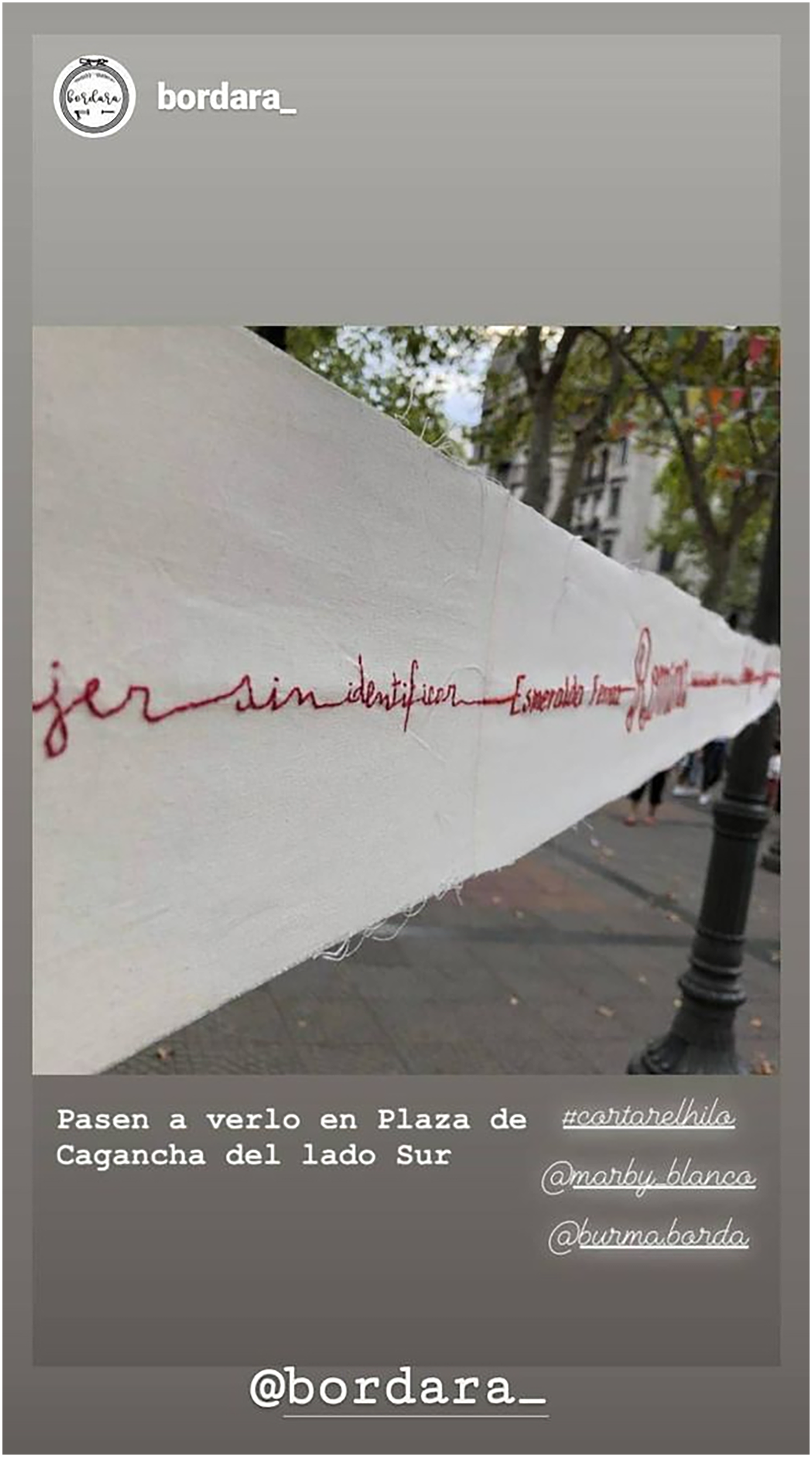
Instagram post announcing Cortar el hilo (screenshot). Courtesy Alejandra García and Marby Blanco.
This data artivist work continues a long Latin American genealogy of “textile crafting as political resistance and historical memory” (Tacchetti et al., 2021: 5) and emphasizes collectivity by producing new relationships between participants, publics, and women who were killed in feminicide in Uruguay.
Colectiva SJF
Colectiva SJF (“SJF Collective”) started off as a group of friends concerned by rising violence against women across Mexico. Acknowledging their own risk as young women professionals living in Mexico City, they built a safety net to take care of each other and soon they started creating together in community. To amplify their voices, they combined their expertises—graphic design, art, photography, and data science—and self-organized and self-funded a feminist collective that uses large-scale public installations to draw attention to human rights issues such as feminicide, disappeared people, and more.
Every year, 8M is celebrated in Mexico with mass demonstrations, which fill public plazas with the rage and chants of thousands of women who march against feminicide and demand equality, including the right to safe legal abortion. For one day, the capital's monuments and streets are transformed with graffiti, tags, posters, and green, purple, pink paint—the colors of 8M and the feminist movement.
In 2020, Colectiva SJF joined the demonstrations with monumental white stencils of women's first names painted onto Mexico City's main public square, the Zócalo (Figure 3). Each had been a victim of feminicide in Mexico between 2016 and 2020. The dataset was collected by Colectiva SJF in collaboration with Data Cívica, 3 and turned into an ephemeral but potent artwork, hundreds of intertwined names written onto a public space that symbolizes the union of state and church power, pillars of patriarchal oppression. Painting the names involved hours of work under the sun by members of the Colectiva and women who spontaneously joined the painting jam. Through their public intervention, Colectiva SJF mobilized data relationally to make visible the scope and scale of the feminicide crisis in Mexico.

Aerial view of Colectiva SJF's installation in the Zócalo, Mexico City. Courtesy Colectiva SJF. Photo by Santiago Arau.
Data artivism: The power to see
Feminicide activists who work with data to visibilizar the issue exercise the “power to see” (Haraway, 1988: 585). Though activists often strategically resort to conventional visualization techniques, the projects we have shared exemplify how they also draw on art and craft to transform horror into beauty and data into visual resistance, creating alternative data-inflected visions of feminicide. If we consider conventional visualization as the privileged mode of thinking about how best to represent data, then data artivism challenges the politics of a visuality that makes data seem “transparent and factual” (Kennedy et al., 2016). “[T]here is an aesthetic dimension in the political and there is a political dimension in art” (Mouffe, 2007), and data artivism shows these dimensions can be explored with/in data.
Data artivists mobilize scale by moving from single data point (No Estamos Todas) to aggregated cases (Cortar el hilo, Colectiva SJF), and from models of individual authorship to collective participation. They humanize data through acts of memory visualization that seek to actively and publicly remember women who were victims to feminicide (Driver, 2015). The collectivities and scales proposed by Latin American feminicide data artivism present us with alternatives to conventional data visualization that “move away from [an] emphasis on ‘objective’ presentation in favor of designs that facilitate pathways to multiple truths” (D’Ignazio and Klein, 2016).
Critical data studies have focused much of its attention on the algorithmic power of platforms, Big Tech, nation-states, and other large-scale actors. This is important work, yet it provides few generative paths for alternative visions of big data and AI. We assert that data artivism enacts alternative epistemologies with data. As Paola Ricaurte (2019: 361) states, “We can reverse extractive technologies and dominant data epistemologies in favor of social justice, the defense of human rights and the rights of nature.” As such, data artivism situated in longer histories of Latin American popular protest can offer powerful models for reclaiming data, AI, quantification, and technology to serve life, living, and vitality (Segato, 2018).
Whether we witness feminicide data artivism in the moment or in subsequent documentation, these data-inflected encounters become invitations to be or “to learn to be affected, meaning ‘effectuated’, moved, put into motion” (Latour, 2004: 205). In mobilizing the affective and aesthetic dimensions of data, data artivists hope to break the social silence, inattention, and feelings that paralyze, which all contribute to perpetuating feminicide (Lagarde y de los Ríos, 2008: 17). They (and we) hope to move us to action, to end feminicide once and for all.
Footnotes
Acknowledgments
We thank the conversatorio panelists for their work and for letting us share it. We see you. We also thank the interpreters who provided live translation, Patricia Antuña Arbulo, Ana Barreiro, Marise Carvalho, and Mariana Fagundez, and Ana Letelier for translating the transcript.
Declaration of conflicting interests
The author(s) declared no potential conflicts of interest with respect to the research, authorship, and/or publication of this article.
Funding
The author(s) received no financial support for the research, authorship, and/or publication of this article.
