




Abstract
This article explores the potential of leveraging blockchain technology to facilitate energy transition within urban settings. It explores three innovative market models—peer-to-peer, community self-consumption, and transactive energy—which hold promise for a shift in (local) electricity trading due to decentralized and digital transactional characteristics. Utilizing a scenario building framework, this research scrutinizes these market models, their corresponding trading mechanisms, and the advantages and disadvantages of implementing blockchain technology. The results provide valuable insights into investment necessities, market democratization, service quality and reliability, urban governance, civic engagement and citizenry welfare. Consequently, this study offers a novel conceptualization of market models, laying the groundwork for a systematic understanding of blockchain’s potentiality in ecosystem governance in the context of energy transition.
Keywords
This article is a part of special theme on City as a License. To see a full list of all articles in this special theme, please click here: https://journals.sagepub.com/page/bds/collections/thecityasalicense
Introduction
The energy market is in transition from a centralized model with an oligopolistic market structure to a decentralized one. This transition is a response to the urgent need to accelerate ceasing dependence on solid fuels. Alongside this move towards more sustainable energy, the energy market has become increasingly “digitalized” which is associated with advances in information and communication technologies, and the proliferation of distributed energy resources, batteries, and home energy management systems (Pratt et al., 2016). This digital transition is arguably useful and beneficial in fighting against climate change through emerging market models (Georgarakis et al., 2021), which are said to have a capacity in generating a wide range of economic, social, and environmental values (Adams et al., 2021). Technical challenges of these models, such as their impact on power grid (Tushar et al., 2020), different market and pricing mechanisms (Capper et al., 2022), security, privacy and data protection aspects (Mustafa et al., 2016), and legal requirements (de Almeida et al., 2021) have been extensively studied, generating important insights into understanding decentralized electricity or flexibility trading.
Recently, blockchain is considered as a promising technology to foster this energy and digital transition in cities (Andoni et al., 2019) as it can provide integrity, transparency and accountability without the presence of a central authority (Montakhabi et al., 2021). Instead, decisions can be made collectively by users via the use of consensus mechanisms (Bano et al., 2017). Blockchain technology has also been explored as the new backbone for civic and urban projects (Rozas et al., 2021), expecting new civic affordances and underpinning inclusive and sustainable urban societies (Gloerich et al., 2020). Furthermore, digital transformation in the energy sector, through the wider deployment of smart meters and the like, has given rise to emerging market models indicative of citizen participation as a promising means to foster energy transition (Montakhabiet al., 2023).
Although some work (Cila et al., 2020; Jabbar and Bjørn, 2019; Mahesh et al., 2019; Wilkins et al., 2020) has already explored blockchain in relation to digital transformation in future energy systems, the usefulness of applying blockchain in emerging new energy market models is unclear. In fact, not much attention has been given to the intersection of new market and business models, blockchain and new civic affordances in the energy realm. With likely disruptive implications and alignment of future market-orientations and public policies with the common interest, this paper sets out to systematically investigate three distinct emerging energy market models, namely, peer-to-peer (P2P), community self-consumption (CSC), and transactive energy (TE) models, which are said to enable citizens to actively participate in electricity or flexibility trading. To accomplish this, a scenario approach was developed using interviews and expert panel discussions to explore these emerging market models, their corresponding trading mechanisms, and dis/advantages of applying blockchain in the future. The findings provide an understanding of novel market designs, business models, value creation and distribution opportunities, requirements, constraints, and their overall feasibility, thereby highlighting new civic capabilities and urban governance possibilities arising from their implementation.
Blockchain and the city: Electricity trading
What do the smart city and blockchain premise have in common? They share a common goal of leveraging technology to create more efficient and sustainable systems, rely on the collection and analysis of data, and require collaboration and partnerships between various stakeholders, thereby giving an important role for citizens, who are not just passive recipients of the benefits of such initiatives, but active participants in shaping them. Citizen participation is often encouraged through citizen engagement and reward platforms, participatory budgeting, and co-creation processes (van der Graaf et al., 2021). Moreover, citizens can be drivers of innovation in both smart cities and blockchain. Citizen-led initiatives can help to identify new use cases and provide valuable feedback on the usability and effectiveness of these technologies. These developments are indicative of “the unique affordances of platforms […] signal[ling] an evolution of the socio-technical relationship between citizens and cities” (Lee et al., 2020), associated with ‘‘platform urbanism’’ (Barns, 2019), and thereby putting forward a multistakeholder approach (van der Graaf, 2018). Specifically, several multi-actor models have been identified which foster and promote citizen engagement in capacity building initiatives within the energy domain (Deakin, 2013). A common element across the various emerging models is the encouragement and incentivization of citizens (‘‘consumers’’ and ‘‘prosumers’’) to have a (more) active role in energy and electricity markets (Montakhabi et al., 2021)–often associated with the notion of value co-creation (van der Graaf et al., 2021), such as exchanging electricity and flexibility with other market participants like fellow prosumers and grid operators, in exchange for financial incentives. Urban centers are encouraged to adopt or facilitate “smart” strategies to capitalize on such opportunities. However, often a critical oversight of social dimensions (Homrich et al., 2018; Merli et al., 2018), particularly with respect to inclusivity, compassion, and overall well-being, perpetuates. There is, however, a growing gap between technological potential and actual implementation in new (decentralized) forms of electricity trading. Digital transformation is said to often start with small adjustments like automation by one or several actors in a given ecosystem and then triggering business model changes (Matt et al., 2015). Such an ecosystem perspective (Adner, 2017; Jacobides et al., 2018) is inherent to digital transformation because of the need for complex stakeholder interactions. This is not new, yet for blockchain, this facilitation is novel. Acknowledging this, blockchain technology can expedite the integration of resources across the entire electricity trading ecosystem. In essence, its dynamic capabilities enable the assimilation of individual actor capacities, as well as the activation of ecosystem level capabilities, in a manner that generates value for the customer. Furthermore, blockchain may also have the potential to revolutionize the governance of the ecosystem. If we consider the electricity market in terms of new market models as ecosystems, employing blockchain technology can assist in orchestrating the ecosystem to deliver value for consumers and/or prosumers.
Method
In order to carry out this exploratory study, a scenario-building approach was developed deploying interviews and an expert panel, supported by desk research (cf. Kvale (1994)), secondary sources helped to detect P2P, CSC, and TE models for electricity or flexibility trading as likely applications of blockchain in cities supporting the energy transition. A set of interviews were conducted with several stakeholders (e.g. distribution system operators, transmission system operators, retailers, aggregators, and regulators) as well as emerging roles (Montakhabi et al., 2020) and potential disruptors (e.g. energy community managers and platform providers). To identify and select the interviewees, a snowball technique was deployed (Noy, 2008; Montakhabi et al., 2021). This helped to approach relevant players that otherwise tend to remain “under the radar” from fulfilling each role in the ecosystem; this continued till data saturation was reached. Thirty five semi-structured interviews were conducted between May 2020 and August 2021. Interviews were conducted face-to-face in-person or online through Skype and lasted about 45 min (see Appendix I). Interviews were recorded and transcribed. Currently, most P2P, CSC, and TE initiatives are pilots, with various factors, including legal requirements, being perceived as potential impediments to their widespread implementation. In exploring the three market models and their possible fit deploying or incorporating a future-orientation towards blockchain, the overarching goal was to identify the conceptual boundaries of each model, and which guided the exploration of different blockchain types and their applicability for each model (in case; cf. Yin (2016)). Using previous insights, scenarios could be proposed and which were validated by an expert panel (cf. Durance and Godet (2010)). The expert panel consisted of four expert members of Global Observatory on P2P, CSC, and TE models—recruited from different subtasks: (a) power systems integration, (b) hardware, software and data, (c) transactions and markets, (d) economic and social value, and (e) policy and regulation. Even though the purpose of the panel was not to identify the application of blockchain and most experts were not acquainted with blockchain as such, hence, a “maieutic” questioning technique (Scraper, 2000) was used to elicit ideas about the possible applications of blockchain in P2P, CSC, and TE models. As a result, we ended up with a mixture of rich and in-depth information about viewpoints and ideas (see Appendix II for more detail about the expert panel).
Next, the three market models are introduced, which offers an exploration of blockchain applications in future electricity trading. These models are said to serve as alternatives for traditional electricity trading, based on decentralized energy production which means they have a diverse range of capacities in value generation (Montakhabi et al., 2022) affecting electricity trading in similar ways, but at different capacities. As outlined, the purpose is to identify the conceptual boundaries of each model, and hence, are not required to be limited to a specific project, pilot test, geographic region, or study (Kenyon and Marjoribanks, 2007), arguably making the conclusions by extension, comparable.
Energy transition and the city: Three cases
As a result of the increased adoption of renewable energy sources, energy storage systems, and advanced devices, in conjunction with the liberalization of electricity markets (Montakhabi et al., 2021), power systems management has experienced a transition from centralization towards decentralization. Prosumers, who seek a return on their investments, have become an integral component of this evolution of the energy sector. They first started providing demand response (Albadi and El-Saadany, 2007) services to grid operators via aggregators, essentially participating in the balancing market, and then slowly eliminating the aggregators by providing services directly to the grid operators, thus forming the backbone of TE market models (Zia et al., 2020) (i.e. consumers and prosumers competing to provide balancing services to the grid). Inspired by this transition, consumers and prosumers aspired to provide services (i.e. trading electricity) to each other too, creating the P2P market models (Zhang et al., 2018) (where consumers/prosumers compete to provide services to each other). Providing services to each other has also unlocked the idea of cooperating with each other to increase their autonomy as well as to provide services to the grid operators as a group, thus creating the CSC market model (Frieden et al., 2020). Subsequently, we focus on P2P, CSC, and TE as emerging energy market models, which are anticipated to serve as significant catalysts for the transformation of the energy sector. As mentioned above, numerous pilots can be detected (see Gunarathna et al. (2022) for a comprehensive list), examining the viability of the three local energy trading models in future real world settings. Skepticism can be detected such as about data privacy and scalability as well, generally, firms that incorporate blockchain technology within their business models for local electricity trading tend to disclose limited information regarding the actual utilization of this technology, potentially raising skepticism about the tangible benefits it may offer. This sentiment was corroborated by our panel of experts. many companies say they use DLT or blockchain technologies, but then if you actually look at the use case, they don’t use it to perform transactions or as a currency. They use it purely as a recording mechanism. (Expert in Blockchain and Local Energy Markets)
We cover a few examples of real-world trial projects on these three market models, which are also listed in Table 1.
Example real-world trial projects that deploy P2P, C2C, and TE models.

NED: Netherlands; UK: United Kingdom; USA: United States of America; P2P: peer-to-peer; CSC: community selfconsumption; TE: transactive energy; TSO: transmission system operator; DSO: distribution system operator; SME: small and medium-sized enterprise.
Scenario 1: Peer-to-peer models
P2P market models support trading of electricity between prosumers (and consumers) directly or through an intermediary (Montakhabi et al., 2020). Apart from prosumers, the scenario also envisions the presence of representatives who can trade electricity on behalf of citizens and a broker (a.k.a. trading platform or market operator) who facilitates and clears the market (Montakhabi et al., 2020). The main objective of these models is to incentivise market transactions that maximize individual prosumers’ benefits (Chakraborty et al., 2020). Successful examples of companies that deploy the P2P market model to a certain degree are Vandebron (the Netherlands) and UrbanChain (the UK). As blockchain is a P2P technology, it is a natural fit for use in P2P market models. As all citizens/prosumers should be able to take part of these markets without any restrictions, permissionless blockchains (which impose no restrictions on participants) are well suited for these market models. Permissionless blockchains could play an important role in two trading phases: market clearance (typically done through auctions) and billing (which facilitates the financial settlements between peers).
Scenario 2: Community self-consumption
CSC market models support communities in reducing their dependence from the electricity grid (Heinisch et al., 2019) through collectively utilizing their members’ available resources (Montakhabiet al., 2023). Apart from aiming at grid independence, they could also provide flexibility services to other communities or to grid operators. Typically, there is a community manager who orchestrates the market and assists members to collectively decide how to utilize their resources (Moret and Pinson, 2018). As the CSC market models also would need to support and manage transactions between various peers, blockchain is a good fit to be deployed. Nevertheless, in contrast to P2P market models, in CSC markets a permissioned blockchain (which can restrict who can participate) is the suitable technology. This is the case for the following two reasons. Firstly, as communities have restrictions/rules on who can join/leave the community, the number of community members is typically static and not every peer can be part of the community. Secondly, as the main aim of the CSC market models is the community to be energy independent from the grid, the efficiency in reaching consensus and executing transactions is of paramount importance. Permissioned blockchains enable multiple parties to form a fixed consortium, providing transparency of operations and transactions to every involved peer; most importantly, no trust between these parties is required. Applications such as we.trade and Diem already utilize permissioned blockchains for their use-cases. Brooklyn Microgrid is also an example of a successful project that deploys CSC model (in addition to the P2P model) to share electricity generated by jointly-owned generation assets amongst the members of the community. If blockchain technology is deployed, prosumers might be more likely to trust and use the services. This was also confirmed by the expert panel. Perhaps prosumers will find it more attractive to participate in a market platform powered by DLT. I tend to think [DLTs] build trust for participants. (Expert in Cryptography)
Scenario 3: Transactive energy models
TE market models support grid operators in balancing the grid at all times (Nizami et al., 2020). They achieve this by facilitating demand response services provided by prosumers based on market-based incentives (Lian et al., 2019). The key difference between the TE and P2P/CSC market models is that in TE models there is typically a single buyer—grid operator or aggregator—who demands a certain amount of flexibility, thus offering financial incentives to prosumers to engage and provide flexibility. Prosumers are competing with each other on who would be selected for the service provision. Typically, the flexibility demanded is substantially larger than the flexibility an individual prosumer could provide (Nguyen et al., 2019). Hence, typically, a number of prosumers is selected such that their aggregated flexibility satisfies the needs of the aggregator/grid operator. Similarly to CSC market models, all selected prosumers are rewarded in proportion to their contributed flexibility.
In a typical TE model setting, the single buyer (e.g. a grid operator) who manages the market is trusted by the other participants. In such a situation, the use of blockchain is actually not needed, as there is a trusted central entity who manages the entire market. In sum, using blockchain would bring limited advantages to the operation/management of TE market models. The Cornwall local energy market project is an example of a successful trial of the TE model, where two types of grid operators, distribution system operator (DSO) and transmission system operator (TSO), have used the services of the developed marketplace to purchase flexibility provided collectively by a number of residential households and small and medium-sized enterprises (SMEs).
Table 2 summarizes the properties of these three market models. All models support multiple sellers (small-/medium-size prosumers, consumers, etc.), while only P2P and CSC support multiple buyers as in the case of the TE model, the buyer of the market is usually only the local DSO (with some exception when the national TSO is also allowed to buy flexibility at these types of market models). In terms of the knowledge of the market participant’s identities, there are also differences between the market models. In CSC and TE models, sellers and buyers usually know the identities of each other. As CSC model supports trades within a community, the community members often know each other. In the TE models, as the flexibility service provided to the grid operator is of paramount importance to keep the grid in balance, the buyer (DSO) will know whom it is relying to provide the necessary flexibility. Only in the P2P market models, as they allow trades between peers who are unknown to each other, peers usually do not know the identity of the peers they are trading with. Similarly, in P2P market models, as each peer can trade with different types of peers, hence it can participate in different P2P market models tailored for different purposes. Hence, there could be many P2P markets, which are run by different market operators, in which peers can partake. In contrast, in CSC models, as prosumers are linked to each by all being a member of a community, there is only one market operator. In the TE models, as there is a single buyer of flexibility, there is also a single market place which is run by the grid operator itself. In terms of the level of trust between prosumers and the market operator, in TE models, there is a well established trust in DSOs, which also translates to a trust in the market operator. In the CSC and P2P models, this level of trust is much lower, especially in P2P market models as they facilitate trades between completely unknown to each other peers. The arguments above have also been confirmed by the expert panel.
Comparison of different market models.

P2P: peer-to-peer; CSC: community selfconsumption; TE: transactive energy.
Communities [are a better fit for DLTs compared to TE models], for the mere fact that we’re talking about the community of participants, as opposed to the TE models with a single central authority. (Expert in Local Energy Markets)
Note that fully decentralized technologies like permissionless blockchain come with privacy concerns, while more centralized systems might actually not benefit at all from DLTs, as it is the case with TE models. This trade-off/friction has also been confirmed by the expert panel. If it’s a [fully] decentralised ledger, then you can’t store on chain private data or load data, because this is a personal data so it’s protected by GDPR. So you can’t have it publicly available. But if it’s then a very centralised distributed ledger technology, then what is the purpose of even using one? So there’s these trade-offs. (Expert in Local Energy Markets)
Framing P2P, C2C, and TE market models
To facilitate the classification of potential transactions among distinct market actors and to categorize these transactions within the respective market models, a conceptual framework has been developed for the P2P, CSC, and TE models, grounded in the underlying scenarios. This framework emphasizes the distinctions between the models and identifies the circumstances under which they are likely to converge or diverge. The framework is informed by two key parameters: the categories of participating trading parties and the nature of the commodities being exchanged. These two parameters enable us to encompass the possible transaction scenarios among various market actors.
Typically, there are four main parties affecting/being affected in the trading practice: peers, communities, grid operators, and retailers (Capper et al., 2022). The peers and communities are the main two emerging actors due to the decentralized nature of the emerging market models. Grid operators and retailers are the currently dominant actors in both electricity and flexibility trading markets whose roles are expected to be challenged by active participation of the emerging actors. “Electricity” and “flexibility” are possible commodities to be traded between the participants (Capper et al., 2022). When market participants have electricity surplus (or, need electricity to satisfy their demand), they can participate in markets to trade electricity. When market participants are able to decrease or increase their supply/demand based on external signals (e.g. price), then they can trade flexibility. Next we provide an overview of the transaction types possible under traditional (retail and balancing), P2P, CSC, and TE market models.
The retail market is the market for sales and purchases of electricity between distributed consumers/producers of electricity and retailers of electricity. Under the retail trading models, the traded commodity is always electricity. Depending on who the seller and buyer of electricity is, retail trading models accommodate the following types of transactions: between prosumers and retailers, and between communities and retailers.
Under the P2P market models, the traded commodity is always the surplus electricity. Depending on who the peers are, P2P market model can accommodate transactions between two prosumers, two communities, and a prosumer and a community. A market model that supports all of these types of transactions is also known as a hybrid P2P market (Sousa et al., 2019). In contrast to the CSC market models where the community (manager) decides (see below), it is the prosumer who decides what to do with the electricity and the community does not exert any influence over prosumer resources. Hence, while a prosumer can be a member of a community, prosumer behavior may differ depending on the type of the model their trade falls into.
Under the CSC market models, the trading commodity can be the electricity surplus or flexibility. There is only one type of transaction that can be accommodated by these models: a transaction between a prosumer and a community. This is a situation where prosumers share their surplus electricity or flexibility with the community. It is necessary that community members pass the control over their surplus electricity or flexibility to the community (manager). It is the community (manager) who decides what to do with the provided electricity/flexibility. In this case, the community has considerable control over prosumers’ resources.
Under the TE market models, flexibility is the traded commodity. This type of model can accommodate transactions between a prosumer and grid operators, and a community and grid operators. When a prosumer provides flexibility directly to the grid operators, then a transaction between a prosumer and grid operator occurs. In this case, prosumers prioritize the grid stability to decide when and how much to use what appliances. If a prosumer provides flexibility to the operators via a community, then a transaction between a community and grid operators occurs.
Table 3 presents an overview of the proposed scenarios for the traditional (i.e. retail and balancing), P2P, CSC, and TE market models. From a prosumers’ perspective, it draws out different choices based on which they can decide to participate in electricity or flexibility trading as it maps the options described, under P2P, CSC, and TE models, which are likely to widen citizens’ inclusion in value cocreation in electricity markets. In addition, it shows three scenarios associated with traditional electricity trading which entails prosumers or communities’ purchase of electricity from retailers, or prosumers or communities selling their surplus electricity to the retailers as well as grid operators purchase flexibility from retailers.
Trading opportunities and domain of each model.
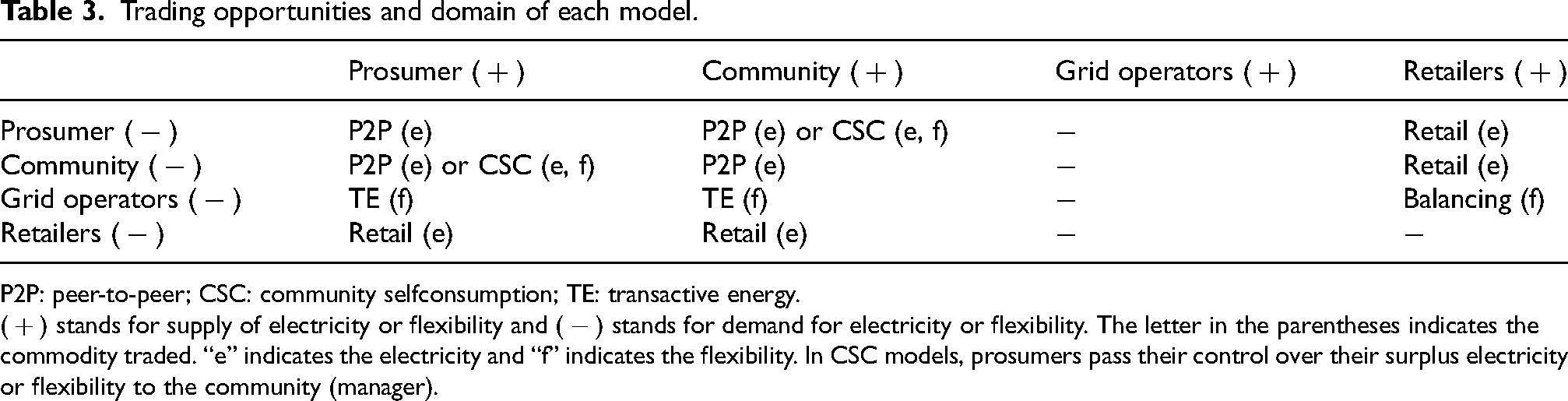
P2P: peer-to-peer; CSC: community selfconsumption; TE: transactive energy.
Discussion
The implications of the three models we analyzed go far beyond their technical aspects. In fact, as we will discuss, how they apply to different market designs with diverse requirements, presenting a variety of limitations that include but also go beyond the technological ones. However, what is probably more relevant for our analysis are their consequences both in the provision of the service, in a commodity as fundamental as energy, both for cities and their citizens. Likewise, these models enable new ways of understanding how energy should be produced and distributed. They offer new civic affordances allowing the generation of new social meanings around the responsibility for energy production and the control of many aspects of its distribution, not only in basic questions such as price or energy sources, but also in terms of to whom and under what conditions the new prosumer accepts its provision. Energy is an essential good but also homogeneous, there is no difference between a unit of energy once it has been converted into electricity. Therefore, the use of blockchain endowing it with traceability creates these new civic affordances. Ultimately, all of these implications coalesce into potentially different urban governance models that should ensure the provision of electricity.
Markets, business models, and opportunities for value creation and sharing
The three scenarios represent different approaches to the problem of energy generation and distribution and with them, different affordances for their participants. For TE models, we can observe an evolution of existing business models, while P2P and CSC represent entirely new market models (Montakhabi et al., 2022).
In fact, TE models maintain the existing market structure where energy companies control governance, introducing a platform approach where consumers become prosumers, providing flexibility that is sold to the grid operators for a fee, who act as platform orchestrators. In addition, the energy company often provides incentives to participants to adjust their energy consumption to capacity. This is normally mediated by technology, the first case was Google Nest introducing a partner program for rush hour rewards, now well attended by many participant companies. Also, on many occasions these companies complement their offer providing the installation of solar panels and their repair as a complementary service. Therefore, we observe a business model extension, introducing both a platform structure, opportunities for shared value (controlling your thermostat in exchange of a discount) and complementary services but with the same market structure.
In contrast, for P2P and CSC, new market models could be observed, redefining existing energy markets. In the case of CSC normally with non-market mechanisms while in P2P can be either non-market or market-based mechanisms. In both cases governance is distributed and in the hands of participants. Undoubtedly, distributed energy generation models offer many opportunities for value creation. As great, in fact, as the amount of energy its participants can produce. However, business models extensions present limited opportunities for value sharing, constrained by the platform creator’s willingness to share some of the value among platform participants (Montakhabi et al., 2020). On the other hand, new market structures offer a lot of room to share value only limited by their governance models. More specifically, they hold different potentials for value generation, and may, therefore, be taken up differently according to prosumers’ preferences (Adams et al., 2021). In this view, participation in a market model is a means for value generation and capturing by and for participants. Prosumers, who may have different preferences at different times, utilize different market models, which have relatively limited, and to some extent, clear affordances in value generation and capturing. As this field is still very much under development, only limited real-world trials have thus far been conducted (Gunarathna et al., 2022). These are complemented by studies based on surveys and interviews which have set out to explore expectations rather than experiences or practices with P2P, CSC, and TE models (Schwidtal et al., 2022).
To provide a better understanding of the potential of the three models in generating value, Table 4 conducts a comparison of the new models as well as traditional models in terms of the capacity of each model to generate different types of values. The first column shows the prosumers’ intended values. Each column ranks different scenarios under each market model, as explained above,—low, medium, or high—based on their capacities in generating that specific type of value. The ranking of the models was based on the potential of each of the market models to provide the prosumers’ values.
Potential value shared in different market models and business model extensions.

P2P: peer-to-peer; CSC: community selfconsumption; TE: transactive energy.
Consequently, prosumers’ active participation also increases the aggregate supply and demand for prosumers’ electricity, or flexibility. Moreover, by framing market models in this way, prosumers can choose their preferred market model based on what they value most. Thus, for example, more “profit-driven” prosumers may choose to participate in a specific market model which focuses on maximizing individual benefits. While, more “environment-conscious” prosumers may choose to have a more active participation in a model which prioritizes grid stability, while more “community-oriented” prosumers may choose a model which is ranked higher on community-related capacities. Coexistence of several market models, however, may not be necessarily beneficial from the grid, or community perspective as some of the P2P models may cause additional grid congestion (Hackbarth and Löbbe, 2020) or may result in a concentration of value transfer to only a few prosumers while increasing the costs for less active electricity grid users, such as consumers (Wilkinson et al., 2020). It remains to be seen whether these market models can converge into one that can satisfy the objectives of prosumers corresponding to various kinds of priorities and values (Adams et al., 2021). An ideal market mechanism would be to use an algorithm that deploys a multi-objective optimization to prioritize and select transactions that do not downplay or contradict each of the market participants’ objectives. In other words, ideal market transactions would simultaneously (i) support the grid stability, (ii) maximize the community benefits, and (iii) provide the best returns for the participants.
We propose P2P, CSC, and TE models as the new dimensions for the electricity market (re)structure in the energy transition. In other words, prosumers can be simultaneously active in these markets, in addition to their presence (as mere consumers) in the traditional electricity retail market. Consequently, P2P, CSC, and TE market models complement and alternate the traditional trading models as well as each other. The main difference between prosumers’ presence in traditional electricity markets and their extended options associated with new market models is that traditional models do not have the capacity to accommodate prosumers’ active participation in trading.
Requirements, limitations, and level of feasibility
The three market models under consideration encompass a broad array of alternatives, ranging from modest expansions of extant models to the introduction of entirely novel market structures. Consequently, we will encounter a multitude of requisites and constraints, which will determine the extent of transformation necessary for successful implementation, or in other words, the degree of deviation from the prevailing status quo to the proposed model, and subsequently, its feasibility. Nevertheless, prior to evaluating the complexities of the transformation and the degree of disruption it may engender, our attention will be directed towards examining the requirements and limitations at three levels: technical aspects, the need for novel infrastructure, and market design considerations.
Technical requirements in TE models are typically small. Since blockchain is not needed, a database being controlled by a grid operator suffices. Instead of the data being replicated at multiple locations, only the grid operator needs to extend its existing infrastructure to cover the new functionalities. In fact, many operators have already done that at different levels, evolving and extending their existing business models (Montakhabi and Van Der Graaf, 2021).
Depending on the market model, and consequently the type of blockchain being implemented, the investment required by peers (prosumers) may differ. In P2P market models, where a permissionless blockchain fits well in theory, the roles of these peers could be split into two distinct categories: market participants and maintainers/miners. Based on their role, the required investment may differ. In the case of market participants, the investment would be small as no special hardware is necessary. However, this is not the case of prosumers who play the role of miners. These prosumers would need to invest considerable resources to be able to validate transactions and publish their blocks to extend the blockchain. Depending on the type of consensus protocol being used, the level of investment may differ. For Proof of Work (PoW), the investment required typically entails computational power. As a higher investment in computational power translates into better chances of being the leader, miners usually invest in high-end and application specific hardware. This increases miners’ chances of publishing a block and earning rewards (de Vries, 2019).
Note that, although permissionless blockchains offer full decentralization, hence one might argue that they are most suited for P2P market models, in practice, it seems that they are not seen as a viable technology due to efficiency, privacy, and scalability issues. Our expert panel was unanimous in the opinion that permissionless blockchains were not a good solution for P2P market models (or any local energy trading models). it’s the permissioned Blockchain, which is most suitable [for P2P markets]. (Expert in Blockchain and Local Energy Markets) Permissionless is not a good fit [for P2P markets], of course, because permissionless it’s a public blockchain, it has very high energy-intense consensus [mechanism]. And you don’t need to make [everything] public. (Expert in Blockchain and Local Energy Markets) Only permissioned [for P2P markets]. (Expert in Cryptography)
The main argument being here is that any local electricity market models (P2P, TE, and CSC) would need to have a central entity involved to some degree and in some capacity to handle unexpected disputes amongst peers. Therefore, fully decentralized solutions, at least in their current form, were not seen by our expert panel as a viable solution. There’s always going to be central unit who has some sort of responsibility in the peer to peer market. You can’t put all the responsibility [on] users, so someone needs to carry the risk. [So], there needs to be some sort of a central party. (Expert in Cryptography) So there is no need for a fully decentralised peer to peer market right now for end users, not in the current environment. (Expert in Blockchain and Local Energy Markets)
Note that smart contracts are seen as the technology that complements DLTs and unlock their full potential by allowing users to deploy any logic on top of the technology. This was indeed supported by one expert panel member. It’s a good technology that can unlock some potential [solutions for] problems, especially if we take into account the smart contract, because the smart contract could play a really good role in the market clearing [phase], for instance, even in [a] community based market, assuming [there is] a community manager, and end users don’t want to share all their data. (Expert in Local energy Markets)
However, not all panelists were so optimistic of the use of smart contracts. I think even if you can eliminate the intermediary role with a smart contract, we still need such an intermediary as a backup. (Expert in Blockchain and Local Energy Markets) We still need the intermediaries for what-if scenarios. What if, due to some unforeseen circumstances, the [market] fails to work due to some [unanticipated circumstances]. The smart contract would fail to execute. (Expert in Blockchain and Local Energy Markets)
In contrast to PoW, the investment required in PoS refers to stake; a miner with the largest stake (money) in the system has a higher probability of being the leader and publishing their block to extend the blockchain. Additionally, regardless of the consensus protocol used, each miner also has to invest in storage space.
In CSC models, since a permissioned blockchain suffices, the investments required reduce substantially. This is due to the simple consensus mechanism employed and the leader (community manager) usually being pre-elected. However, the needs go far beyond the technical requirements, both in the P2P and CSC models, a digital infrastructure must be created. This could also involve creating an organization to host it or using an existing organization. The simplest case is that of TE models where an existing provider extends its business model to support a prosumer platform structure. In the case of community service models, their digital infrastructure is often hosted by a local or regional public authority. This saves the need to create a new institution, facilitates its governance by becoming a natural host of the infrastructure, thus extending the services provided by this local or regional authority. Likewise, its government status facilitates interconnection with the smart grid and agreements with the companies that manage it.
The case of the P2P model is undoubtedly the most complex due to the need to create not only an ecosystem around it, but also an intermediary that interconnects the participants through commercial or ad-hoc intelligent networks. One of the simplest implementations is to establish a broker that is also a market participant. However, this poses some limitations as to what type and to whom energy can be sold due to limited traceability and the fact that energy once transformed into electricity is a commodity.
Finally, market design also presents many challenges, although not in the case of TE models where new functionality will be easily accommodated by extending the existing business model. However, in the other two cases, the incentives must be designed in such a way that they encourage energy production by the participants together with the design of the rules of engagement. For example, in a community service, it is sometimes common to provide free energy to the community in the event of a surplus, on the understanding of reciprocity. However, this design clearly promotes free riders, signaling a potential threat to the entire service by not encouraging investment in new infrastructure. This simple example shows the difficulties of designing a set of incentives that promote investment while stimulating fair distribution and tend to balance shifting the delivery of energy to more convenient hours when necessary (e.g. with the use of batteries that require a higher investment) (Montakhabi, 2023).
There is also an additional problem in terms of market design. The common infrastructure that distributes electricity to participants, hosts and maintains the market suffers from the tragedy of commons. There are no incentives for participants to properly fund and maintain host organizations. This problem is avoided to some extent in community models when the market and brokerage services are managed by local or regional authorities. However, even in this case, the expected lower level of efficiency of the public sector also poses difficulties when it comes to competing with other models such as the TE, hosted by commercial energy operators.
Having explored the requirements and limitations of all three models, we can now address the market entry and survival challenges of each one. The clear winner in terms of feasibility is the extension of existing energy providers’ business models by incorporating a platform with prosumers. The technical, infrastructure and market design requirements are minimal, at the expense of severe limitations for prosumers who will be allowed a voice only to the extent permitted by the platform administrator. The community model, particularly when hosted by a local authority, is the second most feasible. Due to its confinement in local geographical areas, many times in small villages and rural areas and, because it is backed by a government authority, the interconnection with the smart energy grid and its operation is assured. Governance in this case will be managed by the authority, allowing the inclusion of the nuances, fairness and values that the community supports. The drawback is the traditional lack of efficiency of the public sector, however if the type of technology has a low intensity of innovation, it generally works well enough. Finally, the one that undoubtedly has the greatest difficulties, and a lower level of feasibility is P2P, due to the many obstacles that it must overcome. However, in terms of disruption, both the community model and the P2P models have the potential to break up a sector that, due to the type of technology, has been mostly oligopolistic, introducing other elements beyond price in the production and distribution of energy. The potential competition of these models with the TE also promises to inject a certain level of change in the market through the adoption of practices born in community models in the existing energy suppliers through platform extensions.
Implications for markets, services, and citizens
The implications of these new models could be noteworthy, opening the space of solutions far beyond the oligopolistic energy markets that have been dominant until now and promising to end the customer-supplier dichotomy. We will address these implications at three levels—the market, the service itself and citizens. With respect to market dynamics, a transition from centralized to decentralized energy markets utilizing DLTs inherently fosters democratization. Blockchain technology underpins this decentralization by promoting the notion of equitable, rights-based, and value-oriented urban environments, characterized by agency and empowerment (Gloerich et al., 2020). In the context of P2P and CSC models, the capacity for all participants (prosumers) to actively engage in the validation of state updates and its dissemination materializes novel forms of relationships and deconstructing the customer–supplier dichotomy. A comprehensive market metamorphosis may not be anticipated; however, these nascent paradigms will not only augment the heterogeneity of alternatives but also possess the potential to profoundly reshape extant ones. Beyond market transformation and democratization, service quality also stands to gain from the employment of blockchain technology, owing to the heightened transparency throughout the intelligent grid. This assertion has been corroborated by the expert panel as well. Energy suppliers instead of selling energy, they can sell services. And then these services could [help] increasing the economic profit for the end user, reducing electricity bill, having more sustainable energy consumed; if they cannot install solar panels, they can get it from the neighbour, if they care about solar energy. If they have a common roof, then you can make some fair distribution of energy between [users] using the blockchain to verify that these outcomes are fair and transparent. (Expert in Local energy Markets)
In P2P/CSC models, the transparency offered by blockchain helps in improving the quality and reliability of services offered. Since the data stored on both permissionless and permissioned blockchains can be public (depending on the use case), demand and supply become easily predictable. This predictability could essentially enable better load balancing of the grid, providing a more robust infrastructure by design. A possible advantage to the need of storage space for blockchains is the increased data availability. Even if part of the network crashes, data still remains available, hence removing the problem of single point of failures. In TE models, the grid operator remains a single point of failure, hence the robustness of the system remains similar to that of existing central variants. Although increased transparency enhances the reliability of the service, it poses privacy risks as participating peers’ data would be made easily accessible by everyone (Mustafa et al., 2016). In the EU, this data availability may infringe the GDPR regulations. This was also highlighted by our expert panel. Where is the value [of using DLTs] coming from? [From] transparency [and] immutability, [but] then these are also sometimes the disadvantages. Some data needs to be immutable. We want to potentially change it or we want to cover it up after we’ve exposed it. (Expert in Blockchain and Local Energy Market)
Finally, these three new models have large implications for citizens and cities in terms of new civic affordances that may transform energy governance.
New civic affordances
Blockchain as a technological innovation introduces traceability to a market characterized by electricity being a commodity and endowed with an oligopolistic structure. In doing so, it also enables new civic affordances on three dimensions: social, individual, and in governance. From a social perspective, the most prominent attribute is the emergence of novel actors that disrupt, albeit partially, the oligopolistic structure. This undeniably alters market dynamics by presenting an array of options, not solely in terms of quantity but also with respect to diversity. The ascendance of community-based actors, P2P, and to some degree, TE, introduces a variety of qualitatively distinct propositions to the public, each encompassing unprecedented possibilities. For instance, the community model may facilitate balancing energy production and consumption at minimal expense among its constituents, occasionally incorporating the collective utilization of batteries to harmonize energy supply and demand.
In addition, from a social perspective we can observe how social values such as green energy, social responsibility or a reinforcement of community identity, develop from these new models. However, we can also observe a change of user’s perspective due to this transition from consumers to prosumers. The most obvious ones are a certain level of autonomy and the increase in the variety of options to choose from. Additionally, in some cases such as the community model, there is a certain redefinition of citizenship, including the own responsibility for energy production, consumption and investment in infrastructure. Furthermore, there are also changes with respect to governance, particularly in the context of community models, and to a certain degree, the other two frameworks as well. Within these models, the capacity for end consumers to decide upon and influence the selection of energy sources and even establish pricing, occasionally without cost, constitutes a radical departure from a paradigm in which governance was exclusively determined by the supplier.
Urban governance
Considering the aforementioned emerging market paradigms, significant transformations in the discourse begin to surface, advocating for a human-centric and rights-oriented approach that endeavors to actualize a just urban environment and an inclusive civil society, concurrently addressing the pressing issue of climate change (Breuer and Pierson, 2021). This perspective deviates from the conventional conceptualization of the city as an entity primarily serving the interests of corporations and nation-states, as exemplified by the notion of “platform urbanism” (Barns, 2019). The premise of the emerging models—to various extents and in different degrees—is that structuring and formalizing, particularly, prosumption processes (associated with co-production) can bring an ecosystem approach fostering a more responsible innovation and a systemic, value-based approach to sustainable urban development. In fact, at macro, meso and micro level “opportunity structures” are on the rise (van der Graaf et al., 2021). In particular, new ways of working that were made possible by blockchain have enabled actors operating in the public and third sector to promote accountability and transparency (D’Hauwers, van der Bank and Montakhabi, 2020), all while improving on the efficiency and effectiveness of P2P cooperation and algorithmic governance. For example, DLTs can facilitate the roll out of token-based models that support building and (self)governing communities and take up “value” that is broader than merely an economic term (social contracts) (Gloerich et al., 2020; Ostrom, 2010). More precisely, these tokens could portray electricity itself as value (Brunner et al., 2021), or generalize it more to represent fiat money. DLTs are also means for a more fair “energy governance,” and fitting the P2P ideals (Lei et al., 2021). Therefore, applying DLTs can enhance engagement of citizens and support the P2P electricity trading within a community, thereby also alluding to the facilitation of urban commons projects.
Conclusion
In our analysis, we have examined the ongoing metamorphosis within the energy market, characterized by the emergence of novel market structures, participants, and business models. The incorporation of blockchain offers the potential to introduce an additional informational stratum to energy distribution processes, a development of particular significance in light of the shift from centralized to decentralized energy production. By integrating this informational layer and acknowledging the transformation of consumers into prosumers, new opportunities arise at various levels, including market, communal, citizenry, and societal spheres. We have examined three different models assuming that discussing extremes will bring more clarity to the real opportunities that will result from combining these emerging models with today’s centralized models. However, in any of their forms and combinations they hold the potential of disrupting the status quo. Blockchains as an information layer, could bring transparency and traceability to a commodity market that, due to its structure, is a prime example of a natural monopoly. However, because these new opportunities and added benefits come with a cost and multiple barriers, they also imply substantial market transformations. As with any innovation, the perception of the adoption of potential opportunities by established companies and new entrepreneurs, will make these openings real. And the actual adoption by citizens will validate this perception, transforming novel proposals into real innovations. This study presented these emergent opportunities that have arisen in the first projects that use blockchains in the energy sector. As it happens with innovation opportunities, it is reasonable to anticipate that at least a subset of these opportunities will undergo experimentation and subsequent scaling. To what extent an industry wide adoption will follow is uncertain but the potential for disruption and new value creation is undeniably present.
Footnotes
Acknowledgements
This work was supported in part by the Research Council KU-Leuven: C16/15/058 and by the Flemish Government through FWO SBO project SNIPPET S007619. Mustafa A Mustafa is funded by the Dame Kathleen Ollerenshaw Fellowship awarded by The University of Manchester.
Declaration of conflicting interests
The author(s) declared the following potential conflicts of interest with respect to the research, authorship, and/or publication of this article.
Funding
The author(s) disclosed receipt of the following financial support for the research, authorship, and/or publication of this article.

Notes
Appendix I: Interview protocol for identifying the three market models
Interview protocol for the conducting the semi-structured interviews:
Would you please introduce yourself and your organization? What are your organization’s roles in the electricity market How do you describe the current electricity market (Who are actors and what are their roles)? What are the main influencers on the future of electricity market? How do you describe the future electricity market (Who are actors and what are their roles in next 5 to 10 years)? What are the constraints for P2P electricity trading? What are the best and worst scenarios for P2P electricity market? Who are the main actors and their roles in the P2P energy trading? Do existing trading mechanisms in electricity market need to be changed for P2P electricity trading (How should they be in order to allow for P2P trading)? Which non-energy-related market mechanism is applicable for P2P electricity trading? What roles would your company have in the future electricity market? What are your organization’s objectives and business model in P2P electricity market? What problem is P2P is trying to solve? Which type of actors are trustworthy to have the critical roles in P2P, CSC, and TE models for electricity/flexibility trading?
Appendix II: Expert panel information for validating the findings
The results of the study are validated by an expert panel consisting of five expert members of the Global Observatory on P2P, CSC, and TE Models, who are researchers on P2P electricity trading. We recruited them from the five different subtasks of the global observatory: (a) power systems integration, (b) hardware, software & data, (c) transactions and markets, (d) economic and social value, and (f) policy and regulation. The expert panel was organized on 16 October 2022. The panel lasted for one and a half hours. Three of the authors were present in the panel to provide complementary information and answer probable questions to clarify the questions for the members of the panel. The following nine questions were the initial questions from the panel but we did not limit the discussions and let the unexpected relevant discussions go on.
Do you know any cases of actual use of DLTs in the energy sector? Could you discuss the feasibility & likelihood of success of the application of DLTs in three market models (P2P, community, and transactive). Services? Fare? Transparent? Secure? In your opinion will the added affordances that DLTs provide (e.g. transparency, traceability, differential pricing, accountability, etc.) be valued by the market? Is the use of DLTs in the energy sector the future or just a bad idea? Do you think that blockchains (specifically permissionless blockchains) are a good fit for P2P markets? Do you think an auction market (for matching bids with offers for P2P electricity trading) can be deployed on a public blockchain that utilizes smart contracts? In your opinion, which type of DLT is a good fit for CSC market? Or do you think we do not need DLTs in this model at all? Since TE models are usually centralized, do you agree with our assumption that DLTs only provide limited advantages here? Who do you think should be the “market manager” in TE model? Should they be trusted? If not, how do you think we can make this trustless?
We got the panel member’ consent to record the panel. Subsequently, we transcribed the recording. The transcription was processed by all authors, important quotes from the panel are added to the manuscript, and the insights from the panel are used to improve the discussion. Interestingly, panels’ consensus on some questions which were opposing our initial analysis struck us. We used the insights to take a more critical tune in presenting our findings and discussions.