



Abstract
Exploring emergent relations between data-producing individuals and their data products, this study aims to contribute to the ongoing scholarly discussion on agencies in data practices. It focuses on shifts in surveillance structure in the era of Big Data, in which the individual becomes both a subject and an object in the production of data surveillance. Drawing on the concept of the ‘dividual’, the study analyses data practices for a tracing system invented by the South Korean government during the COVID-19 pandemic, with findings from field research conducted with 11 research participants in various urban sites in Seoul. Highlighting how the tracing system positioned surveillance ‘in the hands of citizens’, the study exposes the complexities of the relations that the participants formed with the data they produced, and how they reflexively reappropriated their practices through alterations and deflections on the basis of their tacit knowledge and imaginaries concerning digital data and their constituent positions in the knowledge production system. The resultant expression of surveillance was directly shaped by the evolving relationship between the producers (participants) and products (digital data). The study proposes that an intersectional focus on surveillance and critical data studies, with close attention to ordinary people's relations with data, has the capacity to inquire into the politics of data more fully.
Introduction
I much prefer a QR code to, say, a fingerprint that engages my own body. This is because fingerprints can be changed more easily. (Pointing at her fingers) Yeah, the fingerprint is absolutely less secure than a QR code. I have friends who trained for years as artists, and their fingerprints were erased from scrubbing pastels. You work for a few months like that, you have no fingerprints. They couldn’t even get a resident registration card [which requires signing with fingerprints]. (Emphasis speaker's own)
Jang, a 32-year-old designer who joined the fieldwork for this study in the eastern end of Seoul, provided an example of ‘data valuation’ in her answer. Like all other participants, she preferred electronic to handwritten registration when collaborating with the government's tracing efforts during the COVID-19 pandemic. She also remarked that human bodies are unstable and can easily fail to be translated into digital data. She regarded the QR code generated through her smart device and ‘refreshed’ every 15 s as much more stable and more secure than either handwritten registration or any means of biometric register. This vignette implies diverse possibilities for ordinary citizens’ emergent relations with their data products, requiring reflection on the dominant focus in data studies, much of which ‘conceives of life with data in limited ways, as harmful and oppressive’ (Kennedy, 2018: 20).
This case study examines ordinary people's engagement with a tracing system called the Electronic Entry Register (EER), formulated by the South Korean government during the COVID-19 pandemic. 1 Like the governments of many higher-income countries that immediately turned to technological interventions to combat the pandemic (Leclercq-Vandelannoitte and Aroles, 2020; Taylor et al., 2021) the South Korean government, after its first confirmed case of the novel coronavirus on 20 January 2020, implemented a tracking and tracing policy using various technological affordances available within its legal boundaries (Ko, 2020). Having enforced the Infectious Disease Control and Prevention Act – which grants the government access to personal data when the Minister of Health and Welfare declares a pandemic – in response to the lessons learned from the 2015 Middle East Respiratory Syndrome outbreak, the South Korean government initially simulated a ‘smart city’ environment as a ‘space–time cartographer’ (Sonn and Lee, 2020: 484). This strategy was pursued through three kinds of surveillance technology: credit and debit card usage records, mobile phone locations identified by 860,000 transceivers across the country and closed-circuit television (CCTV) footage. Initially, data collection and analysis for this tracking and tracing strategy were implemented manually, but the process was soon automated with the introduction of the Epidemiological Investigation System on 26 March 2020 (Sonn et al., 2020).
However, despite the fine-grained collection of locational and personal data targeting individuals on the move, this approach was evidently ineffective because, by the end of May 2020, the Ministry of Health and Welfare had announced the EER as a ‘countermeasure’ (Shim, 2020), not long after the authorities had failed to track visitors to a nightclub in the Itaewon neighbourhood of Seoul, whence a large-scale outbreak had ensued. After this incident, the paradigm of surveillance swiftly shifted from tracking bodies through the use of the spatially dispersed, top-down gaze of ubiquitous smart city technologies (Sonn and Lee, 2020) ‘hidden in the background of the city’ (Crang and Graham, 2007: 792) to tracking bodies through digital data produced by the mobile bodies themselves.
Noting the significance of this short-term transition (which took approximately four months), this paper interrogates ‘the scale of the body’ (Leszczynski, 2016: 1691) as the critical place upon which data-based surveillance was exercised. The research question is thus ‘How did the citizens of Seoul experience and make sense of their data productions for the tracing system, and how did these experiences reshape surveillance?’ To answer this question, field research was conducted during the pandemic, comprising walking interviews, observations and sit-in interviews with 11 research participants in various urban sites in Seoul. The research studied the data practices of some citizens at EER sites, where they were associated with their smartphones at all times to instantly produce digital data that identified and quantified their mobile bodies in urban space.
To this end, the study employs the concept of the ‘dividual’ (Deleuze, 1992) as an analytical lens through which to explore how citizens of Seoul related to and made sense of QR codes, the ‘dividual’ that they themselves produced. It explores in empirical depth the complex ways in which the surveilled bodies engage, as ‘acting subjects’ (Klauser and Albrechtslund, 2014: 284), with data production and imagine their positions in the knowledge production system, through the process of learning, valuating, negotiating, circumventing and improvising. In doing so, it underscores how such interactivity, as part of the tracing technology, engendered emerging agencies that materially co-constituted a tracing system that ultimately showed itself to be somewhat imperfect. It was imperfect because the surveilled bodies started to question the efficacies of their own data production, demonstrating a potential for a ‘contentious politics of data’ (Beraldo and Milan, 2019: 1) in which the research participants interfered with or reappropriated the dominant process of data production imposed by the tracing system. This set of embodied data practices, in turn, weakened their perception of the efficacy of the surveillance imposed upon them.
The following is a brief explanation of the workings of the EER (Figure 1). Upon arrival at an urban venue, citizens were required to log in to one of several designated mobile applications on their smartphones to generate QR codes. The QR codes contained a hyperlink to the citizens’ mobile phone numbers stored on the platform companies’ servers. Once generated, the QR code on the smartphone screen remained for 15 s for security reasons before it was refreshed. After the QR code had been scanned onto a designated screen, time-of-entry data were instantly produced and sent to the Social Security Information Service (SSIS), along with the QR code. When the need for tracing arose, the Disease Control and Prevention Agency requested that the SSIS generate personal information by compiling the data on the time of entry and mobile phone numbers (by retrieving them from the servers of the platform companies using QR codes). The data were automatically deleted four weeks after their production.
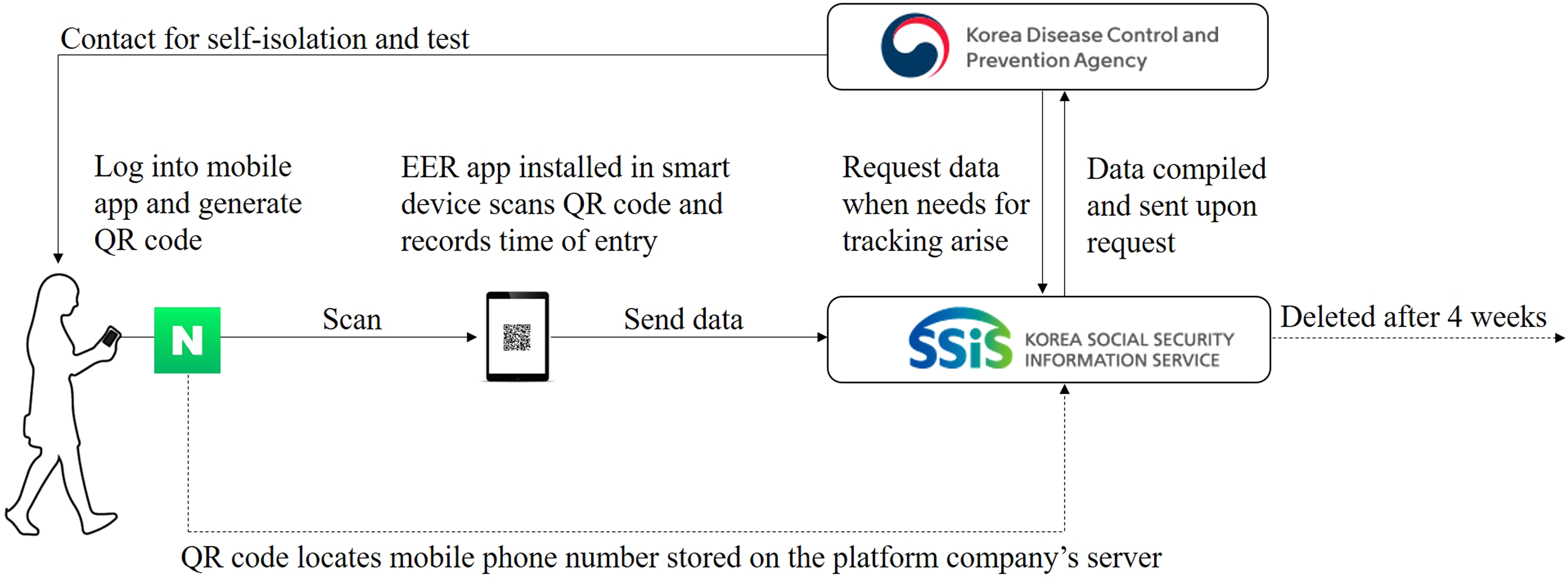
Flow of data (re)production in the Electronic Entry Register surveillance system.
Of the 27 advanced economies studied by Pew Research (Taylor and Silver, 2019), South Korea ranked first in the proportion of its adult population (aged 18 years and above) owning a smartphone as of 2019; nearly 100% of the South Korean adult population owned a mobile phone, 95% owned a smartphone and 5% owned a non-smartphone mobile phone. Thus, using Seoul as the geographic scope of the research can indicate a lifestyle with high levels of sociotechnical potency in terms of the relationship with digital devices. In this regards, this case study is significant and exemplary in its examination of the first real-life example involving an entire national population in the production of digital data, and how this novel form of ‘dataveillance’ made the reality of data production visible in the eyes of citizens – which had been in most cases, ‘systemically, structurally opaque’ (Andrejevic and Gates, 2014: 186) – overcoming to a certain extent the ‘difficulties in the abstract conditions of surveillance being experienced on a daily level’ (Best, 2010: 8).
Many of the detailed accounts acquired in the field research were only feasible because data practices were made more ‘visible’ by the data producers themselves. Indeed, this study was able to move away from the assumption that the users’ role in the production of surveillance was ‘hardly one of conscious actors in the drama’ (Lyon, 2014: 3). Although the topics and issues addressed here are by no means exhaustive of the different shapes of relations that may transpire at the sites of data-producing bodies, they are significant because they extend our understandings of the complexities between data production and surveillance by engaging with ‘a situated, reflexive and contextually nuanced epistemology’ (Kitchin, 2014: 1) in the discourse of data-based surveillance.
The rest of this paper is organised as follows. First, it considers the intersectionality of the recent scholarship on post-Deleuzian surveillance and critical data studies to analyse the data practices for the EER and explore the agencies emerging through these data practices. Second, it discusses the complex relationships that participants formed with their produced data, as well as the resulting expressions of surveillance. To explore these relationships, three headings are used: ‘faster, more accurate, and more secure’, ‘data valuation and negotiation’ and ‘data imaginaries’. Third, the conclusion lays out the theoretical implications of this study and suggests a future research agenda for critical studies of data-based surveillance.
Production of dataveillance at the scale of the body
This study focuses on the intersectionality of the developing literature in critical data studies that emphasise people's engagement with data and surveillance scholarship following a Deleuzian perspective to lay the groundwork for analysis of the data practices of the EER and to explore the effects of emergent agencies on surveillance systems.
The field of critical data studies has been dominated by political economy and neo-Foucauldian analyses (Kennedy, 2018). Articulated through the concept of ‘algorithmic power’, studies of data-based surveillance have primarily emphasised the ‘top-down gaze’, largely sharing a ‘dystopian imaginary of a digital control society’ (Leclercq-Vandelannoitte and Aroles, 2020: 751). Although such a perspective is appropriate for understanding the ways in which new digital technologies remediate power relations and social organisations, it lacks a close-up interrogation of the modalities of technological mediation at the sites of ‘ordinary people’ (Kennedy, 2018: 20) and how their emergent agencies coalesce into the social realities of surveillance.
Even when human agencies are discussed in this field of study, they are normally focused on as ‘sovereign human subjects’ (Rose, 2017: 782) – such as artists producing activist projects – representing ‘the human’ (783) and largely ‘appearing in the form of excessive resistance’ (779) to the digital. Indeed they are often ‘a specific kind of human’ (781) or ‘elites’ (Kennedy, 2018), such as hackers or savvy technology users involved in the Quantified Self movement (Lupton, 2016). Kennedy (2018) identifies this empirical gap with regards to ‘ordinary people’ – and their thoughts and feelings on their everyday production of ‘mundane data’ (Pink et al., 2017) – as a ‘critical absence’ (Kennedy, 2018: 19) in data studies.
Many research participants during the fieldwork of this study remarked that producing the QR code for the tracing system rapidly became ‘mundane’ (e.g., Kim, Park and Seo), emphasising the significance of people's relations with their data products as ‘processual and material’ (Pink et al., 2017: 3) elements of normalisation. In this regards, these actors’ ‘vocabulary of emotions’, which flags the ‘possibility of agency’, is crucial, according to Kennedy (2018: 27), if data activism is to gain meaningful momentum. It is necessary to reconsider portrayals of a ‘general public … homogenously framed as pliable, acquiescent, or unwitting subjects’ (Liu and Graham, 2021: 2) by placing more of a focus on how ordinary people make sense of digital data and their data products (Lupton, 2018; Rose, 2017; Michael and Lupton, 2016; Kennedy, 2018; Kennedy et al., 2020; Leclercq-Vandelannoitte and Aroles, 2020; Pink et al., 2017; Couldry and Powell, 2014; Liu and Graham, 2021) to better explain everyday organisations mediated through data productions.
Many studies on the tracking and tracing apps invented worldwide during the COVID-19 pandemic (e.g., the Alipay Health Code App in China, the NHS COVID-19 app in the UK, COVIDSafe in Australia and TraceTogether in Singapore) highlight how their techno-solutionism threatens civil liberties (e.g., Kitchin, 2020; Yang, 2022), but it is also ‘problematic to assume that the public opinions are downstream effects of state propaganda’ (Liu, 2021: 92) because such approach cannot on its own explain the process through which surveillance systems become normalised, especially in democratic societies. To more fully understand the process, investigation of ‘Big Data from the bottom up’ (Couldry and Powell, 2014: 1) is required to ‘foreground the agency and reflexivity of individual actors as well as the variable ways in which power and participation are constructed and enacted’ (Couldry and Powell, 2014: 1).
In this regards, it is important when studying the mechanisms of the EER to conceptualise individual citizens as ‘social actors … with social ends over and above the basic aim of generating and analysing data’ (Couldry and Powell, 2014: 2, emphasis in the original). This requires an understanding of citizens’ data practices within the social context of having to ‘configure life by tailoring its conditions of possibility’ (Cheney-Lippold, 2011: 169), particularly ‘operating through conditional access to circuits of consumption and civility’ (Rose, 2000: 326) in times of pandemic.
Indeed, the minimum requirement for the citizens of Seoul to lead normal lives while protecting themselves from potential infection was to carry their smartphones at all times, to essentially ‘enhance’ (Hogle, 2005) their bodies as the critical sites of data production in exchange for access to urban venues. Their mobile bodies would thereby be granted the fewest distractions, and these conditional interactions for accomplishing everyday needs influenced their perceptions and feelings towards their data production, which further shaped their attitudes towards the surveillance system. This is why, as explained in Methods section, it was crucial to interrogate the research participants’ everyday mobile lives in urban space and their existing relationships to their smartphones to contextualise their data practices conducted for this tracing system.
For analytical purposes, this study uses the concept of the ‘dividual’ – the ‘dividual material’ (Deleuze, 1992: 7, original emphasis) of the body as a form of knowledge about the body, captured and reproduced through computer technologies often in the forms of ‘code’ or ‘password’ (5) – to infer the process of having bodies reduced to a QR code through the corporeal practices of the citizens themselves. Building on the emphasis in Deleuze (1992) on how technologies determine the means of normalisation, this study highlights ‘interactivity’ as the crucial element of this tracing technology as a whole. As surveillance was positioned ‘in the hands of citizens’, who indicated their presence via the production of a QR code using their own devices, their interactions co-constituted the surveillance system as a working technology. In other words, to explain the normalisation of the tracing system, attention must be paid to individual citizens’ data practices and everyday engagements with the system.
Such required interactivity – or the ‘political tragedy of interactivity’, as Galloway (2006) calls it – is critical to understanding organisation of dataveillance, to considering the political issues at stake at these sites of data production and to uncovering ‘a space in which to explore possible conditions for agency in datafied societies’ (Kennedy, 2018: 27). As explored in the following sections, the evolving relations between the participants and their data products engendered particular ways of imagining their positions within the data system, or what Bucher (2017) calls ‘algorithmic imaginary’ – ‘ways of thinking about what algorithms are, what they should be and how they function’ (30) – and making sense of their becoming ‘desubjectivised flows and fragments’ (Wark, 2017: 79). This transitory and performative character in the production of surveillance, the focus of this study, is reflected in the research design that follows.
Method
This section comprehensively outlines the method employed in this empirical study, which involved a series of decisions to ensure efficient and reliable data collection involving mobile bodies during the pandemic. To examine each research participant's data practices at EER sites, methodological procedures from grounded theory, as suggested by Corbin and Strauss (2008), were employed. The proposed analytical tool, a ‘coding paradigm’, was particularly useful for ensuring systematic examinations when the researcher had to deal with diverse spatial arrangements, the unpredictable movements of people and unforeseen incidents in a wide range of urban sites (including cafés, a warehouse, a community centre, department stores and a reading room).
The ‘coding paradigm’, with its processual categorisations – causal conditions, core phenomenon, contextual conditions, intervening conditions, actions/interactions and consequences – helped the researcher with efficient data collection and analysis, particularly for examining the complexities of participants’ interactions at EER sites, which mostly lasted less than 1 min. Figure 2 illustrates how the coding paradigm was integrated into fieldwork procedures. The structure of the diagram was informed by four studies (i.e., Karimimoshaver et al., 2020; Choi and Hong, 2017; Webster, 2016; Vollstedt and Rezat, 2019) that employed the methodological procedures of Corbin and Strauss (2008).

Categories of coding paradigm integrated into the fieldwork procedures.
To recruit research participants, the study adopted ‘theoretical sampling’, a method of purposeful sampling that involves alternating data collection and analysis to gather data ‘based on evolving concepts’ to ensure ‘density’ (Corbin and Strauss, 2008: 116, 112-113). The analysis began after completing the first fieldwork so that the researcher could identify relevant concepts and emerging questions early on and return to the field to gather additional data selectively. To begin recruitment, the study used the three groups of citizens identified in a previous study conducted for the author's PhD dissertation: citizens who had little difficulty using the EER (A), citizens who found it difficult to use the EER (B) and citizens who attempted to avoid using the EER (C). Four recruitment rounds were conducted before reaching density, resulting in a total of 11 research participants.
As recommended by Corbin and Strauss (2008), the ‘sample selection rationale’ was prepared for each round to shape further questions emerging from the theoretical frameworks discussed earlier. Table A1 (‘Sample Selection Rationale’ in the Appendix) displays detailed accounts of how conceptual density was achieved through this process – for example, research participants’ perception of their data practices as embedded within their everyday prosthetic relations to their smart device (e.g., ‘physical prosthetic-ness’); participants’ experience of the presence of the gaze in spaces of control (e.g., ‘presence of gaze’); and participants’ understanding of the characteristics of digital data and their movements (e.g., ‘perceptions of digital data’). The anonymity of the participants was protected by assigning aliases, and appropriate rewards were provided for participating (see the Ethical Conduct section in the Appendix for details on COVID-19 health and safety considerations for this fieldwork, which took place during the peak of the pandemic).
Each fieldwork session was undertaken in three sequential steps: (1) walking interviews, (2) observations and (3) sit-in interviews. The researcher and the participant conversed as they walked together for 10–15 min to an EER site that the participant chose within the radius of their everyday life. As ‘data generated through walking interviews are profoundly informed by the landscapes in which they take place’ (Evans and Jones, 2011: 849), this approach was effective in quickly grasping the participants’ mobile life in the city and in contextualising the EER within their everyday social activities. As a rapport-building phase, the researcher asked questions such as how participants used their smartphone every day, how they felt about the tool and how they learned to generate the QR code for the EER. These questions were designed to uncover the ‘causal conditions’ specified in Figure 2. Semi-structured interviews were conducted.
Upon arrival at an EER site, participants went through a series of performances with their smartphones to produce the QR code and scan it onto the designated screen (Figure 3). Although complicated, the duration of the performance was mostly less than one minute. The researcher video-recorded the participant's performance to capture the in-the-moment details as well as the non-verbal dimensions of the process. The documented video was examined multiple times to delineate the ‘contextual condition’, ‘core phenomenon’ and ‘action/interaction’, as shown in Figure 2.

Research participants producing digital data for the tracing system.
After the performance, a sit-in interview was conducted in which the participants were asked to reflect on their experiences. The interview aimed to uncover the meanings and imaginaries the participants produced with regards to their data practices by asking questions about, for example, their feelings about sending personal data in the format of a QR code, where they imagined the data were sent after the scan, and how they imagined themselves being networked in the venue. The sit-in interviews focused on uncovering the ‘intervening condition’ and ‘consequences’ of the coding paradigm (Figure 2). Semi-structured interviews were conducted.
After the collected data were transcribed, visual and textual analyses were conducted using NVivo 12, a computer-assisted qualitative data analysis software. The theoretical frameworks informed the coding process, which resulted in 10 final codes with 37 child codes: (1) prosthetic-ness, (2) relationship with the QR code, (3) discipline and/or control, (4) post-human citizens, (5) spatial perceptions, (6) digital technology, (7) urban life with smartphones, (8) mobile bodies, (9) sociality and (10) networked-ness. Detailed accounts of the sampling, interview questions and coding procedures are presented in the Appendix.
The analyses reveal emerging agencies among the citizens of Seoul, as they navigate the attributes and characteristics of the ‘dividual’ that they were required to produce. They also suspected the operational efficacies of ‘connecting the dots’ (Lyon, 2014: 4), the result of which was supposed to indicate the movements of their bodies. A closer look at the participants’ data practices and perceptions revealed that this mode of data-based surveillance has latent capacities for divergence and alteration in the system through the effects engendered by the participants’ developing relationships with the data products.
Faster, more accurate and more secure
This section discusses how the citizens of Seoul came to embody the digital mediations of the EER, which became the foundation upon which the surveillance system was operationalised. Imposed as an ‘acting subject’ (Klauser and Albrechtslund, 2014: 284) in the production of surveillance, each of the 11 research participants acknowledged that the QR code was far more competent as a data form than the personal details left in the handwritten registers during the earlier days of the pandemic (regardless of whether or not they liked the EER as a system), for the following reasons.
First, the instantaneous production of QR codes is better aligned with citizens’ daily mobility in the city. Seo, a 24-year-old university student, recounted how he and his friends had to complete the handwritten register one by one when they visited a restaurant. It was ‘tiresome’, he said, for them to write one after another. Lee, a 33-year-old kindergarten teacher, described the bodily movements involved in handwriting as ‘cumbersome…. You have to write and look at your watch’ (emphasis speaker's own), which aptly described the entrance scene at a field site of a hospital (Figure 4), where only a handwritten register happened to be available. As Yun, a 40-year-old consultant, reasoned, for citizens on the move often in the middle of doing things, the instantaneous materiality of digital technology was much easier to embody, and better supported their bodily engagement in the city.

The bodily movements created chaos at the field site of a hospital.
Second, QR codes represented their bodies more accurately. The value of accuracy emerged through the process of particular means of data production, which was based on the wider social condition of body-smartphone ‘entanglements’ (Barns, 2020: 157). Kang, a 60-year-old retiree, said, ‘The QR code cannot lie’. Lee explained that she found the QR code much ‘clearer’ than handwritten data because it was produced by a body, physically and legally ‘attached’ to a smartphone. As was the case for me, too (laughs),
2
people might have their own reasons for leaving incorrect data. In this sense, one cannot be assured of their accuracy and credibility. However, the QR code, I think, has an accuracy of almost 99%. Or probably 98%? Under the assumption that the smartphone is legally owned by the person, yes, there is clarity.
According to Lee, because the person had to physically ‘hold’ the smartphone, the validation process required for using it to generate the QR code substantiated that they were the legal owner of the device. In this way, the accuracy of the QR code as a ‘dividual’ of the body was ensured. As the ‘acting subject’ (Klauser and Albrechtslund, 2014) in the production of surveillance, these ordinary citizens were not only affected by the sociotechnical meanings of the QR code attached to their bodies during the pandemic but also actively interpreted them.
Fully capturing the emerging agencies of these citizens requires an understanding of how their everyday lives were already highly facilitated by digital capacities. All 11 research participants contended that their smartphones were indispensable for leading their everyday lives, regardless of their differences in age, sex, social class or level of education. For example, Kang said her ‘beloved’ leather wallets were recently replaced by a Samsung Pay app, Ahn, aged 23, always used his fingerprint to enter his university dormitory, and Lee had her iPhone in silence mode at all times while her Apple Watch nudged her about incoming calls or texts while she worked in a kindergarten. Considering that these individuals’ everyday lives are highly infused by digital capacities, the tracing system sustained such a logic of everyday organisation to a large extent.
In this vein, the accuracy of data proving that ‘you are who you say you are’ (Weitzberg et al., 2021: 2) was not only in the interests of the government pursuing control during the pandemic. Citizens as social actors also required ‘accurate’ representations of themselves and other citizens, which they believed would ultimately serve them better in sustaining accessibility to urban services and facilities during the pandemic. Choi, aged 65, reasoned thus: ‘I have to regularly visit the hospital…. I don’t think there is any better way of doing this, because checking all the CCTVs must be really difficult when there are people flooding in.’
Third, for many participants, the digital capacity of the QR code implied security. In particular, the visible display of ‘mutability’ was considered the critical quality of the QR code. According to Ahn, the fact that the QR code was ‘refreshed’ every 15 s meant that it was safer to use. It would become ‘less critical’ in case of failure or malfunction, according to him, echoing similar concerns expressed by Jang, whose comments opened this paper. Im, a 27-year-old gig worker, also asserted that having a regularly refreshed QR code meant that his identity was continually reconfigured. [Demonstrating to the researcher how the QR code gets refreshed on his smartphone screen] As you can see, every 15 s, the one-time password is given out. It is like I am being reformatted myself. (Emphasis speaker's own)
Im's imagining that the mutable QR code represented ‘a snap-shot of a particular moment in time,’ thus allowing ‘shifting forms of selfhood’ (Lupton, 2016: 115, emphasis in the original) was strategically understood as a security improvement for the individual participant whose ‘just-in-time’ identity (Saulnier, 2017: 698) was being constantly registered by a surveillance system. The instantaneous quality of digital reformatting was perceived to be relayed to the smartphone-holding body to protect its privacy. What Deleuze (1992) pointed out as the ‘modulatory’ characteristics of computerised normalisation in the form of a ‘password’ (5) – and more accurately, a ‘one-time password,’ according to Im – was embraced as a positive attribute of the digital technology. These accounts suggest how ordinary people's tacit knowledge of digital materialities, such as ‘reformatting’ – i.e., completely erasing a hard drive – became a resource through which they make sense of and engage with the surveillance system.
After 14 months (as of August 2021) of working with the tracing system, the participants largely came to appraise the QR code as a valid form of ‘dividual’ that indicated their bodies during the pandemic. Although surveillance is often considered to be externally imposed, the ‘acting subjects’ (Klauser and Albrechtslund, 2014) reinterpreted the meanings of surveillance through their interactions and everyday knowledge. These findings point to the need for renewed attention to the ambivalence of data production as practiced and contextualised by ‘ordinary people’ (Kennedy, 2018: 20). Their understanding of digital materialities and capacities, largely informed by their everyday digital practices, influenced the participants’ perceptions of their data products and reshaped their relationship to surveillance systems.
Data valuation and negotiation
Although the participants were externally imposed upon to engage with the tracing system, they were also internally motivated to produce the data, primarily because they wanted to remain inside the ‘circle of knowledge’, to quote Jang. Drawing on the everyday context of epidemiological conditions whereby ‘perceptions of individual risk and potential advantage all play a role’ (Taylor et al., 2020: 15) and being well ‘aware of being classified’ (Couldry and Powell, 2014: 2), the participants formed peculiar relations with their data products as they became ‘both the subjects and objects of knowledge’ (Michael and Lupton, 2016: 105). They negotiated their positions within this knowledge production system as each became ‘simultaneously the informant, the informed, and the information of big data’ (104). Park, a 37-year-old employee at a pharmaceutical company, echoed many other respondents’ comments on the motivations behind their continued use of EER: I don’t like performing for the EER, but I feel I need to do it because I want to be informed just in case the virus breaks out around me. Just in case, you know? There are many new cases in my workplace, so just in case.
As illustrated in Figure 1, showing the flow of data production and dissemination in this tracing system, producing the QR code was the only way to be incorporated into the system so that one could be fed back with relevant information on mobility-engendered risks during the pandemic. Pursuing such social ends, the participants ‘develop[ed] a reflexive relationship to the infrastructures of digital presence’ (Couldry et al., 2016: 119) and ensured the maintenance of their logs in the surveillance system. A new type of citizen has emerged through the dataveillance system: the data-producing citizen who feels entitled to information because they have contributed to governance through the supply of digital data. On the other hand, in this context of knowledge production, the participants reassessed and controlled the level of data production on the basis of their tacit knowledge of the interoperable capabilities of digital technology. Their presumptions and imaginaries about the ways in which their data products would circulate and shaped their relationship with the tracing system. Some participants skipped the EER when they could because they felt they had already left enough digital data behind for the government to track them. When they talked about ‘leaving data’, it always involved the identity of the recipient – the government – and they expected the government to thoroughly ‘capture’, to use Seo's term, any bits of data the citizens left to accomplish its tasks in providing information.
On the basis of these imaginaries, the participants devised tactics and strategies for economies of data production at the individual level. For example, Seo skipped registration at the study café he frequented (but not in any other urban venues) because he thought he was already well networked to the place through its ‘Study Moa’ mobile app and left enough data for the government to do the tracking. The following is an extract from our conversation: Seo (Pointing to the ‘Study Moa’ mobile app on his smartphone screen) This app lets you reserve a seat here. If there's a need for investigation, this [record] should be linked to [the government's] system. I thought it should work like that.
Researcher When you reserve a seat, do you reserve it using a seating plan?
Seo Yes, the reservation is for the seat.
Researcher Oh, then your exact whereabouts are all registered. It is actually even more accurate than the EER.
Seo That's what I mean (laughs).
Similarly, Han, a 25-year-old professional runner, skipped the EER at urban venues when she believed she was already densely networked with other digital systems, such as credit card companies for payments, and her circle of friends who accompanied her to the venues. In her words, she had ‘left enough data’ for the government to trace her movements and give her a call if the virus ever broke out. She reasoned thus: Wouldn’t [the government] find me through my credit card payment records? Or, if one of my friends gets a text message [for a COVID-19 test], I’ll be like, ‘Okey dokey, I will be coming along’.
Others compromised and controlled the scope of their data exchange by discerning the relative significance of different kinds of data. Im said that when handwritten registers were only available in the earlier days, he used to omit details of his residential address but made sure that he left his mobile phone number correctly. I kind of felt like faking my mobile phone number, too, but I didn’t in the end, because I knew of its importance. I wanted to get a call in the case of a virus outbreak. However, the address was a little bit too much for me.
The participants actively negotiated their exchange of data with the government, depending on the presumed significance of the data in question. Some were conscious of the technically interoperable qualities of digital data and assessed that they had contributed ‘enough data’ within a particular assemblage of digital networks surrounding the urban venue. Although they assumed that the government would effectively leverage the existing data already circulating in the agglomeration of multiple networks, their expectations were perhaps much greater than reality, illustrating the gap that the ‘algorithmic imaginary’ (Bucher, 2017) can leave in the actual efficacy of dataveillance.
These strategies developed by the participants on the basis of their beliefs and imagined uses of digital data revealed the potential for a ‘contentious politics of data’ (Beraldo and Milan, 2019: 3), whereby the data practices were creatively reappropriated by ordinary individuals who were well aware of being a constituent component of the knowledge production system. Although the participants’ engagement with data in this case study did not fully denote the transformative initiatives to the degree of, for example, ‘hijacking dominant process of datafication’ (Beraldo and Milan, 2019: 1), its revelations indicate that there is space for reassessments, alterations and modifications through technological mediations at the sites of data-producing individuals.
Indeed, the participants regarded their data production not only as their civic duty in times of pandemic but also as their right to receive proper information feedback, preferably without redundancy in data production. In this sense, the mode of surveillance enacted through the tracing system was not entirely a one-sided enterprise with an apparent authority and passive subjects; it was also a reciprocal and evolving (albeit unequal) one. What emerges as critical is the need for attention to the elastic and manifold power relations involved in the production of data surveillance and the consequent shapes of governance.
The manifested imaginary of surveillance as a top-down gaze alone does not fully capture the current production of data surveillance. As this case study reveals, subjective agencies emerged in the shape of information trade-offs or even in the mode of participatory engagement, signalling the ways in which dataveillance is being socially reshaped and materialised. Interestingly, this finding is consistent with a recent survey report published by the Korean Institute of Criminology and Justice (Han et al., 2019) on citizens’ positive attitudes towards the installation of more CCTVs in public spaces. 3 Underlying this perception is citizens’ agreement to become ‘citizen sensors’ (Gabrys, 2014: 32) or data-producing subjects providing more data on their own behalf in the hope of being fed back with better knowledge and governance.
Data imaginaries
Although, as ‘acting subjects’ (Klauser and Albrechtslund, 2014) in the surveillance system the participants embodied the technological mediations for data production, they also expressed distanciation with regards to the invisibility of how the produced data were further processed and used. For the question, ‘Are we making a good use of the QR code?’ Park said, ‘I don’t see. No, I can’t feel it’.
The lack of transparency in the process of calculation, interpretation and distribution after the QR code was scanned and sent off alienated the actual producers of the data, and ultimately caused them to disregard the surveillance system. From a broader perspective, their attitudes towards digital data in general significantly depended on the transparency of the knowledge production process. Han starkly expressed this dimension: I really don’t understand how the QR code is sorted. For example, if I come to a venue six hours after a virus outbreak, how do they interpret it in terms of proximity? There is too much uncertainty regarding the standards.
Han also raised the issue of how discrete sets of digital data could be used to ‘connect the dots’ (Lyon, 2014), to be translated into spatiotemporal meanings of lived experiences. She further commented on the mismatch between the geographical scope of everyday life and that of the daily feedback citizens received in the form of ‘disaster text messages’ from the government. My friend goes, ‘Hey, there's an outbreak in Gangbuk borough [where Han lives]’. She lives in Seodaemun borough, but still receives texts on Gangbuk borough. My mum lives in the city of Uijeongbu, and she says, ‘I got texts on Seongbuk borough’. I don’t get this. What kind of mechanism is all this?
Her doubts concerned the lack of visibility in deciphering Big Data to produce the spatial governance that citizens encountered every day. The lack of a causal explanation of ‘the feedback loop … as a form of control’ (Cheney-Lippold, 2011: 168) ultimately made her sceptical about the integrity of the surveillance system as a whole.
The lack of visibility in data processes also caused a sense of anxiety. Kim, aged 66, who assumed that the QR code extracted ‘all’ her credit data from her smartphone, said that she skipped the EER whenever she could because she was worried (as she heard from her acquaintances) that all her data might be ‘transported to China to be misused’. Kang thought that the QR code containing all her registered information in the government's archives, including the data on her ‘family relations and tax payment history, anything linked to the government’.
Although ‘time of entry’ and ‘mobile phone number’ were the two datasets collected through the EER, the imagery of the QR code, with its ‘mystic’ patterns, led the participants to imagine that it contained much more than it actually did. Indeed, the sense of detachment from the data they produced was fostered by the fact that the QR code was illegible, with its ‘weird patterns’, to use Choi's phrase. Although some (Ahn and Jang) said that the code's illegibility made it even more secure because it was also illegible to other people (e.g., those lined up behind in the queue for the EER), it also created incomprehensibility, as Park remarked in the following conversation. Researcher What do you think is most interesting about the QR code?
Park How much information may be in it.
The lack of visibility over the process was also expressed in the participants’ imaginings about data movement. Park commented that he had always presumed that his data were already exposed and accessible, and there was nothing he could do about it, reflecting ‘feelings of widespread resignation’ (Dencik and Cable, 2017: 763) to personal data gathering: Wouldn’t they already have all [my data] anyway? The database must be all out there, no? You can’t help it. It has felt even more like that since we have had this QR code stuff.
Han also did not believe that her data would be protected anyway, saying that she would rather give up on them: ‘I would rather think of the data as “flowing away”’ [laughs]. In light of her previous experiences with spam calls, Kang imagined that her personal data for the EER would be transferred ‘here and there’. She said, ‘They all fly away anyway’.
Interestingly, none of the participants said that they had given any thought as to exactly where the data would go after the QR code scan. When asked ‘Where do you imagine or think the data go after the scan?’, none of the participants reported being curious. For example, Im, who explicitly said he felt uncomfortable about the fact that his movements were being exposed, speculated thus: I hope [the data] stay on a server owned by the government, while the platform company just delivers data that will soon be eradicated. But would they have done that? No.
The participants’ agency that emerged at the data production stage was conspicuously cut off during the calculation and dissemination stages. Indeed, within the existing data-based surveillance system, citizens are essentially dichotomised as either data producers or receivers. In this way, the ‘new algorithmic identity is situated at a distance from traditional liberal politics, removed from civil discourse’ (Cheney-Lippold, 2011: 165, emphasis in the original). When agency is unevenly distributed in the knowledge production system in this way, the democratic potential of data-producing citizens remains critically restrained, potentially ‘limit[ing]’ the possibilities of enacting modes of citizenship and of imagining alternatives’ (Dencik and Cable, 2017: 763) despite the data hermeneutics discussed in Big Data discourse. Although the research participants were actively rationalising and negotiating with the dataveillance system by projecting particular imaginings that infused their liberal citizenship onto the ‘dividuals’ they produced during pandemic governance, such efforts were heavily shadowed by confusions, uncertainties and misunderstandings.
Conclusion
This case study drew on post-Deleuzian scholarship on surveillance and critical data studies to explore the relationship that citizens of Seoul formed with the data they produced for the tracing system during the COVID-19 pandemic. Treating individual citizens as social actors conditionally producing ‘dividuals’ to access everyday facilities and services, it focused on the agencies emerging at the sites of the technological mediations. Locating surveillance in the hands of citizens who marked their real-time presence by producing digital data using their own devices, their data practices and their everyday entanglements with their smart devices became a ‘a cog in a larger machine of big data’ (Bueno, 2020: 79). However, citizens’ tacit knowledge and imaginaries concerning digital data and their constituent positions within the knowledge production system also shifted their perceptions of data production, engendering reflexive adjustments to the practices and re-evaluations of the surveilled realities.
The limitation of the study is its scope, which involved working with 11 research participants who were using the EER as part of their everyday urban engagements. However, despite this limitation, this case study is noteworthy because it probes in empirical depth the emerging agencies of ordinary people – whether expressed in the shape of doubt, resignation, negotiation, approval, participation, anxiety or disappointment – engendered through their engagements with the data surveillance system, to indicate how these can be translated as ‘nascent acts of agency [that] point towards possibilities for different data arrangements’ (Kennedy, 2018: 24). Although the context of agential interactions in this case study was limited to data production for surveillance during a pandemic (or perhaps more precisely, as it was expressed through this dominant structure), its findings substantially indicate that citizens’ relations with their data products evolve, with latent capacities for altering or deviating from the system, possibly transforming the organisations of surveillance and cultural manifestations. In line with these arguments, this study has two implications for researchers concerned with data-based surveillance.
First, there is a need to pay more attention to agencies that emerge through data practices within various social contexts. The relations and imaginaries that people formed with the data altered their perceptions of surveillance in this case, as well as the level of their capacities in adjusting their involvement. Understanding these emerging agencies in diverse contexts can open pathways for imagining different shapes of the politics of data. For example, agencies emerging through data production for surveillance systems can vary widely from those emerging through data production for digital music systems.
Second, the implication concerning dichotomisation of citizens either as data producers or receivers can be reconsidered with the concept of ‘representational space’ or ‘lived through’ space (Lefebvre, 1991: 39). If the producers themselves find it difficult to perceive and comprehend the workings of their own production, and if the agential relationship between the producer and the products continue to be unevenly distributed, the potential gap between the ‘representation of space’ – that is, the ‘conceptualized space, the space of scientists, planners, urbanists, technocratic subdividers and social engineers’ (Lefebvre, 1991: 38) – and the ‘representational space’ could widen significantly. One way of closing this gap might be to revisit the conceptual dichotomisation of citizens and to appropriately address these issues in the working designs of data processes and governance.
Klauser and Albrechtslund (2014: 274) remind us: ‘Foucault … reiterates again and again that power must be approached through the study of its mediating techniques and discursive regimes, rather than as the property of specific actors’. Interrogating the dynamics of technological mediation at the sites of data-producing agencies is of substantial importance for understanding how data practices work in our society. For this reason, this study stresses the need to carve out a space in which to pay more critical attention to the agency to reassess the social realities of data-based surveillance, to rethink relations between technologies and practices in the production of surveillance, and to develop a more nuanced understanding of Big Data as social capital.
Supplemental Material
sj-docx-1-bds-10.1177_20539517231173904 - Supplemental material for ‘I’ve left enough data’: Relations between people and data and the production of surveillance
Supplemental material, sj-docx-1-bds-10.1177_20539517231173904 for ‘I’ve left enough data’: Relations between people and data and the production of surveillance by Hwankyung Janet Lee in Big Data & Society
Footnotes
Ethical statement
Ethical approval was obtained for all protocols from the Seoul University Institutional Review Board to confirm that this study met national and international human research guidelines in accordance with the Declaration of Helsinki and its later amendments or comparable ethical standards. (IRB No. 2108/002-008; approved on 3 August 2021).
Data availability statement
The data presented in this study are available upon request. The data were not publicly available because of the ethical standards applied to research studies involving human subjects.
Declaration of conflicting interests
The author(s) declared no potential conflicts of interest with respect to the research, authorship, and/or publication of this article.
Funding
The author(s) received no financial support for the research, authorship, and/or publication of this article.

Supplemental material
Supplemental material for this article is available online.
Notes
References
Supplementary Material
Please find the following supplemental material available below.
For Open Access articles published under a Creative Commons License, all supplemental material carries the same license as the article it is associated with.
For non-Open Access articles published, all supplemental material carries a non-exclusive license, and permission requests for re-use of supplemental material or any part of supplemental material shall be sent directly to the copyright owner as specified in the copyright notice associated with the article.
