




Abstract
In recent years, there have been a growing number of online and offline attacks linked to a loosely connected network of misogynist and antifeminist online communities called ‘the manosphere’. Since 2016, the ideas spread among and by groups of the manosphere have also become more closely aligned with those of other Far-Right online networks. In this commentary, I explore the role of what I term ‘evidence-based misogyny’ for mobilization and radicalization into the antifeminist and misogynist subcultures of the manosphere. Evidence-based misogyny is a discursive strategy, whereby members of the manosphere refer to (and misinterpret) knowledge in the form of statistics, studies, news items and pop-culture and mimic accepted methods of knowledge presentation to support their essentializing, polarizing views about gender relations in society. Evidence-based misogyny is a core aspect for manosphere-related mobilization as it provides a false sense of authority and forges a collective identity, which is framed as a supposed ‘alternative’ to mainstream gender knowledge. Due to its core function to justify and confirm the misogynist sentiments of users, evidence-based misogyny serves as connector between the manosphere and both mainstream conservative as well as other Far-Right and conspiratorial discourses.
Keywords
This article is a part of special theme on Mapping the Micropolitics of Online Oppositional Subcultures. To see a full list of all articles in this special theme, please click here: https://journals.sagepub.com/page/bds/collections/micropoliticsonlinesubcultures
The manosphere is a ‘loose confederacy’ (Ging, 2019) of blogs, websites, forums and social media threads ‘where users share their bigoted, sexist, and toxic views of society in general and masculinity and femininity in particular’ (Rothermel et al., 2022: 117). The manosphere is generally understood to consist of a variety of different subgroups, most notably involuntary celibates (incels), Men's Rights Activists (MRAs), Pick-Up artists (PUAs) and Men Going Their Own Way (MGTOWs). 1 While all of these groups follow slightly different ideologies, 2 they are united by a misogynist and male supremacist 3 worldview, in which men have to defend themselves and their freedoms against the ‘feminization’ of their societies, which is associated with a loss of power and rights for men (Carian, 2022; Schmitz and Kazyak, 2016).
Since the early 2010s, the manosphere has repeatedly been connected to violent events both online and offline (Baele et al., 2021; Jasser et al., 2020; Kelly et al., 2021; Massanari, 2017). Despite this violent history, it was arguably the 2018 terrorist attack in Toronto, which killed 11 people, and whose surviving attacker later stated that he was radicalized online, which forcefully brought the manosphere into the public eye. The increasing attention focused on the manosphere has been accompanied by a growth of its virtual spaces as well as a migration of users towards its more radical sub-communities and an increase in overtly toxic and violent content (Ribeiro et al., 2020). Studies have shown how some groups and platforms of the manosphere have also become increasingly connected with online communities of the Alt-Right (Anti-Defamation, 2018; Leidig, 2021; Mamié et al., 2021)and been involved in the rise of right-wing populism (Dignam and Rohlinger, 2019).
In this commentary, I argue that to (re)produce the misogynist male supremacist worldview that is at the core of the manosphere, many of its members utilize a discursive strategy that I have termed ‘evidence-based misogyny’ (Rothermel, 2020b: 1379). Based on examples 4 from three separate discourse analyses of the manosphere, 5 I conceptualize evidence-based misogyny as a micro-political discursive move whereby different forms of evidence are presented and linked to essentializing misogynist images about gender relations. Manosphere members using evidence-based misogyny refer to (and misinterpret) statistics, studies, news items and pop-culture and mimic accepted methods of knowledge presentation to prop up the apparent validity of their arguments, and ultimately their worldview itself. While the particular application and function of the strategy varies across time and space, evidence-based misogyny is a pattern that can be observed across the different communities of the manosphere. The novelty and mobilizing strength of the micro-political strategy lies in its two-pronged connection of ‘alternative’ truth claims with existing knowledge systems. First, drawing upon authoritative sources and mimicking accepted formats for knowledge communication bolsters the legitimacy of the (otherwise distorted) ‘evidence’ about gender relations that is presented in the manosphere. Second, the resulting gender knowledge systems, while supposedly providing an ‘alternative’ to the mainstream, are inherently connected to underlying misogynist structures in society, thereby both building on and reinforcing patriarchal gender knowledge and unequal gendered power relations. Through this double connection via both ‘evidence’ and ‘misogyny’, evidence-based misogyny not only helps to solidify and legitimize the collective identity of the male supremacist subculture in the manosphere, but also provides a pathway for male supremacist discourses towards both mainstream public conservative standpoints as well as other extreme Far-Right narratives.
The manosphere as space of ‘alternative’ gender knowledge production
According to feminist political scientist Verloo, there are three epistemic communities–the church, the scientific community and the media–which produce gender knowledge about “the way gender and gender relations are defined, understood and given meaning” (Verloo, 2018: 21). The manosphere positions itself as a distinct, ‘alternative’ space for gender knowledge production. An important part of the collective identity of manosphere followers is their self-description as ‘pilled’. The narrative of ‘taking the pill’, which originated initially from the film ‘The Matrix’, has gained a strong foothold in a variety of online right-wing communities (Hagen et al., 2020). In the manosphere, ‘being pilled’ is associated with the awareness of a true notion about gender relations which stands in contrast to a supposed feminist mainstream thinking on gender relations (Kelly et al., 2021; Sugiura, 2021). This framing of the online subculture of the manosphere as ‘alternative’ ‘truer’ space of gender knowledge production fits into a current trend within Far Right spaces to produce what Tischauser and Musgrave 2020have identified as ‘imitated counterpublics’, whereby right-wing actors appropriate Nancy Fraser's notion of counterpublic as a space for subordinated social groups to ‘invent and circulate counterdiscourses’. As Jasser shows at the example of the far-right platform ‘Gab’, online spaces that serve as ‘far-right publics display a counterpublic style [a shared sense of victimization], while residing in a place of relative societal privilege given their alignment with oppressive systems of power’ (Jasser, 2021: 188). Similarly, spaces of the manosphere are based on a discursive vacuum, which is left as part of the notion of ‘being pilled’ into rejecting gender knowledge produced by others. Tapping into this vacuum, evidence-based misogyny has the important function to produce the manosphere's gender knowledge as a ‘truer’ alternative to feminist gender knowledge and thereby provide legitimacy to the collective identities of the manosphere.
The use of ‘evidence’ in evidence-based misogyny
In line with Verloo's understanding of framing gender knowledge through signification not about ‘how the world should be – or at least this is not the obvious message – but how it actually “is”’ (Verloo, 2018: 21), the evidence that is presented by manosphere users centers on a description of gender relations in contemporary society; more concretely on the societal problems that specifically affect men.
To present such ‘evidence’ as trustworthy, it is most often framed in ways that draw on or mimic mainstream systems of knowledge generation that are recognized as authoritative. Examples include the use of statistics (see e.g. Figure 1), 6 studies, or statements from political or cultural authorities to illustrate manosphere claims of men's superiority and societal victimization. In addition to textual references, manosphere knowledge claims also imitate recognized data and knowledge visualization techniques. For example, incels have developed their own wiki, whose layout mirrors Wikipedia and features a range of graphs (often without data sources, see e.g. Figure 1).
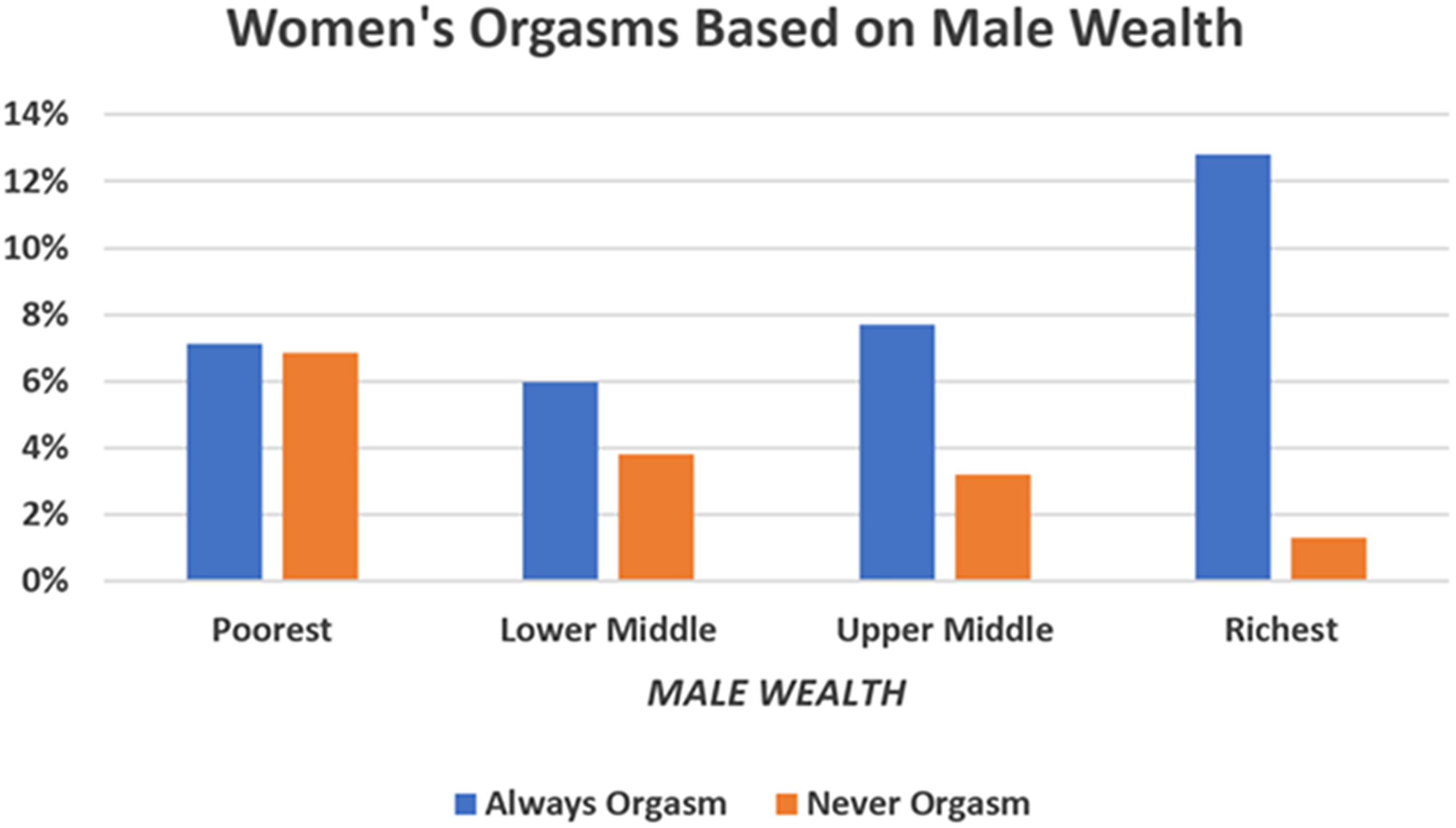
Example for the use of statistics to underline arguments with supposed but often unsubstantiated ‘evidence’ in the manosphere.
While much of what the manosphere claims as ‘evidence’ is distorted or completely fabricated, some of it is factually correct, such as references to men's ‘decreased participation in post-secondary education and increasing social isolation’ as well as a downward trend in men's reported sexual activities (Preston et al., 2021: 824). However, accurate or not, all of the gender evidence becomes distorted through its usage to either steer an otherwise logical argument or to disguise an illogical argument through references to relatable tropes, numerical data and authorities. One common theme for example is to omit how other groups are affected by similar dynamics and instead present men as the most (and often only) disadvantaged group of issues such as homelessness or mental health. Another distortion comes with the creation of false equivalences, for example between the effect of circumcision on women vis-à-vis men (MRA 2015) or by equating rape victims with victims of false rape accusations (PUA, 2013).
Through these dynamics, evidence-based misogyny builds and sustains a zero-sum logic on which the collective identity of manosphere users is built. In this logic, men are presented as the ultimate victims of the current societal climate, whereas other groups (in particular women) are considered as unambiguous winners of current gender relations, who drive discriminatory gender dynamics (Carian, 2022; Chang, 2020; Rothermel, 2020c). This victimization narrative has been identified as a common aspect of right-wing discourses, which is used to justify hatred against certain groups in society (see e.g. Wilson 2022) . The presentation of the so-created ‘alternative’ gender knowledge in juxtaposition to ‘mainstream’ knowledge in society bolsters the collective identity as victims and creates additional legitimacy for the turn towards alternative spaces of gender knowledge creation in the manosphere (see Table 1).
Example of evidence-based misogyny construction justifying ‘alternative’ spaces, PUA 2013.

As the manosphere has developed, a repertoire of much-repeated evidence claims has arguably led to a solidification of the underlying alternative gender knowledge system. To date, almost all manosphere communities have some sort of glossary or wiki, which both mimics traditional ways of presenting knowledge as well as outlines the core tenets of their ideology and provides a closed ‘alternative’ reference system. In their study of the incel wiki, DeCook argues that this alternative archive of incels’ gender knowledge ‘reveals the social epistemology of the group, as well as their shared fantasies, by creating an imaginary order’ in an alternative world that incels inhabit (DeCook, 2021). Studies of other sub-groups of the manosphere have also shown how the image of gendered hierarchies between men and women has become codified in specific language systems (Jones et al., 2020; Menzie, 2020). While these constructed worlds of alternative gender orders differ depending on the sub-group, they usually refer to each other in discursive practices, which acknowledge both differences and commonalities and thereby serve to reaffirm both the collective identity of the own sub-group as well as the existence of the broader manosphere.
The double role of misogyny
As has become clear in the previous section, the worldviews of the manosphere groups are based on a hierarchical gender order, whereby men are presented as victimized in current society to construct and justify a perceived need to turn to alternative spaces of gender knowledge to uncover the truth and reclaim their rights. These zero-sum perceptions of a gendered world in which the gains of groups with other gender identities (particularly women) are automatically seen as evidence of a loss of power for the men of the manosphere relate to misogyny in two ways, which, in turn, extend the relevance of evidence-based misogyny beyond the realm of the manosphere itself.
First, and rather obviously, the knowledge claims in the manosphere create a deeply misogynist image of the world. Multiple studies of manosphere discourses have uncovered how they rely on images of women in general, and feminists in particular, as intellectually and physically inferior, yet violent and monstrous ‘Other’ (Chang, 2020; Jones et al., 2020; O’Malley et al., 2022; Rothermel, 2020c). In this way, the discourses of the manosphere promote misogyny and male supremacism.
Second, a deeper look at the mechanisms of evidence-based misogyny reveals an additional function of misogyny. In Kate Manne's groundbreaking work, Manne defines misogyny as ‘the system that operates within a patriarchal social order to police and enforce women's subordination and to uphold male dominance’ (Manne, 2018: 33). Misogyny thus has a disciplining function to keep patriarchal gender hierarchies in place and is therefore disproportionately directed at those who ‘disrupt or pose a threat to gendered social hierarchies’(Manne, 2018: 61). This definition exposes that the supposedly ‘alternative’ narratives of the manosphere are connected to a much broader hegemonic patriarchal system that views challenges to gender orders as an attack, which legitimizes retaliation. In The politics of fear, Ruth Wodak argues that regressive discourses tend to follow certain structures of argumentation (topoi), which construct collective identities via ‘a useful shortcut appealing to existing knowledge’. In other words, these structures utilize the fact that ‘an opinion […] can be accepted by the majority of people because it represents traditional knowledge but not necessarily true knowledge’ (Wodak, 2015: 52). Applying this to evidence-based misogyny means that the message that is conveyed can be easily integrated into broader existing knowledge systems, thereby rendering the often questionable use of ‘evidence’ more convincing and facilitating identification with the manosphere worldview.
In other words, the ‘evidence’, which is provided gains its power by connecting to an underlying ‘truth’ about society that is already accepted knowledge among the users of the manosphere as well as in (most of) mainstream society. This increases the argumentative power of evidence-based misogyny, because it is actually feminist knowledge which goes against the grain of mainstream patriarchal structures with its call to pay attention to white and male privilege and their effects on ‘Others’ (Bridges, 2021), thus making it easy for manosphere authors to position it as irrational and lacking in ‘evidence’.
It is in this very combination of a (false) positioning of manosphere gender knowledge as ‘alternative’ and victimized, while relying on traditional misogynist assumptions, which are, however subtle, still common place in mainstream society, where evidence-based misogyny gains its power. Positioning manosphere gender knowledge as both ‘common sense’ and marginalized holds immense recruiting power. Once users accept the manosphere story of male victimization (evidence) this creates a disconnect with the socialization into patriarchy (misogyny), which allows for a presentation of patriarchal gender inequality as equity, while simultaneously reproducing blatant sexist and misogynist prejudices, precisely because they are accepted as ‘normal’. At the same time, the constant repetition of claims that create images of a society divided into disadvantaged ‘Us’ versus both irrational and powerful ‘Others’ leads to ‘an endless polarizing reproduction of anger and outrage’ (Rothermel, 2020c), which justifies hatred and violence in ways that connect well to other Far-Right and fascist ideologies. It is therefore not surprising that the institutionalization of the manosphere as a supposedly ‘evidence-based’, ‘alternative reference system’ has coincided with an increasing overlap of this system with other Far Right spaces and conspiracy theories that live off the same mechanisms 8 of presenting their adherents at the margins of society while building on existing underlying hegemonic knowledge systems of white and male supremacy.
Conclusion
Evidence-based misogyny is a discursive strategy used by manosphere users online, in which evidence is constructed as trustworthy through connections to accepted systems of knowledge generation and presentation. This evidence is then used to construct an inherently sexist and misogynist view of gender relations in society, which is presented as a supposed alternative to mainstream views. In this commentary, I have drawn on a range of examples from across the manosphere to showcase how the manosphere's claims about gender knowledge are constructed in opposition to and through imitation of gender knowledge that emanates from traditional epistemic communities to increase their legitimacy. I have also argued that while evidence-based misogyny works to build, legitimate and sustain the manosphere's deeply misogynistic view of gender relations, its efficiency in creating this worldview and mobilizing supporters depends to a large degree on its ability to connect to a baseline of common-sense misogyny in mainstream society. This connection allows for a spiral of self-confirmation and other-derogation that justifies the turn toward ‘alternative’ spaces of gender knowledge and connects them to both mainstream and extremist discourses.
Paying attention to the role of the micro-political strategy of evidence-based misogyny in the subcultures of the manosphere can help to uncover points of intersection with mainstream and extremist discourses and thus to better understand dynamics of recruitment into the manosphere as well as users’ (and terrorists’) membership in multiple Far-Right communities. Therefore, what is needed going forward is first of all a deeper understanding of the nuances of evidence-based misogyny, its variations across different groups and platforms, as well as its changing use and form throughout the history of the manosphere. In addition, we need to better understand the systematic overlaps with other online subcultures, that use evidence-based misogyny as a whole or whose argumentative strategies rely on similar mechanisms of knowledge and identity production.
Footnotes
Acknowledgements
The author would like to thank Jon Prettyman and Megan Kelly for their valuable comments on the first version of this article. A particular thanks goes also to Special Issue editor Melody Devries and the anonymous reviewers for their thoughtful comments and helpful assessment of the article.
Declaration of conflicting interests
The author declared no potential conflicts of interest with respect to the research, authorship, and/or publication of this article.
Funding
The author received no financial support for the research, authorship, and/or publication of this article.
