




Abstract
Effective social data governance rests on a bedrock of social support. Without securing trust from the populace whose information is being collected, analyzed, and deployed, policies on which such data are based will be undermined by a lack of public confidence. The COVID-19 pandemic has accelerated digitalization and datafication by governments for the purposes of contact tracing and epidemiological investigation. However, concerns about surveillance and data privacy have stunted the adoption of such contact-tracing initiatives. This commentary analyzes Singapore's contact-tracing initiative to uncover the reasons for public resistance and efforts by the state to address them. The government's contact-tracing program encompassing its proprietary TraceTogether app and physical token initially triggered vociferous public criticisms of Big Brother style surveillance. Using a dialogic communication framework, we analyze the TraceTogether initiative to interrogate the communicative strategies that were used to overcome public resistance. We argue that these strategies reflect a top-down approach that prioritizes transactional dissemination of information, in line with Singapore's technocratic stance toward governance. We further assert that such communicative tactics represent missed opportunities to foster public confidence in social data governance through greater trust building. We propose solutions for more dialogic communicative forms that build trust, so that officials can develop a sound understanding of the public concerns, increase the level of public engagement, and incorporate public feedback into policies that govern data use.
Keywords
This article is a part of special theme on Social Data Governance. To see a full list of all articles in this special theme, please click here: https://journals.sagepub.com/page/bds/collections/socialdatagovernance
Introduction
The seemingly interminable COVID-19 pandemic has revealed the spatial nature of the crisis (Poom et al., 2020), triggering the proliferation of digital tools for contact tracing, symptoms monitoring, and quarantine compliance, among others (Gasser et al., 2020). This has resulted in burgeoning troves of Big Data that call for enhanced data governance (Bouffanais and Lim, 2020). However, the authorities may have overlooked privacy issues in the rush to deploy these digital solutions to combat the pandemic. An analysis of 50 state-issued COVID-19-related apps by Sharma and Bashir (2020) revealed dismal data governance practices—only 16 had robust data privacy and protection policies in place.
Effective social data collection and usage rests on a bedrock of social support that is built on trust. Public health initiatives involving the collection, analysis, and deployment of citizens’ data may be undermined by a lack of confidence in the public 1 from whom the data are being collected (Redmiles, 2020). For instance, contact-tracing measures may be weakened if surveillance and privacy concerns are not addressed. In this commentary, we emphasize the importance of effective communication in conveying the principles of social data governance that align the government's goals with the public's concerns. This commentary analyzes the challenges encountered by the Singapore Government in introducing a proprietary contact-tracing technology, the reasons for public resistance, and efforts by the state to address them.
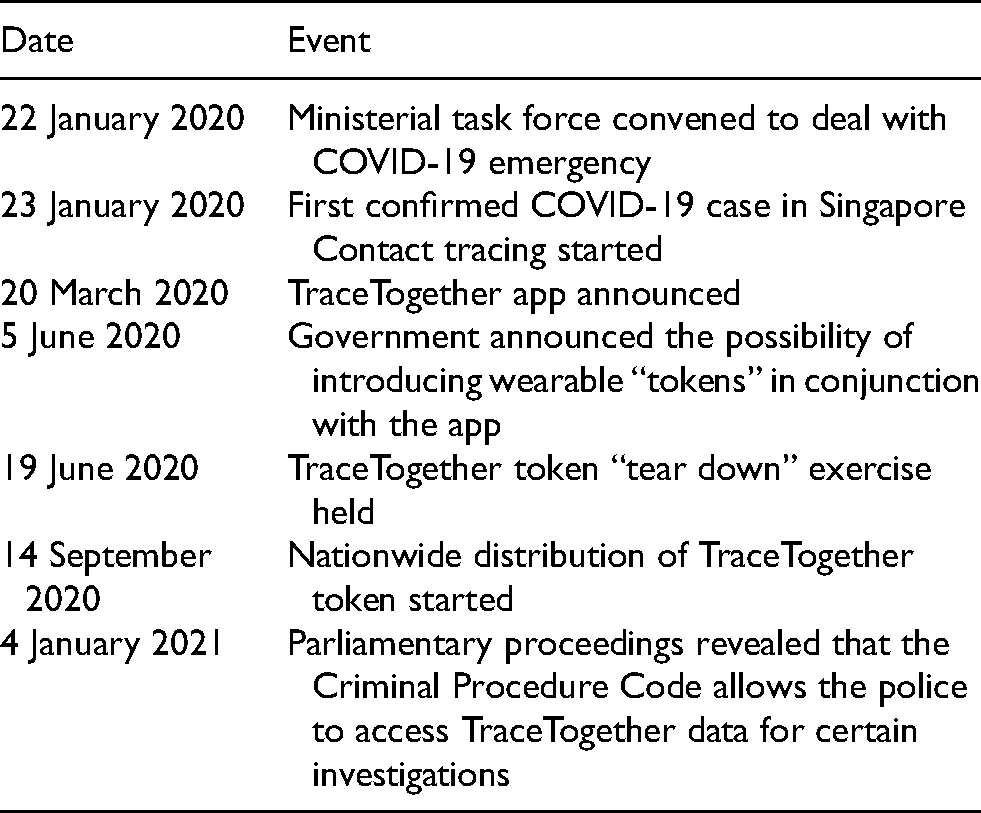
Singapore's rollout of digitalized contract tracing via its government-developed TraceTogether technology was met with strong public pushback and cynicism (Soon, 2020). We retrace key developments (Table 1) in the Singapore government's efforts to launch this national contract-tracing infrastructure, and the public response at each juncture. Using a dialogic communication framework, we unpack the government's communicative response to the public pushback against TraceTogether. Dialogic communication emphasizes the strategic use of communication as a relationship-building exercise with stakeholders through a negotiated exchange of ideas and opinions (Taylor and Kent, 2014). Compared to transactional communication approaches that prioritize efficient and effective dissemination of content, dialogic communication focuses on mutual understanding and building consensus and trust.
Milestones in Singapore's response to COVID-19.
We argue that Singapore's current communicative strategies adopt a transactional communication approach, reflecting the state's technocratic bent. We seek to distill lessons for building public confidence in social data governance, namely, having a sound understanding of the public's concerns, raising the level of public engagement, and introducing specific legislation to govern data use. We conclude with some ideas centering on the deeper involvement of other stakeholders in engendering greater buy-in for future data-reliant public projects.
Expediting contact tracing: Singapore's TraceTogether initiative
When the COVID-19 pandemic first tore through the globe, Singapore was among the first few countries to introduce a digital contact-tracing tool. Developed by the Government Technology Agency (GovTech), the TraceTogether app debuted on 20 March 2020. TraceTogether uses the exchange of Bluetooth signals between mobile devices to determine the proximity and duration of physical interactions between people. If a person is diagnosed with COVID-19, then that person must allow the health authorities access to the Bluetooth proximity data stored on his or her phone to expedite contact-tracing efforts. Within 24 h of its release, TraceTogether reached over 500,000 downloads in a population of 5.7 million.
However, this seemingly avid adoption at the outset was then curtailed by technical issues (albeit subsequently resolved) and more importantly, public concerns over the technoscientific workings of TraceTogether. While it may be tempting to brush off these concerns as “public misunderstandings” of science that can be overcome by correcting deficiencies in understanding, such a characterization is problematic as it ignores the socially constructed nature of public understandings of science (Irwin and Wynne, 1996). Improving the public's scientific understanding relies on “having an accurate sense of how the person seeking an improved understanding sees the problem in the first place” (Turney, 1996: 1089). The public was anxious about their privacy, worrying that the TraceTogether app and token had a location tracking or wireless data-sharing feature (Sim, 2020; Tan, 2020). Amid rising privacy concerns, an online petition against the mandatory use of the token was signed by 55,000 people (as of 18 February 2022), which claimed that TraceTogether facilitated the government's round-the-clock tracking of citizens’ movements under a growing surveillance state. As explained by a security researcher: “Singapore is a very good example of not getting adoption, even with a privacy-preserving app. Technically, everything was well done … (but) people don't understand the technical details behind the app, they just understand ‘the government wants to trace me’”(Ng, 2020).
Such apprehensions also stemmed from weakened trust in the state's management of citizens’ “social proximity” data collected by TraceTogether devices, following several past high-profile breaches of government databases (Sim, 2020; Tan, 2020). One particularly serious incident in 2018 saw hackers stealing the medical records of 1.5 million patients in the country's public healthcare system, including that of the Prime Minister himself (Tham, 2018). Clearly, such incidents lingered in the public consciousness and did not imbue confidence in the fidelity of the state's data governance practices. People, therefore, saw the TraceTogether initiative as government surveillance that infringed on their personal privacy.
Despite negative public perceptions of TraceTogether, on 4 January 2021, the 75% adoption rate target was finally surpassed with 78% of residents using the technology (Tham, 2021a). This high adoption rate can be attributed to soft coercion tactics such as the government mandating that TraceTogether would be required to enter public places like shopping malls and restaurants. It is unlikely to be due to the government's communicative tactics to clarify TraceTogether's technical and privacy features.
We assert that Singapore's public communications strategy for TraceTogether emphasizes a transactional rather than dialogic approach, in which the accurate and efficient dissemination of information (facts and figures), i.e. the content is prioritized. We argue that such a communicative strategy reflects a technocratic ethos that champions rational and logical solutions to governance (Barr, 2008). However, this transactional stance precludes a more active bid to overcome public resistance to TraceTogether through more inclusive, trust-building forms of communication.
Indeed, government messaging on TraceTogether bears the characteristics of transactional communication. Notably, the dedicated TraceTogether website conveys how the technology works in simple terms and contains frequently updated clarifications on data privacy measures together with a frequently asked questions (FAQ) section. The tone is overwhelmingly factual and seeks to distill science for the lay audience. Similarly, alternative media via popular social messaging tools like WhatsApp and Telegram were used to provide subscribers with daily updates on the evolving pandemic, focusing on one-way dissemination of facts and information such as key statistics and control measures. In another instance, a TraceTogether “tech teardown” event was held, where four specially selected independent technical experts were invited to dismantle the token and examine its components. Although the experts unanimously concluded that the token contained no privacy-compromising hardware (GovTech, 2020), this deference to the opinions of a very small group of handpicked technical elite once again echoed a technocratic communicative response. This suite of messaging efforts, while efficiently rolled out, heavily emphasized the top-down dissemination of information.
To the extent that legislation can be considered a form of communication strategy (Van Hoecke, 2002), the Singapore government had introduced legal safeguards such as the Personal Data and Privacy Protection Act of 2012 to strengthen public confidence in personal data governance. However, using legislative means has its limits and risks. In January 2021, it was revealed in Parliament that Singapore's Criminal Procedure Code allows the police to access TraceTogether data during certain investigations (Tham, 2021b). This revelation triggered a considerable backlash, with some feeling betrayed by this unexpected backtracking that was highly inconsistent with its previous emphatic claims that TraceTogether data would be used only for contact tracing. This regrettable fait accompli exemplified a cardinal rule of communication: do not act in ways that undermine public trust. This also highlighted the importance of trust-building exercises in addressing public anxieties about data privacy and social data governance. Furthermore, it underlined how potential conflicts must be identified and addressed at the outset to retain the public's trust and prevent future public data collection initiatives from being eyeballed with distrust and skepticism.
As explained above, the Singapore government's various tactics to assuage public concerns about digital contact tracing are largely transactional and reflect its longstanding technocratic and top-down approach to governance (Barr, 2008). This is perhaps unsurprising given that TraceTogether was developed by a government agency. Admittedly too, the pressures of crisis management may require strict state control over pandemic-related emergency messaging. Nevertheless, the TraceTogether episode clearly demonstrates how discursive practices on social data governance must be grounded in a better grasp of public perception. Only with this understanding can the authorities effectively address the “anxieties of control” (Leszczynski, 2015) over one's personal Big Data flows. This necessitates eschewing current top-down, paternalistic strategies that are fixated on content dissemination, and are instead counterbalanced with new media usage that promotes more sustained public engagement and involvement to nurture trust.
Strategies for addressing concerns and building trust
We propose several ideas for building trust using a dialogic communication framework. At the core, deepening civic involvement through proactive consultation and broadening public participation to help all stakeholders grasp the rationales behind policymaking will facilitate two-way, transparent communication and raise public engagement. Such an approach paves the way for policymakers to factor public attitudes into Big Data-related public health initiatives, enabling them to proactively shape data governance frameworks that better accord with citizens’ perceptions and expectations.
Both form and content are essential in crafting effective governmental communications. We recommend governmental communication strategies that employ a softer, grassroots-based style with social media being one useful channel. Aimed at strengthening mutuality, propinquity, and empathy in government–citizen communication (Soon and Soh, 2014), social media can foster mutual understanding and organizational trust by providing a real-time platform for the government to address the public's questions and concerns through ongoing productive conversations (Camilleri, 2021) within a visible feedback loop. Rather than using these platforms to “correct misconceptions,” it is important for officials to acknowledge concerns and respond to them in a spirit of open and negotiated discussion. As more government officials move toward “hotter” platforms like Instagram and TikTok to connect with citizens, these channels can be leveraged to solicit public views on current issues and to gauge public sentiment from the comments sections. The timeliness of public feedback obtained together with the immediacy of presence will convey inclusiveness in policy development, where “parties involved are communicating in the present about issues, rather than after decisions have been made” (Kent and Taylor, 2002: 26).
While the government already uses hackathons to crowdsource ideas and gather feedback, we suggest that future hackathons be initiated and led by the public itself, such as by civil society organizations and privacy advocacy groups. As government-driven hackathons may be regarded by skeptics as public relations exercises that are limited to the technically inclined, these community-led hackathons could be expanded to include nontechnically oriented individuals who contribute through brainstorming. Such events can foster greater inclusion and trust through open, community-based collaboration or even co-creation. They can help to signal the government's greater willingness to obtain feedback from a wider constituency and to engage in joint policymaking. Diverse feedback is critical to policy design in terms of influencing the shape and form of technologically oriented public health solutions. To ensure greater buy-in, it is desirable for the larger community to have a say in shaping the guiding principles governing issues of privacy and deployment of Big Data that inform what and how personal data should be used. One example is the Urban Prototyping (UP) Singapore community, a local civic-led innovation group that has organized numerous hackathons to tackle diverse socioeconomic and environmental issues such as healthcare and aging.
In-app communicative strategies can also help encourage greater public involvement in shaping the development of public health tools. Such communication techniques that leverage the immediacy and multimodality of digital media in enhancing public engagement can be expanded through improved app design. For example, the “Help” section in the TraceTogether app could be moved to the main interface to promote easy access to the FAQ section that answers common questions on contact tracing. Direct in-app feedback could also be added as a new feature to solicit and respond to comments from users as new problems may arise as the app evolves in response to changing usage scenarios.
The government should also consider privacy impact assessment (PIA) evaluations for future digital public health initiatives. Such evaluations are conducted by an independent party that identifies the inherent risks and mitigation measures (Chong and Velpula, 2020), which are then communicated to users using simple language. More importantly, relevant stakeholders, particularly users, could be consulted during the PIA to provide their perspectives, address community concerns and provide reassurance that their input is taken into consideration in the project design process. This step injects greater confidence in ensuing data governance and privacy practices. As digitally driven epidemiological tools see widespread usage post-pandemic, PIAs can be a valuable platform for stakeholders—including the public—to negotiate issues such as data retention for research purposes, sunset clauses for winding down programs, and conflicts between the tools’ purpose limitation and existing laws. Such efforts will help garner greater support for new initiatives when they are introduced.
Combating public health crises requires a careful calibration of the ongoing tension between public good versus individual rights and civil liberties (Gasser et al., 2020). Singapore's TraceTogether episode has highlighted the salience of dialogic communication strategies in strengthening support for and overcoming public resistance and skepticism toward key initiatives involving data collection. These strategies also allow for greater public participation in efforts that can help build trust and reinforce mutual consensus. Actively engaging different stakeholders is critical to fostering public acceptance of new public health initiatives and a vital complement to enhancing organizational reputation and securing the public's buy-in of future policies.
Singapore's chequered TraceTogether experience has shown that public concerns regarding personal data governance are evolving in response to “smart” initiatives aimed at delivering a public good. The technocratic communication stance as revealed in the TraceTogether episode may be traced to Singapore's tradition of technocratic governance. Adopting dialogic forms of public communication as we have suggested requires a more concerted effort involving a deliberate and gradual shift in governance approach. Given that more digital public health solutions such as vaccine passports and enhanced contact tracing may be sustained even post-pandemic, governments need to demonstrate that they take their responsibilities as custodians of data very seriously. Beyond proposing communicative strategies focusing on a specific public health emergency, this commentary has also highlighted the importance of public communication as a critical and emerging area for the study of social data governance. Future studies can explore other frontier initiatives that produce social Big Data to understand how dialogic communication practices can help to mitigate the underlying tensions behind data governance and improve public trust placed in governments as custodians of citizens’ data. A robust social data governance policy must be rooted in a sound understanding of the public concerns, coupled with a dialogic communication strategy to address them.
Footnotes
Declaration of conflicting interests
The authors declared no potential conflicts of interest with respect to the research, authorship, and/or publication of this article.
Funding
The authors received no financial support for the research, authorship, and/or publication of this article.
