



Abstract
The introduction of digital technologies in collective actions seems to have transformed the dynamics of movement organizing and enabled divergent forms of protest organizing. While some studies emphasize “organizationless” organizing in which traditional organizational forms—social movements organizations and formal-bureaucratic structures—have been pushed into the margins, other studies showcase how traditional forms have assumed alternative features, for example, connective leadership and organizations with fluid boundaries. While existing research correctly points out the evolving organizing dynamics and forms in digital activism, few studies have accounted for why digitally enabled protests take certain organizing forms over others among multiple modes of interaction between protesters and digital technologies. Using a case study of a protest campaign organized by Chinese American immigrants, this study illustrates why immigrant activists struggled to keep the campaign “organizationless” on WeChat, a China-based digital platform that afforded other forms of organizing over such an organizing mode. Building on the mechanism-based approach in social movement studies, the findings show that immigrant activists’ emotional–cognitive responses to the changing digital environments became the driving force behind the relational choices to maintain the protest “organizationless.” The study, therefore, may not only inform future studies to explore why certain structures of protest networks emerge and develop but also contribute to the mechanism-based approach by foregrounding emotional–cognitive mechanisms, which mediate environmental and relational mechanisms.
Keywords
Introduction
Recent digital activism, from the #OccupyWallStreet to #BlackLivesMatter to #MeToo, seems to have been increasingly individualized and personalized (Bennett and Segerberg, 2013; Greene et al., 2019). On the one hand, organizational entities (e.g. social movement organizations, SMOs) no longer lead the mobilization, and grassroots activists and incidental participants—by leveraging a wide variety of digital technologies—are the driving forces behind these protests (Barberá et al., 2015). On the other hand, bureaucratic organizational structures, for example, hierarchical leadership, centralized decision-making, and membership affiliation and fixed roles, are giving way to divergent forms of protest organizing. It seems that digital activism is characterized by some new organizing dynamics, that is, organizing beyond formal organization (Bennett and Segerberg, 2013; Bimber et al., 2012; Earl and Kimport, 2011; Juris, 2012).
Premised on the new organizing dynamics, some studies on digital activism have delved into “organizationless” organizing—the disappearance of formal organizations and organizational structures (such as leadership, centralized decision-making, and coordination), that is, the antithesis to traditional forms of social movement organizing (Castells, 2012; Bennett et al., 2018). Other studies, however, have explored how traditional movement structures assume alternative forms in digital protests (Azer et al., 2019; Kavada, 2015). Indeed, it seems that information and communication technology-enabled activism is witnessing “organizational fecundity,” as “[a]ll sorts of organizational structures and processes are implicated in the new technological landscape for collective action” (Bimber et al., 2012: 6). Nonetheless, few studies have explicated why digital protest networks take certain forms over others, considering the variety of organizing options afforded by the new digital environment (Bimber, 2017).
For instance, in 2016, Chinese American immigrants organized a protest campaign in the aftermath of the conviction of an Asian American police officer, Peter Liang. Touted as a grassroots initiative without any organizational support or centralized coordination, the Liang campaign was largely organized on WeChat—a China-based social media platform that is oriented to “private and exclusive” social networks (DeLuca et al., 2016: 331) and to “a centralizing process that encloses growing amounts of information and interactions inside the platform” (Plantin and De Seta, 2019: 5; see also Harwit, 2017). Why did Liang activists endeavor to keep the protest “organizationless” (meiyouzuzhi or wuzuzhi) even though WeChat seemed to afford other forms of organizing over this mode of protest?
Building on the mechanism-based approach in social movement studies, this study explicates the structures of protests from three aspects, that is, environmental, emotional–cognitive, and relational mechanisms. Through the case study of the Liang campaign, this study reconceptualizes the mechanism-based approach to analyze organizing dynamics in digital activism by placing emotional–cognitive mechanism at the center, which mediates environmental and relational mechanisms. In this way, it aims to account for the structures of digital and protest networks and their relationships.
The evolving forms of organizing digital activism
Since the 1980s, the incorporation of digital technologies in social movement organizing has attracted ample scholarly attention. While most existing studies focus on how digital tools have been leveraged to enhance the efficiency of participation, mobilization, and development of movements (Downing, 1989; Ayers and MacCaughey, 2003; Howard and Hussain, 2011), more recent research directs attention to the evolving organizing dynamics in which digital technologies are implicated in social movements. They point out that different modes of interaction between protesters and digital technologies have spawned various forms of organizing beyond formal organizations. Premised on these theories, empirical studies have also examined many different forms of organizing in digital activism vis-à-vis traditional social movements led by SMOs and dominated by formal bureaucratic structures. Yet, against “organizational fecundity” in digital collective action processes, few studies have accounted for why certain organizing forms take shape over other patterns (Bimber, 2017). This research introduces the mechanism-based approach to explicate trajectories of organizing processes in digital activism.
Theorizing the evolving organizing dynamics of digital activism
Whether under the name of Model Change or the logic of connective action or the logic of aggregation, recent scholarship has increasingly turned to theorizing how the interaction of digital technologies and collective actors has led to evolving organizing dynamics in ICT-enabled social movements. Although these organizing dynamics have been analyzed from different theoretical lenses, these studies seem to agree that the structures of collective actions have gradually been moving beyond formal organizations or organizational structures (Bimber et al., 2012; Leong et al., 2020).
First, building on Lupia and Sin (2003), some studies delve into a Model Change of social movement organizing in which digital technologies have reduced the costs of movement organization and, hence, led to the disappearance of the free-rider dilemma (Earl and Kimport, 2011; Earl et al., 2014). Traditional social movement theories found that self-calculating individuals’ free riding impedes the emergence and development of collective actions, and SMOs and formal movement structures are needed to induce participation (Olson, 1965; McCarthy and Zald, 1977). Digital technologies, however, have fundamentally reduced, or even eliminated, the participation costs in both e-movements and offline protests. As long as the calculation of costs or free-riding becomes less relevant, SMO-led activism is giving way to more “nimble” and “participatory” forms of digital activism (Caren et al., 2020: 444).
Furthermore, Bennett and his colleagues have broached another line of inquiry, connective action (Bennett and Segerberg, 2013). Building on Latour's conception of actor as “any thing that does modify a state of affairs by making a difference … or, if it has no figuration yet, an actant” (Latour, 2005: 71, emphasis original), connective action advocates argue that “[A]t the core of this logic is the recognition of digital media as organizing agents” (Bennett and Segerberg, 2013: 33–34). As individual protesters take part in collective causes online and offline, Internet infrastructures, digital devices (e.g. computers and tablets), artifacts (e.g. hashtags and filters), platform designs (e.g. privacy and ranking), networking linkages (e.g. recommendation and trending), and other digital agents or actants perform organizing functions by suturing discrete protest activities into connective actions. In other words, they “establish relationship, activate attentive participants, channel various resources, and establish narratives and discourses” (Bennett and Segerberg, 2013: 42). Therefore, unlike traditional collective actions dominated by formal organizational entities and structures, connective actions are constituted by protesters’ individualized and personalized interactions with digital technologies.
Similarly, Castells (2012) and Juris (2012) note the “emerging logic of aggregation” in the Arab Spring, los indignados, and the Occupy movement. In these instances, protest networks are aggregated when activists interact with social media, as the latter facilitates the “viral flow of information” (Juris, 2012: 266) or the viral travel of emotions of outrage and hope (Castells, 2012). It is the contagious diffusion of images and ideas that aggregates “crowds of individuals” into protest networks. In such aggregated protests, individual activists engage with social media in the form of microbroadcasting or mass self-communication, which lead to weak tie-based, loosely connected protest networks that lack stable organizational structures (Juris, 2012: 267).
In all, while the aforementioned theories differ in rendering the evolving organizing dynamics in digital activism, they all point to alternative modes of interaction between individual protesters and digital technologies’ affordances in advancing collective causes (Bimber, 2017). They bring to the fore the multiplicity of organizing forms that are different from formally organized traditional movements. Indeed, various movement forms—from decentralized networked movements to hybrid structures—may develop and co-exist in ICT-enabled protest networks (Chadwick, 2007).
Empirical investigations of forms of organizing in digital activism
Inspired by the above theoretical lenses, empirical studies of digital activism have explored new forms of organizing in digital activism vis-à-vis traditional SMO-led, hierarchically structured movements from two aspects. Some studies highlight how digital protest networks assume “organizationless” structures that are diametrically opposite to traditional movement structures. Other studies, however, explore how traditional forms of organizing, for example, leadership and coordination, have taken alternative forms in digital activism.
On the one hand, existing scholarship indicates that recent digital activism has exhibited “organization-less” structures, that is, the disappearance of formal organizations, vertical structures and leadership, and hierarchical decision-making in movement organizing processes. In a range of digital activism from the Arab Spring to the Gezi Park protests, Twitter's retweeting and linking functions allowed easy dissemination of information and participation; in lieu of organizations and organizing cores, it was the rank-and-file protesters who appropriated these affordances to quickly scale up the protest networks (Barberá et al., 2015; Steinert-Threlkeld, 2017). Likewise, the interactivity of social media can facilitate dialogues and involve peripheral protesters in decision making, which was taken by the latter to redefine the agenda of the Occupy movement vis-à-vis the initiators’ frame; this allowed for personalized action frames to emerge from the grassroots (Bennett et al., 2018). Moreover, the hashtagging function on social media can enable the circulation of movement-related symbols (e.g. slogans, emojis, and memes); through liking and reposting, activists’ identification with such symbols may bypass collective identity building, such as in the Anonymous and Occupy movement (Carty, 2018). Finally, during the Hong Kong anti-extradition movement in 2019, encrypted apps, such as Telegram and the LIHKG online, afforded anonymity to protesters, which helped the latter launch diverse tactics without centralized coordination by SMOs (Lai and Sing, 2020). In all these instances, SMOs, leadership, hierarchical decision-making, and collective identity formation typical in traditional movements disappear or fade into the background, giving rise to the so-called “organization-less organizing” in digital activism (Bimber et al., 2012: 10).
On the other hand, other studies shift the attention to how formal organizations and organizational structures have assumed alternative forms—rather than disappearing—in digital activism. First, protest leadership is reconceptualized as “decentred, emergent and collectively performed” in connective networks, instead of being considered as holding power positions as in traditional movement leadership (Azer et al., 2019: 1141; see also, Figueiredo, 2020; Poell et al., 2016). In addition, while collective identity in traditional movements has been associated with a reified, static “one-ness or we-ness” (Snow and McAdam, 2000: 42), the Occupy movement activists constructed a collective identity that was fluid, open-ended, and contested (Kavada, 2015). Indeed, as social media platforms have weakened the boundaries between insiders and outsiders, activists, sympathizers, and counter-movement forces have all been involved in constructing or challenging collective causes, which leads to on-going collective identity making processes that evolve over time (Ray et al., 2017). Lastly, not only formal organizations could take on more or less coordinating roles, but organizations themselves also are transformed from rigid, hierarchical structures to more flexible and networked forms in ICT-enabled collective actions (Bimber et al., 2012). In other words, while there always exist various organizing forms in social movements (Clemens, 2005; Diani, 2003), changing organizing dynamics have made them more likely to emerge and develop in digital activism (Flanagin et al., 2006).
In sum, while emphasizing different aspects of organizing beyond formal organizations, existing studies all point to the “fecundity” of organizational forms in digital activism (Bimber et al., 2012). Indeed, along with formal organizations, the structures of protests may change from one to another pattern, with varying levels of centralization and formal organization, depending on how activists conceive their relationship with techno-structural conditions (Bennett and Segerberg, 2013; Jenkins et al., 2017). Yet few studies have explored when and why protest networks assume more or less decentralized or hierarchical structures, or involve varying degrees of formal organization. A mechanism-based approach can account for this by linking the digitally transformed contexts with specific movement organizing processes.
Explaining the dynamics of digital activism through a mechanism-based approach
In their influential work, Dynamics in Contention, McAdam et al. (2001: 309) indicated that “mechanisms and processes” can better account for the specific dynamics and configurations of social movements. Building on Hedström and Swedberg (1998), they took mechanisms as meso-level theories that specify in what ways social contexts, actors, resources, and other key factors are linked together in producing certain social movement outcomes. In contentious politics, three mechanisms are pivotal in accounting for the development and outcome of movements, that is, environmental, cognitive, and relational. Environmental mechanisms are external conditions that enable or constrain activism. Additionally, while McAdam et al. (2001) neglected the emotional dimension in formulating the cognitive mechanisms, other scholars stressed how emotional and affective mechanisms can inform social movement studies (Della Porta, 2008; Jasper, 2011). Integrating these insights, “emotional-cognitive mechanisms,” hence, refer to collective actors’ cognitions, emotions, and affect toward the environmental conditions (see also, Leong et al., 2020). Finally, relational mechanisms point to the “connections among people, groups, and interpersonal networks” (McAdam et al., 2001: 25–26). When these mechanisms are combined in different ways, collective actors interact with other human and non-human digital agents in producing diverse structures of protest networks. Previously, this mechanism-based approach has been utilized to explain a wide range of insurrections and civic participation (Della Porta, 2008; Boutcher, 2010).
In digital activism, digital technologies have fundamentally transformed environmental mechanisms of activism organizing, which may afford or constrain activists’ choices in context-specific ways (Leong et al., 2020). Yet the changing digital environment per se will not automatically predetermine the shape or outcome of protest networks. Instead, digitally shifted contexts of action need to be sensed affectively, emotionally, and cognitively so that activists can interpret how the changing environment may affect their collective causes. Finally, it is under these emotional–cognitive understandings of the new digital environment that collective actors make organizing choices vis-à-vis other stakeholders (e.g. state, news media, and the bystander public); depending on their relational patterns, the resultant protest network may take many different forms, from “organizationless” to centralized to hybrid (Chadwick, 2007).
The advantage of this mechanism-based framework lies in its ability in establishing the linkage between macro-level environmental factors and micro-level collective actors’ conceptions, emotions, and decision making in contentious politics (Martin and Miller, 2003). It, hence, avoids attributing social movement structures and outcomes to either macro-level digital contexts or micro-level practices only. Yet, not only did the original formulation overemphasize the relational mechanism (McAdam et al., 2001: 306), but empirical investigations informed by this approach also tended to gloss over the emotional–cognitive mechanisms (Hsiao, 2018). This study, henceforth, draws attention to the emotional–cognitive mechanism by exploring why an apparent “organizationless” protest campaign was mobilized in a digital environment that had constrained such organizing.
Methodology: Case selection, data collection, and analysis
Different research questions can be best addressed by different methods; case studies are most suited to answer the “how” and “why” questions (Yin, 2013). Using the Peter Liang campaign as a case study, this investigation aims at explicating why Liang protesters tried to keep the protest network “organizationless” on WeChat, a digital platform that did not seem to favor such a form of organizing. In fact, protesters had to overcome many WeChat-imposed barriers in maintaining the “organizationlessness” of the protest; the case, therefore, can illustrate the complicated dynamics and mechanisms in which human activists interacted with the non-human digital platform in shaping the structure of the campaign.
Compared with more open platforms (e.g. Weibo), big data mining on WeChat is much more difficult because of the platform's enclosure and proprietary rules. 1 This study, hence, uses ethnographic data both as a viable alternative and an attempt to resist WeChat's proprietary data policies. Borrowing insights from constructivist grounded theory in collecting and analyzing data (Charmaz, 2011), I employed multiple sources of data—in-depth interviews, observation, and textual data—to develop a rich account of the organizing dynamics of the campaign.
The case: The “organizationless” Peter Liang campaign in the WeChatsphere
The Peter Liang campaign was mobilized by Chinese American immigrants in response to the conviction of a Chinese American police officer, Peter Liang. On November 20, 2014, Liang was sent by the New York Police Department to perform a vertical patrol in a public housing project in Brooklyn, New York City. Startled by the noise in the unlit stairwell case, Liang accidently fired; the bullet ricocheted off the wall and hit Akai Gurley, an African-American man who was walking downstairs. 2 The fatal injury took Gurley's life later that night. This shooting and the non-indictment of Daniel Pantaleo triggered a new round of #BlackLivesMatter protests that demanded police accountability in NYC. 3 The mounting pressure seemed to finally crack a small opening in the criminal justice system. In February 2015, Liang was indicted with six charges, including one account of second-degree manslaughter; a year later, he was convicted with all the charges.
While Peter Liang's conviction on February 11, 2016 appeared to score a victory for the victim's family and the #BlackLivesMatter movement, Chinese American immigrants rallied around Liang and launched a national protest on behalf of him. On February 20, 2016, tens of thousands of Chinese immigrant protesters took to the streets in over 40 US cities, challenging the unequal treatment between Asian and White officers and demanding “Justice4Liang” (220rally hereafter). In the following weeks, they collected more than 850,000 US dollars and 40,000 petition letters in case of an appeal, as well as the online #Justice4Liang campaign. The campaign's political message and the scale of mobilization baffled many observers (see Cao, 2021 for more detailed discussion on the discursive processes). Indeed, how did this largely politically inactive racial group (Wong et al., 2011) organize such a national protest campaign?
Largely mobilized on WeChat, a China-based digital platform, the Liang campaign seemed to assume key characteristics of an “organizationless” protest network: little organizational presence, decentralized and participatory decision-making, and peer-production of resources. Indeed, Liang campaigners had to go into length to push back other organizational options afforded by WeChat in order to maintain this structure.
Launched in 2011 by China's social media giant Tencent, WeChat is a mobile phone-oriented application that has gradually evolved from an Instant Messenger into an all-encompassing ecosystem that offers numerous functions (Plantin and De Seta, 2019). Users mainly share information and exchange views in three modules, which are most relevant for collective action organizing. Public Accounts (gongzhonghao) are mini-Websites that can broadcast information by WeChat-authorized institutional and individual operators. As of 2016, there were 12 million Public Accounts, which seemed to herald a citizen media boom in China. Yet the top 10 performers were either the outposts of legacy media or content start-ups. 4 This institutional actor-dominated media landscape has been largely replicated in WeChat's immigrant mediasphere in the US (Zhang, 2018). In North America, several influential PAs had registered as cultural industry organizations; even before the Liang campaign, they utilized the platform to mobilize a large following by disseminating conservative sentiments (Zhang, 2018).
Besides, Group Chat (or Group, qun, similar to Facebook's Secret Group) is a common exchange space that can accommodate 3–500 users. One can join in a Group either through its QR code (when a Group has fewer than 100 members) or by manual invitation of an existing Group member (when a Group has more than 100 members). While the access rule may grant a sense of privacy and security for free expression (Wang and Gu, 2016), WeChat delegates enormous power to Group operators and managers (qunzhu) in moderating the access to and content of the Group. They, hence, may shape the agenda and trajectory of the discussion in a Group. Around 2016, dozens of notable Groups based in the US and Canada formed a North American Group Alliance that enforced uniform rules of access and participation in all the Alliance Groups. 5 Anyone who violated the rules would be denied access to all these affiliated Groups. Participation and decision making, hence, had been already stratified and concentrated in the North American WeChatsphere.
Finally, similar to Facebook's Timeline, users can post statuses and share protest-related information in Friend Circles (pengyouquan). Yet the messages and interactions (e.g. Likes and Comments) in the Friends’ Circle are only viewable to one's direct, mutual friends. In the name of protecting privacy, WeChat not only disenables the reposting function of Friend Circle but also throttles communication in and out of the system by prohibiting major search engines from indexing its pages. 6 It is, henceforth, difficult for information and resources critical to collective actions to travel across Friends’ Circles and get aggregated unimpededly, as shown in the Liang campaign. All in all, these settings would impose tremendous barriers for “organizationless” organizing while affording other organizing paths, for example, those being led by organizations and influencers.
Nonetheless, against all the impediments, Liang campaigners still tried to push aside formal organizations and centralized decision-making and resource coordination. First, Liang protesters bypassed WeChat-based organizations when mobilizing protesters. Organizations were not allowed to participate as a whole or brand their identities or agendas on the campaign. Instead, campaigners claimed that they followed the principle of “organizations-participating-as-individuals.” That is, individual Chinese immigrants with diverse origins and political affiliations formed ad hoc organizing teams to perform organizing tasks; members in these teams were asked to temporarily bracket their organizational affiliations and loyalties.
Additionally, Liang campaigners also strove to bypass the hierarchies and flatten the power asymmetries in the WeChatsphere through democratic decision-making. For instance, in selecting the slogans for the 220rally, while influencers tried to leverage their power in managing key PAs and Groups to spread a unified theme, #Justice4Liang, disagreements from the grassroots led to a rough consensus on the co-existence of #Justice4all, #Justice4AkaiGurley, and other claims that emphasized the compatibility of different versions of justice.
Finally, Liang campaigners accumulated and curated resources through peer production, even though WeChat's limitations in hyperlinking and hashtagging impeded the identification and match of resources. Organizers in ad hoc teams acted as mediators to funnel in resources residing in their own interpersonal networks to the campaign. In NYC, for example, organizers utilized their past partnerships or personal ties with businesses to persuade the latter to distribute flyers and petition forms to non-WeChat users. In this way, peer production of protest resources could be sustained even when WeChat constantly throttled the travel and match of such resources.
In sum, Liang campaigners purposively tried to suppress organizational presence and maintained the distributed structure of the protest network, even though they could have mobilized more efficiently through WeChat-based immigrant organizations and influencers. Then, why did Liang campaigners struggle to eliminate organizations and decentralize decision-making while the digital environment also afforded, if not favored, other possibilities of organizing?
Data collection and analysis
To answer the research question, I build the case study mainly on 28 in-depth interviews with informants from eight US cities, that is, Austin (TX), Boston (MA), Chicago (IL), Columbus (OH), Houston (TX), Los Angeles (CA), New York City (NY), and San Francisco (CA). 7 I assembled a purposive sample to represent the variations of geography and Chinese immigrant population so as to lend more credibility to the findings. All the informants were key organizers in the Liang campaign. Their central positions also afforded a more multifaceted and fuller picture to understand the organizing processes. Each interview last from one to three hours in face-to-face settings or through phone calls. The semi-structured interviews followed a loose list of questions that evolved over time, which I mainly asked questions about how they understood the Liang case and organized the Liang campaign. Because of memory loss or time constraints, my informants also shared their blog posts and other digital texts (e.g. chats and Moments) to elaborate their accounts. In the end of each interview, I asked my informants to recommend and refer me to other key organizers. I ended the depth interviews in August 2016 after I interviewed most of the recommended organizers and reached the maturation point. Besides, I also had informal conversations and interactions with many rank-and-file volunteers and participants to get diverse viewpoints.
Additionally, I conducted participant observations in online and offline settings to complement the interviews. Since Liang's conviction on February 11, 2016, heated debates and the campaign mobilization swept the Chinese immigrant community on WeChat. I observed the debates through the WeChat Groups in which I joined prior to and during the campaign. Per my relationship built with the organizers, I also received invitations and attended local meetings organized offline. I made the strategic choice to be an observer in order to avoid getting mired in the controversies and confrontations. The observation helped me make sense of the interactive and collective decision-making processes by the organizers and other participants.
Following the tradition of grounded theory, my data collection and analysis were entwined and informed each other (Charmaz, 2011). I went to the field with some broad questions regarding the campaign's framing and organizing processes. I narrowed down and refined my research questions as I conducted a few interviews and observed the key debates. Specifically, I noted that organizers and participants repeatedly emphasized the campaign as “grassroots,” “leaderless,” “organizations-participating-as-individuals,” and so on. By making sense of what they meant by these, I came up with more specified questions. After a few rounds, my answers also took a clearer shape. In this way, I avoided forcing my data into any specific preexisting framework (Clarke, 2005).
Later, I conducted more detailed textual analysis of the interview transcripts, fieldnotes, as well as the WeChat articles and news reports related to the Liang case after all data were collected. Informed by constructivist grounded theory (Thornberg and Charmaz, 2014), I coded these data with the aid of NVivo. In the initial open coding stage, I identified key recurrent themes related to the campaign's “organizationlessness,” for example, “no organizations,” “democratic decision-making,” or “no leaders,” which seemed to point to connective action features. Subsequently, during focused coding, I found the central tension in the Liang campaign, that is, the protesters’ complaints of WeChat's inconvenient functionalities and their strenuous efforts to keep it “organizationless.” In the final theoretical coding phase, I examined the tension by linking it to existing scholarship of digital activism. All in all, the whole process of data collection and analysis accorded with emergentism that also characterizes the development of social movements.
Why organizing the “organizationless” Liang campaign in the WeChatsphere?
To explicate why the Liang campaigners endeavored to keep the protest network “organizationless” in a digital sphere that had imposed enormous constraints on such organizing, this study examines how they felt and interpreted the digital environmental changes and how these feelings and interpretations drove them to maintain the protest “organizationless” by combining the environmental, emotional–cognitive, and relational mechanisms. Environmentally, WeChat refashioned the contexts of action by funneling in the surveillance from China, carving out a protected space from US powerholders, and building a cross-national space that attracted the attention of Chinese nationals. While these environmental changes seemed to favor organizational actors and vertical structures, Liang campaigners’ reinterpretations of the new digital contexts led to their fear, hesitation, and aversion of organizational involvement, leadership, centralized decision-making and coordination. Relationally, it was under these emotional–cognitive imaginaries that they made the organizing choices to push back organizations and vertical leadership while decentralizing organizing decisions to the grassroots, which resulted in the relatively “organizationless” structure of the Liang protest network (Figure 1). Each of the following section first analyzes how WeChat altered the environmental contexts of action; then, it unpacks the emotional–cognitive responses to the shifting digital environment, which drove Liang campaigners to make the relational choices in maintaining the “organizationless” protest network.
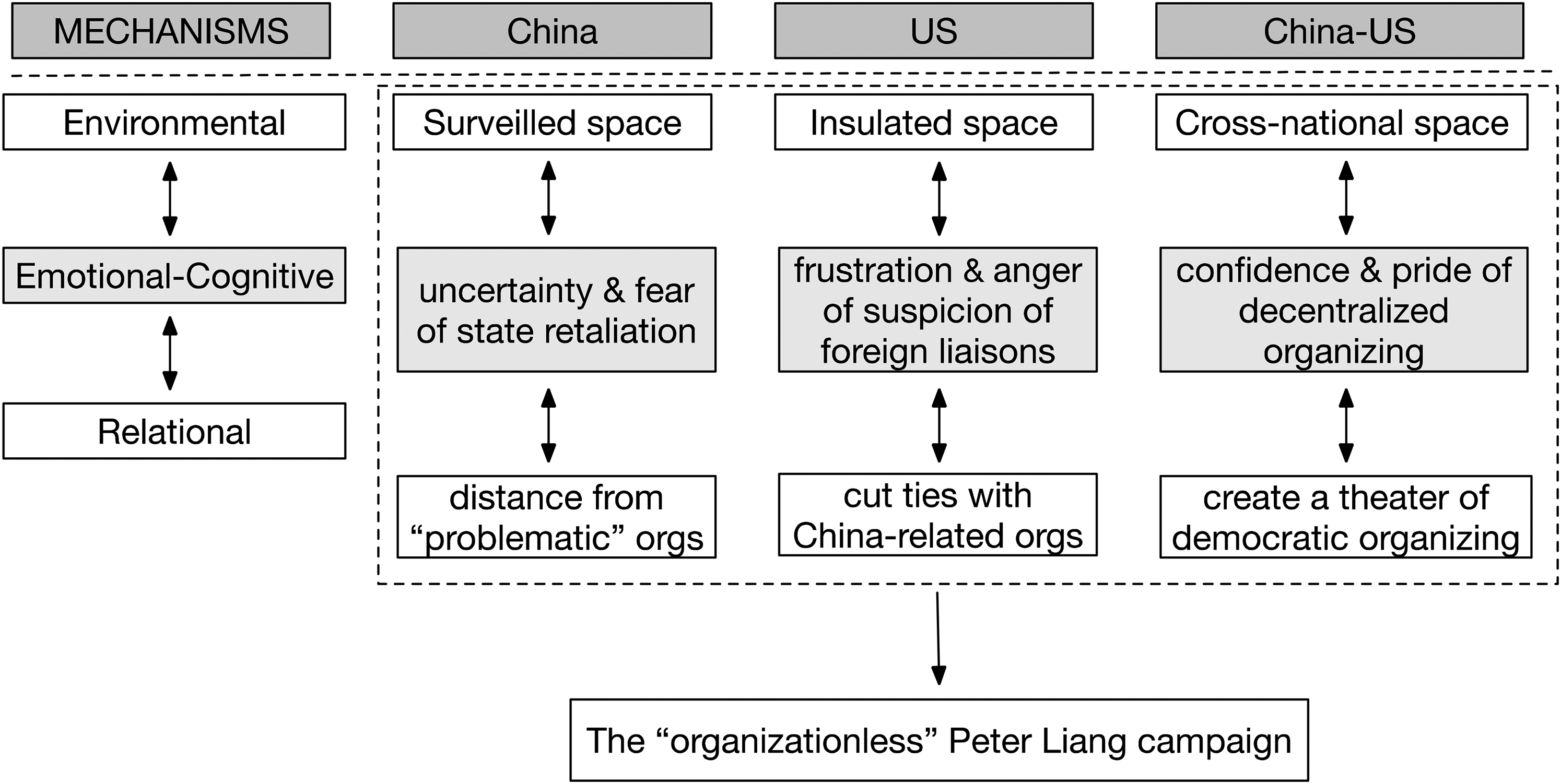
The “organizationless” Peter Liang campaign from a mechanism-based approach centering on emotion–cognition.
Meeting the surveiling eyes: Distancing from “problematic” organizations
As a China-based social media platform, WeChat enlarged the campaign's contexts of action by extending the tentacles of the Chinese state to a protest space beyond its own physical territory. Whereas the surveillance per se did not bring about actual censorship or repression from the state, activists were uncertain and worried of such potentials. They feared that the campaign would be censored and organizers’ families or friends in China would face retaliation. To preempt the ambivalences, organizers consciously distanced the campaign from organizations whose political stances were at odds with the Chinese state.
Although physically removed from China's territory, organizing on WeChat introduced the Chinese government's surveillance into this digital environment. Studies by the University of Toronto Citizen Lab show that WeChat monitors user activities even beyond China's territory, although overseas users are afforded with much more leeway in accessing and posting information. 8 WeChat, through automatic filters and the delegation of power and responsibilities to Group and Public Account gatekeepers, opened the door for the party state to censor the Liang protest network online and retaliate Liang campaigners and their families in China.
Conventional tactics to resist or bypass digital surveillance usually involve developing privacy-enhancing technologies and adaptations, which oftentimes will deepen the dependency on dominant organizations to develop such technologies or tactics (Kazansky, 2021). Liang organizers, however, were uncertain how the state's surveillance would impact the campaign. Moreover, they had no proof of the state's intervention in this protest. In my fieldwork, activists invariably denied that their posts were censored on WeChat; only one incidence of message deletion was mentioned. The informants also mentioned that neither their families in China nor themselves were retaliated for their involvement in this protest. At least two national organizers travelled back and forth between China and the US during the campaign; neither had a problem entering or leaving China. Their experiences seemed to show that while WeChat transformed the environment of the campaign by subjecting activists under the state's surveiling eyes, actual repression from the Chinese government was unlikely. Max's, an organizer from a Californian city, response reflected the cognitive ambivalence of whether the Chinese government would undermine this campaign through WeChat, This conspiracy theory can never be confirmed or falsified in any way. You cannot say that just because this software [WeChat] is developed in China, then the Chinese government manipulated it from behind … This is preposterous, isn’t it? Maybe you can control a tool, but you cannot control how people think. (May 27, 2016)
Lacking the evidence of intervention did not relieve Liang activists of the fear of retaliation altogether. The inarticulate fear was indicated in those revealing moments when they showed distrust to “politically sensitive” organizations. Casey, a core organizer originally from Mainland China, was enraged at a local association's attempt to dominate decision-making, “Do you know that XXX [the association] belongs to the Green Camp [in Taiwan]?! It has been supporting the Democratic Progressive Party for a long time…might have taken money from it [DPP] … we don’t want to be utilized by anyone [as political tools]!” 9 (March 25, 2016). Organizers like her worried that separatist organizations would bring in their political agenda and incur political risks. Organizers with non-Mainland Chinese origins also showed sympathy to this concern, “we understand this … they [immigrants from Mainland China] have families back in China … they are worried about them” (Tracy, March 25, 2016).
While never openly discussing these concerns, the feeling of the threat of the state's potential intervention seemed to be shared by many campaigners and prompted them to be wary of including organizations deemed “problematic” by the state. More importantly, due to the difficulties in ascertaining organizations’ political liaisons and backstage dealings, a general distrust of organizational presence seemed to be prevalent in the campaign. The sentiments became particularly salient in this ad hoc protest. Jordan, a local organizer from a Texan city explained, you should know that many protesters were unwilling to be associated with an organization, myself included. There was merely a week from the initiation to the final completion of the [220]rally. In this short one week’s period, I don’t think there was enough time for me to know an organization thoroughly … and I feel I don’t want to, and many people don’t want to, get ourselves involved in a political organization … there were many people [who shared this view], not just me … [if you ask whether there is] any possible negative consequences [of associating with these organizations]? Because it did not happen, I don’t know. (Jordan, April 2, 2016)
To preempt the perceived threats, organizers consciously excluded organizational entities from the protest network. In preparing for the local 220rallies, while welcoming individuals with varying political stances into the task groups, organizers and volunteers struggled to keep organizational agenda away and prevent any individual or entity from dominating the campaign. For example, donations from the aforementioned pro-Taiwan independence organization were rejected; organizers and volunteers themselves reimbursed the protest-related expenses. Campaigners also declined logistic contributions with organizational marks and logos, which made peer productions by the grassroots participants the only acceptable way to garner resources. Therefore, anxieties of the surveillance and possible intervention from China led to the defensive avoidance of organizational entities in the campaign, even though the new digital environment of surveillance, at the first sight, could have reinforced resource-rich institutional actors’ power in developing and coordinating counter-surveillance tactics.
Pre-empting suspicions of foreign liaisons: Cutting ties with China
The enclosure of WeChat carved out a protected space for the Liang campaign organizing. Yet the insulation also prevented them from discussing and interacting unimpededly with US powerholders and the broader public over this campaign. The apparent secrecy seemed to have incurred the suspicions of the Liang campaign's Chinese liaisons from the view of US powerholders, which also fed into the campaigners’ own anxieties of potential subversions from China. Feeling frustrated of being treated as “perpetual foreigners” and uncertain of the possible consequences on Asian American activism, they tried to forestall the allegations by pushing aside organizations with potential Chinese ties and eliminating leaders through whom China might plant its hidden agendas.
While foreign intervention into US politics was not debated as intensely as of now, the Liang campaign took place at a political paranoid moment. Not only were ethnic Chinese media in the US—including social media—seen as directly or indirectly controlled by China, 10 but prosecutions of Chinese espionage also were on the rise. 11 For example, Sherry Chen, a Chinese American scientist, was indicted of stealing classified information related to the US dam system for a Chinese official. The federal prosecutors, however, dropped all the charges after failing to find any evidence during the two-year long prosecution. Chinese Americans who sympathized with Chen, on the other hand, had been mobilizing help for her through WeChat; these activists also joined in the Liang campaign.
Under these circumstances, WeChat's enclosed architecture seemed to afford Liang campaigners a shielded space from the watching eyes of the US government. Indeed, the Liang campaign, and the 220rally in particular, was largely invisible to the US public. During my fieldwork, many African Americans and US-born Chinese Americans admitted that they were aware of the campaign only after the media reported it. The news media was notified of the 220rally in that very morning. A national organizer who was responsible for media relations recalled, “we released the [220rally] message on PR Newswire hours before the national protest … [on February 20th] my phone never stopped ringing during that day, everyone [media outlets] was asking what happened … I explained it over and over again” (May 31, 2016). Circumscribed within the WeChatsphere, the Liang campaign was organized largely unbeknownst to the US public.
Yet, instead of feeling afforded a protected space, Liang campaigners felt that the insulation seemed to be viewed with suspicions by US powerholders. The feeling that US powerholders treated the campaign as China-rigged arose largely from organizers’ interpretation of the mainstream media's handling of the campaign. Fran, an organizer from California, commented on a Los Angeles Times report on the 220rally, There was another report … [it's] by the LA Times. S/he [The reporter] said the [220]rally was entirely organized on WeChat … S/he intentionally mentioned that XXX [a key national organizer] was in China at the point of the rally and blabla … The report made innuendos that this [the Liang protest campaign] was rigged by China behind the scenes. (May 26, 2016)
Indeed, many Chinese immigrant activists themselves also internalized these suspicions and believed that some activists were bribed by the Chinese government to co-opt the campaign. Sidney, a veteran organizer from California, issued the first mobilizing calls and helped set up many local organizing teams. In spite of being regarded as an important contributor, rumors that his activities were backed by China began to circulate on WeChat. Detractors alleged in Group chats, “the initiator of the Liang campaign was invited by the Chinese Embassy to have dumplings.” Since Sidney had enormous gatekeeping power through managing various WeChat Groups, quite a few organizers worried that he would abuse the power to achieve ulterior purposes.
The suspicions and self-doubts triggered indignation, frustration, and worries among Liang protesters. Fran and several other Californian organizers were indignant of LA Times's misrepresentation. Activists who were accused of being back by China were even more enraged. Sidney was particularly livid with the rumor about his connections to Chinese officials and emphatically dismissed it as “absurd.” In addition to indignation, campaigners were also afraid of the possible backlash from the US government. They feared that the protest would be deemed as anti-US and protesters would suffer the loss of visa or immigration status or even face deportation.
These emotional–cognitive frustration and fear prompted them to take a preemptive organizing decision, that is, cutting ties with Chinese American organizations and associations that could have Chinese ties. These included many student and scholar associations, cultural exchange organizations, and commerce clubs that used to receive direct or indirect supports from China's overseas agencies. In justifying the exclusion of Chinese Students and Scholars Associations, one organizer from a Midwestern city reasoned in her blog, “who would take responsibility if it [including these organizations into the campaign] brings negative ramifications for the already not-so-big Chinese and Asian American community? And who can take such responsibilities?” (February 21, 2016). Indeed, precluding such organizations purported to protecting protesters against the accusations of China's influences, even though these organizations could make mobilizations much easier through their WeChat networks.
In addition to pushing back organizations with potential Chinese ties, organizers also fought to eliminate traditional leadership and hierarchies of roles and positions; this was to ensure that China's manipulation would not be channeled in through self-appointed leaders who might co-opt this collective action to advance pro-China agenda. One telling example was the struggle between Sidney and other organizers over whether leadership and designation of roles would benefit or harm the campaign. While Sidney appointed himself as the de facto General Director of the campaign and assigned positions to other veteran organizers in order to speed up the mobilization and enhance the efficiency of organizing, other organizers vehemently opposed his decisions. One NYC organizer was irritated, “ridiculous! Who gave him this power? … this [the campaign] is a grassroots event. There isn’t such a thing like a leader” (Avery, April 22, 2016). To prevent Sidney and other self-appointed leaders from being used as the conduit to channel in the Chinese state's agenda, activists eliminated him from the national WeChat organizing Group. To forestall similar attempts, most campaigners agreed that no leadership or hierarchy should be allowed in this protest network, even though they might miss the opportunity to utilize these people's large networks and experiences to organize more efficiently. From their perspective, flattening and decentralizing decision-making to numerous protesters would make it impossible to manipulate the campaign and, hence, could defend themselves against allegations of any Chinese liaisons.
Counterflows of influence: Staging a democratic theatre of decentralized organizing
As a rare bridge linking Chinese in and out of China, WeChat afforded the Liang campaign a cross-national digital space in which Chinese nationals could observe Chinese immigrants’ organizing first-hand. Yet they were situated differently in this space, leading to sharply different feelings of the “organizationless” street actions. While Chinese nationals were worried of the campaign's destructive potentials and negative impacts on Chinese immigrants, Liang campaigners showcased their confidence and pride in exercising their US citizenship rights through democratic organizing for social change. The interpretation, henceforth, motivated Liang campaigners to stage a democratic theater of decentralized organizing in front of Chinese nationals in this shared digital space, which further reinforced the principles of what they considered “organizationless” organizing.
By enforcing different rules for domestic and overseas users, WeChat allowed Chinese nationals to watch—but not participate in—the Liang campaign. In the past, because most foreign-based social media platforms (e.g. Facebook and Twitter) were banned in China, Chinese Americans’ civil and political struggles were either largely unseen or selectively presented by the Chinese mainstream media. Liang campaign's organizing processes, however, were almost live broadcasted to the concerned public in China through WeChat. The Chinese bystander public eye-witnessed the campaign through WeChat's citizen reports, Group chats, Friends’ Circles, status updates, photo sharing, and so on. These were further transmitted to other Chinese social media sites, allowing interested Chinese nationals to observe the Liang campaign beyond the narrow range and views offered by the mainstream press.
Yet Chinese nationals and immigrants were situated differently in this cross-national digital space, leading to their different perceptions and emotions toward the “organizationlessness” of this campaign. Chinese nationals were afforded with neither the basic rights of free speech and assembly in general nor the rights to post activist information on WeChat in particular. Judging this grassroots-led protest from their position in China, many Chinese nationals became worried about their fellow Chinese in the US. Taylor, an organizer from California, recalled her parents’ caution, When I took part in it [the campaign], my family in China … were first and foremost worried about whether I would be persecuted by the US government. Because I participated in this political event, would the US government deport me? … I’ve been in the US for over ten years, and this [concern] seemed to be ridiculous to me. But they don’t think so. I understand their concern. Their first reaction was fear, whether you would be persecuted, whether you would lose your Greencard, and whether … other possibilities … (May 28, 2016)
While Liang campaigners reacted with negative emotions and took defensive relational moves to the Chinese and US state actors, they remained confident and proud against Chinese nationals’ concerns. They considered decentralized, horizontal decision-making as the essence of US democracy. By using their newly attained democratic rights to participate in and shape this nation's important debates—however problematic their claims might be—they felt empowered in autonomous decision-making.
They also realized that they could use the shared digital space to influence Chinese nationals on democratic organizing. When being asked how to think about the possible influence from China through WeChat, Blake, a national organizer, replied, I indeed witnessed China-related influence through [the use of] WeChat. But it was not how China influences the US; it’s the opposite. [My] Chinese Mainland [WeChat] Group friends were very interested in this case and sought information from many channels … we Chinese Americans could take to the streets to fight against injustice on behalf of an Asian cop … they [his friends] wondered, is it possible to rally and demonstrate in China? (May 31, 2016)
First, trying to dismiss Chinese nationals’ equation of organizationlessness with mob behavior and their worries of the destructive outcomes, Liang activists demonstrated the efficacy and success of such organizing. On WeChat, they repeatedly shared pictures of the orderly protest scenes, the collaboration among organizers, and the generous contributions made by rank-and-file protesters. The sharing aimed at convincing the Chinese bystanders of the viability, or even the superiority, of horizontally structured campaigns. Some organizers also attributed the failure of past organization-led Asian American activism to internecine struggles over leadership and credit. In showcasing these merits, Liang campaigners themselves were also more assured that future Asian/American activism should follow this mode of organizing.
Furthermore, Liang activists also tried to use their commitments to horizontalism to inspire Chinese nationals to recognize and practice their own capacities of democratic organizing. After an Asian–African American meeting, an organizer of Mainland Chinese origin complained about another organizer with Taiwanese origin for belittling the democratic capacity of campaigners who were originally from Mainland China, did you hear that, he told the African Americans that we Mainlanders do not know about democracy because we came from a non-democratic country … but look at what they [Taiwanese organizations and associations] did! … every time they tried to impose decisions on us, it was us [Mainlander organizers] who fought back. We listened to the grassroots. (Casey, March 25, 2016)
As Mainland China and Taiwan have different political systems, it is not uncommon to doubt whether immigrants from the Mainland are capable of democratic organizing after being ruled under authoritarianism for decades. Campaigners with Mainland Chinese origin, in particular, tried to exhibit their political capacity through their staunch advocacy for democratic principles, for example, deliberating and voting to settle disputes. Whenever there was a standoff over campaign slogans, wording of the press releases, and rally procedures, they initiated dialogues and voting in WeChat Groups and followed the grassroots opinions. Even when agreements could not be achieved, they learned to respect differences by allowing various voices to co-exist in the campaign. By showcasing how they opposed vertical leadership and formal organizations in this common space, Liang campaigners generated a democratic theater that once again practiced and justified what they understood to be the essence of democracy, that is, “organizationless” organizing.
Discussion and conclusion
Through the analysis of the Peter Liang campaign, this study explicates why protesters insisted on maintaining the protest network “organizationless,” even though WeChat seemed to afford other forms of organizing over decentralized organizing at first sight. The study combines environmental, emotional–cognitive, and relational mechanisms to examine the organizing dynamics. Environmentally, the imbrication of WeChat in the organizing processes transformed the contexts of action by introducing the surveillance from China, insulating the campaign from the paranoid climate in the US, and bringing in the attentive bystanders from China. The new digital environment seemed to be more amenable to organizational actors and formal structures that could have more effectively helped them dodge the surveillance, build organizational infrastructure in this protected space, and pacify the concerned Chinese bystander public.
Nevertheless, Liang campaigners did not opt for the aforementioned organizing path afforded by the new digital environment. Instead, their perceptions and feelings toward the Chinese and US state actors and Chinese nationals coalesced into emotional–cognitive responses of uncertainties, fear, frustration, as well as confidence and pride, which prompted them to reinterpret the organization-friendly WeChat environment as organization-inimical contexts of action.
These emotions–cognitions, therefore, drove them to develop and maintain an “organizationless” protest network. Reacting defensively to the Chinese state's surveillance and US powerholders’ suspicions, Liang campaigners decided to distance from “problematic” organizations deemed by China and the US and decentralize the decision-making power to avoid the states’ potential backlash. Responding proactively to the Chinese nationals’ concerns of the campaign's “organizationlessness,” Liang organizers generated a theater of grassroots, horizontal organizing in front of them in order to inspire fellow Chinese nationals’ democratic consciousness. Altogether, by purposively excluding organizations and decentralizing decision-making powers, Liang campaigners attempted to keep the protest network “organizationless.” All in all, the emotional–cognitive understandings mediated the re/interpretation of the digitally shifted environment and the relational organizing choices of building an “organizationless” protest network.
The case study contributes to existing scholarship on digital activism in three ways. First, in line with the affordances-for-practice perspective that perceives technological affordances as “relational and situated, and contingent upon the purpose of human agency” (Zheng and Yu, 2016: 292), this study highlights how Liang campaigners’ emotional–cognitive understandings transformed the technological affordances for formal organizations and structures into technological constraints that ran against their intention to keep the protest network “organizationless.” By resisting WeChat's design settings, Liang campaigners can be seen as engaging in “data-oriented activism” that took WeChat's datafication (e.g. surveillance and insulation) as the target of contention, and resisted it through their organizing choices (Beraldo and Milan, 2019). Future studies can further this line of inquiry by examining how varied protest networks develop on specific digital platforms, as multiple human and non-human agents interact in and across digital spaces.
Second, different to previous works that prize relational mechanisms in examining social movement organizing (McAdam et al., 2001), this study reframes the mechanism-based framework by emphasizing the emotional–cognitive underpinnings of other mechanisms. Although these mechanisms are always entangled, emotional–cognitive mechanisms usually mediate the other two mechanisms in digital activism. That is, digital environment or context of action needs to be sensed and interpreted by collective actors in order to exert influence on protest organizing processes; organizing choices and relational patterns are driven by activists’ cognitions and feelings of the environment. Future studies can explore other cultural, institutional, and political factors that intervene in the mechanisms and their implications on movement structures, for example, the strategic leaderlessness in recent Hong Kong protests. 12
Lastly, this study also cautions us against the blind optimism attached to horizontalism and the rejection of formal organizations in contemporary digital movements (Schradie, 2019). In the Liang campaign, as long as decision-making was decentralized, conservative demands such as “AllLivesMatter” popped up in this protest space; without centralized coordination or leadership, no one could be held accountable to these claims. Indeed, the idolatry of the grassroots and decentralization in digital activism paralleled the rise of populist sentiments and claims; recent studies point to an “elective affinity” between populism and social media (Gerbaudo, 2018). Future studies can extend this line of investigation by unravelling the interacting dynamics among populist organizing and claims vis-à-vis social media platforms, as indicated in the “conservative turn” of the Chinese/Asian American activism, for example, in pushing back Affirmative Action.
Footnotes
Acknowledgements
The author would like to thank Big Data and Society's Managing Editor Matthew Zook and Co-Editor Jennifer Gabrys's generous guidance in the revision process. She would also like to thank three anonymous reviewers for their insightful suggestions in helping improve the manuscript. Her gratitude also extends to Wenhong Chen, Laura Stein, Joe Straubhaar, Karin Wilkins, and Michael Young.
Declaration of conflicting interests
The author declared no potential conflicts of interest with respect to the research, authorship and/or publication of this article.
Funding
The author received no additional financial support for the research, authorship, and/or publication of this article.
